mardi 27 août 2019

Fires ravage the Amazon


ESA - Sentinel-2 Mission logo / ESA - Sentinel-3 Mission logo.

27 August 2019

Thousands of fires have broken out in the Amazon rainforest. Satellite data show that there are almost four times as many fires this year compared to the same period last year. Apart from Brazil, parts of Peru, Bolivia, Paraguay and Argentina have also been affected.

Wildfires in Brazil from Copernicus Sentinel-3

While forest fires normally occur in Brazil’s dry season, which runs from July to October, the unprecedented increase is reported to come from both legal and illegal deforestation which allows land to be used for agricultural purposes, rising global temperatures are also thought to be making the region more susceptible to fire.

The Amazon basin is the world’s largest tropical rainforest, spanning four countries and is home to millions of plants and animals. It is estimated to produce up to 20% of the world’s oxygen – hence the region being called ‘the lungs of the world’ – and is crucial for helping to regulate global warming as the forests absorb millions of tonnes of carbon emissions every year.

Amazon fires seen from International Space Station (ISS) taken by ESA astronaut L. Parmitano

Using Copernicus Sentinel-3 data, as part of the Sentinel-3 World Fires Atlas, almost 4000 fires were detected from 1 August to 24 August 2019, while last year there were far fewer during the same period, just 1110 fires.

“By processing 249 images for August 2018 and 275 images for August 2019, we are able to see the incredible number of fires burning in the Amazon. This was achieved by the World Fire Atlas night time algorithm, in order to avoid any possible false alarms with the daytime algorithm,” says ESA’s Olivier Arino.  

Number of wildfires in the Amazon

Plumes of smoke have spread across the Amazon region. Strong winds have blown smoke to São Paulo – more than 2500 km away— causing a black out in the city. According to the Copernicus Atmosphere Monitoring System (CAMS), smoke has travelled as far as the Atlantic coast.

CAMS also reports that the fires have released 228 megatonnes of carbon dioxide into the atmosphere, as well as copious amounts of carbon monoxide. The fires also threaten the lives of many indigenous people.

The Copernicus Emergency Mapping Service was activated to help respond to the fire. The service uses satellite observations to help civil protection authorities and, in cases of disaster, the international humanitarian community to help to respond to emergencies.

Wildfires on the border between Bolivia, Paraguay and Brazil from Copernicus Sentinel-2

The severity of the fires has reached the highest political levels. Deemed an international crisis, the G7 nations who met in France yesterday, have offered a 20 million euro emergency funding to assist Brazil and its neighbouring countries to put out the fires, according to French President Emmanuel Macron.

Josef Aschbacher, ESA’s Director of Earth Observation Programmes, said, “As we continue to face the ongoing climate crisis, satellites are essential in monitoring wildfires in remote areas, especially for a key component of the Earth system such as the Amazon.”

Related articles:

Uptick in Amazon Fire Activity in 2019
https://orbiterchspacenews.blogspot.com/2019/08/uptick-in-amazon-fire-activity-in-2019.html

NASA's AIRS Maps Carbon Monoxide from Brazil Fires & Cross Country Smoke
https://orbiterchspacenews.blogspot.com/2019/08/nasas-airs-maps-carbon-monoxide-from.html

Related links:

Sentinel-3 World Fires Atlas: https://s3worldfireatlas.esa.int/

Copernicus Emergency Management Service: http://emergency.copernicus.eu/

G7 Summit: https://www.elysee.fr/en/g7

Sentinel-2: http://www.esa.int/Our_Activities/Observing_the_Earth/Copernicus/Sentinel-2

Sentinel-3: http://www.esa.int/Our_Activities/Observing_the_Earth/Copernicus/Sentinel-3

Copernicus: http://www.esa.int/Our_Activities/Observing_the_Earth/Copernicus

Images, Animations, Text, Credits: ESA/Contains modified Copernicus Sentinel data (2019), processed by ESA, CC BY-SA 3.0 IGO/Contains modified Copernicus Sentinel data (2019), processed by ESA on ONDA Copernicus DIAS/ESA/NASA–L. Parmitano.

Greetings, Orbiter.ch

Russian Spacecraft Second Docking Attempt Successful


ROSCOSMOS - Soyuz MS-14 / Skybot F-850 patch.

August 27, 2019

While the spacecraft were flying about 250 miles above Eastern Mongolia, an uncrewed Russian Soyuz spacecraft arrived and docked to the International Space Station at 11:08 p.m. EDT.


Image above: The Soyuz MS-14 spacecraft is pictured during it’s approach. The Soyuz MS-13 is seen in the forground. Image Credit: NASA.

The Soyuz MS-14 spacecraft attached to the station’s aft-facing Zvezda module for a two-week stay as part of its test flight. The Soyuz delivers 1,450 pounds of cargo, including a Skybot F-850 humanoid robot, to the Expedition 60 crew currently residing on the orbital outpost.

Soyuz MS-14 docking

The docking of the unpiloted Soyuz sets the stage for the robotic release of the SpaceX Dragon cargo craft Tuesday morning after a four-week stay at the station. The Dragon is filled with almost 2,700 pounds of valuable scientific experiments and other cargo. NASA Television and the agency’s website will broadcast its departure live beginning at 10:15 a.m. EDT.

Related links:

Expedition 60: https://www.nasa.gov/mission_pages/station/expeditions/expedition60/index.html

SpaceX Dragon: https://www.nasa.gov/press-release/nasa-tv-to-air-us-cargo-ship-departure-from-space-station/

Harmony: https://www.nasa.gov/mission_pages/station/structure/elements/harmony

Canadarm2: https://www.nasa.gov/mission_pages/station/structure/elements/remote-manipulator-system-canadarm2/

NASA TV: https://www.nasa.gov/multimedia/nasatv/#public and https://www.nasa.gov/nasalive

Space Station Research and Technology: https://www.nasa.gov/mission_pages/station/research/index.html

International Space Station (ISS): https://www.nasa.gov/mission_pages/station/main/index.html

Image (mentioned), Video, Text, Credits: NASA/Mark Garcia/Roscosmos/SciNews.

Greetings, Orbiter.ch

lundi 26 août 2019

Scientific Samples Make the Journey Back to Earth aboard SpaceX’s Dragon


SpaceX - Dragon CRS-18 Mission patch.

Aug. 26, 2019

On July 27, 2019, a Dragon cargo spacecraft arrived at the International Space Station carrying dozens of scientific experiments. Now, Dragon heads home. It brings samples, hardware and data from completed investigations back to Earth on its return trip, with undocking from the station currently scheduled for one month after arrival: August 27.

Here are details on some of the investigations returning to the ground for further analysis and reporting of results.

A cinematic look at life and science aboard the space station

The ISS Experience is creating a cinematic virtual reality (VR) film from footage taken during the yearlong investigation covering different aspects of crew life, execution of science and the international partnerships involved on the space station. The immersive VR film will give audiences on Earth an up close and personal taste of the challenges of adaptation to life in space, the work and science, and the human interaction between crew members.


Image above: Canadian Space Agency astronaut David Saint-Jacques setting up the Z-CAM V1 Pro Cinematic camera to film aboard the space station for The ISS Experience. Image Credit: NASA.

Developers Felix & Paul Studios, in partnership with private space services firm NanoRacks and the ISS National Lab, launched two cinematic virtual reality camera systems to the space station on a SpaceX Dragon cargo spacecraft in December 2018. The crew films less than four hours each week. Every week or so, they transfer footage from the camera onto solid state drives – an original and a backup – for storage and downlinking. One of each pair of drives eventually physically returns to Earth for editing and production and astronauts then can reuse the other one.

Seeking Alzheimer’s understanding in microgravity

Amyloid fibrils, a conglomeration of proteins that can build up in the body, are associated with a number of neurodegenerative diseases such as Alzheimer’s and Parkinson’s. The Amyloid Aggregation investigation assesses whether microgravity affects formation of these fibrils, which could represent a possible risk to astronauts on long flights.


Image above: These colored caps distinguish samples with various incubation times for the Amyloid Aggregation investigation. This investigation assesses whether microgravity affects formation of amyloid fibrils, self-assembled fibrous protein aggregates associated with a number of neurodegenerative diseases such as Alzheimer’s and Parkinson’s. Image Credit: NASA.

Samples exposed to microgravity return to Earth using the General Laboratory Active Cryogenic ISS Experiment Refrigerator (GLACIER), a facility that maintains a temperature of -20°C. Teams on the ground must quickly retrieve the equipment and keep the samples at -20°C until delivery to the principal investigators for analysis.

From microgravity lab to manufacturing facility

Physical Optics Corporation’s Fiber Optic Production investigation created optical fibers with high commercial value on the space station using a blend of materials called ZBLAN. Studies suggest that ZBLAN optical fibers produced in microgravity should be higher quality than those produced on Earth. On Earth, ZBLAN optical fibers offer high bandwidth for the telecommunications industry, and potential applications for laser surgery, remote sensing and environmental monitoring.

The fiber produced on the space station is returning to Earth for testing to help verify previous studies and guide future efforts to manufacture large volumes of such fiber in microgravity.

SpaceX dragon. Image Credit: NASA

Testing flexible fuel tanks

Furphy tested the transfer of fluids from a rigid tank to a flexible tank that can launch collapsed and deploy as it fills. This capability would make it possible to fuel small satellites in orbit rather than prior to launch, potentially saving launch mass and volume. This first microgravity test verified tank dynamics including slosh and retention of angular momentum. Flexible fuel tanks also have potential applications on Earth, including supporting operations in remote and harsh environments and in disaster relief.

The investigation used a rigid tank, delivered to the space station filled with water, and a FlexTank™ made from silicone elastomer, which arrived empty and compressed. After the tests, crew offloaded the water to the station’s water supply. The tanks are returning to Earth aboard the Dragon.

Other investigations returning on the Dragon:

The BioRock investigation examines interactions between microbes and rocks and physical and genetic changes in the microbes in space to support future acquisition of materials in space through biomining. After culturing and fixation on the space station, the crew placed samples into cold storage at 4°C for return to the investigation team on the ground for analysis.

LMM Biophysics 6 crystallized two proteins of interest in cancer treatment and radiation protection. The microgravity-grown crystals return to the ground for comparison to control crystallization experiments performed on Earth, using microscopic images, X-Ray diffraction analysis and structural analysis.


Image above: NASA astronaut Andrew Morgan monitors a pair of free-floating Synchronized Position Hold, Engage, Reorient, Experimental Satellites, or SPHERES. Middle and high school students compete to design algorithms that autonomously control the basketball-sized satellites aboard the station. Image Credit: NASA.

Synchronized Position Hold, Engage, Reorient, Experimental Satellites, or SPHERES, are bowling-ball sized satellites used to study formation flying, control algorithms, and material science. First sent to the station during Expedition 13 in 2006, these satellites have been employed in a dozen different investigations. The Dragon brings back hardware from two recent ones that examined the behavior of fluids in microgravity, SPHERES Tether Slosh and SPHERES-Slosh.

The Cell Science-02 investigation examined the effects of microgravity on healing and tissue regeneration and on the agents that induce that healing. Cultures were maintained on-orbit for approximately 21 days and then preserved and placed in -80˚C cold stowage for return to NASA’s Johnson Space Center. They will then ship to the research team within 24 hours of payload handover.


Image above: NASA astronauts Nick Hague and Christina Koch conducting the Cell Science-02 bone healing and tissue regeneration experiment in the Life Sciences Glovebox. Image Credit: NASA.

The Goodyear Tire investigation evaluates the creation of silica fillers using traditional techniques but in microgravity, potentially yielding results not possible on Earth. After processing, the six rubber samples return via cold-stowage to the Goodyear Research facility for analysis.

Mobile Companion examined the efficiency and acceptance by the crew of support from artificial intelligence (AI) during long-term missions in space. AI could provide operational support that reduces the amount of stress and workload on human crew members. Investigation hardware returns to Earth on Dragon.

Space Moss compares mosses grown aboard the space station with those grown on Earth to determine how microgravity affects growth, development, gene expression, photosynthesis and other features. Crew members fixed some of the mosses using a Chemical Fixation Bag and stored the rest for live return.

Related links:

The ISS Experience: https://www.nasa.gov/mission_pages/station/research/experiments/explorer/Investigation.html?#id=7877

Amyloid Aggregation: https://www.nasa.gov/mission_pages/station/research/experiments/explorer/Investigation.html?#id=7902

GLACIER: https://www.nasa.gov/mission_pages/station/research/experiments/explorer/Facility.html?#id=342

Fiber Optic Production: https://www.nasa.gov/mission_pages/station/research/experiments/explorer/Investigation.html?#id=7630

BioRock: https://www.nasa.gov/mission_pages/station/research/news/biorock-iss-research-microbes-space

LMM Biophysics 6: https://www.nasa.gov/mission_pages/station/research/experiments/explorer/Investigation.html?#id=7743

SPHERES: https://www.nasa.gov/mission_pages/station/research/experiments/explorer/Facility.html?#id=1760

SPHERES Tether Slosh: https://www.nasa.gov/mission_pages/station/research/experiments/explorer/Investigation.html?#id=7381

SPHERES-Slosh: https://www.nasa.gov/mission_pages/station/research/experiments/explorer/Investigation.html?#id=953

Cell Science-02: https://www.nasa.gov/mission_pages/station/research/experiments/explorer/Investigation.html?#id=1676

Goodyear Tire: https://www.nasa.gov/mission_pages/station/research/experiments/explorer/Investigation.html?#id=7716

Mobile Companion: https://www.nasa.gov/mission_pages/station/research/experiments/explorer/Investigation.html?#id=7639

Space Moss: https://www.nasa.gov/mission_pages/station/research/experiments/explorer/Investigation.html?#id=7892

Space Station Research and Technology: https://www.nasa.gov/mission_pages/station/research/index.html

International Space Station (ISS): https://www.nasa.gov/mission_pages/station/main/index.html

Images (mentioned), Text, Credits: NASA/Carrie Gilder/JSC/International Space Station Program Science Office/Melissa Gaskill.

Greetings, Orbiter.ch

Russian and U.S. Spaceship Activities Keep Crew Busy


ISS - Expedition 60 Mission patch.

August 26, 2019

An unpiloted Russian spacecraft is ready to make a second docking attempt tonight as a U.S. resupply ship is preparing for its departure Tuesday. This follows Sunday night’s relocation of a Soyuz crew ship at the International Space Station.

Three Expedition 60 crewmembers swapped docking ports in their Soyuz MS-13 crew ship late Sunday. Soyuz Commander Alexander Skvortsov, with Flight Engineers Andrew Morgan and Luca Parmitano seated next to him, backed the Soyuz away from the Zvezda service module at 11:35 p.m. EDT on Sunday and pulled their vehicle into the Poisk module just before midnight.


Image above: International Space Station Configuration: Four spaceships are parked at the space station including the SpaceX Dragon cargo craft and Russia’s Progress 73 resupply ship and Soyuz MS-12 and MS-13 crew ships. Image Credit: NASA.

The relocation opens up Zvezda’s docking port, with its fully operable Kurs automated rendezvous system, to receive the uncrewed Soyuz MS-14 spacecraft today at 11:12 p.m. The MS-14 has been safely trailing the station by over 160 miles after its aborted docking attempt Saturday due to a faulty automated rendezvous component on Poisk.

Morgan and fellow NASA astronauts Christina Koch and Nick Hague are getting the SpaceX Dragon space freighter ready for its release from the Harmony module on Tuesday morning. Ground controllers in Houston will remotely command the Canadarm2 robotic arm to release Dragon from its grips Tuesday at 10:42 a.m. It will splashdown in the Pacific Ocean off the coast of southern California a few hours later for retrieval by SpaceX personnel.

Soyuz MS-13 relocation from Zvezda to Poisk

Video above: The Soyuz MS-13 spacecraft was undocked from the aft port of the Zvezda Service Module on 26 August 2019, at 03:34 UTC (25 August, 23:34 EDT), and manually docked to the Poisk module of the International Space Station at 03:59 UTC (25 August, 23:59 EDT) by cosmonaut Alexander Skvortsov of Roscosmos, joined by astronauts Luca Parmitano of the European Space Agency and Drew Morgan of NASA. The relocation of Soyuz MS-13 was executed to allow the unpiloted Soyuz MS-14 to automatically dock to the Zvezda Service Module. Video Credit: NASA/Roscosmos/SciNews.

NASA TV is covering all of the spaceship docking and departure activities live. Soyuz MS-14 docking coverage begins tonight at 10:30 p.m. Dragon release coverage begins Tuesday at 10:15 a.m. Dragon splashdown will not be broadcast.

Related links:

Expedition 60: https://www.nasa.gov/mission_pages/station/expeditions/expedition60/index.html

Zvezda: https://www.nasa.gov/mission_pages/station/structure/elements/zvezda-service-module.html

Poisk: https://www.nasa.gov/mission_pages/station/structure/elements/poisk-mini-research-module-2

SpaceX Dragon: https://go.nasa.gov/2YqDfHE

Harmony: https://www.nasa.gov/mission_pages/station/structure/elements/harmony

Canadarm2: https://www.nasa.gov/mission_pages/station/structure/elements/remote-manipulator-system-canadarm2/

NASA TV: https://www.nasa.gov/multimedia/nasatv/#public and https://www.nasa.gov/nasalive

Space Station Research and Technology: https://www.nasa.gov/mission_pages/station/research/index.html

International Space Station (ISS): https://www.nasa.gov/mission_pages/station/main/index.html

Image (mentioned), Video (mentioned), Text, Credits: NASA/Mark Garcia.

Best regards, Orbiter.ch

An asteroid to understand the planets


DLR & CNES - Mobile Asteroid Surface Scout (MASCOT) patch.

August 26, 2019

The researchers are trying to solve the biggest question in the history of humanity: how was our solar system formed?


Image above: Two types of rocks and blocks are distinguishable on Ryugu: dark and rough, with friable surface, or clear and smooth. (Photo: MASCOT/DLR/CNES).

The asteroid Ryugu has less and less secrets: new photos taken by the small French-German robot Mascot, the size of a shoebox, will help scientists understand the formation of our solar system.

Mascot (Mobile Asteroid Surface Scout) traveled on the back of the Japanese probe Hayabusa2 before landing on October 3, 2018 on the asteroid Ryugu, 900 meters wide, somewhere in space, between Mars and Earth.

Mascot (Mobile Asteroid Surface Scout)

After a fall of about ten minutes, Mascot, weighing about ten kilos, bounced on the very rough ground of the asteroid, because of the lack of gravity, before stabilizing.

Product of a "violent process"

In addition to taking measurements, Mascot took a series of photos during the 17 hours of his mission. Since then, these clichés are analyzed by scientists. Two types of rocks and blocks are distinguishable: dark and rough, with a friable surface, or clear and smooth.

"This shows that Ryugu is the product of a violent process," says Professor Ralf Jaumann, of the German Aeronautics and Astronautics Center (DLR), the lead author of a study presented Thursday in the magazine Science the conclusions of the analysis of clichés.

Animation: Asteroidlander MASCOT on board Hayabusa2

Ryugu could thus be the "son" of two parent bodies that collided, separated, and then assembled due to gravity, according to the researchers. Another theory is that the asteroid has itself been the victim of a collision with another body. This would have caused the creation of both types of rocks.

"The first material of the solar system"

Asteroid Ryugu. Image Credits: Hayabusa2/JAXA

Many rocks on Ryugu also contain small blue and red "inclusions" - materials that get stuck in the rock during its formation. These inclusions are similar to rare primitive meteorites found on Earth, carbonaceous chondrites.

"This material is extremely primitive, it is the first material in the solar system," Ralf Jaumann explained.

Investigated region on Ryugu

What help researchers to solve the biggest question in the history of humanity: how was formed our solar system? "We do not know how the planets were formed at the beginning. We must find the small bodies, these primitive bodies, primordial in the history of evolution, to understand the first 10 to 100 million years of the formation of planets, "said the researcher.

Mobile Asteroid Surface Scout (MASCOT) DLR portal:
https://www.dlr.de/dlr/en/desktopdefault.aspx/tabid-10975/

Mobile Asteroid Surface Scout (MASCOT) CNES portal:
https://mascot.cnes.fr/en/MASCOT/GP_mascot.htm

Images, Videos, Text, Credits: DLR/CNES/JAXA/AFP/Orbiter.ch Aerospace/Roland Berga.

Greetings, Orbiter.ch

dimanche 25 août 2019

JAXA and Sony CSL to Conduct In-Orbit Demonstrations of Long-Distance Laser Communication


JAXA - H-II Transfer Vehicle (HTV8) "KOUNOTORI-8" patch.

August 25, 2019

JAXA and Sony CSL to Conduct In-Orbit Demonstrations of Long-Distance Laser Communication Using Japanese Experiment Module "Kibo" on the International Space Station

JAXA - H-II Transfer Vehicle "KOUNOTORI" (HTV)

The Japan Aerospace Exploration Agency (JAXA, President: Hiroshi Yamakawa) and Sony Computer Science Laboratories, Inc. (Sony CSL, President and CEO: Hiroaki Kitano) today announced their plans to conduct in-orbit demonstrations of the long-distance laser communication system, which they have jointly developed with the aim of establishing a real-time, mass-data communication system for future inter-satellite communications and communications with ground stations. The system, currently known as Small Optical Link for International Space Station (SOLISS), will be carried aboard the H-II Transfer Vehicle (HTV8) "KOUNOTORI-8", the cargo transporter to the International Space Station (ISS), which is scheduled for launch on September 11th, 2019. The in-orbit demonstrations will be conducted using the Exposed Facility of the Japanese Experiment Module (JEM) "Kibo".

ISS Module - Japanese Experiment Module (JEM) Kibo

Since 2016, JAXA and Sony have jointly conducted ground demonstrations of this long-distance laser communication technology which uses an optical disk technology for fine pointing, under the Request for Proposal (RFP) joint study framework of the JAXA Space Exploration Innovation Hub Center.*1 In the upcoming in-orbit long-distance laser communication demonstrations, the SOLISS system will be attached to the IVA-replaceable Small Exposed Experiment Platform (i-SEEP) hardware adapter installed on the JEM's Exposed Facility to perform ground-to-low earth orbit (LEO) optical communication testing using a 1550 nm bandwidth laser.*2 JAXA and Sony plan to complete the demonstrations within fiscal year 2019.

Figure 1: SOLISS system flight model

As shown in figures 1 and 2 above, the SOLISS system has an optical communication unit, a biaxial gimbal, and a monitor camera that are partially exposed to space, while the rest is covered with a multi-layer heat insulator. The optical communication unit employs Sony's optical disk technology, which is the fruit of Sony's development starting in the 1970s and commercial applications such as CDs, MDs, DVDs, and Blu-ray discs. The optical disk technology is high-precision, low power, compact, and mass production capable. The optical communication unit weighs approximately 1.2 kg, has a cross-sectional area of 90 mm x 100 mm, and is equipped with a built-in small optical control mechanism using optical disk technology. The unit is capable of bidirectional communication and can be operated in the same way as a terrestrial network, even in space, supporting an Ethernet protocol.

Figure 2: SOLISS system flight model overview

The monitor camera employs an omnidirectional camera to observe the operation of the biaxial gimbal. The photos taken can be sent to the ground not only via the ISS but also using SOLISS's laser communication directly.

According to a statement by Vice President Koichi Wakata of JAXA, "The upcoming demonstration of long-distance laser communication technology will mark the first in-orbit demonstration for the Space Exploration Innovation Hub Center, and we have very high expectations for this technology. This technology, which employs a laser for in-orbit mass-data communication, will likely be widely used not only in the telecommunications industry, but in the future as a means of communication in the field of exploration. Specifically, it can be used as a means of communication between the Earth and the International Space Station, the Moon, and Mars. There is a wide range of potential applications, such as communication with the Moon rovers. I am confident that the utilization of the Japanese Experiment Module "Kibo" will enable the timely demonstration of the SOLISS system in space. Going forward, the results of these demonstrations will contribute to the telecommunications industry on Earth and to the future exploration missions in space."

H-II Transfer Vehicle "KOUNOTORI" (HTV) description

President Kitano of Sony CSL remarked, "Long-distance laser communication technology enables transformation of our society with real-time broad-band communication around the globe as well as expanding the humanosphere and increased activity in space. Sony CSL is taking advantage of the in-orbit demonstrations to complete our long-distance laser communication system. It will be the first step for Sony to build upon the results of these demonstrations and put it into practical use in society as we commercialize it. The opportunity to use Kibo for the in-orbit demonstrations makes it possible to greatly advance the research and development of the optical communication system, much more quickly than if we had launched a small satellite for the same purpose on our own. The SOLISS system is built using consumer components. After the demonstrations, we will retrieve the SOLISS unit and perform follow-up analyses, which we expect will further accelerate our commercialization process."

*1 Studies implemented based on the JAXA-Sony agreement concluded in 2016 for conducting fundamental and feasibility studies on long-distance communication system with tree-space laser link technologies as part of JAXA's "Open Innovation Hub for Expanding Humanosphere and the Domain of Human Activity through Solar System Frontier Development," a project commissioned by the Japan Science and Technology Agency (JST) under its innovation hub start-up support program.

*2 Communication tests with the ground are conducted with ground stations of Japan's National Institute of Information and Communications Technology (NICT).

Related Links:

Sony Computer Science Laboratories, Inc.: https://www.sonycsl.co.jp/

Space Exploration Innovation Hub Center: http://www.ihub-tansa.jaxa.jp/english/index.html

HTV8 Mission : H-II Transfer Vehicle KOUNOTORI (HTV): http://iss.jaxa.jp/en/htv/mission/htv-8/

Images, Text, Credits: Japan Aerospace Exploration Agency (JAXA)/National Research and Development Agency/Sony Computer Science Laboratories, Inc./NASA.

Best regards, Orbiter.ch

Second Docking Attempt for Russian Spacecraft Planned for Monday Night


ISS - Expedition 60 Mission patch.

August 25, 2019

International Space Station managers and the international partners met on Saturday and approved a plan to allow a second rendezvous and docking attempt for the unpiloted Soyuz MS-14 spacecraft to occur on Monday night. The Soyuz’ initial docking attempt early Saturday was aborted after what Russian officials said was a suspected problem with a component associated with the Kurs automated rendezvous system for the Poisk module docking port.

The Soyuz was commanded to back away from the station after approaching to within 100 meters of Poisk when the vehicle could not achieve a solid telemetry lock to that docking port through the automated rendezvous system. The unpiloted Soyuz is currently orbiting a safe distance from the ISS with all of its systems functioning normally. The six crewmembers on board the station were never in any danger during the initial rendezvous attempt.


Image above: The Soyuz MS-14 spacecraft is pictured during its first docking attempt early Saturday. Image Credit: NASA.

Plans now call for the unpiloted Soyuz to execute a second docking attempt Monday night at 10:12 p.m. Central time, 11:12 p.m. Eastern time, but this time to the aft port of the Zvezda Service Module. The Kurs system on Zvezda has been checked out and is in perfect working order. NASA TV coverage of the docking Monday night will begin at 9:30 p.m. Central time, 10:30 p.m. Eastern time.

To accommodate the new plan, Expedition 60 crewmembers Alexander Skvortsov of Roscosmos, Luca Parmitano of the European Space Agency and Drew Morgan of NASA will don their Russian Sokol launch and entry suits Sunday night, climb aboard their Soyuz MS-13 spacecraft which docked to Zvezda on July 20 and undock for a 25-minute Soyuz relocation maneuver and a manual docking by Soyuz commander Skvortsov to the Poisk module. The suspect Kurs rendezvous unit component for Poisk is not a factor for the relocation maneuver by Skvortsov and his Soyuz crewmates.

NASA TV coverage of the relocation will begin Sunday night at 10 p.m. Central time, 11 p.m. Eastern time. Undocking of the Soyuz MS-13 spacecraft from Zvezda is scheduled at 10:34 p.m. Central time, 11:34 p.m. Eastern time with redocking to Poisk scheduled at 10:59 p.m. Central time, 11:59 p.m. Eastern time.

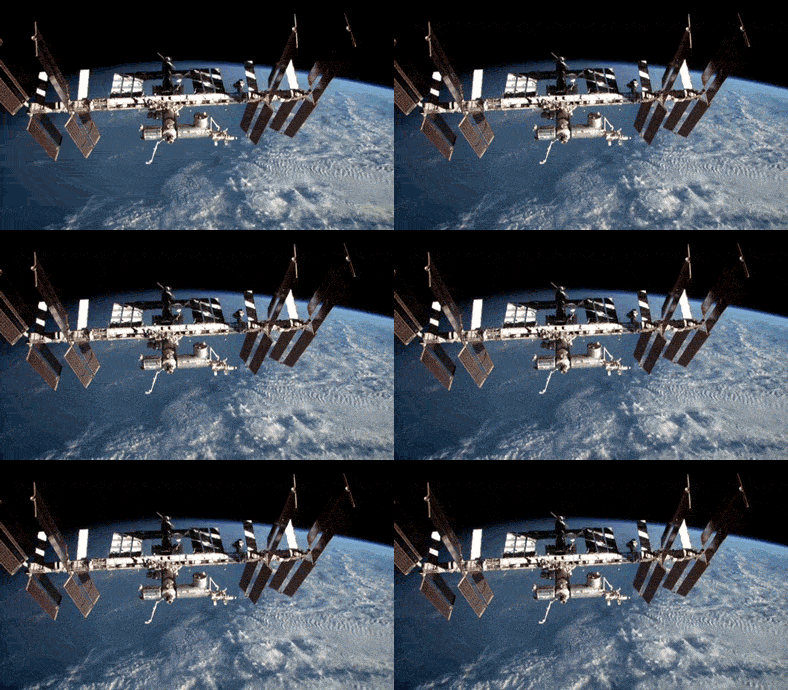
International Space Station (ISS). Animation Credit: NASA

It would be the first Soyuz relocation since August 2015 when Gennady Padalka and Mikhail Kornienko of Roscosmos and NASA’s Scott Kelly conducted a similar operation, but in reverse, flying their Soyuz TMA-16M spacecraft from Poisk to Zvezda.

The docking of the unpiloted Soyuz Monday night will preserve the robotic release of the SpaceX Dragon cargo craft Tuesday morning after a four-week stay at the station. Dragon will be deorbited for a parachute-assisted splashdown several hours later in the Pacific Ocean, bringing home cargo and valuable scientific experiments from the orbital laboratory.

Related articles:

Uncrewed Russian Spacecraft Aborts Station Approach & Docking Attempt No Earlier Than Monday
https://orbiterchspacenews.blogspot.com/2019/08/uncrewed-russian-spacecraft-aborts.html

Uncrewed Soyuz Rocket Launches on Two-Day Trip to Station:
https://orbiterchspacenews.blogspot.com/2019/08/uncrewed-soyuz-rocket-launches-on-two.html

Related links:

Expedition 60: https://www.nasa.gov/mission_pages/station/expeditions/expedition60/index.html

NASA TV: https://www.nasa.gov/multimedia/nasatv/#public and https://www.nasa.gov/nasalive

Space Station Research and Technology: https://www.nasa.gov/mission_pages/station/research/index.html

International Space Station (ISS): https://www.nasa.gov/mission_pages/station/main/index.html

Image (mentioned), Animation (mentioned), Text, Credits: NASA/Mark Garcia.

Best regards, Orbiter.ch