mercredi 28 août 2019

Crew Returns to Science After Coordinating Space Traffic


ISS - Expedition 60 Mission patch.

August 28, 2019

The Expedition 60 crew is back on track with ongoing space research today after coordinating a flurry of space traffic at the International Space Station. The astronauts are also continuing to clean up after last week’s spacewalk.

The SpaceX Dragon is back on Earth after splashing down Tuesday afternoon in the Pacific Ocean. The commercial space freighter delivered critical science experiments to the station last month and returned samples for scientists around the world to analyze.


Image above: NASA astronaut Christina Koch conducts science operations inside Japan’s Kibo laboratory module with a science freezer that preserves biological research samples for later analysis. Image Credit: NASA.

Flight Engineers Andrew Morgan of NASA and Luca Parmitano of ESA (European Space Agency) took turns today organizing spacewalking tools in the U.S. Quest airlock. Morgan also cleaned cooling loops inside the U.S. spacesuits he and fellow astronaut Nick Hague wore last week to install the International Docking Adapter-3.

Parmitano also documented his meals today for a space nutrition study sponsored by ESA. Living in microgravity for a long time impacts the body and nutritionists are seeking the ideal diet to maintain astronaut health.

International Space Station (ISS). Animation Credit: NASA

Astrobee, the free-flying robotic assistant, was testing and calibrating its mobility today inside Japan’s Kibo laboratory module as NASA astronaut Christina Koch monitored. She also printed new station emergency procedures to accommodate a pair of Russian Soyuz crew ships that were required to switch docking ports.

The hatches are open on the Soyuz MS-14 spacecraft after its automated docking to the Zvezda service module Monday night. Cosmonauts Alexey Ovchinin and Alexander Skvortsov will be unloading space cargo from the MS-14 over the next several days before packing it with return gear. The Soyuz will parachute back to Earth in Kazakhstan with no crew onboard and carrying cargo on Sept. 6.

Related articles:

Dragon Splashes Down in Pacific Ocean Packed With Science and Cargo
https://orbiterchspacenews.blogspot.com/2019/08/dragon-splashes-down-in-pacific-ocean.html

Russian Spacecraft Second Docking Attempt Successful
https://orbiterchspacenews.blogspot.com/2019/08/russian-spacecraft-second-docking.html

Related links:

Expedition 60: https://www.nasa.gov/mission_pages/station/expeditions/expedition60/index.html

U.S. Quest airlock: https://www.nasa.gov/mission_pages/station/structure/elements/joint-quest-airlock

Space nutrition study: https://www.nasa.gov/mission_pages/station/research/experiments/explorer/Investigation.html?#id=7875

Astrobee: https://www.nasa.gov/mission_pages/station/research/experiments/explorer/Facility.html?#id=1891

Zvezda service module: https://www.nasa.gov/mission_pages/station/structure/elements/zvezda-service-module.html

Space Station Research and Technology: https://www.nasa.gov/mission_pages/station/research/index.html

International Space Station (ISS): https://www.nasa.gov/mission_pages/station/main/index.html

Image (mentioned), Animation (mentioned), Text, Credits: NASA/Mark Garcia.

Best regards, Orbiter.ch

Landsat Illustrates Five Decades of Change to Greenland Glaciers


NASA - Landsat-8 Mission logo.

Aug. 28, 2019

Ice fronts have retreated, rocky peaks are more exposed, fewer icebergs drift to the ocean: the branching network of glaciers that empty into Greenland’s Sermilik Fjord has changed significantly in the last half century. Comparing Landsat images from 1972 and 2019, those changes and more come into view.


Images above: Glaciers in southeastern Greenland including, from top, Helheim, Fenris and Midgard are seen in a Landsat 8 image from Aug. 12, 2019 (bottom image), and a composite image from Landsat 1 scenes collected in September 1972 (top image). Comparing images across the span of the Landsat mission provides a record of almost five decades of change to this region of southeast Greenland. Images Credits: NASA/Christopher Shuman.

The glaciers appear brownish grey in this true-color Landsat 8 satellite image from Aug. 12, 2019. The color indicates that the surface has melted, a process that concentrates dust and rock particles and leads to a darker recrystallized ice sheet surface.

Landsat satellite. Image Credit: NASA

The darker melt surface in 2019 extends much farther onto the ice sheet than it did in 1972, when the first Landsat satellite gathered data on the area, said Christopher Shuman, a glaciologist with the University of Maryland, Baltimore County, at NASA Goddard Space Flight Center in Greenbelt, Maryland. Landsat is a joint mission of NASA and the U.S. Geological Survey.

Helheim Glacier, one of the largest and fastest flowing of its kind in Greenland, has retreated approximately 4.7 miles (7.5 kilometers) up a wide fjord in the time between the two scenes, leaving a jumble of sea ice where its calving front used to be. To the east, Midgard Glacier has retreated approximately 10 miles (16 kilometers), splitting into two branches farther up the fjord. Changes to the rocky outcrops of the area’s mountains and smaller tributary glaciers are also visible by comparing the two Landsat images.


Image above: The Helheim Glacier is seen in a close-up of the images above. One of the largest glaciers in Greenland, Helheim has retreated approximately 4.7 miles (7.5 kilometers) between when these Landsat scenes were collected in 1972 (top image) and 2019 (bottom image). As the glacier lost ice over the last 47 years, the cliff walls along the glacier and the rocky outrcrops in the middle become more exposed. Images Credits: NASA/ Chris Shuman.

“There’s a lot more bare rock visible now, which used to be covered with ice,” Shuman said. “And all these little glaciers are all getting slammed, as well as the bigger ones like Helheim, Fenris and Midgard. There are scores of examples of change just in this one area.”

In a close-up of the Helheim Glacier, a patch of open water is visible right at the calving front. Three days after Landsat 8 collected the image over Helheim and its neighboring glaciers, NASA’s Oceans Melting Greenland (OMG) project flew over that open patch of water in an airplane and dropped a temperature-measuring probe that detected warm water at the ice front. OMG is examining how oceans melt glaciers from below, even as air temperatures warm the ice from above.


Image above: NASA’s Oceans Melting Greenland campaign flew over a region of open water at the calving front of Helheim Glacier on Aug. 15, 2019, dropping a temperature probe that detected warm water. The open water is visible in the 2019 Landsat image above. Image Credits: NASA /Josh Willis.

Unusually warm air temperatures this summer have caused record melt across Greenland. Approximately 90% of the surface of Greenland’s ice sheet melted at some point between July 30 and Aug. 2, during which time an estimated 55 billion tons of ice melted into the ocean, according to the National Snow and Ice Data Center. Shuman also tracked the unusual warm weather at the top of the Greenland Ice Sheet, 10,550 feet (3,216 meters) above sea level, where temperatures were above freezing for more than 16.5 hours total during July 30 and 31.

- Climate: https://www.nasa.gov/subject/3127/climate

- Earth: https://www.nasa.gov/topics/earth/index.html

- Landsat: https://www.nasa.gov/mission_pages/landsat/main/index.html

- Landsat Science: https://landsat.gsfc.nasa.gov/

Images (mentioned), Text, Credits: NASA/Sara Blumberg/GSFC/Kate Ramsayer.

Greetings, Orbiter.ch

Gaia untangles the starry strings of the Milky Way


ESA - Gaia Mission patch.

28 August 2019

Rather than leaving home young, as expected, stellar ‘siblings’ prefer to stick together in long-lasting, string-like groups, finds a new study of data from ESA’s Gaia spacecraft.

Gaia tracing starry strings in the Milky Way

Exploring the distribution and past history of the starry residents of our galaxy is especially challenging as it requires astronomers to determine the ages of stars. This is not at all trivial, as ‘average’ stars of a similar mass but different ages look very much alike.

To figure out when a star formed, astronomers must instead look at populations of stars thought to have formed at the same time – but knowing which stars are siblings poses a further challenge, since stars do not necessarily hang out long in the stellar cradles where they formed.

“To identify which stars formed together, we look for stars moving similarly, as all of the stars that formed within the same cloud or cluster would move in a similar way,” says Marina Kounkel of Western Washington University, USA, and lead author of the new study.

Stellar groups and strings in the Milky Way – face-on view

“We knew of a few such ‘co-moving’ star groups near the Solar System, but Gaia enabled us to explore the Milky Way in great detail out to far greater distances, revealing many more of these groups.”

Marina used data from Gaia’s second release to trace the structure and star formation activity of a large patch of space surrounding the Solar System, and to explore how this changed over time. This data release, provided in April 2018, lists the motions and positions of over one billion stars with unprecedented precision.

The analysis of the Gaia data, relying on a machine learning algorithm, uncovered nearly 2000 previously unidentified clusters and co-moving groups of stars up to about 3000 light years from us – roughly 750 times the distance to Proxima Centauri, the nearest star to the Sun. The study also determined the ages for hundreds of thousands of stars, making it possible to track stellar ‘families’ and uncover their surprising arrangements.

Stellar families in Gaia’s sky

“Around half of these stars are found in long, string-like configurations that mirror features present within their giant birth clouds,” adds Marina.

“We generally thought young stars would leave their birth sites just a few million years after they form, completely losing ties with their original family – but it seems that stars can stay close to their siblings for as long as a few billion years.”

The strings also appear to be oriented in particular ways with respect to our galaxy’s spiral arms – something that depends upon the ages of the stars within a string. This is especially evident for the youngest strings, comprising stars younger than 100 million years, which tend to be oriented at right angles to the spiral arm nearest to our Solar System.

Stellar groups and strings in the Milky Way – edge-on view

The astronomers suspect that the older strings of stars must have been perpendicular to the spiral arms that existed when these stars formed, which have now been reshuffled over the past billion years.

“The proximity and orientation of the youngest strings to the Milky Way’s present-day spiral arms shows that older strings are an important ‘fossil record’ of our galaxy’s spiral structure,” says co-author Kevin Covey, also of Western Washington University, USA.

“The nature of spiral arms is still debated, with the verdict on them being stable or dynamic structures not settled yet. Studying these older strings will help us understand if the arms are mostly static, or if they move or dissipate and re-form over the course of a few hundred million years – roughly the time it takes for the Sun to orbit around the galactic centre a couple of times.”

Gaia was launched in 2013, and is on a mission to chart a three-dimensional map of our galaxy, pinpointing the locations, motions, and dynamics of roughly one percent of the stars within the Milky Way, along with additional information about many of these stars. Further Gaia releases, including more and increasingly precise data, are planned for the coming decade, providing astronomers with the information they need to unfold the star-formation history of our galaxy.

Gaia

“Gaia is a truly ground-breaking mission that is revealing the history of the Milky Way – and its constituent stars – like never before,” adds Timo Prusti, Gaia project scientist at ESA.

“As we will determine the ages for a larger number of stars distributed throughout our galaxy, not just those residing in compact clusters, we’ll be in an even better position to analyse how these stars have evolved over time.”

Notes for editors:

“Untangling the Galaxy I: Local Structure and Star Formation History of the Milky Way” by M. Kounkel and K. Covey is published in the Astronomical Journal.

The study uses data from Gaia’s second release (DR2), provided in April 2018:
https://www.cosmos.esa.int/web/gaia/data-release-2

Gaia: http://www.esa.int/Our_Activities/Space_Science/Gaia

Text Credits: ESA/Timo Prusti/Western Washington University/Kevin Covey/Marina Kounkel/Images: Courtesy of M. Kounkel & K. Covey (2019)/Gaia/DPAC; Data: M. Kounkel & K. Covey (2019)/Video: ESA/Gaia/DPAC; Data: M. Kounkel & K. Covey (2019); Animation: S. Jordan / T. Sagristá / Gaia Sky (http://www.zah.uni-heidelberg.de/gaia/outreach/gaiasky) – CC BY-SA 3.0 IGO/Animation: ESA.

Greetings, Orbiter.ch

mardi 27 août 2019

Sixteen Images for Spitzer's Sweet 16


NASA - Spitzer Space Telescope patch.

Aug. 27, 2019

NASA launched its Spitzer Space Telescope into orbit around the Sun on Aug. 25, 2003. Since then, the observatory has been lifting the veil on the wonders of the cosmos, from our own solar system to faraway galaxies, using infrared light.

Spitzer Space Telescope. Animation Credit: NASA

Managed by NASA's Jet Propulsion Laboratory in Pasadena, California, Spitzer enabled scientists to confirm the presence of seven rocky, Earth-size planets in the TRAPPIST-1 system. The telescope has also provided weather maps of hot, gaseous exoplanets and revealed a hidden ring around Saturn. It has illuminated hidden collections of dust in a wide variety of locations, including cosmic nebulas (clouds of gas and dust in space), where young stars form, and swirling galaxies. Spitzer has additionally investigated some of the universe's oldest galaxies and stared at the black hole at the center of the Milky Way.

Spitzer's primary mission lasted five-and-a-half years and ended when it ran out of the liquid helium coolant necessary to operate two of its three instruments. But its passive-cooling design has allowed part of its third instrument to continue operating for more than 10 additional years. The mission is scheduled to end on Jan. 30, 2020.

In honor of Spitzer's Sweet 16 in space, here are 16 amazing images from the mission.

Giant Star Makes Waves

Credits: NASA/JPL-Caltech

This Spitzer image shows the giant star Zeta Ophiuchi and the bow shock, or shock wave, in front of it. Visible only in infrared light, the bow shock is created by winds that flow from the star, making ripples in the surrounding dust. Located roughly 370 light-years from Earth, Zeta Ophiuchi dwarfs our Sun: It is about six times hotter, eight times wider, 20 times more massive and about 80,000 times as bright. Even at its great distance, it would be one of the brightest stars in the sky were it not largely obscured by dust clouds.

Read more about this image here:  https://www.jpl.nasa.gov/news/news.php?feature=3630

The Seven Sisters Pose for Spitzer

Credits: NASA/JPL-Caltech

The Pleiades star cluster, also known as the Seven Sisters, is a frequent target for night sky observers. This image from Spitzer zooms in on a few members of the sisterhood. Viewed in the infrared, the stars seem to float on a bed of feathers. The filaments surrounding the stars are dust, and the three colors represent different wavelengths of infrared light. The densest portion of the dust cloud appears in yellow and red, and the more diffuse outskirts appear in green hues.

Read more about this image here: https://www.jpl.nasa.gov/news/news.php?feature=1344

Young Stars in Their Baby Blanket of Dust

Credits: NASA/JPL-Caltech/Harvard-Smithsonian CfA

Newborn stars peek out from beneath their blanket of dust in this image of the Rho Ophiuchi nebula. Called "Rho Oph" by astronomers and located about 400 light-years from Earth, it's one of the closest star-forming regions to our own solar system.

The youngest stars in this image are surrounded by dusty disks of material from which the stars — and their potential planetary systems — are forming. More evolved stars, which have shed their natal material, are blue. The extended white nebula right of center is a region of the cloud that glows in infrared light due to the heating of dust by bright young stars near the cloud's right edge.

Read more about this image here: https://www.jpl.nasa.gov/spaceimages/details.php?id=PIA10181

The Infrared Helix

Credits: NASA/JPL-Caltech

Located about 700 light-years from Earth, the eye-like Helix nebula is a planetary nebula, or the remains of a Sun-like star. When these stars run out of their internal fuel supply, their outer layers puff up to create the nebula. The nebula is heated by the hot core of the dead star, called a white dwarf, which is not visible in this image but is located in the middle of the "eye." Our Sun will blossom into a planetary nebula when it dies in about 5 billion years.

Read more about this image here:

http://www.spitzer.caltech.edu/news/881-feature07-13-Spitzer-Celebrates-Fourth-Anniversary-with-Celestial-Fireworks

The Tortured Clouds of Eta Carinae

Credits: NASA/JPL-Caltech/Harvard-Smithsonian CfA

The bright star at the center of this image is Eta Carinae, one of the most massive stars in the Milky Way galaxy. With around 100 times the mass of the Sun and at least 1 million times the brightness, Eta Carinae releases a tremendous outflow of energy that has eroded the surrounding nebula. Spitzer's infrared vision lets us see the dust, shown in red, as well as clouds of hot, glowing gas, which appear green.

Read more about this image here: https://www.jpl.nasa.gov/spaceimages/details.php?id=PIA17257

Spitzer Spies Spectacular Sombrero

Credits: NASA/JPL-Caltech/STScI

Located 28 light-years from Earth, Messier 104 — also called the Sombrero galaxy or M104 — is notable for its nearly edge-on orientation as seen from our planet. Spitzer observations were the first to reveal the smooth, bright ring of dust (seen in red) circling the galaxy. Spitzer's full view also shows the disk is warped, often the result of a gravitational encounter with another galaxy, and clumpy areas spotted in the far edges of the ring indicate young star-forming regions. Hubble Space Telescope data showing starlight appears blue.

Read more about this image here: https://www.jpl.nasa.gov/spaceimages/details.php?id=PIA07899

Spiral Galaxy Messier 81

Credits: NASA/JPL-Caltech

This infrared image of the galaxy Messier 81, or M81, reveals lanes of dust illuminated by active star formation throughout the galaxy's spiral arms.. Located in the northern constellation of Ursa Major (which includes the Big Dipper), M81 is also about 12 million light-years from Earth.

Read more about this image here: https://astropix.ipac.caltech.edu/image/spitzer/ssc2003-06c1

Spitzer Reveals Stellar Smoke

Credits: NASA/JPL-Caltech

Messier 82 — also known as the Cigar galaxy or M82 — is a hotbed of young, massive stars. In visible light, it appears as a diffuse bar of blue light, but in this infrared image, scientists can see huge red clouds of dust blown out into space by winds and radiation from those stars. Messier 82 is located about 12 million light-years away in the Ursa Major constellation.

Read more about this image here:

http://www.spitzer.caltech.edu/news/234-ssc2006-09-Galaxy-on-Fire-NASA-s-Spitzer-Reveals-Stellar-Smoke

A Pinwheel Galaxy Rainbow

Credits: NASA/JPL-Caltech/STScI/CXC

This image of Messier 101, also known as the Pinwheel Galaxy or M101, combines data in the infrared, visible, ultraviolet and X-rays from Spitzer and three other NASA space telescopes: Hubble, the Galaxy Evolution Explorer's Far Ultraviolet detector (GALEX) and the Chandra X-Ray Observatory. The galaxy is about 70% larger than our own Milky Way, with a diameter of about 170,000 light-years, and sits at a distance of 21 million light-years from Earth.

The red colors in the image show infrared light, as seen by Spitzer. These areas show light emitted by dusty lanes in the galaxy where stars are forming. The yellow component is visible light, observed by Hubble. Most of this light comes from stars, and they trace the same spiral structure as the dust lanes seen in the infrared. The blue areas are ultraviolet light, given off by hot, young stars that formed about 1 million years ago and that were observed by GALEX. The hottest areas are shown in purple, where Chandra observed the X-ray emission from exploded stars, million-degree gas and material colliding around black holes.

Read more about this image here: https://astropix.ipac.caltech.edu/image/spitzer/sig12-005

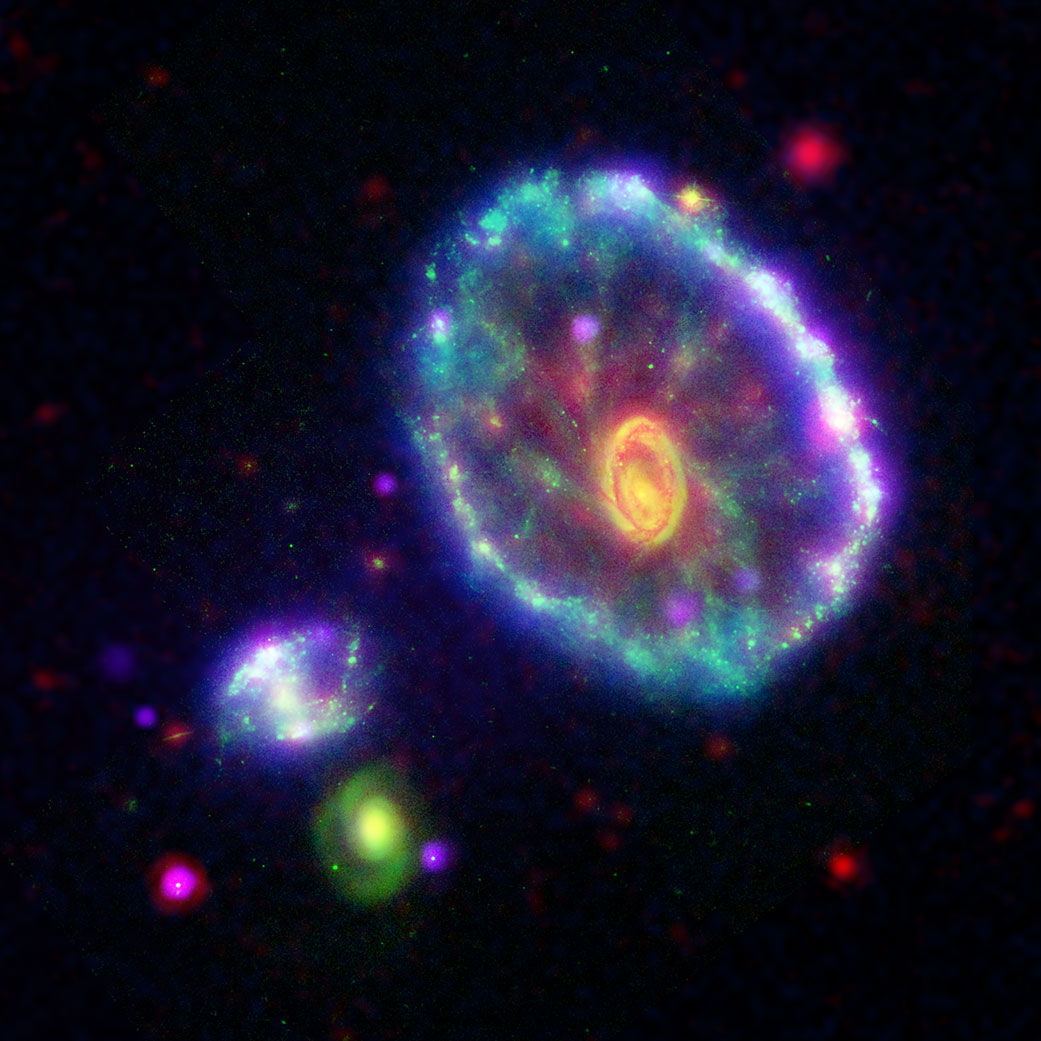
Cartwheel Galaxy Makes Waves

Credits: NASA/JPL-Caltech/STScI/CXC

Approximately 100 million years ago, a smaller galaxy plunged through the heart of the Cartwheel galaxy, creating ripples of brief star formation. As with the Pinwheel galaxy above, this composite image includes data from NASA's Spitzer, Hubble, GALEX and Chandra observatories.

The first ripple appears as a bright blue outer ring around the larger object, radiating ultraviolet light visible to GALEX. The clumps of pink along the outer blue ring are X-ray (observed by Chandra) and ultraviolet radiation.

A combination of visible and infrared light from Hubble and Spitzer, the yellow-orange inner ring and center of the galaxy represent the second ripple, or ring wave, created in the collision. Tints of green are older, less-massive visible-light stars. Although astronomers haven't pinpointed which galaxy collided with the Cartwheel, two of three candidate galaxies can be seen in this image to the bottom left of the ring, one as a neon blob and the other as a green spiral.

Read more about this image here: https://photojournal.jpl.nasa.gov/feature/Cartwheel

Spitzer and Hubble Create Colorful Masterpiece

Credits: NASA/JPL-Caltech/STScI

Located 1,500 light-years from Earth, the Orion nebula is the brightest spot in the sword of the constellation Orion. Both NASA's Spitzer and Hubble space telescopes contributed to this vibrant image. Four massive stars, collectively called the Trapezium, appear as a yellow smudge near the image center. Visible and ultraviolet data from Hubble appear as swirls of green that indicate the presence of gas heated by intense ultraviolet radiation from the Trapezium's stars. Less-embedded stars appear as specks of green, and foreground stars as blue spots. Meanwhile, Spitzer's infrared view exposes carbon-rich molecules called polycyclic aromatic hydrocarbons, shown here as wisps of red and orange. Orange-yellow dots are infant stars deeply embedded in cocoons of dust and gas.

Read more about this image here: https://www.nasa.gov/mission_pages/spitzer/news/spitzer-20061107.html

A Space Spider Watches Over Young Stars

Credits: NASA/JPL-Caltech/2MASS

Located about 10,000 light-years from Earth in the constellation Auriga, the Spider nebula resides in the outer part of the Milky Way. Combining data from Spitzer and the Two Micron All Sky Survey (2MASS), the image shows green clouds of dust illuminated by star formation in the region. Right of center, against the black background of space, lies a bright group of stars called Stock 8. The radiation from this cluster carves out a bowl in the nearby dust clouds. Running in a tributary to the left of Stock 8 are more young stars that appear as red point sources.

Read more about this image here: https://www.jpl.nasa.gov/news/news.php?feature=6422

North America Nebula in Different Lights

Credits: NASA/JPL-Caltech

This view of the North America nebula combines visible light collected by the Digitized Sky Survey with infrared light from NASA's Spitzer Space Telescope. Blue hues represent visible light, while infrared is displayed as red and green. Clusters of young stars (about 1 million years old) can be found throughout the image. Slightly older but still very young stars (about 3 to 5 million years) are also liberally scattered across the complex.

Read more about this image here: https://www.jpl.nasa.gov/spaceimages/details.php?id=PIA13845

Spitzer Captures Our Galaxy's Bustling Center

Credits: NASA/JPL-Caltech

This infrared mosaic offers a stunning view of the Milky Way galaxy's busy center. The pictured region, located in the Sagittarius constellation, is 900 light-years agross and shows hundreds of thousands of mostly old stars amid clouds of glowing dust lit up by younger, more massive stars. Our Sun is located 26,000 light-years away in a more peaceful, spacious neighborhood, out in the galactic suburbs. The bright core in the middle of the image is a dense cluster of stars at the center of the Milky Way, within which lurks a black hole about 4 million times more massive than our Sun.

Viewing the center of the Milky Way from Earth can be difficult because the plane of the galaxy's spiral disk is filled with cold dust. Visible light coming from the galaxy's center is virtually impossible to observe because dust dims it by a factor of 1 trillion. But infrared light can shine through this dust.

Read more about this image here: https://www.jpl.nasa.gov/news/news.php?feature=1008

The Eternal Life of Stardust

Credits: NASA/JPL-Caltech

The Large Magellanic Cloud, a dwarf galaxy located about 160,000 light-years from Earth, looks like a choppy sea of dust in this infrared portrait. The blue color, seen most prominently in the central bar, represents starlight from older stars. The chaotic, bright regions outside this bar are filled with hot, massive stars buried in thick blankets of dust. The red color around these bright regions is from dust heated by stars, while the red dots scattered throughout the picture are either dusty, old stars; young stars newly forming; or more distant galaxies. The greenish clouds contain cooler interstellar gas and molecule-size dust grains illuminated by ambient starlight.

Read more about this image here: https://www.jpl.nasa.gov/news/news.php?feature=1161

A Stellar Family Portrait

Credits: NASA/JPL-Caltech

In this large celestial mosaic from Spitzer, there's a lot to see, including multiple clusters of stars born from the same dense clumps of gas and dust. Some of these clusters are older than others and more evolved, making this a generational stellar portrait.

The grand green-and-orange delta filling most of the image is a faraway nebula. The bright white region at its tip is illuminated by massive stars, and dust that has been heated by the stars' radiation creates the surrounding red glow.

Read more about this image here: https://www.jpl.nasa.gov/news/news.php?feature=7413

More information about Spitzer is available at the following site(s):

https://www.nasa.gov/mission_pages/spitzer/main/index.html

Related links:

Chandra X-Ray Observatory: https://www.nasa.gov/mission_pages/chandra/main/index.html

Hubble Space Telescope: https://www.nasa.gov/mission_pages/hubble/main/index.html

Images (mentioned), Animation (mentioned), Text, Credits: NASA/Tony Greicius/JPL/Calla Cofield.

Best regards, Orbiter.ch

Dragon Splashes Down in Pacific Ocean Packed With Science and Cargo


SpaceX - Dragon CRS-18 Mission patch.

August 27, 2019

SpaceX’s Dragon cargo spacecraft splashed down in the Pacific Ocean at 4:21 p.m. EDT (1:21 p.m PDT), approximately 300 miles southwest of Long Beach, California, marking the end of the company’s 18th contracted cargo resupply mission to the International Space Station for NASA. The spacecraft returned more than 2,700 pounds of valuable scientific experiments and other cargo.


Image above: The SpaceX Dragon resupply ship is pictured above the Canadian Rocky Mountains after it departed the International Space Station today. Image Credit: @Astro_Christina.

Some of the scientific investigations Dragon will return to Earth include:

Bio-Mining in Microgravity

The Biorock investigation provides insight into the physical interactions of liquid, rocks and microorganisms in microgravity and improving the efficiency and understanding of mining materials in space. Bio-mining eventually could help explorers on the Moon or Mars get needed materials on site, lessening the need for precious resources from Earth and reducing the amount of supplies explorers must take with them.

Mechanisms of Moss in Microgravity

Space Moss compares mosses grown aboard the space station with those grown on Earth to determine how microgravity affects its growth, development, and other characteristics. Tiny plants without roots, mosses need only a small area for growth, an advantage for their potential use in space and future bases on the Moon or Mars. This investigation also could yield information that aids in engineering other plants to grow better on the Moon and Mars, as well as on Earth.

Improving Tire Manufacturing from Orbit

The Goodyear Tire investigation uses microgravity to push the limits of silica fillers for tire applications. A better understanding of silica morphology and the relationship between silica structure and its properties could provide improvements for increased fuel efficiency, which would reduce transportation costs and help to protect Earth’s environment.


Image above (archive): Splashdown! SpaceX Dragon Returns To Earth. Image Credits: SpaceX/NASA.

These are just a few of the hundreds of investigations aimed at keeping astronauts healthy during space travel and demonstrating technologies for future human and robotic exploration beyond low-Earth orbit, including missions to the Moon by 2024 and on to Mars. Space station research also provides opportunities for other U.S. government agencies, private industry, and academic and research institutions to conduct microgravity research that leads to new technologies, medical treatments, and products that improve life on Earth.

For more than 18 years, humans have lived and worked continuously aboard the International Space Station, advancing scientific knowledge and demonstrating new technologies, making research breakthroughs not possible on Earth that will enable long-duration human and robotic exploration into deep space. A global endeavor, more than 230 people from 18 countries have visited the unique microgravity laboratory that has hosted more than 2,500 research investigations from researchers in 106 countries.

Related articles:

SpaceX Dragon Released from Station for Earth Return
https://orbiterchspacenews.blogspot.com/2019/08/spacex-dragon-released-from-station-for.html

Scientific Samples Make the Journey Back to Earth aboard SpaceX’s Dragon
https://orbiterchspacenews.blogspot.com/2019/08/scientific-samples-make-journey-back-to.html

Related links:

Biorock: https://www.nasa.gov/mission_pages/station/research/experiments/explorer/Investigation.html?#id=7566

Space Moss: https://www.nasa.gov/mission_pages/station/research/experiments/explorer/Investigation.html?#id=7892

Goodyear Tire: https://www.nasa.gov/mission_pages/station/research/experiments/explorer/Investigation.html?#id=7716

Space Station Research and Technology: https://www.nasa.gov/mission_pages/station/research/index.html

International Space Station (ISS): https://www.nasa.gov/mission_pages/station/main/index.html

Images (mentioned), Text, Credits: NASA/Mark Garcia.

Greetings, Orbiter.ch

SpaceX Dragon Released from Station for Earth Return


SpaceX - Dragon CRS-18 Mission patch.

August 27, 2019


Image above: The SpaceX Dragon resupply ship is pictured attached to the International Space Station’s Harmony module on Aug. 13, 2019, as the orbital complex flew 260 miles above the Nile River Delta in Egypt. Image Credit: NASA.

The SpaceX Dragon cargo spacecraft released from the International Space Station at 10:59 a.m. EDT after flight controllers in Houston delivered remote commands to the station’s Canadarm2 robotic arm. Expedition 60 Flight Engineer Flight Engineer Christina Koch of NASA monitored Dragon’s systems as it departed the microgravity laboratory.

SpaceX CRS-18: Dragon unberthing and departure

Next up, Dragon will fire its thrusters to move a safe distance from the station and execute a deorbit burn around 3:22 p.m. to leave orbit. Splashdown down is targeted for 4:21 p.m. EDT (1:21 p.m. PDT).

Related article:

Scientific Samples Make the Journey Back to Earth aboard SpaceX’s Dragon
https://orbiterchspacenews.blogspot.com/2019/08/scientific-samples-make-journey-back-to.html

Related links:

Expedition 60: https://www.nasa.gov/mission_pages/station/expeditions/expedition60/index.html

Space Station Research and Technology: https://www.nasa.gov/mission_pages/station/research/index.html

International Space Station (ISS): https://www.nasa.gov/mission_pages/station/main/index.html

Image (mentioned), Video, Text, Credits: NASA/Mark Garcia/NASA TV/SciNews.

Best regards, Orbiter.ch

The Latest Look at "First Light" from Chandra


NASA - Chandra X-ray Observatory patch.

Aug. 27, 2019


NASA’s Chandra X-ray Observatory has captured many spectacular images of cosmic phenomena over its two decades of operations, but perhaps its most iconic is the supernova remnant Cassiopeia A.

Located about 11,000 light-years from Earth, Cas A (as it’s nicknamed) is the glowing debris field left behind after a massive star exploded. When the star ran out of fuel, it collapsed onto itself and blew up as a supernova, possibly briefly becoming one of the brightest objects in the sky. (Although astronomers think that this happened around the year 1680, there are no verifiable historical records to confirm this.)

The shock waves generated by this blast supercharged the stellar wreckage and its environment, making the debris glow brightly in many types of light, particularly X-rays. Shortly after Chandra was launched aboard the Space Shuttle Columbia on July 23, 1999, astronomers directed the observatory to point toward Cas A. It was featured in Chandra's official “First Light” image, released Aug. 26, 1999, and marked a seminal moment not just for the observatory, but for the field of X-ray astronomy. Near the center of the intricate pattern of the expanding debris from the shattered star, the image revealed, for the first time, a dense object called a neutron star that the supernova left behind.

Since then, Chandra has repeatedly returned to Cas A to learn more about this important object. A new video shows the evolution of Cas A over time, enabling viewers to watch as incredibly hot gas – about 20 million degrees Fahrenheit – in the remnant expands outward. These X-ray data have been combined with data from another of NASA’s “Great Observatories,” the Hubble Space Telescope, showing delicate filamentary structures of cooler gases with temperatures of about 20,000 degrees Fahrenheit. Hubble data from a single time period are shown to emphasize the changes in the Chandra data.

A Tour of the Latest Look at "First Light" from Chandra

Video above: Credits: NASA/CXC/RIKEN/T. Sato et al.

The video shows Chandra observations of Cas A from 2000 to 2013. In that time, a child could enter kindergarten and graduate from high school. While the transformation might not be as apparent as that of a student over the same period, it is remarkable to watch a cosmic object change on human time scales.

The blue, outer region of Cas A shows the expanding blast wave of the explosion. The blast wave is composed of shock waves, similar to the sonic booms generated by a supersonic aircraft. These expanding shock waves produce X-ray emission and are sites where particles are being accelerated to energies that reach about two times higher than the most powerful accelerator on Earth, the Large Hadron Collider. As the blast wave travels outwards at speeds of about 11 million miles per hour, it encounters surrounding material and slows down, generating a second shock wave – called a “reverse shock” – that travels backwards, similar to how a traffic jam travels backwards from the scene of an accident on a highway.

These reverse shocks are usually observed to be faint and much slower moving than the blast wave. However, a team of astronomers led by Toshiki Sato from RIKEN in Saitama, Japan, and NASA’s Goddard Space Flight Center, have reported reverse shocks in Cas A that appear bright and fast moving, with speeds between about 5 and 9 million miles per hour. These unusual reverse shocks are likely caused by the blast wave encountering clumps of material surrounding the remnant, as Sato and team discuss in their 2018 study. This causes the blast wave to slow down more quickly, which re-energizes the reverse shock, making it brighter and faster. Particles are also accelerated to colossal energies by these inward moving shocks, reaching about 30 times the energies of the LHC.

Chandra X-ray Observatory. Animation Credits: NASA/CXC

This recent study of Cas A adds to a long collection of Chandra discoveries over the course of the telescope’s 20 years. In addition to finding the central neutron star, Chandra data have revealed the distribution of elements essential for life ejected by the explosion, have constructed a remarkable three dimensional model of the supernova remnant, and much more.

Scientists also created a historical record in optical light of Cas A using photographic plates from the Palomar Observatory in California from 1951 and 1989 that had been digitized by the Digitized Access to a Sky Century @ Harvard (DASCH) program, located at the Center for Astrophysics | Harvard & Smithsonian (CfA). These were combined with images taken by the Hubble Space Telescope between 2000 and 2011. This long-term look at Cas A allowed astronomers Dan Patnaude of CfA and Robert Fesen of Dartmouth College to learn more about the physics of the explosion and the resulting remnant from both the X-ray and optical data.

This recent study of Cas A adds to a long collection of Chandra discoveries over the course of the telescope’s 20 years. In addition to finding the central neutron star, Chandra data have revealed the distribution of elements essential for life ejected by the explosion, clues about the details of how the star exploded, and much more.

NASA's Marshall Space Flight Center manages the Chandra program. The Smithsonian Astrophysical Observatory’s Chandra X-ray Center controls science and flight operations from Cambridge, Massachusetts.

2018 study: https://arxiv.org/abs/1710.06992

Read more from NASA's Chandra X-ray Observatory: http://chandra.harvard.edu/photo/2019/firstlight/

For more Chandra images, multimedia and related materials, visit: http://www.nasa.gov/chandra

Image, Video (mentioned), Animation (mentioned), Text, Credits: X-ray: NASA/CXC/RIKEN/T. Sato et al.; Optical: NASA/STScI/Text Credits: NASA/Lee Mohon.

Greetings, Orbiter.ch