ISS - International Space Station logo.
Dec. 26, 2019
Dozens of experiments are going on at any given time aboard the International Space Station. We are advancing our understanding of everything from Parkinson’s disease to combustion thanks to this research. This information is benefiting us on Earth, as well as preparing us for missions to the Moon and Mars.
It can take years before research results based on data collected in microgravity are published. Therefore, much of the space station research results published in 2019 came from experiments performed and data collected over the past 20 years of continuous human habitation on the orbiting laboratory.
Here are some of the things we learned this year from ground-breaking space station science:
Seeing double
The landmark Twins Study brought 10 research teams from around the country together to observe what changes could happen to a human from exposure to spaceflight hazards for a year. The Twins Study demonstrated the resilience and robustness of how a human body can adapt to a multitude of changes created by the spaceflight environment.
The study published a paper in Science in April 2019 in which teams compared a wide range of samples and measurements of astronaut Scott Kelly (now retired) to those of his identical twin brother, retired astronaut Mark Kelly, who remained on Earth. One of the results included the observation of the lengthening of Scott’s telomeres, special features on the ends of each strand of DNA that typically shorten with age.
You can dive into more of the study’s findings here:
https://www.nasa.gov/feature/nasa-s-twins-study-results-published-in-science
Image above: Retired astronaut Mark Kelly faces his identical twin brother, now-retired astronaut Scott Kelly. The brothers participated in the Twins Study, which explored what changes could happen to a human from exposure tospaceflight hazards. Image Credit: NASA.
Observing the Earth
Artificial lighting at night affects the behavior of urban wildlife, according to a recent study published in Scientific Reports, which examined animals in the laboratory and the field. The researchers mapped light levels in the city of Chicago using publicly available images of Earth astronauts took from the space station.
The study is one example of the wide variety of scientific research based on images crew members take from space using the Crew Earth Observations (CEO) investigation. Most orbiting satellites collect data at the same place and about the same time of day for set intervals of time. The space station’s orbit takes its crew and cameras over different parts of the planet at different times, and the station revisits sites at variable intervals, making it possible to collect images from many areas at varying times of day and night. Other recent research used these images to show that urban green areas, which contribute to human well-being, are rarely in close proximity to where people live.

Image above: An image of the city of Chicago at night taken by crew aboard the International Space Station. Scientists have used images such as this one in studies demonstrating the effects of artificial light on urban wildlife and research on the proximity of urban greenspaces to residential areas. Image Credits: Earth Science and Remote Sensing Unit, NASA Johnson Space Center.
Honey, I shrunk the microscope!
A miniaturized fluorescence microscope makes it possible to observe changes in living cells in microgravity. Future observations of astronauts’ cells could provide scientists with important information about how the body adapts to space. The space station crew successfully demonstrated that a 3D high-resolution fluorescence microscope can generate digital images of human T-cell samples while in space during NASA’s FLUMIAS-DEA investigation.
This microscope makes possible real-time analysis of cell behavior during long duration space flight. This fast imaging capability is needed to monitor cellular and molecular reactions that can occur more quickly in altered-gravity environments. The implementation of real-time analysis methods on the station extends our knowledge about how cells react and adapt to the space environment. The microscope might have shrunk, but there is nothing small about its potential. The results of this technology demonstration were published in the International Journal of Molecular Sciences in April 2019.
Image above: Image of fixed macrophages using three chromophores created by the FLUMIAS-DEA miniaturized fluorescence microscope during a verification test. Image courtesy of: Airbus.
A NICER way of looking at the universe
Installed aboard the station in 2017, NASA’s Neutron star Interior Composition Explorer (NICER) provides precise measurements of neutron stars, objects containing ultra-dense matter at the threshold of collapse into black holes. On March 11, 2018, JAXA’s Monitor of All-sky X-ray Image (MAXI) detected a new, transient X-ray source in the sky and designated it "MAXI J1820+070". Shortly after the discovery, NICER began monitoring the source and determined it to be a black hole binary system in which the black hole's mass is several times that of our Sun.
Within days, MAXI J1820+070 became one of the brightest X-ray sources in the sky. NICER tracked the evolution of this system. Its measurements have helped us understand how the inner edge of a black hole’s accretion disk (and the corona above it) change in size and shape as a black hole consumes material from a companion star. These observations were published in Nature in January 2019.
In another result published this year, NICER detected a sudden spike of X-rays caused by a thermonuclear flash on the surface of a pulsar, the crushed remains of a star that long ago exploded as a supernova.
NICER Charts the Area Around a New Black Hole
Video above: Watch how X-ray echoes, mapped by NASA’s Neutron star Interior Composition Explorer (NICER) revealed changes to the corona of black hole MAXI J1820+070. Video Credits: NASA’s Goddard Space Flight Center.
Under control
Astronauts’ bodies adapt to microgravity while in space. When they return to Earth’s gravity, it takes time to re-adapt. This return to gravity can cause numerous adverse effects. NASA’s Manual Control investigation analyzed the effect of spaceflight on the performance of pilots who need to operate and land a vehicle safely.
Active crew members and control groups on the ground completed cognitive assessments and car-driving simulations to test their performance after spaceflight. The tests examined performance indicators such as visual perception, manual dexterity, multitasking abilities and short-term memory.
Image above: The simulator cabin used for the Manual Control investigation, which analyzed the effect of spaceflight on the performance of pilots who need to operate and land a vehicle safely. Image Credit: NASA.
Results published in Scientific Reports showed that on the day of return after spending six months aboard the station, crew members showed significant decreases in manual dexterity, multitasking, motion perception and ability to operate a vehicle. The ground control groups that either shadowed crew operations on the ground or were sleep-deprived did not show these effects. Therefore, it appears that decreased performance post flight was related to spaceflight factors and not other potential concerns such as lack of practice or sleep.
Cementing the future
When humans go to the Moon or Mars to stay, they will need to construct safe places in which to live and work. The most widely used building material on Earth, concrete, may help inform a solution. A recent investigation on the station, Microgravity Investigation of Cement Solidification (MICS), examines how changes in gravity alter the chemistry and structure of cement.
MICS researchers mixed water and the main mineral component of most commercially available cement, tricalcium silicate (C
3S), outside of Earth’s gravity for the first time. As reported in a paper published in Frontiers in Materials, the samples processed on the station show considerable changes in the cement microstructure compared to those processed on Earth. A primary difference was increased porosity, or the presence of more open spaces. Showing that cement can harden in space represents an important step toward building the first structure on the Moon using materials from the Moon.
Image above: NASA astronaut Serena Auñón-Chancellor mixes samples for the Microgravity Investigation of Cement Solidification (MICS) experiment and installs them into the Multi-use Variable-g Platform. The research uses the microgravity environment aboard the International Space Station to investigate the complex process of cement solidification. Image Credit: NASA.
Keep it clean
Counteracting the growth and spread of bacteria resistant to antibiotics and silver coatings requires new materials. A Russian space agency (ROSCOSMOS) investigation known as Biorisk-KM-Metally tested an antimicrobial coating called AGXX® and compared it to silver and stainless steel coatings.
Crew members placed 12 plaques on a space station bathroom door, enough for one plaque coated in each tested material to be collected at six, 12 and 19 months. At all time periods, the researchers found that the AGXX® coating had significantly less bacteria on it than the surfaces coated with silver and stainless steel. These results could contribute to the development of technologies to reduce the risk of biological damage to space equipment and hardware.
Image above: Russian cosmonaut Alexander Samokutyaev, Expedition 28 flight engineer, works with a Biorisk-MSN experiment container in the Zvezda Service Module of the International Space Station. Image Credit: Roscosmos.
Going to the extremes
The space station is unusual in that the external environment does not influence its bacterial composition. It is affected by the arrival of crew members, supplies to support the crew and technical items. The station can be considered an extreme environment for microbes, with unique but almost stable environmental conditions. The ESA (European Space Agency) Extremophiles investigation sought to better understand the contribution of extremophile bacteria, microorganisms that live in extreme environments, to the station.
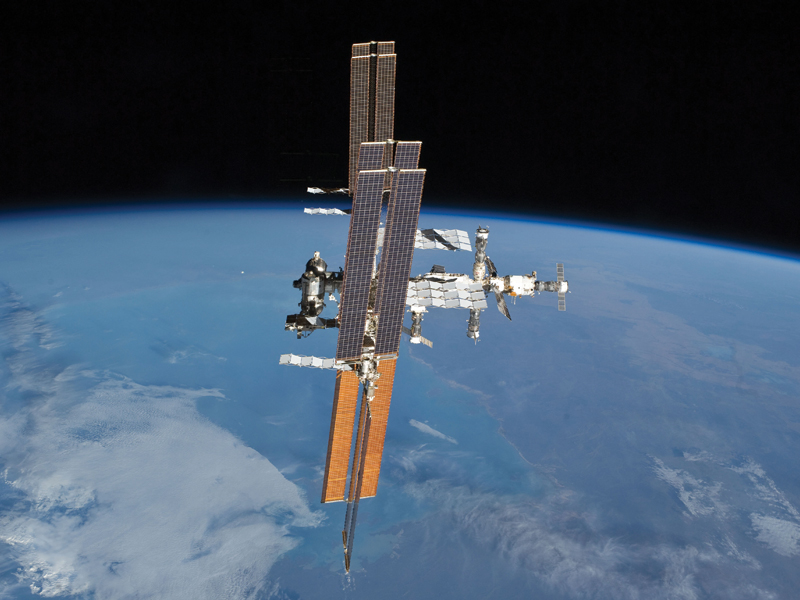
International Space Station (ISS). Animation Credit: NASA
The researchers found that the majority of bacteria found aboard the orbiting laboratory were human-associated, particularly those found on skin. While the space station microbiome fluctuates in composition and diversity, the research found that a core set of bacteria existed over time, suggesting that the station has an established microbiome. The study did not support the hypothesis that bacteria become more extremophilic or antibiotic resistant in space but rather that only the best-adapted organisms survive in the space environment.
Winding back the clock
Spaceflight has many complex effects on the human body, but its effect on aging is not well understood. The Japan Aerospace Exploration Agency (JAXA) Biological Rhythms 48 hrs investigation took a look at how one of the potential hazards for humans, geomagnetic space weather, affects human cardiac activity and how that effect is associated with longevity. The researchers compared how a crew member’s heart rate changed before, during and after spaceflight and compared data collected on magnetically quiet days with days on which a magnetic disturbance occurred.
The results, published in Scientific Reports, showed that changes in the magnetosphere can affect and enhance heart rate variability indices associated with anti-aging biomarkers. That means that exposure to higher magnetic activity in space leads to the human body responding in a way that would indicate an anti-aging-like effect.
These are just a few of the more than 190 papers published based on space station research during 2019. Learn more about the International Space Station results from this past year in our Annual Highlights of Results. To keep up with station science throughout the year, follow @ISS_Research, Space Station Research and Technology News or our Facebook. For opportunities to see the space station pass over your town, check out Spot the Station.
Related links:
Crew Earth Observations (CEO):
https://www.nasa.gov/mission_pages/station/research/experiments/explorer/Investigation.html?#id=84
CEO Research:
https://www.tandfonline.com/doi/full/10.1080/22797254.2019.1617642
FLUMIAS-DEA:
https://www.nasa.gov/mission_pages/station/research/news/ISS_Shrinks_Tool/
International Journal of Molecular Sciences:
https://www.mdpi.com/1422-0067/20/8/2033
Neutron star Interior Composition Explorer (NICER):
https://www.nasa.gov/nicer
Monitor of All-sky X-ray Image (MAXI):
http://www.nasa.gov/mission_pages/station/research/experiments/explorer/Investigation.html?#id=593
Nature:
https://www.nature.com/articles/s41586-018-0803-x
Manual Control:
https://www.nasa.gov/mission_pages/station/research/experiments/explorer/Investigation.html?#id=830
Scientific Reports:
https://www.nature.com/articles/s41598-019-39058-9
Frontiers in Materials:
https://www.frontiersin.org/articles/10.3389/fmats.2019.00083/full
Biorisk-KM-Metally:
https://www.nasa.gov/mission_pages/station/research/experiments/explorer/Investigation.html?#id=195
Extremophiles:
https://www.nasa.gov/mission_pages/station/research/experiments/explorer/Investigation.html?#id=7370
Biological Rhythms 48 hrs:
https://www.nasa.gov/mission_pages/station/research/experiments/explorer/Investigation.html?#id=847
Scientific Reports:
https://doi.org/10.1038/s41598-019-45387-6
Annual Highlights of Results:
http://nasa.gov/stationresults
Space Station Research and Technology:
https://www.nasa.gov/mission_pages/station/research/index.html
International Space Station (ISS):
https://www.nasa.gov/mission_pages/station/main/index.html
Images (mentioned), Video (mentioned), Animation (mentioned), Text, Credits: NASA/Michael Johnson/JSC/International Space Station Program Science Office/Erin Winick.
Best regards, Orbiter.ch