lundi 30 décembre 2019

Crew Packing Dragon Cargo Craft and Researching Flames in Space


ISS - Expedition 61 Mission patch.

December 30, 2019

A U.S. cargo craft is getting ready to depart the International Space Station early next week loaded with research results and degraded hardware for analysis on Earth. Meanwhile, the Expedition 61 crew explored a variety of space phenomena including how flames spread in weightlessness.

The SpaceX Dragon resupply ship is being configured for its departure on Jan. 5 after a month attached to the Harmony module. Dragon will be released from the grips of the Canadarm2 robotic arm on Sunday at 9:41 p.m. EST and splashdown in the Pacific off the coast California a few hours later.


Image above: The SpaceX Dragon resupply ship approaches the International Space Station on Dec. 8, 2019. Image Credit: NASA.

NASA Flight Engineer Andrew Morgan is leading the packing activities today with assistance from fellow NASA astronauts Jessica Meir and Christina Koch. The trio will be preserving and loading finalized experiment results inside Dragon. Obsolete hardware exposed to the harshness of space will also be returned to Earth for engineering inspections.

3-D surround video recordings of station science operations has been ongoing aboard the orbiting lab for months and today was no exception. Commander Luca Parmitano of ESA (European Space Agency) set up the unique video camera this morning to record him and Koch as they worked on combustion research. The duo burned acrylic and fabric samples in the Microgravity Science Glovebox to help scientists understand how flames expand in space to increase fire safety.

International Space Station (ISS). Animation Credit: NASA

Parmitano and Meir also partnered together in the afternoon for life support maintenance tasks. The duo checked out hardware inside the U.S. Destiny laboratory module that condenses water vapor from air.

Cosmonauts Alexander Skvortsov and Oleg Skripochka spent Monday dividing their time between setting up communications gear and studying Russian science. The duo activated video hardware and explored advanced imaging techniques for locating targets on Earth to photograph.

Related links:

Expedition 61: https://www.nasa.gov/mission_pages/station/expeditions/expedition61/index.html

SpaceX Dragon: https://www.nasa.gov/feature/spacex-dragon-launches-arrivals-and-departures

Canadarm2: https://cms.nasa.gov/mission_pages/station/structure/elements/mobile-servicing-system.html

3-D surround video: https://www.nasa.gov/mission_pages/station/research/experiments/explorer/Investigation.html?#id=7877

Combustion research: https://www.nasa.gov/mission_pages/station/research/experiments/explorer/Investigation.html?#id=7886

Microgravity Science Glovebox: https://www.nasa.gov/mission_pages/station/research/experiments/explorer/Facility.html?#id=341

U.S. Destiny laboratory module: https://www.nasa.gov/mission_pages/station/structure/elements/us-destiny-laboratory

Space Station Research and Technology: https://www.nasa.gov/mission_pages/station/research/index.html

International Space Station (ISS): https://www.nasa.gov/mission_pages/station/main/index.html

Image (mentioned), Animation (mentioned), Text, Credits: NASA/Mark Garcia.

Best regards, Orbiter.ch

Exploring the Night Sky with Hubble’s Caldwell Catalog


NASA - Hubble Space Telescope patch.

Dec. 30, 2019


During the 18th century, French astronomer Charles Messier compiled a list of over 100 cosmic objects that might fool fellow comet hunters into thinking they had discovered new comets. In the 1980s, an Englishman named Sir Patrick Moore produced an additional list to highlight more cosmic wonders visible to amateur astronomers. Unlike the Messier catalog, which only features objects that were visible from Charles Messier’s viewing location in Europe, Moore’s Caldwell catalog includes celestial bodies that are found in both the northern and southern skies. The catalog consists of 46 star clusters, 35 galaxies and 28 nebulas. Moore intentionally avoided including any of the Messier objects in his catalog, hoping to expand his fellow amateur astronomers’ cosmic horizons. From nearby clouds of gas and dust that are left over from dying stars to remote galaxies that formed billions of years ago, the Caldwell catalog is brimming with surprising celestial treats.

This loose collections of stars, known as an open star cluster, is image 100 of the catalog. Caldwell 100 (also called Collinder 249) is an open star cluster that’s embedded within a large nebula (named IC 2944) about 6,000 light-years away from Earth. The reddish glow of hydrogen gas surrounding the cluster is typical of emission nebulas found in massive star-forming regions. This Hubble image, taken in visible light using the Wide Field and Planetary Camera 2, shows a small portion of this region.

Hubble Space Telescope (HST)

Related article:

New Hubble Gallery Features Celestial Objects From Caldwell Catalog Visible to Amateur Astronomers
https://orbiterchspacenews.blogspot.com/2019/12/new-hubble-gallery-features-celestial.html

Related link:

Caldwell catalog: https://www.nasa.gov/content/goddard/hubble-s-caldwell-catalog

For more information about Hubble, visit:

http://hubblesite.org/

http://www.nasa.gov/hubble

http://www.spacetelescope.org/

Image, Animation, Text, Credits: NASA, Yvette Smith/ESA and the Hubble Heritage Team (STScI/AURA); Acknowledgment: Bo Reipurth (University of Hawaii).

Greetings, Orbiter.ch

vendredi 27 décembre 2019

A giant red star is acting weird and scientists think it may be about to explode


NASA - Herschel Space Observatory patch.

December 27, 2019

A young, bright star has been acting a little erratic lately.

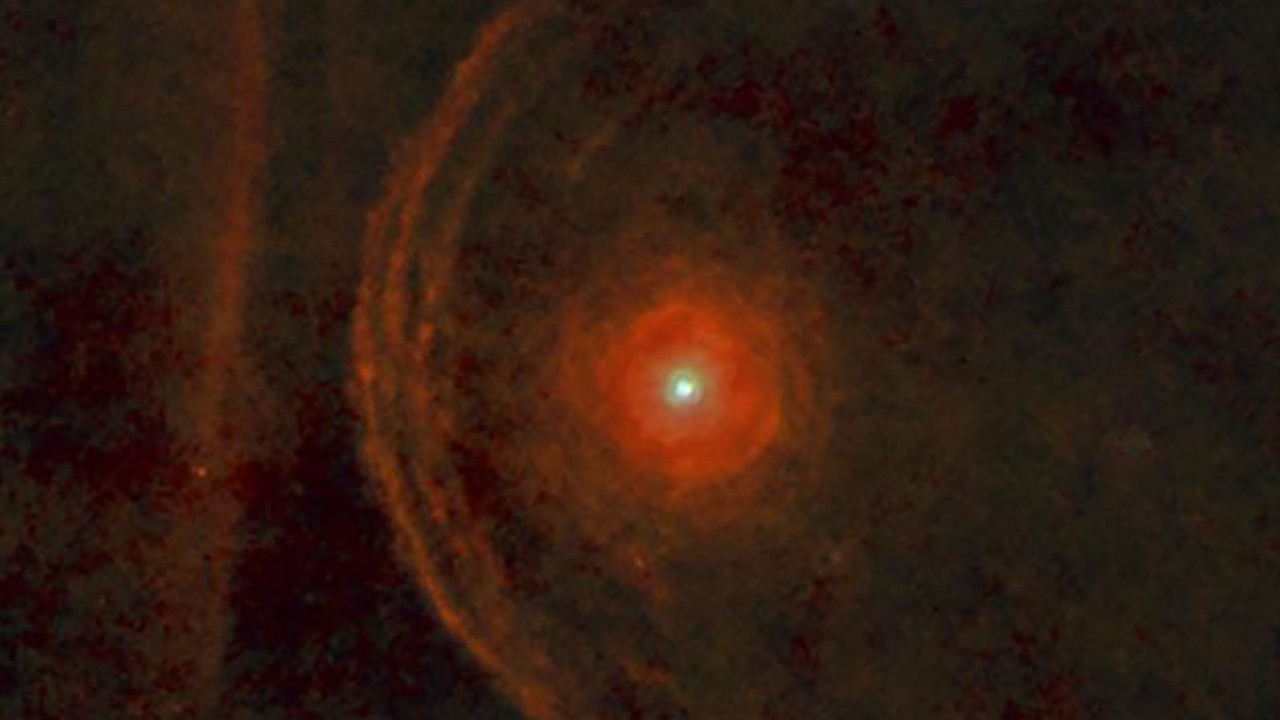
The star, Betelgeuse, is suddenly dimming. It may be a sign, astronomers say, that the star is about to explode. Another possibility is the red supergiant may just be going through a phase.

Ed Guinan, an astronomy professor at Villanova University, was the lead author on a December 8 paper entitled "The Fainting of the Nearby Supergiant Betelgeuse."

He told CNN that Betelgeuse (pronounced: BAY-tel juice) been declining in brightness sharply since October, and was now about 2.5 times fainter than usual. Once the ninth brightest star in the sky, Betelgeuse has fallen now to about the 23rd brightest.

Guinan and his colleagues have been closely observing the star for decades, with "continuous coverage since 1980," he said.

In the last half-century, the star has never dimmed so aggressively, and that could mean we're on the verge of something extraordinary.

"What causes the supernova is deep inside the star," Guinan said. And because the star is so huge, it's impossible to tell what's going on so far down.


Image above: The red supergiant star Betelgeuse is seen here in a new view from the Herschel Space Observatory.

It could be a prelude to a supernova

Betelgeuse is the star at the shoulder of Orion, the iconic constellation in the shape of a hunter wielding a bow in the night sky. Its name is derived from the Arabic for "hand of Orion."

The star, which is about 700 light years away from Earth, is a relatively close neighbor within our galaxy.

"What's special about this is how close it is," Guinan said.

Guinan said it's the most likely nearby supernova candidate. It's about nine million years old, and stars as large as Betelgeuse don't usually have lifespans past 10 million years. Though its time is nigh, it probably won't explode in your lifetime.

"It'll probably happen in the next 200,000 or 300,000 years," Guinan said.

It's a variable star, which means it regularly dims and brightens, in cycles that can last about 420 days. Betelgeuse has been in a normal dimming period over the past few months, but it's just dramatically accelerated compared to past years.

Herschel Space Observatory

The dimming process should end by mid-January, according to mathematical models. But Betelgeuse often follows its own rules, he says.

"I personally think it's going to bounce back, but it's fun to watch stars change," Guinan said. However, he adds, "If it continues dimming, then all bets are off."

If it exploded, it would be be bright enough to see during the day

That might mean we're on the verge of a brilliant light show, because if a star this close exploded, it would make an impact.

Giant star (supernova) explosion

Stars rapidly fuse various elements in their cores. And if Betelgeuse burns down to an iron core, which won't fuse, that core could collapse rapidly, leading to a supernova.

The red supergiant would glow a vibrant blue for three of four months, and would take about a year to fade out.

"It would be a really bright star visible in the daytime," Guinan said.

There wouldn't be any direct danger to life on earth, but ultraviolet radiation from the celestial blast could scorch ozone in our atmosphere.

Betelgeuse has been acting strangely for years

Betelgeuse's curious behavior has stuck out in other ways over the decades.

In 2009, the late astronomer and Nobel Laureate Charles Townes told CNN he had observed Betelgeuse shrinking 15% since the mid 1990s.

Back then, Townes and his colleagues were puzzled because as stars usually get brighter as they shrink. Betelgeuse, however, was dimming.

The star has been acting differently in the past few months, and it's anyone guess what all the unusual readings may mean.

"It might then be a very small bright star, or it might even be a black hole. An explosion would be very surprising," Townes said at the time.

Herschel Space Observatory: https://www.herschel.caltech.edu/ and https://sci.esa.int/web/herschel

Images, Animation, Text, Credits: NASA/ESA/CNN/By Ryan Prior.

Greetings, Orbiter.ch

Space Biology and Fire Research as Station Orbits Higher


ISS - Expedition 61 Mission patch.

December 27, 2019

The Expedition 61 crew is learning how to live and work in space and researching ways to adapt to long-term human spaceflight. Meanwhile, the International Space Station is orbiting higher today to support Russian spacecraft activities planned for 2020.

Rodents are being studied aboard the orbiting lab today since their physiology is similar to humans and reacts the same way to microgravity. NASA Flight Engineer Andrew Morgan set up the Life Sciences Glovebox to research therapies that may prevent space-caused muscle and bone loss in mice. Commander Luca Parmitano and Flight Engineer Jessica Meir supported the research activities cleaning the rodent habitats and feeding the mice.


Image above: NASA astronaut Christina Koch handles media bags that enable the manufacturing of organ-like tissues using the BioFabrication Facility, a 3-D biological printer. Image Credit: NASA.

Safety in a spacecraft is crucial for the success of long-term mission to the Moon, Mars and beyond. Combustion research on the station helps scientists understand how a variety of materials burn and how flames expand in weightlessness. NASA Flight Engineer Christina Koch used the Microgravity Science Glovebox today observing how different fabrics burn under controlled conditions. Results could improve fire safety on Earth and in space.

Veteran cosmonauts Alexander Skvortsov and Oleg Skripochka conducted a variety of space research in the orbital lab’s Russian segment. The duo partnered together in the morning for an exercise study. Skvortsov also explored ways to detect micrometeoroid impacts on the station. Skripochka routed and installed cables supporting a study to observe and forecast Earth catastrophes.

International Space Station (ISS). Animation Credit: NASA

Overnight, a docked Progress 74 cargo craft fired its engines in a sequence of two burns raising the space station’s orbit. The orbital maneuvers set the stage for upcoming Soyuz crew ship and Progress cargo craft missions scheduled in 2020.

Astronaut Christina Koch Poised to Make History Again


NASA astronaut Christina Koch makes observations from the International space Station's cupola. Koch has already made history once in her stay aboard the orbital laboratory.  In October 2019 she was part of the first all-female spacewalk and now she is poised to make history again. On Dec. 28, 2019, she will break the record for the longest single spaceflight by a woman, when she surpasses former Station Commander Peggy Whitson's record. When she arrives back on Earth in February 2020, she will have spent more than 300 days in space.

Related article:

Russian Space Freighter Docks Automatically to Station
https://orbiterchspacenews.blogspot.com/2019/12/russian-space-freighter-docks.html

Related links:

Expedition 61: https://www.nasa.gov/mission_pages/station/expeditions/expedition61/index.html

Rodents: https://www.nasa.gov/mission_pages/station/research/experiments/explorer/Investigation.html?#id=8075

Life Sciences Glovebox: https://www.nasa.gov/mission_pages/station/research/experiments/explorer/Facility.html?#id=7676

Combustion research: https://www.nasa.gov/mission_pages/station/research/experiments/explorer/Investigation.html?#id=7886

Microgravity Science Glovebox: https://www.nasa.gov/mission_pages/station/research/experiments/explorer/Facility.html?#id=341

Exercise study: https://www.energia.ru/en/iss/researches/human/26.html

Micrometeoroid impacts: https://www.energia.ru/en/iss/researches/develop/17.html

Earth catastrophes: https://www.energia.ru/en/iss/researches/study/09.html

Space Station Research and Technology: https://www.nasa.gov/mission_pages/station/research/index.html

International Space Station (ISS): https://www.nasa.gov/mission_pages/station/main/index.html

Image (mentioned), Animation (mentioned), Text, Credits: NASA/Mark Garcia/Yvette Smith.

Best regards, Orbiter.ch

Hubble Views a Galaxy with an Active Center


NASA - Hubble Space Telescope patch.

Dec. 27, 2019


This swirling mass of celestial gas, dust and stars is a moderately luminous spiral galaxy named ESO 021-G004, located just under 130 million light-years away.

This galaxy has something known as an active galactic nucleus. While this phrase sounds complex, this simply means that astronomers measure a lot of radiation at all wavelengths coming from the center of the galaxy. This radiation is generated by material falling inward into the very central region of ESO 021-G004, and meeting the behemoth lurking there — a supermassive black hole. As material falls toward this black hole it is dragged into orbit as part of an accretion disk; it becomes superheated as it swirls around and around, emitting characteristic high-energy radiation until it is eventually devoured.

The data comprising this image were gathered by the Wide Field Camera 3 aboard the NASA/ESA Hubble Space Telescope.

Hubble Space Telescope (HST)

For more information about Hubble, visit:

http://hubblesite.org/

http://www.nasa.gov/hubble

http://www.spacetelescope.org/

Text Credits: ESA (European Space Agency)/NASA/Lynn Jenner/Image, Animation Credits: ESA/Hubble & NASA, D. Rosario et al.

Best regards, Orbiter.ch

CASC - Long March-5 Y3 Successful Launch


CASC - Long March 5 / Shijian 20 Mission patch.

Dec. 27, 2019

Long March-5 Y3 liftoff

The Long March-5 Y3 launch vehicle was launched from the Wenchang Space Launch Center, Hainan Province, China, on 27 December 2019, at 12:46 UTC (20:46 local time).

Long March-5 Y3 launch

This was the third  launch of the Long March-5 rocket, China’s largest launch vehicle. The payload is Shijian 20, an experimental geostationary communications satellite.

Shijian 20 communications satellite

A Chinese Long March 5 rocket launches the Shijian 20 communications satellite. Shijian 20 is the first spacecraft based on the new DFH-5 communications satellite platform, a heavier, higher-power next-generation design, replacing the Shijian 18 satellite lost on a launch failure in 2017.

China Aerospace Science and Technology Corporation (CASC): http://english.spacechina.com/n16421/index.html

CASC/China Central Television (CCTV)/SciNews/Günter Space Page/Orbiter.ch Aerospace/Roland Berga.

Greetings, Orbiter.ch

ROSCOSMOS - Successful Rockot Launch


ROSCOSMOS logo.

Dec. 27, 2019

Rockot liftoff

Launched on December 27, 2019 at 02:11 Moscow time from the First State Testing Cosmodrome of Plesetsk, the Rokot light carrier rocket successfully launched the Gonets-M communication spacecraft into orbit. This launch completes the operation of this modification of the launch vehicle.

All prelaunch operations and the launch of the launch vehicle took place as usual. The space head of the Rokot rocket as part of the Breeze-KM booster block and spacecraft separated at the set time from the second stage of the launch vehicle. Spacecraft launched into the calculated orbit and transferred to the control.

Rokot launches Blits-M and Gonets-M satellites

The Rokot liquid two-stage light rocket was designed at the Khrunichev GKNPC on the basis of the RS-18 intercontinental ballistic missile and is designed to launch small and medium spacecraft into solar-synchronous and near-polar orbits.

Gonets-M satellite

The use of the Briz-KM booster block as a part of the Rokot rocket launcher allows for the implementation of various payload launch schemes, including the group launch of spacecraft into one or more orbits. Over the flight history of the Rokot launch vehicle, since 2000, 31 launches have been made as part of federal and commercial programs.

Blits-M satellite

Currently, the GKNPTs im. M.V. Khrunicheva (part of Roscosmos State Corporation) is developing technical documentation for a modernized version of the Rokot launch vehicle with the replacement of the imported element base with a Russian one.

Roscomos Press Release: https://www.roscosmos.ru/27904/

Images, Video, Text, Credits: ROSCOSMOS/SciNews/Günter Space Page/Orbiter.ch Aerospace/Roland Berga.

Greetings, Orbiter.ch