mardi 16 juin 2020

Martian rover motors ahead


ESA - ExoMars Mission logo.

June 16, 2020

European engineers, together with Canada, are working on the technologies needed to find and retrieve samples from Mars, as part of ESA’s plans to send material from the Red Planet to Earth.

Sample Fetch Rover for Mars Sample Return campaign

The Sample Fetch Rover will need to navigate autonomously, detect tubes of samples collected and packed by an earlier NASA rover, pick them up and return them to Earth.

ESA has selected Airbus for the next stage of the rover’s development. Work has been underway at their site in Stevenage, UK, since July 2018 to scope out and establish the feasibility of the rover concept. As part of this work, Airbus are coordinating industries from Europe and Canada to develop rover technologies.

The ESA Sample Fetch Rover will form part of the Mars Sample Return campaign, with hardware provided by ESA and NASA, which aims to deliver material from the martian surface to Earth by 2031.

To return the Mars samples, three carefully timed missions are required.

Mars Sample Return overview infographic

NASA’s Mars 2020, launching this summer, will send the Perseverance Rover to Mars. The NASA rover will explore the martian surface to retrieve samples of rock and soil, seal them in canisters and drop them at strategic locations.

A further NASA launch of the Sample Retrieval Lander in July 2026 will deliver the ESA Sample Fetch Rover to the vicinity of the Mars 2020 landing site.

The rover will travel up to 15-20 km, with daily steps of about 200 m, to autonomously track down and collect up to 36 sample tubes cached and deposited by Perseverance.

Sophisticated algorithms have already been tested in an artificial martian environment that use the rover’s camera to recognise and calculate the exact position of the sample tubes, which could be covered by martian dust. Airbus is also coordinating European industries for the design of a robotic arm and grasping unit that will be on board the rover to pick up the sample tubes.

The tubes will be carried and then transferred, using another robotic arm provided by ESA and installed on the Sample Retrieval Lander, to the Mars Ascent Vehicle which will launch the samples, protected within a basketball-size sample container, into Mars’ orbit.

Artist's concept of the Sample Fetch Rover approaching sample tubes

ESA’s Earth Return Obiter will then be timed to capture the container from Mars’ orbit before bringing it back to Earth to land in Utah, USA.

“Airbus and their industrial partners bring their expertise and knowhow in designing rover technologies, demonstrated by their work on the ESA ExoMars rover Rosalind Franklin, scheduled to launch in 2022,” says Ludovic Duvet, ESA Senior System and Technology Engineer at the agency’s UK site, who has led the management of Sample Fetch Rover activities from its inception.

“Crucially, such work is being completed with a co-engineering approach. There has been a great deal of interaction between ESA, NASA’s Jet Propulsion Laboratory who are designing the lander, and the Airbus led industrial consortium.”

Jezero Crater neighbourhood – 3D

“It’s exciting for our Airbus team to have such a key involvement in the Mars Sample Return programme which is a major international collaboration to achieve a real world first in space exploration,” says Ben Boyes, Airbus Project Manager for Sample Fetch Rover.

“The Sample Fetch Rover project is a great opportunity to make use of the technology developed in the UK for Rosalind Franklin, and build on this with new cutting edge autonomous visual recognition, sample retrieval system and a faster rover to deliver this challenging mission."

Related links:

ExoMars 2022 mission: https://www.esa.int/Science_Exploration/Human_and_Robotic_Exploration/Exploration/ExoMars/ExoMars_2022_rover

ExoMars: http://www.esa.int/Science_Exploration/Human_and_Robotic_Exploration/Exploration/ExoMars

NASA’s Mars 2020: https://mars.nasa.gov/mars2020/

Trace Gas Orbiter (TGO): https://exploration.esa.int/web/mars/-/46475-trace-gas-orbiter

Colour and Stereo Surface Imaging System (CaSSIS): http://www.cassis.unibe.ch/

Human and Robotic Exploration: http://www.esa.int/Science_Exploration/Human_and_Robotic_Exploration

Images, Video, Text, Credits: ESA/K. Oldenburg/ATG Medialab/NASA/JPL-Caltech/ESA/Roscosmos/CaSSIS, CC BY-SA 3.0 IGO.

Best regards, Orbiter.ch

PICASSO, ESA’s CubeSat to sift secrets from sunrise


ESA - European Space Agency patch.

June 16, 2020

There is always a sunrise and sunset happening somewhere on our planet. Soon ESA’s newest CubeSat – flying aboard Europe’s Vega launcher this Friday – will be keeping watch. The miniature PICASSO mission will use the filtering of sunlight by Earth’s atmosphere to check the health of our protective ozone layer.

PICASSO in orbit

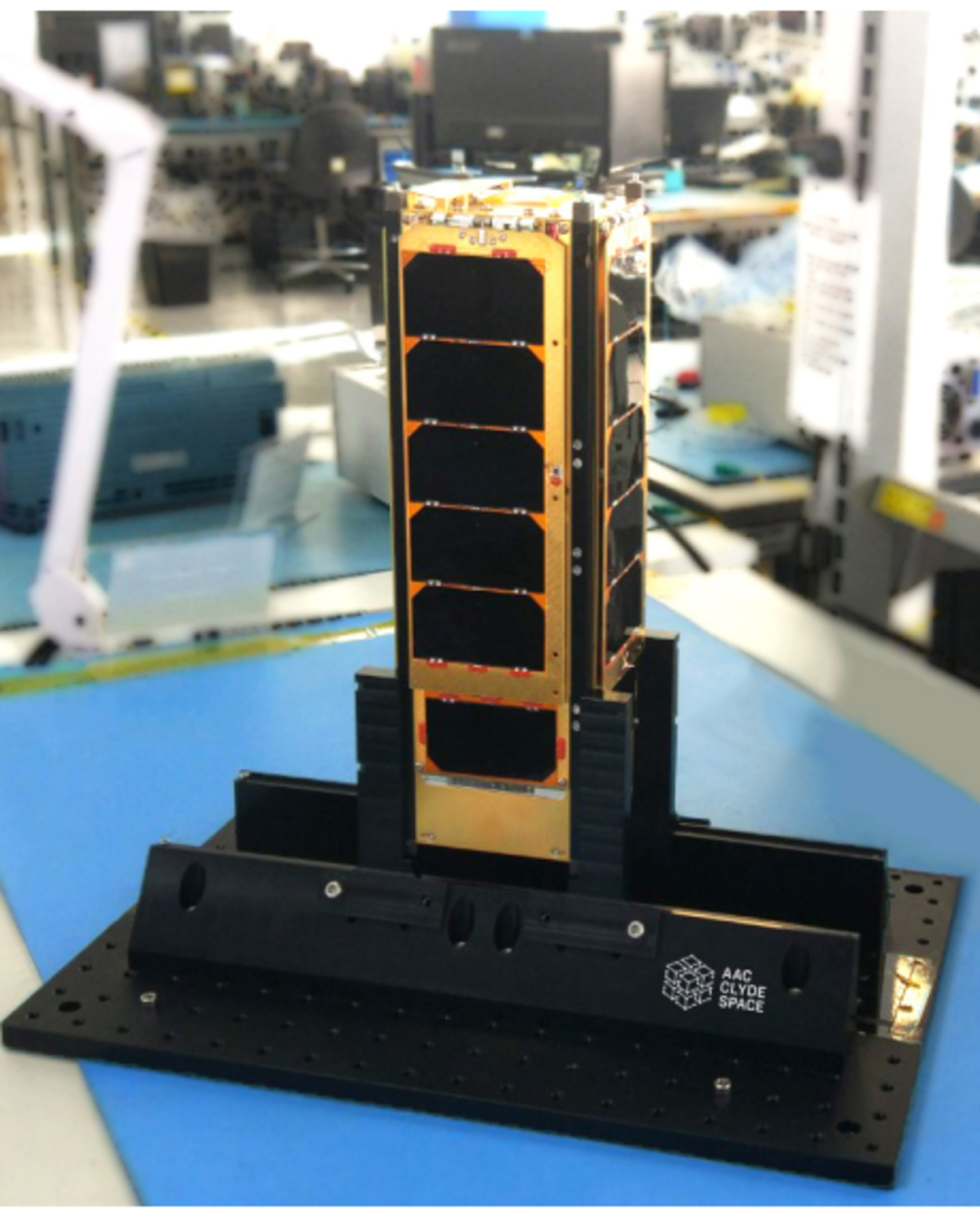
CubeSats are miniature satellites built up from standardised 10-cm boxes. The PICo-satellite for Atmospheric and Space Science Observations, or PICASSO, developed for ESA by the Belgian Institute for Space Aeronomy (BISA), is a ‘3-unit’ CubeSat with two scientific payloads. It hosts a cut-down spectrometer for monitoring the atmosphere, as well as sampling probes (called ‘SLP’) to measure space plasma around the nanosatellite.

“PICASSO is an experiment, basically,” explains project scientist Didier Fussen, heading the Solar Radiation Department at BISA. “Can an instrument providing valid scientific measurements of the ozone layer, which is a vital parameter for the health of life on Earth, be accommodated on a platform the size of a shoe box?

PICASSO CubeSat in cleanroom

“The answer turns out to be yes. To make it happen we’ve worked with our partners AAC Clyde Space in Scotland who constructed our CubeSat, and VTT Finland who provided us with a suitably scaled-down spectrometer.

“Meanwhile BISA colleagues contributed a quartet of homemade Langmuir probes to take advantage of this flight opportunity. Extending from the solar panels of the nanosatellite, these ‘SLP’ probes will sample variations in space plasma across PICASSO’s orbit, opening a new window on space weather.

“The other essential elements enabling the mission have been financial support from BELSPO, the Belgium Science Policy Office, the UK Space Agency and the Belgian National Lottery, as well as the technical backing from ESA: CubeSats are small in scale, and use commercial off-the-shelf parts to boost affordability, but for scientific purposes their overall complexity is starting to approach that of a standard-sized mission.”

Something in the air

Focused on the study of the upper atmosphere, BISA has contributed instruments to many other satellites over the years, in particular by proposing the forthcoming ESA Earth Watch mission Altius which will monitor the ozone layer and upper atmosphere across a much wider spectral band, but PICASSO is the Institute’s first CubeSat mission.

PICASSO CubeSat

The impetus for global ozone monitoring from spaceborne instruments goes back to the mid-1980s, and the shock discovery of a hole in the ozone layer by Antarctic scientists, subsequently confirmed by satellite data. The finding that the ozone layer was being eroded by human-made gases was bad news because it plays a vital role in shielding life from harmful ultraviolet radiation.

In reaction, in parallel to the international banning of the ‘chlorofluorocarbon’ gases responsible, a new generation of ozone-monitoring instruments were designed and launched, many of which BISA contributed to. For instance, ESA’s 2002-launched Envisat environmental satellite alone carried three such atmospheric sounders.

“The result was something of a golden age for ozone monitoring with a good vertical resolution,” adds Dr Fussen, “but this is now coming to an end as most missions reach the end of their lives. So PICASSO will serve as a demonstrator of the capacity of small satellites to perform monitoring of atmospheric composition.

The Ozone Hole, Sentinel-5P

“Current trends suggest the ozone hole is gradually stabilizing or recovering, but we cannot simply hope for the best,” says Didier. “Atmospheric dynamics has a large natural variability year on year, which demands ongoing observation.”

PICASSO’s spectrometer operates on the basis of the solar occultation method, a sophisticated version of ‘spot the difference’. It compares the spectral signatures of sunlight shone through the atmosphere with sunlight coming directly through space to perform vertical mapping of ozone concentration profiles.

Observing sunrises and sunsets twice per orbit, the CubeSat will also attempt an experimental method of taking the temperature of the upper atmosphere. Didier explains: “As we image the solar disc, we will measure how it has been compressed by the lensing effect of atmospheric refraction, making it smaller and less circular. From this ‘angular size variation’ it is possible to calculate the density of the air at high altitude, and from that derive its temperature.”

PICASSO prepared for integration

PICASSO has been supported through the ‘Fly’ element of ESA’s General Support Technology Programme, readying promising technologies for space. It will be launched along with dozens of other CubeSats and small satellites aboard the inaugural flight of ESA’s Vega Small Spacecraft Mission Service this Friday early morning.

Follow the launch on ESA Web TV from 03:15 CEST, with liftoff due at 03:51 CEST (01:51 UTC, 10:51 on Thursday night French Guiana time): https://www.esa.int/ESA_Multimedia/ESA_Web_TV

About SSMS

Vega’s Small Spacecraft Mission Service (SSMS) dispenser provides launch opportunities for multiple light satellites with an overall mass ranging from 0.2 kg CubeSats up to 400 kg minisatellites.

Artist's view of Vega VV16 with SSMS and SAT-AIS

The SSMS has a lightweight modular design comprising a lower and upper part each with attachments that can be used to accommodate a range of configurations of satellites depending on requirements.

About Vega

Vega is a 30 m-high, four-stage launch vehicle operating out of Europe’s Spaceport in French Guiana. It is designed to lift between 300 kg and 1.5 tonnes of payload depending on the orbit and altitude.

ESA’s upcoming Vega-C, a more powerful version of Vega, will offer an extra 700 kg of capacity and enlarged volume within a wider launcher fairing at a similar cost to Vega – allowing even more passengers per individual rideshare launch at significant lower cost per kilogram.

Related article:

Rideshare service for light satellites to launch on Vega
https://orbiterchspacenews.blogspot.com/2020/06/rideshare-service-for-light-satellites.html

Related links:

PICASSO: https://www.aeronomie.be/en/news/2020/picasso-picosatellite-ready-launch

Belgian Institute for Space Aeronomy (BISA): https://www.aeronomie.be/

BELSPO: https://www.belspo.be/

UK Space Agency: https://www.gov.uk/government/organisations/uk-space-agency

AAC Clyde Space: https://www.aac-clyde.space/

VTT Finland: https://www.vttresearch.com/en

Altius: https://www.esa.int/Applications/Observing_the_Earth/Contract_secures_build_of_ozone-monitoring_Altius_satellite

ESA’s General Support Technology Programme: http://www.esa.int/Enabling_Support/Space_Engineering_Technology/Shaping_the_Future/About_the_General_Support_Technology_Programme_GSTP

ESA Web TV: https://www.esa.int/ESA_Multimedia/ESA_Web_TV

Vega: https://www.esa.int/vega

Images, Animation, Text, Credits: ESA/J. Huart/Dr Johan De Keyser @ BIRA-IASB/AAC Clyde Space/BISA/Contains modified Copernicus Sentinel data (2017, processed by DLR/ESA.

Greetings, Orbiter.ch

lundi 15 juin 2020

Crew Starts Week With Spacewalk Preps, Satellite Work


ISS - Expedition 63 Mission patch.

June 15, 2020

The Expedition 63 crew is starting the week getting ready for a pair of upcoming spacewalks and a satellite deployment. The International Space Station residents are also setting up research gear that will analyze hazardous particles and plasma crystals.

The three NASA astronauts onboard the station teamed up today setting up hardware and reviewing plans for two spacewalks planned to start at the end of the month. Commander Chris Cassidy and Flight Engineer Bob Behnken checked out rechargeable batteries that will power up U.S. spacesuit components. Flight Engineer Doug Hurley looked at procedures to put on the spacesuits as well as steps a spacewalker would take during an emergency.


Image above: Russia’s Progress 74 resupply ship is pictured docked to the space station as the orbiting lab flew above northern Iraq. Image Credit: NASA.

The spacewalks will continue power upgrades begun last year on the outside of the space station. Cassidy and Behnken will replace old nickel-hydrogen batteries with new lithium-ion batteries on the Starboard-6 truss segment. The batteries store and distribute power collected from the solar arrays throughout the station.

Cassidy started Monday in Japan’s Kibo laboratory module readying a 110-kilogram Red-Eye satellite for deployment in the next couple of weeks. He installed the satellite inside Kibo’s airlock where it will be placed into the vacuum of space and ejected into orbit from the NanoRacks Kaber Microsat deployer. Red-Eye, the second of three microsatellites, will test satellite communications, flight computers and thermal management technologies.


Image above: NASA astronaut Jessica Meir is pictured during a spacewalk she conducted with NASA astronaut Christina Koch Jessica Meir (out of frame) to install new lithium-ion batteries that store and distribute power collected from solar arrays on the station’s Port-6 truss structure. Image Credit: NASA.

Behnken helped out with the Red-Eye work before installing the new Mochii microscope in the Kibo lab where it will analyze particles that could threaten crew health and spacecraft safety. Hurley worked in the European Columbus laboratory module making room for the new European Drawer Rack-2 that will support a variety of new space experiments.

The two cosmonauts in the Russian segment of the station kept up their schedule of microgravity research and life support operations. Veteran Flight Engineer Anatoly Ivanishin serviced hardware that observes plasma crystals which could lead to improved research methods and new spacecraft designs. First time space-flyer Ivan Vagner checked space radiation readings and set up Earth observation hardware.

Related article:

NASA TV Coverage Set for Final Space Station Spacewalk Power Upgrades
https://www.nasa.gov/press-release/nasa-tv-coverage-set-for-final-space-station-spacewalk-power-upgrades

Related links:

Expedition 63: https://www.nasa.gov/mission_pages/station/expeditions/expedition63/index.html

Truss segment: https://www.nasa.gov/mission_pages/station/structure/elements/truss-structure

Kibo laboratory module: https://www.nasa.gov/mission_pages/station/structure/elements/japan-kibo-laboratory

Red-Eye satellite: https://www.nasa.gov/mission_pages/station/research/experiments/explorer/Facility.html?#id=1788

NanoRacks Kaber Microsat deployer: https://www.nasa.gov/mission_pages/station/research/experiments/explorer/Facility.html?#id=1788

Mochii microscope: https://www.nasa.gov/mission_pages/station/research/experiments/explorer/Facility.html?#id=7657

Columbus laboratory module: https://www.nasa.gov/mission_pages/station/structure/elements/europe-columbus-laboratory

European Drawer Rack-2: https://www.nasa.gov/mission_pages/station/research/experiments/explorer/Facility.html?#id=7978

Plasma crystals: https://www.nasa.gov/mission_pages/station/research/experiments/explorer/Investigation.html?#id=1192

Space Station Research and Technology: https://www.nasa.gov/mission_pages/station/research/overview.html

International Space Station (ISS): https://www.nasa.gov/mission_pages/station/main/index.html

Images (mentioned), Text, Credits: NASA/Norah Moran.

Best regards, Orbiter.ch

While Stargazing on Mars, NASA's Curiosity Rover Spots Earth and Venus


NASA - Mars Science Laboratory (MSL) patch.

June 15, 2020

NASA's Curiosity Mars rover occasionally stops to stargaze. Recently, it captured a shot of Earth and Venus in the Red Planet's night sky.


Image above: Two images of the night sky were combined to show Earth and Venus as seen by NASA's Curiosity Mars rover on June 5, 2020, the mission's 2,784th Martian day, or sol. The planets appear as pinpoints of light owing to a combination of distance and dust in the air. Mars' Tower Butte is visible at bottom. Image Credits: NASA/JPL-Caltech.

Curiosity aimed its Mast Camera, or Mastcam, at the heavens about 75 minutes after sunset on June 5, 2020, the 2,784th Martian day, or sol, of the mission. A two-image twilight panorama reveals Earth in one frame and Venus in the other. Both planets appear as mere pinpoints of light, owing to a combination of distance and dust in the air; they would normally look like very bright stars.

The brief photo session was partly to gauge the twilight brightness: During this time of year on Mars, there's more dust in the air to reflect sunlight, making it particularly bright, said Mastcam co-investigator Mark Lemmon of the Space Science Institute in Boulder, Colorado.

"Even moderately bright stars were not visible when this image of Venus was taken," Lemmon said. "Earth also has bright twilights after some large volcanic eruptions."

Mars Science Laboratory (MSL). Animation Credits: NASA/JPL-Caltech

When Curiosity's Mastcam imaged Earth and its Moon in 2014, the color and brightness of the sky were significantly different than from these most recent images because of all the high-altitude dust in the Martian air right now.

At the bottom of the new images is the top of a rock feature called Tower Butte in the "clay-bearing unit," which Curiosity has been exploring for more than a year. Since landing in 2012, the rover has captured blue Martian sunsets and passing asteroids as well as Mercury and Mars' two moons, Phobos and Deimos, transiting across the Sun.

Related articles:

Quick Detour by NASA Curiosity Checks Ancient Valley and Rover Views Serene Sundown on Mars
https://orbiterchspacenews.blogspot.com/2015/05/quick-detour-by-nasa-curiosity-checks.html

Mercury Passes in Front of the Sun, as Seen From Mars
https://orbiterchspacenews.blogspot.com/2014/06/mercury-passes-in-front-of-sun-as-seen.html

NASA Rover Gets Movie as a Mars Moon Passes Another
https://orbiterchspacenews.blogspot.com/2013/08/nasa-rover-gets-movie-as-mars-moon.html

More information about Curiosity:

https://mars.nasa.gov/msl/home/

https://nasa.gov/msl

https://www.nasa.gov/mission_pages/msl/index.html

Image (mentioned), Animation (mentioned), Text, Credits: NASA/Tony Greicius/Grey Hautaluoma/Alana Johnson/JPL/Andrew Good.

Greetings, Orbiter.ch

ExoMars spots unique green glow at the Red Planet


ESA & ROSCOSMOS - ExoMars Mission patch / ESA - ExoMars Mission logo.

June 15, 2020

ESA’s ExoMars Trace Gas Orbiter has detected glowing green oxygen in Mars’ atmosphere – the first time that this emission has been seen around a planet other than Earth.

ExoMars Trace Gas orbiter spots daylight green oxygen at Mars

On Earth, glowing oxygen is produced during polar auroras when energetic electrons from interplanetary space hit the upper atmosphere. This oxygen-driven emission of light gives polar auroras their beautiful and characteristic green hue.

The aurora, however, is just one way in which planetary atmospheres light up. The atmospheres of planets including Earth and Mars glow constantly during both day and night as sunlight interacts with atoms and molecules within the atmosphere. Day and night glow are caused by slightly different mechanisms: night glow occurs as broken-apart molecules recombine, whereas day glow arises when the Sun’s light directly excites atoms and molecules such as nitrogen and oxygen.

On Earth, green night glow is quite faint, and so is best seen by looking from an ‘edge on’ perspective – as portrayed in many spectacular images taken by astronauts aboard the International Space Station (ISS). This faintness can be an issue when hunting for it around other planets, as their bright surfaces can drown it out.

Airglow observed from the International Space Station

This green glow has now been detected for the first time at Mars by the ExoMars Trace Gas Orbiter (TGO), which has been orbiting Mars since October 2016.

“One of the brightest emissions seen on Earth stems from night glow. More specifically, from oxygen atoms emitting a particular wavelength of light that has never been seen around another planet,” says Jean-Claude Gérard of the Université de Liège, Belgium, and lead author of the new study published in Nature Astronomy.

“However, this emission has been predicted to exist at Mars for around 40 years – and, thanks to TGO, we’ve found it.”

Jean-Claude and colleagues were able to spot this emission using a special observing mode of the TGO. One of the orbiter’s advanced suite of instruments, known as NOMAD (Nadir and Occultation for Mars Discovery) and including the ultraviolet and visible spectrometer (UVIS), can observe in various configurations, one of which positions its instruments to point directly down at the martian surface – also referred to as the ‘nadir’ channel.

“Previous observations hadn’t captured any kind of green glow at Mars, so we decided to reorient the UVIS nadir channel to point at the ‘edge’ of Mars, similar to the perspective you see in images of Earth taken from the ISS,” adds co-author Ann Carine Vandaele of the Institut Royal d'Aéronomie Spatiale de Belgique, Belgium, and Principal Investigator of NOMAD.

Observation and model of green dayglow emission at Mars

Between 24 April and 1 December 2019, Jean-Claude, Ann Carine and colleagues used NOMAD-UVIS to scan altitudes ranging from 20 to 400 kilometres from the martian surface twice per orbit. When they analysed these datasets, they found the green oxygen emission in all of them.

“The emission was strongest at an altitude of around 80 kilometres and varied depending on the changing distance between Mars and the Sun,” adds Ann Carine.

Studying the glow of planetary atmospheres can provide a wealth of information about the composition and dynamics of an atmosphere, and reveal how energy is deposited by both the Sun’s light and the solar wind – the stream of charged particles emanating from our star.

To better understand this green glow at Mars, and compare it to what we see around our own planet, Jean-Claude and colleagues dug further into how it was formed.

“We modelled this emission and found that it’s mostly produced as carbon dioxide, or CO2, is broken up into its constituent parts: carbon monoxide and oxygen,” says Jean-Claude. “We saw the resulting oxygen atoms glowing in both visible and ultraviolet light.”

Simultaneously comparing these two kinds of emission showed that the visible emission was 16.5 times more intense than the ultraviolet.

“The observations at Mars agree with previous theoretical models but not with the actual glowing we’ve spotted around Earth, where the visible emission is far weaker,” adds Jean-Claude. “This suggests we have more to learn about how oxygen atoms behave, which is hugely important for our understanding of atomic and quantum physics.”

This understanding is key to characterising planetary atmospheres and related phenomena – such as auroras. By deciphering the structure and behaviour of this green glowing layer of Mars’ atmosphere, scientists can gain insight into an altitude range that has remained largely unexplored, and monitor how it changes as the Sun’s activity varies and Mars travels along its orbit around our star.

Oxygen emission in dayside limb observations by ExoMars Trace Gas Orbiter

“This is the first time this important emission has ever been observed around another planet beyond Earth, and marks the first scientific publication based on observations from the UVIS channel of the NOMAD instrument on the ExoMars Trace Gas Orbiter,” highlights Håkan Svedhem, ESA’s TGO Project Scientist.

“It demonstrates the remarkably high sensitivity and optical quality of the NOMAD instrument. This is especially true given that this study explored the dayside of Mars, which is much brighter than the nightside, thus making it even more difficult to spot this faint emission.”

Understanding the properties of Mars’ atmosphere is not only interesting scientifically, but is also key to operate the missions we send to the Red Planet. Atmospheric density, for example, directly affects the drag experienced by orbiting satellites and by the parachutes used to deliver probes to the martian surface.

“This type of remote-sensing observation, coupled with in situ measurements at higher altitudes, helps us to predict how the martian atmosphere will respond to seasonal changes and variations in solar activity,” adds Håkan. “Predicting changes in atmospheric density is especially important for forthcoming missions, including the ExoMars 2022 mission that will send a rover and surface science platform to explore the surface of the Red Planet.”

More information:

“Detection of green line emission in the dayside atmosphere of Mars from NOMAD-TGO observations" by J.-C. Gérard et al. (2020) is published in Nature Astronomy.

ExoMars is a joint endeavour of the European Space Agency and Roscosmos.

The NOMAD experiment is led by the Royal Belgian Institute for Space Aeronomy (IASB‐ BIRA), assisted by Co‐PI teams from Spain (IAA‐CSIC), Italy (INAF‐IAPS), and the United Kingdom (Open University). This project acknowledges funding by the Belgian Science Policy Office, with the financial and contractual coordination by the European Space Agency Prodex Office, by the Spanish MICINN through its Plan Nacional, as well as by UK and Italian Space Agencies.

Related links:

ExoMars 2022 mission: https://www.esa.int/Science_Exploration/Human_and_Robotic_Exploration/Exploration/ExoMars/ExoMars_2022_rover

ExoMars: http://www.esa.int/Science_Exploration/Human_and_Robotic_Exploration/Exploration/ExoMars

Trace Gas Orbiter (TGO): https://www.esa.int/Science_Exploration/Human_and_Robotic_Exploration/Exploration/ExoMars/Trace_Gas_Orbiter_instruments

Images, Graphics, Text, Credits: ESA/Håkan Svedhem/NASA/Courtesy of J.-C. Gérard et al. (2020)/Institut Royal d'Aéronomie Spatiale de Belgique/Ann Carine Vandaele/Laboratory for Planetary and Atmospheric Physics (LPAP)/Jean-Claude Gérard.

Greetings, Orbiter.ch

Solar Orbiter makes first close approach to the Sun


ESA / NASA - Solar Orbiter patch.

June 15, 2020

ESA’s Sun-exploring mission Solar Orbiter has made its first close approach to the star on June 15, getting as close as 77 million kilometres to its surface, about half the distance between the Sun and Earth.

 Solar Orbiter reaches first perihelion

In the week following this first perihelion, the point in the orbit closest to the Sun, the mission scientists will test the spacecraft’s ten science instruments, including the six telescopes on-board, which will acquire close-up images of the Sun in unison for the first time. According to ESA’s Solar Orbiter Project Scientist Daniel Müller, the images, to be released in mid-July, will be the closest images of the Sun ever captured.

“We have never taken pictures of the Sun from a closer distance than this,” Daniel says. “There have been higher resolution close-ups, e.g. taken by the four-meter Daniel K. Inouye Solar Telescope in Hawaii earlier this year. But from Earth, with the atmosphere between the telescope and the Sun, you can only see a small part of the solar spectrum that you can see from space.”

NASA’s Parker Solar Probe, launched in 2018, makes closer approaches. The spacecraft, however, doesn’t carry telescopes capable of looking directly at the Sun.

“Our ultraviolet imaging telescopes have the same spatial resolution as those of NASA’s Solar Dynamic Observatory (SDO), which takes high-resolution images of the Sun from an orbit close to Earth. Because we are currently at half the distance to the Sun, our images have twice SDO’s resolution during this perihelion,” says Daniel.

The primary objective of these early observations is to prove that Solar Orbiter’s telescopes are ready for future scientific observations.

“For the first time, we will be able to put together the images from all our telescopes and see how they take complementary data of the various parts of the Sun including the surface, the outer atmosphere, or corona, and the wider heliosphere around it,” says Daniel.

Solar Orbiter’s first close approach to the Sun

The scientists will also analyse data from the four in-situ instruments that measure properties of the environment around the spacecraft, such as the magnetic field and the particles making up the solar wind.

“This is the first time that our in-situ instruments operate at such a close distance to the Sun, providing us with a unique insight into the structure and composition of the solar wind,” says Yannis Zouganelis, ESA’s Solar Orbiter Deputy Project Scientist. “For the in-situ instruments, this is not just a test, we are expecting new and exciting results.”

Solar Orbiter, launched on 10 February this year, is completing its commissioning phase on 15 June and will commence its cruise phase, which will last until November 2021. During the main science phase that follows, the spacecraft will get as close as 42 million kilometres to the Sun’s surface, which is closer than the planet Mercury.

The spacecraft will reach its next perihelion in early 2021. During the first close approach of the main science phase, in early 2022, it will get as close as 48 million kilometres.

Solar Orbiter's journey to the Sun

Video above: Solar Orbiter will use several gravity-assist maneuvres at Venus to shift its orbit out of the ecliptic plane to be able to look at the Sun's poles.

Solar Orbiter operators will then use the gravity of Venus to gradually shift the spacecraft’s orbit out of the ecliptic plane, in which the planets of the Solar System orbit. These fly-by manoeuvres will enable Solar Orbiter to look at the Sun from higher latitudes and get the first ever proper view of its poles. Studying the activity in the polar regions will help the scientists to better understand the behaviour of the Sun’s magnetic field, which drives the creation of the solar wind that in turn affects the environment of the entire Solar System.

Since the spacecraft is currently 134 million kilometres from Earth, it will take about a week for all perihelion images to be downloaded via ESA’s 35-m deep-space antenna in Malargüe, Argentina. The science teams will then process the images before releasing them to the public in mid-July. The data from the in-situ instruments will become public later this year after a careful calibration of all individual sensors.

“We have a nine-hour download window every day but we are already very far from Earth so the data rate is much lower than it was in the early weeks of the mission when we were still very close to Earth,” says Daniel. “In the later phases of the mission, it will occasionally take up to several months to download all the data because Solar Orbiter really is a deep space mission. Unlike near-Earth missions, we can store a lot of data on-board and downlink it when we are closer to home again and the data connection is much better.”

Related links:

Solar Orbiter: http://www.esa.int/Science_Exploration/Space_Science/Solar_Orbiter

Space Science: http://www.esa.int/Science_Exploration/Space_Science

Image, Videos, Text, Credits: ESA/Medialab/ATG medialab.

Best regards, Orbiter.ch

dimanche 14 juin 2020

NASA's Mars Rover Drivers Need Your Help


NASA - Mars Science Laboratory (MSL) logo.

June 14, 2020

Using an online tool to label Martian terrain types, you can train an artificial intelligence algorithm that could improve the way engineers guide the Curiosity rover.


Image Credits: Three images from the tool called AI4Mars show different kinds of Martian terrain as seen by NASA's Curiosity rover. By drawing borders around terrain features and assigning one of four labels to them, you can help train an algorithm that will automatically identify terrain types for Curiosity's rover planners. Image Credits: NASA/JPL-Caltech.

You may be able to help NASA's Curiosity rover drivers better navigate Mars. Using the online tool AI4Mars to label terrain features in pictures downloaded from the Red Planet, you can train an artificial intelligence algorithm to automatically read the landscape.

Is that a big rock to the left? Could it be sand? Or maybe it's nice, flat bedrock. AI4Mars, which is hosted on the citizen science website Zooniverse, lets you draw boundaries around terrain and choose one of four labels. Those labels are key to sharpening the Martian terrain-classification algorithm called SPOC (Soil Property and Object Classification).

Developed at NASA's Jet Propulsion Laboratory, which has managed all of the agency's Mars rover missions, SPOC labels various terrain types, creating a visual map that helps mission team members determine which paths to take. SPOC is already in use, but the system could use further training.

"Typically, hundreds of thousands of examples are needed to train a deep learning algorithm," said Hiro Ono, an AI researcher at JPL. "Algorithms for self-driving cars, for example, are trained with numerous images of roads, signs, traffic lights, pedestrians and other vehicles. Other public datasets for deep learning contain people, animals and buildings - but no Martian landscapes."

Once fully up to speed, SPOC will be able to automatically distinguish between cohesive soil, high rocks, flat bedrock and dangerous sand dunes, sending images to Earth that will make it easier to plan Curiosity's next moves.

Mars Science Laboratory (MSL), or Curiosity. Animation Credits: NASA/JPL-Caltech

"In the future, we hope this algorithm can become accurate enough to do other useful tasks, like predicting how likely a rover's wheels are to slip on different surfaces," Ono said.

The Job of Rover Planners

JPL engineers called rover planners may benefit the most from a better-trained SPOC. They are responsible for Curiosity's every move, whether it's taking a selfie, trickling pulverized samples into the rover's body to be analyzed or driving from one spot to the next.

It can take four to five hours to work out a drive (which is now done virtually), requiring multiple people to write and review hundreds of lines of code. The task involves extensive collaboration with scientists as well: Geologists assess the terrain to predict whether Curiosity's wheels could slip, be damaged by sharp rocks or get stuck in sand, which trapped both the Spirit and Opportunity rovers.

Planners also consider which way the rover will be pointed at the end of a drive, since its high-gain antenna needs a clear line of sight to Earth to receive commands. And they try to anticipate shadows falling across the terrain during a drive, which can interfere with how Curiosity determines distance. (The rover uses a technique called visual odometry, comparing camera images to nearby landmarks.)

How AI Could Help

SPOC won't replace the complicated, time-intensive work of rover planners. But it can free them to focus on other aspects of their job, like discussing with scientists which rocks to study next.

"It's our job to figure out how to safely get the mission's science," said Stephanie Oij, one of the JPL rover planners involved in AI4Mars. "Automatically generating terrain labels would save us time and help us be more productive."

The benefits of a smarter algorithm would extend to planners on NASA's next Mars mission, the Perseverance rover, which launches this summer. But first, an archive of labeled images is needed. More than 8,000 Curiosity images have been uploaded to the AI4Mars site so far, providing plenty of fodder for the algorithm. Ono hopes to add images from Spirit and Opportunity in the future. In the meantime, JPL volunteers are translating the site so that participants who speak Spanish, Hindi, Japanese and several other languages can contribute as well.

Related links:

SPOC (Soil Property and Object Classification): https://www.zooniverse.org/projects/hiro-ono/ai4mars/about/research

AI4Mars: https://www.zooniverse.org/projects/hiro-ono/ai4mars

High-gain antenna: https://mars.nasa.gov/msl/spacecraft/rover/communication/#high-gain

For more, visit:

https://mars.nasa.gov/msl/home/

https://www.nasa.gov/mission_pages/msl/index.html

Image (mentioned), Animation (mentioned), Text, Credits: NASA/Grey Hautaluoma/Alana Johnson/JPL/Andrew Good.

Greetings, Orbiter.ch