mercredi 17 juin 2020
Swiss researchers come across signals of unknown origin
UZH - University of Zurich logo.
June 17, 2020
Scientists at the University of Zurich made an unexpected discovery by analyzing data from the world's most sensitive dark matter detector. A new particle could be at the origin of it.
Image above: The Xenon1T dark matter detector is the most sensitive in the world. Image Credit: UZH.
By analyzing data from the Xenon1T dark matter detector installed at the underground laboratory of Gran Sasso (I) until the end of 2018, researchers from the University of Zurich (UZH) came across unexpected signals.
This detector, the most sensitive in the world, certainly did not detect dark matter, but out of a total of 232 events involving known particles, the researchers found an excess of 53 unexpected signals of unknown origin.
The 163 scientists from 28 institutions in 11 countries working on the XENON collaboration have not yet managed to explain this phenomenon, UZH said in a statement on Wednesday.
Existence of a new particle?
Among the hypotheses retained is the existence of a new particle. The energy spectrum measured resembles that attributed to axions, hypothetical particles which could have been a source of dark matter at the beginning of the universe, explains Laura Baudis, responsible for this work at the UZH, quoted in the press release.
Image above: 1/n We saw an excess of events in the energy region 1-7 keV in XENON1T data. There are 285 electronic recoil events observed, with 232 + -15 expected from the background. Extensive checks allowed us to exclude backgrounds from known particles and systematic effects as the source. Image Credits: UZH / Laura Baudis.
Another explanation could be an unknown property of neutrinos going beyond the standard model of physics. The answer may come from the new, more sensitive XENONnT detector, currently being installed and which should start operating at the end of the year, concludes the UZH.
University of Zurich (UZH): https://www.uzh.ch/en.html
laboratory of Gran Sasso (LNGS): https://www.lngs.infn.it/en
Images (mentioned), Text, Credits: ATS/UZH/Orbiter.ch Aerospace/Roland Berga.
Best regards, Orbiter.ch
mardi 16 juin 2020
Biology and Physics as Crew Enters BEAM, Preps for Spacewalk
ISS - Expedition 63 Mission patch.
June 16, 2020
Tuesday’s science aboard the International Space Station encompassed life science, fluids and flames to help humans on Earth and in space. The Expedition 63 crew also configured spacewalk tools and opened up an expandable module.
Commander Chris Cassidy of NASA collected and stowed his blood and urine samples today for later analysis. He also set up an experiment that observes how fluids flow in micrometer-sized tubes to improve medical diagnostic devices on Earth and in spaceships.
Image above: A waning gibbous Moon is pictured just above the Earth’s horizon on June 7, 2020. Image Credit: NASA.
Cassidy also joined NASA Flight Engineer Bob Behnken organizing and inspecting a variety of gear ahead of two spacewalks planned for June 26 and July 1. The duo will be swapping old nickel-hydrogen batteries with new lithium-ion batteries on the Starboard-6 truss structure to upgrade the station’s power systems.
Behnken opened up and entered BEAM, the Bigelow Expandable Activity Module, to retrieve life support equipment during the afternoon. He also partnered up with fellow Flight Engineer Doug Hurley unpacking new science equipment from Japan’s H-II Transfer Vehicle-9 (HTV-9) resupply ship and installing it in Europe’s Columbus laboratory module.
Bigelow Expandable Activity Module (BEAM) deployment. Animation Credit: NASA
Veteran cosmonaut Anatoly Ivanishin continued to service the Combustion Integrated Rack replacing fuel bottles to maintain safe fuel and flame research in the device. Insights could improve fire safety as well as combustion processes for Earth and space industries. His Russian colleague Ivan Vagner worked on a pair of Earth observation studies monitoring the effects of catastrophes and the development of forests.
Related article:
NASA TV Coverage Set for Final Space Station Spacewalk Power Upgrades
https://www.nasa.gov/press-release/nasa-tv-coverage-set-for-final-space-station-spacewalk-power-upgrades
Related links:
Expedition 63: https://www.nasa.gov/mission_pages/station/expeditions/expedition63/index.html
Commercial Crew Program: http://www.nasa.gov/commercialcrew
How fluids flow: https://www.nasa.gov/mission_pages/station/research/experiments/explorer/Investigation.html?#id=7377
Bigelow Expandable Activity Module (BEAM): https://www.nasa.gov/mission_pages/station/structure/elements/bigelow-expandable-activity-module.html
H-II Transfer Vehicle-9 (HTV-9): https://iss.jaxa.jp/en/htv/mission/htv-9/
Columbus laboratory module: https://www.nasa.gov/mission_pages/station/structure/elements/europe-columbus-laboratory
Combustion Integrated Rack: https://www.nasa.gov/mission_pages/station/research/experiments/explorer/Facility.html?#id=317
Effects of catastrophes: https://www.energia.ru/en/iss/researches/study/09.html
Development of forests: https://www.energia.ru/en/iss/researches/study/13.html
Space Station Research and Technology: https://www.nasa.gov/mission_pages/station/research/overview.html
International Space Station (ISS): https://www.nasa.gov/mission_pages/station/main/index.html
Image (mentioned), Animation (mentioned), Text, Credits: NASA/Mark Garcia.
Greetings, Orbiter.ch
Proposed NASA Mission Would Visit Neptune's Curious Moon Triton
NASA logo.
June 16, 2020
When NASA's Voyager 2 spacecraft flew by Neptune's strange moon Triton three decades ago, it wrote a planetary science cliffhanger.
Voyager 2 is the only spacecraft ever to have flown past Neptune, and it left a lot of unanswered questions. The views were as stunning as they were puzzling, revealing massive, dark plumes of icy material spraying out from Triton's surface. But how? Images showed that the icy landscape was young and had been resurfaced over and over with fresh material. But what material, and from where?
How could an ancient moon six times farther from the Sun than Jupiter still be active? Is there something in its interior that is still warm enough to drive this activity?
A new mission competing for selection under NASA's Discovery Program aims to untangle these mysteries. Called Trident, like the three-pronged spear carried by the ancient Roman sea god Neptune, the team is one of four that is developing concept studies for new missions. Up to two will be selected by summer 2021 to become a full-fledged mission and will launch later in the decade.
Investigating how Triton has changed over time would give scientists a better understanding of how solar system bodies evolve and work.
Image above: A new Discovery mission proposal, Trident would explore Neptune's largest moon, Triton, which is potentially an ocean world with liquid water under its icy crust. Trident aims to answer the questions outlined in the graphic illustration above. Image Credits: NASA/JPL-Caltech.
The oddities of Triton could fill an almanac: As Neptune rotates, Triton orbits in the opposite direction. No other large moon in the solar system does that. And Triton’s orbit lies at an extreme tilt, offset from Neptune's equator by 23 degrees. About three-quarters the diameter of our own Moon, Triton isn't where it used to be, either. It likely migrated from the Kuiper Belt, a region beyond Neptune of icy bodies left over from the early solar system.
Triton has an unusual atmosphere, too: Filled with charged particles, a layer called the ionosphere is 10 times more active than that of any other moon in the solar system.
That last trait is especially strange, because ionospheres generally are charged by solar energy. But Triton and Neptune are far from the Sun — 30 times farther from the Sun than Earth, so some other energy source must be at work. (It takes 165 Earth years for Neptune to complete one orbit around the Sun.)
And Triton's climate is dynamic and changing, with a steady flow of organic material, likely nitrogen, snowing onto the surface.
Image above: This global color mosaic of Neptune's moon Triton was taken in 1989 by Voyager 2 during its flyby of the Neptune system. Image Credits: NASA/JPL-Caltech NASA/JPL/USGS.
"Triton has always been one of the most exciting and intriguing bodies in the solar system," said Louise Prockter, director of the Lunar and Planetary Institute/Universities Space Research Association in Houston. As principal investigator, she would lead the proposed Trident mission, and NASA's Jet Propulsion Laboratory in Southern California would manage it. "I've always loved the Voyager 2 images and their tantalizing glimpses of this bizarre, crazy moon that no one understands," Prockter added.
A Three-Pronged Approach
Those mysterious plumes Voyager 2 spotted are especially intriguing. Plumes seen on Saturn's moon Enceladus, and possibly present on Jupiter's moon Europa, are thought to be caused by water from the interior being forced through thick, icy crusts. If an ocean is the source of the plumes on Triton (which lies much farther out in the solar system than Europa and Enceladus), the discovery would give scientists new information about how interior oceans form. Unlike other known ocean worlds, Triton's potential ocean likely developed after it was captured by Neptune's gravity.
It would also expand scientists' understanding of where we might find water. Figuring out what factors lead to a solar system body having the necessary ingredients to be habitable, which include water, is one Trident's three major goals. The spacecraft would carry an instrument to probe the moon's magnetic field to determine if an ocean lies inside, while other instruments would investigate the intense ionosphere, organic-rich atmosphere and bizarre surface features.
A second goal is to explore vast, unseen lands. Triton offers the largest unexplored solid surface in the solar system this side of the Kuiper Belt. Most of what we know of the moon came from Voyager 2 data, but we've only seen 40% of the moon's surface. Trident would map most of the remainder.
And Trident would use its full-frame imaging camera to capture the same plume-rich area Voyager 2 imaged — in full "Neptune-shine," when the Sun's reflected light illuminates the dark side of Triton. That way scientists could observe changes since the last visit and learn more about just how active Triton is.
Trident's third major goal is to understand how that mysterious surface keeps renewing itself. The surface is remarkably young, geologically speaking (possibly only 10 million years old in a 4.6-billion-year-old solar system) and has almost no visible craters. There's also the question of why it looks so different from other icy moons, and features unusual landforms like dimpled "cantaloupe terrains" and protruding "walled plains." The answers could shed light on how landscapes develop on other icy bodies.
"Triton is weird, but yet relevantly weird, because of the science we can do there," said Karl Mitchell Trident project scientist at JPL. "We know the surface has all these features we've never seen before, which motivates us to want to know 'How does this world work?'
"As we said to NASA in our mission proposal, Triton isn't just a key to solar system science — it's a whole keyring: a captured Kuiper Belt object that evolved, a potential ocean world with active plumes, an energetic ionosphere and a young, unique surface."
The proposed launch date in October 2025 (with a backup in October 2026) would take advantage of a once-in-a-13-year window, when Earth is properly aligned with Jupiter. The spacecraft would use the gravitational pull of Jupiter as a slingshot straight to Triton for an extended 13-day encounter in 2038.
"The mission designers and navigators are so good at this," said JPL's William Frazier, project systems engineer of Trident. "After 13 years of flying through the solar system, we can confidently skim the upper edge of Triton's atmosphere — which is pretty mind-boggling."
And it may seem that time moves slowly in the outer reaches of the solar system, where Neptune's years are long. Ironically for Triton, the long timeline presents limitations. If Trident arrives before 2040, the team could perform its test of what's powering the plume activity. Any later, and the Sun moves too far north … for the next hundred years.
Read more information on Discovery Mission proposals selected to develop concept studies here: https://www.jpl.nasa.gov/news/news.php?feature=7597
Neptune: https://www.nasa.gov/subject/3157/neptune
Triton: https://solarsystem.nasa.gov/moons/neptune-moons/triton/in-depth/
Images (mentioned), Text, Credits: NASA/Tony Greicius/Grey Hautaluoma/Alana Johnson/JPL/Gretchen McCartney.
Greetings, Orbiter.ch
China's quantum satellite clears major hurdle on way to ultrasecure communications
CAS QuantumNet logo.
June 16, 2020
Probe sends entangled photons — which could underpin quantum-based data encryption — over unprecedented distance.
Entanglement-based secure quantum cryptography over 1,120 kilometres
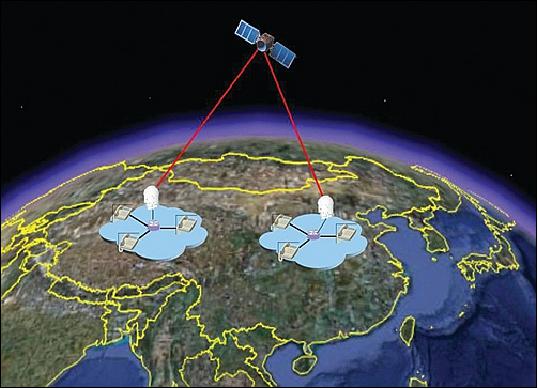
Using the “Micius” satellite, researchers achieved entanglement-based quantum key distribution (QKD) between two ground observatories in Delingha and Nanshan (China), separated by 1,120 kilometres. The QUESS satellite (Quantum Experiments at Space Scale, nicknamed Micius after the ancient Chinese scientist) is the world’s first quantum communication satellite.
Just months into its mission, the world’s first quantum-communications satellite has achieved one of its most ambitious goals.
Researchers report in Science1 that, by beaming photons between the satellite and two distant ground stations, they have shown that particles can remain in a linked quantum state at a record-breaking distance of more than 1,200 kilometres. That phenomenon, known as quantum entanglement, could be used as the basis of a future secure quantum-communications network.
The feat is the first result reported from China’s Quantum Experiments at Space Scale (QUESS) mission, also known as Micius after an ancient Chinese philosopher. Launched last August, the craft is designed to demonstrate principles underlying quantum communication. The team is likely to launch more quantum-enabled satellites to start building a network.
Quantum communication is secure because any interference is detectable. Two parties can exchange secret messages by sharing an encryption key encoded in the properties of entangled particles; any eavesdropper would affect the entanglement and so be detected.
QUESS (Quantum Experiments at Space Scale) or Micius
The Micius team has already done experiments exploring whether it is possible to create such encryption keys using entangled photons, and even 'teleport' information securely between Earth and space, says Pan Jian-Wei, a physicist at the University of Science and Technology of China in Hefei and the main architect of the probe. But he says that his team is not yet ready to announce the results.
Bell test
In theory, entangled particles should remain linked at any separation. That can be checked using a classic experiment called a Bell test.
Central to QUESS's experiments is a laser beam mounted on the satellite. For the Bell test, the beam was split to generate pairs of photons that share a common quantum state, in this case related to polarization. The entangled photons were funnelled into two onboard telescopes that fired them at separate stations on the ground: one in Delingha, on the northern Tibetan Plateau, and the other 1,203 kilometres south, at Gaomeigu Observatory in Lijiang. Once the particles arrived, the team used the Bell test to confirm that they were still entangled.
The researchers had a window of less than 5 minutes each night when the satellite, which orbits at an altitude of about 500 kilometres, was in view of both observatories. Within weeks of launch, they were able to transmit a pair of entangled photons per second — a rate ten times faster than they had hoped. The crucial experiment was completed before the end of the year, says Pan: “We are very happy that the whole system worked properly.” The previous record for such an experiment was 144 kilometres2.
“This proves that one can perform quantum communications at continental distances,” says Frédéric Grosshans, a quantum-communications physicist at the University of Paris South in Orsay. Entangled particles are the “workhorse” of quantum communications, he adds.
Next-generation satellite
“I am really impressed by the result of the Chinese group,” says Wolfgang Tittel, a physicist at the University of Calgary in Canada. “To me, it was not clear after the satellite launch if they would succeed,” he says, or whether they would use it to learn for the next improved mission.
Pan says that in addition to the quantum-key and teleportation experiments, the team also plans to use Micius to test how gravity affects the quantum state of photons. And they want to launch a second, improved, quantum satellite in two years. A major challenge, he says, will be to upgrade the technology so that it can send and receive signals during the day, when there are many more photons around and it is harder to pick out the ones coming from the satellite.
QUESS (Quantum Experiments at Space Scale) satellite
For now, Pan feels vindicated about the first spacecraft’s design. Colleagues thought that it was too ambitious, he says, because it produced the entangled photons in space and required two photon-firing systems.
Similar missions in the planning stages — such as Canada’s Quantum Encryption and Science Satellite (QEYSSat) — use a simpler approach, creating the entangled photons on Earth and beaming them to a satellite. In a study3 published last week, the QEYSSat team reported a successful test of its technology, transmitting photons from the ground to an aircraft as much as 10 kilometres in the air.
Thomas Jennewein, who is at the University of Waterloo in Canada and part of the Canadian mission, says that his group and others around the world are now racing to catch up with the Chinese effort. “They are now clearly the world leader in quantum satellites,” he says.
References:
Yin, J. et al. Science 356, 1140–1144 (2017).
Schmitt-Manderbach, T. et al. Phys. Rev. Lett. 98, 010504 (2007).
Article: http://dx.doi.org/10.1103/PhysRevLett.98.010504
Pugh, C. J. et al. Quantum Sci. Technol. 2, 024009 (2017).
Article: http://dx.doi.org/10.1088/2058-9565/aa701f
Related link:
QUESS satellite (Quantum Experiments at Space Scale: https://en.wikipedia.org/wiki/Quantum_Experiments_at_Space_Scale
Image, Text, Credits: Research: Entanglement-based secure quantum cryptography over 1,120 kilometresJuan Yin, Yu-Huai Li, Sheng-Kai Liao, Meng Yang, Yuan Cao, Liang Zhang, Ji-Gang Ren, Wen-Qi Cai, Wei-Yue Liu, Shuang-Lin Li, Rong Shu, Yong-Mei Huang, Lei Deng, Li Li, Qiang Zhang, Nai-Le Liu, Yu-Ao Chen, Chao-Yang Lu, Xiang-Bin Wang, Feihu Xu, Jian-Yu Wang, Cheng-Zhi Peng, Artur K. Ekert & Jian-Wei Pan, Nature (2020), DOI: 10.1038/s41586-020-2401-y
Video footage: China Central Television (CCTV)/SciNews.
Greetings, Orbiter.ch
Future Space Travelers May Follow Cosmic Lighthouses
ISS - NICER / SEXTANT Mission patch.
June 16, 2020
For centuries, lighthouses helped sailors navigate safely into harbor. Their lights swept across the water, cutting through fog and darkness, guiding mariners around dangerous obstacles and keeping them on the right path. In the future, space explorers may receive similar guidance from the steady signals created by pulsars.
Scientists and engineers are using the International Space Station to develop pulsar-based navigation using these cosmic lighthouses to assist with wayfinding on trips to the Moon under NASA’s Artemis program and on future human missions to Mars.
Image above: An image of NICER on the exterior of the space station with one of the station’s solar panels in the background. Image Credit: NASA.
Pulsars, or rapidly spinning neutron stars, are the extremely dense remains of stars that exploded as supernovas. They emit X-ray photons in bright, narrow beams that sweep the sky like a lighthouse as the stars spin. From a great distance they appear to pulse, hence the name pulsars.
An X-ray telescope on the exterior of the space station, the Neutron star Interior Composition Explorer or NICER, collects and timestamps the arrival of X-ray light from neutron stars across the sky. Software embedded in NICER, called the Station Explorer for X-ray Timing and Navigation Technology or SEXTANT, is using the beacons from pulsars to create a GPS-like system. This concept, often referred to as XNAV, could provide autonomous navigation throughout the solar system and beyond.
“GPS uses precisely synchronized signals. Pulsations from some neutron stars are very stable, some even as stable as terrestrial atomic clocks in the long term, which makes them potentially useful in a similar way,” says Luke Winternitz, a researcher at NASA’s Goddard Space Flight Center in Greenbelt, Maryland.
The stability of the pulses allows highly accurate predictions of their time of arrival to any reference point in the solar system. Scientists have developed detailed models that predict precisely when a pulse would arrive at, for example, the center of Earth. Timing the arrival of the pulse to a detector on a spacecraft, and comparing that to when it is predicted to arrive at a reference point, provides information for navigating far beyond our planet.
“Navigation information provided by pulsars does not degrade by moving away from Earth since pulsars are distributed throughout our Milky Way galaxy,” says SEXTANT team member Munther Hassouneh, navigation technologist.
“It effectively turns the ‘G’ in GPS from Global to Galactic,” adds team member Jason Mitchell, director of the Advanced Communications and Navigation Technology Division in NASA’s Space Communication and Navigation Program. “It could work anywhere in the solar system and even carry robotic or crewed systems beyond the solar system.”
Pulsars also can be observed in the radio band but, unlike radio waves, X-rays are not delayed by matter in space. Additionally, detectors for X-rays can be more compact and smaller than radio dishes.
Image above: Depiction of a pulsar or rapidly spinning neutron star. It emits X-ray photons or radiation particles in bright narrow beams that sweep the sky like a lighthouse as the star spins. Image Credits: Bill Saxton, NRAO/AUI/NSF.
But because X-ray pulses are very weak, a system must be robust enough to collect a signal sufficient for navigating. NICER’s large collection area makes it nearly ideal for XNAV research. A future XNAV system could be made smaller, trading size for longer collection time.
“NICER is roughly the size of a washing machine, but you could dramatically reduce its size and volume,” Mitchell says. “For example, it would be interesting to fit an XNAV telescope into a small satellite that could independently navigate the asteroid belt and characterize primitive solar system bodies.”
As published in a 2018 paper, SEXTANT already has successfully demonstrated real-time pulsar-based navigation aboard the space station. It also studied the use of pulsars for time-keeping and clock synchronization and is helping expand the catalog of pulsars to use as reference points for XNAV.
The SEXTANT team also includes Samuel Price, Sean Semper and Wayne Yu at Goddard; Naval Research Lab partners Paul Ray and Kent Wood; and NICER principal investigator Keith Gendreau and science lead Zaven Arzoumanian.
The team now is studying XNAV autonomous navigation on NASA’s Gateway platform as a technique to support crewed missions to Mars. Astronauts also could potentially use it to supplement onboard navigation capabilities should they need to make it back to Earth on their own.
SEXTANT: Navigating by Cosmic Beacon
Video above: Imagine a technology that would allow space travelers to transmit gigabytes of data per second over interplanetary distances or to navigate to Mars and beyond using powerful beams of light emanating from rotating neutron stars. The concept isn't farfetched. In fact, Goddard astrophysicists Keith Gendreau and Zaven Arzoumanian plan to fly a multi-purpose instrument on the International Space Station to demonstrate the viability of two groundbreaking navigation and communication technologies and, from the same platform, gather scientific data revealing the physics of dense matter in neutron stars. Video Credits: NASA's Goddard Space Flight Center/Rich Melnick.
“Gateway’s orbit around the Moon of approximately six-and-a-half days would let us stare at pulsars for much longer times,” Mitchell says. “That’s where the trade comes in; the instrument is like a bucket and you’re filling that bucket with enough X-ray photons to generate a measurement of when that pulse arrived. You could have a detector a fraction the size of NICER.”
These kinds of experiments could bring cosmic lighthouses to guide spacecraft to their destinations another step closer to reality.
Related links:
Artemis: https://www.nasa.gov/artemisprogram
NICER: https://www.nasa.gov/mission_pages/station/research/experiments/explorer/Investigation.html?#id=1705
SEXTANT: https://gameon.nasa.gov/projects/deep-space-x-ray-navigation-and-communication/
XNAV autonomous navigation: https://ntrs.nasa.gov/archive/nasa/casi.ntrs.nasa.gov/20190001154.pdf
Gateway: https://www.nasa.gov/topics/moon-to-mars/lunar-gateway
Space Tech: https://www.nasa.gov/topics/technology/index.html
Space Station Research and Technology: https://www.nasa.gov/mission_pages/station/research/overview.html
International Space Station (ISS): https://www.nasa.gov/mission_pages/station/main/index.html
Images (mentioned), Video (mentioned), Text, Credits: NASA/Michael Johnson/JSC/International Space Station Program Research Office/Melissa Gaskill.
Best regards, Orbiter.ch
NASA’s OSIRIS-REx Produces Nightingale Mosaic
NASA - OSIRIS-REx Mission logo.
June 16, 2020
Image Credits: NASA/Goddard/University of Arizona
This view of sample site Nightingale on asteroid Bennu is a mosaic of images collected by NASA’s OSIRIS-REx spacecraft on March 3. A total of 345 PolyCam images were stitched together to produce the mosaic, which shows the site at 0.2 inches (4 mm) per pixel at full size. These images were captured when the spacecraft performed an 820-foot (250-meter) reconnaissance pass over site Nightingale, which at the time was the closest the site had been imaged. The low-altitude pass provided high-resolution imagery for the OSIRIS-REx team to identify the best location within the site to target for sample collection.
Sample site Nightingale is located in the relatively clear patch just above the crater’s center – visible in the center of the image. The large, dark boulder located at the top right measures 43 feet (13 meters) on its longest axis. The mosaic is rotated so that Bennu’s east is at the top of the image.
OSIRIS-REx collecting sample on Bennu
Nightingale is the primary sample collection site for the OSIRIS-REx mission. OSIRIS-REx is scheduled to make its first sample collection attempt at site Nightingale on Oct. 20.
OSIRIS-REx (Origins Spectral Interpretation Resource Identification Security Regolith Explorer): http://www.nasa.gov/mission_pages/osiris-rex/index.html
Images (mentioned), Animation, Text, Credits: NASA/ Karl Hille/Written by: Erin Morton, University of Arizona.
Greetings, Orbiter.ch
Hubble Makes a Bright Find
NASA - Hubble Space Telescope patch.
June 16, 2020
Seen here in incredible detail, thanks to the NASA/ESA Hubble Space Telescope, is the starburst galaxy formally known as PLCK G045.1+61.1. The galaxy, which appears as multiple reddish dots near the center of the image, is being gravitationally lensed by a cluster of closer galaxies, also seen in the image.
Gravitational lensing occurs when a large distribution of matter, such as a galaxy cluster, sits between Earth and a distant light source. As space is warped by massive objects, the light from the distant object bends as it travels to us, creating stretched, magnified and sometimes multiple images of the lensed object. This effect was first predicted by Einstein’s general theory of relativity.
From 2009 to 2013, the European Space Agency’s Planck space observatory captured multiple all-sky surveys. In the course of these surveys, with complementary observations by the Herschel Space Observatory, Planck discovered some of the brightest gravitationally lensed, high-redshift galaxies in the night sky.
Hubble Space Telescope (HST)
It was during the study of these Planck-Herschel selected sources using Hubble that the optical starlight emitted from this ultra-bright galaxy was found.
For more information about Hubble, visit:
http://hubblesite.org/
http://www.nasa.gov/hubble
http://www.spacetelescope.org/
Text Credits: ESA (European Space Agency)/NASA/Rob Garner/Image, Animation Credits: ESA/Hubble & NASA, B. Frye.
Greetings, Orbiter.ch
Inscription à :
Articles (Atom)