jeudi 13 août 2020

Hubble Helps Uncover the Mystery of the Dimming of Betelgeuse


ESA - Hubble Space Telescope logo.

13 August 2020

Betelgeuse’s Dust Cloud (Artist’s Impression)

New observations by the NASA/ESA Hubble Space Telescope suggest that the unexpected dimming of the supergiant star Betelgeuse was most likely caused by an immense amount of hot material ejected into space, forming a dust cloud that blocked starlight coming from Betelgeuse’s surface.

Betelgeuse is an aging, red supergiant star that has swelled in size as a result of complex, evolving changes in the nuclear fusion processes in its core. The star is so large that if it replaced the Sun at the centre of our Solar System, its outer surface would extend past the orbit of Jupiter. The unprecedented phenomenon of Betelgeuse’s great dimming, eventually noticeable to even the naked eye, began in October 2019. By mid-February 2020, the brightness of this monster star had dropped by more than a factor of three.

The Atmosphere of Betelgeuse

This sudden dimming has mystified astronomers, who sought to develop theories to account for the abrupt change. Thanks to new Hubble observations [1], a team of researchers now suggest that a dust cloud formed when superhot plasma was unleashed from an upwelling of a large convection cell on the star’s surface and passed through the hot atmosphere to the colder outer layers, where it cooled and formed dust. The resulting cloud blocked light from about a quarter of the star’s surface, beginning in late 2019. By April 2020, the star had returned to its normal brightness.

Several months of Hubble’s ultraviolet-light spectroscopic observations of Betelgeuse, beginning in January 2019, produced an insightful timeline leading up to the star’s dimming. These observations provided important new clues to the mechanism behind the dimming. Hubble saw dense, heated material moving through the star’s atmosphere in September, October, and November 2019. Then, in December, several ground-based telescopes observed the star decreasing in brightness in its southern hemisphere.

Wide-field view of Betelgeuse (ground-based image)

“With Hubble, we see the material as it left the star’s visible surface and moved out through the atmosphere, before the dust formed that caused the star appear to dim,” said lead researcher Andrea Dupree, associate director of The Center for Astrophysics | Harvard & Smithsonian. “We could see the effect of a dense, hot region in the southeast part of the star moving outward.”

“This material was two to four times more luminous than the star’s normal brightness,” she continued. “And then, about a month later, the southern hemisphere of Betelgeuse dimmed conspicuously as the star grew fainter. We think it is possible that a dark cloud resulted from the outflow that Hubble detected. Only Hubble gives us this evidence of what led up to the dimming.”

The team began using Hubble early last year to analyse the massive star. Their observations are part of a three-year Hubble study to monitor variations in the star’s outer atmosphere. The telescope’s sensitivity to ultraviolet light  allowed researchers to probe the layers above the star’s surface, which are so hot that they emit mostly in the ultraviolet region of the spectrum and are not seen in visible light. These layers are heated partly by the star’s turbulent convection cells bubbling up to the surface.

Hubble Space Telescope (HST)

“Spatially resolving a stellar surface is only possible in favourable cases and only with the best available equipment,” said Klaus Strassmeier of the Leibniz Institute for Astrophysics Potsdam (AIP) in Germany. “In that respect, Betelgeuse and Hubble are made for each other.”

Hubble spectra, taken in early and late 2019 and in 2020, probed the star’s outer atmosphere by measuring spectral lines of ionised magnesium. From September to November 2019, the researchers measured material passing from the star’s surface into its outer atmosphere. This hot, dense material continued to travel beyond Betelgeuse’s visible surface, reaching millions of kilometres from the star. At that distance, the material cooled down enough to form dust, the researchers said.

This interpretation is consistent with Hubble ultraviolet-light observations in February 2020, which showed that the behaviour of the star’s outer atmosphere returned to normal, even though in visible light it was still dimming.

Although Dupree does not know the cause of the outburst, she thinks it was aided by the star’s pulsation cycle, which continued normally though the event, as recorded by visible-light observations. Strassmeier used an automated telescope of the Leibniz Institute for Astrophysics called STELLar Activity (STELLA)  to measure changes in the velocity of the gas on the star’s surface as it rose and fell during the pulsation cycle. The star was expanding in its cycle at the same time as the  convective cell was upwelling. The pulsation rippling outward from Betelgeuse may have helped propel the outflowing plasma through the atmosphere.

The red supergiant is destined to end its life in a supernova blast and some astronomers think the sudden dimming may be a pre-supernova event. The star is relatively nearby, about 725 light-years away, so the dimming event would have happened around the year 1300, as its light is just reaching Earth now.

Dupree and her collaborators will get another chance to observe the star with Hubble in late August or early September. Right now, Betelgeuse is in the daytime sky, too close to the Sun for Hubble observations.

Notes:

[1] The team’s paper will appear in the The Astrophysical Journal.

More information:

The Hubble Space Telescope is a project of international cooperation between ESA and NASA.

The international team of astronomers in this study consists of A. Dupree, K. Strassmeier, L. Matthews, H. Uitenbroek, T. Calderwood, T. Granzer, E. Guinan, R. Leike, M. Montargès, A. Richards, R. Wasatonic and M. Weber.

Links:

ESA Hubblesite: http://www.spacetelescope.org/

Images of Hubble: http://www.spacetelescope.org/images/archive/category/spacecraft/

HubbleSite release: https://hubblesite.org/contents/news-releases/2020/news-2020-44

Leibniz Institute for Astrophysics Potsdam (AIP) release: https://www.aip.de/en/news/science/mysterious-dimming-of-betelgeuse

Center for Astrophysics | Harvard & Smithsonian release: http://www.cfa.harvard.edu/news/2020-17

Science paper: https://arxiv.org/pdf/2008.04945.pdf

Space Scoop article: http://www.spacescoop.org/en/scoops/2032/the-curious-case-of-betelgeuse/

Images, Animation, Text,  Credits: ESO, ESA/Hubble, M. Kornmesser/Andrea Dupree (Harvard-Smithsonian CfA), Ronald Gilliland (STScI), NASA and ESA/ESO/Digitized Sky Survey 2/Acknowledgment: Davide De Martin.

Best regards, Orbiter.ch

mercredi 12 août 2020

Crew Packs Japanese Ship, Studies Space Physics and Earth


ISS - Expedition 63 Mission patch.

August 12, 2020

The Expedition 63 crew members are getting a Japanese spaceship ready for departure next week. In the meantime, the International Space Station trio was busy today with science, video communications and orbital plumbing.

Commander Chris Cassidy and Flight Engineer Anatoly Ivanishin partnered up today loading Japan’s resupply ship with trash and old station gear. Cassidy will command the Canadarm2 robotic arm on Aug. 18 to release the H-II Transfer Vehicle-9 (HTV-9) into Earth orbit for a fiery, but safe reentry into the atmosphere above the South Pacific. The HTV-9 arrived at the orbiting lab on May 25 delivering four tons of new science experiments, station hardware, crew supplies and fuel.


Image above: Flying over southern Argentina, this photograph from the space station looks northward with the Sun’s glint beaming on the Atlantic Ocean. Image Credit: NASA.

Cassidy started the morning setting up the Space Frontier Studio that live-streams science activities from inside Japan’s Kibo laboratory module to audiences on the ground. The station commander from NASA then spent the afternoon installing new science hardware that will study gas-liquid flows in porous media in the Microgravity Science Glovebox. Results from the Packed Bed Reactor Experiment could benefit life support systems on the space station and future missions to the Moon and Mars.

Earth observations have been ongoing this week in the Russian segment of the space station. One long-running study has been monitoring natural and man-made conditions around the globe to forecast potential catastrophes. Ivanishin of Roscosmos was servicing photo equipment this morning for that experiment which measures radiation reflected from the Earth in a variety of wavelengths.

International Space Station (ISS). Animation Credit: NASA

Cosmonaut Ivan Vagner worked during the morning servicing Russian plumbing hardware. The first-time space flyer then spent the rest of the day inventorying common office supplies such as printer cartridges, pens and tape.

Related links:

Expedition 63: https://www.nasa.gov/mission_pages/station/expeditions/expedition63/index.html

Canadarm2 robotic arm: https://www.nasa.gov/mission_pages/station/structure/elements/mobile-servicing-system.html

H-II Transfer Vehicle-9 (HTV-9): https://www.nasa.gov/feature/kounotori-htv-launches-arrivals-and-departures

Space Frontier Studio: https://www.nasa.gov/mission_pages/station/research/experiments/explorer/Investigation.html?#id=8233

Kibo laboratory module: https://www.nasa.gov/mission_pages/station/structure/elements/japan-kibo-laboratory

Microgravity Science Glovebox: https://www.nasa.gov/mission_pages/station/research/experiments/explorer/Facility.html?#id=341

Packed Bed Reactor Experiment: https://www.nasa.gov/mission_pages/station/research/experiments/explorer/Investigation.html?#id=1037

Natural and man-made conditions: https://www.energia.ru/en/iss/researches/study/09.html

Space Station Research and Technology: https://www.nasa.gov/mission_pages/station/research/overview.html

International Space Station (ISS): https://www.nasa.gov/mission_pages/station/main/index.html

Image (mentioned), Animation (mentioned), Text, Credits: NASA/Mark Garcia.

Best regards, Orbiter.ch

A Successful Second Rehearsal Puts NASA’s OSIRIS-REx on a Path to Sample Collection


NASA - OSIRIS-REx Mission patch.

Aug. 12, 2020

Yesterday, the OSIRIS-REx spacecraft performed its final practice run of the sampling sequence, reaching an approximate altitude of 131 feet (40 meters) over sample site Nightingale before executing a back-away burn. Nightingale, OSIRIS-REx’s primary sample collection site, is located within a crater in Bennu’s northern hemisphere.


Animation above: OSIRIS-REx Cruises Over Site Nightingale During Final Dress Rehearsal. Animation Credits: NASA/Goddard/University of Arizona.

The approximately four-hour “Matchpoint” rehearsal took the spacecraft through the first three of the sampling sequence’s four maneuvers: the orbit departure burn, the “Checkpoint” burn and the Matchpoint burn. Checkpoint is the point where the spacecraft autonomously checks its position and velocity before adjusting its trajectory down toward the event’s third maneuver. Matchpoint is the moment when the spacecraft matches Bennu’s rotation in order to fly in tandem with the asteroid surface, directly above the sample site, before touching down on the targeted spot.

Four hours after departing its 0.6-mile (1-km) safe-home orbit, OSIRIS-REx performed the Checkpoint maneuver at an approximate altitude of 410 feet (125 meters) above Bennu’s surface. From there, the spacecraft continued to descend for another eight minutes to perform the Matchpoint burn. After descending on this new trajectory for another three minutes, the spacecraft reached an altitude of approximately 131 ft (40 m) – the closest the spacecraft has ever been to Bennu – and then performed a back-away burn to complete the rehearsal.

OSIRIS-REx Cruises Over Site Nightingale During Final Dress Rehearsal

Video above: These images were captured over a 13.5-minute period. The imaging sequence begins at approximately 420 feet (128 meters) above the surface – before the spacecraft executes the “Checkpoint” maneuver – and runs through to the “Matchpoint” maneuver, with the last image taken approximately 144 feet (44 meters) above the surface of Bennu. The spacecraft’s sampling arm – called the Touch-And-Go Sample Acquisition Mechanism (TAGSAM) – is visible in the lower part of the frame. Video Credits: NASA/Goddard/University of Arizona.

During the rehearsal, the spacecraft successfully deployed its sampling arm, the Touch-And-Go Sample Acquisition Mechanism (TAGSAM), from its folded, parked position out to the sample collection configuration. Additionally, some of the spacecraft’s instruments collected science and navigation images and made spectrometry observations of the sample site, as will occur during the sample collection event. These images and science data were downlinked to Earth after the event’s conclusion.

Because the spacecraft and Bennu are currently about 179 million miles (288 million km) from Earth, it takes approximately 16 minutes for the spacecraft to receive the radio signals used to command it. This time lag prevented live commanding of flight activities from the ground during the rehearsal. As a result, the spacecraft performed the entire rehearsal sequence autonomously. Prior to the rehearsal's start, the OSIRIS-REx team uplinked all of the event's commands to the spacecraft and then provided the “Go” command to begin the event. The actual sample collection event in October will be conducted the same way.

This second rehearsal provided the mission team with practice navigating the spacecraft through the first three maneuvers of the sampling event and with an opportunity to verify that the spacecraft’s imaging, navigation and ranging systems operated as expected during the first part of the descent sequence.


Image above: This artist's rendering shows OSIRIS-REx spacecraft descending towards asteroid Bennu to collect a sample of the asteroid’s surface. Image Credits: NASA/Goddard/University of Arizona.

Matchpoint rehearsal also confirmed that OSIRIS-REx’s Natural Feature Tracking (NFT) guidance system accurately estimated the spacecraft’s trajectory after the Matchpoint burn, which is the final maneuver before the sample collection head contacts Bennu’s surface. This rehearsal was also the first time that the spacecraft’s on-board hazard map was employed. The hazard map delineates areas that could potentially harm the spacecraft. If the spacecraft detects that it is on course to touch a hazardous area, it will autonomously back-away once it reaches an altitude of 16 ft (5 m). While OSIRIS-REx did not fly that low during the rehearsal, it did employ the hazard map to assess whether its predicted touchdown trajectory would have avoided surface hazards, and found that the spacecraft’s path during the rehearsal would have allowed for a safe touchdown on sample site Nightingale.

During the last minutes of the spacecraft’s descent, OSIRIS-REx also collected new, high-resolution navigation images for the NFT guidance system. These detailed images of Bennu’s landmarks will be used for the sampling event, and will allow the spacecraft to accurately target a very small area.

 “Many important systems were exercised during this rehearsal – from communications, spacecraft thrusters, and most importantly, the onboard Natural Feature Tracking guidance system and hazard map,” said OSIRIS-REx principal investigator Dante Lauretta of the University of Arizona, Tucson. “Now that we’ve completed this milestone, we are confident in finalizing the procedures for the TAG event. This rehearsal confirmed that the team and all of the spacecraft’s systems are ready to collect a sample in October.”

The mission team has spent the last several months preparing for Matchpoint rehearsal while maximizing remote work as part of the COVID-19 response. On the day of rehearsal, a limited number of personnel monitored the spacecraft’s telemetry from Lockheed Martin Space’s facility, NASA’s Goddard Space Flight Center and the University of Arizona, taking appropriate safety precautions, while the rest of the team performed their roles remotely.

The spacecraft will travel all the way to the asteroid’s surface during its first sample collection attempt, scheduled for Oct. 20. During this event, OSIRIS-REx’s sampling mechanism will touch Bennu’s surface for several seconds, fire a charge of pressurized nitrogen to disturb the surface and collect a sample before the spacecraft backs away. The spacecraft is scheduled to return the sample to Earth on Sept. 24, 2023.

NASA’s Goddard Space Flight Center in Greenbelt, Maryland, provides overall mission management, systems engineering, and the safety and mission assurance for OSIRIS-REx. Dante Lauretta of the University of Arizona, Tucson, is the principal investigator, and the University of Arizona also leads the science team and the mission’s science observation planning and data processing. Lockheed Martin Space in Denver built the spacecraft and provides flight operations. Goddard and KinetX Aerospace are responsible for navigating the OSIRIS-REx spacecraft. OSIRIS-REx is the third mission in NASA’s New Frontiers Program, which is managed by NASA’s Marshall Space Flight Center in Huntsville, Alabama, for the agency’s Science Mission Directorate in Washington.

Related article:

NASA’s OSIRIS-REx is One Rehearsal Away from Touching Asteroid Bennu
https://orbiterchspacenews.blogspot.com/2020/08/nasas-osiris-rex-is-one-rehearsal-away.html

For more information on NASA’s OSIRIS-Rex, visit:

https://www.nasa.gov/osiris-rex and https://www.asteroidmission.org

Video (mentioned), Image (mentioned), Text, Credits: NASA/Karl Hille/University of Arizona/Brittany Enos.

Greetings, Orbiter.ch

Celebrate Mars Reconnaissance Orbiter's Views From Above


NASA - Mars Reconnaissance Orbiter (MRO) patch.

Aug. 12, 2020

Marking its 15th anniversary since launch, one of the oldest spacecraft at the Red Planet has provided glimpses of dust devils, avalanches, and more.


Image above: Five images taken by the HiRISE camera aboard NASA's Mars Reconnaissance Orbiter, which launched 15 years ago, on Aug. 12, 2005. Along with being a rich source of images for research, MRO studies atmospheric temperatures, peers underground with radar, and detects minerals on the planet's surface. Image Credits: NASA/JPL-Caltech/University of Arizona.

Since leaving Earth 15 years ago, NASA's Mars Reconnaissance Orbiter has reshaped our understanding of the Red Planet. The veteran spacecraft studies temperatures in Mars' thin atmosphere, peers underground with radar, and detects minerals on the planet's surface. But perhaps what it's become best known for are stunning images.

Among its instruments, MRO carries three cameras: The Mars Color Imager (MARCI) has a fisheye lens that produces a daily global view. The Context Camera (CTX) provides 19-mile-wide (30-kilometer-wide) black-and-white terrain shots. Those images, in turn, offer context for the tightly focused images provided by MRO's third camera, the High-Resolution Imaging Science Experiment (HiRISE), which produces the most striking views.

Mars Reconnaissance Orbiter (MRO). Image Credits: NASA/JPL-Caltech

Able to zoom in on surface features at the highest resolution, the detailed, color images from HiRISE have captured dramatic scenes of nature: tumbling avalanches, skyscraping dust devils, and other features of a changing landscape. The camera has also provided images of other NASA spacecraft at Mars, like the Curiosity and Opportunity rovers. MRO has even flipped itself around to point HiRISE out at Earth and Phobos, one of Mars' two moons.

As of early August, HiRISE alone had taken 6,882,204 images, generating 194 terabytes of data sent from Mars since 2006. The following images are just a glimpse of the amazing work performed by all three cameras aboard MRO, which is managed by NASA's Jet Propulsion Laboratory in Southern California.

Welcome to Mars

Image Credits: NASA/JPL-Caltech/MSSS

Dust storms are routine on Mars. Most are limited to small regions and are not as dramatic as what's portrayed in movies. But once or twice a decade, a series of regional storms will create a domino effect, lifting enough dust for winds to cover the surface in what's called a "planet-encircling dust event." This one, captured by MARCI in the summer of 2018, darkened the region above the Opportunity rover, depriving its solar panels of sunlight and ultimately leading to the end of the mission.

A Martian Sky Scraper 

Image Credits: NASA/JPL-Caltech/Univ. of Arizona

As HiRISE pans over large swaths of Mars' surface, it occasionally discovers surprises like this towering dust devil, which was captured from 185 miles (297 kilometers) above the ground. The length of this whirlwind's shadow indicates that it was more than half a mile (800 meters) high – about the size of the United Arab Emirate's Burj Khalifa, the tallest building on Earth.

Avalanche Alert

Image Credits: NASA/JPL-Caltech/University of Arizona

HiRISE has captured avalanches in action. As seasonal ice vaporized in the spring, these 1,640-foot-tall (500-meter-tall) cliffs at Mars' north pole began to crumble. Such cliffs reveal the deep time scales on the planet, exposing the many layers of ice and dust that have settled during different eras. Like the rings of a tree, each layer has a story to tell scientists about how the environment was changing.

That's Going to Leave a Dent

Image Credits: NASA/JPL-Caltech/Univ. of Arizona

Mars has a thin atmosphere – just 1% as dense as Earth's. As a result, there's less of a protective barrier to burn up space debris. That means larger meteors make it through the Red Planet's atmosphere than Earth's. CTX has detected over 800 new impact craters during MRO's mission. After CTX spotted this one, scientists took a more detailed image with HiRISE.

The crater spans approximately 100 feet (30 meters) in diameter and is surrounded by a large, rayed blast zone. In examining the distribution of ejecta – the debris tossed outward during the formation of a crater – scientists can learn more about the impact event. The explosion that created this crater threw ejecta as far as 9.3 miles (15 kilometers).

The Face of Time

 Image Credits: NASA/JPL-Caltech/University of Arizona

Land changes over time, so having a spacecraft at Mars for years offers a unique perspective. "The more we look, the more we discover," said Leslie Tamppari, MRO's deputy project scientist at JPL. "Before MRO, it wasn't clear what on Mars really changed, if anything. We thought the atmosphere was so thin that there was almost no sand motion and most dune movement happened in the ancient past."

We now know that's not the case. "False color" has been added to this image to accentuate certain details, like the tops of dunes and ripples. Many of these landforms are migrating, as they do on Earth: Sand grain by sand grain, they're carried by wind, crawling across the planet over millions of years.

Back Atcha, Earth

 Image Credits: NASA/JPL-Caltech/Univ. of Arizona

MRO hasn't only looked at Mars. This composite, made from four sets of HiRISE images of Earth and our Moon, was actually the second time that HiRISE had captured our home planet.

Fearsome Moon

 Image Credits: NASA/JPL-Caltech/University of Arizona

Named for the Greek god of fear, Phobos is one of Mars' two moons (Deimos, named for the god of terror, is the other), and it's only about 13 miles (21 kilometers) across. Stickney Crater, the indentation on the moon's lower right, is about 5.6 miles (9 kilometers) wide in this HiRISE image. Despite its small size, Phobos is of great interest to scientists: Is it a captured asteroid, or a chunk of Mars that broke off after a massive impact? A Japanese mission is scheduled to launch to Phobos in the near future, and the moon has been proposed as a staging ground for astronauts before they go to Mars.

Mapmaker's Tool

 Image Credits: NASA/JPL-Caltech/MSSS

Based on an image from CTX, this map shows the complete traverse of the Opportunity rover after exploring the planet for more than 15 years. Both HiRISE and CTX are used by scientists to make maps of landing sites for future human and robotic missions as well as to chart the progress of rovers on the ground.

Making Treks

Animation Credits: NASA/JPL-Caltech/University of Arizona

HiRISE has frequently been used to snap images of NASA spacecraft on the Martian surface, capturing Spirit, Opportunity, and Curiosity as well as the stationary landers Phoenix and InSight. NASA's newest rover, Perseverance, is currently on its way to Jezero Crater. After it arrives on Feb. 18, 2021, you can bet there will be some images of it as well.

The Eyes Have It

Animation Credits: NASA/JPL-Caltech/Univ. of Arizona

It takes sharp eyes to find unique features on Mars, like recurring slope lineae. These dark streaks appear in the same places at around the same times of year. It was initially proposed they were caused by brine, since salt could allow water to remain liquid in the thin Martian atmosphere. The consensus now, however, is that they're actually caused by dark sand sliding down inclines.

The streaks were discovered by Lujendra Ojha, who was an undergraduate at the University of Arizona, which operates the HiRISE camera, and now is a professor at Rutgers University. "Sometimes you're just looking at the right place at the right time," Ojha said. "I was completely baffled when I first spotted this, because I was just a student at the time – I wasn't even in a planetary program." Undergraduates work alongside experienced scientists to spot unique features like these in HiRISE images.

Want to see more? Scientists and the public can request specific kinds of MRO images.

For more information about MRO:

https://mars.nasa.gov/mro/

https://www.nasa.gov/mission_pages/MRO/main/index.html

JPL, a division of Caltech in Pasadena, California, manages the MRO mission for NASA's Science Mission Directorate in Washington. The University of Arizona, in Tucson, operates HiRISE, which was built by Ball Aerospace & Technologies Corp., in Boulder, Colorado. MARCI and the Context Camera were both built and are operated by Malin Space Science Systems in San Diego.

Images (mentioned), Animations (mentioned), Text, Credits: NASA/Tony Greicius/Alana Johnson/Grey Hautaluoma/JPL/DC Agle.

Greetings, Orbiter.ch

Broken Cable Damages Arecibo Observatory


Arecibo Observatory logo.

August 12, 2020

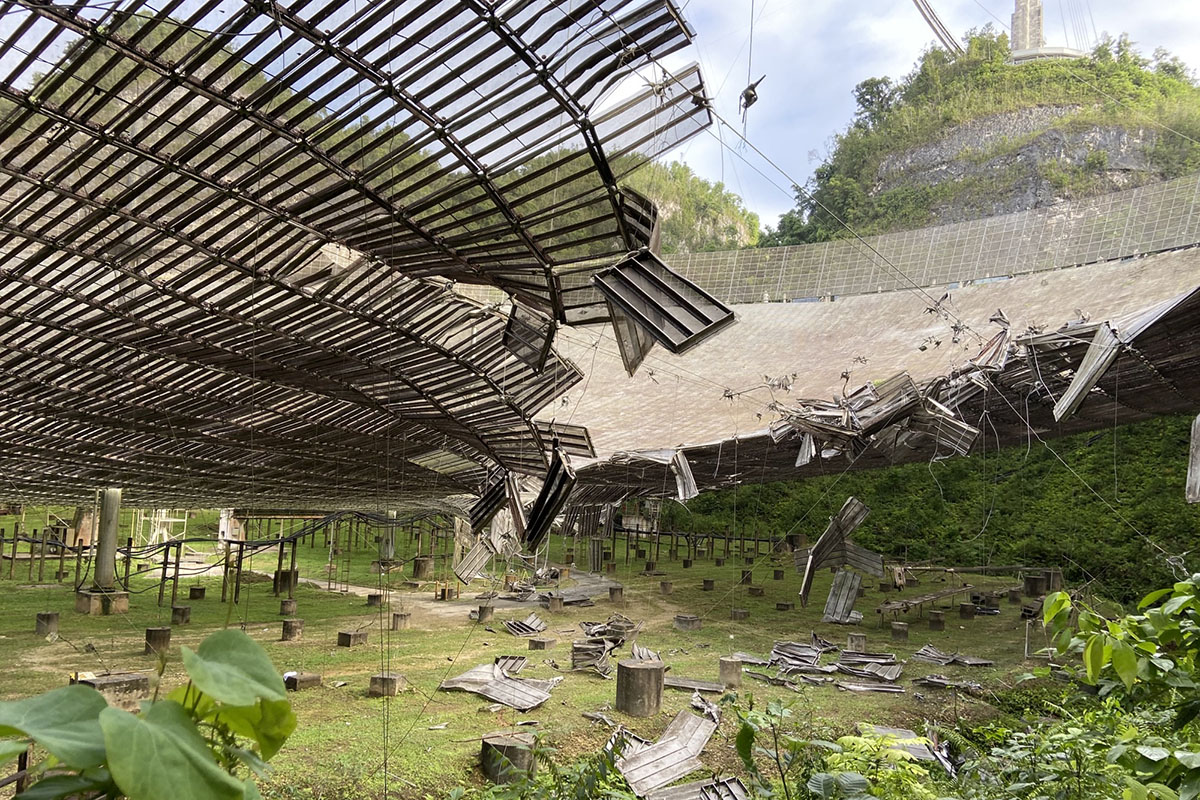
The National Science Foundation facility is closed while engineers review the damage and assess the extent of repairs that will be needed to bring the telescope back online.


Image above: The main collecting dish is among the world’s largest single-dish radio telescopes. The reflective dish is 1,000 feet in diameter, 167 feet deep, and covers an area of about 20 acres.

One of the auxiliary cables that helps support a metal platform in place above the Arecibo Observatory in Puerto Rico, broke on Monday (Aug. 10) causing a 100-foot-long gash on the telescope’s reflector dish. Operations at the UCF-managed observatory are stopped until repairs can be made.

The break occurred about 2:45 a.m. When the three-inch cable fell it also damaged about 6-8 panels in the Gregorian Dome and twisted the platform used to access the dome. It is not yet clear what caused the cable to break.

“We have a team of experts assessing the situation,” says Francisco Cordova, the director of the observatory. “Our focus is assuring the safety of our staff, protecting the facilities and equipment, and restoring the facility to full operations as soon as possible, so it can continue to assist scientists around the world.”

UCF manages the NSF-facility under a cooperative agreement with Universidad Ana G. Méndez and Yang Enterprises Inc. The facility, which is home to one of the most powerful telescopes on the planet, is used by scientists around the world to conduct research in the areas of atmospheric sciences, planetary sciences, radio astronomy and radar astronomy. Arecibo is also home to a team that runs the Planetary Radar Project supported by NASA’s Near-Earth Object Observations Program in NASA’s Planetary Defense Coordination Office through a grant awarded to UCF.

The facility has endured many hurricanes, tropical storms and earthquakes since it was built 50 years ago. Repairs from Hurricane Maria in 2017 are ongoing. Through it all, the facility has continued to contribute to significant breakthroughs in space research in the area of gravitational waves, asteroid characterization, planetary exploration and more.

Arecibo Observatory: http://www.naic.edu/

Image, Text, Credits: University of Central Florida (UCF)/Zenaida Gonzalez Kotala.

Greetings, Orbiter.ch

ALMA sees most distant Milky Way look-alike


ALMA - Atacama Large Millimeter/submillimeter Array logo.

12 August 2020

Galaxy is distorted, appearing as a ring of light in the sky

Lensed view of SPT0418-47

Astronomers using the Atacama Large Millimeter/submillimeter Array (ALMA), in which the European Southern Observatory (ESO) is a partner, have revealed an extremely distant and therefore very young galaxy that looks surprisingly like our Milky Way. The galaxy is so far away its light has taken more than 12 billion years to reach us: we see it as it was when the Universe was just 1.4 billion years old. It is also surprisingly unchaotic, contradicting theories that all galaxies in the early Universe were turbulent and unstable. This unexpected discovery challenges our understanding of how galaxies form, giving new insights into the past of our Universe.

“This result represents a breakthrough in the field of galaxy formation, showing that the structures that we observe in nearby spiral galaxies and in our Milky Way were already in place 12 billion years ago,” says Francesca Rizzo, PhD student from the Max Planck Institute for Astrophysics in Germany, who led the research published today in Nature. While the galaxy the astronomers studied, called SPT0418-47, doesn’t appear to have spiral arms, it has at least two features typical of our Milky Way: a rotating disc and a bulge, the large group of stars packed tightly around the galactic centre. This is the first time a bulge has been seen this early in the history of the Universe, making SPT0418-47 the most distant Milky Way look-alike.

Reconstructed view of SPT0418-47

“The big surprise was to find that this galaxy is actually quite similar to nearby galaxies, contrary to all expectations from the models and previous, less detailed, observations,” says co-author Filippo Fraternali, from the Kapteyn Astronomical Institute, University of Groningen in the Netherlands. In the early Universe, young galaxies were still in the process of forming, so researchers expected them to be chaotic and lacking the distinct structures typical of more mature galaxies like the Milky Way.

Studying distant galaxies like SPT0418-47 is fundamental to our understanding of how galaxies formed and evolved. This galaxy is so far away we see it when the Universe was just 10% of its current age because its light took 12 billion years to reach Earth. By studying it, we are going back to a time when these baby galaxies were just beginning to develop.

Motion of gas in SPT0418-47 

Because these galaxies are so far away, detailed observations with even the most powerful telescopes are almost impossible as the galaxies appear small and faint. The team overcame this obstacle by using a nearby galaxy as a powerful magnifying glass — an effect known as gravitational lensing — allowing ALMA to see into the distant past in unprecedented detail. In this effect, the gravitational pull from the nearby galaxy distorts and bends the light from the distant galaxy, causing it to appear misshapen and magnified. 

The gravitationally lensed, distant galaxy appears as a near-perfect ring of light around the nearby galaxy, thanks to their almost exact alignment. The research team reconstructed the distant galaxy’s true shape and the motion of its gas from the ALMA data using a new computer modelling technique. “When I first saw the reconstructed image of SPT0418-47 I could not believe it: a treasure chest was opening,” says Rizzo.

Gravitational lensing of the distant SPT0418-47 galaxy (schematic)

“What we found was quite puzzling; despite forming stars at a high rate, and therefore being the site of highly energetic processes, SPT0418-47 is the most well-ordered galaxy disc ever observed in the early Universe,” stated co-author Simona Vegetti, also from the Max Planck Institute for Astrophysics. “This result is quite unexpected and has important implications for how we think galaxies evolve." The astronomers note, however, that even though SPT0418-47 has a disc and other features similar to those of spiral galaxies we see today, they expect it to evolve into a galaxy very different from the Milky Way, and join the class of elliptical galaxies, another type of galaxies that, alongside the spirals, inhabit the Universe today.

This unexpected discovery suggests the early Universe may not be as chaotic as once believed and raises many questions on how a well-ordered galaxy could have formed so soon after the Big Bang. This ALMA finding follows the earlier discovery announced in May of a massive rotating disc seen at a similar distance. SPT0418-47 is seen in finer detail, thanks to the lensing effect, and has a bulge in addition to a disc, making it even more similar to our present-day Milky Way than the one studied previously.

SPT0418-47: lensed view to reconstructed view

Future studies, including with ESO’s Extremely Large Telescope, will seek to uncover how typical these ‘baby’ disc galaxies really are and whether they are commonly less chaotic than predicted, opening up new avenues for astronomers to discover how galaxies evolved.

More information:

This research was presented in the paper “A dynamically cold disk galaxy in the early Universe” to appear in Nature (doi: 10.1038/s41586-020-2572-6).

https://www.nature.com/articles/s41586-020-2572-6

The team is composed of F. Rizzo (Max Planck Institute for Astrophysics, Garching, Germany [MPA]), S. Vegetti (MPA), D. Powell (MPA), F. Fraternali (Kapteyn Astronomical Institute, University of Groningen, the Netherlands), J. P. McKean (Kapteyn Astronomical Institute and ASTRON, Netherlands Institute for Radio Astronomy), H. R. Stacey (MPA, Kapteyn Astronomical Institute and ASTRON, Netherlands Institute for Radio Astronomy) and S. D. M. White (MPA).

ESO is the foremost intergovernmental astronomy organisation in Europe and the world’s most productive ground-based astronomical observatory by far. It has 16 Member States: Austria, Belgium, the Czech Republic, Denmark, France, Finland, Germany, Ireland, Italy, the Netherlands, Poland, Portugal, Spain, Sweden, Switzerland and the United Kingdom, along with the host state of Chile and with Australia as a Strategic Partner. ESO carries out an ambitious programme focused on the design, construction and operation of powerful ground-based observing facilities enabling astronomers to make important scientific discoveries. ESO also plays a leading role in promoting and organising cooperation in astronomical research. ESO operates three unique world-class observing sites in Chile: La Silla, Paranal and Chajnantor. At Paranal, ESO operates the Very Large Telescope and its world-leading Very Large Telescope Interferometer as well as two survey telescopes, VISTA working in the infrared and the visible-light VLT Survey Telescope. Also at Paranal ESO will host and operate the Cherenkov Telescope Array South, the world’s largest and most sensitive gamma-ray observatory. ESO is also a major partner in two facilities on Chajnantor, APEX and ALMA, the largest astronomical project in existence. And on Cerro Armazones, close to Paranal, ESO is building the 39-metre Extremely Large Telescope, the ELT, which will become “the world’s biggest eye on the sky”.

Links:

Atacama Large Millimeter/submillimeter Array (ALMA): http://www.eso.org/public/teles-instr/alma/

ESOcast 228 Light: ALMA Sees Most Distant Milky Way Look-alike
https://www.eso.org/public/videos/eso2013a/

Research paper: https://www.eso.org/public/archives/releases/sciencepapers/eso2013/eso2013a.pdf

Photos of ALMA: https://www.eso.org/public/images/archive/category/alma/

For scientists: got a story? Pitch your research: http://eso.org/sci/publications/announcements/sciann17277.html

Images, Text, Credits: ESO/Bárbara Ferreira/Kapteyn Astronomical Institute, University of Groningen/Filippo Fraternali/Max Planck Institute for Astrophysics/Simona Vegetti/Francesca Rizzo/ALMA (ESO/NAOJ/NRAO), Rizzo et al./Videos: ALMA (NRAO/ESO/NAOJ)/Luis Calçada, Martin Kornmesser (ESO).

Best regards, Orbiter.ch

Perseid showers captured by ESA’s meteor camera


ESA - European Space Agency patch.

August 12, 2020

The LIC1 camera of the Canary Long-Baseline Observatory (CILBO) on Tenerife captured the peak of the 2020 Perseid meteor shower in mid-August, detecting dozens of meteors in a single night. One of the most spectacular annual meteor showers, the Perseids, made of debris from comet Swift-Tuttle, have been observed by sky-watchers for thousands of years.

Perseid showers captured by ESA’s meteor camera

The image-intensified (night vision) video camera, operated by ESA’s Meteor Research Group, provides a 22 x 28 degree field of view. On the night of 11 August, it captured an overall 61 meteors, 45 of which were classified as Perseids. On the night of 10 August, it detected 37 meteors in total, about half of which were Perseids.

Such recordings of meteors allow researchers to determine the precise trajectory of each meteor, identify their orbit around the Sun and ultimately the body from which they originated.

Meteoroids are pieces of rock shed by comets or asteroids. Upon entering Earth’s atmosphere, they create the visual display called a meteor. The typical altitude of meteors is around 80 to 120 km above Earth's surface.

Peak of Perseid showers captured by ESA’s meteor camera

The annual Perseid meteor shower occurs in the months of July and August and peaks around mid-August. The Perseids are among the brightest meteor showers and probably the most popular among amateur observers in the Northern Hemisphere since they can be easily observed thanks to usually favourable weather conditions. In fact, observations of Perseids go back to at least 69 BCE.

The Perseids are named after the constellation Perseus as they appear to be coming from the direction of this constellation.

While the most famous, Perseids are not the most interesting meteor shower for the scientists. For example the Leonids, which occur in mid-November, can cause every approximately 33 years  meteor storms with 1000 meteors crossing the atmosphere every hour.

Perseid meteor captured by ESA’s Canary Islands camera

The Meteor Research Group operates another camera setup on La Palma, monitoring the same volume in the atmosphere. The cameras use the meteor detection software MetRec to record the data.

Related links:

LIC1 camera: https://www.cosmos.esa.int/web/meteor/lic

ESA’s Meteor Research Group: https://www.cosmos.esa.int/web/meteor

Animations, Video, Text, Credits: ESA/Meteor Research Group/ CILBO.

Greetings, Orbiter.ch