lundi 7 décembre 2020

Ravn X: A 25-ton drone to launch satellites


Aevum logo.


Dec. 7, 2020

Ravn X

Drones can be extremely useful in many areas. The thing is no longer to demonstrate. However, can they also prove useful for space exploration?

Aevum unveils Ravn X, fully autonomous orbital rocket launching drone

This week, an Alabama-based company by the name of Aevum unveiled the Ravn X, a drone thought and designed to launch satellites into low orbit. The beast weighs around 25 tons when fully loaded, making it one of the heaviest unmanned craft in existence today. The aircraft is also 5.5 meters long, with a wingspan of over 18 meters. It looks like it came straight out of Macross Plus.

Aevum Ravn X, a massive drone for launching satellites into space


The promise of this drone is most interesting: the device should be able to put a satellite into low orbit in about three hours. This, according to Aevum, would allow to significantly shorten the delays in satellite launches, they would then be counted only in months. Apart from its exterior appearance and its impressive measurements, the Ravn X is not that different from any other aircraft. The craft needs about a mile of runway to take off, allowing it to do so from almost any commercial airport. And the drone uses traditional fuel.

Enough to further shorten the launch times

Once the Ravn X is at the correct altitude, the two-stage rocket it carries detaches and ignites its engines in half a second. Ultimately, according to Aevum, 95% of the launch vehicle will be reusable but initially, it will be necessary to be satisfied with 70%. When Ravn X has completed its delivery, it lands, like any airplane, and returns to the hangar to prepare for another launch.


Aevum says the Ravn X represents a new paradigm for rocket launching into space. And while the autonomous aspect of its approach is indeed different, other companies are working to launch rockets into space from aircraft. This is the case with Virgin Orbit, although it has yet to achieve a successful first test launch. The Ravn X's first mission will aim to bring a US Space Force ASLON-45 satellite into orbit somewhere in the course of next year.

Aevum: https://www.aevumspace.com/

Images, Video, Text, Credits: Aevum/Orbiter.ch Aerospace/Roland Berga.

Greetings, Orbiter.ch

dimanche 6 décembre 2020

Chang’e-5 orbiter-sample return vehicle separates from ascender


CLEP - China Lunar Exploration Program logo.


Dec. 6, 2020

The ascender separated from the orbiter-sample return vehicle

Having completed its mission, Chang’e-5’s ascender separated from the orbiter-sample return vehicle. According to Gao Lei(CNSA official), the orbiter-returner will orbit the Moon for about six to seven days, then enter the Earth-Moon transfer orbit, and experience another three to four days of flight before returning to Earth”.

Chang’e-5 orbiter-sample return vehicle separates from ascender

For the rendezvous and docking operations Chang’e-5 used a microwave radar. After docking, the lunar samples were transferred from the ascender to the sample return vehicle.

Chang’e-5 Mission diagram

According to Lin Yangting (professor, Institute of Geology and Geophysics, Chinese Academy of Sciences), a joint team will be formed with European researchers to study the samples, part of the cooperation with the European Space Agency.

Related articles:

Chang’e-5 ascender docks with the orbiter-sample return vehicle
https://orbiterchspacenews.blogspot.com/2020/12/change-5-ascender-docks-with-orbiter.html

Chang’e-5 - Rendezvous and docking explained
https://orbiterchspacenews.blogspot.com/2020/12/change-5-rendezvous-and-docking.html

Chang’e-5 ascends to lunar orbit
https://orbiterchspacenews.blogspot.com/2020/12/change-5-ascends-to-lunar-orbit.html

Chang’e-5 collecting lunar samples
https://orbiterchspacenews.blogspot.com/2020/12/change-5-collecting-lunar-samples.html

Chang’e-5 lands on the Moon
https://orbiterchspacenews.blogspot.com/2020/12/change-5-lands-on-moon.html

Chang’e-5 ready for Moon landing
https://orbiterchspacenews.blogspot.com/2020/11/change-5-ready-for-moon-landing.html

Chang’e-5 enters lunar orbit
https://orbiterchspacenews.blogspot.com/2020/11/change-5-enters-lunar-orbit.html

Chang’e-5 completes first orbital correction
https://orbiterchspacenews.blogspot.com/2020/11/change-5-completes-first-orbital.html

CASC - Long March-5 Y5 launches Chang’e-5 lunar mission
https://orbiterchspacenews.blogspot.com/2020/11/casc-long-march-5-y5-launches-change-5.html

ESA tracks Chang'e-5 Moon mission
https://orbiterchspacenews.blogspot.com/2020/11/esa-tracks-change-5-moon-mission.html

For more information about China Aerospace Science and Technology Corporation (CASC), visit: http://english.spacechina.com/n16421/index.html

For more information about China National Space Administration (CNSA), visit: http://www.cnsa.gov.cn/

Image, Video, Text, Credits: China Central Television (CCTV)/China National Space Administration (CNSA)/SciNews/Orbiter.ch Aerospace/Roland Berga.

Greetings, Orbiter.ch

NASA Science, New Airlock Heads to Space Station on SpaceX Cargo Spacecraft


SpaceX - Dragon CRS-21 Mission patch.


Dec. 6, 2020


Image above: SpaceX launched its 21st commercial resupply mission to the International Space Station at 11:17 a.m. EST Dec. 6, 2020, from Launch Pad 39A at NASA's Kennedy Space Center in Florida. Image Credit: NASA Television.

The latest SpaceX Dragon resupply spacecraft is on its way to the International Space Station with more than 6,400 pounds of science investigations, a new airlock, and other cargo after launching at 11:17 a.m. EST Sunday from NASA’s Kennedy Space Center in Florida.

SpaceX CRS-21 launch and Falcon 9 first stage landing

The spacecraft launched on a Falcon 9 rocket from Launch Pad 39A at Kennedy and is scheduled to arrive at the space station around 1:30 p.m. Monday, Dec. 7, performing the first autonomous docking for SpaceX and remaining at the station for about a month. Coverage of arrival will begin at 11:30 a.m. on NASA Television and the agency’s website: https://www.nasa.gov/nasalive

Image above: SpaceX launched its 21st commercial resupply mission. Image Credits: NASA TV/Orbiter.ch Aerospace/Roland Berga.

This 21st contracted resupply mission for SpaceX is the first flight of an upgraded Dragon design, similar to that of the Crew Dragon used to transport astronauts to and from the station. The upgraded spacecraft has double the capacity for powered lockers, with 12, which preserve science and research samples during transport to and from Earth. Science payloads now also can remain in the upgraded Dragon through the duration of the mission as an extension to the station’s lab space. Four powered payloads will reside in Dragon during this docked mission.

Among the scientific investigations Dragon is delivering to the space station are:

Microbial meteorite miners

A mixture of meteorite samples and microbes are headed to the space station. Certain microbes form layers on the surface of rock that can release metals and minerals, a process known as biomining. A previous investigation from ESA (European Space Agency), BioRock, examined how microgravity affects the processes involved in biomining. ESA follows up on that work with BioAsteroid, which examines biofilm formation and biomining of asteroid or meteorite material in microgravity. Researchers are seeking a better understanding of the basic physical processes that control these mixtures, such as gravity, convection, and mixing. Microbe-rock interactions have many potential uses in space exploration and off-Earth construction. Microbes could break down rocks into soils for plant growth, for example, or extract elements useful for life support systems and production of medicines.

Examining changes in hearts using tissue chips

Microgravity causes changes in the workload and shape of the human heart, and it’s still unknown whether these changes could become permanent if a person lives in space more than a year. Cardinal Heart studies how changes in gravity affect the heart at the cellular and tissue level. The investigation uses 3D-engineered heart tissues, a type of tissue chip. Results could provide a new understanding of heart problems in patients on Earth, help identify new treatments, and support the development of screening measures to predict cardiovascular risk before spaceflight.

Counting white blood cells in space

HemoCue tests the ability of a commercially available device to provide quick and accurate counts of total and differentiated white blood cells in microgravity. Doctors commonly use the total number of white blood cells and five different types of white blood cells to diagnose illnesses and monitor a variety of heath conditions. Verification of an autonomous blood analysis capability on the space station could enhance health care on Earth and is an important step toward meeting the health care needs of crew members on future missions.

Building with brazing

SUBSA-BRAINS examines differences in capillary flow, interface reactions, and bubble formation during the solidification of brazing alloys in microgravity. Brazing is a type of soldering used to bond materials, such as an aluminum alloy to aluminum or aluminum alloy to ceramics, at high temperatures. The technology could serve as a tool for in-space construction of human habitats and vehicles on future space missions, as well as for repairing damage caused by micrometeoroids or space debris.

A new and improved door to space

Launching in the trunk of the Dragon capsule, the Nanoracks Bishop Airlock is a commercial platform that can support a range of scientific work on the space station. Its capabilities include deployment of free-flying payloads such as CubeSats and externally mounted payloads, housing small external payloads, jettisoning trash, and recovering external Orbital Replacement Units. ORUs are modular components of the station that can be replaced when needed, such as pumps and other hardware. Roughly five times larger than the airlock on the Japanese Experiment Module already in use on the station, the Bishop Airlock allows robotic movement of more and larger packages to the exterior of the space station, including hardware to support spacewalks. It also provides capabilities such as power and ethernet required for internal and external payloads.

Your brain on microgravity

The Effect of Microgravity on Human Brain Organoids study observes the response of brain organoids to microgravity. Small living masses of cells that interact and grow, organoids can survive for months, providing a model for understanding how cells and tissues adapt to environmental changes. Organoids grown from neurons or nerve cells exhibit normal processes such as responding to stimuli and stress. Therefore, organoids can be used to look at how microgravity affects survival, metabolism, and features of brain cells, including rudimentary cognitive function.

These are just a few of the hundreds of investigations currently being conducted aboard the orbiting laboratory in the areas of biology and biotechnology, physical sciences, and Earth and space science. Advances in these areas will help keep astronauts healthy during long-duration space travel and demonstrate technologies for future human and robotic exploration beyond low-Earth orbit to the Moon and Mars through NASA’s Artemis program.

Related articles:

SpaceX Falcon 9 and Cargo Dragon Prepare for Rollout
https://orbiterchspacenews.blogspot.com/2020/12/spacex-falcon-9-and-cargo-dragon.html

NASA and SpaceX “Go” for Dec. 5 Cargo Resupply Launch
https://orbiterchspacenews.blogspot.com/2020/11/nasa-and-spacex-go-for-dec-5-cargo.html

Hearts, Airlocks, and Asteroids: New Research Flies on 21st SpaceX Cargo Mission
https://orbiterchspacenews.blogspot.com/2020/11/hearts-airlocks-and-asteroids-new.html

Related links:

BioRock: https://www.nasa.gov/mission_pages/station/research/experiments/explorer/Investigation.html?#id=7566

BioAsteroid: https://www.nasa.gov/mission_pages/station/research/experiments/explorer/Investigation.html?#id=8308

Cardinal Heart: https://www.nasa.gov/mission_pages/station/research/experiments/explorer/Investigation.html?#id=8218

Tissue chip: https://www.nasa.gov/tissue-chips

HemoCue: https://www.nasa.gov/mission_pages/station/research/experiments/explorer/Investigation.html?#id=8325

SUBSA-BRAINS: https://www.nasa.gov/mission_pages/station/research/experiments/explorer/Investigation.html?#id=8295

Nanoracks Bishop Airlock: https://www.nasa.gov/mission_pages/station/research/experiments/explorer/Facility.html?#id=7420

Japanese Experiment Module: https://www.nasa.gov/mission_pages/station/structure/elements/kibo.html

Effect of Microgravity on Human Brain Organoids: https://www.nasa.gov/mission_pages/station/research/experiments/explorer/Investigation.html?#id=8024

SpaceX Commercial Resupply: https://www.nasa.gov/mission_pages/station/structure/launch/spacex.html

Space Station Research and Technology: https://www.nasa.gov/mission_pages/station/research/overview.html

International Space Station (ISS): https://www.nasa.gov/mission_pages/station/main/index.html

Images (mentioned), Video, Text, Credits:NASA/Karen Northon/Stephanie Schierholz/Monica Witt/JSC/Leah Cheshier/SciNews.

Best regards, Orbiter.ch

CASC - Long March-3B launches Gaofen-14


CASC - China Aerospace Science and Technology Corporation logo.


Dec. 6, 2020

A Long March-3B rocket launches the Gaofen-14 satellite

A Long March-3B launch vehicle launched the Gaofen-14 satellite from the Xichang Satellite Launch Center, Sichuan Province, southwest China, on 6 December 2020, at 03:58 UTC (11:58 local time).

Long March-3B launches Gaofen-14

Gaofen-14 (高分十四) is an optical stereo mapping satellite that can efficiently obtain high precision stereo images globally, draw large scale digital topographic map, produce digital elevation models, digital surface models and digital orthophoto images.

Gaofen satellite

Related article:

CASC - Long March-3B launches Gaofen-13
https://orbiterchspacenews.blogspot.com/2020/10/casc-long-march-3b-launches-gaofen-13.html

For more information about China Aerospace Science and Technology Corporation (CASC), visit: http://english.spacechina.com/n16421/index.html

Images, Video, Text, Credits: CASC/China Central Television (CCTV)/SciNews/Orbiter.ch Aerospace/Roland Berga.

Greetings, Orbiter.ch

Chang’e-5 ascender docks with the orbiter-sample return vehicle


CLEP - China Lunar Exploration Program logo.


Dec. 6, 2020

The Chang’e-5 ascender automatically docked with orbiter-sample return vehicle

The Chang’e-5 ascender automatically docked with the orbiter-sample return vehicle on 5 December 2020, at 21:42 UTC (6 December, at 05:42 China Standard Time). At 22:12 UTC (6 December, 06:12 CST), the sample container, containing the soil collected from the Moon, was transferred from the ascender to the sample return vehicle. Chang’e-5 will orbit the Moon for a few days, waiting for adequate window to return to Earth.

Chang’e-5 docking and sample transfer

According to Lin Yangting (professor, Institute of Geology and Geophysics, Chinese Academy of Sciences), a joint team will be formed with European researchers to study the samples, part of the cooperation with the European Space Agency.

Related articles:

Chang’e-5 - Rendezvous and docking explained
https://orbiterchspacenews.blogspot.com/2020/12/change-5-rendezvous-and-docking.html

Chang’e-5 ascends to lunar orbit
https://orbiterchspacenews.blogspot.com/2020/12/change-5-ascends-to-lunar-orbit.html

Chang’e-5 collecting lunar samples
https://orbiterchspacenews.blogspot.com/2020/12/change-5-collecting-lunar-samples.html

Chang’e-5 lands on the Moon
https://orbiterchspacenews.blogspot.com/2020/12/change-5-lands-on-moon.html

Chang’e-5 ready for Moon landing
https://orbiterchspacenews.blogspot.com/2020/11/change-5-ready-for-moon-landing.html

Chang’e-5 enters lunar orbit
https://orbiterchspacenews.blogspot.com/2020/11/change-5-enters-lunar-orbit.html

Chang’e-5 completes first orbital correction
https://orbiterchspacenews.blogspot.com/2020/11/change-5-completes-first-orbital.html

CASC - Long March-5 Y5 launches Chang’e-5 lunar mission
https://orbiterchspacenews.blogspot.com/2020/11/casc-long-march-5-y5-launches-change-5.html

ESA tracks Chang'e-5 Moon mission
https://orbiterchspacenews.blogspot.com/2020/11/esa-tracks-change-5-moon-mission.html

For more information about China Aerospace Science and Technology Corporation (CASC), visit: http://english.spacechina.com/n16421/index.html

For more information about China National Space Administration (CNSA), visit: http://www.cnsa.gov.cn/

Image, Video, Text, Credits: China Central Television (CCTV)/China National Space Administration (CNSA)/SciNews/Orbiter.ch Aerospace/Roland Berga.

Best regards, Orbiter.ch

Hera team congratulates JAXA on asteroid sample return


ESA - Hera Mission patch.


Dec. 6, 2020

The team behind ESA’s Hera asteroid mission for planetary defence congratulates JAXA for returning Hayabusa2’s capsule to Earth laden with pristine asteroid samples. They look forward to applying insights from this audacious space adventure to their own mission.

Reentry of Hayabusa2's sample capsule

After 3.2 billion km of travel through space, Hayabusa2’s reentry capsule parachuted down to Australia’s remote desert Woomera Prohibited Area on Saturday 5 December.

Within the capsule is material gathered from the Ryugu near-Earth asteroid during two sampling operations: an initial touchdown sampling in February 2019 was followed by a second one in July that year that collected subsurface samples after blasting the face of the asteroid with an explosive impactor.

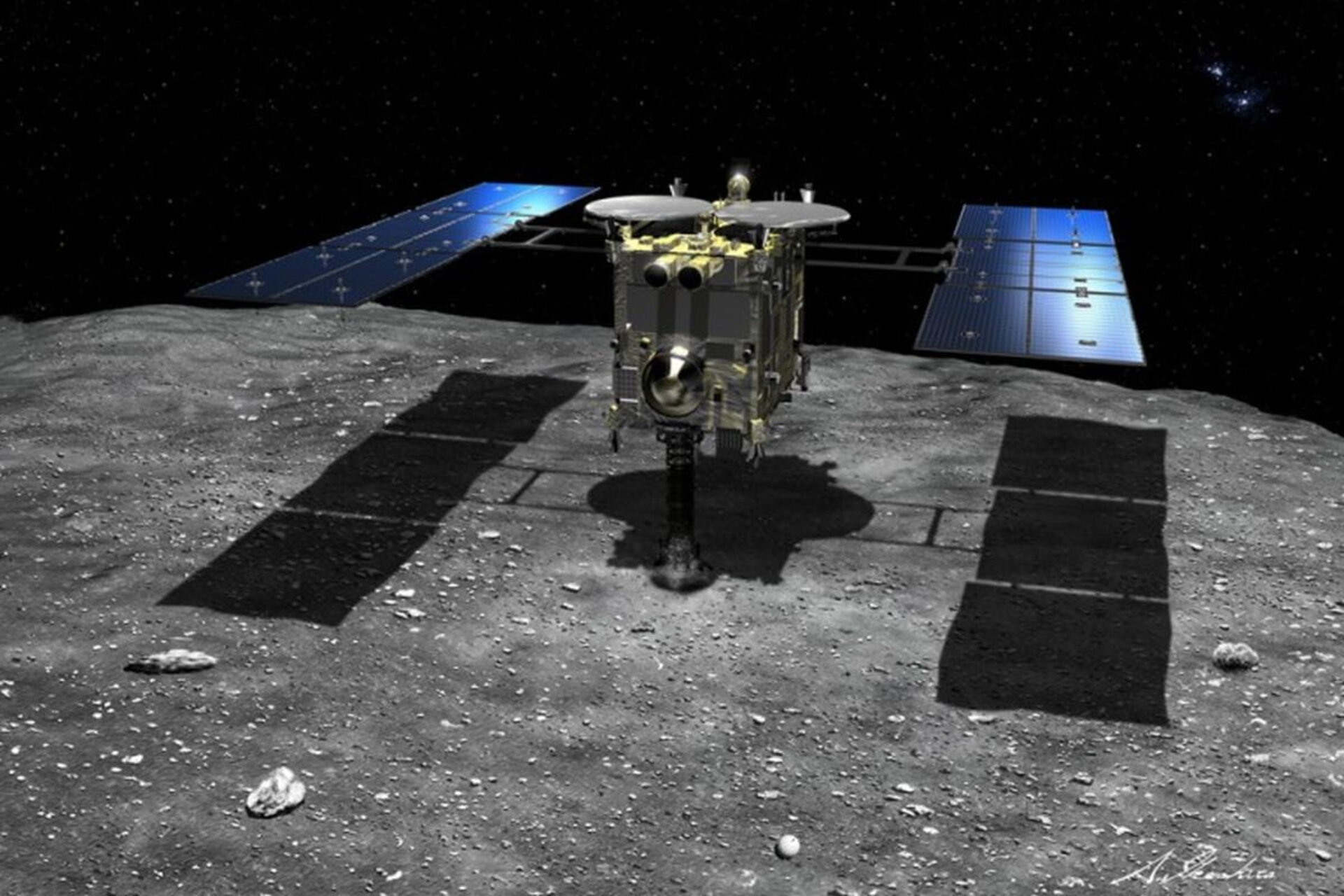
Hayabusa2

Patrick Michel, CNRS Director of Research of France’s Côte d'Azur Observatory, serves as co-investigator and interdisciplinary scientist on the Japanese mission and as Principal Investigator on ESA’s Hera. He comments: “Hayabusa2’s samples should give us an extraordinary opportunity to measure with high accuracy the composition and other material properties of its carbonaceous asteroid target.

The 900-m diameter Ryugu has a spinning top shape; its density is very low and based on the results of the Small Carry-on Impactor (SCI) impact experiment performed in April 2019, its surface appears cohesionless. These findings are extremely relevant to planetary defense, which is the prime goal of the Hera mission.”

Hera, her CubeSats, and their rocky target destination

Hera will not return any samples to Earth, but will be following Hayabusa2’s approach in one notable respect.

When it arrives at its target Didymos asteroid system in late 2026 ESA’s desk-sized spacecraft will similarly examine subsurface material, this time excavated by a far more powerful explosive impact: NASA’s DART spacecraft will in the meantime have collided with the smaller of the two Didymos asteroids in 2022, which will attempt to shift the orbit of the asteroid in a measurable way.

NASA's DART impacting asteroid

To give an idea, Hayabusa2’s SCI 2.5-kg copper projectile shot into the surface of the 900-m diameter Ryugu asteroid at a velocity of around 2 km per second. NASA’s DART will have a mass of 550 kg, and will strike Didymoon at 6 km/s.

Patrick Michel adds: “Hayabusa2’s impact represents a crucial first data point, in anticipation of DART’s impact, striking an asteroid five times smaller with an object more than 200 times larger while moving three times as fast, to move its orbit.”

Plume from impact

Hera, along with a pair of deployed deep space CubeSats, will focus on the crater left by the impact – along with close-up measurements of the target asteroid’s mass, composition as well as its subsurface and internal properties. In so doing Hera will help turn DART’s grand-scale deflection experiment into a well-understood planetary defence technique, with the potential to be reused as required to safeguard Earth from incoming asteroids.

The parent Didymos asteroid shares the same spinning-top shape with Ryugu, as well as being broadly comparable in size, at 780 m in diameter. “Hera will be taking a close look at both Didymos and Dimorphos,” adds Patrick Michel. “How will their surfaces compare with that of Ryugu? Will they also be cohesionless in nature?

Hera mission family portrait

“The observation of natural craters as well as the measurements of DART’s crater should allow us to answer this question and therefore to determine whether the asteroid population’s compositional diversity comes along with mechanical diversity. This is extremely important not only for our scientific understanding, but also to design planetary defense missions, because the mechanical properties have a high influence on deflection efficiency.”

Later in the Hera’s lifetime, the team will get their chance to make their own impression on the asteroids’ surfaces, by landing their two CubeSats on Dimorphos then bringing Hera itself down to Didymos at mission end.

Milani studies asteroid dust

DART and Hera together are supported by the international double-spacecraft Asteroid Impact & Deflection Assessment (AIDA) cooperation.

“Each new space mission reshapes our vision of asteroids,” says Ian Carnelli, overseeing Hera for ESA. “Hayabusa2, with its treasure trove of returned asteroid material will certainly revolutionise our understanding of those objects and their history. Then later this decade Hera will make its own contribution, while also serving to probe how humans might defend Earth in the future.”

Related article:

The Results of “Hayhabusa2” Re-entry Capsule Recovery
https://orbiterchspacenews.blogspot.com/2020/12/the-results-of-hayhabusa2-re-entry.html

Related links:

Hayabusa2: https://www.hayabusa2.jaxa.jp/en/

Hera mission: https://www.esa.int/Safety_Security/Hera

NASA’s DART: https://dart.jhuapl.edu/

Asteroid Impact & Deflection Assessment (AIDA): https://www.esa.int/Safety_Security/Hera/Asteroid_Impact_Deflection_Assessment_AIDA_collaboration

Images, Animation, Text, Credits: ESA/Science Office/Hayabusa2 Collection Team M/JAXA/The University of Tokyo/Kochi University/Rikkyo University/Nagoya University/Chiba Institute of Technology/Meiji University/The University of Aizu/AIST/NASA.

Greetings, Orbiter.ch

The Results of “Hayhabusa2” Re-entry Capsule Recovery


JAXA - Hayhabusa2 Mission patch.


Dec. 6, 2020

On December 6, 2020, Japan Aerospace Exploration Agency (JAXA) has recovered the body of the capsule, the heat shields, and the parachute of the "Hayabusa2" re-entry capsule in the Woomera Prohibited Area (WPA).

Hayabusa2 capsule returns to Earth

Tomorrow, the capsule recovery team will extract gas out of the capsule at the operation headquarters in Australia. Researchers considered the gas originates from the precious sample from Asteroid Ryugu.

Reentry of Hayabusa2's sample capsule

After the capsule separation, the spacecraft performed trajectory correction maneuvers three times every 30 minutes to depart from the Earth's sphere from 15:30 to 16:30 on December 5 (JST). The Hayabusa2 team members confirmed the trajectory correction maneuvers' success at 16:31 on the same day (JST). The current status of the spacecraft is normal.

Hayabusa2 capsule returns to Earth

We take this opportunity to show our deepest gratitude to the governments of Australia and Japan, NASA, and relevant parties for their cooperation in the recovery of the "Hayabusa2" re-entry capsule. Our appreciation extends to the people of Japan and the world for their generous support and encouragement.

Related article:

Successful Separation of Hayabusa2 Re-entry Capsule
https://orbiterchspacenews.blogspot.com/2020/12/successful-separation-of-hayabusa2-re.html

Related Links:

Hayabusa2 Project: http://www.hayabusa2.jaxa.jp/en/

Asteroid Probe Hayabusa2 (ISAS): http://www.isas.jaxa.jp/en/missions/spacecraft/current/hayabusa2.html

Asteroid Explorer "Hayabusa2": http://global.jaxa.jp/projects/sas/hayabusa2/index.html

Tick given for asteroid samples to land in Australia(Minister for Industry, Science and Technology, Australian Goverment): https://www.minister.industry.gov.au/ministers/karenandrews/media-releases/tick-given-asteroid-samples-land-australia

Images, Video, Text, Credits: National Research & Development Agency/Japan Aerospace Exploration Agency (JAXA)/Hayabusa2 Collection Team M/SciNews.

Best regards, Orbiter.ch