mardi 22 décembre 2020

Stellar Snowflake Cluster


NASA - Spitzer Space Telescope patch.


Dec. 22, 2019


Newborn stars, hidden behind thick dust, are revealed in this image of a section of the so-called Christmas Tree Cluster from NASA's Spitzer Space Telescope. The newly revealed infant stars appear as pink and red specks toward the center and appear to have formed in regularly spaced intervals along linear structures in a configuration that resembles the spokes of a wheel or the pattern of a snowflake. Hence, astronomers have nicknamed this the "Snowflake Cluster."

Star-forming clouds like this one are dynamic and evolving structures. Since the stars trace the straight line pattern of spokes of a wheel, scientists believe that these are newborn stars, or "protostars." At a mere 100,000 years old, these infant structures have yet to "crawl" away from their location of birth. Over time, the natural drifting motions of each star will break this order, and the snowflake design will be no more.

While most of the visible-light stars that give the Christmas Tree Cluster its name and triangular shape do not shine brightly in Spitzer's infrared eyes, all of the stars forming from this dusty cloud are considered part of the cluster.

Spitzer Space Telescope. Animation Credit: NASA

Like a dusty cosmic finger pointing up to the newborn clusters, Spitzer also illuminates the optically dark and dense Cone Nebula, the tip of which can be seen towards the bottom left corner of the image.

Spitzer Space Telescope: http://www.nasa.gov/mission_pages/spitzer/main/index.html

Image, Animation, Text,  Credits: NASA/JPL-Caltech/P.S. Teixeira (Center for Astrophysics).

Greetings, Orbiter.ch

CASC - Long March-8 first launch


CASC - China Aerospace Science and Technology Corporation logo.


Dec. 22, 2020

Long March-8 first launch

The first Long March-8 launch vehicle (Long March-8 Y1) was launched from the Wenchang Space Launch Center Hainan Province, China, on 22 December 2020, at 04:37 UTC (12:37 local time). Long March-8 is a new “low-cost commercial medium launch vehicle” developed by the China Aerospace Science and Technology Corporation (CASC).

Long March-8 first launch

According to CNSA, Long March-8 has a payload capacity of over 4.5 tonnes to a 700 km altitude sun-synchronous orbit and 2.8 tons to geostationary transfer orbit. On its first launch, Long March-8 sent five satellites into their planned orbits.

Long March-8 will be reusable

The Long March-8 launch vehicle will be reusable, according to Song Zhengyu, chief designer of the Long March-8 rocket.

The Long March-8 launch vehicle will be reusable

The first launch of the Long March-8 launch vehicle (Long March-8 Y1) took place from the Wenchang Space Launch Center Hainan Province, China, on 22 December 2020, at 04:37 UTC (12:37 local time).

For more information about China Aerospace Science and Technology Corporation (CASC), visit: http://english.spacechina.com/n16421/index.html

For more information about China National Space Administration (CNSA), visit: http://www.cnsa.gov.cn/

Images, Videos, Text, Credits: China Central Television (CCTV)/China National Space Administration (CNSA)/SciNews/Orbiter.ch Aerospace/Roland Berga.

Best regards, Orbiter.ch

Perseverance Arrives at Mars: Feb. 18, 2021


NASA - Mars 2020 Perseverance Rover logo.


Dec. 22, 2020

Perseverance Arrives at Mars: Feb. 18, 2021 (Mission Trailer)

After nearly 300 million miles (470 million km), NASA’s Perseverance rover completes its journey to Mars on Feb. 18, 2021. But, to reach the surface of the Red Planet, it has to survive the harrowing final phase known as Entry, Descent, and Landing. Video Credits: NASA/JPL.

Mars 2020 Perseverance Rover


Image above: In this illustration, NASA's Mars 2020 rover uses its drill to core a rock sample on Mars. Image Credits: NASA/JPL-Caltech.

NASA's Mars 2020 Perseverance rover launched in July and is set to land on the Red Planet Feb. 18, 2021. The car-size rover will search for signs of ancient microbial life. Using a coring drill at the end of its robotic arm, Perseverance has the capability to gather samples of Martian rock and regolith (broken rock and dust) and hermetically seal them in collection tubes. Perseverance can deposit these samples at designated locations on the Martian surface or store them internally.

Related article & link:

NASA Moves Forward with Campaign to Return Mars Samples to Earth
https://orbiterchspacenews.blogspot.com/2020/12/nasa-moves-forward-with-campaign-to.html

NASA's Mars 2020 Perseverance rover: https://mars.nasa.gov/mars2020/

Image (mentioned), Video (mentioned), Text, Credits: NASA/JPL.

Greetings, Orbiter.ch

lundi 21 décembre 2020

CMS sets new bounds on the mass of leptoquarks


CERN - European Organization for Nuclear Research logo.


Dec. 21, 2020

The bounds are some of the tightest yet on the existence of third-generation leptoquarks

The CMS detector (Image: CERN)

At the most fundamental level, matter is made up of two types of particles: leptons, such as the electron, and quarks, which combine to form protons, neutrons and other composite particles. Under the Standard Model of particle physics, both leptons and quarks fall into three generations of increasing mass. Otherwise, the two kinds of particles are distinct. But some theories that extend the Standard Model predict the existence of new particles called leptoquarks that would unify quarks and leptons by interacting with both.

In a new paper, the CMS collaboration reports the results of its latest search for leptoquarks that would interact with third-generation quarks and leptons (the top and bottom quarks, the tau lepton and the tau neutrino). Such third-generation leptoquarks are a possible explanation for an array of tensions with the Standard Model (or “anomalies”), which have been seen in certain transformations of particles called B mesons but have yet to be confirmed. There is therefore an additional reason for hunting down these hypothetical particles.

The CMS team looked for third-generation leptoquarks in a data sample of proton–proton collisions that were produced by the Large Hadron Collider (LHC) at an energy of 13 TeV and were recorded by the CMS experiment between 2016 and 2018. Specifically, the team looked for pairs of leptoquarks that transform into a top or bottom quark and a tau lepton or tau neutrino, as well as for single leptoquarks that are produced together with a tau neutrino and transform into a top quark and a tau lepton.

The CMS researchers didn’t find any indication that such leptoquarks were produced in the collisions. However, they were able to set lower bounds on their mass: they found that such leptoquarks would need to be at least 0.98–1.73 TeV in mass, depending on their intrinsic spin and the strength of their interaction with a quark and a lepton. These bounds are some of the tightest yet on third-generation leptoquarks, and they allow part of the leptoquark-mass range that could explain the B-meson anomalies to be excluded.

The search for leptoquarks continues.

CERN OVERVIEW animation (Video: CERN)

Note:

CERN, the European Organization for Nuclear Research, is one of the world’s largest and most respected centres for scientific research. Its business is fundamental physics, finding out what the Universe is made of and how it works. At CERN, the world’s largest and most complex scientific instruments are used to study the basic constituents of matter — the fundamental particles. By studying what happens when these particles collide, physicists learn about the laws of Nature.

The instruments used at CERN are particle accelerators and detectors. Accelerators boost beams of particles to high energies before they are made to collide with each other or with stationary targets. Detectors observe and record the results of these collisions.

Founded in 1954, the CERN Laboratory sits astride the Franco–Swiss border near Geneva. It was one of Europe’s first joint ventures and now has 23 Member States.

Related links:

CMS collaboration reports: http://cms-results.web.cern.ch/cms-results/public-results/publications/EXO-19-015/index.html

Standard Model: https://home.cern/science/physics/standard-model

Large Hadron Collider (LHC): https://home.cern/science/accelerators/large-hadron-collider

CMS experiment: https://home.cern/science/experiments/cms

For more information about European Organization for Nuclear Research (CERN), Visit: https://home.cern/

Image (mentioned), Video (mentioned), Text, Credits: CERN/By Ana Lopes.

Best regards, Orbiter.ch

Stellar Jewel Box


NASA - Hubble Space Telescope patch.


Dec. 21, 2020


Thousands of sparkling young stars are nestled within the giant nebula NGC 3603, one of the most massive young star clusters in the Milky Way Galaxy.

NGC 3603, a prominent star-forming region in the Carina spiral arm of the Milky Way about 20,000 light-years away, reveals stages in the life cycle of stars.

Powerful ultraviolet radiation and fast winds from the bluest and hottest stars have blown a big bubble around the cluster. Moving into the surrounding nebula, this torrent of radiation sculpted the tall, dark stalks of dense gas, which are embedded in the walls of the nebula. These gaseous monoliths are a few light-years tall and point to the central cluster. The stalks may be incubators for new stars.

On a smaller scale, a cluster of dark clouds called "Bok" globules resides at the top, right corner. These clouds are composed of dense dust and gas and are about 10 to 50 times more massive than the sun. Resembling an insect's cocoon, a Bok globule may be undergoing a gravitational collapse on its way to forming new stars.

The nebula was first discovered by Sir John Herschel in 1834.

Hubble Space Telescope (HST)

For more information about Hubble, visit:

http://hubblesite.org/

http://www.nasa.gov/hubble

http://www.spacetelescope.org/

Image, Animation, Text Credits: NASA, ESA, and the Hubble Heritage (STScI/AURA)-ESA/Hubble Collaboration.

Greetings, Orbiter.ch

New Science Airlock Expands Station’s Research Capacity


ISS - Expedition 64 Mission patch.


Dec. 21, 2020

Science operations continue to expand aboard the International Space Station with the installation of a new research airlock over the weekend. The seven-member Expedition 64 crew also stayed busy exploring a variety of space biology and physics phenomena.

Robotics controllers on Earth spent Saturday remotely commanding the Canadarm2 robotic arm to install the new NanoRacks Bishop science airlock delivered Dec. 7 aboard the SpaceX Cargo Dragon resupply ship. During a series of hours-long maneuvers, Bishop was extracted from Dragon’s unpressurized trunk and installed on the port side of the Tranquility module adjacent to BEAM, the Bigelow Expandable Activity Module.


Image above: The new NanoRacks Bishop research airlock is installed on the port side of the Tranquility module and significantly expands the capacity for commercial space research on the outside of the orbiting lab. Image Credit: NASA.

Bishop significantly increases the capacity for public and private research on the outside of the orbiting lab. The new science airlock also enables the deployment of larger satellites and the transfer of spacewalking tools and hardware inside and outside the station.

Dragon also delivered over 2,000 pounds of new science investigations to the orbiting lab keeping the seven-member crew busy throughout December. Some of that research took place over the weekend with the astronauts studying planetary exploration technologies and potential treatments for heart conditions on and off the Earth.

Animation Credit: ISS HD Live Now

The new BioAsteroid experiment is looking at microbes as a way to breakdown space rocks into fertile soils or extract valuable metals and minerals. The crew serviced samples inside the Kubik incubator on Sunday for the study seeking to enable biomining that may advance space exploration and settlement.

Flight Engineer Kate Rubins has been leading the Cardinal Heart study since activating the experiment shortly after its arrival aboard the Cargo Dragon. She serviced engineered heart tissues over the weekend to understand the cardiovascular response to microgravity. Results may give deeper insights into aging and weakening heart muscles that may lead to more effective therapies for humans living on and off the Earth.

Related links:

Expedition 64: https://www.nasa.gov/mission_pages/station/expeditions/expedition64/index.html

Canadarm2 robotic arm: https://www.nasa.gov/mission_pages/station/structure/elements/mobile-servicing-system.html

NanoRacks Bishop science airlock: https://www.nasa.gov/directorates/spacetech/spinoff/New_Doorway_to_Space

Tranquility module: https://www.nasa.gov/mission_pages/station/structure/elements/tranquility/

Bigelow Expandable Activity Module: https://www.nasa.gov/mission_pages/station/structure/elements/bigelow-expandable-activity-module.html

BioAsteroid: https://www.nasa.gov/mission_pages/station/research/experiments/explorer/Investigation.html?#id=8308

Kubik incubator: https://www.nasa.gov/mission_pages/station/research/experiments/explorer/Facility.html?#id=894

Cardinal Heart: https://www.nasa.gov/mission_pages/station/research/experiments/explorer/Investigation.html?#id=8218

Space Station Research and Technology: https://www.nasa.gov/mission_pages/station/research/overview.html

International Space Station (ISS): https://www.nasa.gov/mission_pages/station/main/index.html

Image (mentioned), Animation (mentioned), Text, Credits: NASA/Norah Moran.

Best regards, Orbiter.ch

This May Be the First Complete Observation of a Nanoflare


NASA - Solar Dynamics Observatory patch.


Dec. 21, 2020

Researchers may have found the long-sought “nanoflares” thought to heat the solar corona to its incredible temperatures.


Animation above: Magnetic Reconnection - Heating & Brightenning. Animation Credits: NASA/SDO/IRIS.

A new study published in Nature Astronomy marks the first time researchers have captured the full lifecycle of a putative nanoflare – from bright origins to blistering demise.

Mini flares for a major puzzle

Nanoflares are tiny eruptions on the Sun, one-billionth the size of normal solar flares. Eugene Parker – of Parker Solar Probe fame – first predicted them in 1972 to solve a major puzzle: the coronal heating problem.

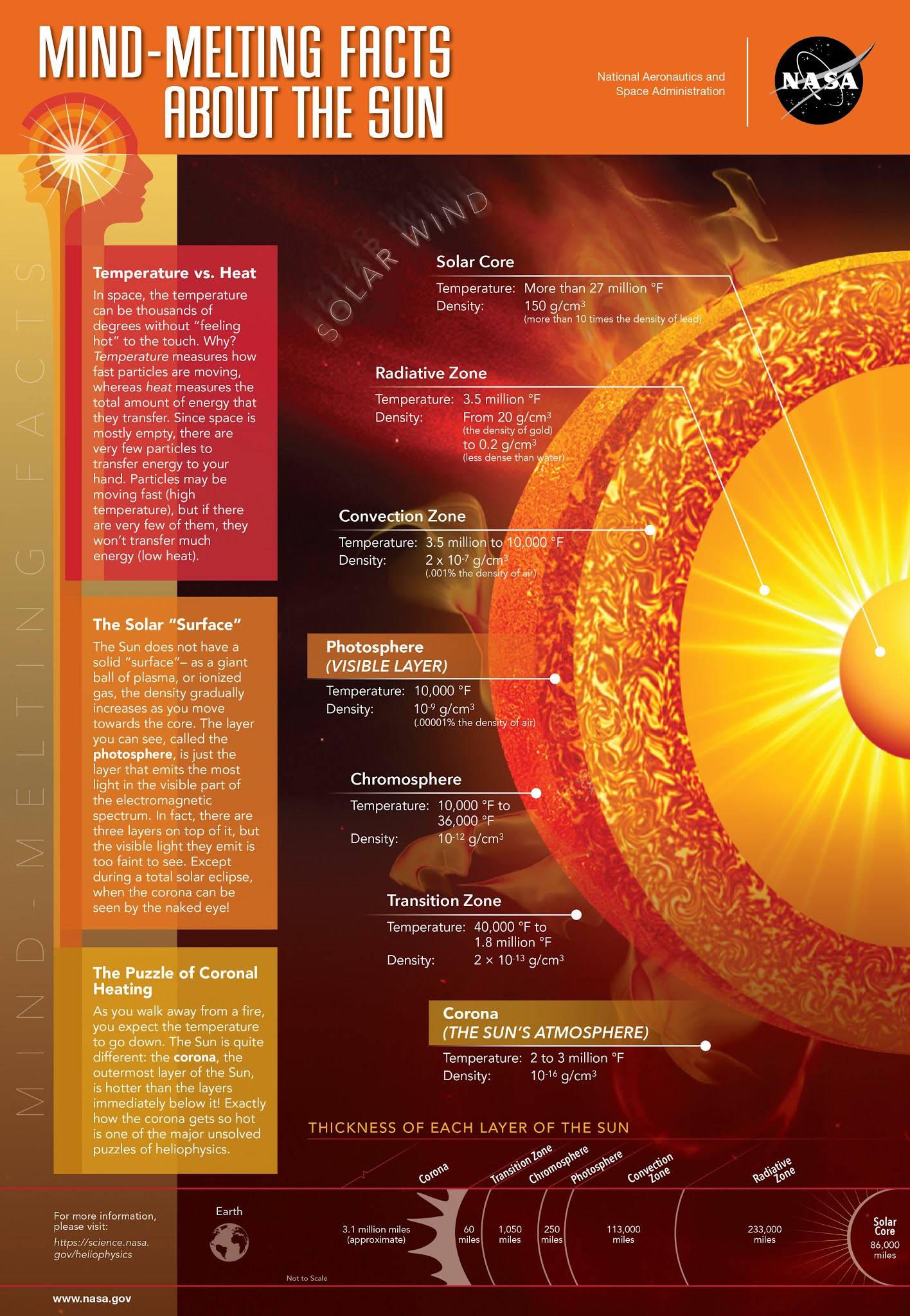
That's the mystery of how the Sun’s outer atmosphere, or corona, gets so incredibly hot. Despite being much farther away from the solar core, it's millions of degrees hotter than the layers beneath it.

Nearly 50 years later the coronal heating problem still hasn’t been solved.  It has been hard to confirm any of a handful of different theories, in part because no one has ever actually seen a nanoflare.


Image above: The coronal heating problem is one of several mind-melting facts about the Sun. Image Credits: NASA/Miles Hatfield/Mary Pat Hrybyk-Keith.

“They’re extremely difficult to observe,” said Shah Bahauddin, Research Faculty at the Laboratory of Atmospheric and Space Physics at the University of Colorado, Boulder, and lead author of the study.

Tiny and brief, our best telescopes have only recently become powerful enough to resolve them. And seeing a tiny flash isn't enough – it takes a lot be considered a true nanoflare sighting. “We know from theory what we should look for – what fingerprint a nanoflare would leave,” Bahauddin said.

A nanoflare by any other name

To say you’ve observed a corona-heating nanoflare, you have to check at least two major boxes.

First, like regular flares, a nanoflare is set alight by magnetic reconnection. If the eruption you’re seeing is heated by some other process, it’s not a nanoflare.

Magnetic reconnection is triggered when magnetic field lines explosively realign. Unlike other mechanisms that heat things up gradually, it can take relatively cool plasma and make it super-hot in an instant.

“It’s like putting two ice cubes together and suddenly the temperature rises to 1000 degrees Fahrenheit,” Bahauddin said.

One way to spot heating via magnetic reconnection is to observe intense heat amidst far cooler surroundings.

Second, the nanoflare has to heat the corona, which might lie thousands of miles above where they erupt. That’s not trivial – many other solar eruptions only heat their immediate surroundings.

“You have to examine if the energy from a nanoflare can be dissipated in the corona,” Bahauddin said. “If the energy goes somewhere else, that doesn’t solve the coronal heating problem.”

A counterintuitive finding becomes a key puzzle piece

When Bahauddin started this research as a PhD student, he wasn’t thinking about nanoflares at all. Looking for a project, he decided to investigate some tiny bright loops – at about 60 miles across, they are tiny on Sun scales – that he’d noticed flickering in the layer just below the super-hot corona.

“I thought maybe the loops made the surrounding atmosphere a bit hotter,” he said. “I never thought that it would make so much energy that it might actually propel hot plasma to the corona and heat it up.”


Image above: A close-up of one of the loop brightenings studied in the article. Each inset frame zooms in to the selected region in the frame to its left. The frame on the far right is the most zoomed in, showing the putative nanoflare. Image Credits: NASA/SDO/IRIS/Shah Bahauddin.

But as Bahauddin zoomed in on images taken by NASA’s Interface Region Imaging Spectrograph, or IRIS satellite, he uncovered two surprises.

First, these loops were incredibly hot – millions of degrees hotter than their surroundings.

But even stranger, this heat was distributed in an unusual way – differently than in most other physical systems.

While the Sun is made mostly of hydrogen and helium, it also contains smaller amounts of every other element. In these loops, somehow the heavier elements – such as silicon, which has 14 protons in its nucleus – were much hotter and more energetic than lighter elements, such as oxygen, which has only eight.

“If you push a ball that is very light across the floor, it should roll farther than a heavy ball,” said Bahauddin. “Yet, in our case, the heavier elements were shooting out at about 60 miles per second, while the lighter ones were almost at zero. That was completely counterintuitive.”

This strange observation told them that something very specific must be happening in these bright loops.

“That was a big clue,” said Amy Winebarger, solar physicist at NASA’s Marshall Space Flight Center in Huntsville, Alabama, and coauthor of the study. “You really had to start thinking about what kind of heating could impact the oxygen atom differently than the silicon atom.”

Bahauddin spent the following years running computer simulations, testing out different heating mechanisms. He needed to find one that could match their observations, including heating the heavier elements more than the lighter ones.

In the end, only one heating mechanism could produce the effect. The heat had to come from a magnetic reconnection event – the same driving force behind solar flares.

The key was in the aftermath. As magnetic field lines twist and re-align, they create a brief electric current that accelerates the newly-freed ions. Bahauddin likens it to a panicked crowd.

“It's like everyone in a room is trying to run at the same time. They start to collide with each other, and there’s a big mess,” Bahauddin said.

Solar Dynamics Observatory (SDO). Image Credit: NASA

Critically, the longer an ion can keep moving in an electric field, the more energy it gains. This is where heavier ions, like silicon, have an advantage. “Since they have more momentum, they can plow through the crowd and steal all the available energy,” Bahauddin said.

In other words, the more massive silicon ions bulldozed their way through the chaos, soaking up the energy from the electric field. The lighter oxygen ions couldn’t do that – they were stopped dead in their tracks after each collision.

This mechanism could explain their results, but still, it was a longshot. The simulations showed that this process only happened under quite specific conditions.

“To make this happen you needed a specific temperature, and you needed the right proportion of silicon to oxygen,” Bahauddin said. “So we looked back at the measurements, and saw that the numbers exactly matched.” Remarkably, the conditions on the Sun mirrored his simulations.

Heating the corona

So far, these bright loops appeared to be tiny flares – but did their heat actually reach the corona?

Bahauddin looked to NASA’s Solar Dynamics Observatory, which carries telescopes tuned to see the extremely hot plasma only found in the corona. Bahauddin located the regions right above the brightenings shortly after they appeared.

“And there it was, just a 20-second delay,” Bahauddin said. “We saw the brightening, and then we suddenly saw the corona got super-heated to multi-million degree temperatures,” Bahauddin said. “SDO gave us this important information: Yes, this is indeed increasing the temperature, transferring energy to the corona.”

Bahauddin documented 10 instances of bright loops with similar effects on the corona. Still, he hesitates to call them nanoflares. “Nobody actually knows because nobody has seen it before,” Bahauddin said. “It’s an educated guess, let’s say.”

From the perspective of the theory that says nanoflares heat the corona, the only thing left to do is to show that these brightenings occur often enough, all over the Sun, to account for the corona’s extreme heat. That’s still work in progress. But observing these tiny bursts as they heat solar atmosphere is a compelling start.

“We have shown how a cool, low-lying structure can actually supply super-hot plasma to the corona,” Bahauddin said. “That, to me, was the most beautiful thing.”

Related links:

Nature Astronomy: https://www.nature.com/articles/s41550-020-01263-2

IRIS (Interface Region Imaging Spectrograph): http://www.nasa.gov/mission_pages/iris/index.html

SDO (Solar Dynamics Observatory): http://www.nasa.gov/mission_pages/sdo/main/index.html

Images (mentioned), Animation (mentioned), Text, Credits: NASA/GSFC/By Miles Hatfield.

Greetings, Orbiter.ch