mardi 19 janvier 2021

Exploring the Solar Wind With A New View of Small Sun Structures


NASA - Solar Dynamics Observatory (SDO) patch.


Jan. 19, 2021

Scientists have combined NASA data and cutting-edge image processing to gain new insight into the solar structures that create the Sun’s flow of high-speed solar wind, detailed in new research published today in The Astrophysical Journal. This first look at relatively small features, dubbed “plumelets,” could help scientists understand how and why disturbances form in the solar wind.

The Sun’s magnetic influence stretches billions of miles, far past the orbit of Pluto and the planets, defined by a driving force: the solar wind. This constant outflow of solar material carries the Sun’s magnetic field out into space, where it shapes the environments around Earth, other worlds, and in the reaches of deep space. Changes in the solar wind can create space weather effects that influence not only the planets, but also human and robotic explorers throughout the solar system — and this work suggests that relatively small, previously-unexplored features close to the Sun’s surface could play a crucial role in the solar wind’s characteristics.

“This shows the importance of small-scale structures and processes on the Sun for understanding the large-scale solar wind and space weather system,” said Vadim Uritsky, a solar scientist at the Catholic University of America and NASA’s Goddard Space Flight Center, who led the study.

Like all solar material, which is made up of a type of ionized gas called plasma, the solar wind is controlled by magnetic forces. And the magnetic forces in the Sun’s atmosphere are particularly complex: The solar surface is threaded through with a constantly-changing combination of closed loops of magnetic field and open magnetic field lines that stretch out into the solar system.
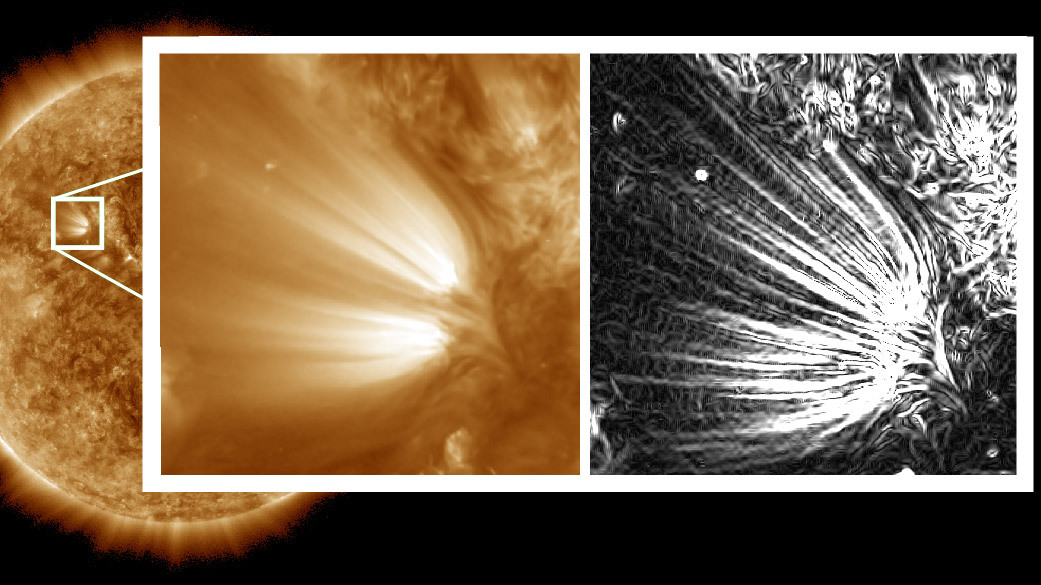

Image above: Scientists used image processing on high-resolution images of the Sun to reveal distinct “plumelets” within structures on the Sun called solar plumes. The full-disk Sun and the left side of the inset image were captured by NASA’s Solar Dynamics Observatory in a wavelength of extreme ultraviolet light and processed to reduce noise. The right side of the inset has been further processed to enhance small features in the images, revealing the edges of the plumelets in clear detail. These plumelets could help scientists understand how and why disturbances in the solar wind form. Image Credits: NASA/SDO/Uritsky, et al.

It’s along these open magnetic field lines that the solar wind escapes from the Sun into space. Areas of open magnetic field on the Sun can create coronal holes, patches of relatively low density that appear as dark splotches in certain ultraviolet views of the Sun. Often, embedded within these coronal holes are geysers of solar material that stream outward from the Sun for days at a time, called plumes. These solar plumes appear bright in extreme ultraviolet views of the Sun, making them easily visible to observatories like NASA’s Solar Dynamics Observatory satellite and other spacecraft and instruments. As regions of particularly dense solar material in open magnetic field, plumes play a large role in creating the high-speed solar wind — meaning that their attributes can shape the characteristics of the solar wind itself.

Using high-resolution observations from NASA’s Solar Dynamics Observatory satellite, or SDO, along with an image processing technique developed for this work, Uritsky and collaborators found that these plumes are actually made up of much smaller strands of material, which they call plumelets. While the entirety of the plume stretches out across about 70,000 miles in SDO’s images, the width of each plumelet strand is only a few thousand miles across, ranging from around 2,300 miles at the smallest to around 4,500 miles in width for the widest plumelets observed.  

Though earlier work has hinted at structure within solar plumes, this is the first time scientists have observed plumelets in sharp focus. The techniques used to process the images reduced the “noise” in the solar images, creating a sharper view that revealed the plumelets and their subtle changes in clear detail.

Their work, focused on a solar plume observed on July 2-3, 2016, shows that the plume’s brightness comes almost entirely from the individual plumelets, without much additional fuzz between structures. This suggests that plumelets are more than just a feature within the larger system of a plume, but rather the building blocks of which plumes are made.

Solar Dynamics Observatory. Animation Credit: NASA

“People have seen structure in and at the base of plumes for a while,” said Judy Karpen, one of the authors of the study and chief of the Space Weather Laboratory in the Heliophysics Science Division at NASA Goddard. “But we’ve found that the plume itself is a bundle of these denser, flowing plumelets, which is very different from the picture of plumes we had before.”

They also found that the plumelets move individually, each oscillating on its own — suggesting that the small-scale behavior of these structures could be a major driver behind disruptions in the solar wind, in addition to their collective, large-scale behavior.

Searching for plumelet signatures

The processes that create the solar wind often leave signatures in the solar wind itself — changes in the wind’s speed, composition, temperature, and magnetic field that can provide clues about the underlying physics on the Sun. Solar plumelets may also leave such fingerprints, revealing more about their exact role in the solar wind’s creation, even though finding and interpreting them can be its own complex challenge.

One key source of data will be NASA’s Parker Solar Probe, which has flown closer to the Sun than any other spacecraft — reaching distances as close as 4 million miles from the solar surface by the end of its mission — captures high-resolution measurements of the solar wind as it swings by the Sun every few months. Its observations, closer to the Sun and more detailed than those from prior missions, could reveal plumelet signatures.   

In fact, one of Parker Solar Probe’s early and unexpected findings might be connected to plumelets. During its first solar flyby in November 2018, Parker Solar Probe observed sudden reversals in the magnetic field direction of the solar wind, nicknamed “switchbacks.” The cause and the exact nature of the switchbacks is still a mystery to scientists, but small-scale structures like plumelets could produce similar signatures.


Animation above: During its first solar flyby in November 2018, NASA’s Parker Solar Probe observed switchbacks — sudden reversals in the magnetic field of the solar wind, illustrated here. Newly-observed solar plumelets might produce similar signatures to switchbacks. Animation Credits: NASA's Goddard Space Flight Center/Conceptual Image Lab/Adriana Manrique Gutierrez.

Finding signatures of the plumelets within the solar wind itself also depends on how well these fingerprints survive their journey away from the Sun — or whether they would be smudged out somewhere along the millions of miles they travel from the Sun to our observatories in space.

Evaluating that question will rely on remote observatories, like ESA and NASA’s Solar Orbiter, which has already taken the closest-ever images of the Sun, including a detailed view of the solar surface — images that will only improve as the spacecraft gets closer to the Sun. NASA’s upcoming PUNCH mission — led by Craig DeForest, one of the authors on the plumelets study — will study how the Sun’s atmosphere transitions to the solar wind and could also provide answers to this question.

“PUNCH will directly observe how the Sun’s atmosphere transitions to the solar wind,” said Uritsky. “This will help us understand if the plumelets can survive as they propagate away from the Sun — if can they actually be injected into the solar wind.”

Related links:

The Astrophysical Journal: https://iopscience.iop.org/article/10.3847/1538-4357/abd186

SDO (Solar Dynamics Observatory): http://www.nasa.gov/mission_pages/sdo/main/index.html

Parker Solar Probe: https://www.nasa.gov/content/goddard/parker-solar-probe

Solar Orbiter: https://www.nasa.gov/solar-orbiter and https://www.esa.int/Science_Exploration/Space_Science/Solar_Orbiter

Image (mentioned), Animations (mentioned), Text, Credits: NASA's Goddard Space Flight Center/By Sarah Frazier.

Greetings, Orbiter.ch

Saffire Ignites New Discoveries in Space


NASA - Saffire Mission patch.


Jan. 19, 2021

Saffire Ignites New Discoveries in Space

Our understanding of the way fire behaves in space is expanding as the fifth in a series of NASA investigations ignited recently. The Spacecraft Fire Safety Experiment-V (Saffire-V) successfully tested larger, more dynamic fires for over 26 hours inside Northrop Grumman’s Cygnus spacecraft, following its primary mission of delivering supplies to the International Space Station.

After Cygnus departed the station on Jan. 6, operators on the ground, for the first time on a Saffire mission, lowered the pressure inside the spacecraft and backfilled it with oxygen to replicate potential atmospheric conditions that would likely be experienced inside future human spacecraft.


Image above: Schematic of the Saffire Experiment Module (top cover removed for clarity). The hardware consists of a flow duct containing the sample card and an avionics bay. All power, computer, and data acquisition modules are contained in the bay. Dimensions are approximately 53 x 90 x 133 cm. Image Credit: NASA.

After ignition, cameras and sensors monitored flame growth, temperature variations, and oxygen changes, which were translated into data. The data will be used to model fire response scenarios, as well as fire detection, combustion product monitoring, and post-fire cleanup.

“The elevated oxygen levels show more energetic flames, which would have a larger impact on the vehicle,” says Gary A. Ruff, Saffire project manager at NASA’s Glenn Research Center in Cleveland. “The Saffire-V data will allow us to model fire scenarios and increase our confidence in safety strategies.”


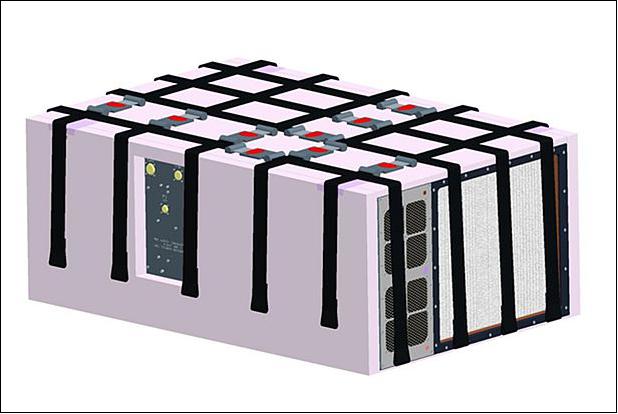
Image above: Saffire experiment module with foam packing and straps as it will be mounted in Cygnus. Image Credit: NASA.

Another Saffire experiment is ready to fly on an upcoming launch to the space station as NASA continues to pursue a greater understanding of the risks and behaviors of fire in space for Artemis astronauts who will explore the Moon and eventually Mars.

Saffire is a series of experiments developed by the Spacecraft Fire Safety Demonstration Project which supports NASA’s Exploration Capabilities Program.

Related links:

Spacecraft Fire Safety Experiment-V (Saffire-V): https://www.nasa.gov/saffire

Artemis: https://www.nasa.gov/specials/artemis/

Images (mentioned), Video, Text, Credits: NASA Glenn Research Center/Kelly Sands.

Greetings, Orbiter.ch

lundi 18 janvier 2021

Machine Learning (AI) Finds More Gravitational Lenses Than All Astronomers Combined


Astrophysics logo.


Jan. 18, 2021


Image above: GAL-CLUS-022058s is one of the largest and most complete Einstein rings ever discovered. This beautiful gravitational lens is created by a bright, distant galaxy which happens to be aligned directly behind a massive galaxy at the center of a massive galaxy cluster. The lensing effect stretches, distorts, and magnifies the background galaxy, as well as creating multiple images of it. Image Credits: ESA/Hubble & NASA, S. Jha; Acknowledgement: L. Shatz.

One of Einstein’s most revolutionary predictions is that mass bends light.


Image above: During a total solar eclipse, stars can be visible during the day. Their apparent positions, as you get closer to the Sun's limb, will be distorted due to the gravitational effect of passing close by the Sun. This image was made from 98 images obtained by means of four different cameras. These 98 images were chosen from totally 275 images in order to minimize the influence of rolling clouds. Images taken during the 2010 solar eclipse. Miloslav Druckmuller, Martin Dietzel, Shadia Habbal, Vojtech Rusin.

Starlight bent around the eclipsed Sun in 1919 confirmed this.


Image above: In 1919, a total solar eclipse occurred, enabling scientists to test General Relativity. According to Einstein's predictions, starlight near the limb of the Sun should be gravitationally deflected, and by a different amount than Newton's theory would predict under any assumptions. The observations agreed with Einstein, confirming General Relativity's validity. New York Times, 10 November 1919 (L); Illustrated London News, 22 November 1919 (R).

The 1930s first developed a prediction for gravitational lenses.


Image above: Gravitational lenses, magnifying and distorting a background source, allow us to see fainter, more distant objects than ever before. Similarly, observing the light that experiences a gravitational lensing effect enables us to reconstruct properties of the lens itself, potentially shedding light on the nature of dark matter. Image Credits: ALMA (ESO/NRAO/NAOJ), L. CALÇADA (ESO), Y. HEZAVEH ET AL.

Large foreground masses would bend and magnify fortuitously aligned background sources.


Image above: This images showcases the effects of both weak and strong gravitational lensing. The strong lensing effect creates multiple images of the same background quasar, while magnifying and distorting background galaxies into rings and arcs. Meanwhile, the shapes of background galaxies are distorted in a circle around the central mass, consistent with weak lensing predictions. Image Credits: ESA, NASA, K. Sharon (Tel Aviv University) and E. Ofek (Caltech).

Multiple images or even “Einstein rings” could occur.


Image above: A horseshoe-shaped Einstein ring, just short of the perfect alignment needed for a 360-degree ring. Systems like this have recently been used to place a strong constraint on the validity of relativity, and can reveal features about ultra-distant galaxies that could never be seen without this serendipitous alignment. Image Credits: NASA/ESA and Hubble.

For decades, they were solely theoretical.


Image above: This illustration shows the physics behind a strong gravitational lensing system. There needs to be a foreground mass that acts as the lens, and the background light source(s) must be properly aligned. If this is the case, it can produce multiple images, distorted light, and highly magnified views of background objects. Image Credits: NASA/ESA.

Finally, in 1979, the “Twin QSO” was found: two lensed images of the same quasar.


Image above: This galaxy cluster appears to be hosting two blue stars, but they are actually the same background object: the distant quasar QSO 0957+561. This was the first gravitationally lensed object ever discovered back in 1979, nearly 50 years after they were predicted within the context of General Relativity. Image Credits: ESA/Hubble & NASA.

Since that time, many more gravitational lenses have been found.


Image above: This image showcases six examples of strong gravitational lenses found in the COSMOS survey, which found 67 such lenses total. The lenses were all found in the same 1.6-square-degree field of sky with several space-based and Earth-based observatories. These gravitational lenses often allow astronomers to peer much further back into the early Universe than they would normally be able to. Image Credits: NASA, ESA, C. Faure (Zentrum für Astronomie, University of Heidelberg) and J.P. Kneib (Laboratoire d'Astrophysique de Marseille).

Features include:

- Quadruple images,


Image above: Two temporally varying images (left) and a 1990 Hubble image (right) of the first quadruple-lens system ever discovered, all resulting from the same distant quasar, known colloquially as an Einstein Cross. We now have scores of quadruple lenses, and that number should only increase as time goes on and we collect more observational data from the deep Universe. Image Credits:NASA, ESA, and STScI.

- Magnified arcs,


Image above: A Hubble image showcasing many of the lensed galaxies inside a massive galaxy cluster. The presence of not only these galaxies but the dark matter within them as well as within the larger cluster is responsible for the observed lensing effects: rings, arcs, magnified and distorted light, etc. These observations allow us to compare the actual universe with numerical simulations. Image Credits: NASA, ESA, G. Caminha (University of Groningen), M. Meneghetti (Observatory of Astrophysics and Space Science of Bologna), P. Natarajan (Yale University), and the CLASH team.

- Hidden background objects,


Image above: The ultra-distant, lensed galaxy candidate, MACS0647-JD, appears magnified and in three disparate locations thanks to the incredible gravity of the gravitational lens of the foreground cluster, MACS J0647. Other weak and strong lensing effects can also be seen elsewhere around this galaxy cluster. NASA, ESA, M. Postman and D. Coe (STScI), and the CLASH Team.

- And nearly-perfect rings.


Image above: Two bright, massive galaxies are relatively close by in space, and their mutual gravity lenses some background galaxies, as shown here. The light from the background galaxies gets stretched and magnified into giant circular arcs, revealing properties of both these background objects as well as the gravitational properties of the lens itself. Image Credits: NASA & ESA Acknowledgement: Judy Schmidt.

Hubble’s deep imaging uncovered many more strong lenses.


Image above: The streaks and arcs present in Abell 370, a distant galaxy cluster some 5-6 billion light years away, are some of the strongest evidence for gravitational lensing and dark matter that we have. The lensed galaxies are even more distant, with some of them making up the most distant galaxies ever seen. Image Credits: NASA, ESA/Hubble, HST Frontier Fields.

Lensing affects only 1 in ~10,000 galaxies.


Image above: This image highlights more than two dozen galaxy candidates that are red, faint, and extremely distant, as found in the Hubble Ultra Deep Field. Many of these galaxies are found extremely close to massive foreground galaxies, whose mass lenses and magnifies the background sources. This technique has helped identify many of the most distant objects known in the Universe. Image Credits: NASA, ESA, R. Bouwens and G. Illingworth (UC, Santa Cruz).

Hubble, unfortunately, only offers narrow-field capabilities.


Image above: This image from the Digitzed Sky Survey shows the area around the Hubble eXtreme Deep Field (XDF), located in the constellation of Fornax (The Furnace). The full Moon is shown to scale for comparison. Over the course of its 30 year lifetime, Hubble has imaged a significant number of square degrees on the sky, but less than 1% of the 40,000 square degrees available. Image Credits: NASA, ESA, Z. Levay (STScI), T. Rector, I. Dell'Antonio/NOAO/AURA/NSF, G. Illingworth, D. Magee, and P. Oesch (University of California, Santa Cruz), R. Bouwens (Leiden University) and the HUDF09 Team.

After 30 years, it’s imaged less than 1% of the sky.


Image above: The Copeland Septet, in the constellation of Leo, was imaged along with about a billion other galaxies as part of the DESI Legacy Imaging Surveys. The survey covers approximately half of the sky, ~20,000 square degrees, to very good depth. With that much data, machine learning was required to extract gravitational lensing signals. Image Credits: KPNO/CTIO/NOIRLab/NSF/AURA/Legacy Imaging Survey.

However, DESI (Dark Energy Spectroscopic Instrument) Legacy Imaging Surveys are both deep and wide.


Image above: This image, part of the DESI Legacy Imaging Survey, showcases a gravitational lens at the center that forms a near-perfect ring. Alignments such as this are rare, affecting fewer than 1-in-10,000 galaxies, but with more than a billion galaxies and the advent of machine learning for handling this Big Data, more than 1,000 new lensed galaxies have been found so far. Image Credits: KPNO/CTIO/NOIRLab/NSF/AURA/Legacy Imaging Survey.

Spanning ~20,000 square degrees, its full map requires over 10 trillion pixels.


Image above: In this image, a massive set of galaxies at the center causes many strong lensing features to appear. Background galaxies have their light bent, stretched, and otherwise distorted into rings and arcs, where it gets magnified by the lens as well. This gravitational lens system is complex, but informative for learning more about Einstein's relativity in action. Image Credits: KPNO/CTIO/NOIRLab/NSF/AURA/Legacy Imaging Survey.

Machine Learning is required to handle that much data.


Image above: Not every gravitational lens is simple and circular, as this image shows. The irregular arcs and multiple stretched, magnified images of background objects, visible in red and blue, help scientists trace out and reconstruct the locations of matter in the foreground cluster. This was taken as part of the DESI Legacy Imaging Survey. Image above: KPNO/CTIO/NOIRLab/NSF/AURA/Legacy Imaging Survey.

That process discovered 1,210 new gravitational lenses.


Image above: One of the best examples of a quadruple lens found with the DESI Legacy Imaging Survey. This was just one of 1,210 lensed systems found in the survey that spanned approximately half of the sky. Many of the targets identified will be studied in more detail in the future, and more lenses will likely be revealed before all is said and done. Image Credits: KPNO/CTIO/NOIRLab/NSF/AURA/Legacy Imaging Survey.

That’s more than previously discovered by all astronomers, combined.


Image above: This Hubble Space Telescope image shows a gravitational lens (center) that was first identified as a lens candidate with the assistance of a neural network that processed ground-based space images. The lens is artificially colorized and circled in this image. Image Credits: Hubble Space Telescope.

Occasionally, Hubble followed up, revealing additional details.


Image above: These two two column composites show side-by-side comparisons of gravitational lens candidates imaged by the ground-based Dark Energy Camera Legacy Survey (color) and the Hubble Space Telescope (black and white). Where data from Hubble was available, it not only confirmed these gravitational lenses, but revealed many additional features that the DESI survey could not. Image above: Dark Energy Camera Legacy Survey, Hubble Space Telescope.

With Euclid, Vera Rubin, and Nancy Roman telescopes coming soon, we’ll certainly find even more.

CosmoView Episode 19: Doubling the Number of Known Gravitational Lenses

Related links:

DESI (Dark Energy Spectroscopic Instrument): https://noirlab.edu/public/news/noirlab2103/

Twin QSO: https://en.wikipedia.org/wiki/Twin_Quasar

Images (mentioned), Video, Text, Credits: Forbes/Ethan Siegel/NOIRLabAstro.

Best regards, Orbiter.ch

NASA Remembers Astronaut William Thornton


NASA logo.


Jan. 18, 2021


NASA is saddened to learn of the loss of former physician-astronaut, Dr. William Thornton, who died last week at his home in Boerne, Texas, at the age of 91. Thornton was selected as an astronaut in 1967, and launched twice on the space shuttle Challenger on STS-8 and STS-51B, the Spacelab 3 mission. He logged 313 hours in space. Thornton had a significant influence in the evolution of space life sciences and held patents on a shuttle flight treadmill and waste collection facility. He worked closely with NASA’s biomedical laboratory teams on topics related to space adaptation sickness, lower body negative pressure, muscle atrophy, and exercise. He retired from NASA in 1994.

Related links:

STS-8: https://www.nasa.gov/mission_pages/shuttle/shuttlemissions/archives/sts-8.html

STS-51B: https://www.nasa.gov/mission_pages/shuttle/shuttlemissions/archives/sts-51B.html

Image, Text, Credits: NASA/Brian Dunbar.

R.I.P., Orbiter.ch

Virgin Orbit LauncherOne launch


Virgin Orbit - Launch Demo-2 Mission patch.


Jan. 18, 2021

ForVirgin Orbit Launch Demo 2 mission, a LauncherOne rocket launched ELaNa 20, from the Mojave Air and Spaceport in California, on 17 January 2021, at 19:39 UTC.

Virgin Orbit LauncherOne launches NASA’s ELaNa 20

NASA’s Educational Launch of NanoSatellites (ELaNa 20) mission included 10 CubeSats: PolarCube, MiTEE, CACTUS-1, Q-PACE, TechEdSat-7, RadFXSat-2, EXOCUBE, CAPE-3 and PICS (two CubeSats). The airplane, Cosmic Girl, can take off from and return to multiple launch locations across the Earth.

The aircraft took off from Mojave Air and Space Port, 90 miles north of Los Angeles, carrying the LauncherOne rocket. After the plane released the rocket over the Pacific, the 747 veered upward and away from the launch path.

Upon reaching space, the rocket's second stage moved the satellites into their intended orbit, releasing them in batches of three.

Virgin Orbit rocket reaches orbit

The launch was the first time a Virgin Orbit rocket carried a commercial payload. The company launched a similar rocket once before in May without a paying customer, but it failed to reach orbit after disengaging from the plane.

One of the satellites is the University of Central Florida's Q-PACE experiment, which has video cameras inside to observe how quartz marbles interact with smaller spheres, dust and other materials in the microgravity of low-Earth orbit.

The device is intended to help explain how electrostatic energy causes dust and rocks to clump together, eventually forming planetary bodies or planetary rings like Saturn's and Neptune's.

Virgin Orbit rocket launch

The University of Colorado at Boulder's PolarCube satellite will study weather and storms from space. It was designed originally to fly over the North Pole and South Pole but that orbit couldn't be reached on the Virgin Orbit mission.

Other satellites included two devices intended to inspect other spacecraft in space, two that will measure space radiation and one that will monitor storms.

Related article:

NASA’s ELaNa 20 Mission First to Fly on Virgin Orbit Launch
https://orbiterchspacenews.blogspot.com/2020/12/nasas-elana-20-mission-first-to-fly-on.html

Related add-on for Flight Simulator X (FSX):


Boeing 747-400 Virgin Orbit for FSX. Image & Add-on by Orbiter.ch Aerospace / Roland Berga
https://simulators.jimdo.com/

Related links:

ELaNa: http://www.nasa.gov/mission_pages/smallsats/elana/index.html

Small Satellite Missions: http://www.nasa.gov/mission_pages/smallsats

CubeSat Launch Initiative (CSLI): https://www.nasa.gov/directorates/heo/home/CubeSats_initiative

Launch Services Program (LSP): https://www.nasa.gov/centers/kennedy/launchingrockets/index.html

Venture Class Launch Services (VCLS): https://www.nasa.gov/press-release/nasa-awards-venture-class-launch-services-contracts-for-cubesat-satellites

Kennedy Space Center (KSC): https://www.nasa.gov/centers/kennedy/home/index.html

Ames Research Center: https://www.nasa.gov/centers/ames/home/index.html

Virgin Orbit: https://virginorbit.com/

Images, Video, Text, Credits: Virgin Orbit/NASA/SciNews/Orbiter.ch Aerospace/Roland Berga.

Best regards, Orbiter.ch

Why 2021 may be ... 1 second less


Astronomy logo.


Jan. 18, 2021

The Earth has revolved around the Sun faster over the past year. A new phenomenon which should continue in 2021.

The Earth revolved around the sun faster in 2020. Image Credit: NASA

Will the clocks have to be moved forward in 2021? Not those of ordinary people certainly, but atomic clocks with ultra-precise measurements certainly! Blame it on our good old Earth, which rotated faster than usual around the sun in 2020.

Thus, the planet has beaten 28 times the previous record for the shortest day which dated back to 2005. For illustration, on July 19, the day was shortened by 1.4602 milliseconds, a new historic mark. A trend that seems to be confirmed in 2021. With all the accumulated delays, it therefore appears more and more likely that the clocks will be withdrawn for a second.

The Moon slows down the Earth's rotation

But what is this phenomenon due to? Scientists put forward several reasons: the movement of the oceans, the core and the atmosphere. But snowfall in the mountainous areas could also have had its effect. Still, this will not have any impact on human life.


On the contrary, it is even a reversal of developments observed for decades. This is indeed the first time that the needle should turn back. The duration of the Earth's rotation decreases over the years due to the force of gravity exerted by its satellite, the Moon. 27 seconds have been added since the 1970s, the last in 2016. A dynamic that should continue in the long term.

Image (mentioned), Animation (mentioned), Text, Credits: AFP/Orbiter.ch Aerospace/Roland Berga.

Greetings, Orbiter.ch

dimanche 17 janvier 2021

NASA Conducts Test of SLS Rocket Core Stage for Artemis I Moon Mission


NASA - ARTEMIS-1 Mission logo.


Jan. 17, 2021


Image above: The core stage for the first flight of NASA’s Space Launch System rocket is seen in the B-2 Test Stand during a hot fire test Jan. 16, 2021, at NASA’s Stennis Space Center near Bay St. Louis, Mississippi. Image Credit: NASA Television.

NASA conducted a hot fire Saturday of the core stage for the agency’s Space Launch System (SLS) rocket that will launch the Artemis I mission to the Moon. The hot fire is the final test of the Green Run series.

The test plan called for the rocket’s four RS-25 engines to fire for a little more than eight minutes – the same amount of time it will take to send the rocket to space following launch. The team successfully completed the countdown and ignited the engines, but the engines shut down a little more than one minute into the hot fire. Teams are assessing the data to determine what caused the early shutdown, and will determine a path forward.

SLS Core Stage Hot Fire Test

For the test, the 212-foot core stage generated 1.6 million pounds of thrust, while anchored in the B-2 Test Stand at NASA’s Stennis Space Center near Bay St. Louis, Mississippi. The hot fire test included loading 733,000 pounds of liquid oxygen and liquid hydrogen – mirroring the launch countdown procedure – and igniting the engines.

"Saturday’s test was an important step forward to ensure that the core stage of the SLS rocket is ready for the Artemis I mission, and to carry crew on future missions,” said NASA Administrator Jim Bridenstine, who attended the test. “Although the engines did not fire for the full duration, the team successfully worked through the countdown, ignited the engines, and gained valuable data to inform our path forward.”


Image above: The hot fire is the final test of the Green Run test series, a comprehensive assessment of the Space Launch System’s core stage prior to launching the Artemis I mission to the Moon. Image Credit: NASA Television.

Support teams across the Stennis test complex provided high-pressure gases to the test stand, delivered all operational electrical power, supplied more than 330,000 gallons of water per minute to protect the test stand flame deflector and ensure the structural integrity of the core stage, and captured data needed to evaluate the core stage performance.

“Seeing all four engines ignite for the first time during the core stage hot fire test was a big milestone for the Space Launch System team” said John Honeycutt, the SLS program manager at NASA’s Marshall Space Flight Center in Huntsville, Alabama. “We will analyze the data, and what we learned from today’s test will help us plan the right path forward for verifying this new core stage is ready for flight on the Artemis I mission.”  

The Green Run series of tests began in January 2020, when the stage was delivered from NASA’s Michoud Assembly Facility in New Orleans and installed in the B-2 test stand at Stennis. The team completed the first of the eight tests in the Green Run series before standing down in March due to the ongoing coronavirus pandemic. After resuming work in May, the team worked through the remaining tests in the series, while also standing down periodically as six tropical storms or hurricanes affected the Gulf Coast. Each test built upon the previous test with increasing complexity to evaluate the stages’ sophisticated systems, and the hot fire test that lit up all four engines was the final test in the series.


Image above: The four RS-25 engines fired for a little more than one minute and generated 1.6 million pounds of thrust. Image Credit: NASA Television.

“Stennis has not witnessed this level of power since the testing of Saturn V stages in the 1960s,” said Stennis Center Director Rick Gilbrech. “Stennis is the premier rocket propulsion facility that tested the Saturn V first and second stages that carried humans to the Moon during the Apollo Program, and now, this hot fire is exactly why we test like we fly and fly like we test. We will learn from today’s early shutdown, identify any corrections if needed, and move forward.”

In addition to analyzing the data, teams also will inspect the core stage and its four RS-25 engines before determining the next steps. Under the Artemis program, NASA is working to land the first woman and the next man on the Moon in 2024. SLS and the Orion spacecraft that will carry astronauts to space, along with the human landing system and the Gateway in orbit around the Moon, are NASA’s backbone for deep space exploration.

For more information about the Green Run test series, visit:

https://www.nasa.gov/artemisprogram/greenrun

Related links:

Artemis I: https://www.nasa.gov/artemis-1

Space Launch System (SLS): https://www.nasa.gov/exploration/systems/sls/index.html

Moon to Mars: https://www.nasa.gov/topics/moon-to-mars/

Images (mentioned), Video, Text, Credits: NASA/Karen Northon/Kathryn Hambleton/Stennis Space Center/Valerie Buckingham/Marshall Space Flight Center/Tracy McMahan/SciNews.

Greetings, Orbiter.ch