jeudi 1 avril 2021

Today ISS orbital altitude will be increased by 360 meters


ROSCOSMOS - Russian Vehicles patch.


April 1, 2021

In accordance with the flight program of the International Space Station, on April 2, 2021, specialists from the TsNIIMash Mission Control Center (part of the Roscosmos State Corporation) will correct the altitude of its orbit. For this, the engines of the Progress MS-14 transport cargo vehicle docked to the Zvezda service module will be automatically switched on at 15:14 Moscow time.

ISS reboost by Progress cargo spacecraft. Image Credit: NASA

The impulse value will be 0.21 m/s. The spacecraft's engines will operate for 129.3 seconds, as a result of which the average altitude of the station's orbit will increase by 0.36 km and will amount to 419.8 km. According to preliminary information from the ballistic and navigation support service of MCC TsNIIMash, the parameters of the ISS orbit will be:

- Orbital period: 92.91 min;
- Orbital inclination: 51.66 degrees;
- Minimum height above the Earth's surface: 418.17 km;
- Maximum height above the surface of the Earth: 439.79 km.

This maneuver is performed to form ballistic conditions before the launch of the Soyuz MS-18 manned spacecraft and the Soyuz MS-17 landing, which are scheduled for April 2021. On April 9, Roscosmos cosmonauts Oleg Novitsky, Pyotr Dubrov, as well as NASA astronaut Mark Vande Hai will go to the ISS.

ROSCOSMOS Press Release: https://www.roscosmos.ru/30560/

Image (mentioned), Text, Credits: ROSCOSMOS/Orbiter.ch Aerospace/Roland Berga.

Best regards, Orbiter.ch

Nervous System, Robotics Research as Station Preps for Crew Ship Move


ISS - Expedition 64 Mission patch.


April 1, 2021

Nervous system and robotics research were the dominant research theme aboard the International Space Station on Thursday. The seven Expedition 64 crew members also focused on next week’s crew ship move and a variety of orbital maintenance tasks.

This week, an ESA (European Space Agency) investigation has been under way exploring how the human nervous system adapts to different gravity environments. NASA Flight Engineers Michael Hopkins and Victor Glover have been strapping themselves into a specialized seat in the Columbus laboratory module and performing a series of dexterous manipulation tasks. Results from ESA’s Grip study may lead to improved spacecraft interfaces and deeper insights into human cognition in space.


Image above: Resilience, the commercial crew ship from SpaceX, is pictured approaching the space station for a docking on Nov. 17, 2020. Image Credit: NASA.

NASA Flight Engineer Kate Rubins powered up the Astrobee robotic assistant Thursday afternoon inside Japan’s Kibo laboratory module. She guided the small, cube-shaped device in various orientations as it photographed and mapped the inside of Kibo while calibrating itself. Astrobee could soon perform routine station tasks freeing up time for astronauts to conduct more space science.

Rubins later scanned the eyes of Glover in the U.S. Destiny laboratory module using non-invasive imaging technology. The eye checks are part of ongoing studies to understand how weightlessness impacts an astronaut’s retina.

NASA astronaut Shannon Walker started her day servicing U.S. spacesuit battery components alongside Glover. Soichi Noguchi of the Japan Aerospace Exploration Agency worked on Kibo’s KOBAIRO rack, installing a water refill device in the facility that explores crystal growth in semiconductors.


Image above: This view of Earth’s horizon as the Sun sets over the Pacific Ocean was taken by the Expedition 7 crew onboard the International Space Station in 2003. Anvil tops of thunderclouds are also visible. Image Credit: NASA.

All five astronauts gathered together for a short afternoon session and reviewed Monday’s upcoming relocation of the SpaceX Crew Dragon Resilience. Rubins will stay in the station as Hopkins, Glover, Walker and Noguchi take a short ride inside Resilience from the Harmony module’s forward-facing port to its zenith, or space-facing port, on Monday at 6:30 a.m. EDT. The autonomous relocation maneuver will take about 45 minutes with NASA TV beginning its live coverage at 6 a.m.

Commander Sergey Ryzhikov of Roscosmos collected air and water samples in the station’s Russian segment today for later analysis. Flight Engineer Sergey Kud-Sverchkov began gathering items for stowage aboard the Soyuz MS-17 crew ship that will take him, Rubins and Ryzhikov home on April 17.

Related links:

NASA TV: https://www.nasa.gov/multimedia/nasatv/index.html

Expedition 64: https://www.nasa.gov/mission_pages/station/expeditions/expedition64/index.html

Columbus laboratory module: https://www.nasa.gov/mission_pages/station/structure/elements/europe-columbus-laboratory

Grip study: https://www.nasa.gov/mission_pages/station/research/experiments/explorer/Investigation.html?#id=1188

Astrobee: https://www.nasa.gov/mission_pages/station/research/experiments/explorer/Facility.html?#id=1891

Kibo laboratory module: https://www.nasa.gov/mission_pages/station/structure/elements/japan-kibo-laboratory

U.S. Destiny laboratory module: https://www.nasa.gov/mission_pages/station/structure/elements/us-destiny-laboratory

KOBAIRO: https://www.nasa.gov/mission_pages/station/research/experiments/explorer/Facility.html?#id=1089

Space Station Research and Technology: https://www.nasa.gov/mission_pages/station/research/overview.html

International Space Station (ISS): https://www.nasa.gov/mission_pages/station/main/index.html

Images (mentioned), Text, Credits: NASA/Mark Garcia/Yvette Smith.

Greetings, Orbiter.ch

NASA OSIRIS-REx's Final Asteroid Observation Run


NASA - OSIRIS-REx Mission patch.


Apr 1, 2021

NASA’s OSIRIS-REx mission is on the brink of discovering the extent of the mess it made on asteroid Bennu’s surface during last fall’s sample collection event. On Apr. 7, the OSIRIS-REx spacecraft will get one last close encounter with Bennu as it performs a final flyover to capture images of the asteroid’s surface. While performing the flyover, the spacecraft will observe Bennu from a distance of about 2.3 miles (3.7 km) – the closest it’s been since the Touch-and-Go Sample Collection event on Oct. 20, 2020.

The OSIRIS-REx team decided to add this last flyover after Bennu’s surface was significantly disturbed by the sample collection event. During touchdown, the spacecraft’s sampling head sunk 1.6 feet (48.8 centimeters) into the asteroid’s surface and simultaneously fired a pressurized charge of nitrogen gas. The spacecraft’s thrusters also mobilized a substantial amount of surface material during the back-away burn. Because Bennu’s gravity is so weak, these various forces from the spacecraft had a dramatic effect on the sample site – launching many of the region’s rocks and a lot of dust in the process. This final flyby of Bennu will provide the mission team an opportunity to learn how the spacecraft’s contact with Bennu’s surface altered the sample site and the region surrounding it.


Image above: This artist’s concept shows the planned flight path of NASA’s OSIRIS-REx spacecraft during its final flyby of asteroid Bennu, which is scheduled for April 7. Image Credits: NASA/Goddard/University of Arizona.

The single flyby will mimic one of the observation sequences conducted during the mission’s Detailed Survey phase in 2019. OSIRIS-REx will image Bennu for 5.9 hours, which is just over a full rotation period of the asteroid. Within this timeframe, the spacecraft’s PolyCam imager will obtain high-resolution images of Bennu’s northern and southern hemispheres and its equatorial region. The team will then compare these new images with the previous high-resolution imagery of the asteroid obtained during 2019.

Most of the spacecraft’s other science instruments will also collect data during the flyover, including the MapCam imager, the OSIRIS-REx Thermal Emission Spectrometer (OTES), the OSIRIS-REx Visible and Infrared Spectrometer (OVIRS), and the OSIRIS-REx Laser Altimeter (OLA). Exercising these instruments will give the team a chance to assess the current state of each science instrument onboard the spacecraft, as dust coated the instruments during the sample collection event. Understanding the health of the instruments is also part of NASA’s evaluation of possible extended mission opportunities after the sample is delivered to Earth.

After the Bennu flyby, it will take several days for the data from the flyover to be downlinked to Earth. Once the data are downlinked, the team will inspect the images to understand how OSIRIS-REx disturbed the asteroid’s surface material. At this point, the team will also be able to evaluate the performance of the science instruments.

The spacecraft will remain in asteroid Bennu’s vicinity until May 10, when the mission will enter its Return Cruise phase and begin its two-year journey back to Earth. As it approaches Earth, the spacecraft will jettison the Sample Return Capsule (SRC) that contains the rocks and dust collected from Bennu. The SRC will then travel through the Earth’s atmosphere and land under parachutes at the Utah Test and Training Range on Sep. 24, 2023.

Once recovered, the capsule will be transported to the curation facility at the agency’s Johnson Space Center in Houston, where the sample will be removed for distribution to laboratories worldwide, enabling scientists to study the formation of our solar system and Earth as a habitable planet.

OSIRIS-REx science survey. Animation Credit: NASA

NASA’s Goddard Space Flight Center in Greenbelt, Maryland, provides overall mission management, systems engineering, and the safety and mission assurance for OSIRIS-REx. Dante Lauretta of the University of Arizona, Tucson, is the principal investigator, and the University of Arizona also leads the science team and the mission’s science observation planning and data processing. Lockheed Martin Space in Denver built the spacecraft and provides flight operations. Goddard and KinetX Aerospace are responsible for navigating the OSIRIS-REx spacecraft. OSIRIS-REx is the third mission in NASA’s New Frontiers Program, which is managed by NASA’s Marshall Space Flight Center in Huntsville, Alabama, for the agency’s Science Mission Directorate in Washington.

For more information about this story and OSIRIS-REx visit: https://www.nasa.gov/osiris-rex

Image (mentioned), Animation (mentioned), Text, Credits: NASA/Lynn Jenner/University of Arizona/By Brittany Enos.

Best regards, Orbiter.ch

SOFIA Offers New Way to Study Earth’s Atmosphere


NASA & DLR - Stratospheric Observatory for Infrared Astronomy (SOFIA) logo.


Apr 1, 2021

The Stratospheric Observatory for Infrared Astronomy, a joint project of NASA and the German Aerospace Center, DLR, has been used extensively to look many objects in the universe, from black holes to galaxies and even the Moon.

A decade ago, German researcher Heinz Hübers led a team to improve one of SOFIA’s infrared instruments – the German Receiver for Astronomy at Terahertz Frequencies, or GREAT – with a new laser technology. He realized that the upgrade would not only help to study the distant cosmos, it could also be used much closer to home.


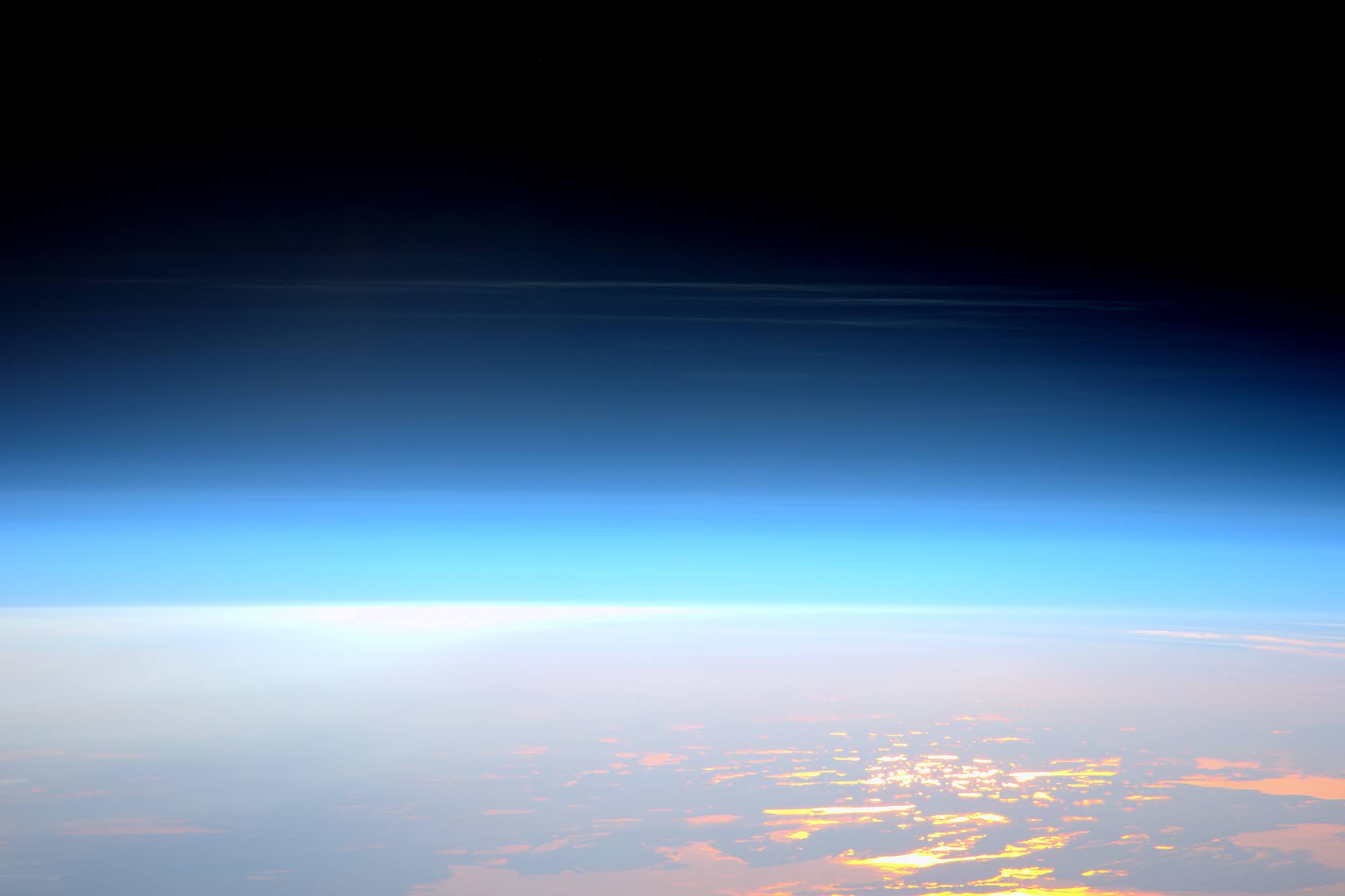
Image above: Noctilucent or "night shining" clouds forming in the mesosphere as seen from the International Space Station on May 29, 2016. These clouds form between 47 to 53 miles (76 to 85 kilometers) above Earth’s surface, near the boundary of the mesosphere and thermosphere, a region known as the mesopause. SOFIA is making direct measurements of atomic oxygen in this region, solidifying some of the basic science of how solar energy is exchanged between the surface and space. Image Credits: ESA/NASA/Tim Peake.

“SOFIA looks right through the Earth’s upper atmosphere as it observes the universe beyond, and I thought it would be fascinating to someday collect data from the GREAT instrument that could benefit studies of our own atmosphere,” said Hübers, director of DLR's Institute of Optical Sensor Systems and professor at Humboldt University in Berlin. “This is certainly not what you think of using SOFIA’s instruments for, but I tucked away the idea until I had an opportunity to test it out.”

Now, Hübers has proven it could be done. He recently published a paper with GREAT data that for the first time directly measured oxygen in one of the least understood regions of Earth’s upper atmosphere, the mesosphere and lower thermosphere.

The SOFIA results more completely confirm what theory, direct, and indirect measurements had predicted about the concentration of oxygen in this atmospheric region. This further solidifies some of the basic science around how solar energy is exchanged between the surface and space. The results were published in Nature Communications Earth and Environment.

SOFIA observed a particular form of unbonded oxygen, known as atomic oxygen, which is distinct from the life-giving O2 found at the Earth’s surface. Atomic oxygen plays an important role in cooling the upper atmosphere and therefore is used to estimate temperatures in this region. Climate models predict that increasing greenhouse gases will raise temperatures in the lower atmosphere yet decrease temperatures in the mesosphere. A more accurate monitoring of the mesosphere’s temperature can help researchers better understand the relationship between the lower and upper atmosphere. SOFIA’s direct measurements improve these temperature estimates.

Beginning at about 30 miles up, the mesosphere and thermosphere have been difficult to study. Ground-based telescopes are hampered by the distortion of water vapor in the lower atmosphere. High-flying satellites rely on other substances to infer levels of oxygen but could not make direct measurements. Instruments that flew on rockets and even on the Space Shuttle in the 1990s offered a brief snapshot of these regions.

Flying at about 40,000 feet (or 7 miles high), SOFIA, which utilizes a Boeing 747SP, soars above 99.9% of the water vapor in the atmosphere and is big enough to carry the infrared instruments needed to directly measure oxygen.  

More Than “Noise”

A trove of Earth’s atmospheric data from many seasons and locations already exists in SOFIA’s raw data archive. Yet, astronomers, interested in the stars, have always treated the atmospheric data as background “noise” and filtered it out from the sought-after celestial data. While Hübers saw that the atmospheric data could itself be valuable, it took several years to develop the right tools and processes to calibrate and analyze it.


Image above: Photo taken through SOFIA’s window during an observing flight from New Zealand. Aurora glow green high in Earth’s atmosphere in a region called the thermosphere. The Milky Way (left) and Mars (right) shine brightly above it. Image Credit: Ian Griffin.

“Given our previous successes, and the strong signal from Earth, it made sense to create the tools necessary to analyze atomic oxygen in the Earth’s atmosphere,” said Hübers. “Though the atmospheric data is really a byproduct of our astronomical observations, we are very pleased to see that SOFIA can contribute to better understanding our home planet.”

The work may prove valuable. This particular result came from data collected in 2015 during a SOFIA science flight that took off from Palmdale, California. As the aircraft headed up the coast toward Canada, it pointed the telescope toward the globular-shaped Jellyfish nebula, 5,000 light years away, collecting the Earth's atmospheric data in the process.

More insights into Earth’s atmosphere are to come. Measurements taken during SOFIA’s observations from New Zealand, in the Southern Hemisphere’s winter months, and during recent flights from Cologne, Germany, will provide information about how this region of the atmosphere changes across seasons and locations. 

SOFIA telescope bay door opening. Animation Credit: NASA

SOFIA is a joint project of NASA and the German Aerospace Center. NASA’s Ames Research Center in California’s Silicon Valley manages the SOFIA program, science, and mission operations in cooperation with the Universities Space Research Association, headquartered in Columbia, Maryland, and the German SOFIA Institute at the University of Stuttgart. The aircraft is maintained and operated by NASA’s Armstrong Flight Research Center Building 703, in Palmdale, California.

Related links:

Nature Communications Earth and Environment: https://www.nature.com/articles/s43247-020-00084-5#citeas

SOFIA: http://www.nasa.gov/mission_pages/SOFIA/index.html

Images (mentioned), Animation (mentioned), Text, Credits: NASA/Kassandra Bell/Elizabeth Landau/Ames Research Center/Alison Hawkes.

Greetings, Orbiter.ch

NASA’s InSight Detects Two Sizable Quakes on Mars


NASA - Mars InSight Mission patch.


Apr 1, 2021

The magnitude 3.3 and 3.1 temblors originated in a region called Cerberus Fossae, further supporting the idea that this location is seismically active.

InSight Starts Burying Seismometer’s Cable

Video above: NASA’s InSight lander used a scoop on its robotic arm to begin trickling soil over the cable connecting its seismometer to the spacecraft on March 14, 2021, the 816th Martian day, or sol of the mission. Scientists hope insulating it from the wind will make it easier to detect marsquakes. Video Credits: NASA/JPL-Caltech.

NASA’s InSight lander has detected two strong, clear quakes originating in a location of Mars called Cerberus Fossae – the same place where two strong quakes were seen earlier in the mission. The new quakes have magnitudes of 3.3 and 3.1; the previous quakes were magnitude 3.6 and 3.5. InSight has recorded over 500 quakes to date, but because of their clear signals, these are four of the best quake records for probing the interior of the planet.

Studying marsquakes is one way the InSight science team seeks to develop a better understanding of Mars’ mantle and core. The planet doesn’t have tectonic plates like Earth, but it does have volcanically active regions that can cause rumbles. The March 7 and March 18 quakes add weight to the idea that Cerberus Fossae is a center of seismic activity.

“Over the course of the mission, we’ve seen two different types of marsquakes: one that is more ‘Moon-like’ and the other, more ‘Earth-like,’” said Taichi Kawamura of France’s Institut de Physique du Globe de Paris, which helped provide InSight’s seismometer and distributes its data along with the Swiss research university ETH Zurich. Earthquake waves travel more directly through the planet, while those of moonquakes tend to be very scattered; marsquakes fall somewhere in between. “Interestingly,” Kawamura continued, “all four of these larger quakes, which come from Cerberus Fossae, are ‘Earth-like.’”

The new quakes have something else in common with InSight’s previous top seismic events, which occurred almost a full Martian year (two Earth years) ago: They occurred in the Martian northern summer. Scientists had predicted this would again be an ideal time to listen for quakes because winds would become calmer. The seismometer, called the Seismic Experiment for Interior Structure (SEIS), is sensitive enough that, even while it is covered by a dome-shaped shield to block it from wind and keep it from getting too cold, wind still causes enough vibration to obscure some marsquakes. During the past northern winter season, InSight couldn’t detect any quakes at all.

“It’s wonderful to once again observe marsquakes after a long period of recording wind noise,” said John Clinton, a seismologist who leads InSight’s Marsquake Service at ETH Zurich. “One Martian year on, we are now much faster at characterizing seismic activity on the Red Planet.”

Better Detection

The winds may have quieted down, but scientists are still hoping to improve their “listening” capability even more. Temperatures near the InSight lander may swing from almost minus 148 degrees Fahrenheit (minus 100 degrees Celsius) at night to 32 degrees Fahrenheit (0 degrees Celsius) during the day. These extreme temperature variations may be causing the cable connecting the seismometer to the lander to expand and contract, resulting in popping sounds and spikes in the data.

So the mission team has begun trying to partially insulate the cable from the weather. They’ve started by using the scoop on the end of InSight’s robotic arm to drop soil on top of the domed Wind and Thermal Shield, allowing it to trickle down onto the cable. That allows the soil to get as close to the shield as possible without interfering with the shield’s seal with the ground. Burying the seismic tether is in fact one of the goals of the next phase of the mission, which NASA recently extended by two years, to December 2022.

Despite the winds that have been shaking the seismometer, InSight’s solar panels remain covered with dust, and power is running lower as Mars moves away from the Sun. Energy levels are expected to improve after July, when the planet begins to approach the Sun again. Until then, the mission will successively turn off the lander’s instruments so that InSight can hibernate, waking periodically to check its health and communicate with Earth. The team hopes to keep the seismometer on for another month or two before it has to be temporarily turned off.

More About the Mission

Mars InSight Lander. Image Credits: NASA/JPL

JPL manages InSight for NASA’s Science Mission Directorate. InSight is part of NASA’s Discovery Program, managed by the agency’s Marshall Space Flight Center in Huntsville, Alabama. Lockheed Martin Space in Denver built the InSight spacecraft, including its cruise stage and lander, and supports spacecraft operations for the mission.

A number of European partners, including France’s Centre National d’Études Spatiales (CNES) and the German Aerospace Center (DLR), are supporting the InSight mission. CNES provided the Seismic Experiment for Interior Structure (SEIS) instrument to NASA, with the principal investigator at IPGP (Institut de Physique du Globe de Paris). Significant contributions for SEIS came from IPGP; the Max Planck Institute for Solar System Research (MPS) in Germany; the Swiss Federal Institute of Technology (ETH Zurich) in Switzerland; Imperial College London and Oxford University in the United Kingdom; and JPL. InSight’s Marsquake Service is a collaborative ground service operation led by ETH Zurich that also includes on-duty seismologists from IPG Paris, University of Bristol and Imperial College London. SEIS and APSS Operations are led by CNES SISMOC, with support of CAB, and SEIS data are formatted and distributed by the IPG Paris Mars SEIS Data Service. DLR provided the Heat Flow and Physical Properties Package (HP3) instrument, with significant contributions from the Space Research Center (CBK) of the Polish Academy of Sciences and Astronika in Poland. Spain’s Centro de Astrobiología (CAB) supplied the temperature and wind sensors.

Related links:

Seismic Experiment for Interior Structure (SEIS): https://mars.nasa.gov/insight/mission/instruments/seis/

Heat Flow and Physical Properties Package (HP3): https://mars.nasa.gov/insight/mission/instruments/hp3/

InSight Mars Lander: https://www.nasa.gov/mission_pages/insight/main/index.html

Video (mentioned), Image (mentioned), Text, Credits: NASA/Tony Greicius/Karen Fox/Alana Johnson/JPL/Andrew Good.

Best regards, Orbiter.ch

Sensors Collect Crucial Data on Mars Landings with Arrival of Perseverance


NASA - Mars 2020 Perseverance Rover logo.


 April 1, 2021


Image above: The MEDLI2 hardware is visible on the Mars 2020 heat shield as the heat shield falls toward the surface of Mars. The critical MEDLI2 electronics, two of the seven heat shield pressure transducers; these measure the stagnation pressure during the hypersonic and supersonic phases of flight, and one of the 11 heat shield temperature locations can be seen. The copper-colored harness snaking around the heat shield is also evident. The circuitous path of the harness was to avoid the rover wheels and other items on the bottom of the rover. Image Credits: NASA/JPL-Caltech.

“Tango delta. Touchdown confirmed. Perseverance safely on the surface of Mars, ready to begin seeking the signs of past life.” For more than six years, the Mars Entry, Descent, and Landing Instrumentation 2 (MEDLI2) team waited to hear these words.

NASA’s Perseverance rover successfully landed Feb. 18, 2021, beginning its robotic exploration of the Red Planet. MEDLI2 was one of the crucial technologies on the rover’s protective aeroshell that helped document the entry, descent, and landing (EDL) of the spacecraft. All of the MEDLI2 data was stored on Perseverance for transmission to Earth after a successful landing.

MEDLI2’s role was to collect critical data about the harsh environment during Perseverance’s entry through the planet’s atmosphere. It included three types of sensors – thermocouples, heat flux sensors, and pressure transducers – that measured extreme heat and pressure during entry. It also contained electronics and hardware for recording the thermal and pressure loads experienced during entry and through the parachute deployment.

MEDLI2 used its measurements to determine the heating and atmospheric forces that occurred on the heat shield and back shell. Together, these two components make up the aeroshell, which housed and protected the Perseverance rover during the cruise to Mars and EDL.


Image above: The MEDLI2 operations team in the control center at NASA’s Langley Research Center in Hampton, Virginia monitoring data received during the Perseverance’s final 5-hour coast to Mars. Image Credit: NASA.

MEDLI2 was powered on five hours before the “7 Minutes of Terror” or final 7-minute descent to Mars. This provided time for MEDLI2’s electronics to stabilize temperature and measure the initial conditions prior to entry. The team was relieved to receive the indication that MEDLI2 was successfully activated. The team continued to monitor the incoming data throughout this five-hour coast phase prior to entry.

The majority of the MEDLI2 sensors and the primary electronics were mounted on the Mars 2020 heat shield. About 10 seconds after the supersonic parachute deployed, MEDLI2 was powered down for the last time as it had completed its job. Since it is critical for the heat shield to be separated to allow the Perseverance rover to be extracted from the entry vehicle, it was required that MEDLI2 be turned off a few seconds before the separation to prevent any electrical power issues. The harness connecting the heat shield and back shell was then severed by the firing of a pyro-cutter, and the heat shield was dropped.

“We didn’t find any issues with the separation,” said Henry Wright, MEDLI2 project manager at NASA’s Langley Research Center in Hampton, Virginia. “The heat shield cleanly separated from the Mars 2020 entry vehicle. The MEDLI2 hardware was clearly visible on the heat shield as it fell toward the surface of Mars. Job well done!”

Perseverance also returned “critical event data” in real time during the EDL. It included a subset of the MEDLI2 data which allowed observations into what the entry vehicle was experiencing as the entry was happening. Three days after Perseverance’s successful landing, the remaining MEDLI2 data was transmitted back to Earth, and the next phase of the project began: data analysis and performance reconstruction.

“The returned data is fascinating. It’s like having a bird’s eye view of what’s happening to the aeroshell as it flies through Martian skies. The MEDLI2 sensor signals are so clear we could immediately pick out interesting phenomenon and crucial events” said Todd White, MEDLI2 principal investigator at NASA’s Ames Research Center in California’s Silicon Valley.

Data collected from MEDLI2 also provides measurements that will be used to determine the properties of the atmosphere the Mars 2020 entry vehicle flew through. MEDLI2 provides essential EDL observation data to understand how much margin remained on the Perseverance entry along with data that will be used to improve prediction models and tools for future missions.


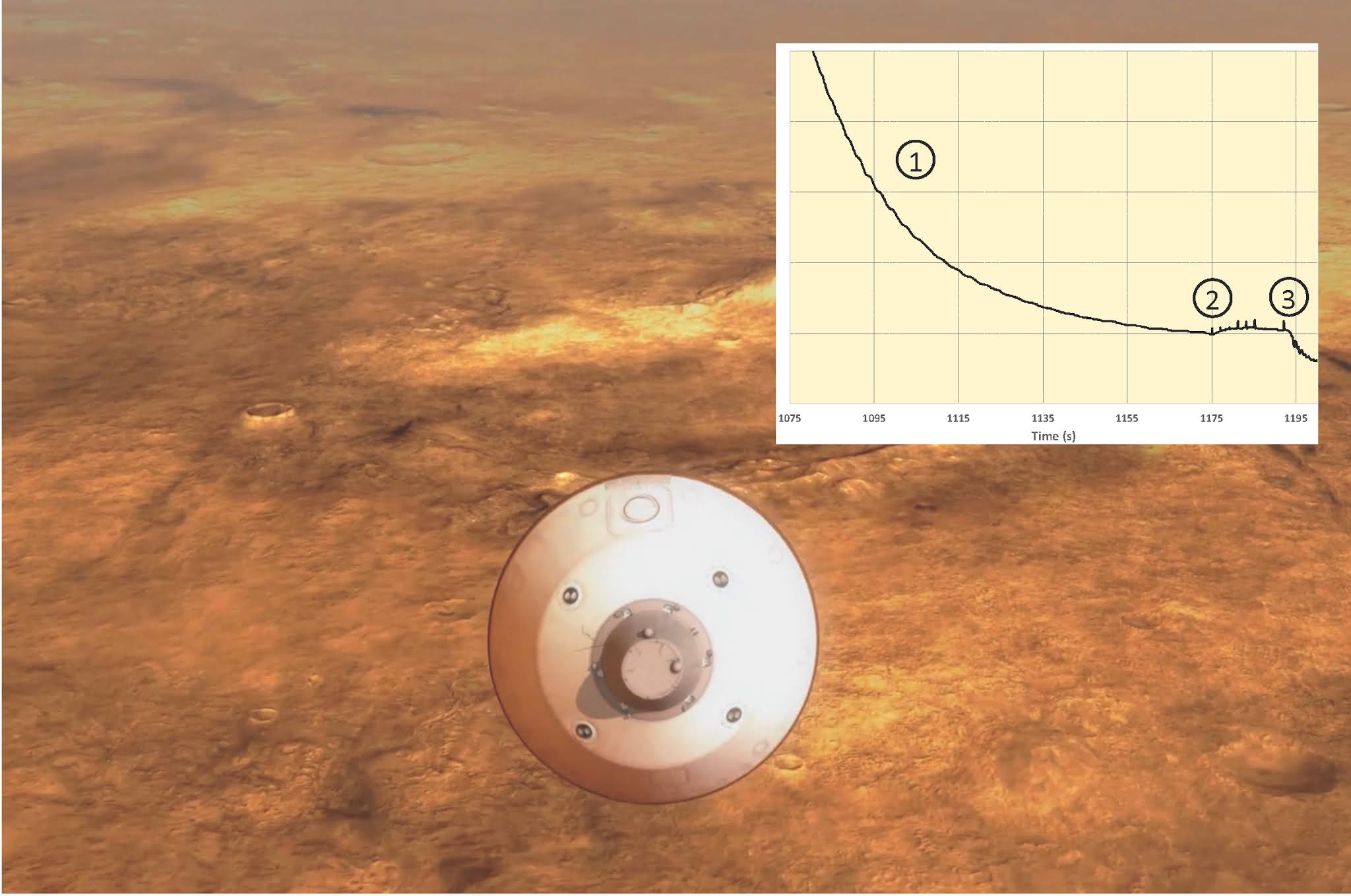
Image above: Shown in this illustration: As the Mars 2020 entry vehicle slowed down, it performed various maneuvers to control its intended landing point. Eventually, the vehicle ejected six tungsten ballast masses to allow the vehicle to better align itself for deployment of its supersonic parachute. MEDLI2 used the new pressure transducers designed specifically for this final phase of flight. 1. The changes in surface pressure that can be correlated to the various roll maneuvers performed by the Mars 2020 entry vehicle. 2. The ejection of the tungsten ballast masses and the change in surface pressure as the entry vehicle changes its attitude due to the shift in the entry vehicle center of mass. 3. The deployment of the supersonic parachute and the final deceleration prior to MEDLI2 being turned off. Image Credits: NASA/JPL-Caltech.

Taking a deeper look into the data

Heat shield insulation temperatures were recorded throughout the complete entry phase and were consistent with the entry predictions. The peak measured temperature in the heat shield during the entry was 1,830 degrees Fahrenheit, or 1,000 degrees Celsius. That correlates to an estimated peak heat shield outer temperature of about 2,550 degrees Fahrenheit, or 1,400 degrees Celsius.

MEDLI2 also used its embedded thermocouples to determine how much of the heat shield protective insulation may have burned away or ablated. All of the thermocouples survived the entry heating pulse, indicating the heat shield ablation was very low. This observation could be used to reevaluate the amount of insulation that is needed on a heat shield to potentially reduce the overall entry vehicle mass.

Surface pressures were also measured throughout the same phase with a peak surface pressure of the heat shield matching the team’s entry predictions. MEDLI2 picked different sensors to focus on accurately capturing different flight regimes. One sensor covered the complete range of the maximum surface pressures. The remaining six heat shield pressure measurements had a range to more accurately capture the conditions during the supersonic flight regime (from about five times the speed of sound on Mars through the deployment of the supersonic parachute). These sensors, combined with onboard inertial measurements, allows additional insight into how the entry vehicle performs when the impacts of atmospheric density variations and winds are more pronounced. The MEDLI2 pressure data will be used to improve the modeling approach for future EDL missions.

MEDLI2 included sensors on the back shell of the Mars 2020 entry vehicle, an area that until now has had limited observations. Surface pressure, insulation temperature, and direct surface heating measurements comprised the back shell sensor suite. Knowledge of the surface pressure on the back of the entry vehicle contributes to a reduction in the size of the landing footprint. Back shell insulation temperature data was within the initial predictions, which can be used to reduce the modeling uncertainty. As with the heat shield insulation, understanding the back shell insulation temperature performance could lead to a reduction in the back shell insulation mass. Direct surface heating measurements of the back shell also contribute to reducing the uncertainty in the predictive models.

MEDLI2 data also included a range of “housekeeping” measurements. These included a number of compensating temperature measurements of critical science sensors. Much of this housekeeping data is also of keen interest to the Mars 2020 team to aid in their own EDL reconstruction efforts. Part of the housekeeping measurements included sensors internal to the MEDLI2 support electronics (voltages, internal temperatures, MEDLI2 heartbeat/clock, etc.).

The MEDLI2 team will continue to analyze the data for the next six months, refining NASA’s understanding of the Mars atmosphere, the extreme conditions of entry, and how well the Mars 2020 aeroshell protected the rover. These lessons will be immediately useful for the next Mars missions, and even missions headed for Titan.


Image above: Data from MEDLI2 captured the complete range of environments experienced by the aeroshell protecting the Perseverance rover. Maximum conditions are experienced when the entry vehicle is traveling at about 20 times the speed of sound on Mars. 1. The current estimate of the maximum surface temperature of about 2500 degrees Fahrenheit. 2. The current estimate of the maximum surface pressure of about 4.2 psiA. 3. The change in slope of the insulation temperature indicating an increase in the surface heat rate due to the change from laminar to turbulent flow. 4. The current estimate of the maximum back shell pressure due to the separated wake flow of about 0.05 psiA. 5. The current estimate of the total heat flux of about 3 to 5 W/cm2 due to the flow over the back shell and the heat radiated from the shock layer. Image Credits: NASA/JPL-Caltech.

Langley led the MEDLI2 instrument development and project management. NASA’s Ames Research Center in California’s Silicon Valley and NASA’s Jet Propulsion Laboratory in Southern California contributed to MEDLI2. NASA’s Game Changing Development program within the Space Technology Mission Directorate funded the technology development.

Related links:

Mars Entry, Descent, and Landing Instrumentation 2 (MEDLI2): https://www.nasa.gov/directorates/spacetech/game_changing_development/projects/MEDLI-2

Perseverance Mars Rover: http://www.nasa.gov/perseverance

Images (mentioned), Text, Credits: NASA/Kristyn Damadeo/Game Changing Development program/Marina Guerges.

Greetings, Orbiter.ch

mercredi 31 mars 2021

First to orbit the Moon


CCCP Lunar Program - Luna-10 commemorative stamp.


March 31, 2021

Exactly 55 years ago, on March 31, 1966, the automatic station "Luna-10", created at the S.А. Lavochkin (now - Scientific and Production Association named after S. A. Lavochkin, part of the State Corporation "Roscosmos"). A few days later, it entered a stable orbit of the Moon and became its first artificial satellite in history!


Since 1958, a program aimed at studying outer space using interplanetary vehicles has been actively developing in the USSR. In 1966, the Soviet apparatus "Luna-9" (also produced by NPO Lavochkin) made a soft landing on the moon for the first time in history. Thanks to this, scientists learned a lot about its surface, but there was an acute question of a comprehensive study of the circumlunar space using orbiting satellites. To do this, NPO Lavochkin developed the Luna-10 apparatus.


The main goal of the Luna-10 interplanetary journey is to gain a foothold in the Moon's orbit, explore the circumlunar space, as well as the chemical composition of its surface on the visible and reverse sides. Entering orbit is not an easy task, as most circumlunar orbits are unstable. If the device flies too high, then it may just fly by, and if it is too low, then it risks falling to the surface of the moon. Despite this, a few days after launch, the device entered a stable orbit of the Moon, and became its first artificial satellite in history!


While Luna 10 was in orbit, scientists received direct data on the lunar surface and near-lunar space. By the nature of the reflected gamma radiation, we learned the general chemical composition and type of rocks that occur on the lunar surface. The device transmitted data on the intensity of the lunar magnetic field and the absence of radiation belts in its orbit. Analyzing the trajectory of the apparatus, scientists first discovered anomalies of the Moon's gravitational field: in some of its areas the attraction was stronger than in others. Flying over them, the device accelerated, which was displayed on the trajectory of its movement.


So scientists made the first map of the distribution of the Moon's gravitational field. These discoveries anticipated subsequent ones: years later, zones with anomalously strong gravity were called mascons and were described in detail using data from the Lunar Orbiter. It is assumed that the mascons were formed due to the excess density of matter in the area of impact craters, which, after their formation, were filled with molten mantle from the interior of the Moon.


In total, the Luna-10 station was actively functioning for 56 days, 219 communication sessions were conducted, which constituted an absolute world record. During this time, the apparatus fully fulfilled the scientific program entrusted to it, having completed 450 revolutions in the orbit of the Moon by the end of its active existence. The Soviet apparatus "Luna-10" was the first step in the study of other planets of the solar system from their orbit. Thanks to the project, extensive scientific information was obtained, which determined the success of future interplanetary missions.

ROSCOSMOS Press Release: https://www.roscosmos.ru/30546/

Images, Text, Credits: ROSCOSMOS/CCCP Lunar Program/Orbiter.ch Aerospace/Roland Berga.

Best regards, Orbiter.ch