lundi 18 octobre 2021

NASA’s Laser Communications Relay Demonstration Gears Up for Launch


NASA - Space Communication and Navigation (SCaN) patch.


Oct 18, 2021

NASA’s Laser Communications Relay Demonstration (LCRD) is gearing up for launch this fall, no earlier than Nov. 22. The payload arrived in Florida in May, fully integrated into its host spacecraft and ready for its final testing before being lofted into space.

Laser Communications Relay Demonstration (LCRD) Overview

Video above: Laser Communications Relay Demonstration (LCRD) Overview. Video Credits: NASA's Goddard Space Flight Center Conceptual Image Lab.

LCRD will leverage the power of infrared light to send and receive information encoded into invisible laser beams from one location to the next. Once in orbit, LCRD will demonstrate the benefits of using infrared lasers to communicate information from space. These benefits include increased data in a single downlink, as well as reduced size, weight, and power requirements for a communications system on a spacecraft.

As part of the final testing campaign, several LCRD team members integrated the last pieces of hardware, completed final inspections, and conducted launch integration systems tests at the Astrotech Space Operations facility in Titusville, Florida. Completed in May, these were the last set of Earth-based tests for the payload, ensuring its readiness for launch. Soon, the host spacecraft will be fueled with propellant and prepared for encapsulation and mating with an Atlas V rocket.


Image above: Illustration of NASA's Laser Communications Relay Demonstration communicating with the International Space Station over laser links. Image Credit: NASA's Goddard Space Flight Center.

Once the spacecraft is thrusted into space and reaches its destination in geosynchronous orbit – 22,000 miles above Earth’s surface – LCRD will become NASA’s first two-way laser communications relay.

LCRD is a NASA payload aboard the Department of Defense’s Space Test Program Satellite-6 (STPSat-6). STPSat-6, part of the third Space Test Program (STP-3) mission, will launch on a United Launch Alliance Atlas V 551 rocket from the Cape Canaveral Space Force Station in Florida. STP is operated by the United States Space Force’s Space Systems Command.

LCRD is led by NASA’s Goddard Space Flight Center in Greenbelt, Maryland. Partners include NASA’s Jet Propulsion Laboratory in Southern California and the MIT Lincoln Laboratory. LCRD is funded through NASA’s Technology Demonstration Missions program as part of the Space Technology Mission Directorate, and the Space Communications and Navigation (SCaN) program at NASA Headquarters.

Related links:

Laser Communications Relay Demonstration (LCRD): https://www.nasa.gov/mission_pages/tdm/lcrd/overview.html

SCaN (Space Communications and Navigation): https://www.nasa.gov/directorates/heo/scan/index.html

Image (mentioned), Video (mentioned), Text, Credits: NASA/GSFC/By Katherine Schauer.

Greetings, Orbiter.ch

Five Facts to Help You Understand Sea Ice


NASA - ICESat-2 Mission patch.


Oct 18, 2021

One way that scientists monitor climate change is through the measure of sea ice extent. Sea ice extent is the area of ice that covers the Arctic Ocean at a given time. Sea ice plays an important role in reflecting sunlight back into space, regulating ocean and air temperature, circulating ocean water, and maintaining animal habitats.


Image above: A still image visualizing Arctic sea ice on Sept. 16, 2021, when the ice appeared to reach its yearly minimum extent. On this date, the extent of the ice was 4.72 million square miles (1.82 million square kilometers). Image Credits: NASA's Scientific Visualization Studio.

NASA and the National Snow and Ice Data Center in Boulder, Colorado, use satellites to observe sea ice extent. Over the past several decades, Arctic sea ice extent has been steeply declining year-round, especially in late summer when it reaches its minimum for the year. Sea ice forms in the cold winter months, when seawater freezes into massive blocks of floating ice, then partially melts away in the warm summer months. This cycle repeats every year.

Here are five facts to help you better understand Arctic sea ice.

1. Sea Ice Extent is Declining


Graphic above: In 2021, Arctic Sea Ice was 12th lowest on record. Graphic Credits: NASA Earth Observatory images by Joshua Stevens, using data from the National Snow and Ice Data Center.

NASA has tracked sea ice minimum (usually in September) and maximum (usually in March) extents since 1978. While the exact extent figures may vary year to year, the overall trend is clear: the Arctic is losing sea ice year-round.

“The last 15 years, we've seen the lowest 15 sea ice minimum extents,” said Dr. Rachel Tilling, a sea ice scientist at the University of Maryland and NASA’s Goddard Space Flight Center in Greenbelt, Maryland. “Each year we're losing an area that's roughly the size of West Virginia.”

Arctic sea ice minimum extent is now declining at a rate of 13.1% per decade. The pace is likely to accelerate because of climate change-induced warming and the ice-albedo feedback cycle. The albedo effect describes the white ice surface’s ability to reflect Earth-bound sunlight back to space. Redirecting solar energy away from the ocean keeps the seawater beneath the ice cooler. When sea ice melts, darker-colored liquid water is left exposed to absorb sunlight. That warmer water then melts additional ice, creating the ice-albedo feedback cycle.

2. Sea Ice Helps Prevent Atmospheric Warming

Sea ice acts as a “blanket,” separating the ocean from the atmosphere, according to Tilling. In addition to keeping sunlight out, sea ice traps existing heat in the ocean, keeping it from warming the air above.

“The ability of the ice to keep heat in the ocean depends not only on its extent, but also on its thickness,” Tilling said.

Every year, some ice survives the summer melt. Once winter hits, more water freezes and it becomes thicker and stronger “multiyear ice.” First-year ice is thinner and more likely to melt, fracture, or even be swept out of the Arctic. With more ice melting every year, there is less recuring, multi-year ice. As a result, Arctic sea ice is as young and thin as it has ever been, making it a less efficient blanket.

Arctic Sea Ice Is the Thinnest and Youngest It's Been in 60 Years

Video above: Working from a combination of satellite records and declassified submarine sonar data, NASA scientists have constructed a 60-year record of Arctic sea ice thickness. Right now, Arctic sea ice is the youngest and thinnest its been since we started keeping records. More than 70 percent of Arctic sea ice is now seasonal, which means it grows in the winter and melts in the summer, but doesn't last from year to year. This seasonal ice melts faster and breaks up easier, making it much more susceptible to wind and atmospheric conditions. Video Credits: NASA/Katy Mersmann.

3. Sea Ice Affects Arctic Wildlife Above and Below Water

“There's a huge ecosystem that's impacted by changes to sea ice,” Tilling said. As sea ice declines, animals such as Arctic Foxes, polar bears and seals lose their habitat.

There are effects beneath the ice’s surface, too.

As ice crystals form atop seawater, they leave behind salt in the ocean below. This dense, salty water can sink to the bottom of the ocean. The descending water in one location will be offset by rising motion in others, which results in more nutrient-dense water circulating up toward the surface. Those nutrients are essential to microscopic phytoplankton, which are then eaten by fish and animals. The regular melt-freeze cycle keeps underwater Arctic life thriving, from algae to killer whales.

4. Sea Ice Melt Does Not Greatly Contribute to Sea Level Rise

Because sea ice forms from the seawater it floats on, it behaves much like an ice cube in a glass of water. Like that ice cube, which does not change the water level of the glass when it melts, melting sea ice in the Arctic does not dramatically change sea level. Melting land ice, for example from the Greenland or Antarctic ice sheets, does contributes to sea level rise. That’s because when land ice melts, it releases water that was previously trapped on land and adds to the water in the oceans.

5. Satellites Allow NASA to Monitor Sea Ice

ICESat-2 Adds the Third Dimension to Earth

Video above: NASA’s Ice, Cloud and land Elevation Satellite-2 (ICESat-2) will provide scientists with height measurements that create a global portrait of Earth's third dimension, gathering data that can precisely track changes of terrain including glaciers, sea ice, and forests. Video Credits: NASA/Ryan Fitzgibbons.

The Arctic Ocean is a difficult place to access and study. That’s why NASA, the National Oceanic and Atmospheric Administration (NOAA), the European Space Agency, and others, turn to the vantage point of space to gather observations from the region. Two types of instruments are generally used to monitor sea ice, Tilling said.

The first type are passive microwave instruments, which track extent over time. A series of these instruments aboard satellites supported by NASA, NOAA, the U.S. Department of Defense, and international partners, have monitored arctic sea ice extent since 1978 – more than 40 years.

“Passive microwave instruments measure the microwave emission of surfaces,” Tilling said. The microwave emissions occur naturally, and the signature of sea ice is different from that of water, allowing scientists to precisely locate both from year to year.

The second type are altimetry instruments, which can be used to estimate sea ice thickness. NASA’s Ice, Cloud and land Elevation Satellite-2 (ICESat-2), launched in 2018, uses a laser to measure the height of the ice and the height of the water. Using the known relationships between the two measurements (what height of ice above the water’s surface corresponds to the depth of the ice below it), scientists can calculate its total thickness.

Researchers continue to study the Arctic to learn more about the local and global consequences of diminishing sea ice.

“Our planet is this huge, interconnected place, and the atmosphere is connected across it,” Tilling says. “The Arctic is changing so rapidly, that we don't even know yet exactly how the changes there are going to impact us. All we know is that they will.”

Relates link:

Ice, Cloud and land Elevation Satellite-2 (ICESat-2): https://icesat-2.gsfc.nasa.gov/

Goddard Space Flight Center (GSFC): https://www.nasa.gov/centers/goddard/home/index.html

Images (mentioned), Videos (mentioned), Text, Credits: NASA/Ellen Gray/GSFC/By Alison Gold.

Greetings, Orbiter.ch

Hear Sounds From Mars Captured by NASA’s Perseverance Rover


NASA - Mars 2020 Perseverance Rover logo.


Oct 18, 2021

Two microphones aboard the six-wheeled spacecraft add a new dimension to the way scientists and engineers explore the Red Planet.


Image above: This illustration of NASA’s Perseverance Mars rover indicates the location of its two microphones. Image Credits: NASA/JPL-Caltech.

Thanks to two microphones aboard NASA’s Perseverance rover, the mission has recorded nearly five hours of Martian wind gusts, rover wheels crunching over gravel, and motors whirring as the spacecraft moves its arm. These sounds allow scientists and engineers to experience the Red Planet in new ways – and everyone is invited to listen in.

“It’s like you’re really standing there,” said Baptiste Chide, a planetary scientist who studies data from the microphones at L’Institut de Recherche en Astrophysique et Planétologie in France. “Martian sounds have strong bass vibrations, so when you put on headphones, you can really feel it. I think microphones will be an important asset to future Mars and solar system science.”


Image above: These commercial-grade microphones are similar to one on the chassis of NASA’s Perseverance Mars rover. Image Credits: Courtesy of DPA.

Perseverance is the first spacecraft to record the sound of the Red Planet using dedicated microphones – both of which were commercially available, off-the-shelf devices. One rides on the side of the rover’s chassis. The second mic sits on Perseverance’s mast as a complement to the SuperCam laser instrument’s investigations of rocks and the atmosphere.

NASA's Perseverance Rover Captures the Sounds of Mars

Video above: NASA’s Perseverance Mars rover carries two microphones which are directly recording sounds on the Red Planet, including the Ingenuity helicopter and the rover itself at work. For the very first time, these audio recordings offer a new way to experience the planet. Image Credits: NASA/JPL-Caltech.

The body mic was provided by NASA’s Jet Propulsion Laboratory in Southern California, while the SuperCam instrument and its microphone were provided by the Los Alamos National Laboratory (LANL) in New Mexico and a consortium of French research laboratories under the auspices of the Centre National d’Etudes Spatiales (CNES).

The Era of Space Microphones

SuperCam studies rocks and soil by zapping them with a laser, then analyzing the resulting vapor with a camera. Because the laser pulses up to hundreds of times per target, opportunities to capture the sound of those zaps quickly add up: the microphone has already recorded more than 25,000 laser shots.

Some of those recordings are teaching scientists about changes in the planet’s atmosphere. After all, sound travels through vibrations in the air. From its perch on Perseverance’s mast, the SuperCam mic is ideally located for monitoring “microturbulence” – minute shifts in the air – and complements the rover’s dedicated wind sensors, which are part of a suite of atmospheric tools called MEDA, short for the Mars Environmental Dynamics Analyzer.

MEDA’s sensors sample the wind’s speed, pressure, and temperature one to two times per second for up to two hours at a time. SuperCam’s microphone, on the other hand, can provide similar information at a rate of 20,000 times per second over several minutes.


Image above: NASA’s Perseverance Mars rover carries two commercial-grade microphones, including this one on its mast. The mast microphone is part of the SuperCam instrument. Image Credits: NASA/JPL-Caltech.

“It’s kind of like comparing a magnifying glass to a microscope with 100 times magnification,” said MEDA’s principal investigator, Jose Rodriguez-Manfredi of the Centro de Astrobiología (CAB) at the Instituto Nacional de Tecnica Aeroespacial in Madrid. “From the weather scientist’s point of view, each perspective – detail and context – complements one another.”

The microphone also allows for research on how sound propagates on Mars. Because the planet’s atmosphere is much less dense than Earth’s, scientists knew higher-pitched sounds in particular would be hard to hear. In fact, a few scientists – unsure if they’d hear anything at all – were surprised when the microphone picked up the Ingenuity helicopter’s buzzing rotors during its fourth flight, on April 30, from a distance of 262 feet (80 meters).

Information from the helicopter audio enabled researchers to eliminate two of three models developed to anticipate how sound propagates on Mars.


Image above: NASA’s Perseverance Mars rover carries two commercial-grade microphones, including this one on its chassis. Image Credits: NASA/JPL-Caltech.

“Sound on Mars carries much farther than we thought,” said Nina Lanza, a SuperCam scientist who works with the microphone data at LANL. “It shows you just how important it is to do field science.”

Sound Check

There’s another aspect of space exploration that could benefit from an audio dimension: spacecraft maintenance. Engineers use cameras to monitor the wheel wear on Curiosity rover and dust accumulating on InSight’s solar panels. With microphones, they could also check a spacecraft’s performance the way mechanics might listen to a car engine.

The Perseverance team is amassing loads of recordings from the rover’s chassis mic, which is well-positioned to listen to its wheels and other internal systems. While there aren’t enough recordings yet to detect any changes, over time, engineers may be able to pore over that data and discern subtle differences, like additional electric current going to a particular wheel. This would add to the ways they already monitor the spacecraft’s health.

“We would love to listen to these sounds regularly,” said Vandi Verma, Perseverance’s chief engineer for robotic operations at JPL. “We routinely listen for changes in sound patterns on our test rover here on Earth, which can indicate there’s an issue that needs attention.”

More About the Mission

A key objective for Perseverance’s mission on Mars is astrobiology, including the search for signs of ancient microbial life. The rover will characterize the planet’s geology and past climate, pave the way for human exploration of the Red Planet, and be the first mission to collect and cache Martian rock and regolith (broken rock and dust).

Subsequent NASA missions, in cooperation with ESA (European Space Agency), would send spacecraft to Mars to collect these sealed samples from the surface and return them to Earth for in-depth analysis.

The Mars 2020 Perseverance mission is part of NASA’s Moon to Mars exploration approach, which includes Artemis missions to the Moon that will help prepare for human exploration of the Red Planet.

JPL, which is managed for NASA by Caltech in Pasadena, California, built and manages operations of the Perseverance rover.

For more about Perseverance:

https://mars.nasa.gov/mars2020/ and https://nasa.gov/perseverance

Images (mentioned), Video (mentioned), Text, Credits: NASA/Tony Greicius/Karen Fox/Alana Johnson/JPL/Andrew Good.

Best regards, Orbiter.ch

NASA Selects Gamma-ray Telescope to Chart Milky Way Evolution


NASA - Compton Spectrometer and Imager (COSI) patch.


Oct 18, 2021

NASA has selected a new space telescope proposal that will study the recent history of star birth, star death, and the formation chemical elements in the Milky Way. The gamma-ray telescope, called the Compton Spectrometer and Imager (COSI), is expected to launch in 2025 as NASA’s latest small astrophysics mission.


Image above: NASA has selected a new gamma-ray space telescope, the Compton Spectrometer and Imager (COSI), that will chart the evolution of the Milky Way, seen here in this illustration. Image Credits: NASA/JPL-Caltech/R. Hurt (SSC/Caltech).

NASA’s Astrophysics Explorers Program received 18 telescope proposals in 2019 and selected four for mission concept studies. After detailed review of these studies by a panel of scientists and engineers, NASA selected COSI to continue into development.

“For more than 60 years, NASA has provided opportunities for inventive, smaller-scale missions to fill knowledge gaps where we still seek answers,” said Thomas Zurbuchen, associate administrator for the agency’s Science Mission Directorate in Washington. “COSI will answer questions about the origin of the chemical elements in our own Milky Way galaxy, the very ingredients critical to the formation of Earth itself.”

COSI will study gamma rays from radioactive atoms produced when massive stars exploded to map where chemical elements were formed in the Milky Way. The mission will also probe the mysterious origin of our galaxy’s positrons, also known as antielectrons – subatomic particles that have the same mass as an electron but a positive charge.

Compton Spectrometer and Imager (COSI). Image Credits: NASA/University of Berkeley

COSI’s principal investigator is John Tomsick at the University of California, Berkeley. The mission will cost approximately $145 million, not including launch costs. NASA will select a launch provider later.

The COSI team spent decades developing their technology through flights on scientific balloons. In 2016, they sent a version of the gamma-ray instrument aboard NASA’s super pressure balloon, which is designed for long flights and heavy lifts.

NASA's Explorers Program is the agency's oldest continuous program. It provides frequent, low-cost access to space using principal investigator-led space research relevant to the astrophysics and heliophysics programs. Since the 1958 launch of Explorer 1, which discovered Earth’s radiation belts, the program has launched more than 90 missions. The Cosmic Background Explorer, another NASA Explorer mission, led to a Nobel Prize in 2006 for its principal investigators.

NASA's Goddard Space Flight Center in Greenbelt, Maryland, manages the program for the agency.

Related link:

Compton Spectrometer and Imager (COSI): https://cosi.ssl.berkeley.edu/

For more information about the Explorers Program, visit: https://explorers.gsfc.nasa.gov

Images (mentioned), Text, Credits: NASA/Sean Potter/Alise Fisher/Liz Landau.

Greetings, Orbiter.ch

Physicists make most precise measurement ever of neutron’s lifetime


Physics logo.


Oct. 18, 2021

But decades-long mystery of how long the particles live persists.

Physicists have measured the lifetime of the neutron more precisely than ever before.


Image above: The magnet array for the UCNτ experiment at Los Alamos National Laboratory, where physicists have measured the lifetime of the neutron with the highest ever precision. Image Credit: Los Alamos National Laboratory.

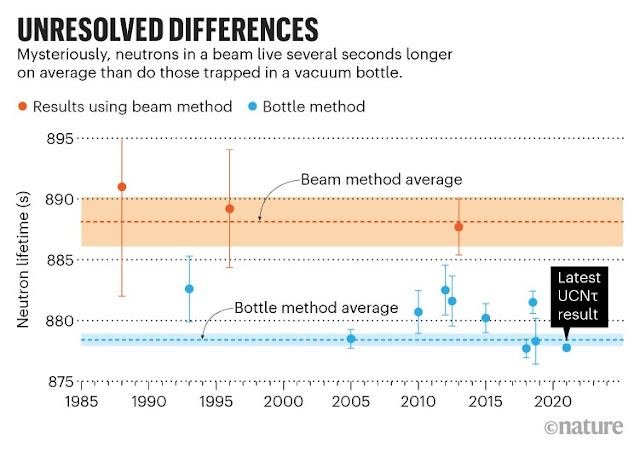
The average time it takes for the subatomic particle to decay is 877.75 seconds, according to an experiment that used magnetic fields to trap ultra-cold neutrons. The results have twice the precision of similar measurements, and are consistent with theoretical calculations. But they do not explain why in an alternative kind of experiment, neutrons last nearly 10 seconds longer.

The latest measurement was presented at a virtual meeting of the American Physical Society on 13 October, and published in Physical Review Letters (1).

The result is “very impressive”, says physicist Shannon Hoogerheide, who measures neutron lifetimes using a competing technique at the US National Institute of Standards and Technology (NIST) in Gaithersburg, Maryland.

Random decay

Most neutrons that exist in nature are part of non-radioactive atomic nuclei, where they can essentially last forever. But isolated neutrons, such as those produced by nuclear fission, are unstable and decay into protons. During the process, each decaying neutron emits an electron and an antineutrino.

Exactly how long it takes for a neutron to decay is random, but the average time is about a quarter of an hour. To get a precise value, Daniel Salvat, an experimental nuclear physicist at Indiana University in Bloomington, and his colleagues built an experiment called UCNτ at the Los Alamos National Laboratory in New Mexico. They slowed neutrons down to ultra-cold temperatures and placed them in a vacuum ‘bottle’, a metal structure shaped like the halfpipe in skateboarding. Magnetic fields at the bottom of the bottle prevented the neutrons from touching the surface, where they would have been lost.

The team kept neutrons in the bottle for periods of between 20 seconds and nearly half an hour, and detected sparks of light each time a neutron decayed. At the end of each cycle, they collected and counted the remaining neutrons, reloaded the bottle with fresh neutrons and started the process again.

UCNτ began more than ten years ago, but for the newly announced results — based on experimental runs in 2017 and 2018 — the team made several improvements that enabled them to halve their error margins.

The result’s precision is now competitive with calculations based on the standard model, the accepted theory of elementary particles, says Salvat. “For the first time, the experimental precision is starting to approach the precision of the theory,” he says. That means that future improvements could put the standard model itself to the test.

Bottle vs. beam

While some researchers use the ‘bottle’ technique to measure the neutron lifetime, others — such as Hoogerheide — use a method that involves watching the particles decay as they move in a beam (2). Until about 15 years ago, the results from these two types of experiment largely agreed within their error margins. But as the techniques became more precise, they began to go their separate ways. Neutrons in beams seem to live longer on average (see ‘Unresolved differences’).


Graphic Source: Wietfeldt, F. E. Atoms 6, 70, https://doi.org/10.3390/atoms6040070 (2018) and Ref. 1.

UCNτ’s latest measurement does not help to bridge the gap, says Anatolii Serebrov at the Petersburg Nuclear Physics Institute in Gatchina, Russia. “Even in the light of that new result, the discrepancy remains almost intact,” says Serebrov, who led a high-precision bottle experiment in 2005 (3) that first pointed to a possible discrepancy.

To help solve the neutron-lifetime dilemma, physicist David Lawrence at Johns Hopkins University in Baltimore, Maryland, and his collaborators have been developing a technique to measure it using neutron detectors on space probes. “It would be really useful to have a third way of doing it,” he says.

The method relies on the fact that most planetary bodies eject neutrons when hit by cosmic rays. Many of the neutrons fail to escape a planet’s gravity and eventually rain back down — but by then, some of those have transformed into protons. Comparing the number of neutrons emitted into space with those that come back can provide an estimate of the neutron’s lifetime (4). “Some fraction of the neutrons will go up, decay and never come back down,” Lawrence says. He adds that the ideal way to do such an experiment would be with a small, dedicated probe in orbit around Venus, because the planet’s carbon dioxide atmosphere does not absorb neutrons well.

The UCNτ team has been working on several improvements to increase precision further. Hoogerheide and her colleagues at NIST are doing the same with the beam technique; they expect that its precision can improve by around a factor of 10, she says.

doi: https://doi.org/10.1038/d41586-021-02812-z

References:

1. Gonzalez, F. M. et al. Phys. Rev. Lett. 127, 162501 (2021)
https://doi.org/10.1103%2FPhysRevLett.127.162501

2. Yue, A. T. et al. Phys. Rev. Lett. 111, 222501 (2013).
http://scholar.google.com/scholar_lookup?&title=&journal=Phys.%20Rev.%20Lett.&volume=111&publication_year=2013&author=Yue%2CA.%20T.

3. Serebrov, A. et al. Physics Letters B 605, 72 (2005).
http://scholar.google.com/scholar_lookup?&title=&journal=Physics%20Letters%20B&volume=605&publication_year=2005&author=Serebrov%2CA.

4. Wilson, J. T. et al. Phys. Rev. C 104, 045501 (2021).
http://scholar.google.com/scholar_lookup?&title=&journal=Phys.%20Rev.%20C&volume=104&publication_year=2021&author=Wilson%2CJ.%20T.

Image (mentioned), Graphic (mentioned), Text, Credits: Nature/Davide Castelvecchi.

Best regards, Orbiter.ch

Three hours to save Integral


ESA - Integral Mission patch.


Oct. 18, 2021

On 22 September, around midday, ESA’s Integral spacecraft went into emergency Safe Mode. One of the spacecraft’s three active ‘reaction wheels’ had turned off without warning and stopped spinning, causing a ripple effect that meant the satellite itself began to rotate.

Integral

As a result of the spacecraft turning, data were only reaching ground control patchily and the batteries were quickly discharging. With just a few hours of power left, it seemed possible that the 19-year-old mission could be lost.

The Integral Flight Control Team, together with Flight Dynamics and Ground Station Teams at ESA's ESOC mission control, teams at ESAC and Airbus Defence & Space, set to work. With quick thinking and ingenious solutions, they found the problem and rescued the mission.

What on Earth?

A Single Event Upset (SEU) occurs when a charged particle strikes a sensitive part of electrical equipment, causing a one-off ‘change of state’ that disrupts its functioning. These charged, ‘ionised’ particles often come from the Sun when it spews out matter and energy during solar flares or coronal mass ejections.

Three hours to save Integral – what happened?

“I don't think that the SEU on this occasion was caused by our local, occasionally grumpy star. This strike happened on a day when no relevant space weather activity was observed,” explains Juha-Pekka Luntama, ESA’s Head of Space Weather.

“Based on a discussion with our colleagues in the Flight Control Team, it looks like that the anomaly was triggered by charged particles trapped in the radiation belts around Earth.”

The Van Allen radiation belts are two doughnut-shaped regions encircling Earth, where energetic charged particles are trapped inside Earth's magnetic field. Their properties vary according to solar activity and they represent a hazard to satellites and humans in space that pass through them. Because the lowest point of Integral’s orbit is now only 1500 km from Earth’s surface, the spacecraft passes through both radiation belts in its orbit.

‘Darmstadt, we have a problem’

Integral uses ‘reaction wheels’ – wheels that store energy as they spin – to subtly control the direction the spacecraft points in without the need of thrusters.

Suddenly, one of these reaction wheels stopped and, because of the law of conservation of energy, that turning force previously in the wheel had to go somewhere else – the entire spacecraft. The spacecraft began to spin, triggering an Emergency Safe Attitude Mode which unfortunately, due to a previous failure, was no longer reliable and did not manage to stabilise the mission.

The reaction wheel was reactivated by teams on the ground, but the spacecraft kept spinning at an average rate of about 17 degrees per minute (roughly one rotation every 21 minutes), as well as wobbling unpredictably about its axes. This may not sound like much, but the spacecraft was rotating at five times its maximum when under control.

“The data coming down from Integral was choppy, coming in for short periods due to it spinning. This made analysis even harder,” explains Richard Southworth, Operations Manager for the mission.

The Integral Flight Control Team set to work rescuing the mission

“The batteries were discharging, as there were only short charging periods when the panels briefly faced the Sun.”

The first challenge was to decrease Integral’s energy consumption to buy more time. First estimates of the charge remaining before blackout and the loss of the satellite was just three hours. Step by step, by turning off various instruments and non-critical components, this increased to more than six hours. Next step – stop the spinning.

With support from industry experts, the team at ESOC analysed the state of the reaction wheels, coming up with a series of commands to change their speed and brake the spinning satellite. By late afternoon, the commands were sent and immediately showed success, but another three long hours passed before the satellite was fully under control and out of immediate danger.

Integral’s ‘Apollo 13’ moment

“Everyone breathed a huge sigh of relief. This was very close, and we were immensely relieved to get the spacecraft out of this ‘near-death’ experience,” recalls Andreas Rudolph, Head of the Astronomy Missions Division in ESOC's Mission Operations Department.

“Most of the Control Team were working from home at this point – I was following operations from the train! – and worked until four in the morning to get the spacecraft fully stable, back into position and facing the Sun to recharge its batteries.”

An artist's impression of the mechanisms in an interacting binary system

Unfortunately, a few hours later as the team reconvened to discuss the next steps, the spacecraft once again started to rotate, its reaction wheels again turning at high speed. The reason for this is still not completely understood but is thought to be associated with a ‘star tracker occultation’ or ‘blinding’ which wasn’t handled correctly by the satellite’s control systems – effectively when Earth gets in the way of the spacecraft’s view of the stars, which it uses to orient itself.

The team repeated the previous days steps to stabilise the spacecraft and return to a Sun pointing position, this time without getting in the way of the star trackers. The recovery took just a couple of hours, putting in to practice the lessons learnt from the first time.

Integral has since remained under control, and from 27 September all systems are back online. Since 1 October, after an extended checkout, its instruments are back observing the high energy Universe.

Hubble’s sharpest view of the Orion Nebula

One of the first targets for Integral will be to observe massive stars in the Orion region, and study the impact on their surroundings when they go supernova.

“We are also back to ‘target of opportunity’ observations, which means that Integral is again reacting quickly to study unexpected explosive events in the Universe,” says Erik Kuulkers, ESA’s Project Scientist for Integral.

A problem of thrust

It’s not the first time this almost 20-year-old mission gave the control team at ESA’s ESOC Operations Centre a scare. Last year, Integral fired its thrusters for possibly the last planned time, after a failure with its propulsion system.

It’s this deficient propulsion system that meant a normally rectifying Safe Mode was ineffective on this occasion. With the mode now disabled, the Control Team are working on a new automatic rescue sequence that should mimic many of the operations carried out after this anomaly, only much faster.

When the propulsion system failed, the team realised they would have to learn to manoeuvre the four-tonne satellite using its highly sensitive reaction wheels alone, to dump energy at regular periods and counteract forces on the spacecraft, including the gentle shove from the Sun’s light. It was a solution that had never been tried before.

Artist's view of Integral

“I didn’t believe it was possible at first. We checked with our flight dynamics colleagues and the theory indicated it would work. After doing a simulation, we tested it on the spacecraft. It worked,” explains Richard.

“Thanks to our quick-witted team and the help of experts from across industry, Integral lives on. Almost two decades old, it is far outliving expectations for what was meant to be a five-year mission.”

Listen to Richard recount the story of Integral’s previous rescue and upgrade and the amazing teamwork that saved the mission, in the latest episode of the ESA Explores Space Operations podcast: https://esaexploresoperations.podbean.com/

Related links:

ESA’s Integral: https://www.esa.int/Science_Exploration/Space_Science/Integral_overview

ESA's ESOC: https://www.esa.int/About_Us/ESOC

ESA's ESAC: https://www.esa.int/About_Us/ESAC

Airbus Defence & Space: https://www.airbus.com/space.html

ESA’s Space Weather: https://www.esa.int/Safety_Security/Space_weather

Images, Text, Credits: ESA/D. Ducros/NASA, ESA, M. Robberto (Space Telescope Science Institute/ESA) and the Hubble Space Telescope Orion Treasury Project Team.

Greetings, Orbiter.ch

dimanche 17 octobre 2021

Russian Station Veteran, Filmmakers Back on Earth


ROSCOSMOS - Soyuz MS-18 Mission patch.


October 17, 2021

Russian cosmonaut Oleg Novitskiy of Roscosmos and Russian actress Yulia Peresild and Russian producer-director Klim Shipenko landed on Earth at 12:35 a.m. EDT Sunday, October 17 in Kazakhstan (10:35 a.m. Kazakhstan time), southeast of the remote town of Dzhezkazgan. The trio departed the International Space Station in their Soyuz MS-18 spacecraft at 9:14 p.m.


Image above: The Soyuz MS-18 crew ship departs the space station with three Russian crew members on their way home to Earth. Image Credit: NASA TV.

Novitskiy arrived to the space station April 9 and returns to Earth after 191 days in space on his third mission that spanned 3,056 orbits of Earth and 80.9 million miles. During the mission, he completed three spacewalks totaling 22 hours, 38 minutes. He has now logged 531 days in space on his three flights.

Soyuz MS-18 undocking and departure

Peresild and Shipenko arrived at the station Oct. 5 as spaceflight participants for 12 days of filming their movie, “Challenge,” under a commercial agreement between Roscosmos and Moscow-based media entities.

The trio will return by Russian helicopters to the recovery staging city in Karaganda, Kazakhstan, before boarding a Gagarin Cosmonaut Training Center aircraft to return to their training base in Star City, Russia.


Image above: The Soyuz MS-18 crew ship with three Russian crew mates is pictured just moments from landing in the steppe of Kazakhstan. Image Credits: Roscosmos/NASA TV.

Remaining aboard the station is the seven-person crew of Expedition 66 with station commander Thomas Pesquet of ESA (European Space Agency), NASA astronauts Shane Kimbrough, Megan McArthur, and Mark Vande Hei, JAXA (Japanese Aerospace Exploration Agency) astronaut Akihiko Hoshide, and Roscosmos cosmonauts Anton Shkaplerov and Pyotr Dubrov.

Soyuz MS-18 landing

Later this month, NASA’s SpaceX Crew-3 members – NASA astronauts Raja Chari, Tom Marshburn, and Kayla Barron as well as ESA (European Space Agency) astronaut Matthias Maurer – will join the Expedition 66 members aboard the station. Crew-3 will be the third long-duration mission to fly as part of NASA’s Commercial Crew Program, continuing to provide the capability of regularly launching humans from American soil.

In November 2020, the International Space Station surpassed a 20-year milestone of continuous human presence, providing opportunities for unique technological demonstrations and research that help prepare for long-duration missions to the Moon and Mars while also improving life on Earth. To date, 246 people from 19 countries have visited the orbiting laboratory that has hosted nearly 3,000 research investigations from researchers in 108 countries and areas.

Related link:

International Space Station (ISS): https://www.nasa.gov/mission_pages/station/main/index.html

Images (mentioned), Videos, Text, Credits: NASA/Mark Garcia/NASA TV/SciNews.

Best regards, Orbiter.ch