mardi 30 novembre 2021

Are Water Plumes Spraying from Europa? NASA’s Europa Clipper is on the Case


NASA - Europa Clipper Mission patch.


Nov 30, 2021

Finding plumes at Europa is an exciting prospect, but scientists warn it’ll be tricky, even from up close.


Image above: On the left is a view of Europa taken on March 2, 1979, by the Voyager 1 spacecraft. Next is a color image of Europa taken by the Voyager 2 spacecraft during its close encounter on July 9, 1979. On the right is a view of Europa made from images taken by the Galileo spacecraft in the late 1990s. Image Credits: NASA/JPL.

In 2005, images of a brilliant watery plume erupting from the surface of Saturn’s moon Enceladus captivated the world. The giant column of vapor, ice particles, and organic molecules spraying from the moon's south polar region suggested that there’s a liquid water ocean below Enceladus’ ice shell and confirmed the moon is geologically active. The plume also thrust Enceladus and other worlds in the outer solar system, with no atmospheres and far from the heat of the Sun, toward the top of NASA’s list of places to search for signs of life.

Scientists now are preparing for a mission to another ice-covered ocean world with possible plumes: Jupiter’s moon Europa. Scheduled to launch in 2024, NASA’s Europa Clipper spacecraft will study the moon from its deep interior to its surface to determine whether it has ingredients that make it a viable home for life.

Like Enceladus, Europa is geologically dynamic, meaning both moons generate heat inside as their solid layers stretch and flex from the gravitational tug-of-war with their host planets and neighboring moons. This, instead of heat from the Sun, keeps subsurface water from freezing on these ice-covered moons. The heat may also help produce or circulate life’s chemical building blocks at the seafloors, including carbon, hydrogen, oxygen, nitrogen, phosphorus, and sulfur.

But that’s where the similarities end.

“A lot of people think Europa is going to be Enceladus 2.0, with plumes constantly spraying from the surface,” said Lynnae Quick, a member of the science team behind Clipper’s Europa Imaging System (EIS) cameras. “But we can’t look at it that way; Europa is a totally different beast,” said Quick, who’s based at NASA’s Goddard Space Flight Center in Greenbelt, Maryland.


Image above: One of the first images of Enceladus’ water jets taken by NASA’s Cassini spacecraft on Nov. 27, 2005. In this image, Enceladus is backlit by the Sun. Image Credits: NASA/JPL/Space Science Institute.

Evidence suggests Europa may vent water from its subsurface just like Enceladus. For example, scientists using NASA’s Galileo spacecraft, NASA’s Hubble Telescope, and large Earth-based telescopes have reported detections of faint water plumes or their chemical components at Europa.

But no one is certain. “We’re still in the space where there’s really intriguing evidence but none of it is a slam dunk,” said Matthew McKay Hedman, a member of Europa Clipper’s Mapping Imaging Spectrometer for Europa (MISE) science team and associate professor in the Department of Physics at the University of Idaho.

Scientists are drawn to plumes for a couple of reasons. First, they’re undeniably cool: “We’re scientists, but we’re also human,” said Shawn Brooks, who is working with Europa Clipper’s Europa Ultraviolet Spectrograph (Europa-UVS) science team and is based at NASA’s Jet Propulsion Laboratory in Southern California.

But more practically, Brooks said, plumes offer scientists easier access to Europa’s interior. “It all comes down to whether Europa is habitable, and that comes down to having some understanding of what is happening below the surface, which we can’t reach yet,” he said.

In other words, the magic of Europa, an archetype for a potentially habitable world, is hidden from view deep within the moon. Compared to Enceladus, which is the size of Texas, Europa is about a quarter of Earth’s size, or a bit smaller than Earth’s moon. And evidence suggests Europa has a much deeper saltwater ocean than Enceladus, possibly 40 to 100 miles (about 60 to 160 kilometers) deep, which means it could contain about twice as much water as Earth’s oceans. Some scientists hypothesize that Europa’s ocean could be reacting with superheated rocks below its seafloor, possibly through hydrothermal vents. On Earth, such areas are hotbeds of chemical activity that nourishes innumerable creatures.

Scientists say there also could be large pockets of melted water in Europa’s ice shell, which are more likely than the ocean to be the source of plumes. These pockets could produce cozy habitats for organisms as well.

Because it’s much closer to Jupiter than Enceladus is to Saturn, more heat is generated at Europa from friction produced as it circles its host planet. Given that internal heat  stimulates geological activity on rocky worlds, Europa is expected to have more extensive geology than Enceladus. Some scientists predict that Europa has plate tectonics that shift and recycle the icy blocks making up the moon’s surface. If so, Europa could be circulating nutrients produced on the surface by radiation from Jupiter, such as oxygen, to pockets of liquid in the ice shell or perhaps to the ocean itself. Through Europa Clipper, scientists will have a chance to test some of their predictions by analyzing the chemical makeup of plumes or the traces they may leave on the surface.


Image above: This composite image shows suspected plumes of water vapor erupting at the 7 o’clock position off the limb of Jupiter’s moon Europa. The plumes, photographed by NASA’s Hubble Space Telescope Imaging Spectrograph, were seen in silhouette as the moon passed in front of Jupiter. The Hubble data were gathered on January 26, 2014. The image of Europa, superimposed on the Hubble data, is assembled from data from the Galileo and Voyager missions. Image Credits: NASA/ESA/W. Sparks (STScI)/USGS Astrogeology Science Center.

Scientists warn that Europan plumes, even if they’re there, could be hard to detect even from up close. They may be sporadic, and they may be small and thin, given that Europa’s gravity, which is much stronger than Enceladus’, likely would keep these water plumes close to the surface. That’s a drastic departure from Enceladus’ spectacular vapor column: It’s always on and bigger than the moon itself, spraying icy particles hundreds of miles above the surface. “Even if they’re there, Europa’s plumes may not be that photogenic,” Hedman said.

Though Europa Clipper scientists are devising a variety of creative strategies to find active plumes when the spacecraft begins exploring Europa in 2031, they’re not relying on them to understand what’s going on inside the moon. “We don’t have to catch one for a successful mission,” Quick said.

Quick added that every instrument aboard Clipper can contribute evidence of habitable conditions below the surface regardless of active plumes.

A few examples of how the science team will search for potential plumes include Europa Clipper’s camera suite, EIS. It will scout for plumes near Europa’s surface partly by looking for their silhouettes at Europa’s limb, or edge, when the moon is illuminated by the light of Jupiter as it passes in front of the planet. EIS will snap photos of plumes should they appear, as well as plume deposits that might be visible on the surface. The Europa-UVS will also strive to detect plumes in ultraviolet light, including at the edge of the moon when Europa passes in front of nearby stars, and it can measure the chemical makeup of such plumes. A thermal camera, the Europa Thermal Emission Imaging System (E-THEMIS), will look for hotspots on the surface that may be evidence of active or recent eruptions.

The Europa Clipper team is set to succeed whether or not researchers find plumes at Europa, though many scientists hope for a spectacular water show to enrich the mission and our understanding of Europa. “I do suspect Europa is active and letting some material escape,” Hedman said. “But I expect that when we actually get to understand how it’s doing that, it’s not going to be what anyone expected.”

Ocean Worlds: The Search for Life

Video above: Life as we know it requires liquid water. Astrobiology, a field of science and engineering that describes efforts to find ingredients of life beyond Earth, is a search for planets, dwarf planets, and moons that harbor substantial liquid water. Scientists call these places “ocean worlds." Video Credits: NASA's Goddard Space Flight Center.

More About the Mission

Missions such as Europa Clipper contribute to the field of astrobiology, the interdisciplinary research on the variables and conditions of distant worlds that could harbor life as we know it. While Europa Clipper is not a life-detection mission, it will conduct detailed reconnaissance of Europa and investigate whether the icy moon, with its subsurface ocean, has the capability to support life. Understanding Europa’s habitability will help scientists better understand how life developed on Earth and the potential for finding life beyond our planet.

Managed by Caltech in Pasadena, California, JPL leads the development of the Europa Clipper mission in partnership with the Johns Hopkins Applied Physics Laboratory in Laurel, Maryland, for NASA’s Science Mission Directorate in Washington. The Planetary Missions Program Office at NASA’s Marshall Space Flight Center in Huntsville, Alabama, executes program management of the Europa Clipper mission.

More information about Europa can be found here: https://europa.nasa.gov/

Europa Clipper: http://www.nasa.gov/europa

Images (mentioned), Video (mentioned), Text, Credits: NASA/Svetlana Shekhtman/Karen Fox/Alana Johnson/JPL/Gretchen McCartney/GSFC/By Lonnie Shekhtman.

Best regards, Orbiter.ch

China’s Mars rover has amassed reams of novel geological data


CNSA - Tianwen-1 (天問-1) Mission to Mars logo.


Nov. 30, 2021

Data collected by the Tianwen-1 mission and Zhurong Mars rover are offering insights into a previously unexplored region of Mars’s northern hemisphere.


Image above: In July Zhurong took this image of the landing site of the parachute and part of the capsule that had carried it safely to the surface. Image Credit: CNSA.

More than 30 scientists across mainland China, Hong Kong and Macau are rushing to process data collected by China’s Mars rover, Zhurong, and by the nation’s Tianwen-1 spacecraft, which is in orbit around the planet. Several studies have trickled out, but researchers say that more are coming in the next weeks and months, offering insights on the climate, geology and history of Mars’s northern hemisphere.

Since September, the National Astronomical Observatories of the Chinese Academy of Sciences (NAOC), which has been receiving the data from space, has released nearly 200 gigabytes of information that was collected from eight instruments on the rover and orbiter between February and June. These instruments include cameras, a radar system, climate sensors and a laser spectrometer.

Some surface features, such as possible sedimentary material and potential mud volcanoes, hint at the historic flow of water, so scientists are looking for any clues that there was once water or ice below the surface. This is “of great scientific interest” as it might provide evidence of an ancient ocean, says Bo Wu, a planetary scientist at the Hong Kong Polytechnic University, who is analysing some of the data.

Tianwen-1 arrived at Mars in February. In May, it dropped a lander containing Zhurong onto a vast basin known as Utopia Planitia. The rover’s initial mission was intended to be only about three months long, but it has exceeded expectations. Over a period of four months, the rover travelled more than 1,000 metres, visiting features of interest and even investigating part of the capsule that brought it to the surface, along with the remains of the descent parachute.

Pause in communications

In September, Zhurong was powered down into hibernation by the China National Space Administration (CNSA) because Mars had passed behind the Sun, relative to Earth, meaning that communication was lost. However, in October it was powered up again, and has traversed another 200 metres in the direction of what may once have been the coastline of an ancient ocean.

The month-long break offered mission scientists at research institutes across China a chance to start analysing data. Some researchers had already received images of Mars from the orbiter’s cameras in March, and the CNSA had previously shared with the public images and videos taken by the rover during its descent and from the surface. But now researchers are studying the much larger volume of data released in September.

This data set includes images from Zhurong’s navigation camera; climatic data on temperature, pressure and wind speed; information on the chemical composition of rocks, soil and sand dunes from a laser spectrometer; and clues from below the surface from its ground-penetrating radar.

Apart from the handful of images and videos released by the CNSA, few scientific insights about the mission have been released or published until now. Researchers say this is because it has taken time to process and clean up the data.

Doing this ensures that the data are reliable and removes noise produced by the instruments, says Lu Pan, a planetary scientist at the University of Copenhagen. The fact that this mission is China’s first to the surface of another planet might also have slowed things down compared with NASA’s recent Mars missions. “If this is the first time you do it, there’s a learning process,” she says.

David Flannery, an astrobiologist at Queensland University of Technology in Brisbane, Australia, who is in communication with scientists in China, says that the team’s approach to managing data could also have contributed to the delay in releasing new insights. With NASA’s Perseverance mission, which Flannery is involved in, each instrument on the rover is designed by a different team, which has exclusive access to data from that instrument for a few months before it becomes available to all.

But under the CNSA model, the data generated for all the instruments on Zhurong and Tianwen-1 are processed by the NAOC, before making the information available to multiple teams of scientists linked to the mission.


Image above: The CNSA released this image in July of the view from the lander up towards the parachute as it drifted down to the surface of Mars. Image Credit: CNSA.

Speeding up the analysis

Two publications have already emerged. One study (1), posted as a pre-print in late September, analysed images and information on friction that were gleaned from the movement of Zhurong’s wheels. The results show that regions of Mars that the rover trundled over have properties similar to those of compact, sandy soil on Earth.

The study “provides useful data about surface soil properties”, says Xiao Long, a planetary geologist at the China University of Geosciences in Wuhan. This might be helpful for understanding how soil and dust on the surface formed, says Long, who is also conducting his own analysis.

A second study (2), published in August, used high-resolution images from the orbiter to pinpoint the rover’s precise coordinates on Mars. But researchers say that many more studies are expected soon, including some on the region’s topography.

So far, the data has been shared only with researchers directly involved with the mission, but Wu says that the NAOC will at some point release them to the public and the international community.

That could help to speed up the analysis. Scientists with more experience of Mars might be able to recognize features of interest and their significance more quickly, says Flannery. “Mars is peculiar in some ways, and geologists are only as good as the rocks they have seen in the past,” he adds.

Zhurong Mars rover. Image Credit: CNSA

Next phase of the mission

Zhurong will now continue to explore, potentially for years, as some of NASA’s Mars rovers have.

Tianwen-1 has also been busy. The spacecraft recently adjusted its orbit and switched from acting mainly as a communications relay between Zhurong and Earth to also conducting its own observations of Mars. Wenzhe Fa, a planetary scientist at Peking University, Beijing, who is analysing Zhurong’s radar data, says that on 11 November, the CNSA deployed and began to test the antenna for the orbiter’s radar.

Also earlier this month, the CNSA and the European Space Agency (ESA) trialled whether the ESA’s Mars Express orbiter could be used to relay Zhurong’s data to Earth — an exercise that Pan says is an “amazing step” towards increased international collaboration with China.

As Zhurong resumes its journey, Bo says that he and his team are providing “suggestions for future data collection” that take in surface features of particular scientific interest.

doi: https://doi.org/10.1038/d41586-021-03554-8

References:

1. Ding, L. et al. Preprint at Research Square https://doi.org/10.21203/rs.3.rs-836162/v1 (2021).

2. Wan, W. et al. Remote Sens. 13, 3439 (2021). https://doi.org/10.3390%2Frs13173439

Related link:

China National Space Administration (CNSA): http://www.cnsa.gov.cn/english/index.html

Images (mentioned), Text, Credits: Nature/Smriti Mallapaty.

Greetings, Orbiter.ch

ESO telescope uncovers closest pair of supermassive black holes yet


ESO - European Southern Observatory logo.


Nov. 30, 2021

Close-up and wide views of the nearest pair of supermassive black holes

Using the European Southern Observatory’s Very Large Telescope (ESO’s VLT), astronomers have revealed the closest pair of supermassive black holes to Earth ever observed. The two objects also have a much smaller separation than any other previously spotted pair of supermassive black holes and will eventually merge into one giant black hole.

Located in the galaxy NGC 7727 in the constellation Aquarius, the supermassive black hole pair is about 89 million light-years away from Earth. Although this may seem distant, it beats the previous record of 470 million light-years by quite some margin, making the newfound supermassive black hole pair the closest to us yet.

Close-up view of the nearest pair of supermassive black holes

Supermassive black holes lurk at the centre of massive galaxies and when two such galaxies merge, the black holes end up on a collision course. The pair in NGC 7727 beat the record for the smallest separation between two supermassive black holes, as they are observed to be just 1600 light-years apart in the sky. “It is the first time we find two supermassive black holes that are this close to each other, less than half the separation of the previous record holder,” says Karina Voggel, an astronomer at the Strasbourg Observatory in France and lead author of the study published online today in Astronomy & Astrophysics.

Bumps in the heavens

“The small separation and velocity of the two black holes indicate that they will merge into one monster black hole, probably within the next 250 million years,” adds co-author Holger Baumgardt, a professor at the University of Queensland, Australia. The merging of black holes like these could explain how the most massive black holes in the Universe come to be.

Voggel and her team were able to determine the masses of the two objects by looking at how the gravitational pull of the black holes influences the motion of the stars around them. The bigger black hole, located right at the core of NGC 7727, was found to have a mass almost 154 million times that of the Sun, while its companion is 6.3 million solar masses.

Wide-field view of the region of the sky hosting NGC 7727

It is the first time the masses have been measured in this way for a supermassive black hole pair. This feat was made possible thanks to the close proximity of the system to Earth and the detailed observations the team obtained at the Paranal Observatory in Chile using the Multi-Unit Spectroscopic Explorer (MUSE) on ESO’s VLT, an instrument Voggel learnt to work with during her time as a student at ESO. Measuring the masses with MUSE, and using additional data from the NASA/ESA Hubble Space Telescope, allowed the team to confirm that the objects in NGC 7727 were indeed supermassive black holes.

Journey to the closest pair of supermassive black holes

Astronomers suspected that the galaxy hosted the two black holes, but they had not been able to confirm their presence until now since we do not see large amounts of high-energy radiation coming from their immediate surroundings, which would otherwise give them away. “Our finding implies that there might be many more of these relics of galaxy mergers out there and they may contain many hidden massive black holes that still wait to be found,” says Voggel. “It could increase the total number of supermassive black holes known in the local Universe by 30 percent.”

How MUSE uncovered the closest pair of supermassive black holes

The search for similarly hidden supermassive black hole pairs is expected to make a great leap forward with ESO’s Extremely Large Telescope (ELT), set to start operating later this decade in Chile’s Atacama Desert. “This detection of a supermassive black hole pair is just the beginning,” says co-author Steffen Mieske, an astronomer at ESO in Chile and Head of ESO Paranal Science Operations. “With the HARMONI instrument on the ELT we will be able to make detections like this considerably further than currently possible. ESO’s ELT will be integral to understanding these objects.”

More information

This research was presented in a paper titled "First Direct Dynamical Detection of a Dual Super-Massive Black Hole System at sub-kpc Separation" to appear in Astronomy & Astrophysics (doi: https://www.edpsciences.org/10.1051/0004-6361/202140827).

The team is composed of Karina T. Voggel (Université de Strasbourg, CNRS, Observatoire astronomique de Strasbourg, France), Anil C. Seth (University of Utah, Salt Lake City, USA [UofU]), Holger Baumgardt (School of Mathematics and Physics, University of Queensland, St. Lucia, Australia), Bernd Husemann (Max-Planck-Institut für Astronomie, Heidelberg, Germany [MPIA]), Nadine Neumayer (MPIA), Michael Hilker (European Southern Observatory, Garching bei München, Germany), Renuka Pechetti (Astrophysics Research Institute, Liverpool John Moores University, Liverpool, UK), Steffen Mieske (European Southern Observatory, Santiago de Chile, Chile), Antoine Dumont (UofU), and Iskren Georgiev (MPIA).

The European Southern Observatory (ESO) enables scientists worldwide to discover the secrets of the Universe for the benefit of all. We design, build and operate world-class observatories on the ground — which astronomers use to tackle exciting questions and spread the fascination of astronomy — and promote international collaboration in astronomy. Established as an intergovernmental organisation in 1962, today ESO is supported by 16 Member States (Austria, Belgium, the Czech Republic, Denmark, France, Finland, Germany, Ireland, Italy, the Netherlands, Poland, Portugal, Spain, Sweden, Switzerland and the United Kingdom), along with the host state of Chile and with Australia as a Strategic Partner. ESO’s headquarters and its visitor centre and planetarium, the ESO Supernova, are located close to Munich in Germany, while the Chilean Atacama Desert, a marvellous place with unique conditions to observe the sky, hosts our telescopes. ESO operates three observing sites: La Silla, Paranal and Chajnantor. At Paranal, ESO operates the Very Large Telescope and its Very Large Telescope Interferometer, as well as two survey telescopes, VISTA working in the infrared and the visible-light VLT Survey Telescope. Also at Paranal ESO will host and operate the Cherenkov Telescope Array South, the world’s largest and most sensitive gamma-ray observatory. Together with international partners, ESO operates APEX and ALMA on Chajnantor, two facilities that observe the skies in the millimetre and submillimetre range. At Cerro Armazones, near Paranal, we are building “the world’s biggest eye on the sky” — ESO’s Extremely Large Telescope. From our offices in Santiago, Chile we support our operations in the country and engage with Chilean partners and society.

Links:

Supermassive Black Holes on a Collision Course (ESOcast 246 Light): https://www.eso.org/public/videos/eso2117a/

Research paper: https://www.edpsciences.org/10.1051/0004-6361/202140827

Photos of the VLT: http://www.eso.org/public/images/archive/category/paranal/

For journalists: subscribe to receive our releases under embargo in your language: https://www.eso.org/public/outreach/pressmedia/#epodpress_form

For scientists: got a story? Pitch your research: http://eso.org/sci/publications/announcements/sciann17369.html

Multi-Unit Spectroscopic Explorer (MUSE): https://www.eso.org/public/teles-instr/paranal-observatory/vlt/vlt-instr/muse/

HARMONI: https://elt.eso.org/instrument/HARMONI/

ESO’s Extremely Large Telescope (ELT): https://elt.eso.org/

Images Credits: ESO/Voggel et al.; ESO/VST ATLAS team. Acknowledgement: Durham University/CASU/WFAU/ESO/Voggel et al./ESO/Digitized Sky Survey 2. Acknowledgement: Davide De Martin/Videos Credits: ESO/L. Calçada ; N. Risinger (skysurvey.org); Digitized Sky Survey 2; VST ATLAS team; Voggel et al. Music: Azul Cobalto/ESO/L. Calçada; VST ATLAS team; Voggel et al./Text Credits: ESO/Bárbara Ferreira/Steffen Mieske/School of Mathematics and Physics, University of Queensland/Holger Baumgardt/Strasbourg Observatory, University of Strasbourg/Karina Voggel.

Best regards, Orbiter.ch

lundi 29 novembre 2021

Astronauts Ready for Tuesday’s Spacewalk


ISS - Expedition 66 Mission patch.


Nov. 29, 2021

Two NASA astronauts are preparing for a spacewalk on Tuesday to replace a faulty antenna system on the International Space Station. Flight Engineers Thomas Marshburn and Kayla Barron will exit the orbiting lab tomorrow after setting their U.S. spacesuits to battery power at 7:10 a.m. EST signifying the start of their spacewalk.

The duo was joined on Monday by three of their fellow Expedition 66 flight engineers collecting tools and reviewing procedures planned for the six-and-a-half-hour spacewalk. NASA astronaut Raja Chari partnered with Marshburn and Barron gathering and organizing tethers, cameras, and pistol grip tools. The three astronauts then joined NASA astronaut Mark Vande Hei and ESA (European Space Agency) astronaut Matthias Maurer for a procedures conference with spacewalk specialists on the ground.


Image above: The space station was pictured from the SpaceX Crew Dragon Endeavour during its departure on Nov. 8, 2021. Image Credit: NASA.

Chari and Vande Hei will be on duty throughout Tuesday monitoring the two astronauts during the spacewalk and helping them in and out of their spacesuits. Maurer will be at the controls of the Canadarm2 robotic arm assisting the spacewalkers at the Port-1 truss structure worksite. NASA TV begins its live coverage on Tuesday at 5:30 a.m. on the agency’s website, and the NASA app.

The station’s two cosmonauts, Flight Engineer Pyotr Dubrov and Commander Anton Shkaplerov, spent their day on a variety of space research and maintenance tasks in the orbiting lab’s Russian segment. Dubrov photographed the condition of the Nauka multipurpose laboratory module following the Prichal module’s docking on Friday. Shkaplerov swapped out life support hardware and began unpacking cargo from the newly arrived Prichal docking port.

NASA TV Covers Station Spacewalk Live on Tuesday

NASA astronauts Thomas Marshburn and Kayla Barron are scheduled to exit the International Space Station’s Quest airlock Tuesday for a spacewalk that will focus on replacing an S-band Antenna Subassembly (SASA) with a spare already available on the station’s truss structure.

Live coverage of the spacewalk will air on NASA Television, the agency’s website, and the NASA app beginning Nov. 30 at 5:30 a.m. EST, with the crew members scheduled to set their spacesuits to battery power about 7:10 a.m., signifying the start of their spacewalk.


Image above: NASA astronauts Thomas Marshburn and Kayla Barron will go on a spacewalk on Tuesday for station maintenance work. Image Credit: NASA.

Marshburn and Barron will work at the Port 1 (P1) truss structure, where the antenna is mounted. The antenna recently lost its ability to send signals to Earth via NASA’s Tracking and Data Relay Satellite System. Although its degradation has had limited impact on station operations, mission managers decided to install a new antenna to ensure communications redundancy. The space station has additional low-rate S-band systems, as well as the high-rate KU-band communications system that relays video.

During the planned six-and-a-half hour spacewalk, Marshburn will position himself at the end of the Canadarm2 robotic arm, working in tandem with Barron. Astronaut Matthias Maurer of ESA (European Space Agency) will control the robotic arm from inside the space station.

Spacewalk. Animation Credit: NASA

This will be the 245th spacewalk in support of space station assembly. Marshburn will be extravehicular crew member 1 (EV 1), with red stripes on his spacesuit, while Barron will be extravehicular crew member 2 (EV 2), with an unmarked suit.

This will be the fifth spacewalk for Marshburn, the first spacewalk for Barron, and the 13th spacewalk on the space station this year. The pair arrived for a six-month science mission at the space station Nov. 11 with NASA’s SpaceX Crew-3 mission aboard the Crew Dragon Endurance.

Related links:

NASA TV: https://www.nasa.gov/nasalive

Expedition 66: https://www.nasa.gov/mission_pages/station/expeditions/expedition66/index.html

Canadarm2 robotic arm: https://www.nasa.gov/mission_pages/station/structure/elements/mobile-servicing-system.html

Port-1 truss structure: https://www.nasa.gov/mission_pages/station/structure/elements/truss-structure

Space Station Research and Technology: https://www.nasa.gov/mission_pages/station/research/overview.html

International Space Station (ISS): https://www.nasa.gov/mission_pages/station/main/index.html

Images (mentioned), Animation (mentioned), Text, Credits: NASA/Mark Garcia.

Best regards, Orbiter.ch

Hubble’s View of Planetary Nebula Reveals Complex Structure


NASA - Hubble Space Telescope patch.


Nov 29, 2021


NGC 6891 is a bright, asymmetrical planetary nebula in the constellation Delphinus, the Dolphin. This Hubble image reveals a wealth of structure, including a spherical outer halo that is expanding faster than the inner nebula, and at least two ellipsoidal shells that are orientated differently. The image also reveals filaments and knots in the nebula’s interior, surrounding the central white dwarf star. From their motions, astronomers estimate that one of the shells is 4,800 years old while the outer halo is some 28,000 years old, indicating a series of outbursts from the dying star at different times.

Hubble studied NGC 6891 as part of efforts to gauge the distances to nebulae, and to learn more about how their structures formed and evolved. NGC 6891 is made up of gas that’s been ionized by the central white dwarf star, which stripped electrons from the nebula’s hydrogen atoms. As the energized electrons revert from their higher-energy state to a lower-energy state by recombining with the hydrogen nuclei, they emit energy in the form of light, causing the nebula’s gas to glow.

Hubble Space Telescope (HST)

For more information about Hubble, visit:

http://hubblesite.org/

http://www.nasa.gov/hubble

http://www.spacetelescope.org/

Image Credits: NASA, ESA, A. Hajian (University of Waterloo), H. Bond (Pennsylvania State University), and B. Balick (University of Washington); Processing: Gladys Kober (NASA/Catholic University of America)/Animation Credits: NASA/ESA/Text Credits: NASA/Andrea Gianopoulos/GSFC/Claire Andreoli.

Greetings, Orbiter.ch

Sentinel-6 returning most precise data ever on sea level


ESA / NASA - Sentinel-6 Mission patch.


Nov. 29, 2021

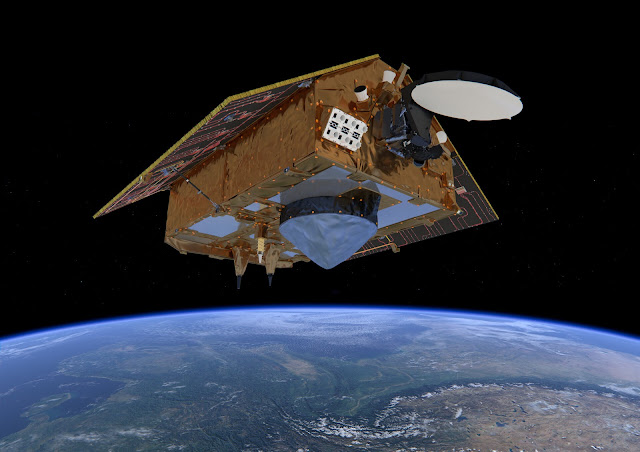
Sea-level rise is one of the most immediate consequences of climate change, as highlighted recently through urgent pleas from leaders of island nations at the COP26 summit. Global measures of sea-level rise are imperative to underpinning global policy and for strategies to protect coastlines and low-lying lands. Measuring tiny differences in the height of the sea surface from space is no easy task – but that’s exactly what the Copernicus Sentinel-6 Michael Freilich satellite is doing. And, after a year of exhaustive testing, this new mission is now delivering the world’s most accurate data on sea-level rise.

Tarawa, Kiribati

Launched on 21 November 2020, Copernicus Sentinel-6 Michael Freilich uses the latest radar altimetry technology, developed by ESA, to advance the long-term record of sea-surface height measurements that began in 1992 by the French–US Topex-Poseidon satellite and that were followed by the Jason series of satellite missions.

With the importance of monitoring sea-level rise so high on the global agenda, numerous organisations have been involved in making Copernicus Sentinel-6 the gold standard reference mission to take the record of sea-surface height measurements into the future, and to do this with greater precision than ever before.

So while Sentinel-6 is one of the European Union’s family of Copernicus missions, its implementation is the result of an exceptional cooperation between the European Commission ESA, Eumetsat, NASA and NOAA, with support from the CNES French space agency.

Tracking sea-level change

Eumetsat – the European Organisation for the Exploitation of Meteorological Satellites, is responsible for operating the satellite and for making the data available to users.

The first data products, which were low-resolution products, were released in June. This was an important step in the transition to the higher-resolution products being released today. The data have been used for weather forecasting and seasonal forecasting models, and to forecast the development and track of hurricanes.

Sentinel-6’s Poseidon-4 altimeter was designed to bring new high-resolution Ku-band synthetic aperture radar measurements into the altimetry reference time series. It, therefore, delivers simultaneous low-resolution measurements and high-resolution measurements. The low-resolution measurements are matched with measurements from the mission’s predecessor, Jason-3, and, therefore, critical to ensuring continuity, and the enhanced high-resolution data can then be offered with absolute confidence.

Copernicus Sentinel-6 in action

To make sure that differences between the historical low-resolution time series and the new data from Copernicus Sentinel-6 Michael Freilich are fully understood, a 12-month tandem flight has been taking place. This involves Sentinel-6 flying 30 seconds behind its predecessor satellite, Jason-3, following the same ground track.

Following months of careful testing, the stream of Copernicus Sentinel-6 high-resolution data are now available.

Eumetsat’s ocean altimetry programme manager, Julia Figa Saldana, said, “Experts from around the globe have closely examined and validated the data, confirming that the Copernicus Sentinel-6 mission is robust, precise and highly reliable. By cross-calibrating Sentinel-6 against its predecessor Jason-3 to within 1 mm, we ensure that the 30-year record of mean sea level, as captured by satellite radar altimeters, continues uninterrupted.

“The data released today is critical for monitoring the impact of climate change on Earth’s oceans.”

ESA’s Sentinel-6 mission scientist, Craig Donlon, added, “Measurements of sea-level rise provide a unique but integrated view of climate change since a warming ocean expands and increased melting of ice on land both lead to an increase in sea level.

“Sentinel-6 Michael Freilich securely brings a new synthetic aperture radar measurement technique into the reference altimeter time series for the first time. This allows Sentinel-6 to provide improved sea state and wind speed measurements, enhanced capabilities for river and lake hydrology applications while maintaining the stability of sea-level rise estimates. These measurements provide evidence that is critical to develop and implement robust societal policy for our future.”

Happy launch anniversary Sentinel-6 Michael Freilich

ESA’s Copernicus Sentinel-6 project manager, Pierrik Vuilleumier, noted, “The collaboration with NASA, EUMETSAT, NOAA and CNES has, today, come to fruition with the timely release of mission products to operational users, providing both continuity with previous reference missions and new high-resolution synthetic aperture radar products. The Poseidon-4 altimeter’s digital technology brings unprecedented level of performance.”

“While Sentinel-6 Michael Freilich is exceeding expectations in orbit, we are busy with its follow on, Sentinel-6B. The satellite is now at IABG’s facilities in Ottobrunn, Germany, undergoing an environmental test campaign that will run through until next March. In the middle of the year it will be put into storage until we prepare it for launch at the end of 2025.”

Related links:

Copernicus: https://www.esa.int/Applications/Observing_the_Earth/Copernicus

Sentinel-6: https://www.esa.int/Applications/Observing_the_Earth/Copernicus/Sentinel-6

Images, Videos, Text, Credits: ESA/Contains modified Copernicus Sentinel data (2020), processed by ESA, CC BY-SA 3.0 IGO/ATG medialab.

Best regards, Orbiter.ch

NASA Takes Another Step Toward Full Hubble Ops: Spectrograph Returns


NASA - Hubble Space Telescope patch.


Nov 29, 2021

The Hubble Space Telescope team recovered the Cosmic Origins Spectrograph instrument on Sunday, Nov. 28, moving the telescope further toward full science operations. Three of Hubble’s four active instruments are now collecting science data once again.

Hubble Space Telescope (HST). Image Credit: NASA

The team also continued work on developing and testing changes to instrument software that would allow them to conduct science operations even if they encounter several lost synchronization messages in the future. Those changes would first be installed on the Cosmic Origins Spectrograph once they’re completed and tested within a few weeks. Hubble’s other instruments would also receive similar changes. The team has not detected further synchronization message issues since monitoring began Nov. 1.

Related articles:

NASA Closer to Full Hubble Operations as Another Instrument Resumes Science
https://orbiterchspacenews.blogspot.com/2021/11/nasa-closer-to-full-hubble-operations.html

NASA’s Next Steps to Return Hubble Instruments to Normal Operation Status
https://orbiterchspacenews.blogspot.com/2021/11/nasas-next-steps-to-return-hubble.html

Hubble’s Advanced Camera for Surveys Instrument Resumes Science, Investigation Continues (Update)
https://orbiterchspacenews.blogspot.com/2021/11/hubbles-advanced-camera-for-surveys.html

NASA Takes Additional Steps to Investigate Hubble Instruments in Safe Mode
https://orbiterchspacenews.blogspot.com/2021/11/nasa-takes-additional-steps-to.html

Hubble Remains in Safe Mode, NASA Team Investigating
https://orbiterchspacenews.blogspot.com/2021/11/hubble-remains-in-safe-mode-nasa-team.html

Related links:

Hubble Space Telescope (HST): https://www.nasa.gov/mission_pages/hubble/main/index.html

Goddard Space Flight Center (GSFC): https://www.nasa.gov/centers/goddard/home/index.html

Image (mentioned), Text, Credits: NASA/Jamie Adkins/Elizabeth Landau/GSFC/Claire Andreoli.

Greetings, Orbiter.ch