jeudi 6 janvier 2022

SpaceX Starlink 34 launch


SpaceX - Falcon 9 / Starlink Mission patch.


Jan 6, 2022

SpaceX Starlink 34 liftoff

A SpaceX Falcon 9 rocket launched 49 Starlink satellites (Starlink-34) from Launch Complex 39A (LC-39A) at Kennedy Space Center in Florida, on 6 January 2022, at 21:49 UTC (16:49 EST).

SpaceX Starlink 34 launch & Falcon 9 first stage landing, 6 January 2022

Following stage separation, Falcon 9’s first stage (B1062) landed on the “A Shortfall of Gravitas” droneship, having previously supported three missions: GPS III Space Vehicle 04 (GPS III SV04), GPS III SV05 and Inspiration4.

Related links:

SpaceX: https://www.spacex.com/

Starlink: https://www.starlink.com/
 
Image, Video, Text, Credits: SpaceX/SciNews/Orbiter.ch Aerospace/Roland Berga.

Greetings, Orbiter.ch

mercredi 5 janvier 2022

Moon - Klondike on the surface (2)


ROSCOSMOS logo.


Jan 5, 2022

The discovery of water ice on the Moon on an industrial scale would open up great prospects for its development. Almost all existing projects for the construction of lunar bases provide for the use of local water resources. They are needed in the life support systems of manned stations, and are also required to obtain rocket fuel components. The second part of the article on the resources of the Moon will focus on water, California and, of course, the legendary helium-3.

One of the most unexpected discoveries made during the study of the moon was the discovery of signs of a significant amount of water ice under its surface. And this is in the absence of the atmosphere and traces of water bodies!


The first guesses appeared in 1994 thanks to a radar experiment carried out by the American probe "Clementine". The intensity and degree of polarization of the reflected radio waves recorded by ground-based radio telescopes made it possible to think about the presence of water ice in the region of the south pole of the moon. The authors of the discovery estimated the volume of deposits at about one cubic kilometer.

The studies continued in 1998. The neutron spectrometer installed on the Lunar Prospector spacecraft recorded an increased concentration of hydrogen on the surface near the lunar poles. According to new calculations, the share of water ice in the polar regions could be three to four percent of the mass of the upper soil layer.

More accurate information was obtained in 2009 thanks to an interesting experiment.

In a cloud of dust and gas

The American interplanetary station LRO was launched into orbit around the Moon with the Russian neutron detector LEND, developed and manufactured at IKI RAS under the guidance of Doctor of Phys.-Math. sciences Igor Mitrofanov. Studying the surface, the device indicated that in the area of ​​the Cabeus crater, there may be a particularly large amount of water ice.

To test the hypothesis, it was decided to use the upper stage Centaur, with the help of which the LRO flew to the Moon. It was to become a projectile fired at Cabeo crater for scientific purposes. The idea was that the fall of a heavy structure at high speed would inevitably lead to a flash of light and the ejection of a cloud of gas and dust. And the LCROSS research probe, sent after the Centaur block, flying through the ejected cloud, was supposed to analyze the chemical composition of the material raised from the bottom of the crater. We managed to carry out our plans in full.

As a result of the fall of the upper stage Centaur, an impact crater with a diameter of about 80 m was formed, from which a vapor cloud with a temperature of about 827 ° C rose. Following it, a dust cloud "grew", in which LCROSS was able to detect about 155 ± 12 kg of water in the form of steam.

Fig. 1

Taking into account the estimated total mass of the ejected regolith, the concentration of water ice in the surface layer at the site of the LCROSS fall was estimated at 2.7–8.5% of the mass. Some scientists believe that some of the steam passed the LCROSS sensors and the water concentration in the ground raised by the impact may be even higher.

In addition to water, spectral bands were also observed for a number of other volatile compounds, including light hydrocarbons, sulfur compounds, and carbon dioxide.

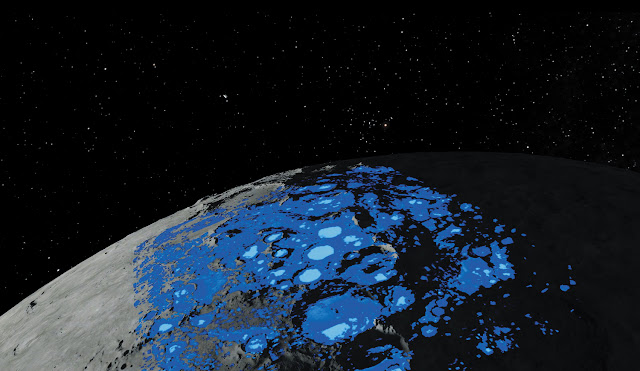
According to scientists from the PK Sternberg State Astronomical Institute (GAISh), Moscow State University, the total area of ​​eternally shaded areas in the Cabeo crater, in which water ice accumulates, may be ~ 530 km2 (Fig. 1). Based on these estimates, it can be assumed that the total mass of water ice in the ground of the Cabeo crater reaches ~ 18,000 tons. If this assumption is correct, then the total ice reserves in the south polar region of the Moon can be 100-200 thousand tons.

Ice caps

Over the past decade, the LEND instrument has completed more than 12,400 orbits of the Moon and transmitted more than 110 gigabytes of scientific information to Earth. On its basis, maps of the mass fraction of water in the lunar matter were constructed. Perhaps the main conclusion is that in the vicinity of the north and south lunar poles there are likely to be permafrost regions with a relatively high content of water ice, increasing at some points to several percent of the soil mass (Fig. 2).

Fig. 2

Similar studies were carried out by the Indian spacecraft "Chandrayan-1" with a multispectral scanner, the task of which was to map the locations of various minerals on the lunar surface. With its help, regions of distribution of minerals enriched in hydroxyl and water were discovered (Fig. 3).

Fig. 3

And in the region of the North Pole, in a relatively small area, the researchers found about 40 craters filled with ice. The diameters of these craters range from 2 km to 15 km. Calculations show that the total mass of ice deposits in them can reach 600 million tons.

Ice under your feet

In reality, there may be even more water resources on the moon. As already mentioned, before the launch of the LRO probe, it was believed that the most likely areas of the Moon with deposits of water ice are the so-called "cold traps" - shaded areas at the bottom of craters or depressions where the sun's rays do not fall. It was assumed that water molecules can no longer evaporate from such areas due to the constantly low temperature (about 60 degrees Kelvin, or −213 ° С).

Fig. 4

As a result of generalization of the research carried out with the help of LEND, it was concluded that frozen water can be found not only in "cold traps", but also on the normal surface of the Moon illuminated by the Sun. This was indicated by the weak emission of neutrons, which most likely indicates the concentration of hydrogen. This result was unexpected: it was believed that areas with a high content of hydrogen, and therefore ice, should coincide with the eternally shaded areas in the vicinity of the lunar poles.

Fig. 5

Trying to understand the metamorphosis, scientists looked closely at the photographs taken earlier during the lunar missions, in particular the Soviet "Lunokhod-1" (Fig. 4). It turned out that the loose, rough structure of the relief creates shadow micro-areas that can occupy up to half of the Moon's area. These "patches" of the lunar surface, most likely, hide ice in their shadow from heating by the rays of the Sun (Fig. 5).

Not only comets

For several years now, the discussion of options for the origin of lunar water ice has been going on. The initial versions - that water got to the moon with comets - are gradually being supplemented by more complex ones, which take into account the processes of interaction at the molecular level of the lunar surface with the surrounding space.

According to one of the modern hypotheses, water could be formed not only with the help of comets, but also by combining hydrogen atoms brought with the solar wind with oxygen, which is part of the lunar minerals. As a result of such a compound, hydroxyl could be formed (it consists of an oxygen atom and a hydrogen atom and resembles a water molecule - Ed.). Then the energy released by the impact of meteorites could contribute to the conversion of hydroxyl into water in the form of microscopic deposits of water ice.

Rarity in the Universe

The interaction of the solar wind and other types of cosmic radiation with the surface material of the Moon may present another surprise to earthlings.

In the description of the developments that are supposed to be included in the program of the China National Space Administration (CNSA), another truly unique material is mentioned. We are talking about California (Cf) - a radioactive chemical element. This metal is the most expensive in the world: the price of one gram reaches $ 30 million. Californium is used for scientific research and in medicine. Despite the high cost, the economic effect from the use of this rare metal covers the costs of its production.

On Earth, californium (isotope 252) is created in nuclear reactors by fissioning products irradiated with radioactive plutonium, curium, or neutrons. The essence of the production of this metal lies in the repeatedly repeated stages of decay and transformation of the initial element into an intermediate state - an isotope of another element.

Fig. 6

Chinese scientists suggest that californium can form on the lunar surface in natural conditions (Fig. 6). In their opinion, the concentration of californium on the moon is steadily increasing as a result of the bombardment of the surface by protons formed during solar flares.

Extraction of elements like california on the moon is likely to pay off any lunar program. But until the US Congress allocated funding for the entire Artemis program, and China's planned costs for a manned lunar program are not advertised, it is almost impossible to reliably estimate the cost of mining California on the Moon and delivering it to Earth.

But what about helium-3?

We should also recall the “legendary” helium-3, the “hero” of publications popular 10-15 years ago about saving mankind from energy hunger. It was supposed to be used as fuel in thermonuclear reactors in order to generate electricity for the entire Earth. It must be admitted that the efficiency of such a power plant would be really great. In addition, a helium-3 fusion reactor would be safer than a traditional one.

The problem, however, is that the temperature required to maintain the reaction with helium-3 is on the order of a billion degrees ... a billion! It is difficult even to imagine technical solutions for creating and maintaining such a temperature.

And as a last argument, it should be noted that the amount of helium-3 that falls on the moon as part of the particles of the solar wind and lingers in the lunar soil is catastrophically small. Its amount, according to the journal "Geokhimiya" (volume 51, No. 12 for 2013), varies from 0.02 mg to 130 mg per ton of surface soil, and it will be very difficult to extract it. Those who are interested in this issue, we can refer to the detailed article by A. A. Petrukovich "The moon and a penny of lunar energy" in the journal "Science and Life" No. 8, 2004.

Lunar reckoning

The stage of exploration of the Moon is far from over, and from the now begun new round of the "Lunar Race" (in which the domestic automatic devices "Luna-25", -26 and -27, and, hopefully, manned expeditions will also take a worthy part), we expect the next discoveries. It happens that in the process of such a search, researchers often find not at all what they originally planned, but something much more interesting. It is possible that the picture of lunar resources attractive to earthlings will look different in a few decades.

For example, you can recall that the main result of Columbus's travels to a new continent (then not yet called America, after the name of his main competitor) was not piles of gold (however, not too large), delivered to the Spanish crown, but the most ordinary potatoes, without which it is difficult imagine the life of medieval Europe in a couple of centuries.

The concept of lunar resources from the science fiction section should move in the coming years into a concrete practical plane. According to experts, the global concept of space exploration and the real use of extraterrestrial natural resources requires allocating up to a third of the total costs for the development of an industrial complex to space science.

Such a level of funding will be unattainable for any country in the world for a very long time. Society has not yet realized the gravity of the impending global problems. As a result, truly vital scientific space programs receive only very limited support, losing out to projects that, from the perspective of the future, can only be seen as petty fuss.

The authors hope that this article will help draw attention to the possibility of using space (in our case, lunar) resources to solve the serious problems that humanity will face in this century. The exploration of the Moon - actually the seventh continent of the Earth - should be a logical continuation of the space expansion that began on October 4, 1957 with the launch of the First artificial Earth satellite.

Credits: Lev Zeleny, Vladislav Shevchenko, Russian space.

Related article:

Moon - Klondike on the surface
https://orbiterchspacenews.blogspot.com/2021/12/moon-klondike-on-surface.html

Related links:

ROSCOSMOS Press Release: https://www.roscosmos.ru/33766/

Russian space: https://www.roscosmos.ru/tag/russkiy-kosmos/

Moon: https://www.roscosmos.ru/tag/luna/

Images, Text, Credits: ROSCOSMOS/Russian space/NASA/Orbiter.ch Aerospace/Roland Berga.

Best regards, Orbiter.ch

Space Biology, Science Hardware Work Keeping Station Crew Busy


ISS - Expedition 66 Mission patch.


Jan 5, 2022

Space biology work and science hardware maintenance and were the main research goals for the Expedition 66 crew aboard the International Space Station on Wednesday. The orbital residents also checked out life support gear and worked on cargo transfers.

Three NASA astronauts, Mark Vande Hei, Thomas Marshburn and Kayla Barron, joined each other in the Kibo laboratory module during the afternoon and set up external research components. Vande Hei installed the Multi-Purpose Experiment Platform (MPEP) in Kibo’s airlock that will later be placed outside in the vacuum of space. Marshburn and Barron assisted with the MPEP installation work ahead of tiny satellites, or CubeSats, being deployed from the device into Earth orbit.


Image above: NASA astronaut Kayla Barron sets up the Plant Habitat-05 Growth experiment that is studying cotton genetics in microgravity. Image Credit: NASA.

Marshburn then joined NASA Flight Engineer Raja Chari for vein scans in the Columbus laboratory module. Chari once again led the biomedical activities as crew medical officer using the Ultrasound 2 device to scan Marshburn’s neck, shoulder, and leg veins. Doctors on Earth monitor the health checks in real time to gain insight into how long-term microgravity affects the human body.

Barron also tended to the oxygen generation system before analyzing microbe samples collected from inside BEAM, the Bigelow Expandable Activity Module. Flight Engineer Matthias Maurer of ESA (European Space Agency) installed the ANITA-2 cabin air analyzer then inspected the Muscle Atrophy Research Exercise System ahead of upcoming new component work.

International Space Station (ISS). Animation Credit: NASA

Commander Anton Shkaplerov worked throughout Wednesday in the station’s Russian segment on electronics maintenance on cargo transfers from the ISS Progress 79 resupply ship. Shkaplerov also spent some time on a study researching how international crews and mission controllers relate during a long-duration spaceflight. Flight Engineer Pyotr Dubrov spent most of the day installing payload interface controller units while also finding time for immunity system research work.

Related links:

Expedition 66: https://www.nasa.gov/mission_pages/station/expeditions/expedition66/index.html

Kibo laboratory module: https://www.nasa.gov/mission_pages/station/structure/elements/japan-kibo-laboratory

Columbus laboratory module: https://www.nasa.gov/mission_pages/station/structure/elements/europe-columbus-laboratory

Ultrasound 2: https://www.nasa.gov/mission_pages/station/research/experiments/explorer/Facility.html?#id=736

Bigelow Expandable Activity Module (BEAM): https://www.nasa.gov/mission_pages/station/structure/elements/bigelow-expandable-activity-module.html

Muscle Atrophy Research Exercise System: https://www.nasa.gov/mission_pages/station/research/experiments/explorer/Facility.html?#id=343

How international crews and mission controllers relate: https://www.energia.ru/en/iss/researches/human/18.html

Immunity system: https://www.energia.ru/en/iss/researches/human/22.html

Space Station Research and Technology: https://www.nasa.gov/mission_pages/station/research/overview.html

International Space Station (ISS): https://www.nasa.gov/mission_pages/station/main/index.html

Image (mentioned), Animation (mentioned), Text, Credits: NASA/Mark Garcia.

Greetings, Orbiter.ch

Webb sunshield fully deployed


NASA / ESA / CSA-ASC - James Webb Space Telescope (JWST) patch.


Jan 5, 2022

The NASA/ESA/CSA James Webb Space Telescope team has fully deployed the spacecraft’s sunshield in space, a key milestone in preparing it for science operations.

The sunshield – about the size of a tennis court at full size – was folded to fit inside the Ariane 5 rocket’s nose cone prior to launch. The Webb team began remotely deploying the sunshield on 28 December 2021, three days after launch. The five-layered sunshield will protect the telescope from the light and heat of the Sun, Earth and Moon.

The unfolding occurred in the following order, over the course of eight days:

- Two pallet structures – forward and aft – unfolded to bring the observatory to its full 21 m length;

- The Deployable Tower Assembly deployed to separate the telescope and instruments from the sunshield and the main body of the spacecraft, allowing room for the sunshield to fully deploy;

- The aft momentum flap and membrane covers were released and deployed;

- The mid-booms deployed, expanding perpendicular to the pallet structures and allowing the sunshield to extend to its full width of 14 m;

- Finally, the sunshield was fully tensioned and secured into position, marking the completion of the sunshield deployment.

Webb unfolding sequence

The unfolding and tensioning of the sunshield involved 139 of Webb’s 178 release mechanisms, 70 hinge assemblies, eight deployment motors, roughly 400 pulleys, and 90 individual cables totaling almost half a kilometre in length. The team also paused deployment operations for a day to work on optimising Webb’s power systems and tensioning motors, to ensure Webb was in prime condition before beginning the major work of sunshield tensioning.

The world’s largest and most complex space science observatory has another 5.5 months of setup still to come, including deployment of the secondary mirror and primary mirror wings, alignment of the telescope optics, and calibration of the science instruments. After that, Webb will deliver its first images.

The telescope’s revolutionary technology will explore every phase of cosmic history – from within our Solar System to the most distant observable galaxies in the early Universe, to everything in between. Webb will reveal new and unexpected discoveries and help humankind understand the origins of the Universe and our place in it.

Webb’s journey to L2

Webb is the largest, most powerful telescope ever launched into space. As part of an international collaboration agreement, ESA has provided the telescope’s launch service using the Ariane 5 launch vehicle. Working with partners, ESA was responsible for the development and qualification of Ariane 5 adaptations for the Webb mission and for the procurement of the launch service by Arianespace.

Secondary Mirror Deployment Confirmed

Today, Webb teams successfully deployed the observatory’s secondary mirror support structure. When light from the distant universe hits Webb’s iconic 18 gold primary mirrors, it will reflect off and hit the smaller, 2.4-foot (.74-meter) secondary mirror, which will direct the light into its instruments. The secondary mirror is supported by three lightweight deployable struts that are each almost 25 feet long and are designed to withstand the space environment. Specialized heating systems were used to warm up the joints and motors needed for seamless operation.

“Another banner day for JWST,” said Bill Ochs, Webb project manager at NASA’s Goddard Space Flight Center, as he congratulated the secondary mirror deployment team at the Mission Operations Center in Baltimore. “This is unbelievable…We’re about 600,000 miles from Earth, and we actually have a telescope.”

Webb launch campaign highlights

The deployment process began at approximately 9:52 a.m. EST, and the secondary mirror finished moving into its extended position at about 11:28 a.m. EST. The secondary mirror support structure was then latched at about 11:51 a.m. EST. At approximately 12:23 p.m. EST, engineers confirmed that the structure was fully secured and locked into place and the deployment was complete.

“The world’s most sophisticated tripod has deployed,” said Lee Feinberg, optical telescope element manager for Webb at Goddard. “That’s really the way one can think of it. Webb’s secondary mirror had to deploy in microgravity, and in extremely cold temperatures, and it ultimately had to work the first time without error. It also had to deploy, position, and lock itself into place to a tolerance of about one and a half millimeters, and then it has to stay extremely stable while the telescope points to different places in the sky – and that’s all for a secondary mirror support structure that is over 7 meters in length.”

Next Webb will deploy an important radiator system known as the aft deployable infrared radiator (ADIR), which helps shed heat away from its instruments and mirrors.

Webb is an international partnership between NASA, ESA and the Canadian Space Agency (CSA).

Related article:

Sunshield Successfully Deploys on James Webb Space Telescope
https://orbiterchspacenews.blogspot.com/2022/01/sunshield-successfully-deploys-on-james.html

Related link:

James Webb Space Telescope (JWST): https://www.esa.int/Science_Exploration/Space_Science/Webb

Images, Video, Text, Credits: European Space Agency (ESA)/NASA.

Best regards, Orbiter.ch

NASA’s X-59 Kicks Off 2022 in Texas for Ground Testing


NASA - X-59 QueSST Mission patch.


Jan 5, 2022


Image above: NASA’s X-59 Quiet SuperSonic Technology aircraft (QueSST) is pictured here at Lockheed Martin Skunk Works in California, wrapped up in preparation for its move to Texas. The X-plane will undergo ground tests to ensure it can withstand the stresses of flight before returning to California for completion. Image Credits: Lockheed Martin.

2021 saw significant milestones achieved in the assembly of NASA’s X-59 Quiet SuperSonic Technology aircraft (QueSST), and all eyes now look forward to a pivotal 2022. Following the X-plane’s temporary move from Lockheed Martin’s Skunk Works in California to their facilities in Texas, the X-59 is set to start 2022 with critical ground testing, as progress continues toward NASA’s target of the aircraft’s first flight later this year.

While in Texas, ground testing of the X-59 will be done to ensure the aircraft can withstand the loads and stresses that typically occur during flight. The team will also calibrate and test the fuel systems before the X-59 makes the journey back to California for more tests and completion.

The X-59 is designed to reduce the loudness of the sonic boom, which occurs when an aircraft flies faster than the speed of sound, to a gentle, quiet sonic “thump”. The X-plane will demonstrate this in flights over communities around the U.S. starting in 2024, as NASA collects data that could open the future to commercial supersonic flights over land.

Related links:

Low-Boom Flight Demonstration (LBFD): https://www.nasa.gov/mission_pages/lowboom/index.html

X-59 Quiet SuperSonic Technology aircraft (QueSST): https://www.nasa.gov/specials/X59/

Image (mentioned), Text, Credits: NASA/Laura Newton/Armstrong Flight Research Center/Matt Kamlet.

Greetings, Orbiter.ch

mardi 4 janvier 2022

Dragon Checks, Biology and Spacewalk Preps Fill Crew Day


ISS - Expedition 66 Mission patch.


Jan 4, 2022

Crew Dragon proficiency checks were on the schedule for a pair of NASA astronauts aboard the International Space Station on Tuesday. Eye checks, space biology research, and spacewalk preparations also kept the Expedition 66 crew busy throughout the day.

The SpaceX Crew Dragon Endeavour, which delivered four astronauts to the orbiting lab, has been docked to the Harmony module’s forward port since Nov. 11, 2021. The Crew Dragon’s commander and pilot, Raja Chari and Thomas Marshburn, both station flight engineers, practiced and familiarized themselves with deorbit and landing procedures in Endeavour today. The duo will return to Earth, along with Kayla Barron of NASA and Matthias Maurer of ESA (European Space Agency), aboard the Crew Dragon in the spring.


Image above: The SpaceX Cargo Dragon approaches the station on Dec. 22. The SpaceX Crew Dragon Endeavour can be seen docked to the Harmony module’s forward port. Image Credit: NASA.

Chari and Barron earlier joined each other Tuesday morning for vein scans. Chari took charge as crew medical officer and scanned the veins in Barron’s neck, shoulder and legs with the Ultrasound 2 device. Chari later partnered with Marshburn for eye checks and retina scans using medical imaging gear. Doctors on the ground monitored the vein and eye scans in real time. The regularly scheduled health checks provide researchers insight into how microgravity affects the human body long term.

NASA Flight Engineer Mark Vande Hei documented his meals today to understand how nutrition affects space health. The veteran astronaut, who will be on the station for nearly a year, also serviced a variety of science hardware to ensure ongoing research operations. Maurer continued setting up the Cytoskeleton space biology study that will explore how the human cell’s internal machinery adapts to weightlessness. The ESA astronaut later assisted Chari and Barron with retinal scans then stowing the eye imaging gear.

International Space Station (ISS). Animation Credit: NASA

Cosmonauts Anton Shkaplerov and Pyotr Dubrov are moving right along with their preparations for a spacewalk planned for Jan. 19. The pair from Roscosmos continued collecting and organizing the spacewalk tools they will use to finish configuring and connecting Nauka multipurpose laboratory module to the station’s Russian segment. They are scheduled to work for seven-and-a-half hours outside in the vacuum of space inside their Russian Orlan spacesuits.

Related links:

Expedition 66: https://www.nasa.gov/mission_pages/station/expeditions/expedition66/index.html

Harmony module: https://www.nasa.gov/mission_pages/station/structure/elements/harmony

Ultrasound 2: https://www.nasa.gov/mission_pages/station/research/experiments/explorer/Facility.html?#id=736

Cytoskeleton: https://www.nasa.gov/mission_pages/station/research/experiments/explorer/Investigation.html?#id=1702

Nauka multipurpose laboratory module: https://www.roscosmos.ru/tag/nauka/

Space Station Research and Technology: https://www.nasa.gov/mission_pages/station/research/overview.html

International Space Station (ISS): https://www.nasa.gov/mission_pages/station/main/index.html

Image (mentioned), Animation (mentioned), Text, Credits: NASA/Mark Garcia.

Best regards, Orbiter.ch

Sunshield Successfully Deploys on James Webb Space Telescope


NASA / ESA / CSA-ASC - James Webb Space Telescope patch.


Jan 4, 2022

The James Webb Space Telescope team has fully deployed the spacecraft’s 70-foot sunshield, a key milestone in preparing it for science operations.


Image above: On Jan. 4, 2022, engineers successfully completed the deployment of the James Webb Space Telescope’s sunshield, seen here during its final deployment test on Earth in December 2020 at Northrop Grumman in Redondo Beach, California. The five-layer, tennis court-sized sunshield is essential for protecting the telescope from heat, allowing Webb’s instruments to cool down to the extremely low temperatures necessary to carry out its science goals. Image Credits: NASA/Chris Gunn.

The sunshield – about the size of a tennis court at full size – was folded to fit inside the payload area of an Arianespace Ariane 5 rocket’s nose cone prior to launch. The Webb team began remotely deploying the sunshield Dec. 28, 2021, three days after launch.

NASA will hold a media teleconference at 12:45 p.m. EST today, Tuesday, Jan. 4, to discuss the completion of this critical step. To participate by telephone, media must RSVP to Laura Betz at: laura.e.betz@nasa.gov. Audio of the teleconference will also stream on the agency’s website.

Webb Space Telescope separation & solar panel deployment (full video)

“This is the first time anyone has ever attempted to put a telescope this large into space,” said Thomas Zurbuchen, associate administrator for NASA’s Science Mission Directorate at the agency’s headquarters in Washington. “Webb required not only careful assembly but also careful deployments. The success of its most challenging deployment – the sunshield – is an incredible testament to the human ingenuity and engineering skill that will enable Webb to accomplish its science goals.”

The five-layered sunshield will protect the telescope from the light and heat of the Sun, Earth, and Moon. Each plastic sheet is about as thin as a human hair and coated with reflective metal, providing protection on the order of more than SPF 1 million. Together, the five layers reduce exposure from the Sun from over 200 kilowatts of solar energy to a fraction of a watt.

This protection is crucial to keep Webb’s scientific instruments at temperatures of 40 kelvins, or under minus 380 degrees Fahrenheit – cold enough to see the faint infrared light that Webb seeks to observe.

James Webb Space Telescope: Deployment Animation

“Unfolding Webb’s sunshield in space is an incredible milestone, crucial to the success of the mission,” said Gregory L. Robinson, Webb’s program director at NASA Headquarters. “Thousands of parts had to work with precision for this marvel of engineering to fully unfurl. The team has accomplished an audacious feat with the complexity of this deployment – one of the boldest undertakings yet for Webb.”

The unfolding occurred in the following order, over the course of eight days:

- Two pallet structures – forward and aft – unfolded to bring the observatory to its full 70-foot length

- The Deployable Tower Assembly deployed to separate the telescope and instruments from the sunshield and the main body of the spacecraft, allowing room for the sunshield to fully deploy

- The aft momentum flap and membrane covers were released and deployed

- The mid-booms deployed, expanding perpendicular to the pallet structures and allowing the sunshield to extend to its full width of 47 feet

- Finally, at approximately 11:59 a.m. EST Tuesday, the sunshield was fully tensioned and secured into position, marking the completion of the sunshield deployment


The unfolding and tensioning of the sunshield involved 139 of Webb’s 178 release mechanisms, 70 hinge assemblies, eight deployment motors, roughly 400 pulleys, and 90 individual cables totaling roughly one quarter of a mile in length. The team also paused deployment operations for a day to work on optimizing Webb’s power systems and tensioning motors, to ensure Webb was in prime condition before beginning the major work of sunshield tensioning.

“The sunshield is remarkable as it will protect the telescope on this historic mission,” said Jim Flynn, sunshield manager at Northrop Grumman, NASA’s primary contractor for Webb. “This milestone represents the pioneering spirit of thousands of engineers, scientists, and technicians who spent significant portions of their careers developing, designing, manufacturing, and testing this first-of-its-kind space technology.”

The world’s largest and most complex space science observatory has another 5 1/2 months of setup still to come, including deployment of the secondary mirror and primary mirror wings, alignment of the telescope optics, and calibration of the science instruments. After that, Webb will deliver its first images.

The telescope’s revolutionary technology will explore every phase of cosmic history – from within our solar system to the most distant observable galaxies in the early universe, to everything in between. Webb will reveal new and unexpected discoveries and help humanity understand the origins of the universe and our place in it.

The James Webb Space Telescope is an international partnership with the ESA (European Space Agency) and the Canadian Space Agency. NASA Headquarters oversees the mission. NASA’s Goddard Space Flight Center in Greenbelt, Maryland, manages Webb for the agency and oversees work on the mission performed by the Space Telescope Science Institute, Northrop Grumman, and other mission partners. In addition to Goddard, several NASA centers contributed to the project, including the agency’s Johnson Space Center in Houston, Jet Propulsion Laboratory in Southern California, Marshall Space Flight Center in Huntsville, Alabama, Ames Research Center in California’s Silicon Valley, and others.

For more on where Webb is in the commissioning process:

https://webb.nasa.gov/content/webbLaunch/deploymentExplorer.html

https://www.nasa.gov/mission_pages/webb/main/index.html

Image (mentioned), Video, Text, Credits: NASA/Sean Potter/Alise Fisher/Natasha Pinol/GSFC/Laura Betz/ESA/SciNews.

Greetings, Orbiter.ch