vendredi 21 janvier 2022

Hubble Sights a Sail of Stars


NASA - Hubble Space Telescope patch.


Jan 21, 2022


The spiral arms of the galaxy NGC 3318 are lazily draped across this image from the NASA/ESA Hubble Space Telescope. This spiral galaxy lies in the constellation Vela and is roughly 115 million light-years away from Earth. Vela was originally part of a far larger constellation, known as Argo Navis after the fabled ship Argo from Greek mythology, but this unwieldy constellation proved to be impractically large. Argo Navis was split into three separate parts called Carina, Puppis, and Vela – each named after part of the Argo. As befits a galaxy in a nautically inspired constellation, the outer edges of NGC 3318 almost resemble a ship’s sails billowing in a gentle breeze.

Hubble Space Telescope (HST)

For more information about Hubble, visit:

http://hubblesite.org/

http://www.nasa.gov/hubble

http://www.spacetelescope.org/

Text Credits: European Space Agency (ESA)/NASA/Andrea Gianopoulos/Image, Animation Credits: ESA/Hubble & NASA, European Southern Observatory (ESO), R. J. Foley; Acknowledgment: R. Colombari.

Greetings, Orbiter.ch

NASA, Boeing Prepare to Replace Starliner Service Modules Ahead of Upcoming Orbital Flight Test-2


Boeing & NASA - Starliner Orbital Flight Test-2 (OFT-2) patch.


Jan 21. 2022

NASA and Boeing continue making progress toward the agency’s upcoming Starliner Orbital Flight Test-2 (OFT-2) mission to the International Space Station as part of NASA’s Commercial Crew Program.

Teams recently completed offloading fuel from the OFT-2 spacecraft inside Starliner’s production factory at NASA’s Kennedy Space Center in Florida in preparation for separating and replacing the current service module (SM2) from the crew module.

“The Starliner team and successful completion of the spacecraft’s development phase are critical to sustaining International Space Station operations through 2030,” said Steve Stich, manager, NASA Commercial Crew Program. “The team’s dedication to developing effective remedies and corrective action after our first OFT-2 launch attempt demonstrates their continued commitment to safely flying NASA crews for years to come.”


Image above: Starliner technicians work on the Orbital Flight Test-2 spacecraft in the high bay of Boeing’s Commercial Crew and Cargo Processing Facility at NASA’s Kennedy Space Center in Florida on Jan. 13, 2022. Image Credit: NASA.

In December, Boeing decided to move up service modules currently in production for its upcoming uncrewed and crewed flight tests. The service module originally planned for the Crew Flight Test (CFT) is now being used for OFT-2, and the service module originally planned for Starliner’s first post-certification mission, Starliner-1, now will  be used for CFT.

With fuel offload complete, the spacecraft was moved out of the hazardous processing area and into the production factory high bay.

“Because this is not an operation that we normally perform, our team took the time to fully coordinate and assess the proper spacecraft and ground support equipment configurations, and then execute to plan to ensure the safety of our team,” said John Vollmer, vice president and program manager, Boeing’s Commercial Crew Program.

Once separated in the coming weeks from the OFT-2 crew module, SM2 will be sent to NASA’s White Sands Test Facility in New Mexico for additional testing related to the issue affecting the spacecraft’s oxidizer isolation valves.

The investigation into the valve issue continues to substantiate that the most probable cause is interaction of moisture with nitrogen tetroxide that permeates through the Teflon seal in the valve, leading to corrosion. Testing continues to fully understand how this occurrence affects the valves in various environments.

Tests include environmental seal evaluation and exposing valves, in a controlled setting, to temperatures and conditions similar to those the spacecraft experienced prior to the planned launch of OFT-2. The results of these tests will help in the ongoing development of remediation efforts to prevent similar issues on future service modules.

For example, the team designed a purging system that will be integrated into the spacecraft to protect the valves from potential exposure to moisture at the factory, launch complex, and launch pad.

CST-100 Starliner on the way to ISS. Animation Credit: Boeing

Progress also continues with production of the new service module (SM4) that will go onto the OFT-2 crew module. That service module was recently moved from the low bay production area to the factory’s hazardous processing area for high pressure leak testing. Remaining tasks before mating this service module with the OFT-2 crew module include acceptance testing, final wire harness mating, installation of solar array panels, and final closeouts.

NASA and Boeing continue to work toward an opening in United Launch Alliance’s launch window availability in May for OFT-2. An actual launch date will be determined closer to spacecraft readiness, and with consideration of Eastern Range and International Space Station availability. Potential launch windows for CFT are under review and will be determined after a safe and successful OFT-2.

Related articles:

NASA, Boeing to Move Starliner to Production Facility for Propulsion System Evaluation
https://orbiterchspacenews.blogspot.com/2021/08/nasa-boeing-to-move-starliner-to.html

NASA, Boeing Continue to Work Toward Understanding Starliner Service Module Valve Performance Issue
https://orbiterchspacenews.blogspot.com/2021/08/nasa-boeing-continue-to-work-toward.html

Related links:

CST-100 Starliner: https://www.boeing.com/space/starliner/

Commercial Crew Program: https://www.nasa.gov/exploration/commercial/crew/index.html

Kennedy Space Center (KSC): https://www.nasa.gov/centers/kennedy/home/index.html

Image (mentioned), Animation (mentioned), Text, Credits: NASA/Linda Herridge.

Best regards, Orbiter.ch

jeudi 20 janvier 2022

Dragon Departure Delayed as Cosmonauts Cleanup after Spacewalk


ISS - Expedition 66 Mission patch.


Jan 20, 2022

A U.S. resupply ship will wait at least one extra day to undock from the International Space Station while being packed with critical research samples for return to Earth. Meanwhile, two Expedition 66 cosmonauts are cleaning up following a spacewalk to activate a Russian docking module.


Image above: Cosmonauts Anton Shkaplerov and Pyotr Dubrov (bottom left to right) work outside the Nauka and Prichal modules during a seven-hour, 11-minute spacewalk. Image Credit: NASA TV.

A forecast of inclement weather has caused a postponement of the departure of the SpaceX Cargo Dragon from the Harmony module‘s space-facing port from Friday to Saturday. Undocking is now targeted for Saturday, Jan. 22 at 10:40 a.m. EST. NASA TV coverage, on the NASA app and the agency’s website, will begin Saturday at 10:15 a.m.

The next weather briefing by SpaceX is planned for 12 p.m. Friday. If undocking occurs on Saturday, splashdown would be scheduled for Sunday, Jan. 23 around 4 p.m. The final splashdown site will be selected closer to deorbit and splashdown time.

Meanwhile, NASA Flight Engineers Kayla Barron and Thomas Marshburn spent Thursday morning loading biology samples inside the Cargo Dragon for return and analysis on Earth. Barron also joined ESA (European Space Agency) astronaut Matthias Maurer transferring science freezers filled with more research samples into the U.S. resupply ship.

Dragon Commercial Resupply Service (CRS) departure. Animation Credit: NASA

Life science moved right along throughout Thursday as Maurer and NASA Flight Engineer Mark Vande Hei continued studying how a long-term space mission affects an astronaut’s visual function. NASA astronaut Raja Chari collected his blood and urine samples for stowage in a science freezer and later analysis. Chari later worked on the Food Physiology human research study that is exploring how diet and nutrition affect a crew member’s health in space.

Cosmonauts Anton Shkaplerov and Pyotr Dubrov called down to Russian mission controllers in the morning for a post-spacewalk conference. The duo activated the new Prichal docking module successfully integrating it with the orbiting lab’s Russian segment during Thursday’s seven-hour and 11-minute spacewalk. Vande Hei, who assisted the spacewalkers on Thursday, also joined the pair on Friday helping remove U.S. lights and cameras installed on the Orlan spacesuits.

Related links:

NASA TV: https://www.nasa.gov/live

Expedition 66: https://www.nasa.gov/mission_pages/station/expeditions/expedition66/index.html

Harmony module: https://www.nasa.gov/mission_pages/station/structure/elements/harmony

Visual function: https://www.nasa.gov/mission_pages/station/research/experiments/explorer/Investigation.html?#id=7930

Food Physiology: https://www.nasa.gov/mission_pages/station/research/experiments/explorer/Investigation.html?#id=7870

Nauka multipurpose laboratory module:  https://www.roscosmos.ru/tag/nauka/

Space Station Research and Technology: https://www.nasa.gov/mission_pages/station/research/overview.html

International Space Station (ISS): https://www.nasa.gov/mission_pages/station/main/index.html

Image (mentioned), Animation (mentioned), Text, Credits: NASA/Mark Garcia.

Greetings, Orbiter.ch

Hubble Finds a Black Hole Igniting Star Formation in a Dwarf Galaxy


NASA - Hubble Space Telescope patch.


Jan 20, 2022

Often portrayed as destructive monsters that hold light captive, black holes take on a less villainous role in the latest research from NASA's Hubble Space Telescope. A black hole at the heart of the dwarf galaxy Henize 2-10 is creating stars rather than gobbling them up. The black hole is apparently contributing to the firestorm of new star formation taking place in the galaxy. The dwarf galaxy lies 30 million light-years away, in the southern constellation Pyxis.


Image Credit: NASA, ESA, Zachary Schutte (XGI), Amy Reines (XGI); Image Processing: Alyssa Pagan (STScI).

A decade ago this small galaxy set off debate among astronomers as to whether dwarf galaxies were home to black holes proportional to the supermassive behemoths found in the hearts of larger galaxies. This new discovery has little Henize 2-10, containing only one-tenth the number of stars found in our Milky Way, poised to play a big part in solving the mystery of where supermassive black holes came from in the first place.

"Ten years ago, as a graduate student thinking I would spend my career on star formation, I looked at the data from Henize 2-10 and everything changed," said Amy Reines, who published the first evidence for a black hole in the galaxy in 2011 and is the principal investigator on the new Hubble observations, published in the January 19 issue of Nature.

"From the beginning I knew something unusual and special was happening in Henize 2-10, and now Hubble has provided a very clear picture of the connection between the black hole and a neighboring star forming region located 230 light-years from the black hole," Reines said.

That connection is an outflow of gas stretching across space like an umbilical cord to a bright stellar nursery. The region was already home to a dense cocoon of gas when the low-velocity outflow arrived. Hubble spectroscopy shows the outflow was moving about 1 million miles per hour, slamming into the dense gas like a garden hose hitting a pile of dirt and spreading out. Newborn star clusters dot the path of the outflow's spread, their ages also calculated by Hubble.

This is the opposite effect of what's seen in larger galaxies, where material falling toward the black hole is whisked away by surrounding magnetic fields, forming blazing jets of plasma moving at close to the speed of light. Gas clouds caught in the jets' path would be heated far beyond their ability to cool back down and form stars. But with the less-massive black hole in Henize 2-10, and its gentler outflow, gas was compressed just enough to precipitate new star formation.


Image above: A pullout of the central region of dwarf starburst galaxy Henize 2-10 traces an outflow, or bridge of hot gas 230 light-years long, connecting the galaxy's massive black hole and a star-forming region. Hubble data on the velocity of the outflow from the black hole, as well as the age of the young stars, indicates a causal relationship between the two. A few million years ago, the outflow of hot gas slammed into the dense cloud of a stellar nursery and spread out, like water from a hose impacting a mound of dirt. Now clusters of young stars are aligned perpendicular to the outflow, revealing the path of its spread. Image Credits: NASA, ESA, Zachary Schutte (XGI), Amy Reines (XGI); Image Processing: Alysa Pagan (STScI).

"At only 30 million light-years away, Henize 2-10 is close enough that Hubble was able to capture both images and spectroscopic evidence of a black hole outflow very clearly. The additional surprise was that, rather than suppressing star formation, the outflow was triggering the birth of new stars," said Zachary Schutte, Reines' graduate student and lead author of the new study.

Ever since her first discovery of distinctive radio and X-ray emissions in Henize 2-10, Reines has thought they likely came from a massive black hole, but not as supermassive as those seen in larger galaxies. Other astronomers, however, thought that the radiation was more likely being emitted by a supernova remnant, which would be a familiar occurrence in a galaxy that is rapidly pumping out massive stars that quickly explode.

"Hubble's amazing resolution clearly shows a corkscrew-like pattern in the velocities of the gas, which we can fit to the model of a precessing, or wobbling, outflow from a black hole. A supernova remnant would not have that pattern, and so it is effectively our smoking-gun proof that this is a black hole," Reines said.

Reines expects that even more research will be directed at dwarf galaxy black holes in the future, with the aim of using them as clues to the mystery of how supermassive black holes came to be in the early universe. It's a persistent puzzle for astronomers. The relationship between the mass of the galaxy and its black hole can provide clues. The black hole in Henize 2-10 is around 1 million solar masses. In larger galaxies, black holes can be more than 1 billion times our Sun's mass. The more massive the host galaxy, the more massive the central black hole.

Current theories on the origin of supermassive black holes break down into three categories: 1) they formed just like smaller stellar-mass black holes, from the implosion of stars, and somehow gathered enough material to grow supermassive, 2) special conditions in the early universe allowed for the formation of supermassive stars, which collapsed to form massive black hole "seeds" right off the bat, or 3) the seeds of future supermassive black holes were born in dense star clusters, where the cluster's overall mass would have been enough to somehow create them from gravitational collapse.

So far, none of these black hole seeding theories has taken the lead. Dwarf galaxies like Henize 2-10 offer promising potential clues, because they have remained small over cosmic time, rather than undergoing the growth and mergers of large galaxies like the Milky Way. Astronomers think that dwarf galaxy black holes could serve as an analog for black holes in the early universe, when they were just beginning to form and grow.

"The era of the first black holes is not something that we have been able to see, so it really has become the big question: where did they come from? Dwarf galaxies may retain some memory of the black hole seeding scenario that has otherwise been lost to time and space," Reines said.

Hubble finds a Black Hole Igniting Star Formation in a Dwarf Galaxy

Video above: Hubble imaging and spectroscopy of the dwarf starburst galaxy Henize 2-10 clearly show a gas outflow stretching from the black hole to a bright star birth region like an umbilical cord, triggering the already dense cloud into forming clusters of stars. Video Credits: NASA's Goddard Space Flight Center; Lead Producer: Paul Morris.

The Hubble Space Telescope is a project of international cooperation between NASA and ESA (European Space Agency). NASA's Goddard Space Flight Center in Greenbelt, Maryland, manages the telescope. The Space Telescope Science Institute (STScI) in Baltimore, Maryland, conducts Hubble science operations. STScI is operated for NASA by the Association of Universities for Research in Astronomy in Washington, D.C.

Related links:

Nature: https://www.nature.com/articles/s41586-021-04215-6

Hubble Space Telescope (HST): https://www.nasa.gov/mission_pages/hubble/main/index.html

Images (mentioned), Video (mentioned), Text, Credits: NASA/Andrea Gianopoulos/GSFC/Claire Andreoli/STSI/Leah Ramsay/Ray Villard/eXtreme Gravity Institute, Montana State University/Amy Reines.

Best regards, Orbiter.ch

Scientific Hardware, Experiments Return to Earth on SpaceX CRS-24 Dragon


SpaceX - Dragon CRS-24 Mission patch.


Jan 20, 2022

A retired microscope and samples from studies on colloids and cellular signaling are among the cargo returning from the International Space Station aboard the 24th SpaceX commercial resupply services mission. The Dragon craft, which arrived at the station Dec. 22, 2021, is scheduled to undock Jan. 22 with splashdown the next afternoon off the coast of Florida.

SpaceX Dragon CRS-24. Image Credit: NASA

These quick return flights allow scientists to make additional observations and analyses of their experiments at Kennedy Space Center, minimizing the effects of gravity on samples. Investigators then can conduct more in-depth analyses back at their home labs.

Read more about some of the equipment and experiment samples making the journey back to Earth:

Last light for LMM

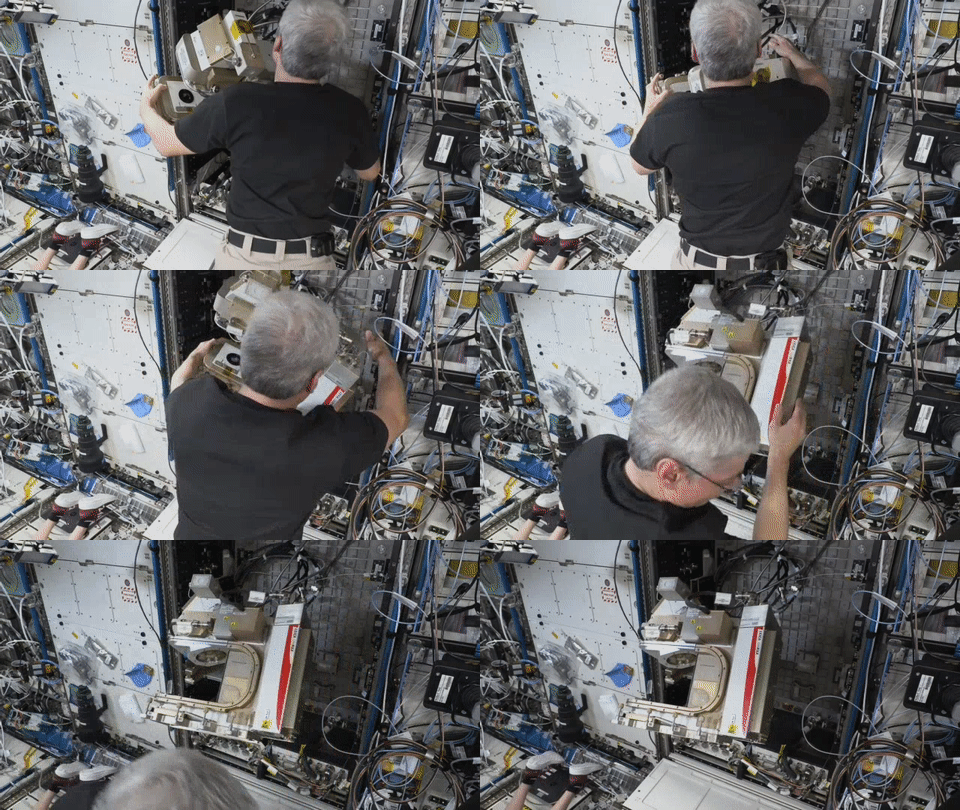
A state-of-the-art light imaging microscope, the Light Microscopy Module (LMM), launched to station in 2009 and returns to Earth aboard Dragon for a well-earned retirement. Sponsored by NASA’s Biological and Physical Sciences division, this powerful diagnostic tool enabled novel research of microscopic phenomena in microgravity, providing the capability to remotely acquire and download images and videos at many levels of magnification.

LMM made it possible to observe and record the way matter is organized and moves on the microscopic level. Scientists employed this tool for microgravity research on colloids, tiny particles suspended in a liquid, that contributed to advances in formulations and the shelf life of consumer products such as toothpaste and shampoo, 3D printing, and technology for detecting shifting sands on Mars. The LMM also contributed to studies of plants in microgravity, including the CARA investigation, and supported thermophysics research, including CVB and CVB-2, studies on heat transfer systems in microgravity.


Animation above: NASA astronaut Mark Vande Hei uninstalls the Light Microscopy Module from the station. The instrument returns to Earth after more than a decade of supporting scientific investigations. Animation Credit: NASA.

Tiny structures, assemble

InSPACE-4 studies assembly of tiny structures from colloids, or particles suspended in a liquid, using magnetic fields. Colloidal structures change the properties of the assembled material, such as its mechanical response to or interaction with light and heat. Microgravity offers a unique opportunity to observe assembly in ways and over time scales not possible on Earth.

Results could provide insight into how to harness nanoparticles to fabricate and manufacture new materials and lead to more advanced materials for space applications, including thermal shields, protection from micrometeorites, energy production, energy-transfer, and actuators and sensors for robotic and human missions. Other potential applications include advancing the manufacturing of materials on Earth for applications such as thermal shields, sound damping devices, camouflage, and medical diagnostics. The technology also could support larger-scale applications such as building foundation stabilizers for areas prone to earthquakes.

Investigators monitored the experiment via video downlink and vials containing the colloidal structures are returning to Earth for additional analysis.


Image above: Thomas Pesquet of ESA (European Space Agency) conducts a session for the InSPACE-4 physics study, which could provide insight into how to harness nanoparticles to fabricate and manufacture new materials for Earth and space applications. Image Credit: NASA.

Cell signaling in microgravity

Scientists continue to study how microgravity affects mammalian cells. Cytoskeleton, an investigation from ESA (European Space Agency), examines whether microgravity affects the function of cellular signaling molecules known as RhoGTPases. These molecules function as "molecular switches" and are involved in the control of cell proliferation, programmed cell death, gene expression, and organization of the cytoskeleton (the network of protein filaments and tubules that give cells their shape).

This investigation contributes to our understanding of how the human body responds to microgravity and could support development of countermeasures to help crew members maintain optimum health on future missions. The work also may expand knowledge about cellular function on Earth and contribute to future medical research here on the ground. Cell cultures are returning to the ground for analysis.


Animation above: ESA (European Space Agency) astronaut Matthias Maurer sets up for the Cytoskeleton investigation. Image Credit: NASA.

Editor's Note:

The SpaceX Cargo Dragon undock date was updated to Saturday, Jan. 22.

Live coverage of the departure begins on Saturday, Jan. 22. at 10:15 a.m. EST on NASA Television, the agency’s website, and the NASA app.

Related links:

NASA Television: https://www.nasa.gov/live/

Light Microscopy Module (LMM): https://www.nasa.gov/mission_pages/station/research/experiments/explorer/Facility.html?#id=531

Biological and Physical Sciences: https://science.nasa.gov/biological-physical

CARA: https://www.nasa.gov/ission_pages/station/research/news/petri_plants

CVB: https://www.nasa.gov/mission_pages/station/research/experiments/explorer/Investigation.html?#id=455

CVB-2: https://www.nasa.gov/mission_pages/station/research/experiments/explorer/Investigation.html?#id=1061

InSPACE-4: https://www.nasa.gov/mission_pages/station/research/experiments/explorer/Investigation.html?#id=7669

Cytoskeleton: https://www.nasa.gov/mission_pages/station/research/experiments/explorer/Investigation.html?#id=1702

Space Station Research and Technology: https://www.nasa.gov/mission_pages/station/research/overview.html

International Space Station (ISS): https://www.nasa.gov/mission_pages/station/main/index.html

Images (mentioned), Animation (mentioned), Text, Credits: NASA/Ana Guzman/JSC/International Space Station Program Research Office/Melissa Gaskill.

Greetings, Orbiter.ch

How the Tonga eruption is helping space scientists understand Mars


Natural Disasters logo.


Jan 20, 2022

NASA researchers are studying the unusual explosion of submarine volcano Hunga Tonga–Hunga Haʻapai to shed light on landforms on the red planet.


Image above: The Hunga Tonga–Hunga Haʻapai volcanic island as it appeared prior to the massive eruption on 15 January. Image Credits: Planet Labs PBC/EYEPRESS/Shutterstock.

NASA scientists say that the eruption of a submarine volcano in Tonga is helping them to understand how features formed on the surfaces of Mars and Venus.

The unusual explosion — which has been calculated at more than 500 times the force of the atom bomb dropped on Hiroshima, Japan, in 1945 — is offering researchers a rare chance to study how water and lava interact.

Studying the Hunga Tonga–Hunga Haʻapai volcano and its evolution in recent weeks is “important for planetary science”, says Petr Brož, a planetary volcanologist at the Institute of Geophysics of the Czech Academy of Sciences in Prague.

The knowledge “might help us to reveal results of water–lava interactions on the red planet and elsewhere across the Solar System”, he says.

Front-row seat

The volcanic island, which began to form from ash and lava expelled from an undersea volcano in early 2015, piqued the interest of researchers including James Garvin, chief scientist at NASA’s Goddard Space Flight Center in Greenbelt, Maryland, because of its similarity to structures on Mars and possibly also Venus. “We don’t normally get to see islands form,” explains Garvin, but this one offered “a front-row seat”.

Volcanic islands typically last for just months before being eroded away. But Hunga Tonga–Hunga Haʻapai survived for years, allowing Garvin’s team to use satellite observations and seafloor surveys to study how such islands form, erode and persist (1). The researchers wanted to use that knowledge to understand how small conical volcanoes found on Mars may have formed in the presence of water billions of years ago.


Image above: Small conical volcanoes on Mars, such as this one coloured to represent relative elevation, might have formed in shallow water. Image Credits: NASA's Scientific Visualization Studio.

Submarine eruptions differ significantly from those that occur on land, and can produce different landforms, says Brož. The presence of large quantities of sea water can make the explosions more violent, while also rapidly cooling the lava and restricting the amount of gas emitted from it.

Many volcanoes on Mars are thought to have erupted with steady flows of lava, but some could have been explosive, like Hunga Tonga–Hunga Haʻapai, says Joseph Michalski, a planetary scientist at the University of Hong Kong.

The marine environment also mimics some aspects of the low-gravity settings on small planets such as Mars and “can shed unique light on Martian features that formed in lower gravity”, he adds.

Little left of island

Last weekend’s violent explosion was preceded by a series of small eruptions starting in December, which increased the size of the island. That excited Garvin’s team. The researchers were in the process of submitting a paper describing the island’s slow erosion and a theoretical model for what makes it so stable — but “then BOOM. We had to hit reset,” says Garvin.

Teams around the world are now monitoring the island using optical, radar and laser satellites to measure what is left. The International Space Station’s Global Ecosystem Dynamics Investigation instrument has also collected data, says Garvin.


Image above: Following the recent eruption very little of the Hunga Tonga–Hunga Haʻapai island is left, as seen in this satellite image taken on 17 January. Image Credit: Maxar Technologies.

The vast majority of the island is now gone, says Daniel Slayback, a geographer at the Goddard Space Flight Center, who has visited Hunga Tonga–Hunga Haʻapai. “It’s kind of shocking to see,” he says. “It’s pretty dramatic.”

Garvin is hopeful that the giant chamber of magma deep under Earth’s crust that formed Hunga Tonga–Hunga Haʻapai will eventually create another island for researchers to study. If that happens, “we’ll measure it, and describe it and build a story about it”.

doi: https://doi.org/10.1038/d41586-022-00137-z

Related articles:

Hunga Tonga-Hunga Ha‘apai Erupts
https://orbiterchspacenews.blogspot.com/2022/01/hunga-tonga-hunga-haapai-erupts.html

Tonga eruption heard in New Zealand, pressure waves picked up in Europe
https://orbiterchspacenews.blogspot.com/2022/01/tonga-eruption-heard-in-new-zealand.html

Reference:

1. Garvin, J. B. et al. Geophysical Research Letters 45, 3445–3452 (2018).
https://doi.org/10.1002%2F2017GL076621

Images (mentioned), Text, Credits: Nature/Smriti Mallapaty.

Best regards, Orbiter.ch

NASA Solar Sail Mission to Chase Tiny Asteroid After Artemis I Launch


NASA - NEA Scout Mission patch.


Jan 20, 2022

NEA Scout will visit an asteroid estimated to be smaller than a school bus – the smallest asteroid ever to be studied by a spacecraft.

Launching with the Artemis I uncrewed test flight, NASA’s shoebox-size Near-Earth Asteroid Scout will chase down what will become the smallest asteroid ever to be visited by a spacecraft. It will get there by unfurling a solar sail to harness solar radiation for propulsion, making this the agency’s first deep space mission of its kind.


Images above: NEA Scout is composed of a small, shoebox-sized CubeSat (top left) and a thin, aluminum-coated solar sail about the size of a racquetball court (bottom left). After the spacecraft launches aboard Artemis I, the sail will use sunlight to propel the CubeSat to a small asteroid (as depicted in an illustration, right). Image Credit: NASA.

The target is 2020 GE, a near-Earth asteroid (NEA) that is less than 60 feet (18 meters) in size. Asteroids smaller than 330 feet (100 meters) across have never been explored up close before. The spacecraft will use its science camera to get a closer look, measuring the object’s size, shape, rotation, and surface properties while looking for any dust and debris that might surround 2020 GE.

Because the camera has a resolution of less than 4 inches (10 centimeters) per pixel, the mission’s science team will be able to determine whether 2020 GE is solid – like a boulder – or if it’s composed of smaller rocks and dust clumped together like some of its larger asteroid cousins, such as asteroid Bennu.

“Thanks to the discoveries of NEAs by Earth-based observatories, several targets had been identified for NEA Scout, all within the 16-to-100-foot [5-to-30-meter] size range,” said Julie Castillo-Rogez, the mission’s principal science investigator at NASA’s Jet Propulsion Laboratory in Southern California. “2020 GE represents a class of asteroid that we currently know very little about.”

2020 GE was first observed on March 12, 2020, by the University of Arizona’s Catalina Sky Survey as part of its search for near-Earth objects for NASA’s Planetary Defense Coordination Office.

NEA Scout Mission sail deployment. Animation Credit: NASA

Developed under NASA’s Advanced Exploration Systems Division by Marshall Space Flight Center in Huntsville, Alabama, and JPL, NEA Scout is a science and technology demonstration mission that will enhance the agency’s understanding of small NEAs. Using a six-unit CubeSat form factor, it will ride as one of 10 secondary payloads aboard the powerful Space Launch System (SLS) rocket, which will launch no earlier than March 2022 at NASA’s Kennedy Space Center in Florida. NEA Scout will then be deployed from a dispenser attached to the adapter ring that connects the rocket and Orion spacecraft.

The mission will act as a nimble scout for future human and robotic missions that may utilize asteroid resources – and will gain important planetary defense insights about this class of NEA.

“Although large asteroids are of most concern from a planetary defense perspective, objects like 2020 GE are far more common and can pose a hazard to our planet, despite their smaller size,” said Castillo-Rogez. The Chelyabinsk meteor was caused by a small asteroid about 65 feet (20 meters) in diameter – it exploded over the Russian city on Feb. 15, 2013, creating a shockwave that broke windows all over the city and injured more than 1,600 people. That was the same class of NEA as 2020 GE.

Low Mass, High Performance

Learning more about asteroid 2020 GE is only part of NEA Scout’s job. It will also demonstrate solar sail technology for deep space encounters. When released from its dispenser after launch, the spacecraft will use stainless steel alloy booms to unfurl a solar sail that will expand from a small package to a sail about the size of a racquetball court, or 925 square feet (86 square meters).

Made from plastic-coated aluminum thinner than a human hair, this lightweight, mirror-like sail will generate thrust by reflecting solar photons – quantum particles of light radiating from the Sun. The sail will provide most of NEA Scout’s propulsion, but small cold-gas thrusters with a limited propellant supply will also assist with maneuvers and orientation.

“The genesis of this project was a question: Can we really use a tiny spacecraft to do deep space missions and produce useful science at a low cost?” said Les Johnson, the mission’s principal technology investigator at Marshall. “This is a huge challenge. For asteroid characterization missions, there’s simply not enough room on a CubeSat for large propulsion systems and the fuel they require.”

Sunlight acts as a constant force, so a tiny spacecraft equipped with a large solar sail can eventually travel many miles per second. Solar sails are a high-performance propulsion system for low-mass and low-volume spacecraft, according to Johnson. NEA Scout will maneuver by tipping and tilting its sail to change the angle of sunlight, altering the amount of thrust and direction of travel, similar to how a boat uses the wind to sail.

In September 2023, asteroid 2020 GE will make a close approach with Earth, and with a gravitational assist from the Moon, NEA Scout will have gathered enough speed to catch up. Mission navigators will fine-tune NEA Scout’s trajectory before the spacecraft approaches within a mile of the asteroid.

“NEA Scout will accomplish probably the slowest flyby of an asteroid ever – at a relative speed of less than 100 feet [30 meters] per second,” said Castillo-Rogez. “This will give us a few hours to gather invaluable science and allow us to see what asteroids of this class look like up close.”

NEA Scout sets the stage for future solar sails: NASA’s Advanced Composite Solar Sail System will demonstrate novel, lightweight booms to deploy a solar sail from a CubeSat following its 2022 launch. After that, Solar Cruiser, an 18,000-square-foot (nearly 1,700-square-meter) solar sail technology demonstration, will use sunlight to travel toward the Sun in 2025, enabling future missions to better monitor space weather.

For more about the NEA Scout mission, visit: https://www.nasa.gov/content/nea-scout

Related links:

Catalina Sky Survey: https://catalina.lpl.arizona.edu/

Planetary Defense Coordination Office: https://www.nasa.gov/planetarydefense

Advanced Exploration Systems Division: https://www.nasa.gov/directorates/heo/aes/index.html

Advanced Composite Solar Sail System: https://www.nasa.gov/directorates/spacetech/small_spacecraft/ACS3

Image (mentioned), Animation (mentioned), Text, Credits: NASA/Naomi Hartono/Marshall Space Flight Center/Molly Porter/JPL/Ian J. O’Neill.

Best regards, Orbiter.ch