vendredi 18 février 2022

Weather 75% Favorable for Saturday Antares Launch


Northrop Grumman - Cygnus NG-17 (CRS) Mission patch.


Feb 18, 2022

The Wallops Range continues to predict 75% favorable weather 24 hours ahead of the launch window of NASA commercial cargo provider Northrop Grumman’s Antares rocket and Cygnus cargo spacecraft.


Image above: This file photo from Feb. 16, 2021, shows the Northrop Grumman CRS-15 Antares rocket on Pad-0A on Wallops Island Virginia. Image Credits: NASA Wallops/Patrick Black.

The primary concern for launch at this time is strong southwesterly surface winds that could violate weather constraints.

Northrop Grumman is targeting 12:40 p.m EST Saturday, Feb. 19, for the International Space Station-bound Cygnus spacecraft, loaded with about 8,300 pounds of research, crew supplies, and hardware. Launch will be from Virginia Space’s Mid-Atlantic Regional Spaceport at NASA’s Wallops Flight Facility on the Eastern Shore of Virginia.

Live coverage of the launch will air on NASA Television, the agency’s website and the NASA app beginning at 12:15 p.m. EST Saturday, Feb. 19.

For those in the mid-Atlantic region, weather permitting, you may have a chance to see the Antares rocket in the sky after launch. Check out the visibility map below.


Image above: This map shows how many seconds after launch the Antares rocket may be visible in the sky to the mid-Atlantic region. Image Credit: NASA.

Related article:

Northrop Grumman’s 17th Resupply Mission Carries Science Experiments, Technology Demonstrations to Space Station
https://orbiterchspacenews.blogspot.com/2022/02/northrop-grummans-17th-resupply-mission.html

Related links:

NASA Television: https://www.nasa.gov/live

Northrop Grumman: https://www.nasa.gov/mission_pages/station/structure/launch/northrop-grumman.html

Antares: https://blogs.nasa.gov/ng-crs-17/tag/antares/

International Space Station (ISS): https://www.nasa.gov/mission_pages/station/main/index.html

Images (mentioned), Text, Credits: NASA/Jamie Adkins.

Best regards, Orbiter.ch

Hubble Captures Swirling Galactic Trio


NASA - Hubble Space Telescope patch.


Feb 18, 2022


The mass of dust and bright swirls of stars in this image are the distant galaxy merger IC 2431, which lies 681 million light-years from Earth in the constellation Cancer. The NASA/ESA Hubble Space Telescope has captured what appears to be a triple galaxy merger in progress, as well as a tumultuous mixture of star formation and tidal distortions caused by the gravitational interactions of this galactic trio. A thick cloud of dust obscures the center of this image – though light from a background galaxy is piercing its outer extremities.

This image is from a series of Hubble observations investigating weird and wonderful galaxies found by the Galaxy Zoo citizen science project. Using Hubble’s powerful Advanced Camera for Surveys, astronomers took a closer look at some of the more unusual galaxies that volunteers identified. The original Galaxy Zoo project was the largest galaxy census ever carried out and relied on crowdsourcing time from more than 100,000 volunteers to classify 900,000 unexamined galaxies. The project achieved what would have been years of work for a professional astronomer in only 175 days and has led to a steady stream of similar astronomical citizen science projects. Later Galaxy Zoo projects have included the largest ever studies of galaxy mergers and tidal dwarf galaxies, as well as the discovery of entirely new types of compact star-forming galaxies.

Hubble Space Telescope (HST)

For more information about Hubble, visit:

http://hubblesite.org/

http://www.nasa.gov/hubble

http://www.spacetelescope.org/

Text Credits: European Space Agency (ESA)/NASA/Andrea Gianopoulos/Image, Animation Credits: ESA/Hubble & NASA, W. Keel, Dark Energy Survey, Department of Energy, Fermilab, Dark Energy Survey Camera, (DECam), Cerro Tololo Inter-American Observatory, NoirLab/National Science Foundation/AURA, Sloan Digital Sky Survey; Acknowledgment: J. Schmidt.

Best regards, Orbiter.ch

Space Station Science Highlights: Week of February 14, 2022


ISS - Expedition 66 Mission patch.


Feb 18, 2022

Crew members aboard the International Space Station conducted scientific investigations during the week of Feb. 14 that included examining combustion and flammability, demonstrating a new wireless network infrastructure, and collecting data on human adaptation to space. Northrop Grumman’s 17th commercial resupply services mission delivering scientific investigations and technology demonstrations, supplies, and equipment aboard its Cygnus spacecraft is targeted for liftoff on Saturday, Feb. 19.

The space station, continuously inhabited by humans for 21 years, has supported many scientific breakthroughs. A robust microgravity laboratory with dozens of research facilities and tools, the station supports investigations spanning every major scientific discipline, conveying benefits to future space exploration and advancing basic and applied research on Earth. The orbiting lab also provides a platform for a growing commercial presence in low-Earth orbit that includes research, satellite services, and in-space manufacturing.

Here are details on some of the microgravity investigations currently taking place:

Answering burning questions


Image above: NASA astronaut Mark Vande Hei configures the Combustion Integrated Rack for upcoming experiments utilizing the SoFIE (Solid Fuel Ignition and Extinction) insert. Image Credit: NASA.

During the week, crew members continued reconfiguring the Combustion Integrated Rack (CIR) for SoFIE, hardware that enables a wide range of solid-material combustion and fire suppression studies. SoFIE initially supports five investigations, including SoFIE-MIST, examining thermally-assisted burning in microgravity, and SoFIE-GEL, which measures heating in a fuel sample to determine how fuel temperature affects material flammability. Results could improve understanding of early fire growth behavior, help inform selection of materials for future space facilities, and determine the best methods for extinguishing fires in space.

Wireless technology

Wireless Compose-2, an investigation from ESA (European Space Agency), demonstrates a wireless network infrastructure for sensor monitoring and data transmission to support scientific experiments in microgravity. The investigation includes an experiment examining the effect of the space environment on the cardiovascular system that could contribute to development of new technologies for monitoring the health of astronauts and people on the ground. Wireless Compose-2 also demonstrates new hardware that could enable precise control of free-flying robotic systems and identification of obstacles to operating such systems in environments comparable to the space station. During the week, crew members conducted troubleshooting in preparation for performing the investigation.


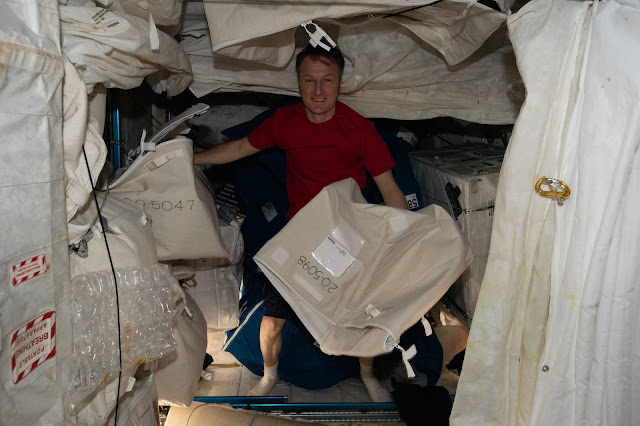
Image above: ESA (European Space Agency) astronaut Matthias Maurer organizes cargo in anticipation of new supplies and scientific investigations launching to the space station. Image Credit: NASA.

Measure this

Preparing for long-duration missions to other planets requires a set of consistent, meaningful data on how crew members respond to life in microgravity. Standard Measures collects a set of core measurements, including data on behavioral health and performance, cellular profiles and immunology, the microbiome, biochemistry markers, sensorimotor changes, and cardiovascular health. This consistent collection of data from crew members through the entire life of the space station aims to characterize adaptive responses to living and working in space, monitor countermeasure effectiveness, and support future research on planetary missions. During the week, crew members completed post-sleep questionnaires for the investigation.


Image above: The desert of Semnan Province southeast of Tehran, Iran, is pictured from the International Space Station as it orbits 258 miles above. Image Credit: NASA.

Other investigations involving the crew:

- SQuARE studies objects and built spaces and how crew members use them over time. Results could contribute to better design for future spacecraft and habitats.
https://www.nasa.gov/mission_pages/station/research/experiments/explorer/Investigation.html?#id=8684
 
- Veggie PONDS uses a newly developed passive nutrient delivery system and the station’s Veggie plant growth facility to cultivate lettuce and mizuna greens. Results could improve our understanding of how plants respond to microgravity and demonstrate reliable vegetable production on orbit.
https://www.nasa.gov/mission_pages/station/research/experiments/explorer/Investigation.html?#id=7581

https://www.nasa.gov/mission_pages/station/research/experiments/explorer/Facility.html?#id=374

- JAXA’s JEM Water Recovery System tests a technology to increase the recovery of drinkable water from urine. Adequate water supply could be a limiting factor on future long-term missions, and this technology could be a vital part of the Environmental Control and Life Support System (ECLSS) on future spacecraft as well as provide water regeneration in dry regions or after disasters on Earth.
https://www.nasa.gov/mission_pages/station/research/experiments/explorer/Investigation.html?#id=2049

https://www.nasa.gov/mission_pages/station/research/experiments/explorer/Investigation.html?#id=8102

- Mochii demonstrates a miniature scanning electron microscope that images and measures particles on the space station in real time. Such particles can cause equipment malfunctions and threaten crew health, and currently, samples must be returned to Earth for analysis, causing delays in addressing possible risks.
https://www.nasa.gov/mission_pages/station/research/experiments/explorer/Facility.html?#id=7657

- EarthKAM allows students to remotely control a digital camera mounted on the space station to take photographs of coastlines, mountain ranges, and other interesting features and phenomena on Earth. The EarthKAM team posts the images online, where they are available to the public and participating classrooms.
https://www.nasa.gov/mission_pages/station/research/experiments/explorer/Investigation.html?#id=87

https://www.earthkam.org/home

- EasyMotion from ESA tests a suit worn during pre- and postflight exercise that provides Electro-Myo-Stimulation (EMS). It could save crew time and improve outcomes of inflight exercise on future space missions and in healthy populations on Earth.
https://www.nasa.gov/mission_pages/station/research/experiments/explorer/Investigation.html?#id=8526

- Actiwatch is a wearable monitor that continuously collects data on a crew member’s circadian rhythms, sleep-wake patterns, and activity during flight, beginning as soon as possible after arrival aboard the station.
https://www.nasa.gov/mission_pages/station/research/experiments/explorer/Facility.html?#id=838

- JAXA’s Hicari aims to verify a new method to grow high-quality crystals of silicon-germanium, a semiconductor material. This technology could support development of more efficient solar cells and semiconductor-based electronics.
https://www.nasa.gov/mission_pages/station/research/experiments/explorer/Investigation.html?#id=71

- ISS Ham Radio provides students, teachers, parents, and others the opportunity to communicate with astronauts using amateur radio units. Before a scheduled call, students learn about the station, radio waves, and other topics, and prepare a list of questions on topics they have researched.
https://www.nasa.gov/mission_pages/station/research/experiments/explorer/Investigation.html?#id=337

- Lumina, an ESA investigation, demonstrates a dosimeter using optical fibers that darken when exposed to radiation to monitor in real time the radiation dose received by crew members. Monitoring ionizing radiation is a key challenge for future longer-term space exploration, and a fiber-based dosimeter that provides real-time measurements could make it possible to anticipate potentially dangerous radiation flares and react to them properly.
https://www.nasa.gov/mission_pages/station/research/experiments/explorer/Investigation.html?#id=8444

Space to Ground: Targeting Cancer Cells: 02/18/2022

Related links:

Expedition 66: https://www.nasa.gov/mission_pages/station/expeditions/expedition66/index.html

Combustion Integrated Rack (CIR): https://www.nasa.gov/mission_pages/station/research/experiments/explorer/Facility.html?#id=317

SoFIE-MIST: https://www.nasa.gov/mission_pages/station/research/experiments/explorer/Investigation.html?#id=8272

SoFIE-GEL: https://www.nasa.gov/mission_pages/station/research/experiments/explorer/Investigation.html?#id=8266

Wireless Compose-2: https://www.nasa.gov/mission_pages/station/research/experiments/explorer/Investigation.html?#id=8563

Standard Measures: https://www.nasa.gov/mission_pages/station/research/experiments/explorer/Investigation.html?#id=7711

ISS National Lab: https://www.issnationallab.org/

Spot the Station: https://spotthestation.nasa.gov/

Space Station Research and Technology: https://www.nasa.gov/mission_pages/station/research/overview.html

International Space Station (ISS): https://www.nasa.gov/mission_pages/station/main/index.html

Images (mentioned), Video (NASA), Text, Credits: NASA/Ana Guzman/John Love, ISS Research Planning Integration Scientist Expedition 66.

Greetings, Orbiter.ch

NASA’s Perseverance Celebrates First Year on Mars by Learning to Run


NASA - Mars 2020 Perseverance Rover logo.


Feb 18, 2022

The rover has racked up a series of accomplishments, including new distance records, as it reaches the end of the first of several planned science campaigns on the Red Planet.


Image above: The Mars 2020 descent stage lowers NASA’s Perseverance rover onto the Red Planet on Feb. 18, 2021. The image is from video captured by a camera aboard the descent stage. Image Credits: NASA/JPL-Caltech.

NASA’s Perseverance rover has notched up a slew of firsts since touching down on Mars one year ago, on Feb. 18, 2021, and the six-wheeled scientist has other important accomplishments in store as it speeds toward its new destination and a new science campaign.

Weighing roughly 1 ton (1,025 kilograms), Perseverance is the heaviest rover ever to touch down on Mars, returning dramatic video of its landing. The rover collected the first rock core samples from another planet (it’s carrying six so far), served as an indispensable base station for Ingenuity, the first helicopter on Mars, and tested MOXIE (Mars Oxygen In-Situ Resource Utilization Experiment), the first prototype oxygen generator on the Red Planet.

Perseverance also recently broke a record for the most distance driven by a Mars rover in a single day, traveling almost 1,050 feet (320 meters) on Feb. 14, 2022, the 351st Martian day, or sol, of the mission. And it performed the entire drive using AutoNav, the self-driving software that allows Perseverance to find its own path around rocks and other obstacles.


Image above: Perseverance snapped this view of a hill called “Santa Cruz” on April 29, 2021. About 20 inches (50 centimeters) across on average, the boulders in the foreground are among the type of rocks the rover team has named “Ch’ał” (the Navajo term for “frog” and pronounced “chesh”). Perseverance will return to the area next week or so. Image Credits: NASA/JPL-Caltech/ASU/MSSS.

The rover has nearly wrapped up its first science campaign in Jezero Crater, a location that contained a lake billions of years ago and features some of the oldest rocks Mars scientists have been able to study up close. Rocks that have recorded and preserved environments that once hosted water are prime locations to search for signs of ancient microscopic life.

Using a drill on the end of its robotic arm and a complex sample collection system in its belly, Perseverance is snagging rock cores from the crater floor – the first step in the Mars Sample Return campaign.

“The samples Perseverance has been collecting will provide a key chronology for the formation of Jezero Crater,” said Thomas Zurbuchen, associate administrator of NASA’s Science Mission Directorate in Washington. “Each one is carefully considered for its scientific value.”

Counting the Eons

Two more samples will be collected in coming weeks from the “Ch’ał” rock type (named with the Navajo term for “frog”), a set of dark, rubbly rocks representative of what’s seen across much of the crater floor. If samples of these rocks are returned to Earth, scientists think they could provide an age range for Jezero’s formation and the lake that once resided there.

Scientists can approximate the age of a planet or moon’s surface by counting its impact craters. Older surfaces have had more time to accumulate impact craters of various sizes. In the case of the Moon, scientists were able to refine their estimates by analyzing Apollo lunar samples. They’ve taken those lessons to narrow down the age estimates of surfaces on Mars. But having rock samples from the Red Planet would improve crater-based estimates of how old the surface is – and help them find more pieces of the puzzle that is Mars’ geological history.

Perseverance Lands on Mars, as the World Watches

Video above: NASA’s Mars 2020 Perseverance mission captured thrilling footage of the rover landing in Mars’ Jezero Crater on Feb. 18, 2021. Video Credits: NASA/JPL-Caltech.

“Right now, we take what we know about the age of impact craters on the Moon and extrapolate that to Mars,” said Katie Stack Morgan, Perseverance’s deputy project scientist at NASA’s Jet Propulsion Laboratory in Southern California, which manages the rover mission. “Bringing back a sample from this heavily cratered surface in Jezero could provide a tie-point to calibrate the Mars crater dating system independently, instead of relying solely on the lunar one.”

The mission hasn’t been without challenges. The rover’s first attempt at drilling a rock core came up empty, prompting an extensive testing campaign to better understand fragile rocks. The team also needed to clear out pebbles that had dropped into the part of the sampling system that holds the drill bits.


Image above: NASA’s Perseverance Mars rover landed on the Red Planet on Feb. 18, 2021, and took this selfie over a rock nicknamed “Rochette,” on Sept. 10, 2021, the 198th Martian day, or sol of the mission. Two holes can be seen where the rover used its robotic arm to drill rock core samples. Image Credits: NASA/JPL-Caltech/MSSS.

Perseverance’s airborne companion, NASA’s Ingenuity Mars Helicopter, has proven similarly plucky: It was grounded for almost a month following a dust storm before recently resuming its flights. Originally slated to fly five times, the rotorcraft has successfully completed 19 flights now, providing a new perspective of Martian terrain and helping Perseverance’s team to plan the path ahead.

To the west of “Octavia E. Butler Landing,” where Perseverance started its journey, are the remains of a fan-shaped delta formed by an ancient river as it fed the lake in Jezero Crater. Deltas accumulate sediment over time, potentially trapping organic matter and possible biosignatures – signs of life – that may be in the environment. That makes this destination, which the mission expects to reach this summer, a highlight of the year to come.

More About the Mission

A key objective for Perseverance’s mission on Mars is astrobiology, including the search for signs of ancient microbial life. The rover will characterize the planet’s geology and past climate, pave the way for human exploration of the Red Planet, and be the first mission to collect and cache Martian rock and regolith (broken rock and dust).

Subsequent NASA missions, in cooperation with ESA (European Space Agency), would send spacecraft to Mars to collect these sealed samples from the surface and return them to Earth for in-depth analysis.

The Mars 2020 Perseverance mission is part of NASA’s Moon to Mars exploration approach, which includes Artemis missions to the Moon that will help prepare for human exploration of the Red Planet.

JPL, which is managed for NASA by Caltech in Pasadena, California, built and manages operations of the Perseverance rover.

For more about Perseverance:

https://mars.nasa.gov/mars2020/ and https://nasa.gov/perseverance

Related links:

Mars Oxygen In-Situ Resource Utilization Experiment (MOXIE): https://mars.nasa.gov/news/8926/nasas-perseverance-mars-rover-extracts-first-oxygen-from-red-planet/

Mars Sample Return campaign: https://mars.nasa.gov/msr/

Images (mentioned), Video (mentioned), Text, Credits: NASA/Naomi Hartono/Karen Fox/Alana Johnson/JPL/Andrew Good.

Best regards, Orbiter.ch

Giant solar eruption seen by Solar Orbiter


ESA / NASA - Solar Orbiter Mission patch.


Feb 18, 2022

The ESA/NASA Solar Orbiter spacecraft has captured the largest solar prominence eruption ever observed in a single image together with the full solar disc.

Solar Orbiter and SOHO’s view of a giant eruption

Solar prominences are large structures of tangled magnetic field lines that keep dense concentrations of solar plasma suspended above the Sun’s surface, sometimes taking the form of arching loops. They are often associated with coronal mass ejections, which if directed towards Earth, can wreak havoc with our technology and everyday lives.

This latest event took place on 15 February and extended millions of kilometres into space. The coronal mass ejection was not directed at Earth. In fact, it is travelling away from us. There is no signature of the eruption on the solar disc facing the spacecraft – which is currently approaching the Earth-Sun line – meaning that it must have originated from the side of the Sun facing away from us.

Solar Orbiter captures giant solar eruption

The imagery was captured by the ‘Full Sun Imager’ (FSI) of the Extreme Ultraviolet Imager (EUI) on Solar Orbiter. FSI is designed to look at the full solar disc even during close passages of the Sun, such as during the upcoming perihelion passage next month. At closest approach on 26 March, which will see the spacecraft pass within about 0.3 times the Sun-Earth distance, the Sun will fill a much larger portion of the telescope’s field of view. Right now, there is still a lot of ‘viewing margin’ around the disc, enabling stunning detail to be captured by FSI out to about 3.5 million kilometres, equivalent to five times the radius of the Sun.

Solar Orbiter and SOHO’s view of a giant eruption – wide view

Other space telescopes such as the ESA/NASA SOHO satellite frequently see solar activity like this, but either closer to the Sun, or further out by means of an occulter, which blocks out the glare of the Sun’s disc to enable detailed imagery of the corona itself. Thus, the prominence observed by Solar Orbiter is the largest ever event of its kind to be captured in a single field of view together with the solar disc, opening up new possibilities to see how events like these connect to the solar disc for the first time. At the same time, SOHO can provide complementary views to even larger distances.

Solar Orbiter and SOHO’s view of a giant eruption - side by side

Other space missions were also watching the event, including NASA’s Parker Solar Probe. Next week, Solar Orbiter and Parker Solar Probe will perform dedicated joint observations during Parker’s perihelion passage.

Even spacecraft not dedicated to solar science felt its blast – the ESA/JAXA BepiColombo mission, currently in the vicinity of Mercury’s orbit – detected a massive increase in the readings for electrons, protons, and heavy ions with its radiation monitor.

Solar Orbiter

And while this event did not send a blast of deadly particles towards Earth, it is an important reminder of the unpredictable nature of the Sun and the importance of understanding and monitoring its behaviour. Together with ESA’s future dedicated space weather mission Vigil, which will provide unique views of events like these, we can better protect our home planet from the Sun’s violent outbursts.

Related links:

Solar Orbiter: https://www.esa.int/Science_Exploration/Space_Science/Solar_Orbiter

Extreme Ultraviolet Imager (EUI): https://www.esa.int/ESA_Multimedia/Images/2020/01/Solar_Orbiter_Instruments

ESA/NASA SOHO satellite: https://sohowww.nascom.nasa.gov/

Vigil: https://www.esa.int/Safety_Security/Vigil

Image, Animation, Videos, Text, Credits: ESA/Solar Orbiter/EUI Team/ESA & NASA.

Greetings, Orbiter.ch

jeudi 17 février 2022

Russian Space Freighter Docks to Station After Two Days


ISS - Expedition 66 Mission patch.


Feb 17, 2022


Image above: Russia’s Progress 80 resupply ship approaches the station for docking on Feb. 17, 2022. Image Credit: NASA TV.

An uncrewed Russian Progress 80 spacecraft arrived at the International Space Station’s Poisk module at 2:03 a.m. EST, about two days after launch from the Baikonur Cosmodrome in Kazakhstan.

Progress MS-19 docking

Progress is delivering almost three tons of food, fuel and supplies to the International Space Station for the Expedition 66 crew.

U.S. Cargo Mission Nears Launch, Crew Unloads Russian Space Freighter

A U.S. rocket carrying Northrop Grumman’s Cygnus space freighter is counting down to launch toward the International Space Station on Saturday. Meanwhile, Russia’s Progress 80 cargo craft completed a two-day space delivery mission to the Expedition 66 crew early Thursday.

An Antares rocket stands at the Wallops Flight Facility launch pad in Virginia ready to boost the Cygnus cargo craft to orbit on Saturday. It will lift off at 12:40 p.m. EST placing Cygnus, carrying more than 8,300 pounds of station gear and science experiments, into space about nine minutes later. Once on orbit, Cygnus will deploy its cymbal-shaped UltraFlex solar arrays which will power the vehicle during its journey to the orbiting lab.


Image above: The Cygnus space freighter is pictured launching atop the Antares rocket from Virgina to the space station in April of 2019. Image Credit: Northrop Grumman.

NASA Flight Engineers Raja Chari and Kayla Barron will be on duty early Monday monitoring Cygnus’ automated approach and rendezvous. When Cygnus reaches a point about 10 meters from the station, Chari will command the Canadarm2 robotic arm to reach out and capture the vehicle at 4:35 a.m. Ground controllers will then take over the Canadarm2 and remotely install the U.S. cargo craft to the Unity module a couple of hours later.

Russia’s Progress 80 resupply ship docked to the Poisk module at 2:03 a.m. on Thursday, delivering nearly three-and-a-half tons of food, fuel, and supplies, to the seven orbital residents. Station commander Anton Shkaplerov and Flight Engineer Pyotr Dubrov opened the hatch a few hours later and began unpacking the cargo that had launched from Kazakhstan just over two days earlier.

International Space Station (ISS). Animation Credit: ESA

Despite the busy cargo schedule this week, biomedical science was in full-swing on the station today. Barron joined NASA astronauts Thomas Marshburn and Mark Vande Hei investigating how weightlessness affects visual function. Chari partnered with ESA (European Space Agency) Flight Engineer Matthias Maurer and checked his eyes using medical imaging gear.

Related links:

Expedition 66: https://www.nasa.gov/mission_pages/station/expeditions/expedition66/index.html

Canadarm2 robotic arm: https://www.nasa.gov/mission_pages/station/structure/elements/mobile-servicing-system.html

Unity module: https://www.nasa.gov/mission_pages/station/structure/elements/unity

Poisk module: https://www.nasa.gov/mission_pages/station/structure/elements/poisk-mini-research-module-2

Visual function: https://www.nasa.gov/mission_pages/station/research/experiments/explorer/Investigation.html?#id=7930

Space Station Research and Technology: https://www.nasa.gov/mission_pages/station/research/overview.html

International Space Station (ISS): https://www.nasa.gov/mission_pages/station/main/index.html

Images (mentioned), Animation (mentioned), Video, Text, Credits: NASA/Mark Garcia/NASA TV/SciNews.

Best regards, Orbiter.ch

Gaia reveals a new member of the Milky Way family


ESA - Gaia Mission patch.


Feb 17, 2022


Our galaxy, the Milky Way, began forming around 12 billion years ago. Since then, it has been growing in both mass and size through a sequence of mergers with other galaxies.

Perhaps most exciting is that this process has not quite finished, and by using data from ESA’s Gaia spacecraft, astronomers can see it taking place. This in turn allows to reconstruct the history of our galaxy, revealing the ‘family tree’ of smaller galaxies that has helped make the Milky Way what it is today.

The latest work on this subject comes from Khyati Malhan, a Humboldt Fellow at the Max-Planck-Institut für Astronomie, Heidelberg, Germany, and colleagues. Together, they have analysed data based on Gaia’s early third data release (EDR3) looking for the remains of smaller galaxies merging with our own. These can be found in the so-called halo of the Milky Way, which surrounds the disc of younger stars and central bulge of older stars that comprise the more luminous parts of the Milky Way.

When a foreign galaxy falls into our own, great gravitational forces known as tidal forces pull it apart. If this process goes slowly, the stars from the merging galaxy will form a vast stellar stream that can be easily distinguished in the halo. If the process goes quickly, the merging galaxy’s stars will be more scattered throughout the halo and no clear signature will be visible.

But the merging galaxy may contain more than just stars. It could also be surrounded by a population of globular star cluster and small satellite galaxies. So, the team looked for these in the Gaia data.

In total they studied 170 globular clusters, 41 stellar streams and 46 satellites of the Milky Way. Plotting them according to their energy and momentum revealed that 25 percent of these objects fall into six distinct groups. Each group is a merger taking place with the Milky Way. There was also a possible seventh merger in the data.

Gaia

Five had been previously identified on surveys of stars. They are known as Sagittarius, Cetus, Gaia-Sausage/Enceladus, LMS-1/Wukong, and Arjuna/Sequoia/I’itoi. But the sixth was a newly identified merger event. The team called it Pontus, meaning the sea. In Greek mythology, Pontus is the name of one of the first children of Gaia, the Greek goddess of the Earth.

Based upon the way Pontus has been pulled apart by the Milky Way, Khyati and colleagues estimate that it probably fell into the Milky Way some eight to ten billion years ago. Four of the other five merger events likely also took place around this time as well. But the sixth event, Sagittarius, is more recent. It might have fallen into the Milky Way sometime in the last five to six billion years. As a result, the Milky Way has not yet been able to completely disrupt it.

Piece by piece, astronomers are fitting together the merger history of the Galaxy, and Gaia data is proving invaluable.

On 13 June 2022, the Gaia mission will issue its data release 3, which will provide even more detailed information about the Milky Way’s past, present, and future.

Image description:

This image shows the Milky Way as seen by Gaia. The squares represent the location of globular clusters, the triangles the location of satellite galaxies, and the small dots are stellar streams. The dots and squares in purple are objects brought into the Milky Way by the Pontus merging galaxy.

This research by Khyati Malhan was published in The Astrophysical Journal: 

https://iopscience.iop.org/article/10.3847/1538-4357/ac4d2a

Related link:

Gaia data release 3: https://www.cosmos.esa.int/web/gaia/data-release-3

ESA’s Gaia spacecraft: https://www.esa.int/Science_Exploration/Space_Science/Gaia

Image, Animation, Text, Credits: ESA/Gaia/DPAC, CC BY-SA 3.0 IGO.

Greetings, Orbiter.ch