lundi 2 mai 2022

CASC - Long March-11 launches five Jilin-1 satellites


CASC -  Sea Launch logo.


May 2, 2022

Long March-11 carrying five Jilin-1 satellites liftoff

A Long March-11 launch vehicle launched five Jilin-1 satellites, Jilin-1 Gaofen 03D04-07 (吉林一号高分03D04星~07) and Jilin-1 Gaofen 04A (吉林一号高分04A), from a sea-based platform in the Yellow Sea, on 30 April 2022, at 03:30 UTC (11:30 local time).

Long March-11 launches five Jilin-1 satellites

According to official sources, the satellites have entered their planned orbits and will provide “richer remote sensing data and product services for users in forestry, agriculture, grassland, marine, resources, environment, urban construction and other industries.” Jilin-1 Gaofen 04A is also known as “Anxi Tieguanyin-2” (安溪铁观音二号).

For more information about China Aerospace Science and Technology Corporation (CASC), visit: http://english.spacechina.com/n16421/index.html

Image, Video, Text, Credits: China Media Group(CMG)/China Central Television (CCTV)/China Aerospace Science and Technology Corporation (CASC)/SciNews/Orbiter.ch Aerospace/Roland Berga.

Greetings, Orbiter.ch

vendredi 29 avril 2022

Expedition 67 Crew Wraps Up Week After Crew Arrival and Spacewalk


ISS - Expedition 67 Mission patch.


April 29, 2022

Two Roscosmos cosmonauts went on a spacewalk to activate the new European robotic arm (ERA) less than a day after the SpaceX Crew-4 mission arrived at the International Space Station. The next mission event taking place will occur next week when four Expedition 67 astronauts complete their stay aboard the orbiting lab.

Cosmonauts Oleg Artemyev and Denis Matveev exited the station in their Orlan spacesuits at 10:58 a.m. EDT on Thursday beginning the fifth spacewalk of the year. Fellow cosmonaut Sergey Korsakov assisted the spacewalkers from inside the station’s Russian segment as they released the ERA from its launch restraints on the Nauka multipurpose laboratory module and monitored the new robotic arm’s first motion.


Image above: Cosmonauts (from left) Denis Matveev and Oleg Artemyev worked outside the station’s Russian segment during the first spacewalk to outfit Nauka and configure the European robotic arm on April 18, 2022. Image Credit: NASA TV.

The day before, the SpaceX Dragon Freedom crew ship, carrying four Crew-4 astronauts, docked to the Harmony module’s space-facing port at 7:37 p.m. EDT. Less than two hours later, NASA astronauts Kjell Lindgren, Robert Hines, and Jessica Watkins with ESA (European Space Agency) astronaut Samantha Cristoforetti, entered the station beginning a four-and-a-half month research mission aboard the space station. The 11-person crew will live and work together until next week when the SpaceX Crew-3 mission ends.

How do Astronauts Communicate Nonverbally in Space

Station Commander Tom Marshburn along with Flight Engineers Raja Chari, and Kayla Barron, all NASA astronauts, and ESA astronaut Matthias Maurer, are packing up to end their stay on the orbiting lab. The four astronauts representing the Commercial Crew Program are finalizing a six-month science mission on the space lab. NASA and SpaceX mission managers are planning for the quartet to enter the Dragon Endurance crew ship and undock from Harmony’s forward port for a splashdown off the coast of Florida next week.

Related links:

Expedition 67: https://www.nasa.gov/mission_pages/station/expeditions/expedition67/index.html

Nauka multipurpose laboratory module: https://www.roscosmos.ru/tag/nauka/

Harmony module: https://www.nasa.gov/mission_pages/station/structure/elements/harmony

Commercial Crew Program: https://blogs.nasa.gov/commercialcrew/

Space Station Research and Technology: https://www.nasa.gov/mission_pages/station/research/overview.html

International Space Station (ISS): https://www.nasa.gov/mission_pages/station/main/index.html

Image (mentioned), Video (NASA), Text, Credits: NASA/Heidi Lavelle.

Best regards, Orbiter.ch

Hubble Views a Galactic Oddity


NASA - Hubble Space Telescope patch.


April 29, 2022


The ultra-diffuse galaxy GAMA 526784 appears as a tenuous patch of light in this image from the NASA/ESA Hubble Space Telescope. This wispy object resides in the constellation Hydra, roughly four billion light-years from Earth. Ultra-diffuse galaxies such as GAMA 526784 have a number of peculiarities. For example, they can have either very low or high amounts of dark matter, the invisible substance thought to make up the majority of matter in the universe. Observations of ultra-diffuse galaxies found some with an almost complete lack of dark matter, whereas others consist of almost nothing but dark matter. Another oddity of this class of galaxies is their unusual abundance of bright globular clusters, something not observed in other types of galaxies.

Hubble captured GAMA 526784 with the Advanced Camera for Surveys (ACS), which was installed in 2002 by astronauts during Hubble Servicing Mission 3B. Since then, the instrument has played a pivotal role in some of Hubble’s most impressive scientific results, including capturing the Hubble Ultra Deep Field. The ACS has also photographed Pluto in advance of the New Horizon mission, observed gargantuan gravitational lenses, and found fully formed galaxies in the early universe.

This image comes from a set of Hubble observations designed to shed light on the properties of ultra-diffuse galaxies. Hubble’s keen vision allowed astronomers to study GAMA 526784 in high resolution at ultraviolet wavelengths, helping to gauge the sizes and ages of the compact star-forming regions studding the galaxy.

Hubble Space Telescope (HST)

For more information about Hubble, visit:

http://hubblesite.org/

http://www.nasa.gov/hubble

http://www.spacetelescope.org/

Text Credits: European Space Agency (ESA)/NASA/Andrea Gianopoulos/Image, Animation Credits: ESA/Hubble & NASA, R. van der Burg; Acknowledgment: L. Shatz.

Greetings, Orbiter.ch

Black holes


ESA - European Space Agency emblem.


April 29, 2022

What are black holes? How do they form and evolve? What effect do they have on their surroundings and the rest of the Universe – and why should we care about them?

Black hole (artist's impression)

ESA is working on answering these questions and many more using a suite of unique but complementary space missions.

Even light cannot escape

A black hole is an extremely dense object whose gravity is so strong that nothing, not even light, can escape it.

Black hole in a strong magnetic field

Every object in space has an 'escape velocity': the minimum speed at which something must move to escape the object's gravitational field. On the surface of Earth, the escape velocity is about 11 kilometres per second, meaning that anything leaving our planet must travel faster than this to break free of Earth's gravitational pull.

This may sound fast, but Earth’s escape velocity pales in comparison to that of a typical black hole. A black hole’s gravitational field is so strong that its escape velocity is greater than the speed of light. This means that even light cannot escape (rendering them ‘invisible’, hence the name ‘black’ hole).

What is a black hole?

Supermassive black holes

We call the end product of the life of a massive star a ‘stellar mass black hole’. Once a star becomes a black hole, everything, including light, collapses into the centre. The gravitational attraction is so large that surrounding objects will also be sucked inwards.

But we know that much bigger ‘supermassive black holes’ lurk at the centres of most galaxies, including the Milky Way. The gravity of these supermassive black holes causes nearby stars and gas to swirl around them, getting closer and closer… this ‘accretion’ of matter onto the black hole powers some of the most energetic objects in the Universe, including quasars and blazars.

Artist’s impression of a rapidly rotating supermassive black hole

Observing black holes

Because light cannot escape a black hole, these objects can only be spied indirectly; as a result, they are difficult to study and therefore have remained somewhat mysterious. But thanks to state-of-the-art space missions developed by ESA and other science agencies, we are gradually uncovering the secrets behind how black holes form, evolve and behave.

Black holes were predicted by Einstein through his general theory of relativity in 1915. However, they remained a theoretical curiosity for decades until space telescopes could finally probe the highly energetic X-ray emission from the stars and gas in the vicinity of these extreme objects.

Pair of coalescing black holes

Einstein also predicted gravitational waves – ripples in the fabric of space-time emitted during the most powerful events in the Universe, such as pairs of black holes coming together and merging. A black hole merger was first detected in 2015 by LIGO, the Laser Interferometer Gravitational-Wave Observatory, which measured the gravitational waves created by the giant collision.

As for the first direct image of a black hole, in 2019 the Event Horizon Telescope captured a black hole’s dark silhouette cast against light from matter in its immediate surroundings. Then in 2021, ESA’s XMM-Newton saw X-ray light from behind a black hole, enabling them to study the processes taking place on its far side.

ESA’s black hole missions

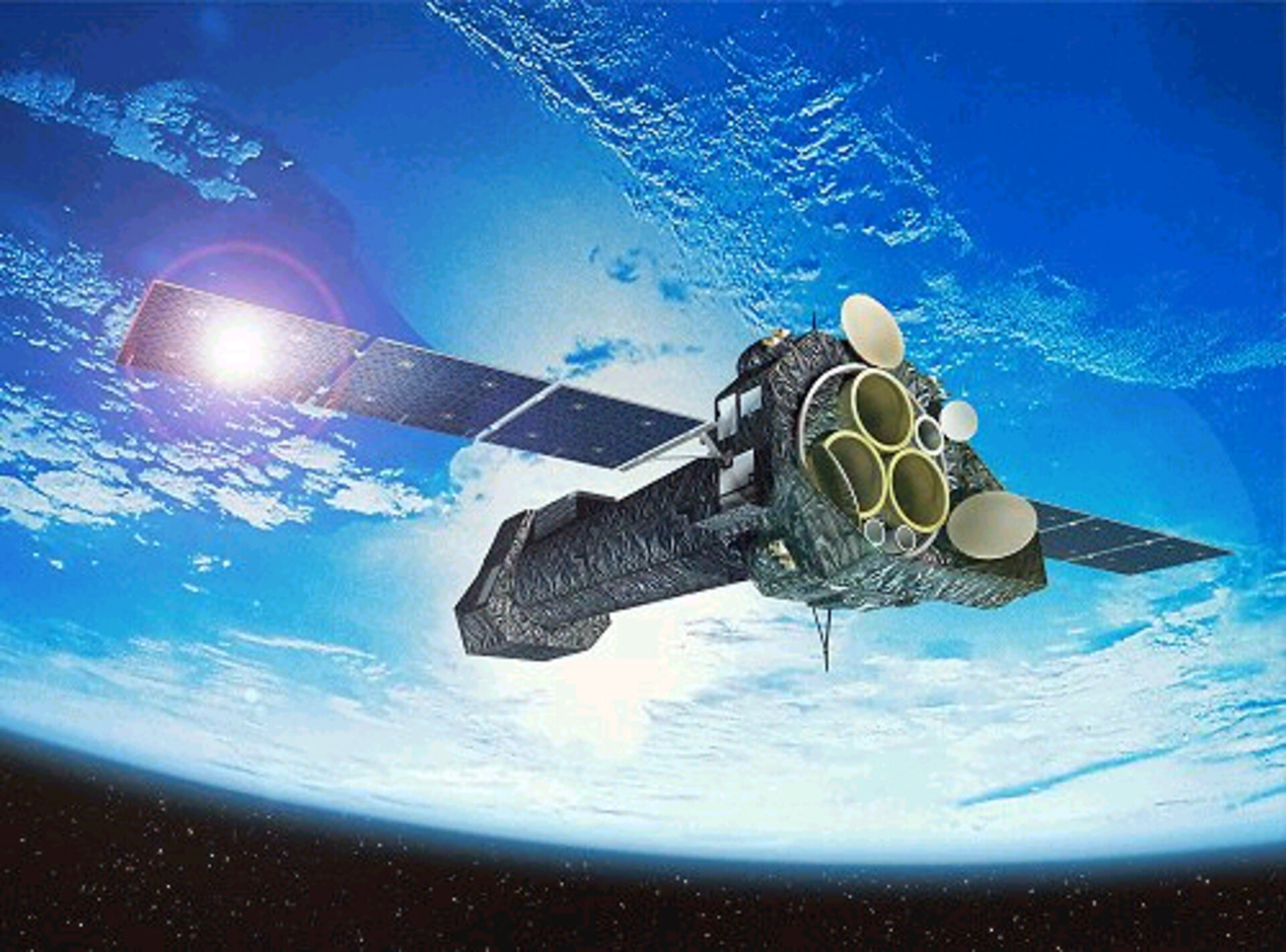
ESA currently operates two high-energy space observatories: XMM-Newton and Integral. Together, these telescopes probe the highly energetic emission from matter in the vicinity of black holes.

Since its launch in 1999, the XMM-Newton X-ray observatory has helped scientists to investigate some of the most violent and mysterious cosmic phenomena, including the interaction of black holes with their surroundings. XMM-Newton has also explored the origin of powerful explosions known as gamma-ray bursts, which are thought to be caused by black holes.

XMM-Newton

Integral – or the International Gamma-Ray Astrophysics Laboratory – is the first space observatory that can simultaneously observe objects in gamma rays, X-rays, and visible light. Its principal targets include gamma-ray bursts and regions in the Universe thought to contain black holes. Integral is helping us understand the black hole at the centre of the Milky Way, as well as those at the centres of other galaxies.

Looking to the future, ESA’s LISA and Athena missions will work both individually and together to address fundamental questions in modern astrophysics. Together, the duo could reveal much about distant and merging black holes, bright quasars in active galaxies, rapid jets around spinning black holes, the cosmic distance scale, and the speed of gravity.

Integral

By combining a large X-ray telescope with state-of-the-art scientific instruments, Athena will address key questions in astrophysics, such as how black holes grow and shape their galaxies. Athena will observe hundreds of thousands of black holes, from relatively near to far away, and map the million-degree-hot matter in their surroundings. This includes black holes that formed in the first few hundred million years of the Universe’s long history.

LISA will be the first space-based observatory dedicated to studying gravitational waves, some of which can only be detected using a space observatory that spans millions of kilometres. Using these waves, LISA will be the first mission to probe the entire history of the Universe. Formed of three spacecraft flying in a triangular formation, LISA will help us explore the fundamental nature of gravity and black holes.

Although XMM-Newton, Integral, Athena and Lisa are ESA’s most dedicated black hole missions, other missions are also contributing in big ways. For example, the NASA/ESA/CSA James Webb Space Telescope will help answer the question ‘did black holes form immediately after the Big Bang?’, the NASA/ESA Hubble Space Telescope has found black holes three billion times as massive as our Sun at the centre of some galaxies, and ESA’s Euclid mission, which will probe the dark Universe in greater detail than ever before, could help identify primordial black holes as dark matter candidates.

Related links:

LIGO: https://www.ligo.caltech.edu/

Event Horizon Telescope: https://eventhorizontelescope.org/

XMM-Newton: https://www.esa.int/Science_Exploration/Space_Science/XMM-Newton_overview

Integral: https://www.esa.int/Science_Exploration/Space_Science/Integral_overview

NASA/ESA/CSA James Webb Space Telescope: https://www.esa.int/Science_Exploration/Space_Science/Webb%20

NASA/ESA Hubble Space Telescope: https://www.esa.int/Science_Exploration/Space_Science/Hubble_overview

ESA’s Euclid: https://www.esa.int/Science_Exploration/Space_Science/Euclid_overview

Space Science: https://www.esa.int/Science_Exploration/Space_Science

Images, Video, Text, Credits: European Space Agency (ESA) - Illustration by Ducros, NASA and Felix Mirabel (the French Atomic Energy Commission & the Institute for Astronomy and Space Physics/Conicet of Argentina)/NASA/C. Henze/JPL-Caltech.

Greetings, Orbiter.ch

Space Station Science Highlights: Week of April 25, 2022


ISS - Expedition 67 Mission patch.


April 29, 2022

Crew members aboard the International Space Station conducted scientific investigations during the week of April 25 that included testing radiation dose detectors and wearable cardiopulmonary monitors and examining the effects of diet on immune function during spaceflight. The Space-X Crew-4 mission, carrying NASA astronauts Kjell Lindgren, Robert Hines, and Jessica Watkins and ESA (European Space Agency) astronaut Samantha Cristoforetti, arrived at the space station on Wed., April 27, along with new microgravity science payloads.

The space station, continuously inhabited by humans for 21 years, has supported many scientific breakthroughs. A robust microgravity laboratory with dozens of research facilities and tools, the station supports investigations spanning every major scientific discipline, conveying benefits to future space exploration and advancing basic and applied research on Earth. The orbiting lab also provides a platform for a growing commercial presence in low-Earth orbit that includes research, satellite services, and in-space manufacturing.

Here are details on some of the microgravity investigations currently taking place:

Mapping radiation


Image above: The DOSIS-3D investigation takes measurements at specific locations inside the space station to create a three-dimensional map pinpointing the distribution and levels of radiation throughout the orbiting lab. In this image, ESA astronaut Matthias Maurer relocates a passive radiation monitor. Image Credit: NASA.

Spaceflight exposes crew members to varying levels of radiation, which can be harmful to their health. DOSIS-3D, an investigation from ESA, measures the radiation doses at specific locations inside the space station using several active and passive detectors. The goal is a three-dimensional map of the levels and distribution of radiation throughout the orbiting lab. A comprehensive understanding of the space radiation environment could help scientists make recommendations for how to protect crews on future missions. On Earth, airline crews and nuclear plant workers experience greater-than-average exposure to radiation. Results from this investigation could provide direction for combining different devices to monitor dosage and collect real-time data to help protect them as well. Crew members de-installed specific detectors during the week.

Wearable monitors


Image above: During a static bike ride, ESA astronaut Matthias Maurer wears a breathing mask and sensors on his chest that monitor heart rate, oxygen, and carbon dioxide levels for Metabolic Space. This investigation demonstrates wearable devices to improve cardiopulmonary diagnostics and assess performance without restricting mobility. Image Credit: ESA.

Metabolic Space from ESA demonstrates a wearable device to measure cardiopulmonary function during physical activity. The primary objective of this experiment is validating that the device works in microgravity and that users can manage it. The secondary objective is to provide experience with the device that can enhance the system for future space applications, such as medical monitoring for space tourists. This technology could reduce the effort required to diagnose cardiopulmonary issues in space and may have applications for making it easier to make such diagnoses on the ground. During the week, crew members used the Metabolic Space hardware and protocol during an exercise session.

Eat this, not that


Image above: This image shows food on the table for a meal on the space station. The Food Physiology investigation examines the effects of diet on immune function, the gut microbiome, and nutritional status. Results could help improve food systems to maintain crew health and performance on future long-duration missions. Image Credit: NASA.

Research has documented that spaceflight affects human physiology, including causing changes in the immune system. Immune function is linked to diet and the gut microbiome, and diet is a factor that can be easily and meaningfully altered on Earth and during flight. Food Physiology characterizes the effects of an enhanced spaceflight diet on immune function and the gut microbiome. Results could help define targeted, efficient dietary interventions and requirements for a food system to maintain crew health and performance on future long-duration missions. The study also could have scientific and medical applications for people on Earth.

Other investigations involving the crew:

- The Japan Aerospace Exploration Agency (JAXA) Electrostatic Levitation Furnace (ELF) is a processing facility to levitate, melt, and solidify materials without solid containers, which reduces imperfections and makes it possible to examine the behavior of the materials. Results could improve the manufacture and use of oxide melts on Earth.
https://www.nasa.gov/mission_pages/station/research/experiments/explorer/Facility.html?#id=1536

- XROOTS uses hydroponic (liquid-based) and aeroponic (air-based) techniques to grow plants without soil or other traditional growth media. Current space-based plant systems do not scale up well in space, and hydroponic and aeroponic techniques could enable production of crops on a larger scale for future space exploration.
https://www.nasa.gov/mission_pages/station/research/experiments/explorer/Investigation.html?#id=8088

- Transparent Alloys - METCOMP, an investigation from ESA, studies the formation of layered structures during solidification of an alloy, or mixture of different metals, using specific organic materials that solidify like a metal yet remain transparent. Alloys are used in a wide variety of applications from smartphones to aircraft, and lighter, stronger versions could benefit consumers and industry.
https://www.nasa.gov/mission_pages/station/research/experiments/explorer/Investigation.html?#id=8504

- For ESA’s CalliopEO, German school children write software to run experiments on a Calliope mini-computer aboard the space station. The experience helps motivate students to pursue science, technology, engineering, and mathematics fields and become the next generation of explorers.
https://www.nasa.gov/mission_pages/station/research/experiments/explorer/Investigation.html?#id=8567

- Rhodium Crystal Preservation studies using crystal formation to preserve biological material for research. These crystal matrices do not require special conditions and could provide a way to maintain biological materials for research on future space missions.
https://www.nasa.gov/mission_pages/station/research/experiments/explorer/Investigation.html?#id=8712

- Actiwatch is a wearable monitor that continuously collects data on a crew member’s circadian rhythms, sleep-wake patterns, and activity during flight, beginning as soon as possible after arrival aboard the station.
https://www.nasa.gov/mission_pages/station/research/experiments/explorer/Facility.html?#id=838

Space to Ground: Fantastic Four: 04/29/2022

Related links:

Expedition 67: https://www.nasa.gov/mission_pages/station/expeditions/expedition67/index.html

DOSIS-3D: https://www.nasa.gov/mission_pages/station/research/experiments/explorer/Investigation.html?#id=177

Metabolic Space: https://www.nasa.gov/mission_pages/station/research/experiments/explorer/Investigation.html?#id=7574

Food Physiology: https://www.nasa.gov/mission_pages/station/research/experiments/explorer/Investigation.html?#id=7870

ISS National Lab: https://www.issnationallab.org/

Spot the Station: https://spotthestation.nasa.gov/

Space Station Research and Technology: https://www.nasa.gov/mission_pages/station/research/overview.html

International Space Station (ISS): https://www.nasa.gov/mission_pages/station/main/index.html

Images (mentioned), Video (NASA), Text, Credits: NASA/Ana Guzman/John Love, ISS Research Planning Integration Scientist Expedition 67.

Best regards, Orbiter.ch

CASC - Long March-2C launches Siwei-01 and Siwei-02


CASC - China Aerospace Science and Technology Corporation logo.


April 29, 2022

Long March-2C carrying Siwei-01 and Siwei-02 liftoff

A Long March-2C launch vehicle launched the Siwei-01 and Siwei-02 satellites from the Jiuquan Satellite Launch Center, Gansu Province, northwest China, 29 April 2022, at 04:11 UTC (12:11 local time).

Long March-2C launches Siwei-01 and Siwei-02

According to official sources, the satellites have entered the planned orbits and will “provide commercial remote sensing data services for industries including surveying and mapping, environmental protection, as well as urban security and digital rural development.”

Siwei Gaojing 1-01, 02 (SuperView Neo 1-01, 02) satellite

Siwei-01 and Siwei-02 (四维01/02), also known as SuperView Neo 1-01 and 02, are “two commercial earth observation satellites of 0.5m resolution” designed and developed by China Academy of Space Technology (CAST).

For more information about China Aerospace Science and Technology Corporation (CASC), visit: http://english.spacechina.com/n16421/index.html

Images, Video, Text, Credits: China Media Group(CMG)/China Central Television (CCTV)/China Aerospace Science and Technology Corporation (CASC)/SciNews/Gunter's Space Page/Orbiter.ch Aerospace/Roland Berga.

Greetings, Orbiter.ch

jeudi 28 avril 2022

Cosmonauts Set Up Robotic Arm’s First Motion, Wrap Up Spacewalk


ROSCOSMOS - Russian Cosmonaut patch.


April 28, 2022

Russian cosmonauts Oleg Artemyev and Denis Matveev of Roscosmos concluded their spacewalk outside of the International Space Station at  6:40 p.m. EDT after 7 hours and 42 minutes.


Image above: Spacewalkers Oleg Artemyev and Denis Matveev monitor the station’s new European robotic arm as it moves on the Nauka multipurpose laboratory module. Image Credit: NASA TV.

Artemyev and Matveev completed their major objectives during the spacewalk, which included monitoring the first commanded movements of the robotic arm from its grapple fixtures after removing thermal blankets and launch locks. The duo monitored the robotic arm as its end effectors translated one at a time to a new base points. The crew also installed more handrails on Nauka multipurpose laboratory module.

This was the fifth spacewalk in Artemyev’s career, and the second for Matveev. It will be the fifth spacewalk at the station in 2022 and the 250th spacewalk for space station assembly, maintenance, and upgrades.

Additional spacewalks are planned to continue outfitting the European robotic arm and to activate Nauka’s airlock for future spacewalks.

Related article:

Spacewalkers Exit Station to Activate New Robotic Arm
https://orbiterchspacenews.blogspot.com/2022/04/spacewalkers-exit-station-to-activate.html

Related link:

Nauka multipurpose laboratory module: https://www.roscosmos.ru/tag/nauka/

International Space Station (ISS): https://www.nasa.gov/mission_pages/station/main/index.html

Image (mentioned), Text, Credits: NASA/Mark Garcia.

Best regards, Orbiter.ch