mardi 30 août 2022

Engineers Assess Data After Scrub, Mission Managers to Meet Tuesday Afternoon


NASA - ARTEMIS 1 Mission patch.


Aug. 30, 2022

Engineers are evaluating data gathered during the Artemis I launch attempt Monday, Aug. 29, when teams could not get the rocket’s engines to the proper temperature range required to start the engines at liftoff, and ran out of time in the two-hour launch window to continue. The mission management team will convene Tuesday afternoon to discuss the data and develop a plan forward.


Image above: A NASA helicopter flies past the agency’s Space Launch System (SLS) rocket with the Orion spacecraft aboard atop the mobile launcher at Launch Pad 39B at NASA’s Kennedy Space Center in Florida, Monday, Aug. 29, 2022. NASA’s Artemis I flight test is the first integrated test of the agency’s deep space exploration systems: the Orion spacecraft, SLS rocket, and supporting ground systems. Image Credit: NASA.

The Space Launch System’s four RS-25 engines must be thermally conditioned before super cold propellant begins flowing through them for liftoff. Launch controllers condition them by increasing the pressure on the core stage liquid hydrogen tank to route, or “bleed” as it is often called, a portion of the approximately minus 423 F liquid hydrogen to the engines. Managers suspect the issue, seen on engine 3, is unlikely to be the result of a problem with the engine itself.

During the countdown, launch controllers worked through several additional issues, including storms in the area that delayed the start of propellant loading operations, a leak at the quick disconnect on the 8-inch line used to fill and drain core stage liquid hydrogen, and a hydrogen leak from a valve used to vent the propellant from the core stage intertank.

NASA will host a media teleconference Tuesday, Aug. 30, at approximately 6 p.m. EDT to provide an update on data analysis and discussions. The time is subject to change. While managers have not yet set a date for the next launch attempt, the earliest possible opportunity is Friday, Sept. 2, during a two-hour launch window that opens at 12:48 p.m.

Audio of the teleconference will stream live online at: https://www.nasa.gov/live

Related articles:

NASA to Provide Update on Artemis I Moon Mission Status
https://www.nasa.gov/press-release/nasa-to-provide-update-on-artemis-i-moon-mission-status

ARTEMIS 1 - Launch Attempt Scrubbed
https://orbiterchspacenews.blogspot.com/2022/08/artemis-1-launch-attempt-scrubbed.html

Related links:

NASA Television: http://www.nasa.gov/live

Artemis I: https://www.nasa.gov/specials/artemis-i/

Space Launch System (SLS): https://www.nasa.gov/exploration/systems/sls/index.html

Orion spacecraft: https://www.nasa.gov/exploration/systems/orion/index.html

Image (mentioned), Text Credit: National Aeronautics and Space Administration (NASA).

Greetings, Orbiter.ch

lundi 29 août 2022

Crew Studies Muscles, Skin Healing During Spacewalk Preps


ISS - Expedition 67 Mission patch.


August 29, 2022

Space biology kicked off the week for the Expedition 67 crew on Monday to help NASA and its international partners support astronauts on long spaceflight missions. Two cosmonauts are also preparing for a spacewalk to continue outfitting the International Space Station’s third robotic arm.

NASA Flight Engineers Kjell Lindgren and Bob Hines began Monday morning with muscle measurements inside the Columbus laboratory module. Using the Myotones device the pair measured the biochemical properties of their neck, back, and leg muscles. By understanding how weightlessness impacts muscular tone, stiffness, and elasticity, doctors can better evaluate crew health and develop effective space fitness strategies.


Image above: The sun’s glint beams off the Indian Ocean in this photograph from the space station as it soared 260 miles above. Image Credit: NASA.

Lindgren downloaded the muscle data captured from the Myotones device to a laptop computer connected to Columbus’ European Physiology Module, a research rack that supports neuroscientific, cardiovascular, and physiological studies. Afterward, the two-time station resident collected and stowed urine samples in a science freezer for later analysis.

Hines then went over to the Kibo laboratory module to continue studying how wounds heal in space. He joined Flight Engineers Jessica Watkins of NASA and Samantha Cristoforetti of ESA (European Space Agency) and practiced surgical techniques such as biopsies, suture splints, and wound dressing, inside Kibo’s Life Science Glovebox. Researchers are exploring the molecular processes behind space-caused skin aging that may impact the way wounds heal and possibly improve skin healing treatments for both astronauts and Earthlings.

International Space Station (ISS). Animation Credit: NASA

Cosmonauts Oleg Artemyev and Denis Matveev continued setting up their tools and Orlan spacesuits today ahead of another planned spacewalk to configure the European robotic arm (ERA) for payload operations on the station’s Russian segment. Roscosmos Flight Engineer Sergey Korsakov spent his morning on computer maintenance inside the Nauka multipurpose laboratory module before switching to orbital plumbing duties during the afternoon.

Related links:

Expedition 67: https://www.nasa.gov/mission_pages/station/expeditions/expedition67/index.html

Columbus laboratory module: https://www.nasa.gov/mission_pages/station/structure/elements/europe-columbus-laboratory

Muscular tone, stiffness, and elasticity: https://www.nasa.gov/mission_pages/station/research/experiments/explorer/Investigation.html?#id=7573

European Physiology Module: https://www.nasa.gov/mission_pages/station/research/experiments/explorer/Facility.html?#id=328

Science freezer: https://www.nasa.gov/mission_pages/station/research/experiments/explorer/Facility.html?#id=56

Kibo laboratory module: https://www.nasa.gov/mission_pages/station/structure/elements/japan-kibo-laboratory

How wounds heal in space: https://www.nasa.gov/mission_pages/station/research/experiments/explorer/Investigation.html?#id=8227

Life Science Glovebox: https://www.nasa.gov/mission_pages/station/research/experiments/explorer/Facility.html?#id=7676

Nauka multipurpose laboratory module: https://www.roscosmos.ru/tag/nauka/

Space Station Research and Technology: https://www.nasa.gov/mission_pages/station/research/overview.html

International Space Station (ISS): https://www.nasa.gov/mission_pages/station/main/index.html

Image (mentioned), Animation (mentioned), Text, Credits: NASA/Mark Garcia.

Greetings, Orbiter.ch

Webb inspects the heart of the Phantom Galaxy


NASA / ESA / CSA-ASC - James Webb Space Telescope (JWST) patch.


Aug. 29, 2022

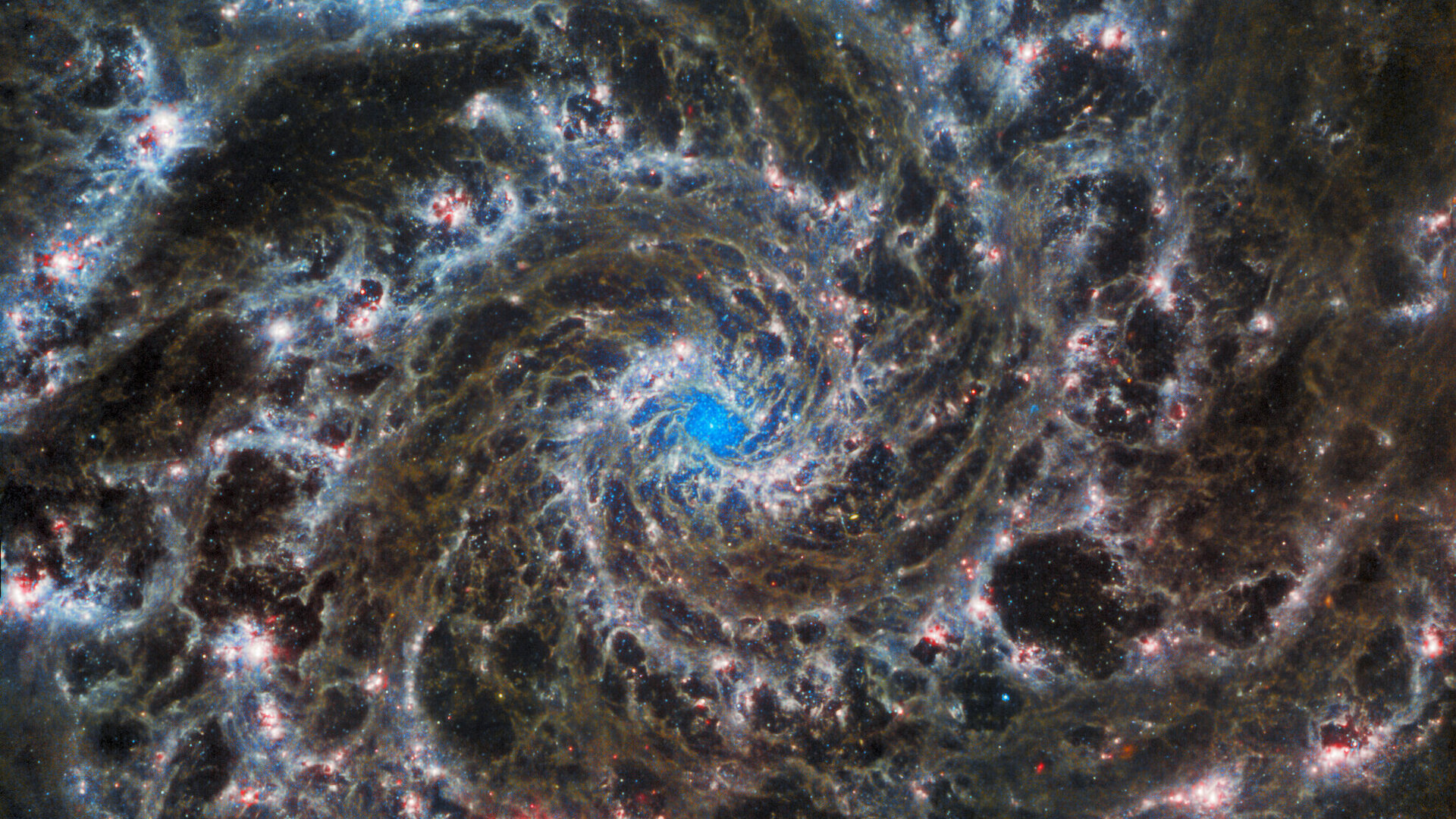
New images of the spectacular Phantom Galaxy, M74, showcase the power of space observatories working together in multiple wavelengths. In this case, data from the NASA/ESA/CSA James Webb Space Telescope and the NASA/ESA Hubble Space Telescope compliment each other to provide a comprehensive view of the galaxy.

Heart of the Phantom Galaxy

The Phantom Galaxy is around 32 million light-years away from Earth in the constellation Pisces, and lies almost face-on to Earth. This, coupled with its well-defined spiral arms, makes it a favourite target for astronomers studying the origin and structure of galactic spirals.

M74 is a particular class of spiral galaxy known as a ‘grand design spiral’, meaning that its spiral arms are prominent and well-defined, unlike the patchy and ragged structure seen in some spiral galaxies.

Phantom Galaxy across the spectrum

Webb’s sharp vision has revealed delicate filaments of gas and dust in the grandiose spiral arms of M74, which wind outwards from the centre of the image. A lack of gas in the nuclear region also provides an unobscured view of the nuclear star cluster at the galaxy's centre.

Webb gazed into M74 with its Mid-InfraRed Instrument (MIRI) in order to learn more about the earliest phases of star formation in the local Universe. These observations are part of a larger effort to chart 19 nearby star-forming galaxies in the infrared by the international PHANGS collaboration. Those galaxies have already been observed using the NASA/ESA Hubble Space Telescope and ground-based observatories.

Multi-observatory views of M74

The addition of crystal-clear Webb observations at longer wavelengths will allow astronomers to pinpoint star-forming regions in the galaxies, accurately measure the masses and ages of star clusters, and gain insights into the nature of the small grains of dust drifting in interstellar space.


Hubble observations of M74 have revealed particularly bright areas of star formation known as HII regions. Hubble’s sharp vision at ultraviolet and visible wavelengths complements Webb’s unparalleled sensitivity at infrared wavelengths, as do observations from ground-based radio telescopes such as the Atacama Large Millimeter/submillimeter Array, ALMA.

By combining data from telescopes operating across the electromagnetic spectrum, scientists can gain greater insight into astronomical objects than by using a single observatory – even one as powerful as Webb!

About Webb

James Webb Space Telescope (JWST)

The James Webb Space Telescope is the world's premier space science observatory. Webb will solve mysteries in our Solar System, look beyond to distant worlds around other stars, and probe the mysterious structures and origins of our Universe and our place in it. Webb is an international program led by NASA with its partners, ESA and the Canadian Space Agency.
 The major contributions of ESA to the mission are: the NIRSpec instrument; the MIRI instrument optical bench assembly; the provision of the launch services; and personnel to support mission operations. In return for these contributions, European scientists will get a minimum share of 15% of the total observing time, like for the NASA/ESA Hubble Space Telescope.

MIRI was contributed by ESA and NASA, with the instrument designed and built by a consortium of nationally funded European Institutes (the MIRI European Consortium) in partnership with JPL and the University of Arizona.

Related links:

Mid-InfraRed Instrument (MIRI): https://www.esa.int/Science_Exploration/Space_Science/MIRI_factsheet

James Webb Space Telescope (JWST): https://www.esa.int/Science_Exploration/Space_Science/Webb

Images, Animation, Text, Credits: ESA/Webb, NASA & CSA, J. Lee and the PHANGS-JWST Team/ESA/Webb, NASA & CSA, J. Lee and the PHANGS-JWST Team; ESA/Hubble & NASA, R. Chandar Acknowledgement: J. Schmidt.

Best regards, Orbiter.ch

Rocket Lab is Sending its own Mission to Venus to Search for Life


Rocket Lab logo.


Aug. 29, 2022

In a recent study published in Instrumentation and Methods for Astrophysics, the private space company, Rocket Lab, outlines a plan to send their high-energy Photon spacecraft to Venus in May 2023 with the primary goal of searching for life within the Venusian atmosphere. The planet Venus has become a recent hot topic in the field of astrobiology, which makes the high-energy Photon mission that much more exciting.

Rocket Lab hopes to build off their recent successful launch of the CAPSTONE mission using its Photon satellite bus, and consists of a CubeSat designed to study the near rectilinear halo orbit (NRHO) around the Moon and its applications for long-term missions such as Gateway.


Image above: Rocket Lab’s high-energy Photon mission hopes to search for life in the clouds of Venus and is scheduled to launch in May 2023. Image Credit: Rocket Lab.

“With the high delta-V capabilities we just demonstrated on CAPSTONE, we can now access almost every destination in the inner solar system with Photon,” said Richard French, who is the Director of Business Development Strategy for the Space Systems Division at Rocket Lab, and lead author of the paper. “What makes Venus compelling to us is that until recently it hadn’t gotten a lot of attention in terms of missions targeting Venus, and in particular planning in-situ measurements. With VERITAS and DAVINCI now in implementation by NASA there is more focus but with those missions going no earlier than the late 2020’s we hope to increase the rate of discovery by going much sooner.” VERITAS and DAVINCI+ are two recently approved missions by NASA meant to study Venus more in-depth, to include its atmospheric composition and geologic history. Currently, high-energy Photon appears to be on schedule for a May 2023 launch.

“The development is proceeding as quickly as possible, with an eye towards taking advantage of next May’s launch opportunity,” explains French. “If we can’t make it, then we have a backup in January 2025. Either way, we are committed to moving as quickly as we can. We are benefiting from a strong partnership with our science team delivering the flight instrument late this summer and a bunch of flight spare hardware from the CAPSTONE mission.”

High-energy Photon will launch onboard Rocket Lab’s Electron launch vehicle while ferrying a small probe with a single ~1-kilogram (2.2-pound) science instrument known as the autofluorescing nephelometer (AFN), which is designed to shine a laser onto cloud particles within Venus’ atmosphere in hopes of causing organic molecules to fluoresce, or light up. One such organic molecule, the amino acid tryptophan, is known to possess fluorescent properties. The probe is scheduled to spend approximately 5 minutes in the Venus atmosphere at 48-60 kilometers (30-37 miles) above the surface collecting an assortment of data to search for evidence of life.


Image above: Rocket Lab’s planned high-energy Photon mission to Venus is slated to conduct the approximate 5-minute science phase of its mission at 48-60 kilometers (30-37 miles) above the surface. Image Credits: NASA Ames Research Center.

Since scientific planetary missions have been in the purview of government organizations throughout the Space Age, the high-energy Photon mission to Venus could have the potential to expand scientific planetary missions from the private sector.

“The ability to send a small payload of one or two instruments at a time enables focused science on rapid timescales and is a game changer for science,” said Dr. Sara Seager, a Professor of Planetary Science at the Massachusetts Institute of Technology, the mission’s Principal Investigator, and a co-author on the paper. “Missions otherwise typically take years to a decade to plan and implement, making it hard to jump on answering new and exciting science questions.”

As stated, the probe itself will only spend approximately 5 minutes collecting data within the Venusian atmosphere. Despite this small window, this mission is considered a “first step in a campaign of small missions to better understand Venus”, as noted by the paper.

“We envision two follow-on missions,” explains Dr. Seager. “One with a larger Probe with a parachute that can spend an hour in the Venus atmospheric cloud layers. The next a small balloon mission to last a week or more, inspired by the Russian Vega balloons sent in the 1980s.”

Related articles:

CAPSTONE Launches to Test New Orbit for NASA’s Artemis Moon Missions
https://orbiterchspacenews.blogspot.com/2022/06/capstone-launches-to-test-new-orbit-for.html

Rocket Lab - Celebrating 5 Years of Electron Launches!
https://orbiterchspacenews.blogspot.com/2022/06/rocket-lab-celebrating-5-years-of.html

CAPSTONE Charts a New Path for NASA's Moon-Orbiting Space Station
https://orbiterchspacenews.blogspot.com/2022/05/capstone-charts-new-path-for-nasas-moon.html

Related links:

Instrumentation and Methods for Astrophysics: https://arxiv.org/abs/2208.07724

Rocket Lab: https://www.rocketlabusa.com/

Images (mentioned), Text, Credits: Rocket Lab/Universe Today/By Laurence Tognetti.

Greetings, Orbiter.ch

ARTEMIS 1 - Launch Attempt Scrubbed


NASA - ARTEMIS 1 Mission patch.


Aug. 29, 2022

Engineers Troubleshooting Engine Conditioning Issue


While liquid oxygen loading into the interim cryogenic propulsion stage continues and core stage tanks continue to be replenished with propellants, engineers are troubleshooting an issue conditioning one of the RS-25 engines (engine 3) on the bottom of the core stage. Launch controllers condition the engines by increasing pressure on the core stage tanks to bleed some of the cryogenic propellant to the engines to get them to the proper temperature range to start them. Engine 3 is not properly being conditioned through the bleed process, and engineers are troubleshooting.


Teams also are assessing what appears to be a crack in the thermal protection system material on one of the flanges on the core stage. The flanges are connection joints that function like a seam on a shirt, are affixed at the top and bottom of the intertank so the two tanks can be attached to it.

Teams Continue to Hold While Data Gathering Continues


Teams are in a hold in the countdown at T-40 minutes while engineers evaluate why the bleed test to condition the engines was not successful. Engineers are looking at options to gather as much data as possible. The Artemis I rocket and spacecraft are in a stable, safe condition.

Launch Attempt Scrubbed


The launch director halted today’s Artemis I launch attempt at approximately 8:34 a.m. EDT. The Space Launch System rocket and Orion spacecraft remain in a safe and stable configuration. Launch controllers were continuing to evaluate why a bleed test to get the RS-25 engines on the bottom of the core stage to the proper temperature range for liftoff was not successful, and ran out of time in the two-hour launch window. Engineers are continuing to gather additional data.


 Artemis I aborted launch

Related article about launch scrub:

NASA Waves Off First Artemis I Launch Attempt, to Provide Media Update
https://www.nasa.gov/press-release/nasa-waves-off-first-artemis-i-launch-attempt-to-provide-media-update

Related articles:

Countdown Continues, Teams Confirm No Impacts from Lightning Strikes
https://orbiterchspacenews.blogspot.com/2022/08/countdown-continues-teams-confirm-no.html

Europe to support Artemis CubeSats in return to the Moon
https://orbiterchspacenews.blogspot.com/2022/08/europe-to-support-artemis-cubesats-in.html

Artemis I to Launch First-of-a-Kind Deep Space Biology Mission
https://orbiterchspacenews.blogspot.com/2022/08/artemis-i-to-launch-first-of-kind-deep.html

NASA’s Moon-observing CubeSat Ready for Artemis Launch
https://orbiterchspacenews.blogspot.com/2022/08/nasas-moon-observing-cubesat-ready-for.html

Artemis I Moon Rocket Arrives at Launch Pad Ahead of Historic Mission
https://orbiterchspacenews.blogspot.com/2022/08/artemis-i-moon-rocket-arrives-at-launch.html

Related links:

NASA Television: http://www.nasa.gov/live

Artemis I: https://www.nasa.gov/specials/artemis-i/

Space Launch System (SLS): https://www.nasa.gov/exploration/systems/sls/index.html

Orion spacecraft: https://www.nasa.gov/exploration/systems/orion/index.html

Images, Video, Text, Credits: NASA/Rachel Kraft/NASA TV/SciNews/Orbiter.ch Aerospace/Roland Berga.

Greetings, Orbiter.ch

dimanche 28 août 2022

Countdown Continues, Teams Confirm No Impacts from Lightning Strikes


NASA - ARTEMIS 1 Mission patch.


August 28, 2022

Overnight engineers evaluated data from lightning strikes to the lightning protection system at Launch Pad 39B that occurred yesterday. They confirmed the strikes were of low magnitude and had no impacts to Space Launch System, Orion, or ground systems.


Image above: NASA’s Space Launch System (SLS) rocket with the Orion spacecraft aboard is seen atop a mobile launcher at Launch Pad 39B as preparations for launch continue, Thursday, Aug. 25, 2022, at NASA’s Kennedy Space Center in Florida. NASA’s Artemis I flight test is the first integrated test of the agency’s deep space exploration systems: the Orion spacecraft, SLS rocket, and supporting ground systems. Launch of the uncrewed flight test is targeted for no earlier than Aug. 29 at 8:33 a.m. ET. Photo Credits: NASA/Joel Kowsky.

Meteorologists with the U.S. Space Force Space Launch Delta 45 predict an 80% chance of favorable weather conditions at the beginning of the two-hour launch window that opens at 8:33 a.m. EDT Aug. 29, with a 60% change of favorable weather conditions toward the later part of the window. The primary weather concern for the two-hour launch window remains scattered rain showers. The weather guidelines for NASA’s Artemis I flight test identify conditions to launch the agency’s Space Launch System and Orion spacecraft. 

ARTEMIS 1 Launch, Ascent. Image Credit: NASA (click on the image for enlarge)

 Overnight teams also powered up the Space Launch System rocket’s core stage, charged Orion and core stage batteries, and conducted final preparations on the umbilicals. A pre-launch walkdown are continuing at the launch pad this morning. Teams will continue working their way through the countdown today, including powering up the interim cryogenic propulsion stage, conducting planned health checks on Orion systems.

Artemis I launch explained

Live coverage of tanking operations will begin at midnight on NASA television, the agency’s website, and the NASA app. Full launch coverage begin at 6:30 a.m. EDT on NASA Television and the agency’s website, as well as YouTube, Twitter, Facebook, LinkedIn, Twitch, Daily Motion, Theta.TV, and the NASA app. 

The uncrewed flight test will test SLS and Orion as an integrated system, demonstrating the performance of the rocket and testing the spacecraft’s capabilities as it journeys about 40,000 miles beyond the Moon over the course of about six weeks.

ARTEMIS 1 Mission Profile. Image Credit: NASA (click on the image for enlarge)

The first in an increasingly complex series of missions, Artemis I will pave the way for long-term lunar exploration, providing the foundation for extending human presence to the Moon and beyond.

Related articles:

Europe to support Artemis CubeSats in return to the Moon
https://orbiterchspacenews.blogspot.com/2022/08/europe-to-support-artemis-cubesats-in.html

Artemis I to Launch First-of-a-Kind Deep Space Biology Mission
https://orbiterchspacenews.blogspot.com/2022/08/artemis-i-to-launch-first-of-kind-deep.html

NASA’s Moon-observing CubeSat Ready for Artemis Launch
https://orbiterchspacenews.blogspot.com/2022/08/nasas-moon-observing-cubesat-ready-for.html

Artemis I Moon Rocket Arrives at Launch Pad Ahead of Historic Mission
https://orbiterchspacenews.blogspot.com/2022/08/artemis-i-moon-rocket-arrives-at-launch.html

Related links:

NASA Television: http://www.nasa.gov/live

Artemis I: https://www.nasa.gov/specials/artemis-i/

Space Launch System (SLS): https://www.nasa.gov/exploration/systems/sls/index.html

Orion spacecraft: https://www.nasa.gov/exploration/systems/orion/index.html

Images (mentioned), Video, Text, Credits: NASA/NASA TV/SciNews.

Best regards, Orbiter.ch

SpaceX Starlink 57 launch


SpaceX - Falcon 9 / Starlink Mission patch.


Aug. 28, 2022

Falcon 9 carrying Starlink 57 liftoff

A SpaceX Falcon 9 launch vehicle launched 54 Starlink satellites (Starlink-57 / Starlink 4-23) from Space Launch Complex 40 (SLC-40) at Cape Canaveral Space Force Station in Florida, on 28 August 2022, at 03:41 UTC (27 August, at 23:41 EDT).

SpaceX Starlink 57 launch & Falcon 9 first stage landing, 28 August 2022

Following stage separation, Falcon 9’s first stage landed on the “A Shortfall of Gravitas” droneship, stationed in the Atlantic Ocean. Falcon 9’s first stage (B1069) previously launched the CRS-24 mission.

Related links:

SpaceX: https://www.spacex.com/

Starlink: https://www.starlink.com/
 
Image, Video, Text, Credits: SpaceX/SciNews/Orbiter.ch Aerospace/Roland Berga.

Greetings, Orbiter.ch