mardi 29 novembre 2022

NASA, ICON Advance Lunar Construction Technology for Moon Missions


NASA - ARTEMIS Program logo.


November 29, 2022

As NASA plans for long-term human exploration of the Moon under Artemis, new technologies are required to meet the unique challenges of living and working on another world.

Image above: A new award from NASA will support ICON in developing construction technology that could be used on the Moon and Mars. Image Credit: ICON.

NASA has awarded ICON, located in Austin, a contract to develop construction technologies that could help build infrastructure such as landing pads, habitats, and roads on the lunar surface.

"In order to explore other worlds, we need innovative new technologies adapted to those environments and our exploration needs," said Niki Werkheiser, director of technology maturation in NASA's Space Technology Mission Directorate (STMD). "Pushing this development forward with our commercial partners will create the capabilities we need for future missions."

The award is a continuation of ICON's work under a Small Business Innovation Research (SBIR) dual-use contract with the U.S. Air Force, partly funded by NASA. The new NASA SBIR Phase III award will support the development of ICON's Olympus construction system, which is designed to use local resources on the Moon and Mars as building materials. The contract runs through 2028 and has a value of $57.2 million.

ICON will work with NASA’s Marshall Space Flight Center in Huntsville, Alabama, under STMD’s Moon to Mars Planetary Autonomous Construction Technologies (MMPACT) project. NASA is partnering with industry, government, and academic institutions under the MMPACT project.

The award will build on ICON’s commercial activities and other work with NASA.

ICON 3D printed a 1,700-square-foot simulated Martian habitat, called Mars Dune Alpha, that will be used during NASA's Crew Health and Performance Analog, or CHAPEA, analog mission starting in 2023.

ICON also competed in NASA's 3D Printed Habitat Challenge. The company partnered with the Colorado School of Mines in Golden, and the team won a prize for 3D printing a structure sample that was tested for its ability to hold a seal, for strength, and for durability in temperature extremes.

MMPACT is part of the Game Changing Development program within NASA’s STMD.

To learn more about NASA’s space technology development, visit: https://nasa.gov/spacetech

Related links:

Artemis: https://www.nasa.gov/specials/artemis/

Crew Health and Performance Analog (CHAPEA): https://www.nasa.gov/chapea

Image (mentioned), Text, Credits: NASA/Sarah Frazier.

Best regards, Orbiter.ch

Space Station Science Highlights: Week of November 21, 2022


ISS - Expedition 68 Mission patch.


Nov 29, 2022

Crew members aboard the International Space Station conducted scientific investigations during the week of Nov. 21 that included radio contact between astronauts and science students on the ground, tracking how the human body adapts to microgravity, and analyzing how microgravity affects the nervous system.

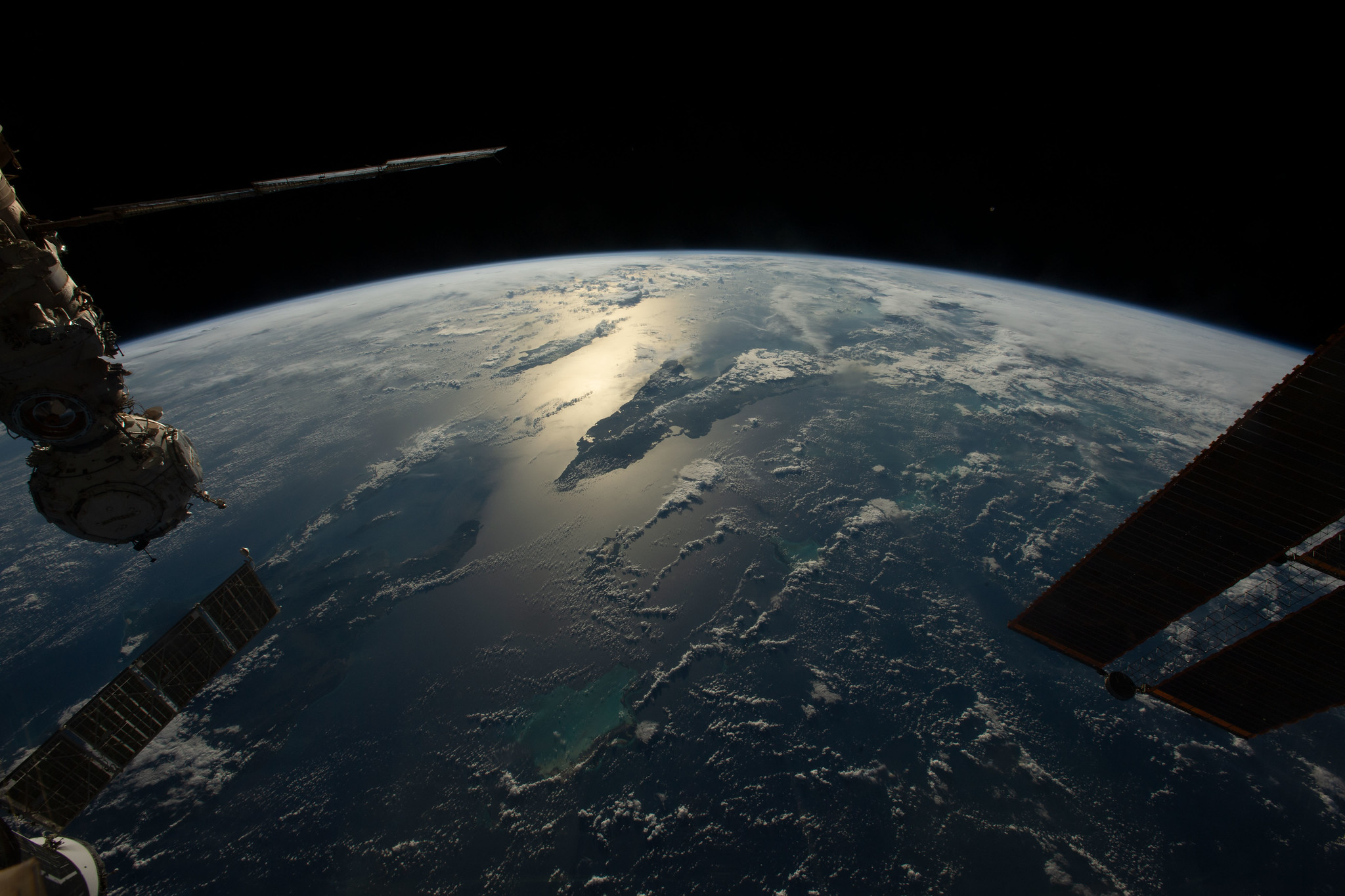
Image above: The Caribbean Sea and Atlantic Ocean, with Cuba and Haiti in the foreground, are visible in this photograph from the International Space Station as it orbits 258 miles above. Image Credit: NASA.

Here are details on some of the microgravity investigations currently taking place aboard the orbiting lab:

Students speak to astronauts

Animation above: NASA astronaut Josh Cassada conducts an ISS Ham Radio session. These experiences, which use amateur radio to connect students, teachers, parents, and other members of a community directly to astronauts on the space station, help inspire interest in science, technology, engineering, and math.
Animation Credit: NASA.

ISS Ham Radio sessions use ground-based amateur radio units to connect students, teachers, parents, and other members of a community directly to astronauts on the space station. These radio experiences help inspire interest in science, technology, engineering, and math. During the week, crew members spoke with students studying and monitoring natural hazards at 12 schools in nine Caribbean and Central American countries, hosted by St. Joseph´s Convent Secondary School in Saint Lucia. The crew also held a session with the community at Five Bridges Junior High School in Nova Scotia, Canada. Those students are learning about space exploration with activities that include constructing solar system models and growing tomato seeds that previously flew on the space station.

Adapting to space

For the Standard Measures investigation, crew members complete cognition tests and sleep questionnaires and collect blood, saliva, and urine samples for various analyses, including immune function and microbiome health. Other measures include artery ultrasounds and sensorimotor tests. These data, collected over the life of the space station, enable researchers to examine how crew members adapt to living and working in space and to monitor countermeasure effectiveness in support of future long-duration missions. During the week, crew members completed questionnaires and collected samples for the investigation.

Hitting a nerve

Image above: Culture Bags for the JAXA Neural Integration System investigation prior to launch to the space station. The investigation uses nematodes to examine how microgravity affects the nervous system. Image Credit: JAXA.

Neural Integration System, an investigation from the Japan Aerospace Exploration Agency (JAXA), uses the roundworm C. elegans to examine how microgravity affects the nervous system. Previous space experiments show that this species experiences muscle atrophy and reduced motor activity and metabolism in microgravity. Other research has shown that the effects of space on the nervous system may be transmitted throughout the body by neural networks. Results from this investigation could support development of countermeasures to help maintain human health and well-being on future space missions. Changes caused by microgravity resemble diseases related to aging on Earth, and this study also could provide insight into such diseases and improve quality of life for people on Earth. During the week, crew members prepared for arrival of the investigation by setting up the Confocal Space Microscope, which will be used to observe samples.

Other investigations involving the crew:

- Rhodium Microgravity Bioprospecting-1 studies a way to search for microbes that, due to changes induced by exposure to space, may yield substances with commercial value. Results could expedite the discovery of substances in plants and animals with potential uses in medicine and industry on Earth.
https://www.nasa.gov/mission_pages/station/research/experiments/explorer/Investigation.html?#id=8806

- Sponsored by NASA and the Italian Space Agency (ASI) and coordinated by ASI, OVOSPACE examines the effect of microgravity on bovine ovary cell cultures. This research could improve fertility treatments on Earth and help prepare for future human settlement in space.
https://www.nasa.gov/mission_pages/station/research/experiments/explorer/Investigation.html?#id=8759

Image above: This image shows coarse hydrophobic sand mixed with water and air as part of preparation for Catastrophic Post-Wildfire Mudflows. This investigation studies the formation and stability of bubble-sand structures in microgravity to help improve the modeling and predicting of devastating mudflows that often follow wildfires. Image Credits: UCSD Geo-Micromechanics Research Group.

- Catastrophic Post-Wildfire Mudflows evaluates the structure and behavior of mixtures of sand, water, and trapped air in microgravity, which removes complicating forces. Climate change and global warming are increasing the occurrence of wildfires, and results could help develop models that predict the spread and velocity of mudflows and their effect on infrastructure and natural obstacles.
https://www.nasa.gov/mission_pages/station/research/experiments/explorer/Investigation.html?#id=8799

- Cellbox-3 contains two experiments that investigate cell behavior in microgravity, where 3D structures form that closely resemble the growth and behavior of cells inside the body. These structures can be used for drug and toxicity screening and serve as models for development and maintenance of healthy tissues in a living organism.
https://www.nasa.gov/mission_pages/station/research/experiments/explorer/Investigation.html?#id=8758

- Girl Scouts conduct experiments on plant growth, ant colonization, and brine shrimp lifecycle in Faraday boxes for Faraday-Girl Scouts, part of a year-long effort by the Girl Scouts of Citrus Council to engage young people in the study and understanding of space.
https://www.nasa.gov/mission_pages/station/research/experiments/explorer/Investigation.html?#id=8502

Space to Ground: It's a Feast: 11/23/2022

The space station, a robust microgravity laboratory with a multitude of specialized research facilities and tools, has supported many scientific breakthroughs from investigations spanning every major scientific discipline. The ISS Benefits for Humanity 2022 publication details the expanding universe of results realized from more than 20 years of experiments conducted on the station.

Related links:

Expedition 68: https://www.nasa.gov/mission_pages/station/expeditions/expedition68/index.html

ISS Ham Radio: https://www.nasa.gov/mission_pages/station/research/experiments/explorer/Investigation.html?#id=337

Standard Measures: https://www.nasa.gov/mission_pages/station/research/experiments/explorer/Investigation.html?#id=7711

Neural Integration System: https://www.nasa.gov/mission_pages/station/research/experiments/explorer/Investigation.html?#id=8809

Confocal Space Microscope: https://www.nasa.gov/mission_pages/station/research/experiments/explorer/Facility.html?#id=7428

ISS National Lab: https://www.issnationallab.org/

Spot the Station: https://spotthestation.nasa.gov/

Space Station Research and Technology: https://www.nasa.gov/mission_pages/station/research/overview.html

International Space Station (ISS): https://www.nasa.gov/mission_pages/station/main/index.html

Animation (mentioned), Images (mentioned), Video (NASA), Text, Credits: NASA/Ana Guzman/John Love, ISS Research Planning Integration Scientist Expedition 68.

Greetings, Orbiter.ch

Artemis I — Flight Day 13: Orion Goes the (Max) Distance


NASA / ESA - Orion Crew Vehicle patch.


Nov 29, 2022

(Update Monday Nov 28, 2022)

NASA’s uncrewed Orion spacecraft reached the farthest distance from Earth it will travel during the Artemis I mission — 268,563 miles from our home planet — just after 3 p.m. CST. The spacecraft also captured imagery of Earth and the Moon together throughout the day, including of the Moon appearing to eclipse Earth.

Reaching the halfway point of the mission on Flight Day 13 of a 25.5 day mission, the spacecraft remains in healthy condition as it continues its journey in distant retrograde orbit, an approximately six-day leg of its larger mission thousands of miles beyond the Moon.

Image above: (Nov. 28, 2022) On flight day 13, Orion reached its maximum distance from Earth during the Artemis I mission when it was 268,563 miles away from our home planet. Orion has now traveled farther than any other spacecraft built for humans. Image Credit: NASA.

“Because of the unbelievable can-do spirit, Artemis I has had extraordinary success and has completed a series of history making events,” said NASA Administrator Bill Nelson. “It’s incredible just how smoothly this mission has gone, but this is a test. That’s what we do – we test it and we stress it.”

Engineers had originally planned an orbital maintenance burn today but determined it was not necessary because of Orion’s already precise trajectory in distant retrograde orbit. Based on Orion’s performance, managers are examining adding seven additional test objectives to further characterize the spacecraft’s thermal environment and propulsion system to reduce risk before flying future missions with crew. To date, flight controllers have accomplished or are in the process of completing 37.5% of the test objectives associated with the mission, with many remaining objectives set to be evaluated during entry, descent, splashdown, and recovery.

NASA’s Exploration Ground Systems team and the U.S. Navy are beginning initial operations for recovery of Orion when it splashes down in the Pacific Ocean. The team will deploy Tuesday for training at sea before return to shore to make final preparations ahead of splashdown.

Orion spacecraft sees Earth and Moon from farthest distance

Managers also closed out today a team formed earlier in the mission to investigate readings associated with the spacecraft’s star trackers after determining the hardware is performing as expected and initially suspect readings are a byproduct of the flight environment.  

Flight controllers also have completed 9 of 19 translational burns and exercised the three types of engines on Orion – the main engine, auxiliary thrusters, and reaction control system thrusters. Approximately 5,640 pounds of propellants have been used, which is about 150 pounds fewer than prelaunch expected values. More than 2,000 pounds of margin remain available beyond what teams plan to use for the mission, an increase of more than 120 pounds from prelaunch expected values. So far, teams have already sent more than 2,000 files from the spacecraft to Earth.

Just before 8 p.m. EST, Orion was 268,457 miles from Earth and 43,138 miles from the Moon, cruising at 1,679 miles per hour.

Related articles:

Artemis I – Flight Day 12: Orion Star Trackers, Reaction Control Thrusters Tested
https://orbiterchspacenews.blogspot.com/2022/11/artemis-i-flight-day-12-orion-star.html

Artemis I enters Moon orbit
https://orbiterchspacenews.blogspot.com/2022/11/artemis-i-enters-moon-orbit.html

Artemis I – Flight Day 11: Orion Surpasses Apollo 13 Record Distance from Earth
https://orbiterchspacenews.blogspot.com/2022/11/artemis-i-flight-day-11-orion-surpasses.html

Flight Day 10: Orion Enters Distant Retrograde Orbit
https://orbiterchspacenews.blogspot.com/2022/11/flight-day-10-orion-enters-distant.html

Artemis I – Flight Day Nine: Orion One Day Away from Distant Retrograde Insertion
https://orbiterchspacenews.blogspot.com/2022/11/artemis-i-flight-day-nine-orion-one-day.html

Latest Updates from Artemis I
https://orbiterchspacenews.blogspot.com/2022/11/latest-updates-from-artemis-i.html

Artemis I – Flight Day Six: Orion Performs Lunar Flyby, Closest Outbound Approach
https://orbiterchspacenews.blogspot.com/2022/11/artemis-i-flight-day-six-orion-performs.html

Artemis powering past the Moon
https://orbiterchspacenews.blogspot.com/2022/11/artemis-powering-past-moon.html

Orion Successfully Completes Lunar Flyby, Re-acquires Signal with Earth
https://orbiterchspacenews.blogspot.com/2022/11/orion-successfully-completes-lunar.html

Artemis I – Flight Day Four: Testing WiFi Signals, Radiator System, GO for Outbound Powered Flyby
https://orbiterchspacenews.blogspot.com/2022/11/artemis-i-flight-day-four-testing-wifi.html

NASA’s Artemis I Cameras to Offer New Views of Orion, Earth, Moon
https://orbiterchspacenews.blogspot.com/2022/11/nasas-artemis-i-cameras-to-offer-new.html

Artemis I Liftoff! 50 years after Apollo 17, Orion on Its Way to the Moon
https://orbiterchspacenews.blogspot.com/2022/11/artemis-i-liftoff-50-years-after-apollo.html

Related links:

Artemis I reference guide: https://www.nasa.gov/specials/artemis-i/img/Artemis%20I%20Reference%20Guide_Inter.pdf

Artemis II mission: https://www.nasa.gov/feature/nasa-s-first-flight-with-crew-important-step-on-long-term-return-to-the-moon-missions-to/

Callisto: https://www.nasa.gov/feature/callisto-technology-demonstration-to-fly-aboard-orion-for-artemis-i/

Track Orion: https://www.nasa.gov/trackartemis

Artemis I: https://www.nasa.gov/artemis-1

Orion spacecraft (ESA): https://www.esa.int/Science_Exploration/Human_and_Robotic_Exploration/Orion

Orion Spacecraft (NASA): https://www.nasa.gov/exploration/systems/orion/index.html

Image (mentioned), Video, Text, Credits: NASA/Leah Cheshier/NASA TV/SciNews.

Best regards, Orbiter.ch

dimanche 27 novembre 2022

Artemis I – Flight Day 12: Orion Star Trackers, Reaction Control Thrusters Tested


NASA / ESA - Orion Crew Vehicle patch.


Nov 27, 2022

On the 12th day of the Artemis I mission, team members conducted another planned test of the star trackers aboard Orion as it continued along a distant retrograde orbit of the Moon, and began another reaction control thruster flight test.

Engineers hope to characterize the alignment between the star trackers and the Orion inertial measurements units, both of which are part of the guidance, navigation and control system, by exposing different areas of the spacecraft to the Sun and activating the star trackers in different thermal states. Star trackers are navigation tools that measure the positions of stars to help the spacecraft determine its orientation. The inertial measurement units contain three devices, called gyros, used to measure spacecraft body rotation rates, and three accelerometers used to measure spacecraft accelerations.

Image above: On flight day 9, NASA’s Orion spacecraft captured imagery looking back at the Moon from a camera mounted on one of its solar arrays. The spacecraft is enroute to a distant retrograde orbit around the Moon. Image Credit: NASA.  

Together, the star tracker and inertial measurement unit data are used by Orion’s vehicle management computers to compute spacecraft position, velocity, and attitude. The measurements will help engineers understand how thermal states affect the accuracy of the navigation state, which ultimately affects the amount of propellant needed for spacecraft maneuvers. Read more about Orion’s guidance, navigation, and control system in the Artemis I reference guide.

Engineers began a development flight test objective today that changed the minimum jet firing time for the reaction control thrusters over a period of 24 hours. This test objective is designed to exercise the reaction control system jets in a different configuration to model how thruster jets will be used for the crewed Artemis II mission.

Teams also activated and interacted with the Callisto payload, a technology demonstration from Lockheed Martin in collaboration with Amazon and Cisco. Callisto is located in the Orion cabin and will test voice activated and video technology in the deep space environment.

Monday, Nov. 28, Orion will reach its farthest distance from Earth when it is nearly 270,000 miles from our home planet.

As of 4:30 p.m. CST, Orion was over 264,000  miles from Earth and 45,600  miles from the Moon, cruising at 1,750 miles per hour.

To follow the mission real-time, you can track Orion during its mission around the Moon and back.

Related articles:

Artemis I enters Moon orbit
https://orbiterchspacenews.blogspot.com/2022/11/artemis-i-enters-moon-orbit.html

Artemis I – Flight Day 11: Orion Surpasses Apollo 13 Record Distance from Earth
https://orbiterchspacenews.blogspot.com/2022/11/artemis-i-flight-day-11-orion-surpasses.html

Flight Day 10: Orion Enters Distant Retrograde Orbit
https://orbiterchspacenews.blogspot.com/2022/11/flight-day-10-orion-enters-distant.html

Artemis I – Flight Day Nine: Orion One Day Away from Distant Retrograde Insertion
https://orbiterchspacenews.blogspot.com/2022/11/artemis-i-flight-day-nine-orion-one-day.html

Latest Updates from Artemis I
https://orbiterchspacenews.blogspot.com/2022/11/latest-updates-from-artemis-i.html

Artemis I – Flight Day Six: Orion Performs Lunar Flyby, Closest Outbound Approach
https://orbiterchspacenews.blogspot.com/2022/11/artemis-i-flight-day-six-orion-performs.html

Artemis powering past the Moon
https://orbiterchspacenews.blogspot.com/2022/11/artemis-powering-past-moon.html

Orion Successfully Completes Lunar Flyby, Re-acquires Signal with Earth
https://orbiterchspacenews.blogspot.com/2022/11/orion-successfully-completes-lunar.html

Artemis I – Flight Day Four: Testing WiFi Signals, Radiator System, GO for Outbound Powered Flyby
https://orbiterchspacenews.blogspot.com/2022/11/artemis-i-flight-day-four-testing-wifi.html

NASA’s Artemis I Cameras to Offer New Views of Orion, Earth, Moon
https://orbiterchspacenews.blogspot.com/2022/11/nasas-artemis-i-cameras-to-offer-new.html

Artemis I Liftoff! 50 years after Apollo 17, Orion on Its Way to the Moon
https://orbiterchspacenews.blogspot.com/2022/11/artemis-i-liftoff-50-years-after-apollo.html

Related links:

Artemis I reference guide: https://www.nasa.gov/specials/artemis-i/img/Artemis%20I%20Reference%20Guide_Inter.pdf

Artemis II mission: https://www.nasa.gov/feature/nasa-s-first-flight-with-crew-important-step-on-long-term-return-to-the-moon-missions-to/

Callisto: https://www.nasa.gov/feature/callisto-technology-demonstration-to-fly-aboard-orion-for-artemis-i/

Track Orion: https://www.nasa.gov/trackartemis

Artemis I: https://www.nasa.gov/artemis-1

Orion spacecraft (ESA): https://www.esa.int/Science_Exploration/Human_and_Robotic_Exploration/Orion

Orion Spacecraft (NASA): https://www.nasa.gov/exploration/systems/orion/index.html

Image (mentioned), Text, Credits: NASA/Sandra Jones.

Best regards, Orbiter.ch

CASC - Long March-2D launches Yaogan-36 03


CASC - CZ-2D Y89 / Long March-2D / Yaogan-36 03 patch.


Nov 27, 2022

Long March-2D carrying Yaogan-36 03 liftoff

A Long March-2D launch vehicle launched the third Yaogan-36 mission from the Xichang Satellite Launch Center, Sichuan Province, China, on 27 November 2022, at 12:23 UTC (20:23 local time).

Long March-2D launches Yaogan-36 03

According to official sources, the satellite (遥感三十六号, Yaogan-36) has entered the planned orbit successfully.

For more information about China Aerospace Science and Technology Corporation (CASC), visit: http://english.spacechina.com/n16421/index.html

Image, Video, Text, Credits: China Central Television (CCTV)/China Aerospace Science and Technology Corporation (CASC)/SciNews/Orbiter.ch Aerospace/Roland Berga.

Greetings, Orbiter.ch

Dragon Docks to Station with Solar Arrays and Science


SpaceX - Dragon CRS-26 Mission patch.


Nov 27, 2022

Image above: Nov. 27, 2022: International Space Station Configuration. Six spaceships are parked at the space station including the Cygnus space freighter, the SpaceX Dragon cargo craft and Crew Dragon Endurance, and Russia’s Soyuz MS-22 crew ship and the Progress 81 and 82 resupply ships. Image Credit: NASA.

While the International Space Station was traveling over the Pacific Ocean, a SpaceX Dragon cargo spacecraft autonomously docked to the space-facing port of the station’s Harmony module at 7:39 a.m. EST, with NASA astronauts Nicole Mann and Josh Cassada monitoring operations from the station.

SpaceX CRS-26 Dragon docking

The Dragon launched on SpaceX’s 26th contracted commercial resupply mission for NASA at 2:20 p.m. EST, Saturday, Nov. 26, from Launch Complex 39A at the agency’s Kennedy Space Center in Florida. After Dragon spends about one month attached to the space station, the spacecraft will return to Earth with cargo and research.

Among the science experiments Dragon is delivering to the space station are:

Big Hopes for Small Tomatoes

A continuous source of nutritious food is essential for long-duration exploration missions, and the typical pre-packaged astronaut diet may need to be supplemented by fresh foods produced in space. Researchers have been testing a plant growth unit on station known as Veggie and have successfully grown a variety of leafy greens. Veg-05, the next step in that work, focuses on growing dwarf tomatoes.

Picture of Health

Moon Microscope tests a kit for in-flight medical diagnosis that includes a portable hand-held microscope and a small self-contained blood sample staining device. An astronaut collects and stains a blood sample, obtains images with the microscope, and transmits images to the ground, where flight surgeons use them to diagnose illness and prescribe treatment.

The kit could provide diagnostic capabilities for crew members in space or on the surface of the Moon or Mars, as well as the ability to test water, food, and surfaces for contamination. The hardware also may enable improved medical monitoring on upcoming Artemis and Gateway missions.

Building Bigger Structures

On Earth, gravity deforms large objects such as the beams used in large-scale construction. Microgravity enables fabrication of longer and thinner structures without this deformation. Extrusion demonstrates a technology using liquid resin to create shapes and forms that cannot be created on Earth. Photocurable resin, which uses light to harden the material into its final form, is injected into pre-made flexible forms and a camera captures footage of the process. The capability for using these forms could enable in-space construction of structures such as space stations, solar arrays, and equipment.

The Space Exploration Initiative supports a range of microgravity and lunar research across science, engineering, art, and design. The experiment is packed inside a Nanoracks Black Box with several other experiments from the Massachussetts Institute of Technology Media Lab and is sponsored by the ISS National Lab.

On-Demand Nutrients

Supplying adequate nutrition is a major challenge to maintaining crew health on future long-duration space missions. Many vitamins, nutrients, and pharmaceuticals have limited shelf-life, and the ability to make such compounds on-demand could help maintain crew health and well-being. BioNutrients-2 tests a system for producing key nutrients from yogurt, a fermented milk product known as kefir, and a yeast-based beverage.

The investigation kicks off phase two of the five-year BioNutrients program, headed by NASA’s Ames Research Center and managed by Game Changing Development in NASA’s Space Technology Mission Directorate. The program began with the launch of BioNutrients-1 in 2019. BioNutrients-2 employs a smaller system with a heated incubator that promotes growth of beneficial organisms.

The researchers also are working to find efficient ways to use local resources to make bulk products such as plastics, construction binders, and feedstock chemicals. Such technologies are designed to reduce launch costs and increase self-sufficiency, extending the horizons of human exploration.

Adding Solar Power

Two International Space Station Roll-Out Solar Arrays, or iROSAs, launched aboard SpaceX’s 22nd commercial resupply mission for the agency and were installed in 2021. These solar panels, which roll out using stored kinetic energy, expand the energy-production capabilities of the space station. The second set launching in the Dragon’s trunk once installed, will be a part of the overall plan to provide a 20% to 30% increase in power for space station research and operations.

These arrays, the second of three packages, will complete the upgrade of half the station’s power channels. iROSA technology was first tested on the space station in 2017. Roll-out solar array technology was used on NASA’s Double Asteroid Redirection Test mission and is planned for use on the Gateway lunar space station, a vital component of NASA’s Artemis program. The iROSA upgrades use the space station as a proving ground for the technology and research needed to explore farther into space.

Easing Gravity Transitions

Travelers to space all face the transition from one gravity field to another. On future exploration missions, astronauts may encounter three different gravity fields: weightlessness while traveling in space, the gravity of another planet, and Earth’s gravity when they return. These transitions can affect spatial orientation, head-eye and hand-eye coordination, balance, and locomotion, and cause some crew members to experience space motion sickness.

The Falcon Goggles hardware captures high-speed video of a subject’s eyes, providing precise data on ocular alignment and balance.

These are just a few of the hundreds of investigations currently being conducted aboard the orbiting laboratory in the areas of biology and biotechnology, physical sciences, and Earth and space science. Advances in these areas will help keep astronauts healthy during long-duration space travel and demonstrate technologies for future human and robotic exploration beyond low-Earth orbit to the Moon and Mars through NASA’s Artemis missions.

Related article:

Moon Microscope, Solar Arrays Launch on NASA’s SpaceX Cargo Ship
https://orbiterchspacenews.blogspot.com/2022/11/moon-microscope-solar-arrays-launch-on.html

Related links:

Veggie: https://www.nasa.gov/mission_pages/station/research/experiments/explorer/Facility.html?#id=374

Veg-05: https://www.nasa.gov/mission_pages/station/research/experiments/explorer/Investigation.html?#id=7443

Moon Microscope: https://www.nasa.gov/mission_pages/station/research/experiments/explorer/Investigation.html?#id=8821

Extrusion: https://www.nasa.gov/mission_pages/station/research/experiments/explorer/Investigation.html?#id=8910

BioNutrients-2: https://www.nasa.gov/mission_pages/station/research/experiments/explorer/Investigation.html?#id=8521

BioNutrients-1: https://www.nasa.gov/mission_pages/station/research/experiments/explorer/Investigation.html?#id=7400

Dragon: http://www.nasa.gov/mission_pages/station/structure/launch/index.html

Commercial Resupply: http://www.nasa.gov/mission_pages/station/structure/launch/index.html

Commercial Space: http://www.nasa.gov/exploration/commercial/index.html

Space Station Research and Technology: https://www.nasa.gov/mission_pages/station/research/overview.html

International Space Station (ISS): https://www.nasa.gov/mission_pages/station/main/index.html

Image (mentioned), Video, Text, Credits: NASA/Mark Garcia/NASA TV/SciNews.

Greetings, Orbiter.ch

Artemis I enters Moon orbit


ESA - Orion European Service Module-1 logo.


Nov 27, 2022

In brief

On Friday November 25 at 22:52 CET (21:52 GMT) the European Service Module’s auxiliary thrusters fired to put NASA’s Orion spacecraft into a lunar orbit, ten days after liftoff on Earth.

European Service Module solar panels and Moon

In-depth

The European Service Module is powering Orion to the Moon and back, providing electricity, propulsion, keeping electronics and the crew module at the right temperature and, on the next Artemis missions, will provide water and air for astronauts.

Orion and the European powerhouse

The Artemis I mission is uncrewed but is being used to demonstrate and test the Orion spacecraft’s capabilities, as well as allowing mission control to get used to flying Orion and operating the European Service Module.

Distant lunar orbit

Today’s firing of the engines has pushed Orion in the opposite direction of travel to our Moon, and occurred relatively far away from the lunar surface, putting the spacecraft into a so-called distant retrograde orbit. This elongated orbit around the Moon uses little fuel. Orion's mission profile will see it leave half-way before the full twelve-day orbit, firing its thrusters in six days to fly closer to the Moon on a final flyby and then slingshot back to Earth.

Far side of the Moon

ESA’s Philippe Deloo explains “The European Service Module is operating more fuel-efficiently than the Artemis mission designers had foreseen, and it produces more electrical power while consuming less – many things have impressed us on the module’s performance so far.”

Orion spreading its X-wings

The Artemis I mission is an opportunity to push the Orion spacecraft to its limits. Throughout the mission multiple demonstrations are taking place, testing the mission operations teams and allowing them to learn how the new spacecraft is behaving.

European Service Module solar panels and Earth

“Mission control is enjoying pushing Orion and the European Service Module to their limits,” continues Philippe, “the years of planning, designing and building to the highest specifications are paying off, the European Service Module is performing better than we could have ever expected and we have lots of data to analyse and learn from, to ensure we will be taking astronauts to the Moon in the safest and most efficient way possible.”

As the first European Service Module has been earning its wings flying around the Moon, the second module is already almost complete – its solar wings are folded and packed in storage to be attached to the second Orion spacecraft next year. The second Artemis mission will have astronauts aboard and fly a less intensive route around the Moon and back.

Frame for Artemis IV

The third European Service Module – that will take astronauts to a Moon landing – is in production at the Airbus integration hall in Bremen, Germany, alongside the the fourth European Service Module that will power the first ESA astronaut and European lunar Gateway element to lunar orbit. The structure for the fifth European Service Module is set to arrive in Bremen next month.

“The demonstrated flight excellence of the European Service Module and Orion so far, together with ESA’s ambitious plans and newly announced astronauts make for and exciting immediate future for European human spaceflight” concludes Philippe.

Heading to the Moon

The mission is set to end with a splashdown in the Pacific Ocean on 11 December.

Related articles:

Artemis I – Flight Day 11: Orion Surpasses Apollo 13 Record Distance from Earth
https://orbiterchspacenews.blogspot.com/2022/11/artemis-i-flight-day-11-orion-surpasses.html

Flight Day 10: Orion Enters Distant Retrograde Orbit
https://orbiterchspacenews.blogspot.com/2022/11/flight-day-10-orion-enters-distant.html

Artemis I – Flight Day Nine: Orion One Day Away from Distant Retrograde Insertion
https://orbiterchspacenews.blogspot.com/2022/11/artemis-i-flight-day-nine-orion-one-day.html

Latest Updates from Artemis I
https://orbiterchspacenews.blogspot.com/2022/11/latest-updates-from-artemis-i.html

Artemis I – Flight Day Six: Orion Performs Lunar Flyby, Closest Outbound Approach
https://orbiterchspacenews.blogspot.com/2022/11/artemis-i-flight-day-six-orion-performs.html

Artemis powering past the Moon
https://orbiterchspacenews.blogspot.com/2022/11/artemis-powering-past-moon.html

Orion Successfully Completes Lunar Flyby, Re-acquires Signal with Earth
https://orbiterchspacenews.blogspot.com/2022/11/orion-successfully-completes-lunar.html

Artemis I – Flight Day Four: Testing WiFi Signals, Radiator System, GO for Outbound Powered Flyby
https://orbiterchspacenews.blogspot.com/2022/11/artemis-i-flight-day-four-testing-wifi.html

NASA’s Artemis I Cameras to Offer New Views of Orion, Earth, Moon
https://orbiterchspacenews.blogspot.com/2022/11/nasas-artemis-i-cameras-to-offer-new.html

Artemis I Liftoff! 50 years after Apollo 17, Orion on Its Way to the Moon
https://orbiterchspacenews.blogspot.com/2022/11/artemis-i-liftoff-50-years-after-apollo.html

Related links:

Track Orion: https://www.nasa.gov/trackartemis

Artemis I: https://www.nasa.gov/artemis-1

Orion spacecraft (ESA): https://www.esa.int/Science_Exploration/Human_and_Robotic_Exploration/Orion

Orion Spacecraft (NASA): https://www.nasa.gov/exploration/systems/orion/index.html

Images, Text, Credits: ESA/NASA.

Best regards, Orbiter.ch