jeudi 1 décembre 2022

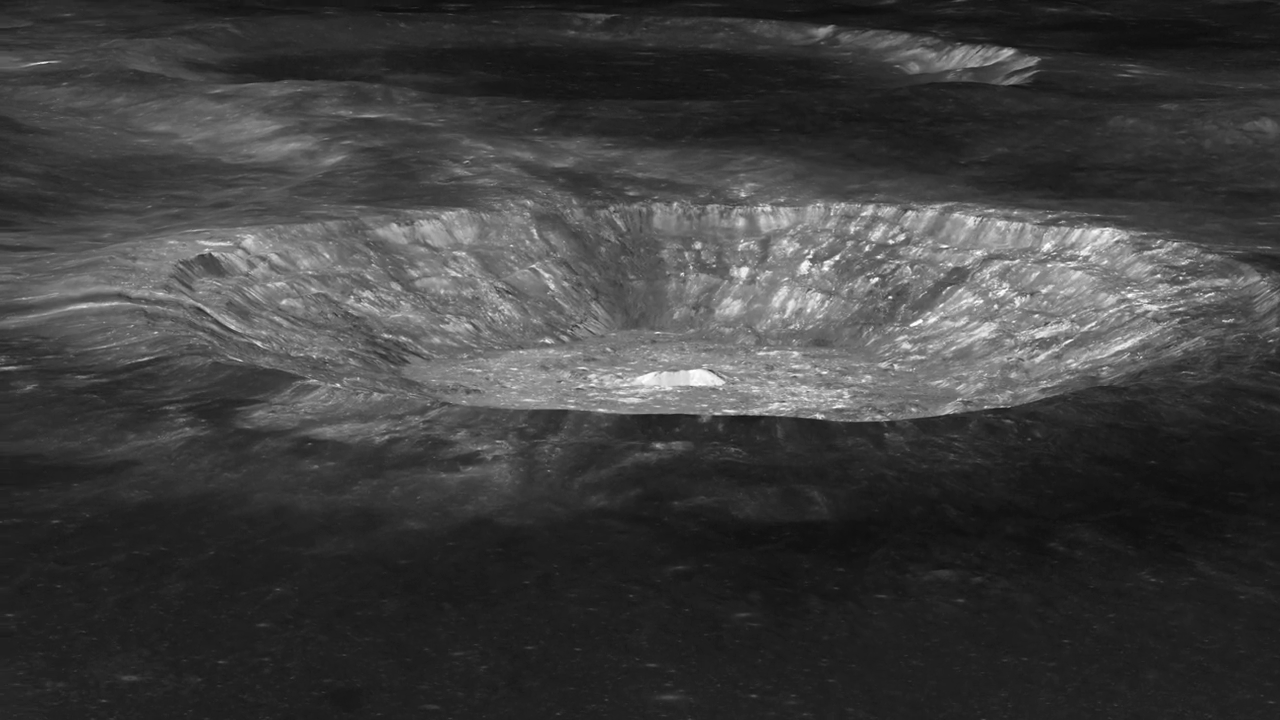
Central Peak of the Aristarchus Crater (Moon)


NASA - Lunar Reconnaissance Orbiter (LRO) patch.


Dec 1, 2022

Aristarchus crater on the Moon

The Aristarchus crater on the Moon is about is 40 kilometres in diameter and 2700 metres deep.

Central Peak of the Aristarchus Crater

The central peak is 3000 metres wide (left-to-right) and 400 metres tall. The image was acquired by NASA’s Lunar Reconnaissance Orbiter from an altitude of 96 kilometres.

Lunar Reconnaissance Orbiter (LRO)

LRO (Lunar Reconnaissance Orbiter): http://www.nasa.gov/mission_pages/LRO/main/index.html

Image, Video, Animation, Text, Credits: NASA/GSFC/Arizona State University/Music: “Moonlight Sonata by Beethoven” courtesy of YouTube Audio Library/SciNews/Orbiter.ch Aerospace/Roland Berga.

Best regards, Orbiter.ch

Astronauts Prepare to Grow Tomatoes, Get Ready for Spacewalk


ISS - Expedition 68 Mission patch.


Dec 1, 2022

The Expedition 68 crew began installing a new space botany experiment today while gearing up for a spacewalk planned for this weekend. The orbital residents are also continuing their research into the nervous system, unpacking a U.S. cargo craft, and keeping up International Space Station systems.

NASA and its international partners have been learning how to grow fresh food on the orbiting lab for several years. Today, NASA Flight Engineer Nicole Mann began installing the new Veg-05 space agriculture study that will soon grow dwarf tomatoes with the astronauts testing fertilizer techniques, microbial food safety, nutritional value, and taste. Growing fresh food during future missions farther away from Earth may promote crew morale and reduce crew dependency on space cargo missions.

Image above: Astronauts (from top) Frank Rubio and Josh Cassada work on a pair of Extravehicular Mobility Units (EMUs), or spacesuits, inside the space station’s Quest airlock. Image Credit: NASA.

Veteran station astronaut Koichi Wakata of the Japan Aerospace Exploration Agency (JAXA) serviced microbe samples being observed for the Neural Integration System biotechnology experiment. Wakata fed the microbes inside the Cell Biology Experiment Facility, a specialized incubator with an artificial gravity generator, for the study that may provide insights into neuromuscular conditions such as Parkinson’s disease.

Mann and Wakata later joined NASA astronauts Josh Cassada and Frank Rubio and continued preparing for a spacewalk planned to start at 7:25 a.m. EST on Saturday. The quartet reviewed the steps Cassada and Rubio will use to install a roll-out solar array on the station’s Starboard- 4 truss segment during the seven-hour excursion. Mann and Wakata will be inside the station supporting the duo before, during, and after the spacewalk.

Image above: NASA astronaut and Expedition 68 Flight Engineer Frank Rubio is pictured during a spacewalk tethered to the International Space Station's starboard truss structure. Image Credit: NASA.

The roll-out-solar array, also known as an International Space Station Roll-Out Solar Array, or iROSA, was extracted from inside the SpaceX Dragon resupply ship’s unpressurized trunk by ground controllers remotely commanding the Canadarm2 robotic arm. The iROSA was then placed on a starboard truss structure attachment point. From there, the spacewalkers will retrieve the roll-out solar array on Saturday and install it on the starboard truss segment. The new iROSA is augmenting the space station’s power generation system.

The space station’s three cosmonauts spent Thursday servicing a variety of life support hardware and space station gear. Roscosmos Commander Sergey Prokopyev began the day checking cameras and their components before cleaning the Zvezda service module’s ventilation system. Flight Engineer Dmitri Petelin completed his 24-hour heart monitoring activity on Thursday morning then worked on Ethernet cable connections and orbital plumbing gear. Flight Engineer Anna Kikina spent the day maintaining an assortment of station systems and their components ensuring the orbiting lab operates in tip-top shape.

Related article:

NASA to Provide Live Coverage of US Spacewalks Outside Space Station
https://www.nasa.gov/press-release/nasa-to-provide-live-coverage-of-us-spacewalks-outside-space-station

Related links:

Expedition 68: https://www.nasa.gov/mission_pages/station/expeditions/expedition68/index.html

Veg-05: https://www.nasa.gov/mission_pages/station/research/experiments/explorer/Investigation.html?#id=7443

Neural Integration System: https://www.nasa.gov/mission_pages/station/research/experiments/explorer/Investigation.html?#id=8809

Cell Biology Experiment Facility: https://www.nasa.gov/mission_pages/station/research/experiments/explorer/Facility.html?#id=333

Starboard- 4 truss segment: https://www.nasa.gov/mission_pages/station/structure/elements/truss-structure

Canadarm2 robotic arm: https://www.nasa.gov/mission_pages/station/structure/elements/mobile-servicing-system.html

Zvezda service module: https://www.nasa.gov/mission_pages/station/structure/elements/zvezda-service-module.html

Space Station Research and Technology: https://www.nasa.gov/mission_pages/station/research/overview.html

International Space Station (ISS): https://www.nasa.gov/mission_pages/station/main/index.html

Images (mentioned), Text, Credits: NASA/Mark Garcia.

Greetings, Orbiter.ch

Hubble Views a Cloud-Filled, Starry Scene


NASA - Hubble Space Telescope patch.


Dec 1, 2022

Bright, blue-white stars of the open cluster BSDL 2757 pierce through the rusty-red tones of gas and dust clouds in this NASA Hubble Space Telescope image. Hubble captured the scene as part of a study looking at how dust in the Large Magellanic Cloud obscures ultraviolet light in four different star-forming regions of this nearby, irregular galaxy. The researchers studied growing, early-stage stars that are still accumulating mass from the clouds that envelop them. As gas and dust spirals toward a budding, young star, it releases ultraviolet light. By analyzing how this light interacts with dust, astronomers can better understand the dust’s properties in different environments.

The colors blue, green, and orange in this image represent their respective colors in the visible light spectrum. The color red represents light in the near-infrared part of the spectrum.

Hubble Space Telescope (HST)

For more information about Hubble, visit:

http://hubblesite.org/

http://www.nasa.gov/hubble

https://esahubble.org/

Image, Animation Credits: NASA, ESA, and L. Bianchi (Johns Hopkins University); Processing: G. Kober (NASA/Catholic University of America)/Text Credits: NASA/Andrea Gianopoulos.

Best regards, Orbiter.ch

Initial Assessment Shows Excellent Performance for Artemis Moon Rocket


NASA - ARTEMIS Program logo.


Dec. 1, 2022

The Space Launch System (SLS) rocket performed with precision, meeting or exceeding all expectations during its debut launch on Artemis I. The world’s most powerful rocket set NASA’s Orion spacecraft on course for a journey beyond the Moon and back, and laying the foundation for the first mission with astronauts on Artemis II and humanity’s return to the lunar surface beginning with Artemis III.

“The first launch of the Space Launch System rocket was simply eye-watering,” said Mike Sarafin, Artemis mission manager. “While our mission with Orion is still underway and we continue to learn over the course of our flight, the rocket’s systems performed as designed and as expected in every case.”

Rocket Camera Footage from the World's Most Powerful Rocket

The twin solid rocket booster motors responsible for producing more than 7 million pounds of thrust at liftoff reached their performance target, helping the rocket and spacecraft travel more than 27 miles from its launch site at Kennedy Space Center in Florida and reaching a speed of about 4,000 mph in just over two minutes before the boosters separated. No issues were reported for any of the booster subsystems including its avionics and thrust vector control system used for steering.

Analysis shows the rocket’s core stage and four RS-25 engines, which burned through the stage’s 735,000 gallons of propellants in just over eight minutes, met every expectation during launch as well as in the final minutes of the countdown before liftoff, when the flight computers and software are in control and many dynamic events involving pressurizing tanks, starting the engines, and igniting the boosters, happen in quick succession.

The mega Moon rocket delivered Orion within about three miles of its planned orbit altitude of 975 by 16 nautical miles, well within the planned range required for the mission, at a speed of approximately 17,500 mph. Analysis shows the rocket’s ascent and in-space software also performed as expected.

The interim cryogenic propulsion stage, the upper stage of the rocket used to perform two burns during the mission to first raise Orion’s orbit and then propel it toward the Moon, performed exactly as planned. The upper stage’s single RL-10 engine, which has powered successful missions to every planet in the solar system and to interstellar space over its more than 50 years in operation, set a single duration burn record, firing for more than 18 minutes to set Orion precisely on its multi-day outbound trek to intercept Earth’s nearest celestial neighbor.

Artemis 1 - Space Launch System (SLS) and Orion spacecraft liftoff

“Performance was off by less than 0.3 percent in all cases across the board,” Sarafin said.  

Engineers will continue conducting more detailed analysis of Space Launch System performance over the next several months as the agency continues making progress building and assembling elements for the rocket for Artemis II and beyond.

“I’ve been privileged to lead the team which designed, built, tested and now flown the Space Launch System rocket on its historic first flight, the Artemis I mission,” said John Honeycutt, SLS program manager at NASA’s Marshall Space Flight Center in Huntsville, Alabama.  “With this amazing Moon rocket, we’ve laid the foundation for Artemis and for our long-term presence at the Moon. The performance of the rocket and the team supporting its maiden voyage was simply outstanding.”

The SLS Program is managed by Marshall, and many parts of the rocket were built and tested at Marshall and at NASA’s Michoud Assembly Facility in New Orleans, as well as at Stennis Space Center in Bay St. Louis, Mississippi. Engineers at Marshall supported the Artemis I launch real-time from the center’s SLS Engineering Support Center as well as in the Launch Control Center at NASA’s Kennedy Space Center in Florida.

Related links:

Artemis Program: https://www.nasa.gov/artemisprogram

Artemis I: http://www.nasa.gov/artemis-1

Space Launch System (SLS): http://www.nasa.gov/sls

RS-25 engines: https://www.nasa.gov/exploration/systems/sls/multimedia/infographics.html

Orion spacecraft: http://www.nasa.gov/orion

Image, Video, Text, Credits: NASA/Lee Mohon/Rachel Kraft/Marshall Space Flight Center/Corinne Edmiston.

Greetings, Orbiter.ch

mercredi 30 novembre 2022

Artemis I Flight Day 15 – Team Polls “Go” For Distant Retrograde Orbit Departure


NASA / ESA - Orion Crew Vehicle patch.


Nov 30, 2022

The Artemis I mission management team met today to review the overall status of the flight test and polled “go” for Orion to depart from its distant retrograde orbit, where it has been since Nov. 25. Orion will conduct a burn to depart the orbit at 3:53 p.m. CST Thurs., Dec. 1 and begin its trek back toward Earth. 

“We are continuing to collect flight test data and buy down risk for crewed flight,” said Mike Sarafin, Artemis mission manager. “We continue to learn how the system is performing, where our margins are, and how to operate and work with the vehicle as an integrated team.”

Image above: (Nov. 27, 2022) On flight day 12 of the 25.5-day Artemis I mission, a camera on the tip of one of Orion’s solar arrays captured the Moon as Orion travels in distant retrograde orbit around the Moon. Image Credit: NASA.

On Flight Day 15, Orion also performed a planned orbit maintenance burn to maintain the spacecraft’s trajectory and decrease its velocity ahead of its Thursday departure from a distant lunar orbit. During the burn, Orion used six of its auxiliary thrusters on the European Service module to fire for 95 seconds. The burn was initially planned for a shorter duration but was lengthened as part of the team’s effort to add test objectives to the mission. The 95-second burn provided additional data to characterize the thrusters and the radiative heating on the spacecraft’s solar array wings to help inform Orion’s operational constraints. All previous thruster burns were 17 seconds or less. 

Orion’s European-built service module has provided the propulsive capabilities to adjust the spacecraft’s course in space via its 33 engines of various types, and serves as Orion’s powerhouse, supplying it will electricity, thermal control, and air and water for future crews, in addition to propulsion. Artemis I is the first time NASA is using a European-built system as a critical element to power an American spacecraft. Provided by ESA (European Space Agency) and its partner Airbus Defence and Space, the service module extends NASA’s international cooperation from the International Space Station into deep space exploration.

Animation above: (Nov. 28, 2022) On flight day 13, Orion reached its maximum distance from Earth during the Artemis I mission when it was 268,563 miles away from our home planet. Orion has now traveled farther than any other spacecraft built for humans. Animation Credit: NASA.

NASA is continuing to extend its relationships with its international partners to explore the Moon under Artemis. The agency’s Gateway, a multi-purpose outpost in development to orbit the Moon that will provide essential support for long-term lunar exploration, includes contributions from ESA as well as the Canadian Space Agency and the Japan Aerospace Exploration Agency. Agencywide, NASA has more than 600 active international agreements with organizations and space agencies around the world.

Teams also elected to add four additional test objectives to Orion’s return trip to Earth to gather additional data on the spacecraft’s capabilities. Two will evaluate whether opening and closing a valve the pressure control assembly affects a slow leak rate in that system; a third will demonstrate Orion’s ability to perform attitude maneuvers at the rate that will be necessary for a test on Artemis II; and the fourth will test its capability to fly in a three degree of freedom attitude control mode, as opposed to the six degree of freedom mode it typically flies in.

Prior to today’s orbital maintenance burn, a total of 5,681 pounds of propellant had been used, 203 pounds less than values expected before launch. Some 2,004 pounds of margin is available beyond what is planned for use during the mission, a 94-pound increase above prelaunch expected values.

Just after 4 p.m. CST on Nov. 30, Orion was traveling 253,079 miles from Earth and 50,901 miles from the Moon, cruising at 2,052 mph.

Coverage of the distant retrograde orbit departure burn will begin Thursday at 3:30 p.m. CST, with the burn scheduled to occur at 3:53 p.m. Watch live on NASA TV, the agency’s website (https://www.nasa.gov/nasalive), and the NASA app.

Related articles:

Artemis I — I Flight Day 14: Deep Space Testing Continues
https://orbiterchspacenews.blogspot.com/2022/11/artemis-i-i-flight-day-14-deep-space.html

Artemis I — Flight Day 13: Orion Goes the (Max) Distance
https://orbiterchspacenews.blogspot.com/2022/11/artemis-i-flight-day-13-orion-goes-max.html

Artemis I – Flight Day 12: Orion Star Trackers, Reaction Control Thrusters Tested
https://orbiterchspacenews.blogspot.com/2022/11/artemis-i-flight-day-12-orion-star.html

Artemis I enters Moon orbit
https://orbiterchspacenews.blogspot.com/2022/11/artemis-i-enters-moon-orbit.html

Artemis I – Flight Day 11: Orion Surpasses Apollo 13 Record Distance from Earth
https://orbiterchspacenews.blogspot.com/2022/11/artemis-i-flight-day-11-orion-surpasses.html

Flight Day 10: Orion Enters Distant Retrograde Orbit
https://orbiterchspacenews.blogspot.com/2022/11/flight-day-10-orion-enters-distant.html

Artemis I – Flight Day Nine: Orion One Day Away from Distant Retrograde Insertion
https://orbiterchspacenews.blogspot.com/2022/11/artemis-i-flight-day-nine-orion-one-day.html

Latest Updates from Artemis I
https://orbiterchspacenews.blogspot.com/2022/11/latest-updates-from-artemis-i.html

Artemis I – Flight Day Six: Orion Performs Lunar Flyby, Closest Outbound Approach
https://orbiterchspacenews.blogspot.com/2022/11/artemis-i-flight-day-six-orion-performs.html

Artemis powering past the Moon
https://orbiterchspacenews.blogspot.com/2022/11/artemis-powering-past-moon.html

Orion Successfully Completes Lunar Flyby, Re-acquires Signal with Earth
https://orbiterchspacenews.blogspot.com/2022/11/orion-successfully-completes-lunar.html

Artemis I – Flight Day Four: Testing WiFi Signals, Radiator System, GO for Outbound Powered Flyby
https://orbiterchspacenews.blogspot.com/2022/11/artemis-i-flight-day-four-testing-wifi.html

NASA’s Artemis I Cameras to Offer New Views of Orion, Earth, Moon
https://orbiterchspacenews.blogspot.com/2022/11/nasas-artemis-i-cameras-to-offer-new.html

Artemis I Liftoff! 50 years after Apollo 17, Orion on Its Way to the Moon
https://orbiterchspacenews.blogspot.com/2022/11/artemis-i-liftoff-50-years-after-apollo.html

Related links:

Artemis I reference guide: https://www.nasa.gov/specials/artemis-i/img/Artemis%20I%20Reference%20Guide_Inter.pdf

Artemis II mission: https://www.nasa.gov/feature/nasa-s-first-flight-with-crew-important-step-on-long-term-return-to-the-moon-missions-to/

Callisto: https://www.nasa.gov/feature/callisto-technology-demonstration-to-fly-aboard-orion-for-artemis-i/

Track Orion: https://www.nasa.gov/trackartemis

Artemis I: https://www.nasa.gov/artemis-1

Orion spacecraft (ESA): https://www.esa.int/Science_Exploration/Human_and_Robotic_Exploration/Orion

Orion Spacecraft (NASA): https://www.nasa.gov/exploration/systems/orion/index.html

Image (mentioned), Animation (mentioned), Text, Credits: NASA/Shaneequa Vereen.

Best regards, Orbiter.ch

Life Science, Spacewalk Preps as Station Orbits Higher


ISS - Expedition 68 Mission patch.


Nov 30, 2022

Science and spacewalk preparations kept the Expedition 68 crew busy throughout Wednesday. Meanwhile, the International Space Station is orbiting slightly higher after a docked cargo craft fired its engines during the morning.

NASA astronauts Nicole Mann and Frank Rubio began the morning cleaning and stowing biology hardware used to transfer research samples from the SpaceX Dragon resupply ship into the space station’s U.S. Destiny laboratory module. Those samples will soon be examined to understand how microgravity affects the regeneration of skeletal stem cells possibly improving therapies for bone conditions on Earth and in space.

Image above: Astronaut Nicole Mann is pictured inside the seven-window cupola as the SpaceX Dragon cargo craft approaches the space station on Nov. 27, 2022. Image Credit: NASA.

NASA Flight Engineer Josh Cassada started his day supporting student-designed botany experiments packed inside specialized tubes delivered aboard Dragon. Flight Engineer Koichi Wakata of the Japan Aerospace Exploration Agency (JAXA) peered at microscopic worms inside the Confocal microscope for deeper insight into how the nervous system adapts to weightlessness. Observations may help doctors keep astronauts healthy in space and design therapies for neuromuscular diseases such as Parkinson’s.

After working on advanced science experiments during the morning, all four astronauts joined each other and reviewed plans for Saturday’s spacewalk set to start at 7:25 a.m. EST. Cassada and Rubio will exit the station for a seven-hour job to install a new roll-out solar array on the station’s starboard truss structure. Mann and Wakata will support the duo in and out of their Extravehicular Mobility Units (EMUs), or spacesuits, and operate the Canadarm2 robotic arm during the spacewalk.

International Space Station (ISS). Animation Credit: ESA

Station Commander Sergey Prokopyev from Roscosmos worked inside the Zvezda service module replacing life support gear on Wednesday afternoon after completing a heart-monitoring session during the morning. Flight Engineer Dmitri Petelin continued the heart research and attached sensors to himself to monitor his cardiac activity and blood pressure for 24 hours. Petelin then spent the rest of the day cleaning hydraulic components inside a Russian Orlan spacesuit. Flight Engineer Anna Kikina analyzed the Zarya module’s power supply system using an oscilloscope and infrared camera before conducting ventilation maintenance inside Zvezda.

A docked ISS Progress 81 space freighter fired its engines for 12 minutes early Wednesday raising the station’s altitude. The orbital reboost places the station at the correct altitude for an upcoming crew swap planned for early spring.

Related links:

Expedition 68: https://www.nasa.gov/mission_pages/station/expeditions/expedition68/index.html

Regeneration of skeletal stem cells: https://www.nasa.gov/mission_pages/station/research/experiments/explorer/Investigation.html?#id=8846

Confocal microscope: https://www.nasa.gov/mission_pages/station/research/experiments/explorer/Facility.html?#id=7428

Nervous system: https://www.nasa.gov/mission_pages/station/research/experiments/explorer/Investigation.html?#id=8809

Truss structure: https://www.nasa.gov/mission_pages/station/structure/elements/truss-structure

Canadarm2 robotic arm: https://www.nasa.gov/mission_pages/station/structure/elements/mobile-servicing-system.html

Zvezda service module: https://www.nasa.gov/mission_pages/station/structure/elements/zvezda-service-module.html

Zarya module: https://www.nasa.gov/mission_pages/station/structure/elements/zarya-cargo-module

Space Station Research and Technology: https://www.nasa.gov/mission_pages/station/research/overview.html

International Space Station (ISS): https://www.nasa.gov/mission_pages/station/main/index.html

Image (mentioned), Animation (mentioned), Text, Credits: NASA/Mark Garcia.

Best regards, Orbiter.ch

Most distant detection of a black hole swallowing a star


ESO - European Southern Observatory logo.


Nov 30, 2022

Artist’s impression of a black hole swallowing a star

Earlier this year, the European Southern Observatory’s Very Large Telescope (ESO’s VLT) was alerted after an unusual source of visible light had been detected by a survey telescope. The VLT, together with other telescopes, was swiftly repositioned towards the source: a supermassive black hole in a distant galaxy that had devoured a star, expelling the leftovers in a jet. The VLT determined it to be the furthest example of such an event to have ever been observed. Because the jet is pointing almost towards us, this is also the first time it has been discovered with visible light, providing a new way of detecting these extreme events.

Stars that wander too close to a black hole are ripped apart by the incredible tidal forces of the black hole in what is known as a tidal disruption event (TDE). Approximately 1% of these cause jets of plasma and radiation to be ejected from the poles of the rotating black hole. In 1971, the black hole pioneer John Wheeler[1] introduced the concept of jetted-TDEs as “a tube of toothpaste gripped tight about its middle,” causing the system to “squirt matter out of both ends.”

“We have only seen a handful of these jetted-TDEs and they remain very exotic and poorly understood events,” says Nial Tanvir from the University of Leicester in the UK, who led the observations to determine the object’s distance with the VLT. Astronomers are thus constantly hunting for these extreme events to understand how the jets are actually created and why such a small fraction of TDEs produce them.

As part of this quest many telescopes, including the Zwicky Transient Facility (ZTF) in the US, repeatedly survey the sky for signs of short-lived, often extreme, events that could then be studied in much greater detail by telescopes such as ESO’s VLT in Chile. “We developed an open-source data pipeline to store and mine important information from the ZTF survey and alert us about atypical events in real time,” explains Igor Andreoni, an astronomer at the University of Maryland in the US who co-led the paper published today in Nature together with Michael Coughlin from the University of Minnesota. 

In February of this year the ZTF detected a new source of visible light. The event, named AT2022cmc, was reminiscent of a gamma ray burst — the most powerful source of light in the Universe. The prospect of witnessing this rare phenomenon prompted astronomers to trigger several telescopes from across the globe to observe the mystery source in more detail. This included ESO’s VLT, which quickly observed this new event with the X-shooter instrument. The VLT data placed the source at an unprecedented distance for these events: the light produced from AT2022cmc began its journey when the universe was about one third of its current age.

Animation of a black hole swallowing a star

A wide variety of light, from high energy gamma rays to radio waves, was collected by 21 telescopes around the world. The team compared these data with different kinds of known events, from collapsing stars to kilonovae. But the only scenario that matched the data was a rare jetted-TDE pointing towards us. Giorgos Leloudas, an astronomer at DTU Space in Denmark and co-author of this study, explains that "because the relativistic jet is pointing at us, it makes the event much brighter than it would otherwise appear, and visible over a broader span of the electromagnetic spectrum."

The VLT distance measurement found AT2022cmc to be the most distant TDE to have ever been discovered, but this is not the only record-breaking aspect of this object. “Until now, the small number of jetted-TDEs that are known were initially detected using high energy gamma-ray and X-ray telescopes, but this was the first discovery of one during an optical survey,” says Daniel Perley, an astronomer at Liverpool John Moores University in the UK and co-author of the study. This demonstrates a new way of detecting jetted-TDEs, allowing further study of these rare events and probing of the extreme environments surrounding black holes.
Notes

[1] John Archibald Wheeler is also often credited with coining the term ‘black hole’ in a 1967 speech to NASA.

More information:

This research was presented in a paper titled “A very luminous jet from the disruption of a star by a massive black hole” to appear in Nature (doi: 10.1038/s41586-022-05465-8)

The team is composed of Igor Andreoni (Joint Space-Science Institute, University of Maryland, USA [JSI/UMD]; Department of Astronomy, University of Maryland, USA [UMD]; Astrophysics Science Division, NASA Goddard Space Flight Center [NASA/GSFC], USA), Michael W. Coughlin (School of Physics and Astronomy, University of Minnesota, USA), Daniel A. Perley (Astrophysics Research Institute, Liverpool John Moores University, UK), Yuhan Yao (Division of Physics, Mathematics and Astronomy, California Institute of Technology, USA [Caltech]), Wenbin Lu (Department of Astrophysical Sciences, Princeton University, USA), S. Bradley Cenko (JSI/UMD; NASA/GSFC), Harsh Kumar (Indian Institute of Technology Bombay, India [IIT/Bombay]), Shreya Anand (Caltech), Anna Y. Q. Ho (Department of Astronomy, University of California, Berkeley, USA [UCB]; Lawrence Berkeley National Laboratory, USA [LBNL]; Miller Institute for Basic Research in Science, USA), Mansi M. Kasliwal (Caltech), Antonio de Ugarte Postigo (Université Côte d’Azur, Observatoire de la Côte d’Azur, France), Ana Sagués-Carracedo (The Oskar Klein Centre, Stockholm University, Sweden [OKC]), Steve Schulze (OKC), D. Alexander Kann (Instituto de Astrofisica de Andalucia, Glorieta de la Astronomia, Spain [IAA-CSIC]), S. R. Kulkarni (Caltech), Jesper Sollerman (OKC), Nial Tanvir (Department of Physics and Astronomy, University of Leicester, UK), Armin Rest (Space Telescope Science Institute, Baltimore, USA [STScI]; Department of Physics and Astronomy, The Johns Hopkins University, USA), Luca Izzo (DARK, Niels Bohr Institute, University of Copenhagen, Denmark), Jean J. Somalwar (Caltech), David L. Kaplan (Center for Gravitation, Cosmology and Astrophysics, Department of Physics, University of Wisconsin–Milwaukee, USA), Tomás Ahumada (UMD), G. C. Anupama (Indian Institute of Astrophysics, Bangalore, India [IIA]), Katie Auchettl (School of Physics, University of Melbourne, Australia; ARC Centre of Excellence for All Sky Astrophysics in 3 Dimensions; Department of Astronomy and Astrophysics, University of California, Santa Cruz, USA), Sudhanshu Barway (IIA), Eric C. Bellm (DIRAC Institute, University of Washington, USA), Varun Bhalerao (IIT/Bombay), Joshua S. Bloom (LBNL; UCB), Michael Bremer (Institut de Radioastronomie Millimetrique, France [IRAM]), Mattia Bulla (OKC), Eric Burns (Department of Physics & Astronomy, Louisiana State University, USA), Sergio Campana (INAF-Osservatorio Astronomico di Brera, Italy), Poonam Chandra (National Centre for Radio Astrophysics, Tata Institute of Fundamental Research, Pune University, India), Panos Charalampopoulos (DTU Space, National Space Institute, Technical University of Denmark, Denmark [DTU]), Jeff Cooke (Australian Research Council Centre of Excellence for Gravitational Wave Discovery, Swinburne University of Technology, Hawthorn, Australia [OzGrav]; Centre for Astrophysics and Supercomputing, Swinburne University of Technology, Australia [CAS]), Valerio D’Elia (Space Science Data Center - Agenzia Spaziale Italiana, Italy), Kaustav Kashyap Das (Caltech), Dougal Dobie (OzGrav; CAS), Jose Feliciano Agüí Fernández (IAA-CSIC), James Freeburn (OzGrav; CAS), Cristoffer Fremling (Caltech), Suvi Gezari (STScI), Matthew Graham (Caltech), Erica Hammerstein (UMD), Viraj R. Karambelkar (Caltech), Charles D. Kilpatrick (Center for Interdisciplinary Exploration and Research in Astrophysics, Northwestern University, USA), Erik C. Kool (OKC), Melanie Krips (IRAM), Russ R. Laher (IPAC, California Institute of Technology, USA [IPAC]), Giorgos Leloudas (DTU), Andrew Levan (Department of Astrophysics, Radboud University, The Netherlands), Michael J. Lundquist (W. M. Keck Observatory, USA), Ashish A. Mahabal (Caltech; Center for Data Driven Discovery, California Institute of Technology, USA), Michael S. Medford (UCB; LBNL), M. Coleman Miller (JSI/UMD; UMD), Anais Möller (OzGrav; CAS), Kunal Mooley (Caltech), A. J. Nayana (Indian Institute of Astrophysics, India), Guy Nir (UCB), Peter T. H. Pang (Nikhef, The Netherlands; Institute for Gravitational and Subatomic Physics, Utrecht University, The Netherlands), Emmy Paraskeva (IAASARS, National Observatory of Athens, Greece; Department of Astrophysics, Astronomy & Mechanics, University of Athens, Greece; Nordic Optical Telescope, Spain; Department of Physics and Astronomy, Aarhus University, Denmark), Richard A. Perley (National Radio Astronomy Observatory, USA), Glen Petitpas (Center for Astrophysics | Harvard & Smithsonian, Cambridge, USA), Miika Pursiainen (DTU), Vikram Ravi (Caltech), Ryan Ridden-Harper (School of Physical and Chemical Sciences — Te Kura Matu, University of Canterbury, New Zealand), Reed Riddle (Caltech Optical Observatories, California Institute of Technology, USA), Mickael Rigault (Université de Lyon, France), Antonio C. Rodriguez (Caltech), Ben Rusholme (IPAC), Yashvi Sharma (Caltech), I. A. Smith (Institute for Astronomy, University of Hawaii, USA), Robert D. Stein (Caltech), Christina Thöne (Astronomical Institute of the Czech Academy of Sciences, Czech Republic), Aaron Tohuvavohu (Department of Astronomy and Astrophysics, University of Toronto, Canada), Frank Valdes (National Optical Astronomy Observatory, USA), Jan van Roestel (Caltech), Susanna D. Vergani (GEPI, Observatoire de Paris, PSL Research University, France; Institut d’Astrophysique de Paris, France), Qinan Wang (STScI), Jielai Zhang (OzGrav; CAS).

The European Southern Observatory (ESO) enables scientists worldwide to discover the secrets of the Universe for the benefit of all. We design, build and operate world-class observatories on the ground — which astronomers use to tackle exciting questions and spread the fascination of astronomy — and promote international collaboration in astronomy. Established as an intergovernmental organisation in 1962, today ESO is supported by 16 Member States (Austria, Belgium, the Czech Republic, Denmark, France, Finland, Germany, Ireland, Italy, the Netherlands, Poland, Portugal, Spain, Sweden, Switzerland and the United Kingdom), along with the host state of Chile and with Australia as a Strategic Partner. ESO’s headquarters and its visitor centre and planetarium, the ESO Supernova, are located close to Munich in Germany, while the Chilean Atacama Desert, a marvellous place with unique conditions to observe the sky, hosts our telescopes. ESO operates three observing sites: La Silla, Paranal and Chajnantor. At Paranal, ESO operates the Very Large Telescope and its Very Large Telescope Interferometer, as well as survey telescopes such as VISTA. Also at Paranal ESO will host and operate the Cherenkov Telescope Array South, the world’s largest and most sensitive gamma-ray observatory. Together with international partners, ESO operates APEX and ALMA on Chajnantor, two facilities that observe the skies in the millimetre and submillimetre range. At Cerro Armazones, near Paranal, we are building “the world’s biggest eye on the sky” — ESO’s Extremely Large Telescope. From our offices in Santiago, Chile we support our operations in the country and engage with Chilean partners and society.

Links:

- Research paper: https://www.eso.org/public/archives/releases/sciencepapers/eso2216/eso2216a.pdf

- Photos of the VLT: http://www.eso.org/public/images/archive/category/paranal/

- For journalists: subscribe to receive our releases under embargo in your language: https://www.eso.org/public/outreach/pressmedia/#epodpress_form

- For scientists: got a story? Pitch your research: http://www.eso.org/sci/publications/announcements/sciann17463.html%20

Images Credits: ESO/M.Kornmesser/Video Credits: ESO/M.Kornmesser/Text Credits: ESO/Juan Carlos Muñoz Mateos/DTU Space, National Space Institute, Technical University of Denmark/Giorgos Leloudas/Department of Physics and Astronomy, University of Leicester/Nial Tanvir/Astrophysics Research Institute, Liverpool John Moores University/Daniel Perley/Joint Space-Science Institute, University of Maryland, NASA Goddard Space Flight Center/Igor Andreoni.

Greetings, Orbiter.ch