lundi 5 décembre 2022

A company's nuclear fusion rockets could help us escape the Solar System in our lifetime


Pulsar Fusion logo.


Dec 5, 2022

The space firm has already built the most powerful electric propulsion engine in Europe.

An artist's impression of a Pulsar rocket. Image Credits: Pulsar Fusion/YouTube

Nuclear fusion-powered rockets might be nearer than you think.

UK rocket company Pulsar Fusion has been awarded funding from the UK Space Agency to help it develop "integrated nuclear fission-based power systems for electric propulsion", a press statement shared with IE via email reveals.

The company is working toward both nuclear fission and fusion-based rocket engines. Fusion is a longer-term goal as the technology required to effectively harness nuclear fusion on Earth is in development but does not yet exist.

The firm will collaborate with the Universities of Cambridge and Southampton, as well as Nuclear AMRC to make its vision of green rocket technology, in the form of nuclear propulsion, a reality.

Harnessing nuclear fusion to build hyper-speed rockets

Pulsar Fusion's main mission goal is to eventually harness its namesake, nuclear fusion, to build hyper-speed rocket technology. Nuclear fusion is the method the Sun and the stars use to produce vast amounts of energy over millennia.

In the company's press release, Pulsar Fusion says, "while nuclear fusion may be the answer to the energy crisis it is also the answer to in-orbit satellite management, in addition to deep space exploration. [Pulsar] believes the only way the human race can ever leave the solar system in a lifetime is with fusion propulsion."

Scientists all over the world are working towards harnessing nuclear fusion for energy production on Earth, but they're not quite there yet. Pulsar Fusion may have to wait for advances in that technology before it can achieve its ultimate goal, though it may also help to advance the pursuit of commercially viable nuclear fusion technologies.

In the meantime, the company also is also developing and manufacturing a number of other rocket engines. This includes the largest and most powerful electric spacecraft engine in Europe, which has been independently tested by scientists at the University of Southampton via a government-funded initiative in 2021.

Pulsar Fusion - In orbit assembly of nuclear fusion rocket

The most powerful electric propulsion engine in Europe

Pulsar Fusion's "green" hybrid rocket engine burns nitrous oxide (N2O) oxidizer, high-density polyethylene (HDPE) fuel, and oxygen. A control valve feeds the liquid oxidized under a regulated pressure through to a combustion chamber.

The company conducted a series of successful tests on its engine last November (2021) at the Cranfield Ordnance Test and Evaluation Centre (COTEC), a UK Ministry of Defence military base in Salisbury, Wilts. Before that, it also successfully carried out an international demonstration for space clients in Switzerland.

"Pulsar has built and tested the most powerful electric propulsion engines in Europe," Dr. James Lambert, Head of Operations at Pulsar, explained.

The opportunity of Fusion Energy in space (Pulsar Fusion rocket cutaway)

"Combining this part of our propulsion portfolio with nuclear fission reactor technology is perfectly suited to the company’s skillsets and I am delighted that this has been recognized by the UKSA. The project will help us to build relationships and gather important data that will contribute towards our longer-term ambitions for nuclear fusion propulsion."

Pulsar Fusion also received UK government funding in September last year to help develop its Mach-7 Hall Effect Thruster, or HET, plasma satellite engines, which are capable of 20-kilometer-per-second particle exhaust speeds. The company aims to carry out in-orbit tests on its engines in the near future.

The UK rocket firm has previously stated it aims to build a nuclear fusion rocket prototype by 2025. Ambitiously, its latest release states the company believes it can develop the "fusion-based infrastructure and propulsion systems" required to enable nuclear fusion rockets "in less than four years."

If it does so, that technology could also be adapted for Earth, meaning it would help to transform the way we travel through space as well as how we produce energy down here on the ground.

Editor's note:

(05/12/22): An extra paragraph was added to the article to clarify the fact that Pulsar Fusion is working towards both nuclear fission and nuclear fusion-based rocket propulsion.

Related link:

Pulsar Fusion: https://pulsarfusion.com/

Images, Video, Text, Credits: Pulsar Fusion/Interesting Engineering/Chris Young.

Best regards, Orbiter.ch

Hubble Observes an Outstanding Open Cluster


NASA / ESA - Hubble Space Telescope (HST) patch.


Dec 5, 2022

A twinkling group of stars dominates the center of this image. NGC 2002 is an open star cluster that resides roughly 160,000 light-years away from Earth in the Large Magellanic Cloud, a satellite galaxy of our Milky Way containing numerous star-forming regions. NGC 2002 is about 30 light-years in diameter and is a relatively young cluster at 18 million years old.

The Large and Small Magellanic Clouds (LMC, SMC) are rich in young star clusters, making them ideal laboratories for studying stellar formation and evolution. In fact, the LMC and SMC are the only systems that contain star clusters at all stages of evolution while also being near enough to Earth to be fully resolved, meaning that one can make out and study individual stars.

NGC 2002 is more spherical than a typical open cluster, which is a type of star cluster that has low star density and an irregular shape due to the weak mutual gravitational attraction of its constituent stars. Individual stars in an open cluster can generally be observed, while the stars in a globular cluster – the other main type of cluster – are often too dense to make out even with powerful telescopes. Researchers used Hubble’s high resolution and sensitivity at discerning individual stars to study NGC 2002.

NGC 2002 contains about 1,100 stars. The more massive stars in the cluster tend to sink inwards towards the center, while the lighter stars move away from the center as the cluster evolves. Visible in the center of the cluster are five red supergiants, which are physically massive but cooler stars that are fusing helium after exhausting their hydrogen fuel.

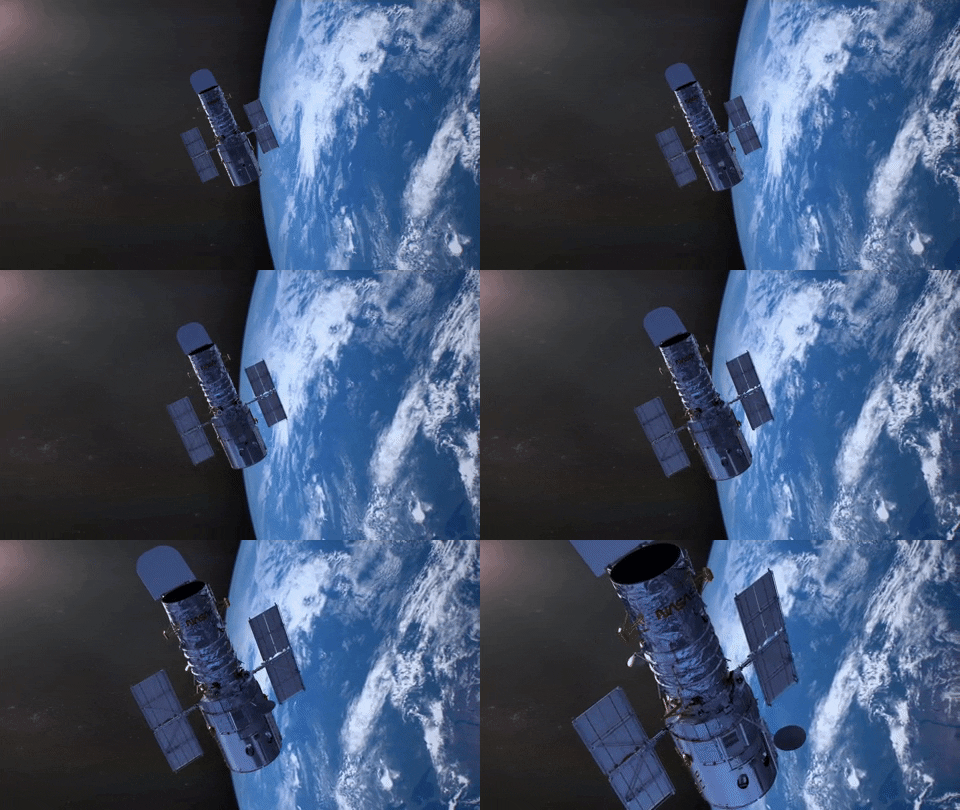
Hubble Space Telescope (HST)

For more information about Hubble, visit:

http://hubblesite.org/

http://www.nasa.gov/hubble

https://esahubble.org/

Image, Animation Credits: NASA, ESA and G. Gilmore (University of Cambridge); Processing: Gladys Kober (NASA/Catholic University of America)/Text Credits: NASA/Andrea Gianopoulos.

Best regards, Orbiter.ch

Artemis lunar flyby: Orion is coming home


ESA - Orion European Service Module-1 logo.


Dec 5, 2022

Today at 17:43 CET (16:43 GMT) the European Service Module for Orion fired its main engine at less than 127 km from the Moon's surface to put the Artemis spacecraft on a collision course with Earth.

Artemis flight day 19: A slice of Earth

Over the last 20 days in space, Orion has ventured farther from Earth than any human-rated spacecraft ever before, and the Artemis spacecraft is now truly on its way home.

The return powered flyby burn was the longest and most powerful thruster firing the European Service Module has completed, and the last big burn before the end of the Artemis I mission.

Artemis I step-by-step

The European Service Module has 33 engines that control and power Orion around the Moon and through deep space. The module also provides electricity, fuel and climate and temperature control for the spacecraft.

“Orion and the European Service Module have been exceeding expectations from the start,” says ESA's mission manager Philippe Deloo,” the four solar array wings have been producing 15% more power while we are consuming less electricity due to the spacecraft fluctuating less in temperature than expected.

Artemis I mission overview - three dimensional view

“There are some minor issues that are common for a first test flight and Orion is designed to the highest human-rated specifications with fail-safes and backups. Thanks to the engineering and hard work of the flight control teams at NASA's Johnson Space Center and ESA's mission evaluation room in ESTEC, the Netherlands, the Artemis I mission has been a smooth operation so far.”

Far side of the Moon

The largest burn in the Artemis mission occurred when Orion was flying behind the Moon and was out of contact with ground control. The three minute and 26 second firing accelerated Orion by 1054 km/h, using the Moon's gravity to slingshot back to Earth.

Far side of the Moon

The spacecraft spent half an hour without being able to phone home as the Moon blocked all signals with Earth. The European Service Modules for Orion evolved from ESA's Automated Transfer Vehicles that flew autonomously to the International Space Station. As such Orion is more than equipped to fly on its own if necessary. ESA is working on project Moonlight to create satellite navigation and communications coverage around the Moon that will reduce or avoid completely this loss of signals.

Return home

Orion is now well and truly on its way back home. The Artemis I mission will test a reentry and splashdown at speeds never attempted before so the return powered flyby has set the spacecraft up for an intense splashdown in the Pacific Ocean which will see Orion enter our atmosphere at speeds of 39 590 km/h, 30 percent faster than an International Space Station return, and 24 times faster than a speeding bullet.

European Service Module solar panels and Earth

The European Service Module has just three minor orbit corrections planned in the next six days cruise to Earth. Less than an hour before splashdown on 11 December, Orion and the European Service Module and Crew Module Adapter separate with the Orion crew capsule returning to Earth, the European Service Module and Crew Module Adapter burn up harmlessly in the atmosphere, their mission complete having taken Orion beyond the Moon and back.

Related articles:

Artemis I – Flight Day 19: Orion Prepares for Close Lunar Flyby, Teams Examining Power Conditioning Issue
https://orbiterchspacenews.blogspot.com/2022/12/artemis-i-flight-day-19-orion-prepares.html

Artemis I Flight Day 18 – Orion Re-enters Lunar Sphere of Influence
https://orbiterchspacenews.blogspot.com/2022/12/artemis-i-flight-day-18-orion-re-enters.html

Flight Day 17 - Orion Fine-tunes Trajectory, Downlinks Data, Continues Test Objectives
https://orbiterchspacenews.blogspot.com/2022/12/flight-day-17-orion-fine-tunes.html

Artemis I Flight Day 16 – Orion Successfully Completes Distant Retrograde Departure Burn
https://orbiterchspacenews.blogspot.com/2022/12/artemis-i-flight-day-16-orion.html

Artemis I Flight Day 15 – Team Polls “Go” For Distant Retrograde Orbit Departure
https://orbiterchspacenews.blogspot.com/2022/11/artemis-i-flight-day-15-team-polls-go.html

Artemis I — I Flight Day 14: Deep Space Testing Continues
https://orbiterchspacenews.blogspot.com/2022/11/artemis-i-i-flight-day-14-deep-space.html

Artemis I — Flight Day 13: Orion Goes the (Max) Distance
https://orbiterchspacenews.blogspot.com/2022/11/artemis-i-flight-day-13-orion-goes-max.html

Artemis I – Flight Day 12: Orion Star Trackers, Reaction Control Thrusters Tested
https://orbiterchspacenews.blogspot.com/2022/11/artemis-i-flight-day-12-orion-star.html

Artemis I enters Moon orbit
https://orbiterchspacenews.blogspot.com/2022/11/artemis-i-enters-moon-orbit.html

Artemis I – Flight Day 11: Orion Surpasses Apollo 13 Record Distance from Earth
https://orbiterchspacenews.blogspot.com/2022/11/artemis-i-flight-day-11-orion-surpasses.html

Flight Day 10: Orion Enters Distant Retrograde Orbit
https://orbiterchspacenews.blogspot.com/2022/11/flight-day-10-orion-enters-distant.html

Artemis I – Flight Day Nine: Orion One Day Away from Distant Retrograde Insertion
https://orbiterchspacenews.blogspot.com/2022/11/artemis-i-flight-day-nine-orion-one-day.html

Latest Updates from Artemis I
https://orbiterchspacenews.blogspot.com/2022/11/latest-updates-from-artemis-i.html

Artemis I – Flight Day Six: Orion Performs Lunar Flyby, Closest Outbound Approach
https://orbiterchspacenews.blogspot.com/2022/11/artemis-i-flight-day-six-orion-performs.html

Artemis powering past the Moon
https://orbiterchspacenews.blogspot.com/2022/11/artemis-powering-past-moon.html

Orion Successfully Completes Lunar Flyby, Re-acquires Signal with Earth
https://orbiterchspacenews.blogspot.com/2022/11/orion-successfully-completes-lunar.html

Artemis I – Flight Day Four: Testing WiFi Signals, Radiator System, GO for Outbound Powered Flyby
https://orbiterchspacenews.blogspot.com/2022/11/artemis-i-flight-day-four-testing-wifi.html

NASA’s Artemis I Cameras to Offer New Views of Orion, Earth, Moon
https://orbiterchspacenews.blogspot.com/2022/11/nasas-artemis-i-cameras-to-offer-new.html

Artemis I Liftoff! 50 years after Apollo 17, Orion on Its Way to the Moon
https://orbiterchspacenews.blogspot.com/2022/11/artemis-i-liftoff-50-years-after-apollo.html

Related links:

Artemis I reference guide: https://www.nasa.gov/specials/artemis-i/img/Artemis%20I%20Reference%20Guide_Inter.pdf

Artemis II mission: https://www.nasa.gov/feature/nasa-s-first-flight-with-crew-important-step-on-long-term-return-to-the-moon-missions-to/

Callisto: https://www.nasa.gov/feature/callisto-technology-demonstration-to-fly-aboard-orion-for-artemis-i/

Track Orion: https://www.nasa.gov/trackartemis

Artemis I: https://www.nasa.gov/artemis-1

Orion spacecraft (ESA): https://www.esa.int/Science_Exploration/Human_and_Robotic_Exploration/Orion

Orion Spacecraft (NASA): https://www.nasa.gov/exploration/systems/orion/index.html

Images, Animation, Text, Credits: ESA/NASA.

Greetings, Orbiter.ch

CERN - CAST-CAPP inches closer to axion dark matter


CERN - European Organization for Nuclear Research logo.


Dec 5, 2022

The CAPP axion haloscope at the CAST experiment has hunted for axions from the Milky Way’s “halo” of dark matter, and has narrowed down the theoretical space in which to look for these hypothetical particles.

Image above: The CAST experiment at CERN. The CAST-CAPP resonator was placed inside one of the two bores of CAST’s magnet (blue). (Image: CERN).

Hypothetical particles called axions could solve two enigmas at once. They could account for dark matter, the mysterious substance that is thought to make up most of the matter in the Universe, and they could also explain the puzzling symmetry properties of the strong force that holds protons and neutrons together in atomic nuclei.

But the theoretical space of possibilities for axions is vast, both in terms of their mass and the strength of their interaction with other particles. Axion searches are therefore targeting different regions of this space, each search bringing with it the possibility of discovery and its results guiding future searches.

In a new paper published in Nature Communications, a team of researchers working on the CAST experiment at CERN report how they have repurposed part of the experiment to target a previously uncharted region of the axion space.

CAST was originally designed to hunt for axions originating from the Sun. In their new study, the CAST team placed a resonator consisting of four cavities inside one of the two bores of the experiment’s magnet in order to build an axion detector that looks instead for axions from the Milky Way’s “halo” of dark matter – an axion haloscope, which they named CAST-CAPP.

In a strong magnetic field, such as the one provided by CAST’s magnet, axions should convert into photons. An axion haloscope’s resonator is basically a radio that researchers can tune to find the frequency of these axion-converted photons. But the frequency of the axion “radio station” is not known, so the researchers must slowly scan a band of frequencies to try to identify the frequency of the axion signal.

The CAST-CAPP resonator can be tuned to pick up axion signals ranging from 4.774 to 5.434 GHz, corresponding to axion masses of between 19.74 and 22.47 microelectronvolts.

The CAST researchers scanned this 660 MHz band of frequencies in steps of 200 kHz for 4124 hours, from 12 September 2019 to 21 June 2021, and isolated known background signals such as the 5 GHz Wireless Local Area Network (WLAN), but did not pick up any signal coming from axions. However, the CAST-CAPP data places new bounds on the maximum strength of the interaction of axions with photons for axion masses of 19.74 to 22.47 microelectronvolts, narrowing down the space in which to look for axion dark matter.

The new bounds are complementary to results from previous axion searches, including those from another CAST haloscope, RADES, which took data in 2018.

The hunt for dark matter continues. Tune in to this station again to check for updates from CAST-CAPP or from other dark-matter investigations taking place at CERN, such as searches for dark matter that may be produced at the Large Hadron Collider.

Note:

CERN, the European Organization for Nuclear Research, is one of the world’s largest and most respected centres for scientific research. Its business is fundamental physics, finding out what the Universe is made of and how it works. At CERN, the world’s largest and most complex scientific instruments are used to study the basic constituents of matter — the fundamental particles. By studying what happens when these particles collide, physicists learn about the laws of Nature.

The instruments used at CERN are particle accelerators and detectors. Accelerators boost beams of particles to high energies before they are made to collide with each other or with stationary targets. Detectors observe and record the results of these collisions.

Founded in 1954, the CERN Laboratory sits astride the Franco–Swiss border near Geneva. It was one of Europe’s first joint ventures and now has 23 Member States.

Related links:

Nature Communications: https://www.nature.com/articles/s41467-022-33913-6

Large Hadron Collider (LHC): https://home.cern/science/accelerators/large-hadron-collider

CAST experiment: https://home.cern/science/experiments/cast

RADES: https://home.cern/news/news/physics/rades-joins-hunt-dark-matter

For more information about European Organization for Nuclear Research (CERN), Visit: https://home.cern/

Image (mentioned), Text, Credits: CERN/By Ana Lopes.

Best regards, Orbiter.ch

dimanche 4 décembre 2022

Artemis I – Flight Day 19: Orion Prepares for Close Lunar Flyby, Teams Examining Power Conditioning Issue


NASA / ESA - Orion Crew Vehicle patch.


Dec 4, 2022

Orion performed the second return trajectory correction burn on Sunday, Dec. 4, at 10:43 a.m. CST, using the auxiliary thrusters and increasing the spacecraft’s velocity by 1.16 mph (1.71 feet per second).  

Shortly after acquiring signal with the Deep Space Network’s Canberra ground station at 12:41 a.m. CST, Orion experienced an issue with a power conditioning distribution unit (PCDU), in which four of the latching current limiters responsible for downstream power were switched off. These lower-level switches connect to the propulsion and heater subsystems. Teams confirmed the system was healthy and successfully repowered the downstream components. There was no interruption of power to any critical systems, and there were no adverse effects to Orion’s navigation or communication systems.

Image above: (Dec. 4, 2022) On the 19th day of the Artemis I mission, Orion captures Earth from a camera mounted on one of its solar arrays as the spacecraft prepares for the return powered flyby of the Moon on Dec. 5, when it will pass approximately 79 miles above the lunar surface. Image Credit: NASA.

Teams are examining whether a potential contributor to this issue is related to a power configuration test implemented by the flight teams to investigate previous instances in which one of eight units opened without a command. The umbilical was successfully commanded closed each time and there was no loss of power flowing to avionics on the spacecraft. 

The spacecraft obtained additional data using its optical navigation system, which is a sensitive camera to take images of the Moon and Earth to help orient the spacecraft by looking at the size and position of the celestial bodies in the images. Engineers also continue to work plans to accomplish several additional test objectives during Orion’s journey back to Earth. A host of test objectives provide information to engineers about how Orion operates in space, allowing them opportunities to validate performance models and learn as much as possible about the spacecraft.

In preparation for Orion’s return to Earth, the team from NASA’s Exploration Ground Systems Program and the U.S. Navy, who will recover Orion from the Pacific Ocean, completed its final training day at sea, using a mock capsule in the water for divers and small boats to practice open water recovery procedures.

On Monday, Dec. 5, Orion will make its closest approach to the Moon, flying 79.2 miles above the lunar surface. It will perform the return powered flyby burn at 10:43 a.m. CST, which will last about 3 minutes and 27 seconds, changing the velocity of the spacecraft by approximately 655 mph (961 feet per second). The return powered flyby is the last large maneuver of the mission, with only smaller trajectory corrections to target Earth remaining.

Live coverage of the close lunar flyby and burn will begin at 8 a.m. CST on NASA TV, the agency’s website, and the NASA app. During the coverage, lighting will be different than it was during Orion’s initial close lunar flyby on Nov. 21. The spacecraft will lose communications with Earth for approximately 31 minutes beginning at 10:40 a.m. CST, as it flies behind the far side of the Moon.

NASA TV: https://www.nasa.gov/nasalive

At 4 p.m. CST on Dec. 5, NASA leaders will discuss the results of the return powered flyby burn and the deployment of recovery assets to sea ahead of Orion’s splashdown on Dec. 11. Live coverage will be available on all NASA channels.

Just after 4:30 p.m. CST on Dec. 4, Orion was traveling 222,213 miles from Earth and 23,873 miles from the Moon, cruising at 3,076 mph.

Related articles:

Artemis I Flight Day 18 – Orion Re-enters Lunar Sphere of Influence
https://orbiterchspacenews.blogspot.com/2022/12/artemis-i-flight-day-18-orion-re-enters.html

Flight Day 17 - Orion Fine-tunes Trajectory, Downlinks Data, Continues Test Objectives
https://orbiterchspacenews.blogspot.com/2022/12/flight-day-17-orion-fine-tunes.html

Artemis I Flight Day 16 – Orion Successfully Completes Distant Retrograde Departure Burn
https://orbiterchspacenews.blogspot.com/2022/12/artemis-i-flight-day-16-orion.html

Artemis I Flight Day 15 – Team Polls “Go” For Distant Retrograde Orbit Departure
https://orbiterchspacenews.blogspot.com/2022/11/artemis-i-flight-day-15-team-polls-go.html

Artemis I — I Flight Day 14: Deep Space Testing Continues
https://orbiterchspacenews.blogspot.com/2022/11/artemis-i-i-flight-day-14-deep-space.html

Artemis I — Flight Day 13: Orion Goes the (Max) Distance
https://orbiterchspacenews.blogspot.com/2022/11/artemis-i-flight-day-13-orion-goes-max.html

Artemis I – Flight Day 12: Orion Star Trackers, Reaction Control Thrusters Tested
https://orbiterchspacenews.blogspot.com/2022/11/artemis-i-flight-day-12-orion-star.html

Artemis I enters Moon orbit
https://orbiterchspacenews.blogspot.com/2022/11/artemis-i-enters-moon-orbit.html

Artemis I – Flight Day 11: Orion Surpasses Apollo 13 Record Distance from Earth
https://orbiterchspacenews.blogspot.com/2022/11/artemis-i-flight-day-11-orion-surpasses.html

Flight Day 10: Orion Enters Distant Retrograde Orbit
https://orbiterchspacenews.blogspot.com/2022/11/flight-day-10-orion-enters-distant.html

Artemis I – Flight Day Nine: Orion One Day Away from Distant Retrograde Insertion
https://orbiterchspacenews.blogspot.com/2022/11/artemis-i-flight-day-nine-orion-one-day.html

Latest Updates from Artemis I
https://orbiterchspacenews.blogspot.com/2022/11/latest-updates-from-artemis-i.html

Artemis I – Flight Day Six: Orion Performs Lunar Flyby, Closest Outbound Approach
https://orbiterchspacenews.blogspot.com/2022/11/artemis-i-flight-day-six-orion-performs.html

Artemis powering past the Moon
https://orbiterchspacenews.blogspot.com/2022/11/artemis-powering-past-moon.html

Orion Successfully Completes Lunar Flyby, Re-acquires Signal with Earth
https://orbiterchspacenews.blogspot.com/2022/11/orion-successfully-completes-lunar.html

Artemis I – Flight Day Four: Testing WiFi Signals, Radiator System, GO for Outbound Powered Flyby
https://orbiterchspacenews.blogspot.com/2022/11/artemis-i-flight-day-four-testing-wifi.html

NASA’s Artemis I Cameras to Offer New Views of Orion, Earth, Moon
https://orbiterchspacenews.blogspot.com/2022/11/nasas-artemis-i-cameras-to-offer-new.html

Artemis I Liftoff! 50 years after Apollo 17, Orion on Its Way to the Moon
https://orbiterchspacenews.blogspot.com/2022/11/artemis-i-liftoff-50-years-after-apollo.html

Related links:

Artemis I reference guide: https://www.nasa.gov/specials/artemis-i/img/Artemis%20I%20Reference%20Guide_Inter.pdf

Artemis II mission: https://www.nasa.gov/feature/nasa-s-first-flight-with-crew-important-step-on-long-term-return-to-the-moon-missions-to/

Callisto: https://www.nasa.gov/feature/callisto-technology-demonstration-to-fly-aboard-orion-for-artemis-i/

Track Orion: https://www.nasa.gov/trackartemis

Artemis I: https://www.nasa.gov/artemis-1

Orion spacecraft (ESA): https://www.esa.int/Science_Exploration/Human_and_Robotic_Exploration/Orion

Orion Spacecraft (NASA): https://www.nasa.gov/exploration/systems/orion/index.html

Image (mentioned), Text, Credits: NASA/Shaneequa Vereen.

Greetings, Orbiter.ch

China Space Station (CSS) - Shenzhou-14 undocking & Shenzhou-14 landing


CNSA - Shenzhou-14 Mission patch.


Dec 4, 2022

Shenzhou-14 undocking

The Shenzhou-14 (神舟十四) crew spacecraft undocked from the Tianhe Core Module (天和核心舱), departing the China Space Station (中国空间站), on 4 December 2022, at 03:01 UTC (11:01 China Standard Time).

Shenzhou-14 undocking

The Shenzhou-14 spacecraft is expected to make a parachute-assisted landing at the Dongfeng landing site, Inner Mongolia Autonomous Region, China, returning the third crew of three astronauts, Chen Dong (陈冬, commander), Liu Yang (刘洋) and Cai Xuzhe (蔡旭哲), from the second six-month mission on the China Space Station.

Shenzhou-14 landing

The Shenzhou-14 (神舟十四) spacecraft, with a crew of three astronauts, Chen Dong (陈冬, commander), Liu Yang (刘洋) and Cai Xuzhe (蔡旭哲), successfully landed at the Dongfeng landing site, Inner Mongolia Autonomous Region, China, on on 4 December 2022, at 12:07 UTC (20:07 China Standard Time).

Shenzhou-14 landing

The Shenzhou-14 (神舟十四) crew, astronauts Dong Chen (陈冬, commander), Yang Liu (刘洋) and Xuzhe Cai (蔡旭哲), was successfully recovered after landing at the Dongfeng landing site, Inner Mongolia Autonomous Region, China, on 4 December 2022, at 12:07 UTC (20:07 China Standard Time).

Shenzhou-14 astronauts egress

Shenzhou-14 was the second six-month mission on the China Space Station (中国空间站).

Shenzhou-14 astronauts egress

Related articles:

China Space Station (CSS) - Shenzhou-15 docking & Shenzhou-15 hatch opening
https://orbiterchspacenews.blogspot.com/2022/11/china-space-station-css-shenzhou-15_30.html

China Space Station (CSS) - Shenzhou-15 launch
https://orbiterchspacenews.blogspot.com/2022/11/china-space-station-css-shenzhou-15.html

For more information about China National Space Administration (CNSA), visit: http://www.cnsa.gov.cn/

Images, Videos, Text, Credits: China National Space Administration (CNSA)/China Central Television (CCTV)/SciNews/Orbiter.ch Aerospace/Roland Berga.

Best regards, Orbiter.ch

Artemis I Flight Day 18 – Orion Re-enters Lunar Sphere of Influence


NASA / ESA - Orion Crew Vehicle patch.


Dec 4, 2022

(Update Dec 3, 2022)

Orion re-entered the lunar sphere of influence at 4:45 p.m. CST Saturday, Dec. 3, making the Moon the main gravitational force acting on the spacecraft. Entry into the lunar sphere of entry occurred when the spacecraft was about 39,993 miles from the lunar surface. It will exit the lunar sphere of influence for a final time on Tuesday, Dec. 6, one day after the return powered flyby about 79 miles above the lunar surface.

On Flight Day 18, engineers also performed a development flight test objective that changed the minimum jet firing time for the reaction control thrusters over a period of 24 hours. This test objective is designed to exercise the reaction control system jets in a pre-planned sequence to model jet thruster firings that will be incorporated into the crewed Artemis II mission.

Image above: (Dec. 2, 2022) A camera mounted on one of Orion’s four solar arrays captured this image of the Moon on flight day 17 of the 25.5-day Artemis I mission from a distance of more than 222,000 miles from Earth. Orion has exited the distant lunar orbit and is heading for a Dec. 11 splashdown in the Pacific Ocean. Image Credit: NASA.

The test used the reaction control system (RCS) thrusters, built by ArianeGroup, on the European Service Module. All firings of RCS thrusters during the flight test to date have used those on the service module. Another set of 12 RCS thrusters, built by Aerojet Rocketdyne, are located on the crew module. 

While the crew module thrusters will be tested a few days before Orion’s splashdown on Earth, their primary role takes place in the final hour before splashdown in the Pacific Ocean. After the crew module and service module separate the crew module’s RCS thrusters will be used to ensure the spacecraft is properly oriented for re-entry, with its heat shield pointed forward, and stable during descent under parachutes.

Orion will be out of communication with NASA’s Deep Space Network for about 4.5 hours from 7:40 p.m. CST to 12:00 a.m. while network teams reconfigure ground stations. The flight control team has adjusted the activity timeline, and there is no impact to the mission’s trajectory. Automated commands will guide the spacecraft during this period, and Orion will reacquire signal as it passes within range of the Canberra ground station.

Just after 4:30 p.m. CST on Dec. 3, Orion was traveling 221,630 miles from Earth and 40,086 miles from the Moon, cruising at 2,777 miles per hour.

Related articles:

Flight Day 17 - Orion Fine-tunes Trajectory, Downlinks Data, Continues Test Objectives
https://orbiterchspacenews.blogspot.com/2022/12/flight-day-17-orion-fine-tunes.html

Artemis I Flight Day 16 – Orion Successfully Completes Distant Retrograde Departure Burn
https://orbiterchspacenews.blogspot.com/2022/12/artemis-i-flight-day-16-orion.html

Artemis I Flight Day 15 – Team Polls “Go” For Distant Retrograde Orbit Departure
https://orbiterchspacenews.blogspot.com/2022/11/artemis-i-flight-day-15-team-polls-go.html

Artemis I — I Flight Day 14: Deep Space Testing Continues
https://orbiterchspacenews.blogspot.com/2022/11/artemis-i-i-flight-day-14-deep-space.html

Artemis I — Flight Day 13: Orion Goes the (Max) Distance
https://orbiterchspacenews.blogspot.com/2022/11/artemis-i-flight-day-13-orion-goes-max.html

Artemis I – Flight Day 12: Orion Star Trackers, Reaction Control Thrusters Tested
https://orbiterchspacenews.blogspot.com/2022/11/artemis-i-flight-day-12-orion-star.html

Artemis I enters Moon orbit
https://orbiterchspacenews.blogspot.com/2022/11/artemis-i-enters-moon-orbit.html

Artemis I – Flight Day 11: Orion Surpasses Apollo 13 Record Distance from Earth
https://orbiterchspacenews.blogspot.com/2022/11/artemis-i-flight-day-11-orion-surpasses.html

Flight Day 10: Orion Enters Distant Retrograde Orbit
https://orbiterchspacenews.blogspot.com/2022/11/flight-day-10-orion-enters-distant.html

Artemis I – Flight Day Nine: Orion One Day Away from Distant Retrograde Insertion
https://orbiterchspacenews.blogspot.com/2022/11/artemis-i-flight-day-nine-orion-one-day.html

Latest Updates from Artemis I
https://orbiterchspacenews.blogspot.com/2022/11/latest-updates-from-artemis-i.html

Artemis I – Flight Day Six: Orion Performs Lunar Flyby, Closest Outbound Approach
https://orbiterchspacenews.blogspot.com/2022/11/artemis-i-flight-day-six-orion-performs.html

Artemis powering past the Moon
https://orbiterchspacenews.blogspot.com/2022/11/artemis-powering-past-moon.html

Orion Successfully Completes Lunar Flyby, Re-acquires Signal with Earth
https://orbiterchspacenews.blogspot.com/2022/11/orion-successfully-completes-lunar.html

Artemis I – Flight Day Four: Testing WiFi Signals, Radiator System, GO for Outbound Powered Flyby
https://orbiterchspacenews.blogspot.com/2022/11/artemis-i-flight-day-four-testing-wifi.html

NASA’s Artemis I Cameras to Offer New Views of Orion, Earth, Moon
https://orbiterchspacenews.blogspot.com/2022/11/nasas-artemis-i-cameras-to-offer-new.html

Artemis I Liftoff! 50 years after Apollo 17, Orion on Its Way to the Moon
https://orbiterchspacenews.blogspot.com/2022/11/artemis-i-liftoff-50-years-after-apollo.html

Related links:

Artemis I reference guide: https://www.nasa.gov/specials/artemis-i/img/Artemis%20I%20Reference%20Guide_Inter.pdf

Artemis II mission: https://www.nasa.gov/feature/nasa-s-first-flight-with-crew-important-step-on-long-term-return-to-the-moon-missions-to/

Callisto: https://www.nasa.gov/feature/callisto-technology-demonstration-to-fly-aboard-orion-for-artemis-i/

Track Orion: https://www.nasa.gov/trackartemis

Artemis I: https://www.nasa.gov/artemis-1

Orion spacecraft (ESA): https://www.esa.int/Science_Exploration/Human_and_Robotic_Exploration/Orion

Orion Spacecraft (NASA): https://www.nasa.gov/exploration/systems/orion/index.html

Image (mentioned), Text, Credits: NASA/Shaneequa Vereen.

Greetings, Orbiter.ch