mardi 7 juin 2011

Having a Solar Blast


NASA - Solar Dynamics Observatory (SDO) patch / NASA - Solar Terrestrial Relations Observatory (STEREO) logo.

June 8, 2011


Image above: Coronal Mass Ejection as viewed by the Solar Dynamics Observatory on June 7, 2011. Credit: NASA / SDO.

The Sun unleashed an M-2 (medium-sized) solar flare, an S1-class (minor) radiation storm and a spectacular coronal mass ejection (CME) on June 7, 2011 from sunspot complex 1226-1227. The large cloud of particles mushroomed up and fell back down looking as if it covered an area of almost half the solar surface.


Video from the Solar Dynamics Observatory (SDO) in 304 Angstrom of the June 7, 2011 M-2 Flare and CME. Credit: NASA/SDO.

The Solar Dynamics Observatory (SDO) observed the flare's peak at 1:41a.m. ET (0641 UT). SDO recorded these images (above) in extreme ultraviolet light that show a very large eruption of cool gas. It is somewhat unique because at many places in the eruption there seems to be even cooler material -- at temperatures less than 80,000 K.

All of the solar Heliophysics System Observatory missions captured the event.


Zoom-in SDO composite (211, 193 and 171 wavelengths) video of this event with a GOES-15 satellite graph at the top, showing corresponding x-ray measurements of the event. Credit: NASA / SDO / GOES.

When viewed in Solar and Heliospheric Observatory's (SOHO) coronagraphs (top right), the event shows bright plasma and high-energy particles roaring from the Sun.

Also to the right are links to the Solar Terrestrial Relations Observatory (STEREO) Ahead and Behind coronograph videos showing the CME expansion as viewed from each side of the sun. The STEREO Ahead satellite precedes the Earth as it circles the Sun. The STEREO Behind satellite follows behind the Earth in it's orbit of the Sun. (NOTE: Both STEREO videos will be replaced by better quality version when they become available in 48 hours.)

Screen capture from video of the event, taken by the SOHO C3 coronograph. Credit: NASA / SOHO

This not-squarely Earth-directed CME is moving at 1400 km/s according to NASA models. The CME should deliver a glancing blow to Earth's magnetic field during the late hours of June 8th or June 9th. High-latitude sky watchers should be alert for auroras when the CME arrives.


Video above: STEREO A's coronograph captured this event video. Credit: NASA / STEREO.


Video above: STEREO B's coronograph captured this event video. Credit: NASA / STEREO.

What is a solar flare? What is a CME?

For answers to these and other space weather questions, please visit the Spaceweather Frequently Asked Questions page: http://www.nasa.gov/mission_pages/sunearth/spaceweather/index.html

Images (mentioned), Videos (mentioned), Text, Credits: Karen C. Fox / Tony Phillips/Holly Zell / NASA's Goddard Space Flight Center.

Greetings, Orbiter.ch

Soyuz FG Successfully Lifts Off from Baikonur with Soyuz TMA-02M Crew Vehicle


ISS - Expedition 28 Mission patch.

June 8, 2011

Three new Expedition 28 flight engineers -- NASA astronaut Mike Fossum, Russian cosmonaut Sergei Volkov and Japan Aerospace Exploration Agency astronaut Satoshi Furukawa -- launched from the Baikonur Cosmodrome in Kazakhstan aboard the Soyuz TMA-02M spacecraft at 4:12 p.m. EDT (2:12 a.m. Wednesday, Baikonur time) to begin a two-day journey to the International Space Station.


Image above: The Soyuz TMA-02M spacecraft launches from the Baikonur Cosmodrome in Kazakhstan. Credit: NASA TV.

The Soyuz spacecraft, under the command of Volkov, will dock to the Rassvet module on the Earth-facing side of the station at 5:22 p.m. Thursday. After hatch opening, the trio will be welcomed aboard by their Expedition 28 crewmates, Commander Andrey Borisenko and Flight Engineers Alexander Samokutyaev and Ron Garan, who have been living and working on the station since April 6. Fossum, Volkov and Furukawa will become the Expedition 29 crew when Borisenko, Samokutyaev and Garan return home in the Soyuz TMA-21 in September.

As the Soyuz TMA-02M crew prepared for launch Tuesday, Garan, Borisenko and Samokutyaev focused on station maintenance and scientific research.


Image above: Soyuz Commander Sergei Volkov (lower left) and Flight Engineer Satoshi Furukawa write notations in their manuals as the Soyuz TMA-02M climbs to orbit. Credit: NASA TV.

The Mission Control team in Houston worked with Garan to recover the remaining onboard computers after a corrupted file in the software load disrupted Monday’s equipment and network refresh.

Garan also changed out some samples in the Fluids Integrated Rack and later performed some routine maintenance inside the Quest airlock on the spacesuits located there.

Borisenko started his workday with the Typology experiment, which studies a crew member's psychophysical state and ability to perform and communicate under stress. Donning a cap fitted with electrodes, Borisenko performed a session with the experiment to measure operator activities.

Later, Borisenko and Samokutyaev performed a video downlink test using the station’s Ku-band system in advance of Thursday’s Soyuz docking.

Expedition 28 Launch

Borisenko also worked with the Relaksatsiya experiment, which is an investigation of chemiluminescent chemical reactions and atmospheric optical phenomena occurring during high-speed interaction between jet engine exhausts and the Earth's upper atmosphere.

The station’s residents also had several opportunities to observe and photograph the planet as they orbit the world every 90 minutes. A top priority among the sites suggested by researchers for photography Tuesday was Puyehue Volcano in Chile, which erupted Saturday after 51 years of inactivity.

Read more about Expedition 28: http://www.nasa.gov/mission_pages/station/expeditions/expedition28/index.html

Fossum will blog about his experiences while aboard the space station. His first blog entry will be posted later today at: http://blogs.nasa.gov

For NASA TV streaming video, schedule and downlink information, visit: http://www.nasa.gov/ntv

For more information about Expedition 29 and the space station, visit: http://www.nasa.gov/station

To follow Twitter updates from Expedition 28-29 crew member Garan, visit: http://twitter.com/Astro_Ron

Images, Video, Text, Credits: Roscosmos PAO / NASA / NASA TV.

Best regards, Orbiter.ch

Springtime at Mars’ south pole


ESA - Mars Express Mission patch.

7 June 2011

ESA’s Mars Express celebrates eight years in space with a new view of ice in the southern polar region of Mars. The poles are closely linked to the planet’s climate and constantly change with the seasons. Their study is an important scientific objective of the mission.

Springtime at Mars’ south pole (click on the images for enlarge)

About two-thirds of the image is covered by part of the southern polar ice cap and other scattered ice deposits, near a feature known as Ulyxis Rupes. The left side of the image is dominated by the polar cap’s ice shield, which is covered by dark dusty material that hides the bright ices beneath.

Ulyxis Rupes in context

At this location, further than 1000 km from the south pole itself, the ice is relatively thin: radar data indicate it is only about 500 m thick, whereas near the south pole it can reach more than 3.7 km.

However, on the north-facing cliffs the layers of ice and dust are discernible. These form part of the polar, layered deposits. The cliffs are often curved, which could mean that they are shaped by underlying impact craters.

Features near Ulyxis Rupes

The elevation of this region decreases markedly from south to north, dropping in steps by about 1500 m in total from left to right across the image.

Elevation of Ulyxis Rupes

Just northward of the ice shield, about halfway across the image, there are large ice deposits that are heavily covered by overlying material blown into long dunes by the prevailing winds in this region. The orientation of the dunes suggests the wind must come predominantly from the northwest.

Ulyxis Rupes in high resolution

With increasing distance from the south pole, ice becomes confined to larger impact craters, such as the one in the top right of the image. These provide the best shelter. The ice itself is slightly offset towards the north because, with the sunlight coming from the north, the southern walls of the crater tend to warm up more, causing the ice to melt.

Ulyxis Rupes is a large cliff and is the only named feature in this image (‘rupes’ is the Latin term for cliff). With a length of 390 km and a height of up to 1 km, it is just visible at the top right of this image where it intrudes on the immediate left of the crater there.

Ulyxis Rupes in perspective

Puzzling parallel structures in the martian dust can be seen in the bottom right quarter of the image. Although their origin is uncertain, it is possible that they are the result of underlying ice deposits, permanently frozen because they are protected by overlying dust and rocks.

Ulyxis Rupes in 3D

The image was taken in January 2011, during the southern spring on Mars. At the moment it is summer there, but when the southern winter begins in March 2012, the temperatures will drop again and more ice will accumulate. Mars Express will be waiting.

Related links:

High Resolution Stereo Camera: http://berlinadmin.dlr.de/Missions/express/indexeng.shtml

Behind the lens: http://www.esa.int/SPECIALS/Mars_Express/SEMSXE1PGQD_0.html

Frequently asked questions: http://www.esa.int/SPECIALS/Mars_Express/SEM76D9OY2F_0.html

For specialists:

ESA Planetary Science archive (PSA): http://www.rssd.esa.int/PSA

NASA Planetary Data System: http://pds-geosciences.wustl.edu/missions/mars_express/hrsc.htm

HRSC data viewer: http://hrscview.fu-berlin.de/

Images, Text, Credits: ESA / DLR / FU Berlin (G. Neukum) / NASA / MGS / MOLA Science Team.

Cheers, Orbiter.ch

lundi 6 juin 2011

Europe’s new way to experiment in partial gravity


ESA - 54th parabolic flight campaign patch.

6 June 2011

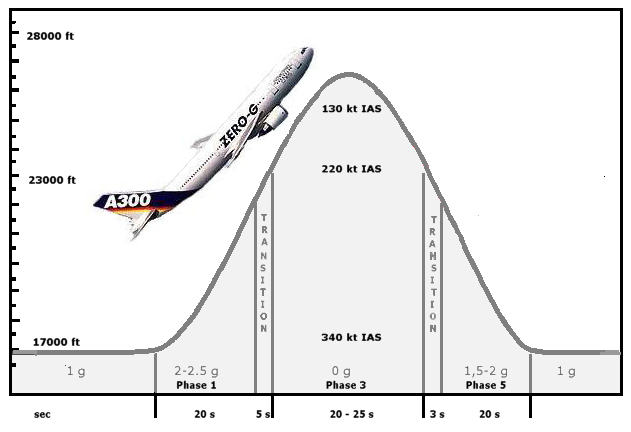
A new way to fly experiments takes off tomorrow with the first campaign dedicated to research in ‘partial’ gravity. Scientists on Europe’s ‘Zero-G’ Airbus will experiment with gravity conditions like those on the Moon and Mars.

The Joint European Partial-g Parabolic Flight campaign is an unprecedented research mission organised jointly by ESA and the French and German space agencies, CNES and DLR.

Airbus A300 Zero-G at the Bordeaux airport during the 54th ESA parabolic flight campaign

The pilots will follow special parabolic paths to create Moon and Mars gravity conditions for at least 25 seconds each time. The final parabola will provide full weightlessness for the experiments.

Each flight can provide a total of up to 12 minutes of partial gravity inside the aircraft. The Airbus A300, owned by Novespace, will perform consecutive flights on the three days starting tomorrow from Mérignac-Bordeaux airport, France.

Work during a 'normal' parabolic flight last week

Thirteen European experiments selected by the three agencies will test the effects of partial gravity.

The scientists’ response to this new partial gravity opportunity has been enormous. “This is a unique campaign in the world, and we have received outstanding scientific proposals from all over Europe,” say the agencies’ project managers.

The science behind the flights

The experiments cover a wide range of research, such as biology, human physiology and physics, as well as technology demonstrations. The goal is improve our knowledge about how systems react to different accelerations and where the level of sensitivity is.


Image above: French experiment on bubbles in weightlessness abord the Zero-G Airbus during the 54th ESA parabolic flight campaign.

“Lunar and martian reduced-gravity environments will provide scientists with additional data at different gravity levels,” explain the campaign’s managers.

The physical behaviour of bubbles, dust and granular packing will be closely monitored. Engineers will test technologies for the ExoMars robotic mission in martian gravity.

Parabolic flight

Plants and rats are also among the passengers, together with a video game console to be tested as a training device for balance control under reduced-gravity conditions.

A fruitful cooperation

Despite extensive experience with zero-g flights during the last 25 years, European scientists have always been interested in a partial-gravity parabolic flight campaign.

A300 Zero-G

ESA, CNES and DLR worked together to produce a balanced set of 13 experiments. A joint committee made the final selection based on scientific merit and feasibility.

Each agency will perform four experiments, with an extra one devoted to the ESA/NASA ExoMars mission. This first campaign is ideal for providing martian gravity for the mission’s preparations.

Follow the campaign blog


A blog will keep us updated every day with the latest information about the experiments and the experiences shared by the scientists before and after this unique parabolic flight campaign.

Follow the first partial-gravity campaign here!: http://www.esa.int/export/esaHS/SEML5MJ4LOG_research_0.html

Related links:

Parabolic flights: http://www.esa.int/SPECIALS/HSF_Research/SEMU945XT9G_0.html

Novespace: http://www.novespace.fr/

CNES: http://www.cnes.fr/

DLR: http://www.dlr.de/

Images, Text, Credits: ESA / A. Le Floc'h / Novespace.

Greetings, Orbiter.ch
dimanche 5 juin 2011

Antimatter atoms have been trapped for 1000 seconds in an experiment at CERN in Geneva


CERN - European Centre for Nuclear Research logo.

June 5, 2011

Antimatter atoms of antihydrogen have been trapped for more than 16 minutes during an experiment at the European Centre for Nuclear Research (CERN) in Geneva, which should facilitate the study of antimatter, according a study published Sunday.

"We can trap atoms of antihydrogen for 1,000 seconds," time "long enough to begin to study them," said Jeffrey Hangst (University of Aarhus, Denmark) on behalf of participants in the ALPHA experiment at CERN.

Antimatter captured for the first time at CERN in the ALPHA experiment

Matter "mirror" of what we know, antimatter is difficult to observe because every atom of antimatter annihilates matter upon contact, producing an enormous amount of energy. A hydrogen atom consists of a proton with a positive electrical charge and a negative electron. An atom of antihydrogen consists of a negative proton (antiproton) and a positive electron (positron).

Matter and antimatter were created in equal quantities in the moments after the Big Bang, but there remains little that matter. Where is the antimatter? This question torments physicists who want to analyze the properties of antimatter created in particle accelerators.

First atoms of antihydrogen were produced at CERN in 1995. But they had annihilated almost instantly on contact with matter. The ALPHA team at CERN had recently made a step forward in developing a new type of magnetic trap: 38 atoms of antihydrogen were stayed for 0.17 seconds.


Image above: Anti-hydrogen atoms annihilating not captured on the inner surface of the trap ALPHA at CERN 10 November 2010. © CERN.

The term of confinement has been increased to 1000 seconds, according to the study published Sunday online by the journal Nature Physics. And 309 atoms of antihydrogen have been trapped long enough for us to "begin to study their properties in detail," said CERN in a statement.

Antimatter is it subject to anti-gravity? This is one of the questions posed by physicists. Discover such a "repulsive gravity" could provide an answer to another riddle, that of the unknown energy that favors the accelerating expansion of the universe. Gravity, tends to push the galaxies approach each other.

Anti-mater graphic detection

When undergoing certain transformations, this material mirror she meets the same "symmetry" of physical laws that normal matter? According to the CPT symmetry (electric charge, parity, time), "a particle which progresses over time in our universe would be indistinguishable from an antiparticle backward in time in a mirror universe", says Alpha Team at CERN.

"Any indication of symmetry breaking would require CPT to seriously rethink our understanding of nature," says Hangst, whose team is preparing to probe anti-atoms to compare their properties with those of matter.

For more information about the CERN, visit: http://public.web.cern.ch/public/Welcome.html

Images, Text, Credit: CERN / AFP / Translation: Orbiter.ch.


Best regards, Orbiter.ch

vendredi 3 juin 2011

Rosetta to sleep through loneliest leg of comet mission


ESA - Rosetta Mission patch.

3 June 2011

On 8 June, mission controllers will have the first opportunity to switch ESA's Rosetta comet-hunter into deep-space hibernation for 31 months. During this loneliest leg of its decade-long mission, Rosetta will loop ever closer toward comet 67-P, soaring to almost 1000 million km from Earth.

Marking one of the most dramatic and distant stages of the probe's 10-year journey to rendezvous with Comet 67-P/Churyumov-Gerasimenko, ground controllers at ESOC, ESA's European Space Operations Centre, plan to issue the final command next week to switch Rosetta into hibernation mode.

Artist's impression of the Rosetta orbiter and lander

This will trigger the last steps in the shut-down of the spacecraft, turning off almost all flight control systems including telecommunications and attitude control. Rosetta's scientific instruments were already individually powered down during the first four months of this year.

"Rosetta is getting farther from the Sun, and soon there simply isn't going to be enough sunlight to power its systems," says Paolo Ferri, Head of ESOC's Solar and Planetary Mission Operations Division.

"We already achieved a record in July 2010 when we reached 400 million km from the Sun and became the most distant spacecraft ever to operate on solar power alone. Rosetta will double the record distance during the hibernation period."

Virtual shutdown of the entire spacecraft

The only devices left running will be the onboard computer and several heaters. These will be powered by the solar wings, and will be automatically switched on periodically to ensure that the entire satellite doesn't freeze up as its orbit takes it from 660 million km from the Sun out to 790 million km and back between now and January 2014.

Close-up Earth image during Rosetta swingby 2009

Prior to entering hibernation, Rosetta will be oriented so that its solar wings face the Sun and be placed into a slow spin, which will stabilise the satellite.

The window for issuing the hibernation command opens on 8 June, once the spacecraft status is confirmed. After the command is sent, there will be no signal sent to or from ground until 2014. A single computer timer will tick down the 136-week hibernation period.

Deep-space wake up call

At precisely 10:00 GMT on 20 January 2014, the timer will wake the spacecraft, which, seven hours later, will transmit a check signal to let mission controllers know that the spacecraft has woken.

Mars as seen by the lander's camera during swingby in 2007

"We've planned for hibernation for some time, and it's a complex phase of the mission," says Andrea Accomazzo, Spacecraft Operations Manager at ESOC.

"Still, for the flight control team, it's an emotional moment. We're essentially turning the spacecraft off. We're already looking forward to January 2014 when it wakes up and we get our spacecraft back."

In depth:

Rosetta in depth: http://sci.esa.int/rosetta

Max Planck Institute for Solar System Research: http://www.mps.mpg.de/en/

ESA's comet chaser:

Take part in ESA's Cool Comet Campaign: http://www.esa.int/SPECIALS/Operations/SEM2ACNSNNG_0.html

Images, Text, Credits: ESA / MPS for OSIRIS Team / MPS / UPD / LAM / IAA / RSSD / INTA / UPM / DASP / IDA / CIVA / Philae / ESA Rosetta.

Cheers, Orbiter.ch

One year in isolation


ESA - Mars500 Mission patch.

3 June 2011

The six men in the Mars500 facility near Moscow have been in isolation now 365 days. The European crewmembers have been writing in their latest letters home about the highlights, monotonous life, team spirit and determination to go on.

“Wow, it’s already been a year,” begins Diego Urbina, one of the two Mars500 crewmembers from ESA, in his latest diary entry.

“One way to visualise it is if you think of what you were doing exactly one year ago, and then picture yourself living in a windowless metal box from then!”

The crew have not actually gone anywhere in those 12 months, but in theory they have been to Mars and are now on the way back.

Mars500 crew having a fun portrait with red protective goggles

The crew of six – three Russians, two Europeans and one Chinese – walked from the flashlights of a hectic press conference into their isolation modules on 3 June 2010 and began their virtual mission towards the Red Planet.

The facility faithfully mimics every aspect of an interplanetary flight, as far as it is possible without really flying into space. Their ‘craft’ is composed of four sealed interconnected cylinders with a total volume of 550 cubic metres. They have their own private cabins and they live and work very much like the astronauts on the Space Station.


Image above: Romain, Yue, Diego and Aleksandr preparing an EEG recording. EEG (electroencephalography) is a recording of electrical activity along the scalp produced by the firing of neurons within the brain).

“The dark side of this routine is that every day for the past year we woke up at the same time to do the same medical controls with the same devices: no weekend or holiday breaks for a year!” writes Romain Charles, another ESA crewmember, in his diary.

To Mars and back

After the first exciting months, life settled into a routine and the crew waited for Mars arrival at the end of January.


Image above: Crew training for 'Marswalk' at the simulated martian terrain of the Mars500 experiment. The terrain, about 10 m long and 6 m wide, is covered with reddish sand and is built to resemble the surface at Gusev crater. On the ‘surface’, they conducted simulated scientific research by driving a rover and working with sensors to gather physical and chemical measurements.

They ‘docked’ with a ‘lander’ (in reality, another module connected to their main habitation modules) that had been waiting with supplies in orbit around Mars.

After unloading the cargo, Diego settled into the lander with Wang Yue and Alexandr Smoleevskiy, and ‘landed’ on Mars.

They completed three sorties in Orlan spacesuits into a big hall that was built to look like the martian surface.

During these marswalks they collected samples, set up experiments and drove a rover, like real marsonauts will do one day.

After conquering the Red Planet, the trio ‘flew ‘back to the interplanetary ship, and the crew was reunited to begin their long trip back home on 2 March.

They will ‘arrive’ on 5 November, when the hatch of the isolation facility is opened. The mission will still go on some weeks after that with medical checks and debriefings.

Good spirit

The biggest problem of future exploration flights is not necessarily the technology, but the humans and interactions between the crewmembers. This is the main focus of the Mars500 experiment.

Mars500 crew lunch

“Our crew has been keeping up the dozens of experiments we have to do constantly, no matter the good times or the hard times, producing data of quality that helps some of Europe's best scientists to evaluate what the space travelers of the future will go through,” writes Diego.

“We still have 5 months ahead of us a lot of opportunities to make this trip to Mars even more special,” adds Romain.

“We have a great crew and although our backgrounds are significantly different, we never had any conflicts between us. That's why I'm full of optimism for our last days in the Mars500 modules. We'll see you on the 5th of November when we'll land on Earth after our 520 day's journey to the Red Planet, not before!”

Mars 500 one year inside

Read the newest diaries from Mars500: Romain’s last letter is here and Diego’s letter is here:

http://www.esa.int/SPECIALS/Mars500/SEMOKY58BOG_0.html

Watch also ESA TV's video about Mars500: 'One year inside':
http://multimedia.esa.int/Videos/2011/05/Mars-500-one-year-inside

Images, Video, Text, Credits: ESA / Mars500 crew / IPMB.

Greetings, Orbiter.ch