dimanche 1 juillet 2012

Trio From International Space Station Lands Safely in Kazakhstan


ROSCOSMOS - Soyuz TMA-03M Mission patch.

July 01, 2012

 Expedition 31 Heads Home

Three members of the Expedition 31 crew undocked from the International Space Station and returned safely to Earth Sunday, July 1, wrapping up a mission that lasted six-and-a-half months.

Russian Commander Oleg Kononenko, NASA Flight Engineer Don Pettit and European Space Agency Flight Engineer Andre Kuipers landed their Soyuz TMA-03M spacecraft in Kazakhstan at 3:14 a.m. CDT (2:14 p.m. local time) after undocking from the space station's Rassvet module at 11:47 p.m. June 30. The trio, which arrived at the station Dec. 23, 2011, spent a total of 193 days in space, 191 of which were aboard the station.


Image above: The Soyuz TMA-03M spacecraft is seen as it lands in a remote area near the town of Zhezkazgan, Kazakhstan, on Sunday. Photo Credit: NASA / Bill Ingalls.

During their expedition, the crew supported more than 200 scientific investigations involving more than 400 researchers around the world. The studies ranged from integrated investigations of the human cardiovascular and immune systems to fluid, flame and robotic research.

Station Crew Lands in Kazakhstan

Before leaving the station, Kononenko handed over command of Expedition 32 to the Russian Federal Space Agency's Gennady Padalka, who remains aboard the station with NASA astronaut Joe Acaba and Russian cosmonaut Sergei Revin. NASA astronaut Sunita Williams, Russian cosmonaut Yuri Malenchenko and Japan Aerospace Exploration Agency astronaut Akihiko Hoshide will join them July 17. Williams, Malenchenko and Hoshide are scheduled to launch July 14 from the Baikonur Cosmodrome in Kazakhstan.

Welcome back André (ESA Astronaut). Credits: ESA – S. Corvaja.

On June 25, Pettit celebrated achieving one cumulative year in space, combining his time in orbit on Expedition 6, Expedition 30/31 and the STS-126 space shuttle Endeavour flight to the station in November 2008. Pettit now has 370 days in space, placing him fourth among U.S. space fliers for the longest time in space.

Soyuz TMA-03M landed. Credits: ESA – S. Corvaja.

During Expedition 31, Pettit also used household objects aboard the station to perform a variety of unusual physics experiments for the video series "Science Off the Sphere." Through these demonstrations, Pettit showed more than a million Internet viewers how space affects scientific principles.

To watch "Science Off the Sphere" videos, visit: http://www.physicscentral.com/sots

To follow Twitter updates from NASA's Expedition 31 and 32 astronauts, visit:

http://twitter.com/Astro_Suni

https://twitter.com/AstroAcaba

https://twitter.com/Aki_Hoshide

For more information about Expedition 32 and the space station, visit: http://www.nasa.gov/station

Images (mentioned), Videos, Text, Credits: NASA / NASA TV / Roscosmos TV / ROSCOSMOS.

Best regards, Orbiter.ch

vendredi 29 juin 2012

Chinese Space Capsule With 3 Taïkonauts Returns to Earth


CNSA - China National Space Administration logo.

June 29. 2012

Three Chinese Taïkonauts returned to Earth Thursday (June 28) after 13 days in space on a historic mission that made their country only the third nation ever to successfully dock a manned spacecraft to another in orbit.

China's Shenzhou-9 spacecraft returns to Earth

China's Shenzhou 9 space capsule landed at about10 p.m. EDT (10 a.m. Friday, June 29 Beijing time) in Inner Mongolia, an autonomous region of the People's Republic of China. To prepare for their journey home, the space crew — which included China's first female Taïkonaut Liu Yang — separated the Shenzhou 9 capsule its target, the Tiangong 1 prototype space module, on Wednesday (June 27).


Image above: This photograph of a China CCTV broadcast shows the Shenzhou 9 space capsule lying on its side after landing in an autonomous region of China in Inner Mongolia on June 29, 2012 Beijing time (10 p.m. June 28 EDT) to end a 13-day mission to the Tiangong 1 space lab module. Credit: CCTV.

Their landing was broadcast live on China's state-run CCTV television network, showing the capsule streaking through the atmosphere like a meteor, deploying its main parachute, then making the final landing and rolling over on its side in a rough touchdown.

China's Shenzhou-9 spacecraft undocking & returns to Earth

"We fulfilled the first manned manual docking," mission commander Jing Haipeng told CCTV reporters after exiting the Shenzhou 9 capsule. His comments in Chinese were translated into English by CCTV. "For the country and people all across the country, thank you for your concerns." 
Jing and crewmates Liu Yang and Liu Wang appeared to be in good health after their space mission. The trio wore broad smiles and waved to cameras after leaving their spacecraft, but did sit in reclined chairs to help ease their adaptation back to Earth's gravity after nearly two weeks in weightlessness.


Image above: Chinese Taïkonaut Jing Haipeng, commander of the Shenzhou 9 mission, salutes after exiting the space capsule following landing in Inner Mongolia autonomous mission on June 28, 2012. Credit: China Central Television/CCTV.

Shortly after the landing, China's Premier Wen Jiabao proclaimed the Shenzhou 9 mission a complete success.

"This manned docking mission of Tiangong 1 and Shenzhou 9 marks a large milestone, a major breakthrough for China to master the space docking technology," Wen said while reading a statement. "And also, it marks a decisive step forward on China's second step on its space strategy."

For more information about CNSA, visit: http://www.cnsa.gov.cn/n615709/cindex.html

Images (mentioned), Videos, Text, Credits: AP / China Central Television / CCTV / IBTime / CNSA.

Best regards, Orbiter.ch

Has the Speediest Pulsar Been Found?


NASA - Chandra X-ray Observatory patch / ESA - XMM Newton Mission patch.

June 29, 2012

Researchers using three different telescopes -- NASA's Chandra X-ray Observatory and ESA's XMM-Newton in space, and the Parkes radio telescope in Australia -- may have found the fastest moving pulsar ever seen.


The evidence for this potentially record-breaking speed comes, in part, from the features highlighted in this composite image. X-ray observations from Chandra (green) and XMM-Newton (purple) have been combined with infrared data from the 2MASS project and optical data from the Digitized Sky Survey (colored red, green and blue, but appearing in the image as white).

The large area of diffuse X-rays seen by XMM-Newton was produced when a massive star exploded as a supernova, leaving behind a debris field, or supernova remnant known as SNR MSH 11-16A. Shocks waves from the supernova have heated surrounding gas to several million degrees Kelvin, causing the remnant to glow brightly in X-rays.

The Chandra image shown in the inset ("X-ray close-up") reveals a comet-shaped X-ray source well outside the boundary of the supernova remnant. This source consists of a point-like object with a long tail trailing behind it for about 3 light years. The bright star nearby and also the one in SNR MSH11-16A are both likely to be foreground stars unrelated to the supernova remnant.

The point-like X-ray source was discovered by the International Gamma-Ray Astrophysics Laboratory, or INTEGRAL, and is called IGR J11014-6103 (or IGR J11014 for short). It may be a rapidly spinning, super-dense star (known as a "pulsar", a type of neutron star) that was ejected during the explosion. If so, it is racing away from the center of the supernova remnant at millions of miles per hour.

The favored interpretation for the tail of X-ray emission is that a pulsar wind nebula, that is, a "wind" of high-energy particles produced by the pulsar, has been swept behind a bow shock created by the pulsar's high speed. (A similar case was seen in another object known as PSR B1957+20 [http://chandra.harvard.edu/photo/2003/b1957/closer_look.html].

The elongated emission is pointing towards the center of MSH 11-61A where the pulsar would have been formed, supporting the idea that the Chandra image is of a pulsar wind nebula and its bow shock. Another interesting feature of the Chandra image, also seen with XMM-Newton, is the faint X-ray tail extending to the top-right. The cause of this feature is unknown, but similar tails have been seen from other pulsars that also do not line up with the pulsar's direction of motion.

Based on earlier observations, astronomers estimate that the age of MSH 11-61A is approximately 15,000 years, and it lies at a distance of about 30,000 light years away from Earth. Combining these values with the distance that the pulsar has appeared to have traveled from the center of the MSH 11-61A, astronomers estimate that IGR J11014 is moving at a speed between 5.4 million and 6.5 million miles per hour.


The only other neutron star associated with a supernova remnant that may rival this in speed is the candidate found in the supernova remnant known as G350.1-0.3. The speed of the neutron star candidate in this system is estimated to lie between 3 and 6 million miles per hour (http://chandra.harvard.edu/photo/2012/g350/). The high speeds estimated for both IGR J11014 and the neutron star candidate in G350.1-0.3 are preliminary and need to be confirmed. If they are confirmed, explaining the high speeds of the neutron star presents a severe challenge to existing models for supernova explosions.

One important caveat in the conclusion that IGR J11014 may be the fastest moving pulsar is that pulsations have not been detected in it during a search with the Commonwealth Scientific and Industrial Research Organization (CSIRO) Parkes radio telescope. This non-detection is not surprising for a pulsar located about 30,000 light years away.

However, there are other pieces of evidence that support the pulsar interpretation. First, the lack of detection of a counterpart to the X-ray source in optical or infrared images supports the idea that it is a pulsar, since such objects are very faint at these wavelengths. Also, there are no apparent differences in the brightness of the source between XMM-Newton observations in 2003 and the Chandra observations in 2011, behavior that is expected if IGR J11014 is a pulsar. Finally, the X-ray spectrum of the source, that is, its signature in energy, is similar to what astronomers expect to see for a pulsar.

These results were published in the May 10, 2012 issue of The Astrophysical Journal Letters. The authors were John Tomsick and Arash Bodaghee (University of California, Berkeley), Jerome Rodriguez and Sylvain Chaty (University of Paris, CEA Saclay), Fernando Camilo (Columbia University), Francesca Fornasini (UC Berkeley), and Farhid Rahoui (Harvard-Smithsonian Center for Astrophysics).

NASA's Marshall Space Flight Center in Huntsville, Ala., manages the Chandra program for NASA's Science Mission Directorate in Washington. The Smithsonian Astrophysical Observatory controls Chandra's science and flight operations from Cambridge, Mass.

Read more/access all images: http://chandra.harvard.edu/photo/2012/igrj11014/

Chandra's Flickr photoset: http://www.flickr.com/photos/nasamarshall/sets/72157606205297786/with/7268281472/

Image, Video, Credits: X-ray: NASA / CXC / UC Berkeley / J. Tomsick et al and ESA / XMM-Newton; Optical: DSS, 2MASS / UMass/IPAC-Caltech / NASA / NSF.

Text Credits: NASA / Marshall Space Flight Center / Janet Anderson / Chandra X-ray Center / Megan Watzke.

Greetings, Orbiter.ch

jeudi 28 juin 2012

Hubble, Swift Detect First-Ever Changes in an Exoplanet Atmosphere


ESA - Hubble Space Telescope Logo / NASA - SWIFT Mission patch.

June 28, 2012

An international team of astronomers using data from NASA's Hubble Space Telescope has made an unparalleled observation, detecting significant changes in the atmosphere of a planet located beyond our solar system.

Stellar Flare Sweeps Up Exoplanet's Atmosphere

The exoplanet HD 189733b lies so near its star that it completes an orbit every 2.2 days. In late 2011, NASA's Hubble Space Telescope found that the planet's upper atmosphere was streaming away at speeds exceeding 300,000 mph. Just before the Hubble observation, NASA's Swift detected the star blasting out a strong X-ray flare, one powerful enough to blow away part of the planet's atmosphere.

The scientists conclude the atmospheric variations occurred in response to a powerful eruption on the planet's host star, an event observed by NASA's Swift satellite.

"The multiwavelength coverage by Hubble and Swift has given us an unprecedented view of the interaction between a flare on an active star and the atmosphere of a giant planet," said lead researcher Alain Lecavelier des Etangs at the Paris Institute of Astrophysics (IAP), part of the French National Scientific Research Center located at Pierre and Marie Curie University in Paris.

The exoplanet is HD 189733b, a gas giant similar to Jupiter, but about 14 percent larger and more massive. The planet circles its star at a distance of only 3 million miles, or about 30 times closer than Earth's distance from the sun, and completes an orbit every 2.2 days. Its star, named HD 189733A, is about 80 percent the size and mass of our sun.


This artist's rendering illustrates the evaporation of HD 189733b's atmosphere in response to a powerful eruption from its host star. NASA's Hubble Space Telescope detected the escaping gases and NASA's Swift satellite caught the stellar flare. (Credit: NASA's Goddard Space Flight Center).

Astronomers classify the planet as a "hot Jupiter." Previous Hubble observations show that the planet's deep atmosphere reaches a temperature of about 1,900 degrees Fahrenheit (1,030 C).

HD 189733b periodically passes across, or transits, its parent star, and these events give astronomers an opportunity to probe its atmosphere and environment. In a previous study, a group led by Lecavelier des Etangs used Hubble to show that hydrogen gas was escaping from the planet's upper atmosphere. The finding made HD 189733b only the second-known "evaporating" exoplanet at the time.

The system is just 63 light-years away, so close that its star can be seen with binoculars near the famous Dumbbell Nebula. This makes HD 189733b an ideal target for studying the processes that drive atmospheric escape.

"Astronomers have been debating the details of atmospheric evaporation for years, and studying HD 189733b is our best opportunity for understanding the process," said Vincent Bourrier, a doctoral student at IAP and a team member on the new study.

When HD 189733b transits its star, some of the star's light passes through the planet's atmosphere. This interaction imprints information on the composition and motion of the planet's atmosphere into the star's light.


Image above: Swift's Ultraviolet/Optical Telescope captured this view of HD 189733b's star on Sept. 14, 2011. The image is 6 arcminutes across. Credit: NASA/Swift/Stefan Immler.

In April 2010, the researchers observed a single transit using Hubble's Space Telescope Imaging Spectrograph (STIS), but they detected no trace of the planet's atmosphere. Follow-up STIS observations in September 2011 showed a surprising reversal, with striking evidence that a plume of gas was streaming away from the exoplanet.

The researchers determined that at least 1,000 tons of gas was leaving the planet's atmosphere every second. The hydrogen atoms were racing away at speeds greater than 300,000 mph. The findings will appear in an upcoming issue of the journal Astronomy & Astrophysics.

Because X-rays and extreme ultraviolet starlight heat the planet's atmosphere and likely drive its escape, the team also monitored the star with Swift's X-ray Telescope (XRT). On Sept. 7, 2011, just eight hours before Hubble was scheduled to observe the transit, Swift was monitoring the star when it unleashed a powerful flare. It brightened by 3.6 times in X-rays, a spike occurring atop emission levels that already were greater than the sun's.


Image above: Strong X-ray emission makes the host star of HD 189733b stand out in this view from Swift's X-Ray Telescope. The image combines data from Sept. 13 and 14, 2011, and is 6 arcminutes across. Credit: NASA/Swift/Stefan Immler.

"The planet's close proximity to the star means it was struck by a blast of X-rays tens of thousands of times stronger than the Earth suffers even during an X-class solar flare, the strongest category," said co-author Peter Wheatley, a physicist at the University of Warwick in England.

After accounting for the planet's enormous size, the team notes that HD 189733b encountered about 3 million times as many X-rays as Earth receives from a solar flare at the threshold of the X class.

Hubble is a project of international cooperation between NASA and the European Space Agency. Swift is operated in collaboration with several U.S. institutions and partners in the United Kingdom, Italy, Germany and Japan. NASA's Goddard Space Flight Center in Greenbelt, Md., manages both missions.

For more information about Swift, visit: http://www.nasa.gov/swift

For more information about Hubble, visit: http://www.nasa.gov/hubble
and http://www.spacetelescope.org/

Images (mentioned), Video, Text, Credits: NASA / ESA / Goddard Space Flight Center.

Cheers, Orbiter.ch

Cassini Finds Likely Subsurface Ocean on Saturn Moon


NASA / ESA - Cassini Mission to Saturn & Titan patch.

June 28, 2012

Data from NASA's Cassini spacecraft have revealed Saturn's moon Titan likely harbors a layer of liquid water under its ice shell.


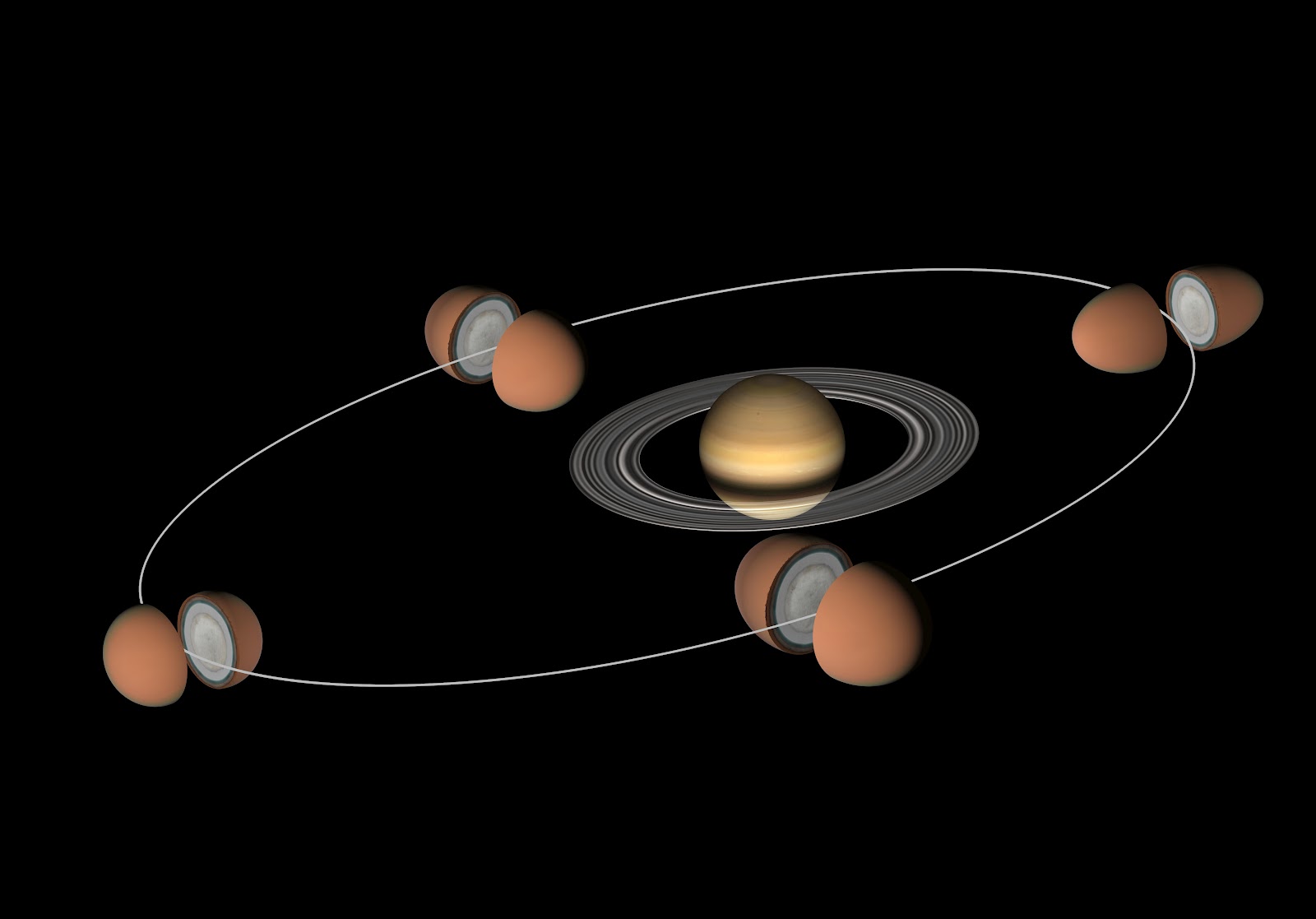
This artist's concept shows a possible scenario for the internal structure of Titan, as suggested by data from NASA's Cassini spacecraft. Image credit: A. Tavani.

Researchers saw a large amount of squeezing and stretching as the moon orbited Saturn. They deduced that if Titan were composed entirely of stiff rock, the gravitational attraction of Saturn would cause bulges, or solid "tides," on the moon only 3 feet (1 meter) in height. Spacecraft data show Saturn creates solid tides approximately 30 feet (10 meters) in height, which suggests Titan is not made entirely of solid rocky material. The finding appears in today's edition of the journal Science.

"Cassini's detection of large tides on Titan leads to the almost inescapable conclusion that there is a hidden ocean at depth," said Luciano Iess, the paper's lead author and a Cassini team member at the Sapienza University of Rome, Italy. "The search for water is an important goal in solar system exploration, and now we've spotted another place where it is abundant."

Squeezing and Stretching Titan

Titan takes only 16 days to orbit Saturn, and scientists were able to study the moon's shape at different parts of its orbit. Because Titan is not spherical, but slightly elongated like a football, its long axis grew when it was closer to Saturn. Eight days later, when Titan was farther from Saturn, it became less elongated and more nearly round. Cassini measured the gravitational effect of that squeeze and pull.

Scientists were not sure Cassini would be able to detect the bulges caused by Saturn's pull on Titan. By studying six close flybys of Titan from Feb. 27, 2006, to Feb. 18, 2011, researchers were able to determine the moon's internal structure by measuring variations in the gravitational pull of Titan using data returned to NASA's Deep Space Network (DSN).

"We were making ultrasensitive measurements, and thankfully Cassini and the DSN were able to maintain a very stable link," said Sami Asmar, a Cassini team member at NASA's Jet Propulsion Laboratory in Pasadena, Calif. "The tides on Titan pulled up by Saturn aren't huge compared to the pull the biggest planet, Jupiter, has on some of its moons. But, short of being able to drill on Titan's surface, the gravity measurements provide the best data we have of Titan's internal structure."


Image above: The colorful globe of Saturn's largest moon, Titan, passes in front of the planet and its rings in this true color snapshot from NASA's Cassini spacecraft. Image credit: NASA/JPL-Caltech/Space Science Institute.

An ocean layer does not have to be huge or deep to create these tides. A liquid layer between the external, deformable shell and a solid mantle would enable Titan to bulge and compress as it orbits Saturn. Because Titan's surface is mostly made of water ice, which is abundant in moons of the outer solar system, scientists infer Titan's ocean is likely mostly liquid water.

On Earth, tides result from the gravitational attraction of the moon and sun pulling on our surface oceans. In the open oceans, those can be as high as two feet (60 centimeters). While water is easier to move, the gravitational pulling by the sun and moon also causes Earth's crust to bulge in solid tides of about 20 inches (50 centimeters).

The presence of a subsurface layer of liquid water at Titan is not itself an indicator for life. Scientists think life is more likely to arise when liquid water is in contact with rock, and these measurements cannot tell whether the ocean bottom is made up of rock or ice. The results have a bigger implication for the mystery of methane replenishment on Titan.

"The presence of a liquid water layer in Titan is important because we want to understand how methane is stored in Titan's interior and how it may outgas to the surface," said Jonathan Lunine, a Cassini team member at Cornell University, Ithaca, N.Y. "This is important because everything that is unique about Titan derives from the presence of abundant methane, yet the methane in the atmosphere is unstable and will be destroyed on geologically short timescales."

A liquid water ocean, "salted" with ammonia, could produce buoyant ammonia-water liquids that bubble up through the crust and liberate methane from the ice. Such an ocean could serve also as a deep reservoir for storing methane.


Image above: The shape of the moon changes along its orbit because of the varying tidal pull from Saturn such that it is stretched into a rugby-ball shape at its closest point to the gas giant and is more spherical at its most distant point. The change in shape causes a redistribution of mass in the moon and therefore a change in the gravity field, which is measured by Cassini in the form of the change in acceleration of the spacecraft as tracked by microwave radio links with the ground antennas of NASA’s Deep Space Network.

The Cassini-Huygens mission is a cooperative project of NASA, the European Space Agency and the Italian Space Agency. The mission is managed by JPL for NASA's Science Mission Directorate in Washington. DSN, also managed by JPL, is an international network of antennas that supports interplanetary spacecraft missions and radio and radar astronomy observations for the exploration of the solar system and the universe. The network also supports selected Earth-orbiting missions. Cassini's radio science team is based at Wellesley College in Massachusetts. JPL is a division of the California Institute of Technology in Pasadena.

For more information about the mission, visit: http://www.nasa.gov/cassini and http://saturn.jpl.nasa.gov and http://www.esa.int/esaMI/Cassini-Huygens/

Images (mentioned), Video, Text, Credits: NASA / ESA / Dwayne Brown / JPL / Jia-Rui Cook / JPL-Caltech / Space Science Institute.

Greetings, Orbiter.ch

mercredi 27 juin 2012

NuSTAR Mission Status Report


NASA - NuSTAR Mission patch.

June 27, 2012

After deploying its mast, the NuSTAR observatory began a series of checkout procedures. The procedures include measuring the alignment of all the components of the spacecraft systems that determine the pointing direction of the telescope, and bringing the X-ray digital cameras online. The team tuned up the spacecraft so that the long telescope can be pointed accurately at different locations in the sky, and they are completing the process of making the pointing direction accurate.


Artist's concept showing NASA's NuSTAR mission orbiting Earth. Image credit: NASA/JPL-Caltech. Image credit: NASA/JPL-Caltech.

The X-ray digital cameras were turned on so that the team can tune up their performance. The cameras are operating well. A calibration source was inserted in the field, and it has been determined that the cameras are accurately measuring the energy of incoming X-rays. The team is preparing for the first-light images on Thursday.

For more information, visit http://www.nasa.gov/nustar and http://www.nustar.caltech.edu/.

Image (mentioned), Credits: NASA / Text Written by NuSTAR Principal Investigator Fiona Harrison.
California Institute of Technology in Pasadena.

Greetings, Orbiter.ch

New Way of Probing Exoplanet Atmospheres


ESO - European Southern Observatory logo.

27 June 2012

Tau Boötis b revealed

Artist’s impression of the exoplanet Tau Boötis b

For the first time a clever new technique has allowed astronomers to study the atmosphere of an exoplanet in detail — even though it does not pass in front of its parent star. An international team has used ESO’s Very Large Telescope to directly catch the faint glow from the planet Tau Boötis b. They have studied the planet’s atmosphere and measured its orbit and mass precisely for the first time — in the process solving a 15-year old problem. Surprisingly, the team also finds that the planet’s atmosphere seems to be cooler higher up, the opposite of what was expected. The results will be published in the 28 June 2012 issue of the journal Nature.

The planet Tau Boötis b [1] was one of the first exoplanets to be discovered back in 1996, and it is still one of the closest exoplanets known. Although its parent star is easily visible with the naked eye, the planet itself certainly is not, and up to now it could only be detected by its gravitational effects on the star. Tau Boötis b is a large “hot Jupiter” planet orbiting very close to its parent star.

Like most exoplanets, this planet does not transit the disc of its star (like the recent transit of Venus). Up to now such transits were essential to allow the study of hot Jupiter atmospheres: when a planet passes in front of its star it imprints the properties of the atmosphere onto the starlight. As no starlight shines through Tau Boötis b’s atmosphere towards us, this means the planet’s atmosphere could not be studied before.

The parent star of the famous exoplanet Tau Boötis b

But now, after 15 years of attempting to study the faint glow that is emitted from hot Jupiter exoplanets, astronomers have finally succeeded in reliably probing the structure of the atmosphere of Tau Boötis b and deducing its mass accurately for the first time. The team used the CRIRES [2] instrument on the Very Large Telescope (VLT) at ESO’s Paranal Observatory in Chile. They combined high quality infrared observations (at wavelengths around 2.3 microns) [3] with a clever new trick to tease out the weak signal of the planet from the much stronger one from the parent star [4].

Lead author of the study Matteo Brogi (Leiden Observatory, the Netherlands) explains: “Thanks to the high quality observations provided by the VLT and CRIRES we were able to study the spectrum of the system in much more detail than has been possible before. Only about 0.01% of the light we see comes from the planet, and the rest from the star, so this was not easy”.

Wide-field view of the parent star of the famous exoplanet Tau Boötis b

The majority of planets around other stars were discovered by their gravitational effects on their parent stars, which limits the information that can be gleaned about their mass: they only allow a lower limit to be calculated for a planet’s mass [5]. The new technique pioneered here is much more powerful. Seeing the planet’s light directly has allowed the astronomers to measure the angle of the planet’s orbit and hence work out its mass precisely. By tracing the changes in the planet’s motion as it orbits its star, the team has determined reliably for the first time that Tau Boötis b orbits its host star at an angle of 44 degrees and has a mass six times that of the planet Jupiter in our own Solar System.

“The new VLT observations solve the 15-year old problem of the mass of Tau Boötis b. And the new technique also means that we can now study the atmospheres of exoplanets that don’t transit their stars, as well as measuring their masses accurately, which was impossible before”, says Ignas Snellen (Leiden Observatory, the Netherlands), co-author of the paper. “This is a big step forward.”

Artist’s impression of the famous exoplanet Tau Boötis b

As well as detecting the glow of the atmosphere and measuring Tau Boötis b’s mass, the team has probed its atmosphere and measured the amount of carbon monoxide present, as well as the temperature at different altitudes by means of a comparison between the observations and theoretical models. A surprising result from this work was that the new observations indicated an atmosphere with a temperature that falls higher up. This result is the exact opposite of the temperature inversion — an increase in temperature with height — found for other hot Jupiter exoplanets [6] [7].

The VLT observations show that high resolution spectroscopy from ground-based telescopes is a valuable tool for a detailed analysis of non-transiting exoplanets’ atmospheres. The detection of different molecules in future will allow astronomers to learn more about the planet’s atmospheric conditions. By making measurements along the planet’s orbit, astronomers may even be able to track atmospheric changes between the planet’s morning and evening.

Zooming in on the star Tau Boötis

"This study shows the enormous potential of current and future ground-based telescopes, such as the E-ELT. Maybe one day we may even find evidence for biological activity on Earth-like planets in this way”, concludes Ignas Snellen.

Notes:

[1] The name of the planet, Tau Boötis b, combines the name of the star (Tau Boötis, or τ Bootis, τ is the Greek letter “tau”, not a letter “t” ) with the letter “b” indicating that this is the first planet found around this star. The designation Tau Boötis a is used for the star itself.

[2] CRyogenic InfraRed Echelle Spectrometer

[3] At infrared wavelengths, the parent star emits less light than in the optical regime, so this is a wavelength regime favorable for separating out the dim planet’s signal.

[4] This method uses the velocity of the planet in orbit around its parent star to distinguish its radiation from that of the star and also from features coming from the Earth’s atmosphere. The same team of astronomers tested this technique before on a transiting planet, measuring its orbital velocity during its crossing of the stellar disc.

[5] This is because the tilt of the orbit is normally unknown. If the planet’s orbit is tilted relative to the line of sight between Earth and the star then a more massive planet causes the same observed back and forth motion of the star as a lighter planet in a less tilted orbit and it is not possible to separate the two effects.

[6] Thermal inversions are thought to be characterised by molecular features in emission in the spectrum, rather than in absorption, as interpreted from photometric observations of hot Jupiters with the Spitzer Space Telescope. The exoplanet HD209458b is the best-studied example of thermal inversions in the exoplanet atmospheres.

[7] This observation supports models in which strong ultraviolet emission associated to chromospheric activity — similar to the one exhibited by the host star of Tau Boötis b — is responsible for the inhibition of the thermal inversion.

More information:

This research was presented in a paper "The signature of orbital motion from the dayside of the planet τ Boötis b" to appear in the journal Nature on 28 June 2012.

The team is composed of Matteo Brogi (Leiden Observatory, the Netherlands), Ignas A. G. Snellen (Leiden Observatory), Remco J. de Kok (SRON, Utrecht, the Netherlands), Simon Albrecht (Massachusetts Institute of Technology, Cambridge, USA), Jayne Birkby (Leiden Observatory) and Ernst J. W. de Mooij (University of Toronto, Canada; Leiden Observatory).

The year 2012 marks the 50th anniversary of the founding of the European Southern Observatory (ESO). ESO is the foremost intergovernmental astronomy organisation in Europe and the world’s most productive astronomical observatory. It is supported by 15 countries: Austria, Belgium, Brazil, the Czech Republic, Denmark, France, Finland, Germany, Italy, the Netherlands, Portugal, Spain, Sweden, Switzerland and the United Kingdom. ESO carries out an ambitious programme focused on the design, construction and operation of powerful ground-based observing facilities enabling astronomers to make important scientific discoveries. ESO also plays a leading role in promoting and organising cooperation in astronomical research. ESO operates three unique world-class observing sites in Chile: La Silla, Paranal and Chajnantor. At Paranal, ESO operates the Very Large Telescope, the world’s most advanced visible-light astronomical observatory and two survey telescopes. VISTA works in the infrared and is the world’s largest survey telescope and the VLT Survey Telescope is the largest telescope designed to exclusively survey the skies in visible light. ESO is the European partner of a revolutionary astronomical telescope ALMA, the largest astronomical project in existence. ESO is currently planning a 40-metre-class European Extremely Large optical/near-infrared Telescope, the E-ELT, which will become “the world’s biggest eye on the sky”.

Links:

    Research paper in Nature: http://www.eso.org/public/archives/releases/sciencepapers/eso1227/eso1227.pdf

    Photos of the VLT: http://www.eso.org/public/images/archive/search/?adv=&subject_name=Very%20Large%20Telescope

    Other images taken with the VLT: http://www.eso.org/public/images/archive/search/?adv=&facility=31

ESO, La Silla, Paranal, E-ELT & Survey Telescopes / Richard Hook / L. Calçada / Leiden Observatory, Leiden University Leiden / Ignas Snellen / Matteo Brogi / Jayne Birkby / Space Research Organization Netherlands (SRON) / Remco de Kok / IAU and Sky & Telescope / Digitized Sky Survey 2 / Videos: ESO / L. Calçada / A. Fujii/Digitized Sky Survey 2. Music: Disasterpeace (http://disasterpeace.com/).