jeudi 10 janvier 2013

NASA Rules Out Earth Impact in 2036 for Asteroid Apophis


Asteroid Watch.

Jan. 10, 2013

NASA scientists at the agency's Jet Propulsion Laboratory in Pasadena, Calif., effectively have ruled out the possibility the asteroid Apophis will impact Earth during a close flyby in 2036. The scientists used updated information obtained by NASA-supported telescopes in 2011 and 2012, as well as new data from the time leading up to Apophis' distant Earth flyby yesterday (Jan. 9).

Discovered in 2004, the asteroid, which is the size of three-and-a-half football fields, gathered the immediate attention of space scientists and the media when initial calculations of its orbit indicated a 2.7 percent possibility of an Earth impact during a close flyby in 2029. Data discovered during a search of old astronomical images provided the additional information required to rule out the 2029 impact scenario, but a remote possibility of one in 2036 remained - until yesterday.

"With the new data provided by the Magdalena Ridge [New Mexico Institute of Mining and Technology] and the Pan-STARRS [Univ. of Hawaii] optical observatories, along with very recent data provided by the Goldstone Solar System Radar, we have effectively ruled out the possibility of an Earth impact by Apophis in 2036," said Don Yeomans, manager of NASA's Near-Earth Object Program Office at JPL. "The impact odds as they stand now are less than one in a million, which makes us comfortable saying we can effectively rule out an Earth impact in 2036. Our interest in asteroid Apophis will essentially be for its scientific interest for the foreseeable future."

Asteroid Apophis was discovered on June 19, 2004. Image credit: UH/IA

The April 13, 2029, flyby of asteroid Apophis will be one for the record books. On that date, Apophis will become the closest flyby of an asteroid of its size when it comes no closer than 19, 400 miles (31,300 kilometers) above Earth's surface.

"But much sooner, a closer approach by a lesser-known asteroid is going to occur in the middle of next month when a 40-meter-sized asteroid, 2012 DA14, flies safely past Earth's surface at about 17,200 miles," said Yeomans. "With new telescopes coming online, the upgrade of existing telescopes and the continued refinement of our orbital determination process, there's never a dull moment working on near-Earth objects."

NASA detects and tracks asteroids and comets passing close to Earth using both ground and space-based telescopes. The Near-Earth Object Observations Program, commonly called "Spaceguard," discovers these objects, characterizes a subset of them and plots their orbits to determine if any could be potentially hazardous to our planet.

The Near-Earth Object Program Office at JPL manages the technical and scientific activities for NASA's Near-Earth Object Program of the Science Mission Directorate in Washington. JPL is a division of the California Institute of Technology in Pasadena.

For more information about asteroids and near-Earth objects, visit: http://www.jpl.nasa.gov/asteroidwatch Updates about near-Earth objects are also available by following AsteroidWatch on Twitter at http://www.twitter.com/asteroidwatch .

Image, Text, Credits: NASA / Dwayne Brown / JPL / DC Agle.

Cheers, Orbiter.ch

NASA's GALEX Reveals the Largest-Known Spiral Galaxy


NASA GALEX Mission patch.

Jan. 10, 2013


This composite of the giant barred spiral galaxy NGC 6872 combines visible light images from the European Southern Observatory's Very Large Telescope with far-ultraviolet (1,528 angstroms) data from NASA's GALEX and 3.6-micron infrared data acquired by NASA's Spitzer Space Telescope. A previously unsuspected tidal dwarf galaxy candidate (circled) appears only in the ultraviolet, indicating the presence of many hot young stars. IC 4970, the small disk galaxy interacting with NGC 6872, is located above the spiral's central region. The spiral is 522,000 light-years across from the tip of one outstretched arm to the tip of the other, which makes it about 5 times the size of our home galaxy, the Milky Way. Images of lower resolution from the Digital Sky Survey were used to fill in marginal areas not covered by the other data. Credit: NASA's Goddard Space Flight Center/ESO/JPL-Caltech/DSS.

The spectacular barred spiral galaxy NGC 6872 has ranked among the biggest stellar systems for decades. Now a team of astronomers from the United States, Chile and Brazil has crowned it the largest-known spiral, based on archival data from NASA's Galaxy Evolution Explorer (GALEX) mission, which has since been loaned to the California Institute of Technology, Pasadena, Calif.

Measuring tip-to-tip across its two outsized spiral arms, NGC 6872 spans more than 522,000 light-years, making it more than five times the size of our Milky Way galaxy.

"Without GALEX's ability to detect the ultraviolet light of the youngest, hottest stars, we would never have recognized the full extent of this intriguing system," said lead scientist Rafael Eufrasio, a research assistant at NASA's Goddard Space Flight Center in Greenbelt, Md., and a doctoral student at Catholic University of America in Washington. He presented the findings Thursday at the American Astronomical Society meeting in Long Beach, Calif.

The galaxy's unusual size and appearance stem from its interaction with a much smaller disk galaxy named IC 4970, which has only about one-fifth the mass of NGC 6872. The odd couple is located 212 million light-years from Earth in the southern constellation Pavo.

Astronomers think large galaxies, including our own, grew through mergers and acquisitions -- assembling over billions of years by absorbing numerous smaller systems.

Intriguingly, the gravitational interaction of NGC 6872 and IC 4970 may have done the opposite, spawning what may develop into a new small galaxy.

"The northeastern arm of NGC 6872 is the most disturbed and is rippling with star formation, but at its far end, visible only in the ultraviolet, is an object that appears to be a tidal dwarf galaxy similar to those seen in other interacting systems," said team member Duilia de Mello, a professor of astronomy at Catholic University.


Computer simulations of the collision between NGC 6872 and IC 4970 reproduce the basic features of the galaxies as we see them today. They indicate that IC 4970's closest encounter occurred 130 million years ago and that the smaller galaxy followed a path (dashed curve) close to the plane of the spiral's disk and in the same direction it rotates. Credit: NASA's Goddard Space Flight Center, after C. Horellou (Onsala Space Observatory) and B. Koribalski (ATNF).

The tidal dwarf candidate is brighter in the ultraviolet than other regions of the galaxy, a sign it bears a rich supply of hot young stars less than 200 million years old.

The researchers studied the galaxy across the spectrum using archival data from the European Southern Observatory's Very Large Telescope, the Two Micron All Sky Survey, and NASA's Spitzer Space Telescope, as well as GALEX.

By analyzing the distribution of energy by wavelength, the team uncovered a distinct pattern of stellar age along the galaxy's two prominent spiral arms. The youngest stars appear in the far end of the northwestern arm, within the tidal dwarf candidate, and stellar ages skew progressively older toward the galaxy's center.

The southwestern arm displays the same pattern, which is likely connected to waves of star formation triggered by the galactic encounter.

A 2007 study by Cathy Horellou at Onsala Space Observatory in Sweden and Baerbel Koribalski of the Australia National Telescope Facility developed computer simulations of the collision that reproduced the overall appearance of the system as we see it today. According to the closest match, IC 4970 made its closest approach about 130 million years ago and followed a path that took it nearly along the plane of the spiral's disk in the same direction it rotates. The current study is consistent with this picture.

As in all barred spirals, NGC 6872 contains a stellar bar component that transitions between the spiral arms and the galaxy's central regions. Measuring about 26,000 light-years in radius, or about twice the average length found in nearby barred spirals, it is a bar that befits a giant galaxy.

GALEX spacecraft. Image Credit: NASA's Goddard Space Flight Center / JPL

The team found no sign of recent star formation along the bar, which indicates it formed at least a few billion years ago. Its aged stars provide a fossil record of the galaxy's stellar population before the encounter with IC 4970 stirred things up.

"Understanding the structure and dynamics of nearby interacting systems like this one brings us a step closer to placing these events into their proper cosmological context, paving the way to decoding what we find in younger, more distant systems," said team member and Goddard astrophysicist Eli Dwek.

The study also included Fernanda Urrutia-Viscarra and Claudia Mendes de Oliveira at the University of Sao Paulo in Brazil and Dimitri Gadotti at the European Southern Observatory in Santiago, Chile.

The GALEX mission is led by the California Institute of Technology in Pasadena, which is responsible for science operations and data analysis. NASA's Jet Propulsion Laboratory, also in Pasadena, manages the mission and built the science instrument. GALEX was developed under NASA's Explorers Program managed by NASA's Goddard Space Flight Center. In May 2012, NASA loaned GALEX to Caltech, which continues spacecraft operations and data management using private funds.

Related Links:

Paper: "Stars and Gas in the Very Large Interacting Galaxy NGC 6872." doi: 10.1051/0004-6361:20066023: http://www.aanda.org/index.php?option=com_article&access=doi&doi=10.1051/0004-6361:20066023&Itemid=129

"IC 4970 and NGC 6872: Galaxy Collision Switches on Black Hole" (12.10.2009): http://chandra.harvard.edu/photo/2009/ngc6872/

Image (mentioned), Text, Credits: NASA /  Goddard Space Flight Center / Francis Reddy.

Greetings, Orbiter.ch

A Jumble of Exotic Stars


ESO - European Southern Observatory logo.

10 January 2013

New VISTA snap of star cluster 47 Tucanae

 The globular star cluster 47 Tucanae

This new infrared image from ESO’s VISTA telescope shows the globular cluster 47 Tucanae in striking detail. This cluster contains millions of stars, and there are many nestled at its core that are exotic and display unusual properties. Studying objects within clusters like 47 Tucanae may help us to understand how these oddballs form and interact. This image is very sharp and deep due to the size, sensitivity, and location of VISTA, which is sited at ESO's Paranal Observatory in Chile.

The globular star cluster 47 Tucanae in the constellation of Tucana (The Toucan)

Globular clusters are vast, spherical clouds of old stars bound together by gravity. They are found circling the cores of galaxies, as satellites orbit the Earth. These star clumps contain very little dust and gas — it is thought that most of it has been either blown from the cluster by winds and explosions from the stars within, or stripped away by interstellar gas interacting with the cluster. Any remaining material coalesced to form stars billions of years ago.

These globular clusters spark a considerable amount of interest for astronomers — 47 Tucanae, otherwise known as NGC 104, is a huge, ancient globular cluster about 15 000 light-years away from us, and is known to contain many bizarre and interesting stars and systems.

Wide-field view of the sky around the globular cluster 47 Tucanae

Located in the southern constellation of Tucana (The Toucan), 47 Tucanae orbits our Milky Way. At about 120 light-years across it is so large that, despite its distance, it looks about as big as the full Moon. Hosting millions of stars, it is one of the brightest and most massive globular clusters known and is visible to the naked eye [1]. In amongst the swirling mass of stars at its heart lie many intriguing systems, including X-ray sources, variable stars, vampire stars, unexpectedly bright “normal” stars known as blue stragglers (eso1243), and tiny objects known as millisecond pulsars, small dead stars that rotate astonishingly quickly [2].

Red giants, stars that have exhausted the fuel in their cores and swollen in size, are scattered across this VISTA image and are easy to pick out, glowing a deep amber against the bright white-yellow background stars. The densely packed core is contrasted against the more sparse outer regions of the cluster, and in the background huge numbers of stars in the Small Magellanic Cloud are visible.

A close look at the globular star cluster 47 Tucanae

This image was taken using ESO’s VISTA (Visible and Infrared Survey Telescope for Astronomy) as part of a survey of the region of the Magellanic Clouds, two of the closest known galaxies to us. 47 Tucanae, although much closer than the Clouds, by chance lies in the the foreground of the Small Magellanic Cloud (eso1008), and was snapped during the survey.

VISTA is the world’s largest telescope dedicated to mapping the sky. Located at ESO’s Paranal Observatory in Chile, this infrared telescope, with its large mirror, wide field of view and sensitive detectors, is revealing a new view of the southern sky. Using a combination of sharp infrared images — such as the VISTA image above — and visible-light observations allows astronomers to probe the contents and history of objects like 47 Tucanae in great detail.

Notes:

[1] There are over 150 globular clusters orbiting our galaxy. 47 Tucanae is the second most massive after Omega Centauri (eso0844).

[2] Millisecond pulsars are incredibly quickly rotating versions of regular pulsars, highly magnetised, rotating stellar remnants that emit bursts of radiation as they spin. There are 23 known millisecond pulsars in 47 Tucanae — more than in all other globular clusters bar one, Terzan 5 (eso0945).
More information

ESO is the foremost intergovernmental astronomy organisation in Europe and the world’s most productive astronomical observatory. It is supported by 15 countries: Austria, Belgium, Brazil, the Czech Republic, Denmark, France, Finland, Germany, Italy, the Netherlands, Portugal, Spain, Sweden, Switzerland and the United Kingdom. ESO carries out an ambitious programme focused on the design, construction and operation of powerful ground-based observing facilities enabling astronomers to make important scientific discoveries. ESO also plays a leading role in promoting and organising cooperation in astronomical research. ESO operates three unique world-class observing sites in Chile: La Silla, Paranal and Chajnantor. At Paranal, ESO operates the Very Large Telescope, the world’s most advanced visible-light astronomical observatory and two survey telescopes. VISTA works in the infrared and is the world’s largest survey telescope and the VLT Survey Telescope is the largest telescope designed to exclusively survey the skies in visible light. ESO is the European partner of a revolutionary astronomical telescope ALMA, the largest astronomical project in existence. ESO is currently planning the 39-metre European Extremely Large optical/near-infrared Telescope, the E-ELT, which will become “the world’s biggest eye on the sky”.

Links:

Photos of VISTA: http://www.eso.org/public/images/archive/search/?adv=&subject_name=Visible%20and%20Infrared%20Survey%20Telescope%20for%20Astronomy

Pictures of Paranal Observatory: http://www.eso.org/public/images/archive/category/paranal/

Other images taken with VISTA: http://www.eso.org/public/images/archive/search/?adv=&facility=30

Images, Text, Credits: ESO / M.-R. Cioni / VISTA Magellanic Cloud survey. Acknowledgment: Cambridge Astronomical Survey Unit / IAU, and Sky & Telescope / Digitized Sky Survey 2, Acknowledgment: Davide De Martin / Video: ESO/Digitized Sky Survey 2/M.-R. Cioni/VISTA Magellanic Cloud Survey/Stanislav Volskiy, acknowledgment: Cambridge Astronomical Survey Unit / Music: movetwo.

Greetings, Orbiter.ch

mercredi 9 janvier 2013

Robot Spheres in Zero-Gravity Action


NASA - Spheres Mission patch.

Jan. 9, 2013

 André and Spheres robots

A squadron of mini satellites on the International Space Station will wake up this Friday to obey remote commands from students across Europe. Watch a live broadcast from space as teams make the droids compete in a space game called RetroSpheres.

Up until now the students have run their code in a virtual world, but this Friday the high-school finals will be held using the real thing: robotic droids on the International Space Station. This year’s RetroSpheres scenario involves using the Spheres, which move using jets of compressed gas, to push simulated space debris out of orbit.
Six alliances made of European finalists from Italy, Germany, Spain and Portugal will confront each other and see their computer code operate robots in space for the first time.

2012 Spheres finals on International Space Station

ESA astronaut André Kuipers will provide commentary from ESA’s space research and technology centre, ESTEC, in the Netherlands, as NASA’s Kevin Ford and Tom Marshburn set up the games on the Station. Over 130 students will be at ESTEC with André to learn more about robotics and run their code on the Spheres floating in the Space Station.

You can follow the event this Friday from 14:30 to 17:30 CET via ESA web-tv: http://spaceinvideos.esa.int/esalive

For more information about the International Space Station, visit: http://www.nasa.gov/mission_pages/station/main/index.html

Images, Text, Credits: NASA / ESA.

Cheers, Orbiter.ch

Herschel Intercepts Asteroid Apophis


ESA - Herschel Space Telescope patch.

Jan. 09, 2013

 Herschel’s three-colour view of asteroid Apophis

ESA’s Herschel space observatory made new observations of asteroid Apophis as it approached Earth this weekend. The data shows the asteroid to be bigger than first estimated, and less reflective.

Catalogued as asteroid (99942) Apophis (previously 2004 MN4), it is often nicknamed ‘the doomsday asteroid’ in popular media, after initial observations made after its discovery in 2004 gave it a 2.7% chance of striking Earth in April 2029.

With additional data, however, an impact in 2029 was soon ruled out, although the asteroid will pass within 36 000 km of Earth’s surface, closer even than the orbits of geostationary satellites.

The asteroid will return to Earth’s neighbourhood again in 2036, but quite how close it will come then is uncertain, as the 2029 approach is predicted to alter its orbit substantially. Obtaining improved physical parameters for Apophis and its orbit is thus of great importance in being able to make better predictions of its future trajectory.

Herschel had a good opportunity at the weekend, observing the asteroid for about two hours on its approach to Earth, ahead of today’s closest encounter at a little less than one tenth of the distance from Earth to the Sun: about 14.5 million km. The observations were made as part of Herschel’s Guaranteed Time Programme MACH‑11.

“As well as the data being scientifically important in their own right, understanding key properties of asteroids will provide vital details for missions that might eventually visit potentially hazardous objects,” says Laurence O'Rourke, Principal Investigator of the MACH-11 observing programme, from the European Space Astronomy Centre (ESAC), near Madrid, Spain.

“Apophis is only the second near-Earth asteroid observed by Herschel, and these were the fastest tracked observations by the space telescope – the asteroid moved at a rate of 205 arcseconds per hour as seen from Herschel’s viewpoint.”

Apophis temperature model

Herschel provided the first thermal infrared observations of Apophis at different wavelengths, which together with optical measurements helped refine estimates of the asteroid’s properties. Previous estimates bracketed the asteroid’s average diameter at 270 ± 60 m; the new Herschel observations returned a more precise diameter of 325 ± 15 m.

“The 20% increase in diameter, from 270 to 325 m, translates into a 75% increase in our estimates of the asteroid’s volume or mass,” says Thomas Müller of the Max Planck Institute for Extraterrestrial Physics in Garching, Germany, who is leading the analysis of the new data.

By analysing the heat emitted by Apophis, Herschel also provided a new estimate of the asteroid’s albedo – a measure of its reflectivity – of 0.23. This value means that 23% of the sunlight falling onto the asteroid is reflected; the rest is absorbed and heats up the asteroid. The previous albedo estimate for Apophis was 0.33.

Knowing the thermal properties of an asteroid indicates how its orbit might be altered due to subtle heating by the Sun. Known as the Yarkovsky effect, the heating and cooling cycle of a small body as it rotates and as its distance from the Sun changes can instigate long-term changes to the asteroid’s orbit.

Herschel Space Telescope

“These numbers are first estimates based on the Herschel measurements alone, and other ongoing ground-based campaigns might produce additional pieces of information which will allow us to improve our results,” adds Müller.

“Although Apophis initially caught public interest as a possible Earth impactor, which is now considered highly improbable for the foreseeable future, it is of considerable interest in its own right, and as an example of the class of Near Earth Objects,” says Göran Pilbratt, ESA’s Herschel Project Scientist.

“Our unique Herschel measurements play a key role for the physical characterisation of Apophis, and will improve the long-term prediction of its orbit.”

Related links:

Herschel observations of YU55: http://www.mpg.de/4652308/2005_YU55_rocks_in_space

Herschel overview: http://www.esa.int/Our_Activities/Space_Science/Herschel

Online Showcase of Herschel images: http://oshi.esa.int/

Space Situational Awareness: http://www.esa.int/Our_Activities/Operations/Space_Situational_Awareness2

NEO: http://www.esa.int/Our_Activities/Technology/NEO

Images, Text, Credits: ESA / Herschel / PACS / MACH-11/MPE/B.Altieri (ESAC) and C. Kiss (Konkoly Observatory) / T.Müller MPE (Germany).

Greetings, Orbiter.ch

mardi 8 janvier 2013

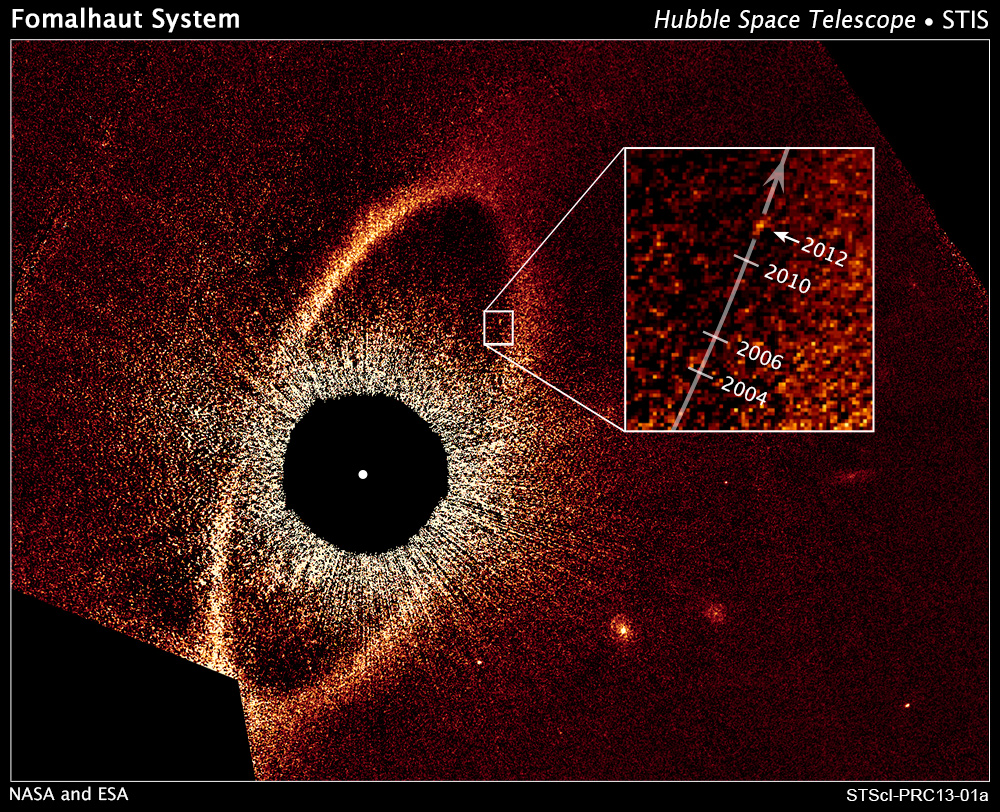
NASA's & ESA's Hubble Reveals Rogue Planetary Orbit For Fomalhaut B

NASA / ESA - Hubble Space Telescope patch.

Jan. 9, 2013


This false-color composite image, taken with the Hubble Space Telescope, reveals the orbital motion of the planet Fomalhaut b. Based on these observations, astronomers calculated that the planet is in a 2,000-year-long, highly elliptical orbit. The planet will appear to cross a vast belt of debris around the star roughly 20 years from now. If the planet's orbit lies in the same plane with the belt, icy and rocky debris in the belt could crash into the planet's atmosphere and produce various phenomena. The black circle at the center of the image blocks out the light from the bright star, allowing reflected light from the belt and planet to be photographed. The Hubble images were taken with the Space Telescope Imaging Spectrograph in 2010 and 2012. Credit: NASA, ESA, and P. Kalas (University of California, Berkeley and SETI Institute)

Newly released NASA Hubble Space Telescope images of a vast debris disk encircling the nearby star Fomalhaut and a mysterious planet circling it may provide forensic evidence of a titanic planetary disruption in the system.

Astronomers are surprised to find the debris belt is wider than previously known, spanning a section of space from 14 to nearly 20 billion miles from the star. Even more surprisingly, the latest Hubble images have allowed a team of astronomers to calculate the planet follows an unusual elliptical orbit that carries it on a potentially destructive path through the vast dust ring.

The planet, called Fomalhaut b, swings as close to its star as 4.6 billion miles, and the outermost point of its orbit is 27 billion miles away from the star. The orbit was recalculated from the newest Hubble observation made last year.

"We are shocked. This is not what we expected," said Paul Kalas of the University of California at Berkeley and the SETI Institute in Mountain View, Calif.

The Fomalhaut team led by Kalas considers this circumstantial evidence there may be other planet-like bodies in the system that gravitationally disturbed Fomalhaut b to place it in such a highly eccentric orbit. The team presented its finding Tuesday at the 221st meeting of the American Astronomical Society in Long Beach, Calif.

Among several scenarios to explain Fomalhaut b's 2,000-year-long orbit is the hypothesis that an as yet undiscovered planet gravitationally ejected Fomalhaut b from a position closer to the star, and sent it flying in an orbit that extends beyond the dust belt.

"Hot Jupiters get tossed through scattering events, where one planet goes in and one gets thrown out," said co-investigator Mark Clampin of NASA's Goddard Space Flight Center in Greenbelt, Md. "This could be the planet that gets thrown out."


Image above: Jupiter get tossed through scattering events, Galileo images of the comet Shoemaker Levy impact on Jupiter in in July 1994. Image credit: NASA.

Hubble also found the dust and ice belt encircling the star Fomalhaut has an apparent gap slicing across the belt. This might have been carved by another undetected planet. Hubble's exquisite view of the dust belt shows irregularities that strongly motivate a search for other planets in the system.

If its orbit lies in the same plane with the dust belt, then Fomalhaut b will intersect the belt around 2032 on the outbound leg of its orbit. During the crossing, icy and rocky debris in the belt could crash into the planet's atmosphere and create the type of cosmic fireworks seen when Comet Shoemaker-Levy 9 crashed into Jupiter. Most of the fireworks from collisions will be seen in infrared light. However, if Fomalhaut b is not co-planar with the belt, the only thing to be seen will be a gradual dimming of Fomalhaut b as it travels farther from the star.

Kalas hypothesized that Fomalhaut b's extreme orbit is a major clue in explaining why the planet is unusually bright in visible light, but very dim in infrared light. It is possible the planet's optical brightness originates from a ring or shroud of dust around the planet, which reflects starlight. The dust would be rapidly produced by satellites orbiting the planet, which would suffer extreme erosion by impacts and gravitational stirring when Fomalhaut b enters into the planetary system after a millennium of deep freeze beyond the main belt. An analogy can be found by looking at Saturn, which has a tenuous, but very large dust ring produced when meteoroids hit the outer moon Phoebe.

The team has also considered a different scenario where a hypothetical second dwarf planet suffered a catastrophic collision with Fomalhaut b. The collision scenario would explain why the star Fomalhaut has a narrow outer belt linked to an extreme planet. But in this case the belt is young, less than 10,000 years old, and it is difficult to produce energetic collisions far from the star in such young systems.

Fomalhaut is a special system because it looks like scientists may have a snapshot of what our solar system was doing 4 billion years ago. The planetary architecture is being redrawn, the comet belts are evolving, and planets may be gaining and losing their moons. Astronomers will continue monitoring Fomalhaut b for decades to come because they may have a chance to observe a planet entering an icy debris belt that is like the Kuiper Belt at the fringe of our own solar system.

For more information and for related images, please visit:

    http://www.nasa.gov/hubble
    and
    http://hubblesite.org/news/2013/01

Images (mentioned), Text, Credits: NASA / J.D. Harrington / ESA / Space Telescope Science Institute / Ray Villard.

Best regards, Orbiter.ch

NASA Telescopes See Weather Patterns in Brown Dwarf


NASA / ESA - Hubble Space Telescope patch / NASA - Spitzer Space Telescope patch.

Jan. 9, 2013


This artist's conception illustrates the brown dwarf named 2MASSJ22282889-431026. Image credit: NASA/JPL-Caltech.

Astronomers using NASA's Spitzer and Hubble space telescopes have probed the stormy atmosphere of a brown dwarf, creating the most detailed "weather map" yet for this class of cool, star-like orbs. The forecast shows wind-driven, planet-sized clouds enshrouding these strange worlds.

Brown dwarfs form out of condensing gas, as stars do, but lack the mass to fuse hydrogen atoms and produce energy. Instead, these objects, which some call failed stars, are more similar to gas planets with their complex, varied atmospheres. The new research is a stepping-stone toward a better understanding not only of brown dwarfs, but also of the atmospheres of planets beyond our solar system.


This artist's illustration shows the atmosphere of a brown dwarf called 2MASSJ22282889-431026, which was observed simultaneously by NASA's Spitzer and Hubble space telescopes. Image credit: NASA/JPL-Caltech.

"With Hubble and Spitzer, we were able to look at different atmospheric layers of a brown dwarf, similar to the way doctors use medical imaging techniques to study the different tissues in your body," said Daniel Apai, the principal investigator of the research at the University of Arizona in Tucson, who presented the results at the American Astronomical Society meeting Tuesday in Long Beach, Calif.

A study describing the results, led by Esther Buenzli, also of the University of Arizona, is published in the Astrophysical Journal Letters.

The researchers turned Hubble and Spitzer simultaneously toward a brown dwarf with the long name of 2MASSJ22282889-431026. They found that its light varied in time, brightening and dimming about every 90 minutes as the body rotated. But more surprising, the team also found the timing of this change in brightness depended on whether they looked using different wavelengths of infrared light.


This graph shows the brightness variations of the brown dwarf named 2MASSJ22282889-431026 measured simultaneously by both NASA’s Hubble and Spitzer space telescopes. Image credit: NASA/JPL-Caltech/University of Arizona.

These variations are the result of different layers or patches of material swirling around the brown dwarf in windy storms as large as Earth itself. Spitzer and Hubble see different atmospheric layers because certain infrared wavelengths are blocked by vapors of water and methane high up, while other infrared wavelengths emerge from much deeper layers.

"Unlike the water clouds of Earth or the ammonia clouds of Jupiter, clouds on brown dwarfs are composed of hot grains of sand, liquid drops of iron, and other exotic compounds," said Mark Marley, research scientist at NASA's Ames Research Center in Moffett Field, Calif., and co-author of the paper. "So this large atmospheric disturbance found by Spitzer and Hubble gives a new meaning to the concept of extreme weather."

Buenzli says this is the first time researchers can probe variability at several different altitudes at the same time in the atmosphere of a brown dwarf. "Although brown dwarfs are cool relative to other stars, they are actually hot by earthly standards. This particular object is about 1,100 to 1,300 degrees Fahrenheit (600 to 700 degrees Celsius)," Buenzli said.

Spitzer Space Telescope. Image credit: NASA.

"What we see here is evidence for massive, organized cloud systems, perhaps akin to giant versions of the Great Red Spot on Jupiter," said Adam Showman, a theorist at the University of Arizona involved in the research. "These out-of-sync light variations provide a fingerprint of how the brown dwarf's weather systems stack up vertically. The data suggest regions on the brown dwarf where the weather is cloudy and rich in silicate vapor deep in the atmosphere coincide with balmier, drier conditions at higher altitudes -- and vice versa."

Researchers plan to look at the atmospheres of dozens of additional nearby brown dwarfs using Spitzer and Hubble.

Hubble Space Telescope. Image credit: NASA / ESA

"From studies such as this we will learn much about this important class of objects, whose mass falls between that of stars and Jupiter-sized planets," said Glenn Wahlgren, Spitzer program scientist at NASA Headquarters in Washington. "This technique will see extensive use when we are able to image individual exoplanets."

NASA's Jet Propulsion Laboratory, Pasadena, Calif., manages the Spitzer Space Telescope mission for NASA's Science Mission Directorate, Washington. Science operations are conducted at the Spitzer Science Center at the California Institute of Technology in Pasadena. Data are archived at the Infrared Science Archive housed at the Infrared Processing and Analysis Center at Caltech. Caltech manages JPL for NASA. For more information about Spitzer, visit http://spitzer.caltech.edu and http://www.nasa.gov/spitzer .

The Hubble Space Telescope is a project of international cooperation between NASA and the European Space Agency. NASA's Goddard Space Flight Center in Greenbelt, Md., manages the telescope. The Space Telescope Science Institute (STScI) in Baltimore, Md., conducts Hubble science operations. STScI is operated by the Association of Universities for Research in Astronomy, Inc., in Washington. For more information about Hubble, visit http://www.hubblesite.org and http://www.nasa.gov/hubble .

Images (mentioned), Text, Credits: NASA / J.D. Harrington / ESA / JPL / Whitney Clavin.

Best regards, Orbiter.ch