mardi 1 décembre 2015

New comet shape model


ESA - Rosetta Mission patch.

December 1, 2015

A new 3D shape model of Comet 67P/Churyumov-Gerasimenko has been released by ESA’s Rosetta archive team today. The model includes images taken by Rosetta’s NAVCAM up until mid-late July 2015, and reveals parts of the comet’s southern hemisphere that were not included in earlier shape models.


Image above: The updated shape model now includes recent images of the comet’s southern hemisphere. Click to explore and for download options. Image Credit: ESA/Rosetta/NAVCAM, CC BY-SA IGO 3.0.

The release also includes .WRL, OBJ, STL files, which can be used for 3D printing.

At the same time, 681 images have been added to the Archive Image Browser covering the period 6 May to 30 June 2015 as part of ESA’s regular monthly release of NAVCAM images.

During this period the comet was heading towards perihelion on 13 August, the closest point to the Sun along its orbit, and so the images capture some details of the comet's increasing activity.


Images above: Caption: The latest Archive Image Browser release. Click to enter browser. All images Credits: ESA/Rosetta/NAVCAM, CC BY-SA IGO 3.0.

Taking into account the upcoming seasonal holiday, the next NAVCAM archive release will be made early-mid January 2016.

For background information on what a shape model is, read our blog post:

How Rosetta’s comet got its shape:
http://orbiterchspacenews.blogspot.ch/2015/09/how-rosettas-comet-got-its-shape.html

Related links:

New 3D shape model of Comet 67P/Churyumov-Gerasimenko: http://imagearchives.esac.esa.int/index.php?/page/navcam_3d_models

Archive Image Browser: http://imagearchives.esac.esa.int/

For more information about Rosetta mission, visit: http://www.esa.int/Our_Activities/Space_Science/Rosetta

Rosetta overview: http://www.esa.int/Our_Activities/Space_Science/Rosetta_overview

Rosetta in depth:http://sci.esa.int/rosetta

Rosetta factsheet: http://www.esa.int/Our_Activities/Space_Science/Rosetta/Rosetta_factsheet

Frequently asked questions: http://www.esa.int/Our_Activities/Space_Science/Rosetta/Frequently_asked_questions

Image (mentioned), Text, Credit: European Space Agency (ESA).

Best regards, Orbiter.ch

Getting Into the Flow on the International Space Station


ISS - International Space Station patch.

Dec. 1, 2015

International Space Station (ISS). Image Credit: NASA

Think about underground water and gas as they filter through porous materials like soil and rock beds. On Earth, gravity forces water and gas to separate as they flow through the ground, cleaning the water and storing it in underground pools. Gravity's role is significant in the process, both in nature with ground water and in chemical processes such as water reclamation reactors.

How this filtering works on Earth is well understood, even when the flow consists of different fluids. The process is still a mystery in microgravity.


Images above: This video frame capture shows a pulse flow in the microgravity airplane. The frames should be read from the top down, and show the pulse front (seen as the leading edge of a "lighter" region in the image) advancing from left to right. Pulse flows are desired in packed bed reactors because they enhance inter-phase contact --thus making the process more efficient. Images Credits: NASA Video Capture.

"There are a lot of different types of reactors," said Dr. Brian Motil, principal investigator, PBRE, NASA's Glenn Research Center. "When you have a single phase, just a liquid or a gas, it behaves pretty much the same on Earth as it does in microgravity. However, when you get two different phases, like gas-liquid where the densities are very different, you end up with some very different behavior when you go from the ground to space."

The Packed Bed Reactor Experiment (PBRE) is a basic science investigation designed to fill in the missing information as to how two-phase mixtures flow through porous media in microgravity. PBRE, which is scheduled to launch on the next Commercial Resupply Services mission to the International Space Station Dec. 3, could provide answers that would help design more efficient reactors for space, particularly for those long-duration missions like trips to Mars.


Image above: The PBRE is seen integrated into the Microgravity Science Glovebox. Image Credit: NASA.

Reactors used on the space station and in space missions are critical. Without them, life in space would not be possible. They reclaim water, clean air, and provide many of the life-sustaining processes we take for granted. Because of the gap in our knowledge about how two-phase systems work in microgravity, designers don't have the necessary tools to create more efficient systems.

"In general, what we've done at NASA is try to avoid two-phase reactors," said Dr. Enrique Ramé, project scientist, NASA Glenn. "It's a complex problem, but we can't always avoid two-phases. Sometimes gas bubbles come out of a solution and you end up with two phases even though you don't want them in the reactor. That causes problems for people who are designing water reclamation, air revitalization and those types of systems."

PBRE will be conducted over eight weeks on the space station in the Microgravity Science Glovebox (MSG), a self-contained, suit-case sized lab. At 324 pounds (147 kilograms), PBRE is the heaviest and largest experiment in the MSG to date.

While PBRE will look at hydrodynamics, it will not include any chemical reactions.

"The PBRE has the capability to provide a wide range of water and air flows through two randomly packed test beds. The packing is 3 mm spherical beads," said Cathy Frey, PBRE operations lead, NASA Glenn.


Image above: One of the two PBRE test beds. One column will use randomly packed glass beads (shown), while the other will use randomly packed Teflon beads. Image Credit: NASA.

Using two types of beads will allow researchers to measure flow through materials that have different levels of "wetting", a liquid's ability to maintain contact with a surface. One test bed will be packed with a glass beads, wetting, while the other will have non-wetting Teflon™ beads. 

The experiment will measure pressure and flow rates. Two high-speed, high-resolution cameras will capture images of the flow conditions.

"After the initial testing is complete, PBRE will be available for additional research," said Motil. "The test section and diagnostics are replaceable to allow for any type of air-water experiment, allowing for NASA or industry to test any type of component or subsystem."

PBRE will develop and validate scaling and design tools for future two-phase reactors in microgravity. It will also identify strategies to recover single-phase packed beds from undesired gas bubbles. Results from this experiment may lead to the ability to operate reactors in space at greater efficiency than we can on Earth, thus benefiting future deep space missions.

Related links:

NASA's Glenn Research Center: http://www.nasa.gov/centers/glenn/home/index.html

Packed Bed Reactor Experiment (PBRE): https://spaceflightsystems.grc.nasa.gov/sopo/ihho/psrp/msg/pbre/

Microgravity Science Glovebox (MSG): http://www.nasa.gov/mission_pages/station/research/experiments/350.html

Space Station Research and Technology: http://www.nasa.gov/mission_pages/station/research/index.html

International Space Station (ISS): http://www.nasa.gov/mission_pages/station/main/index.html

Images (mentioned), Text, Credits: NASA's Glenn Research Center/Mike Giannone/Kristine Rainey.

Greetings, Orbiter.ch

Celebrating 20 Years of the Solar and Heliospheric Observatory (SOHO)


NASA / ESA - SOHO Mission patch.

Dec. 1, 2015

After 20 years in space, ESA and NASA’s Solar and Heliospheric Observatory, or SOHO, is still going strong. Originally launched in 1995 to study the sun and its influence out to the very edges of the solar system, SOHO revolutionized this field of science, known as heliophysics, providing the basis for more than 5,000 scientific papers. SOHO also found an unexpected role as the greatest comet hunter of all time—reaching 3,000 comet discoveries in September 2015.

Artist's view of SOHO spacecraft. Image Credit: NASA

When SOHO was launched on Dec. 2, 1995, the field of heliophysics looked very different than it does today. Questions about the interior of the sun, the origin of the constant outflow of material from the sun known as the solar wind, and the mysterious heating of the solar atmosphere were still unanswered. Twenty years later, not only do we have a much better idea about what powers the sun, but our entire understanding of how the sun behaves has changed.

Highlights from SOHO's 20 Years in Space

Video above: Video Credits: NASA's Goddard Space Flight Center.

“SOHO changed the popular view of the sun from a picture of a static, unchanging object in the sky to the dynamic beast it is,” said Bernhard Fleck, ESA SOHO project scientist at NASA’s Goddard Space Flight Center in Greenbelt, Maryland.

Even the concept of space weather—now defined to encompass any events or conditions stemming from the sun that can affect space-borne and ground-based technological systems and through these, human life and endeavors—wasn’t well-understood when SOHO launched. At the time, it was thought that solar flares were the primary Earth-effective solar event, in part because they were the most commonly-observed. Thanks to SOHO’s coronagraph—a type of camera that uses a solid disk to block out the bright face of the sun to better observe the comparatively faint solar atmosphere, known as the corona—today we know that giant clouds that burst off the sun called coronal mass ejections, or CMEs, are a major piece of the space weather puzzle. Though two space-based coronagraphs preceded the one on SOHO, neither provided the same quantity or quality of observations. 


Image above: This image of a coronal mass ejection, or CME, was taken by NASA’s Solar and Heliospheric Observatory, or SOHO, on March 5, 2013. This event is a halo CME, named for the way the glowing cloud of solar material spreads out in a faint circle around the sun’s disk. Before SOHO discovered the solar tsunamis that often happen in close conjunction with CMEs, scientists generally had no way of knowing if a halo CME was heading directly toward or directly away from Earth. The large, bright spot in the lower right of the image is Venus. Image Credits: ESA/NASA/SOHO.

“Many faint CMEs had escaped notice on older coronagraphs,” said Joe Gurman, US project scientist for SOHO at Goddard. “In light of the SOHO data, we realized CMEs are much more common—and more variable throughout the solar cycle—than we thought.”

CMEs, which are huge, fast-moving clouds of electrically-charged solar material that contain embedded magnetic fields, can cause geomagnetic storms when they collide with Earth’s magnetic field, causing it to shimmy and shake. The ability to connect the effects of geomagnetic storms—like auroras, GPS and communication disturbances, and geomagnetically induced currents, which can put a strain on power grids—to events on the sun has brought the idea of space weather into the mainstream.

“Thanks to SOHO, there’s a growing public recognition that we live in the extended atmosphere of a magnetically active star,” said Gurman. “And people realize that solar activity can affect Earth.”

But SOHO’s coronagraph wasn’t the only game-changing instrument. Before SOHO launched, carrying the Extreme ultraviolet Imaging Telescope, or EIT, the only cameras taking images of the sun in extreme ultraviolet light—which Earth’s atmosphere blocks, making it impossible to observe from the ground—were on suborbital sounding rockets, which collect data for only minutes at a time.

“For the first time ever, we saw waves rippling across the sun at a million miles an hour in extreme ultraviolet light,” said Alex Young, a space scientist at Goddard.

These tsunamis on the solar surface—still known by many as EIT waves, after the instrument that first observed them—happen in close conjunction with CMEs. Before the discovery of solar tsunamis, scientists often had no way of knowing if a CME was heading directly toward or directly away from Earth, since all CMEs on the Earth-sun line simply appear in coronagraph images as a giant halo around the sun.


Animation above: This animation shows a solar tsunami—also known as an EIT wave, after SOHO’s Extreme ultraviolet Imaging Telescope, which took the first images of these events—expanding out from an active region just after a solar flare on July 14, 2000. Solar tsunamis, which often happen in conjunction with coronal mass ejections, or CMEs, gave scientists the first clues as to whether halo CMEs—which spread out all around the sun in coronagraph images—were heading directly toward or away from Earth. Animation Credits: ESA/NASA/SOHO.

Scientists almost missed out on this and SOHO’s other discoveries. In 1998, the spacecraft was lost for four months because of a software error. A joint ESA/NASA team was finally able to recover the spacecraft in September 1998, in part using the giant Arecibo radio telescope to locate the spacecraft and reestablish command. This rescue was crucial for heliophysics, as much of SOHO’s scientific success can be attributed to its 20 years of near-constant observation.

Image above: Image Credits: NASA/SDO

“With SOHO, we found that the sun varies on every timescale we can measure,” said Gurman. “Whether it’s 20 years or just a few milliseconds, we discover new phenomena.”

Though it expanded our knowledge of every facet of heliophysics, SOHO was launched to answer three primary questions. First—what is the interior structure of the sun?

Though scientists had developed theories about the layers of ionized gas and complex magnetic field that compose our nearest star, they had no way of confirming their ideas other than by observing the sun’s surface. But SOHO carries onboard an instrument that can take a kind of solar sonogram, helping researchers understand the sun’s internal structure.

This helped to solve what was known as the solar neutrino problem, in which the number of a certain type of solar neutrino observed at Earth didn't jibe with the number predicted by our theories about the sun.

“Getting an accurate picture of the interior structure of the sun confirmed our theories about the number of neutrinos it emits,” said Fleck. “That proved the solar neutrino problem came from a misunderstanding of neutrinos themselves—not the sun.”

It was later discovered that neutrinos can undergo a change of type in their journey from the sun, accounting for the difference between predictions and observations. This research won the Nobel Prize in Physics in 2015.

The second question SOHO was designed to answer was that of solar wind acceleration. The sun is constantly losing material in all directions, but the speed of that flowing material—known as the solar wind—is much higher than one would expect from a relatively simple view of the sun. SOHO’s observations showed how some of the fastest solar wind streams are accelerated in coronal holes, areas on the sun where the magnetic field is open to interplanetary space.

As of yet, no one has managed to definitely answer SOHO’s third question—what causes the extraordinarily high temperatures in the sun’s atmosphere, the corona?

“The corona is incredibly hot, hundreds of times hotter than the layers below,” said Fleck. “Since the sun’s source of energy is at the center, on a simple level, we would expect the corona—the outermost layer—to be the coolest.”

Though SOHO’s observations have provided the basis for many possible explanations for the coronal heating problem, as it’s known, it still hasn’t been settled. However, NASA’s Solar Probe Plus mission, planned for launch in 2018, will fly closer to the sun than any other spacecraft in order to investigate this very question.

Solar Probe Plus is one of many missions that has been shaped by SOHO and its discoveries. Others include NASA’s Solar Dynamics Observatory, NASA’s Solar and Terrestrial Relations Observatory, and NASA’s Interface Region Imaging Spectrograph, and JAXA/NASA’s Hinode.

“Without SOHO, there would be no SDO, no STEREO, no IRIS, no Hinode,” said Young. “SOHO showed us things we’d never seen before, and then we realized we needed more eyes on the sun.”


After 20 years in space, ESA and NASA’s Solar and Heliospheric Observatory, or SOHO, is still going strong. Originally launched in 1995 to study the sun and its influence out to the very edges of the solar system, SOHO revolutionized this field of science, known as heliophysics, providing the basis for nearly 5,000 scientific papers. SOHO discovered dynamic solar phenomena such as coronal waves, solar tsunamis and sun quakes, and found an unexpected role as the greatest comet hunter of all time—reaching 3,000 comet discoveries in September 2015.

This "Best of SOHO" image by the observatory's LASCO C2 coronograph from Nov. 8, 2000, shows what appears to be two coronal mass ejections (CMEs) heading in symmetrically opposite directions from the sun. A 304Å image from SOHO's Extreme ultraviolet Imaging Telescope (EIT) taken on the same day has been superimposed over the dark disk which blocks the sun so that the LASCO instrument can observe the structures of the corona in visible light. CMEs, which are huge, fast-moving clouds of electrically-charged solar material that contain embedded magnetic fields, can cause geomagnetic storms when they collide with Earth’s magnetic field, causing it to shimmy and shake. The ability to connect the effects of geomagnetic storms—like auroras, GPS and communication disturbances, and geomagnetically induced currents, which can put a strain on power grids—to events on the sun has brought the idea of space weather into the mainstream.

Related article:

ESA/NASA Solar Observatory Discovers Its 3,000th Comet:
http://orbiterchspacenews.blogspot.ch/2015/09/esanasa-solar-observatory-discovers-its.html

Related links:

Feature: "A Look Back at NASA Solar Missions": http://www.nasa.gov/feature/goddard/a-look-back-at-nasa-solar-missions

SOHO "beauty pass" animation: https://www.youtube.com/watch?v=63MWYfCif1c

NASA's SOHO website: http://www.nasa.gov/soho

ESA's SOHO website: http://soho.esac.esa.int/

Heliophysics news from NASA: http://www.nasa.gov/sunearth

"Best of SOHO" images: http://sohowww.nascom.nasa.gov/gallery/images.html

Images (mentioned), Animation (mentioned), Video (mentioned), Text, Credits: ESA/NASA/SOHO/GSFC/Sarah Frazier/Rob Garner.

Best regards, Orbiter.ch

Orion - European Service Module


NASA - Orion Crew Exploration Vehicle patch.

December 1, 2015

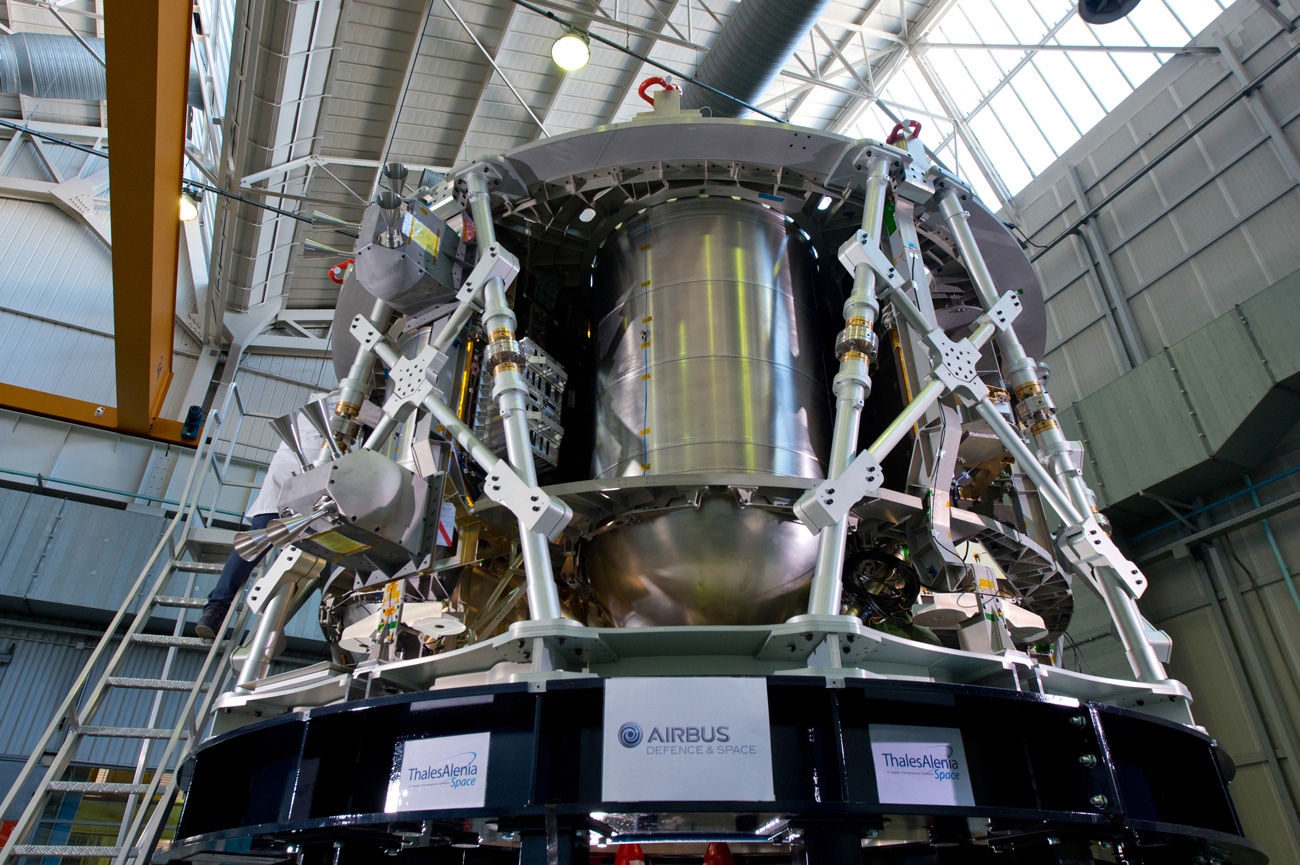
Orion with European Service Module

The European Service Module is ESA’s contribution to NASA’s Orion spacecraft that will send astronauts to the Moon and beyond. It provides electricity, water, oxygen and nitrogen as well as keeping the spacecraft at the right temperature and on course.

Orion European Service Module

The cylindrical module is unpressurised and 4 m long, including the main engine and tanks for gas and propellant. During launch it is held in place by the Spacecraft Adapter and is connected to the capsule where the astronauts are by the Crew Module Adapter.

The main body of the service module is around 2 m high but its main engine, the Orbital Maneuvering System Engine, extends into the Spacecraft Adapter. Likewise, some of the equipment in ESA’s service module protrudes into the Crew Module Adapter. 

Orion European Service Module test article

During launch the service module fits into a 5.2 m-diameter housing. Once Orion is above the atmosphere and the rocket fairing is jettisoned, the service module’s solar array unfolds to span 19 m.

The spacecraft resembles ESA’s Automated Transfer Vehicle, from which it evolved. Five Automated Transfer Vehicles delivered supplies to the International Space Station and helped to keep the outpost in orbit.

Three types of engine push Orion to its destination and can turn it in all directions to align the spacecraft as needed.

ATV-4 docking

Inside the Service Module, large tanks hold fuel as well consumables for the astronauts: oxygen, nitrogen and water.

Radiators and heat exchangers keep the astronauts and equipment at a comfortable temperature, while the module’s structure is the backbone of the entire vehicle, like a car chassis.

European Service Module

The European Service Module is built by main contractor Airbus Defence and Space, with many companies all over Europe supplying components. The final product is assembled in Europe before being shipped to NASA in the USA.

Read more about the elements of the European Service Module for Orion through the links on the left.

Related links:

What is Orion?: http://www.esa.int/Our_Activities/Human_Spaceflight/Orion/What_is_Orion

The spacecraft: http://www.esa.int/Our_Activities/Human_Spaceflight/Orion/The_spacecraft

ESA’s contribution to Orion:

European Service Module: http://www.esa.int/Our_Activities/Human_Spaceflight/Orion/European_Service_Module

Images, Text, Credits: ESA/NASA/Airbus.

Best regards, Orbiter.ch

lundi 30 novembre 2015

“Cyg”-nificant Science Launching to Space Station


ISS - International Space Station patch / Orbital - Cygnus - ISS Cargo Resupply Service logo.

Nov. 30, 2015


Image above: Artist's concept of Orbital ATK's Cygnus spacecraft in orbit. Image Credits: Orbital ATK.

NASA’s commercial partner Orbital ATK plans to launch its Cygnus spacecraft into orbit Dec. 3, atop a United Launch Alliance Atlas V rocket for its fourth contracted resupply mission. The flight, known as CRS-4, will deliver samples and equipment to the International Space Station for research investigations that will occur during current and future expeditions in the many science disciplines aboard the orbiting multi-disciplinary laboratory.

This delivery will support significant research being conducted off the Earth to benefit the Earth, including investigations in advanced and automated data collection and in the behavior of gases, liquids and burning textiles in microgravity.


Image above: BASS-M textile sample example. A stainless steel frame supports a red treated textile and a blue untreated textile which are directly attached to each other. A hot wire igniter goes across the leading edge of the untreated textile. Image Credit: NASA.

Research equipment includes the Space Automated Bioproduct Lab (SABL), a single locker-sized facility that will enable a wide variety of fundamental, applied and commercial life sciences research, as well as K-16 education-based investigations aboard the space station. SABL consists of a temperature-controlled chamber that can house a variety of passive or active experiments that can be automated or remotely operated by the crew members or by personnel in a remote operations center on the ground. SABL supports automated collection of experiment data from various sensors and from high-definition video. It can display data on a touchscreen interface on the front of the payload or downlink data files and HD video streams to the ground for analysis by scientists anywhere in the world.

CRS-4 will also carry the Packed Bed Reactor Experiment (PBRE). This investigation studies the behavior of gases and liquids when they flow simultaneously through a column filled with fixed porous media. The porous media or “packing” can be made of different shapes and materials that are used widely in chemical engineering as a means to enhance the contact between two unmixable fluid phases (e.g., liquid-gas, water-oil, etc.). Packed columns can serve as reactors, scrubbers, strippers, etc. in systems where efficient interphase contact is desired, both on Earth and in space.

Water recovery systems, fuel cells and other equipment on the space station use packed bed reactors, but currently none are designed to handle both liquid and gas at the same time. With improved understanding of how packed bed flow works in microgravity, scientists are able to design more efficient, lightweight thermal management and life support systems that use less energy, benefiting the space station and future long-duration missions.


Image above: Close-up view of the approach to the International Space Station of the first Cygnus commercial cargo spacecraft built by Orbital ATK with the Earth in the background. Image Credit: NASA.

The investigation is also of interest in many chemical and biological processing systems as well as many geophysical applications on Earth.

Another hot investigation launching on CRS-4 includes the Burning and Suppression of Solids – Milliken (BASS-M) investigation, which examines the extinction characteristics of a variety of flame retardant textiles in microgravity when exposed to a controlled flame. The flame retardant behavior of treated cotton fabrics is very different than traditional flame retardant materials, but little has been documented about its behavior in microgravity. This investigation tests the hypothesis that with adequate ventilation, materials in microgravity, burn as well, if not better, than the same material in normal gravity with other conditions being identical. BASS-M will test ten different treated textiles at various air flow rates found in forced convection (heat transfer through external means versus natural means) in microgravity environments or in a free fall environment. Scientists will evaluate and compare against normal terrestrial behavior each textile’s ability to self-extinguish. The BASS-M experiment will provide data on treated cotton fabrics in microgravity and could be used to screen materials for safe use in clothing and textiles in future missions.


Image above: The Packed Bed Reactor Experiment shown inside the Materials Science Glovebox work volume. Image Credit: NASA.

Additionally, the launch cargo will include two Nodes satellites that will be deployed from the space station to demonstrate new network capabilities critical to the operation of swarms of spacecraft. They will demonstrate the ability of multi-spacecraft swarms to receive and distribute ground commands, exchange information periodically and autonomously configure a network by determining which spacecraft should communicate with the ground each day of a mission.

These and additional samples and equipment launched to the space station aboard CRS-4 enable science on the orbiting laboratory that continues to create “cyg”-nificant benefits off the Earth for the Earth and beyond.

Related links:

International Space Station (ISS): https://www.nasa.gov/mission_pages/station/main/index.html

Space Station Research and Technology: http://www.nasa.gov/mission_pages/station/research/index.html

Packed Bed Reactor Experiment (PBRE): http://www.nasa.gov/mission_pages/station/research/experiments/1111.html

Burning and Suppression of Solids – Milliken (BASS-M): http://www.nasa.gov/mission_pages/station/research/experiments/2123.html

For more information about the Orbital ATK resupply mission, visit: http://www.nasa.gov/orbital

Images (mentioned), Text, Credits: NASA’s Johnson Space Center/International Space Station Program Science Office/Andrea Dunn.

Greetings, Orbiter.ch

Water World


NASA - Cassini Mission to Saturn patch.

November 30, 2015


Although Enceladus and Saturn's rings are largely made up of water ice, they show very different characteristics. The small ring particles are too tiny to retain internal heat and have no way to get warm, so they are frozen and geologically dead. Enceladus, on the other hand, is subject to forces that heat its interior to this very day. This results in its famous south polar water jets, which are just visible above the moon’s dark, southern limb, along with a sub-surface ocean.

Recent work by Cassini scientists suggests that Enceladus (313 miles or 504 kilometers across) has a global ocean of liquid water under its surface. This discovery increases scientists' interest in Enceladus and the quest to understand the role of water in the development of life in the solar system. (For more on the sub-surface ocean, see this story.

This view looks toward the unilluminated side of the rings from about 0.3 degrees below the ring plane. The image was taken in visible light with the Cassini spacecraft narrow-angle camera on July 29, 2015.

The view was acquired at a distance of approximately 630,000 miles (1.0 million kilometers) from Enceladus and at a Sun-Enceladus-spacecraft, or phase angle of 155 degrees. Image scale is 4 miles (6 kilometers) per pixel.

Artist's view of the Cassini spacecraft and Saturn

The Cassini mission is a cooperative project of NASA, ESA (the European Space Agency) and the Italian Space Agency. The Jet Propulsion Laboratory, a division of the California Institute of Technology in Pasadena, manages the mission for NASA's Science Mission Directorate, Washington. The Cassini orbiter and its two onboard cameras were designed, developed and assembled at JPL. The imaging operations center is based at the Space Science Institute in Boulder, Colorado.

For more information about the Cassini-Huygens mission visit http://saturn.jpl.nasa.gov or http://www.nasa.gov/cassini . The Cassini imaging team homepage is at http://ciclops.org , ESA website: http://www.esa.int/Our_Activities/Space_Science/Cassini-Huygens

Images, Text, Credits: NASA/JPL-Caltech/Space Science Institute/Tony Greicius.

Greetings, Orbiter.ch

vendredi 27 novembre 2015

Release the beams! Linac 4 hits the 50 MeV mark


CERN - European Organization for Nuclear Research logo.

November 27, 2015


Image above: The Linac 4 tunnel where DTL tubes guide the 50MeV beam, taken on the Photowalk. (Image: Andrew Hara/CERN).

This week the Linac 4 accelerator has reached a milestone energy of 50 MeV – meaning it is now able to replace the ageing Linac 2 and eventually become the head of the accelerator chain .

Linac 4 was built to boost negative hydrogen ions – consisting of a hydrogen atom with an additional electron – to high energies to provide protons to the Large Hadron and to replace the  Linac 2. This 37-year-old accelerator is the first in a series of four, which are boosting particles to higher and higher energies before they are injected into the Large Hadron Collider (LHC). These accelerators are also providing beams to many other experiments at CERN.

Eventually Linac 4 will accelerate ions to 160 MeV to prepare them to enter the Proton Synchrotron Booster – the second acclerator in the LHC injection chain. These ions are stripped of their two electrons during injection from Linac 4 into the Proton Synchrotron Booster to leave only protons. This allows more particles to accumulate in the synchrotron, simplifies injection, reduces beam loss at injection and gives a more brilliant beam. As a key part of the LHC injector upgrade programme, Linac 4 will allow the PS Booster to double its beam brightness, which will contribute to increasing the LHC’s luminosity, a crucial factor proportional to the number of particles colliding within a defined amount of time.


Image above: A photo montage from the 2015 photowalk, with Maurizio Vretenar, the Linac 4 project leader, alongside both the designs for and the constructed accelerator  2015. (Image: Maelle Baud/CERN).

Reaching 50MeV is a milestone as it’s the energy Linac 2 runs at, and means Linac4 is now capable of taking over the task of providing particles to CERN’s accelerator chain – a process that will begin during the long shutdown from 2018.

The Linac 4 is composed of a hydrogen ion source and four types of accelerating structures which are progressively commissioned one after another. Earlier this year the second part of this accelerating chain, the Drift Tube Linac tanks were fully installed and commissioned, meaning the beam could be boosted to a new, higher, energy from its previous 3 MeV.

“This innovative and patented design is a huge achievement that was eight years in the making,” says Maurizio Vretenar, the Linac 4 project leader. “We saw these tanks through from the drawing board to the test bench, and now to the accelerator chain itself; we couldn’t be happier with their performance so far.”

Ensuring faultless connections between the seperate accelerator components was a key part of the commissioning process. The tubes and their components had to be aligned with ±0.1 mm precision to each other and to the rest of the Linac 4 line.

“The first step was to accelerate the beam through the first tank of the DTL, to find the correct settings of the low energy part,” says Alessandra Lombardi, who is in charge of the commissioning phase of Linac 4. We then accelerated the beam progressively through the second and the third tank to the energy of 50 MeV.”

Now the beam has reached 50 MeV, the Linac 4 team is moving on to the next item on the schedule: the Cell-Coupled DTLs (CCDTL), which will bring Linac 4 up to 100 MeV.

Note:


CERN, the European Organization for Nuclear Research, is one of the world’s largest and most respected centres for scientific research. Its business is fundamental physics, finding out what the Universe is made of and how it works. At CERN, the world’s largest and most complex scientific instruments are used to study the basic constituents of matter — the fundamental particles. By studying what happens when these particles collide, physicists learn about the laws of Nature.

The instruments used at CERN are particle accelerators and detectors. Accelerators boost beams of particles to high energies before they are made to collide with each other or with stationary targets. Detectors observe and record the results of these collisions.

Founded in 1954, the CERN Laboratory sits astride the Franco–Swiss border near Geneva. It was one of Europe’s first joint ventures and now has 22 Member States.

Related links:

Linac 4 accelerator: http://home.cern/about/accelerators/linear-accelerator-4

 Linac 2 accelerator: http://home.cern/about/accelerators/linear-accelerator-2

Proton Synchrotron Booster: http://home.cern/about/accelerators/proton-synchrotron-booster

For more information about European Organization for Nuclear Research (CERN), visit: http://home.cern/

Images (mentioned), Text, Credits: CERN/Harriet Kim Jarlett.

Greetings, Orbiter.ch