mardi 6 mars 2018
The Case of the Martian Boulder Piles
NASA - Mars Reconnaissance Orbiter (MRO) patch.
March 6, 2018
This image was originally meant to track the movement of sand dunes near the North Pole of Mars, but what's on the ground in between the dunes is just as interesting!
The ground has parallel dark and light stripes from upper left to lower right in this area. In the dark stripes, we see piles of boulders at regular intervals.
What organized these boulders into neatly-spaced piles? In the Arctic back on Earth, rocks can be organized by a process called "frost heave." With frost heave, repeatedly freezing and thawing of the ground can bring rocks to the surface and organize them into piles, stripes, or even circles. On Earth, one of these temperature cycles takes a year, but on Mars it might be connected to changes in the planet's orbit around the Sun that take much longer.
The map is projected here at a scale of 25 centimeters (9.8 inches) per pixel. [The original image scale is 32 centimeters (12.6 inches) per pixel (with 1 x 1 binning); objects on the order of 96 centimeters (37.8 inches) across are resolved.] North is up.
This is a stereo pair with https://www.uahirise.org/ESP_053937_2550
The University of Arizona, Tucson, operates HiRISE, which was built by Ball Aerospace & Technologies Corp., Boulder, Colorado. NASA's Jet Propulsion Laboratory, a division of Caltech in Pasadena, California, manages the Mars Reconnaissance Orbiter Project for NASA's Science Mission Directorate, Washington.
Mars Reconnaissance Orbiter (MRO): http://www.nasa.gov/mission_pages/MRO/main/index.html
Image, Text, Credits: NASA/Tony Greicius/JPL-Caltech/Univ. of Arizona.
Greetings, Orbiter.ch
SpaceX - Hispasat 30W-6 Mission Success
SpaceX - Falcon 9 / Hispasat 30W-6 Mission patch.
March 6, 2018
Falcon 9 carrying Hispasat 30W-6 launch
Falcon 9 successfully delivered the Hispasat 30W-6 satellite to a Geostationary Transfer Orbit (GTO) on Tuesday, March 6 after launching from Space Launch Complex 40 (SLC-40) at Cape Canaveral Air Force Station, Florida.
HISPASAT 30W-6 Mission
The Hispasat 30W-6 satellite was deployed approximately 33 minutes after launch. SpaceX did not attempt to land Falcon 9’s first stage after launch due to unfavorable weather conditions in the recovery area off the Atlantic Coast.
Hispasat 30W-6 satellite
Hispasat 30W-6 communications satellite, formerly known as Hispasat 1F, for Madrid-based Hispasat. Hispasat 30W-6 will provide television, broadband, corporate networks and other communications services over Europe, North Africa and the Americas. The Hispasat 30W-6 satellite was built by Space Systems/Loral.
For more information about SpaceX, visit: http://www.spacex.com/
Images, Video, Text, Credits: SpaceX/Günter Space Page/Orbiter.ch Aerospace/Roland Berga.
Greetings, Orbiter.ch
lundi 5 mars 2018
Hubble's Frenzy of Stars
NASA - Hubble Space Telescope patch.
March 5, 2018
Discovered in 1900 by astronomer DeLisle Stewart and here imaged by the NASA/ESA Hubble Space Telescope, IC 4710 is an undeniably spectacular sight. The galaxy is a busy cloud of bright stars, with bright pockets - marking bursts of new star formation - scattered around its edges.
IC 4710 is a dwarf irregular galaxy. As the name suggests, such galaxies are irregular and chaotic in appearance, lacking central bulges and spiral arms - they are distinctly different from spirals or ellipticals. It is thought that irregular galaxies may once have been spirals or ellipticals, but became distorted over time through external gravitational forces during interactions or mergers with other galaxies. Dwarf irregulars in particular are important to our overall understanding of galactic evolution, as they are thought to be similar to the first galaxies that formed in the universe.
IC 4710 lies roughly 25 million light-years away in the southern constellation of Pavo (the Peacock). This constellation also contains the third-brightest globular cluster in the sky, NGC 6752, the spiral galaxy NGC 6744, and six known planetary systems (including HD 181433, which is host to a super-Earth).
The data used to create this image were gathered by Hubble's Advanced Camera for Surveys (ACS).
Hubble Space Telescope (HST)
For more information about Hubble, visit:
http://hubblesite.org/
http://www.nasa.gov/hubble
http://www.spacetelescope.org/
Image, Animation Credits: ESA/Hubble & NASA, Acknowledgements: Judy Schmidt/Text: European Space Agency/NASA/Karl Hille.
Best regards, Orbiter.ch
New Crew Arrives at Launch Site Before March 21 Liftoff
ISS - Expedition 55 Mission patch.
March 5, 2018
Image above: Expedition 55 crew members (from left) Ricky Arnold, Oleg Artemyev and Drew Feustel pose for pictures with their Russian Sokol launch and entry suits as part of the crew’s first vehicle fit check activities. Image Credit: NASA.
The next three International Space Station crew members arrived at their launch site Sunday at the Baikonur Cosmodrome in Kazakhstan. Cosmonaut Oleg Artemyev and NASA astronauts Ricky Arnold and Drew Feustel are in final launch preparations ahead of their March 21 launch to their new home in space. They suited up in their Russian Sokol launch and entry suits today and climbed into their Soyuz MS-08 spacecraft for their first vehicle fit check activities.
Waiting for them onboard the orbital laboratory are Expedition 55 Commander Anton Shkaplerov and Flight Engineers Scott Tingle and Norishige Kanai. Their new crewmates will dock on March 23 to the Poisk module inside the Soyuz MS-08 spacecraft.
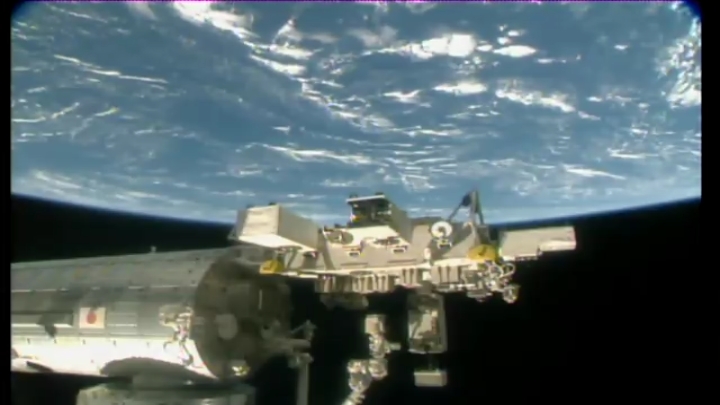
Image above: Flying over South Atlantic Ocean seen by EarthCam on ISS, speed: 27'579 Km/h, altitude: 417,19 Km, image captured by Roland Berga (on Earth in Switzerland) from International Space Station (ISS) using ISS-HD Live application with EarthCam's from ISS on March 2, 2018 at 16:50 UTC.
Meanwhile, the current orbital residents are ensuring the station remains in tip-top shape and conducting ongoing microgravity science.
Shkaplerov worked on Russian life support equipment throughout the day and handed over radiation detection equipment to the U.S. astronauts. Tingle inspected the Destiny laboratory module’s large window and cleaned vents in the Tranquility module.
Kanai worked on a variety of scientific gear all day Monday. He disassembled and replaced the METEOR camera before some maintenance work on a physics furnace and science freezer. The rest of the afternoon Kanai worked on the Combustion Integrated Rack connecting cables and checking for leaks.
Related links:
Radiation detection equipment: https://www.nasa.gov/mission_pages/station/research/experiments/explorer/Investigation.html?#id=190
METEOR: https://www.nasa.gov/mission_pages/station/research/experiments/explorer/Investigation.html?#id=1174
Physics furnace: https://www.nasa.gov/mission_pages/station/research/experiments/explorer/Facility.html?#id=1536
Science freezer: https://www.nasa.gov/mission_pages/station/research/experiments/explorer/Facility.html?#id=56
Combustion Integrated Rack: https://www.nasa.gov/mission_pages/station/research/experiments/explorer/Facility.html?#id=317
Expedition 55: https://www.nasa.gov/mission_pages/station/expeditions/expedition55/index.html
Space Station Research and Technology: https://www.nasa.gov/mission_pages/station/research/index.html
International Space Station (ISS): https://www.nasa.gov/mission_pages/station/main/index.html
Images (mentioned), Text, Credits: NASA/Mark Garcia/Orbiter.ch Aerospace/Roland Berga.
Greetings, Orbiter.ch
Donor Star Breathes Life Into Zombie Compagnion
ESA - Integral Mission patch.
5 March 2018
ESA’s Integral space observatory has witnessed a rare event: the moment that winds emitted by a swollen red giant star revived its slow-spinning companion, the core of a dead star, bringing it back to life in a flash of X-rays.
The X-ray flare was first detected by Integral on 13 August 2017 from an unknown source in the direction of the crowded centre of our Milky Way. The sudden detection triggered a slew of follow-up observations in the following weeks to pin down the culprit.
Red giant and neutron star interaction
The observations revealed a strongly magnetised and slowly rotating neutron star that had likely just begun to feed on material from a neighbouring red giant star.
Stars the mass of our Sun, and up to eight times more massive, evolve into red giants towards the end of their lives. Their outer layers puff up and expand millions of kilometres, their dusty, gassy shells blown away from the central star in relatively slow winds up to few hundreds of km/s.
Even larger stars, up to 25–30 times more massive than the Sun, race through their fuel and explode in a supernova, sometimes leaving behind a spinning stellar corpse with a strong magnetic field, known as a neutron star. This tiny core packs the mass of nearly one and half Suns into a sphere only 10 km across, making them some of the densest celestial objects known.
It is not uncommon to find stars paired together, but the new system of a neutron star and red giant is a particularly rare breed known as a ‘symbiotic X-ray binary’, with no more than 10 known.
“Integral caught a unique moment in the birth of a rare binary system,” says Enrico Bozzo from University of Geneva and lead author of the paper that describes the discovery. “The red giant released a sufficiently dense slow wind to feed its neutron star companion, giving rise to high-energy emission from the dead stellar core for the first time.”
Stellar evolution
The pairing is certainly peculiar. ESA’s XMM-Newton and NASA’s NuSTAR space telescopes showed that the neutron star spins almost every two hours – very slow compared with other neutron stars, which can spin up to many times per second. Then, the first measurement of the magnetic field of such a neutron star revealed it to be surprisingly strong.
A strong magnetic field typically points to a young neutron star – the magnetic field is thought to fade over time – while a red giant is much older, making it a bizarre couple to have grown up together.
“These objects are puzzling,” says Enrico. “It might be that either the neutron star magnetic field does not decay substantially with time after all, or the neutron star actually formed later in the history of the binary system. That would mean it collapsed from a white dwarf into a neutron star as a result of feeding off the red giant over a long time, rather than becoming a neutron star as a result of a more traditional supernova explosion of a short-lived massive star.”
With a young neutron star and an old red giant, at some point the winds travelling from the puffed-up giant will begin to rain on to the smaller star, slowing its spin and emitting X-rays.
Integral spacecraft
Notes for Editors:
“IGR J17329-2731: the birth of a symbiotic X-ray binary,” by E. Bozzo et al is accepted for publication in Astronomy & Astrophysics: https://doi.org/10.1051/0004-6361/201832588
The rapid response of the follow-up observations was enabled by the SmartNet community. This included important contributions from ESA’s XMM-Newton and NASA’s NuSTARand Swift space telescopes, and the ground-based Southern Astrophysical Research Telescope, Faulkes Telescopes North and South and the Las Cumbres Observatory.
Related links:
SmartNet: http://www.isdc.unige.ch/smartnet/
ESA’s Integral space observatory: http://sci.esa.int/integral/
Images, Animation, Text, Credits: ESA/Markus Bauer/Erik Kuulkers/University of Geneva/Enrico Bozzo.
Best regards, Orbiter.ch
vendredi 2 mars 2018
Space Station Science Highlights: Week of Feb 26, 2018
ISS - Expedition 55 Mission patch.
March 2, 2018
Image above: This week, the Sally Ride EarthKAM aboard the International Space Station captured this image of the country of Mauritania, the 11th largest in Africa. Ninety percent of Mauritania lies within the Sahara Desert. Image Credit: NASA.
Crew members aboard the International Space Station put in many hours working on scientific investigations this week. Expedition 55 Commander Anton Shkaplerov, Flight Engineers Scott Tingle of NASA and Norishige Kanai of the Japan Aerospace Exploration Agency also took a day off after saying farewell to Roscosmos cosmonaut Alexander Misurkin and NASA astronauts Joe Acaba and Mark Vande Hei. The three returned to Earth inside the Soyuz MS-06 spacecraft Feb 27, landing in south central Kazakhstan at 9:31 p.m. EST.
Veteran NASA astronauts Ricky Arnold and Drew Feustel, along with cosmonaut Oleg Artemyev of Russian space agency Roscosmos, are scheduled for a March 21 launch to the station from the Baikonur Cosmodrome aboard the Russian Soyuz MS-08 spacecraft.
Image above: Crew members aboard the International Space Station have grown two batches of mixed greens (mizuna, red romaine lettuce and tokyo bekana cabbage), and are now running two Veggie facilities simultaneously. Image Credit: NASA.
Here are more details on some of the science that happened last week aboard your orbiting laboratory:
Blood sample collection continues
Cell-Free Epigenome, a JAXA study, collects blood samples from astronauts and analyzes them for cellular genes. Blood carries molecular signals released from cells inside the body, and this analysis gives scientists insight into how the human body functions during space flight. This week, crew members completed blood draws for the experiment.
Device installed to study almost-boiling liquids
Device for the study of Critical Liquids and Crystallization (DECLIC) is a multi-user facility for studying transparent media and their phase transitions in microgravity. This week, the crew installed and activated the DECLIC Alice-Like Insert-Refurbishment (DECLIC ALI-R), which studies liquids at the verge of boiling. Heat during boiling events flows in different ways in microgravity and on Earth, and understanding these heat flows helps scientists develop better cooling systems for use in microgravity.
Image above: This week, the crew relocated the LAB1P1 Internal Thermal Control System (ITCS), a reconfiguration that allows MTL rack flow control, which is required to support the Life Support Rack, arriving on HTV-7 later this year. Image Credit: NASA.
EarthKAM racked up thousands of images
The Sally Ride Earth Knowledge Acquired by Middle school students (EarthKAM) investigation allowed students to remotely control a digital camera aboard the station to photograph interesting features on Earth. This week, crew shut down and stowed EarthKAM. In all, a total of 273 schools representing 21,417 students and 35 countries signed up to request images, 36,801 image requests were submitted, with 8,716 images downlinked and posted to the website earthkam.org.
Other work was done on these investigations: Crew Earth Observations, BEAM, Space Headaches, Lighting Effects, Transparent Alloys, DOSIS-3D, Manufacturing Device, VESSEL ID, Plant Gravity Perception, VEG-03, Rodent Research-6, Circadian Rhythms, Biochem Profile, Meteor, NICER, Two Phase Flow, Functional Immune, Marrow, and Cerebral Autoregulation.
Space to Ground: Home at Last: 03/02/2018
For opportunities to see the space station pass over your town, check out Spot the Station: https://spotthestation.nasa.gov/
Related links:
Critical Liquids and Crystallization (DECLIC): https://www.nasa.gov/mission_pages/station/research/experiments/explorer/Facility.html?#id=7351
DECLIC Alice-Like Insert-Refurbishment (DECLIC ALI-R): https://www.nasa.gov/mission_pages/station/research/experiments/explorer/Investigation.html?#id=1187
EarthKAM: https://www.nasa.gov/mission_pages/station/research/experiments/explorer/Investigation.html?#id=87
Crew Earth Observations: https://www.nasa.gov/mission_pages/station/research/experiments/explorer/Investigation.html?#id=84
BEAM: https://www.nasa.gov/mission_pages/station/research/experiments/explorer/Investigation.html?#id=1579
Space Headaches: https://www.nasa.gov/mission_pages/station/research/experiments/explorer/Investigation.html?#id=174
Lighting Effects: https://www.nasa.gov/mission_pages/station/research/experiments/explorer/Investigation.html?#id=2013
Transparent Alloys: https://www.eusoc.upm.es/transparent-alloys/
DOSIS-3D: https://www.nasa.gov/mission_pages/station/research/experiments/explorer/Investigation.html?#id=177
Manufacturing Device: https://www.nasa.gov/mission_pages/station/research/experiments/explorer/Facility.html?#id=1934
VESSEL ID: https://www.nasa.gov/mission_pages/station/research/experiments/explorer/Investigation.html?#id=737
Plant Gravity Perception: https://www.nasa.gov/mission_pages/station/research/experiments/explorer/Investigation.html?#id=2019
VEG-03: https://www.nasa.gov/mission_pages/station/research/experiments/explorer/Investigation.html?#id=1159
Rodent Research-6: https://www.nasa.gov/mission_pages/station/research/experiments/explorer/Investigation.html?#id=7423
Circadian Rhythms: https://www.nasa.gov/mission_pages/station/research/experiments/explorer/Investigation.html?#id=869
Biochem Profile: https://www.nasa.gov/mission_pages/station/research/experiments/explorer/Investigation.html?#id=980
Meteor: https://www.nasa.gov/mission_pages/station/research/experiments/explorer/Investigation.html?#id=1174
NICER: https://www.nasa.gov/mission_pages/station/research/experiments/explorer/Investigation.html?#id=1705
Two Phase Flow: https://www.nasa.gov/mission_pages/station/research/experiments/explorer/Investigation.html?#id=1034
Functional Immune: https://www.nasa.gov/mission_pages/station/research/experiments/explorer/Investigation.html?#id=2011
Marrow: https://www.nasa.gov/mission_pages/station/research/experiments/explorer/Investigation.html?#id=1673
Cerebral Autoregulation: https://www.nasa.gov/mission_pages/station/research/experiments/explorer/Investigation.html?#id=1938
Space Station Research and Technology: https://www.nasa.gov/mission_pages/station/research/index.html
International Space Station (ISS): https://www.nasa.gov/mission_pages/station/main/index.html
Images (mentioned), Video, Text, Credits: NASA/Michael Johnson/NASA Johnson/John Love, Lead Increment Scientist Expeditions 53 & 54.
Best regards, Orbiter.ch
Beaming with the Light of Millions of Suns
NASA - Chandra X-ray Observatory patch.
March 2, 2018
In the 1980s, scientists started discovering a new class of extremely bright sources of X-rays in galaxies. These sources were a surprise, as they were clearly located away from the supermassive black holes found in the center of galaxies. At first, researchers thought that many of these ultraluminous X-ray sources, or ULXs, were black holes containing masses between about a hundred and a hundred thousand times that of the sun. Later work has shown some of them may be stellar-mass black holes, containing up to a few tens of times the mass of the sun.
In 2014, observations with NASA's NuSTAR (Nuclear Spectroscopic Telescope Array) and Chandra X-ray Observatory showed that a few ULXs, which glow with X-ray light equal in luminosity to the total output at all wavelengths of millions of suns, are even less massive objects called neutron stars. These are the burnt-out cores of massive stars that exploded. Neutron stars typically contain only about 1.5 times the mass of the sun. Three such ULXs were identified as neutron stars in the last few years. Scientists discovered regular variations, or "pulsations," in the X-ray emission from ULXs, behavior that is exhibited by neutron stars but not black holes.
Now, researchers using data from NASA's Chandra X-ray Observatory have identified a fourth ULX as being a neutron star, and found new clues about how these objects can shine so brightly. The newly characterized ULX is located in the Whirlpool galaxy, also known as M51. This composite image of the Whirlpool contains X-rays from Chandra (purple) and optical data from the Hubble Space Telescope (red, green, and blue). The ULX is marked with a circle.
Neutron stars are extremely dense objects — a teaspoon would weigh more than a billion tons, as much as a mountain. The intense gravity of the neutron stars pulls surrounding material away from companion stars, and as this material falls toward the neutron star, it heats up and glows with X-rays. As more and more matter falls onto the neutron star, there comes a time when the pressure from the resulting X-ray light becomes so intense that it pushes the matter away. Astronomers call this point — when the objects typically cannot accumulate matter any faster and give off any more X-rays — the Eddington limit. The new result shows this ULX is surpassing the Eddington limit for a neutron star.
The scientists analyzed archival X-ray data taken by Chandra and discovered an unusual dip in the ULX's X-ray spectrum, which is the intensity of X-rays measured at different wavelengths. After ruling out other possibilities, they concluded that the dip was likely from a process called cyclotron resonance scattering, which occurs when charged particles — either positively charged protons or negatively charged electrons — circle around in a magnetic field. The size of the dip in the X-ray spectrum, called a cyclotron line, implies magnetic field strengths that are at least 10,000 times greater than those associated with matter spiraling into a stellar-mass black hole, but are within the range observed for neutron stars. This provides strong evidence that this ULX is a neutron star rather than a black hole, and is the first such identification that did not involve the detection of X-ray pulsations.
Chandra X-ray Observatory. Animation Credits: NASA/CXC
An accurate determination of the magnetic field strength depends on whether the cause of the cyclotron line, either protons or electrons, is known. If the line is from protons, then the magnetic fields around the neutron star are extremely strong, comparable to the strongest magnetic fields produced by neutron stars, and may in fact be helping to break the Eddington limit. Such strong magnetic fields could reduce the pressure from a ULX's X-rays — the pressure that normally pushes away matter — allowing the neutron star to consume more matter than expected.
If the cyclotron line is from circling electrons, by contrast, then the magnetic field strength around the neutron star would be about 10,000 times less strong, and thus not powerful enough for the flow onto this neutron star to break the Eddington limit.
The researchers currently don't have a spectrum of the new ULX with enough detail to determine the cyclotron line's origin. To further address this mystery, the researchers are planning to acquire more X-ray data on the ULX in M51 and look for cyclotron lines in other ULXs.
A paper describing this research, led by Murray Brightman of the California Institute of Technology, appears in the latest issue of Nature Astronomy. The other authors include F. Fürst of the European Space Astronomy Centre; M.J. Middleton of University of Southampton, United Kingdom; D.J. Walton and A.C. Fabian of University of Cambridge, United Kingdom; D. Stern of NASA's Jet Propulsion Laboratory; M. Heida of Caltech; D. Barret of France's Centre national de la recherche scientifique and University of Toulouse; and M. Bachetti of Italy's Istituto Nazionale di Astrofisica.
NASA's Marshall Space Flight Center in Huntsville, Alabama, manages the Chandra program for NASA's Science Mission Directorate in Washington. The Smithsonian Astrophysical Observatory in Cambridge, Massachusetts, controls Chandra's science and flight operations.
Image credits: X-ray: NASA/CXC/Caltech/M. Brightman et al.; Optical: NASA/STScI.
Eddington limit.: http://chandra.harvard.edu/photo/2018/m51/more.html
Nature Astronomy issue: https://www.nature.com/articles/s41550-018-0391-6
Read More from NASA's Chandra X-ray Observatory: http://chandra.harvard.edu/photo/2018/m51/
For more Chandra images, multimedia and related materials, visit: http://www.nasa.gov/chandra
Image (mentioned), Animation (mentioned), Text, Credits: NASA/Lee Mohon.
Greetings, Orbiter.ch
Inscription à :
Articles (Atom)