lundi 26 novembre 2018

NASA’s InSight Spacecraft Has Touched Down on Mars


NASA - InSight Mission logo.

Nov. 26, 2018

NASA’s InSight lander will complete its seven-month journey to the Red Planet.

 InSight EDL, final approach of Mars. Image Credit: NASA


Image above: NASA's twin MarCO spacecraft are scheduled to make a flyby of Mars on Nov. 26. On Nov. 24, a wide-angle camera on MarCO-B took this picture of the Red Planet, which appears as small, grey dot in the lower left quadrant of the image. Image Credits: NASA/JPL-Caltech.

InSight Prepares to Enter Martian Atmosphere. Animation Credit: CNES

Mission controllers at NASA’s Jet Propulsion Laboratory in Pasadena, California, have completed the final adjustments for landing NASA’s InSight spacecraft on Mars.

InSight atmospheric entry. Animation Credits: NASA/JPL-Caltech

Atmospheric entry is expected around 11:47 p.m. PST (2:47 p.m. EST) and touchdown, about seven minutes later. NASA’s InSight lander has separated from the cruise stage. It is turning to orient its heat shield in preparation for the entry, descent and landing process at Mars.

MarCO CubeSats Relaying InSight Data: Image Credit: NASA

First CubeSats to deep space — Mars Cube One A and B — have begun to relay communications from the InSight spacecraft as it lands on Mars. MarCOs’ transmissions may be interrupted during the landing process, but their signals do not affect whether InSight completes its activities.

Heat shield separation. Animation Credits: NASA/JPL-Caltech
InSight descent on Mars. Image Credits: NASA/JPL-Caltech

NASA’s InSight has begun its entry, descent and landing phase at Mars. Within seven minutes of entering the atmosphere, the spacecraft is expected to deploy its parachute, separate from its heat shield, pop out its landing legs, turn on its landing radar and start firing its retrorockets as it separates from its back shell. Touchdown is expected around 11:54 a.m. PST (2:54 p.m. EST).

 InSight Mars landing. Image Credits: NASA/JPL-Caltech

Engineers be huddled with scientists at JPL on Nov. 26, watching with nervous anticipation for signals that InSight successfully touched down, and a few seconds after... Touchdown!
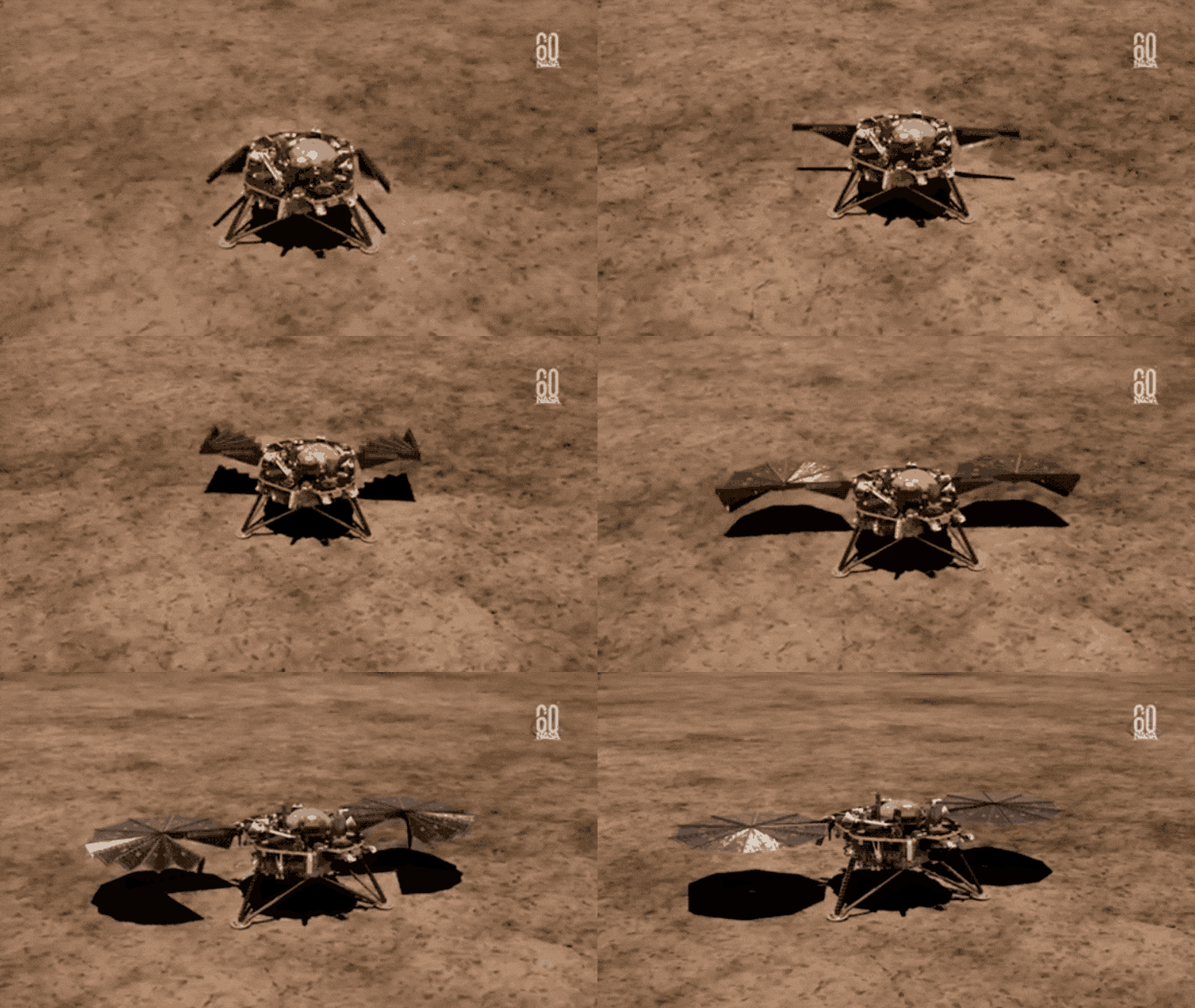
Solar panels opening.  Animation Credits: NASA/JPL-Caltech

Image above: Mission controllers at NASA’s Jet Propulsion Laboratory in Pasadena, California, celebrate InSight landing mission success. Image Credit: NASA.

Mission controllers at NASA-JPL have received a signal from NASA’s InSight lander on the Mars surface via MarCO OR a beep from InSight’s X-band radio. In the coming hours, engineers will be checking on the spacecraft’s health. A post-landing news briefing expected at 2 p.m. PST (5 p.m. EST).

InSight instruments deployment

Animation above: NASA's Interior Exploration using Seismic Investigations, Geodesy and Heat Transport (InSight) Seismic instrument deployment on the surface of Mars. Animation Credits: NASA/JPL-Caltech.

"It's taken more than a decade to bring InSight from a concept to a spacecraft approaching Mars — and even longer since I was first inspired to try to undertake this kind of mission," said Bruce Banerdt of JPL, InSight's principal investigator. "But even after landing, we'll need to be patient for the science to begin."

It will take two to three months for InSight's robotic arm to set the mission's instruments on the surface. During that time, engineers will monitor the environment and photograph the terrain in front of the lander.

Back at JPL, the surface operations team will practice setting down the instruments. They'll use a working replica of InSight in an indoor "Mars sandbox," which will be sculpted to match the mission's actual landing site on Mars. The team will check to make sure the instruments can be deployed safely, even if there are rocks nearby or InSight lands at an angle.

NASA’s InSight landed on Mars!

Video above: NASA’s InSight mission successfully landed on Elysium Planitia, Mars, on 26 November 2018, at around 19:54 UTC (12:54 PST, 15:54 EST). The InSight lander, short for Interior Exploration using Seismic Investigations, Geodesy and Heat Transport, is a NASA mission designed to study Mars’ interior structure.

Animation Credits: NASA/JPL-Caltech

Once the final position of each instrument is decided, it will take several weeks to carefully lift each one and calibrate their measurements. Then the science really gets underway.

About InSight:

JPL manages InSight for NASA's Science Mission Directorate. InSight is part of NASA's Discovery Program, managed by the agency's Marshall Space Flight Center in Huntsville, Alabama. Lockheed Martin Space in Denver built the InSight spacecraft, including its cruise stage and lander, and supports spacecraft operations for the mission.

A number of European partners, including France's Centre National d'Études Spatiales (CNES), the Institut de Physique du Globe de Paris (IPGP) and the German Aerospace Center (DLR), are supporting the InSight mission. CNES and IPGP provided the Seismic Experiment for Interior Structure (SEIS) instrument, with significant contributions from the Max Planck Institute for Solar System Research (MPS) in Germany, the Swiss Institute of Technology (ETH) in Switzerland, Imperial College and Oxford University in the United Kingdom, and JPL. DLR provided the Heat Flow and Physical Properties Package (HP3) instrument, with significant contributions from the Space Research Center (CBK) of the Polish Academy of Sciences and Astronika in Poland. Spain’s Centro de Astrobiología (CAB) supplied the wind sensors.

For more detailed information on the InSight mission, visit: https://mars.nasa.gov/insight

For more information about MarCO, visit: https://www.jpl.nasa.gov/cubesat/missions/marco.php

Animations (mentioned), Images (mentioned), Video, Text, Credits: NASA/NASA TV/SciNews.

Best regards, Orbiter.ch

dimanche 25 novembre 2018

ESA lends a hand at Mars


ESA & ROSCOSMOS - ExoMars Mission patch / NASA - InSight Mission logo.

25 November 2018

NASA's InSight lander operating on the surface of Mars

The Red Planet will receive its first new resident in six years on Monday when NASA’s InSight lander touches down, aiming to investigate the Martian interior. ESA ground stations and orbiters are playing a crucial role in helping the mission get to its destination and deliver its data back to Earth.

On 26 November, NASA’s robotic science lab will land on the dusty Martian surface around 20:00 UTC (21:00 CET).

Equipped with a suite of geological instruments, InSight will land at Elysium Planitia, a broad plain that has been called the “the biggest parking lot on Mars,” ready to spend two years measuring the planet’s internal heat, detect ‘marsquakes’ and more.

A portion of the Cerberus Fossae system in Elysium Planitia, near the martian equator

Because the lander will not rove across the Martian surface, it is vital that it lands in the right place the first time, where it will then release its solar panels and deploy its instruments, becoming the first mission to directly study another planet’s interior.

The European Space Agency is providing mission-critical support to InSight, using its deep-space ground tracking stations to communicate with the mission during the journey to Mars and, after landing, assigning the Agency’s ExoMars Trace Gas Orbiter (TGO) to help relay lander data back to Earth. Teams at ESA's ESOC mission control centre, in Darmstadt, Germany, are also on standby to relay instructions the other way, from Earth to the lander, if needed.

Getting by with a little help

Just five hours after InSight launched on 5 May 2018, ESA’s deep space ground station at New Norcia, in Western Australia, established contact and transmitted commands to InSight, the first time an ESA station transmitted commands to a NASA Mars mission in flight.

New Norcia antenna supports NASA's InSight lander on Mars

As InSight set out for Mars, ESA Estrack network stations provided additional communication slots, and served as back-up to NASA’s own Deep Space Network stations. The support is part of a long-standing cross-support agreement between the two agencies, in which one provides tracking station support to the other, boosting efficiency and redundancy for both.

On landing day, about 12 hours prior to the critical entry, descent and landing phase, ESA’s New Norcia station will again be in action, providing a ‘hot’ back-up communication link to InSight for the final ‘Target Correction Manoeuvre’ before it enters the Martian atmosphere.

Data from down below

Once on the surface, InSight will be located in view of a number of NASA and ESA orbiters, including ESA’s ExoMars TGO, which will provide routine data relay services to the lander throughout its life on Mars.

ExoMars Trace Gas Orbiter

TGO, which is equipped with NASA-provided radio relay technology, will catch InSight data signals from the surface and relay them back to Earth, and slots for this important service are already planned starting the day after arrival, on 27 November.

While contingency data relay from NASA rovers and landers on the surface has been tested in the past using ESA’s Mars Express orbiter, use of TGO to provide routine data relay is a new aspect of cooperation at Mars for the two Agencies. TGO has also been providing regular data relay services for NASA's Curiosity and Opportunity rovers.

It is part of a larger cooperation at Mars that will see orbiters from both ESA and NASA relaying data from not only current and future NASA rovers and landers on the surface, but also from ESA’s ExoMars rover slated to land in 2021 and from the accompanying Russian surface platform.

ExoMars rover

“NASA's InSIght mission relies on crucial ESA support, and this is a highlight of the cooperation we have between the NASA and ESA Mars programmes,” says Paolo Ferri, Head of Mission Operations at ESA.

“In return, our ExoMars mission has received essential NASA support.”

“Mars is a rich scientific target, but an extremely challenging destination. Extending our long-standing technical, scientific and operational cooperation at the Red Planet is the only way to go.”

Watch the landing live on Monday from 19:00 UTC (20:00 CET), via NASA’s webcast: https://mars.nasa.gov/insight/timeline/landing/watch-online/

Related links:

NASA's InSight surface operations: https://mars.nasa.gov/insight/timeline/surface-operations/

Estrack: http://www.esa.int/Our_Activities/Operations/Estrack

New Norcia - DSA 1: http://www.esa.int/Our_Activities/Operations/Estrack/New_Norcia_-_DSA_1

NASA's InSight lander: https://mars.nasa.gov/insight/

ESA's ExoMars: http://www.esa.int/Our_Activities/Space_Science/ExoMars

Images, Text, Credits: ESA/DLR/FU Berlin, D. O'Donnell, D. Ducros, CC BY-SA 3.0 IGO/NASA/JPL-Caltech.

Greetings, Orbiter.ch

vendredi 23 novembre 2018

NASA Highlights Science on Next Resupply Mission to International Space Station

SpaceX - Dragon CRS-16 patch.

Nov. 23, 2018


Image above: The SpaceX Dragon cargo craft is pictured in the grips of the Canadarm2 robotic arm as the International Space Station was orbiting above northern Africa. Scientific investigations on the next SpaceX flight, targeted for Tuesday, Dec. 4. include a test of robotic technology for refueling spacecraft, a project to map the world’s forests, and studies in several areas to benefit future space explorers as well as lives on Earth. Image Credit: NASA.

NASA will host a media teleconference at 1 p.m. EST Wednesday, Nov. 28, to discuss select science investigations launching on the next SpaceX commercial resupply flight to the International Space Station.

SpaceX is targeting Dec. 4 for launch of its Dragon spacecraft on a Falcon 9 rocket from Space Launch Complex 40 at Cape Canaveral Air Force Station (CCAFS) in Florida.

Participants in the briefing will be:

- Hsiao Smith, deputy director for technical of the Satellite Servicing Projects Division at NASA’s Goddard Space Flight Center in Greenbelt, Maryland, will discuss the Robotic Refueling Mission-3 to demonstrate the storage and transfer of liquid methane in space for the first time: https://www.nasa.gov/feature/goddard/2018/nasa-to-launch-new-refueling-mission-helping-spacecraft-live-longer-and-journey-farther

- Timothy Etheridge, principal investigator for the Molecular Muscle investigation, and a professor at University of Exeter, Department of Sport and Health Sciences in the United Kingdom,will discuss research to examine the molecular causes of muscle abnormalities during spaceflight in order to establish effective countermeasures: https://www.nasa.gov/mission_pages/station/research/experiments/explorer/Investigation.html?#id=7576

- Ralph Dubayah, principal investigator for Global Ecosystem Dynamics Investigation (GEDI) at the Joint Global Carbon Cycle Center in College Park, Maryland, will discuss an investigation to test high-quality laser ranging observations of the Earth’s forests and topography required to advance the understanding of important carbon and water cycling processes, biodiversity, and habitat: https://www.nasa.gov/feature/goddard/2018/gedi-to-measure-earths-forests

- Vic Keasler, Director of Research, Development and Engineering at Nalco Champion, an Ecolab company, will discuss an investigation to examine the rate of corrosion on carbon steel materials caused by films made up of microorganisms on Earth and in space: https://www.nasa.gov/mission_pages/station/research/experiments/explorer/Investigation.html?#id=7645

- Jahaun Azadmanesh, a doctoral student at the University of Nebraska Medical Center in Omaha, Nebraska, will discuss the Perfect Crystals investigation which aims to help understand how an antioxidant protein helps protect the human body from oxidizing radiation and oxidants created as a byproduct of metabolism: https://www.nasa.gov/mission_pages/station/research/experiments/explorer/Investigation.html?#id=7617

Audio of the teleconference will be streamed live online at: https://www.nasa.gov/nasalive

SpaceX’s Dragon spacecraft will carry crew supplies, scientific research and hardware to the orbiting laboratory to support the Expedition 57 and 58 crews for the 16th contracted mission by SpaceX under NASA’s Commercial Resupply Services contract.

For launch countdown coverage, NASA's launch blog, and more information about the mission, visit: https://www.nasa.gov/spacex

Related links:

Expedition 57: https://www.nasa.gov/mission_pages/station/expeditions/expedition57/index.html

Expedition 58: https://www.nasa.gov/mission_pages/station/expeditions/expedition58/index.html

Space Station Research and Technology: https://www.nasa.gov/mission_pages/station/research/index.html

International Space Station (ISS): https://www.nasa.gov/mission_pages/station/main/index.html

Image (mentioned), Text, Credits: NASA/Sean Potter/Kathryn Hambleton.

Greetings, Orbiter.ch

NASA's Lucy in the Sky with … Asteroids?


NASA - LUCY Mission patch.

Nov. 23, 2018

A little over 4 billion years ago, the planets in our solar system coexisted with vast numbers of small rocky or icy objects orbiting the Sun. These were the last remnants of the planetesimals – the primitive building blocks that formed the planets. Most of these leftover objects were then lost, as shifts in the orbits of the giant planets scattered them to the distant outer reaches of the solar system or beyond. But some were captured in two less-distant regions, near points where the gravitational influence of Jupiter and the Sun balance, and have remained trapped there, mostly untouched, for billions of years.

Not quite 4 million years ago, an ancient ancestor of modern humans roamed the land in what later would become the country of Ethiopia. Thirty-four years ago, Donald Johanson discovered the fossilized skeleton of this creature, later named Lucy, after the Beatles’ 1967 hit “Lucy in the Sky with Diamonds.”


Image above: Conceptual image of the Lucy mission to the Trojan asteroids. Image Credits: NASA/SwRI.

Three years from now, a spacecraft named Lucy, inspired by the famous fossil, will begin its exploration that could help determine the early history of the Solar System.

NASA’s Lucy mission will fly by six of those trapped planetesimals – the Jupiter Trojan asteroids – giving humanity its first glimpse of these ancient objects. By studying these fossils of planet formation, the Lucy mission could reveal as much about the development of the solar system as the Lucy fossil did about human evolution. And on the way to the Trojans, Lucy will visit an asteroid that the team has named Donaldjohanson, after the anthropologist that discovered the fossilized skeleton of our ancestor.

“The Trojans hold vital clues to the origin of the Solar System because they are leftover remnants from, and so were witnesses to, the process that built the planets,” said Principal Investigator Harold Levison of the Southwest Research Institute in Boulder, Colorado.


Animation above: The time-lapsed animation above shows the movements of the inner planets, Jupiter and both swarms of Trojans (green) during the time period of the Lucy mission. The L4 Trojans lead Jupiter in its orbit and the L5 Trojans follow. By tradition, the L4 Trojans are named for Greek characters in accounts of the Trojan War. The L5 bodies are named for characters on the Trojan side of the conflict. Animation Credits: Astronomical Institute of CAS/Petr Scheirich (used with permission).

The Trojans orbit the Sun in synchrony with Jupiter, following almost the same path, but leading the giant planet by about one-sixth of the way around the orbit, or trailing by the same amount. This keeps them near one of two gravitationally stable “Lagrange” points, L4 and L5, positioned at the apex of an equilateral triangle with Jupiter and the Sun, where they are protected from being perturbed onto different orbits or out of the solar system entirely. The areas around Jupiter’s L4 and L5 points each contain a swarm of objects billions of years old that hold information about the history of our solar system.


Image above: SwRI scientist studied the binary asteroid Patroclus-Menoetius, shown in this artist’s conception, to determine that a shake-up of the giant planets likely happened early in the solar system’s history, within the first 100 million years. Image Credits: Image Courtesy of W.M. Keck Observatory/Lynette Cook.

Earth-based observations have enabled astronomers to classify the Trojan asteroids by subtle variations in color and likely composition. “We see variation in the properties we can measure from the Earth and we would like to know the physical basis behind this variation,” Lucy Project Scientist Keith Noll said. “A mission to a single object would not have allowed that kind of comparison – by sampling a diverse set of objects, Lucy will provide a better basis for understanding what we are seeing in the broader population.” By visiting six Trojans spanning all of the major types, two of which make up a binary system (two objects that orbit each other), Lucy will gain a wealth of information about the objects that made up the solar system’s original planetesimal disk. Noll works at NASA’s Goddard Space Flight Center in Greenbelt, Maryland which is a key partner in the Lucy mission.

One characteristic the Trojans have in common is that they are dark. “They only reflect four or five percent of the light that hits them,” said Noll. “That’s really dark. Black pavement on the road is far more reflective.”

What darkens the Trojans is a mystery that could have surprising implications for our Earth. “Dark objects may have organic (carbon-containing) compounds on their surfaces,” said Senior Scientist Amy Simon. “If many of the Trojans we survey show evidence of organics, it will imply that the building blocks for life were common throughout the early solar system.” Simon works at NASA Goddard where she serves as a deputy principal investigator for one of the Lucy spacecraft’s instruments.

Some of the same processes that trapped the Trojans in their present orbits sent other leftover planetesimals farther from the Sun, and we now find them in the Kuiper Belt, the icy region beyond Neptune that is home to Pluto and other dwarf planets. (NASA’s New Horizons spacecraft explored Pluto following a 9-year journey, and will fly past another Kuiper Belt Object on New Year’s Day 2019.)


Image above: An artist's concept of the Lucy Mission. Image Credit: SwRI.

Data collection will be vital to Lucy’s success. The mission will carry four instruments in its payload: L’Ralph, consisting of MVIC (Multi-spectral Visible Imaging Camera), a multi-color imager, and LEISA (Linear Etalon Imaging Spectral Array), a spectrograph that will provide information on surface composition; L’LORRI (Long Range Reconnaissance Imager), a high-resolution camera; and L’TES (Thermal Emission Spectrometer), which will measure the surface temperatures of the Trojans. And in addition to the scientific instruments, Lucy’s communications (radio) and target acquisition system (TTCam) will contribute to the science mission. L’Ralph will analyze the Trojans’ surfaces to look for the presence of different silicates, ices and organics on these asteroids. L’LORRI will take high-definition pictures of the Trojans supplemented by TTCam at closest approach. L’TES will investigate the physical state of the Trojans’ surfaces, and the radio data will be used jointly with the imaging data to determine their masses and densities.

Lucy is scheduled to launch in October 2021, flying by more targets in different orbits around the Sun than any other mission in history. Answers to key questions about the solar system’s distant past will be now within reach, thanks to the Lucy mission.

The Lucy mission is led by Dr. Harold Levison and his team at the Southwest Research Institute and is managed by NASA’s Goddard Space Flight Center. The instruments on Lucy are developed by Goddard, Arizona State University, and the Johns Hopkins University Applied Physics Laboratory. The spacecraft will be developed and constructed by Lockheed Martin. Following its construction, Lucy will undergo further testing, and in three years be launched on a mission that will forever change our knowledge of the solar system.

For more information about the Lucy mission, visit: http://www.nasa.gov/lucy

Images (mentioned), Animation (mentioned), Text, Credits: NASA/Karl Hille/Goddard Space Flight Center, by Tamsyn Brann.

Greetings, Orbiter.ch

jeudi 22 novembre 2018

Shaping the surface of Mars with water, wind, and ice


ESA - Mars Express Mission patch.

22 November 2018

ESA’s Mars Express has imaged an intriguing part of the Red Planet’s surface: a rocky, fragmented, furrowed escarpment lying at the boundary of the northern and southern hemisphere.

Perspective view of Nili Fossae

This region is an impressive example of past activity on the planet and shows signs of where flowing wind, water and ice once moved material from place to place, carving out distinctive patterns and landforms as it did so.

Mars is a planet of two halves. In places, the northern hemisphere of the planet sits a full few kilometres lower than the southern; this clear topographic split is known as the martian dichotomy, and is an especially distinctive feature on the Red Planet’s surface.

Northern Mars also displays large areas of smooth land, whereas the planet’s southern regions are heavily pockmarked and scattered with craters. This is thought to be the result of past volcanic activity, which has resurfaced parts of Mars to create smooth plains in the north – and left other regions ancient and untouched.

Nili Fossae in context

The star of this Mars Express image, a furrowed, rock-filled escarpment known as Nili Fossae, sits at the boundary of this north-south divide. This region is filled with rocky valleys, small hills, and clusters of flat-topped landforms (known as mesas in geological terms), with some chunks of crustal rock appearing to be depressed down into the surface creating a number of ditch-like features known as graben.

Mars Express view of Nili Fossae

As with much of the surrounding environment, and despite Mars’ reputation as a dry, arid world today, water is believed to have played a key role in sculpting Nili Fossae via ongoing erosion. In addition to visual cues, signs of past interaction with water have been spotted in the western (upper) part of this image – instruments such as Mars Express’ OMEGA spectrometer have spotted clay minerals here, which are key indicators that water was once present.

Topography of Nili Fossae

The elevation of Nili Fossae and surroundings, shown in the topographic view above, is somewhat varied; regions to the left and lower left (south) sit higher than those to the other side of the frame (north), illustrating the aforementioned dichotomy. This higher-altitude terrain appears to consist mostly of rocky plateaus, while lower terrain comprises smaller rocks, mesas, hills, and more, with the two sections roughly separated by erosion channels and valleys.

This split is thought to be the result of material moving around on Mars hundreds of millions of years ago. Similar to glaciers on Earth, flows of water and ice cut through the martian terrain and slowly sculpted and eroded it over time, also carrying material along with them. In the case of Nili Fossae, this was carried from higher areas to lower ones, with chunks of resistant rock and hardy material remaining largely intact but shifting downslope to form the mesas and landforms seen today.

Nili Fossae in 3D

The shapes and structures scattered throughout this image are thought to have been shaped over time by flows of not only water and ice, but also wind. Examples can be seen in this image in patches of the surface that appear to be notably dark against the ochre background, as if smudged with charcoal or ink. These are areas of darker volcanic sand, which have been transported and deposited by present-day martian winds. Wind moves sand and dust around often on Mars’ surface, creating rippling dune fields across the planet and forming multi-coloured, patchy terrain like Nili Fossae.

The data comprising this image were gathered by Mars Express’ High Resolution Stereo Camera (HRSC) on 26 February 2018.

Mars Express

ESA’s Mars Express was launched in 2003. As well as producing striking views of the martian surface such as this, the mission has shed light on many of the planet’s biggest mysteries – and helped to build the picture of Mars as a planet that was once warmer, wetter and potentially habitable. Read more about the past 15 years of Mars Express, and what the mission has discovered so far, here: https://www.esa.int/Our_Activities/Space_Science/Mars_Express/From_horizon_to_horizon_Celebrating_15_years_of_Mars_Express

Related links:

Mars Express: http://www.esa.int/Our_Activities/Space_Science/Mars_Express

Mars Express overview: http://www.esa.int/Our_Activities/Space_Science/Mars_Express_overview

Mars Express in-depth: http://sci.esa.int/marsexpress

Mars Webcam: http://blogs.esa.int/vmc

Images, Text, Credits: ESA/DLR/FU Berlin, CC BY-SA 3.0 IGO/NASA MGS MOLA Science Team.

Best regards, Orbiter.ch

mercredi 21 novembre 2018

TAGSAM Testing Complete: OSIRIS-REx Prepared to TAG an Asteroid


NASA - OSIRIS-REx Mission patch.

Nov. 21, 2018

On Nov. 14, NASA’s OSIRIS-REx spacecraft stretched out its robotic sampling arm for the first time in space. The arm, more formally known as the Touch-and-Go Sample Acquisition Mechanism (TAGSAM), is key to the spacecraft achieving the primary goal of the mission: returning a sample from asteroid Bennu in 2023.

As planned, engineers at Lockheed Martin commanded the spacecraft to move the arm through its full range of motion – flexing its shoulder, elbow, and wrist “joints.” This long-awaited stretch, which was confirmed by telemetry data and imagery captured by the spacecraft’s SamCam camera, demonstrates that the TAGSAM head is ready to collect a sample of loose dirt and rock (called regolith) from Bennu’s surface.


Image above: This image shows the OSIRIS-REx Touch-and-Go Sample Acquisition Mechanism (TAGSAM) sampling head extended from the spacecraft at the end of the TAGSAM arm. The image was obtained by the SamCam camera on Nov. 14, 2018 as part of a visual checkout of the spacecraft’s sample acquisition system. This is a rehearsal image for an observation that will be taken at Bennu during the moment of sample collection to help document the asteroid material collected in the TAGSAM head. There are two witness plate assemblies on the top perimeter of the TAGSAM head, one of which is entirely visible in this image. These witness plates record the deposition of material on the TAGSAM head over the duration of the mission, giving scientists a record of material on the TAGSAM head that is not from Bennu. Image Credits: NASA/Goddard/University of Arizona.

“The TAGSAM exercise is an important milestone, as the prime objective of the OSIRIS-REx mission is to return a sample of Bennu to Earth,” said Dante Lauretta, OSIRIS-REx principal investigator at the University of Arizona, Tucson. “This successful test shows that, when the time comes, TAGSAM is ready to reach out and tag the asteroid.”

Years of innovation

Lockheed Martin engineers spent more than a decade designing, building, and testing TAGSAM, which includes an 11-foot (3.35-meter) arm with three articulating joints, a round sampler head at the end of the arm that resembles the air filter in a car, and three bottles of high-pressure nitrogen gas.

This test deployment was a rehearsal for a date in mid-2020 when the spacecraft will unfold the TAGSAM arm again, slowly descend to Bennu’s surface, and briefly touch the asteroid with the sampler head. A burst of nitrogen gas will stir up regolith on the asteroid’s surface, which will be caught in the TAGSAM head. The TAG sequence will take about five seconds, after which the spacecraft will execute small maneuvers to carefully back away from Bennu. Afterward, SamCam will image the sampler head, as it did during the test deployment, to help confirm that TAGSAM collected at least 2.1 ounces (60 grams) of regolith.

TAGSAM Taking a Sample

Video above: In mid-2020, the OSIRIS-REx spacecraft will use its TAGSAM device to stir up and collect a sample of loose material from asteroid Bennu’s surface. That material will be returned to Earth for study in 2023. Video Credits: NASA/Goddard/University of Arizona.

The TAGSAM mechanism was designed for the key challenge unique to the OSIRIS-REx mission: collecting a sample from the smallest planetary body ever to be orbited by a spacecraft. “First-of-its-kind innovations like this one serve as the precursor for future missions to small bodies,” said Sandy Freund, systems engineer manager and Lockheed Martin OSIRIS-REx MSA manager. “By proving out these technologies and techniques, we are going to be able to return the largest sample from space in half a century and pave the way for other missions.”

A month of testing

The unfolding of the TAGSAM arm was the latest and most significant step in a series of tests and check-outs of the spacecraft’s sampling system, which began in October when OSIRIS-REx jettisoned the cover that protected the TAGSAM head during launch and the mission’s outbound cruise phase. Shortly before the cover ejection, and again the day after, OSIRIS-REx performed two spins called Sample Mass Measurements. By comparing the spacecraft’s inertial properties during these before-and-after spins, the team confirmed that the 2.67-pound (1.21-kilogram) cover was successfully ejected on Oct. 17.

OSIRIS-REx taking sample on Bennu. Image Credit: NASA

A week later, on Oct. 25, the Frangibolts holding the TAGSAM arm in place fired successfully, releasing the arm and allowing the team to move it into a parked position just outside its protective housing. After resting in this position for a few weeks, the arm was fully deployed into its sampling position, its joints were tested, and images were captured with SamCam. The spacecraft will execute two additional Sample Mass Measurements over the next two days. The mission team will use these spins as a baseline to compare with the results of similar spins that will be conducted after TAG in 2020 in order to confirm the mass of the sample collected.

TAGSAM Arm Deployment and Mass Measurement Spin

Video above: Over the past month, the OSIRIS-REx team conducted a series of tests to ensure that TAGSAM, the spacecraft’s sampling mechanism, is ready to collect a sample from Bennu in 2020. This rehearsal marked the first time since launch that the TAGSAM arm has moved through its full range of motion. Video Credits: NASA/Goddard/University of Arizona.

Although the sampling system was rigorously tested on Earth, this rehearsal marked the first time that the team has deployed TAGSAM in the micro-gravity environment of space.

"The team is very pleased that TAGSAM has been released, deployed, and is operating as commanded through its full range of motion." said Rich Burns, OSIRIS-REx project manager at NASA’s Goddard Space Flight Center in Greenbelt, Maryland. "It has been restrained for over two years since launch, so it is gratifying to see it out of its shackles and performing well."

OSIRIS-REx is scheduled to arrive at Bennu on Dec. 3. It will spend nearly one year surveying the asteroid with five scientific instruments so that the mission team can select a location that is safe and scientifically interesting to collect the sample.


Animation above: Over the past month, the OSIRIS-REx team conducted a series of tests to ensure that TAGSAM, the spacecraft’s sampling mechanism, is ready to collect a sample from Bennu in 2020. This rehearsal marked the first time since launch that the TAGSAM arm has moved through its full range of motion. Animation Credits: NASA/Goddard/University of Arizona.

“Now that we have put TAGSAM through its paces in space and know it is ready to perform at Bennu, we can focus on the challenges of navigating around the asteroid and seeking out the best possible sample site,” said Lauretta.

NASA Goddard Space Flight Center in Greenbelt, Maryland, provides overall mission management, systems engineering and safety and mission assurance for OSIRIS-REx. Dante Lauretta of the University of Arizona, Tucson, is the principal investigator, and the University of Arizona also leads the science team, the mission’s science observation planning, and data processing. Lockheed Martin Space Systems in Denver built the spacecraft and is providing flight operations. OSIRIS-REx is the third mission in NASA's New Frontiers Program. NASA Marshall Space Flight Center in Huntsville, Alabama, manages New Frontiers for the agency's Science Mission Directorate in Washington.

Related link:

TAGSAM: https://www.asteroidmission.org/?attachment_id=1699#main

For more information on OSIRIS-REx visit: http://www.nasa.gov/osiris-rex and http://www.asteroidmission.org/

Image (mentioned), Animation (mentioned), Videos (mentioned), Text, Credits: NASA/Karl Hille/University of Arizona, by Christine Hoekenga.

Greetings, Orbiter.ch

Three Humans Will Spend Thanksgiving 260 Miles Above Earth


ISS - Expedition 57 Mission patch.

November 21, 2018

Three humans will spend Thanksgiving orbiting about 260 miles above Earth. Another three individuals are spending the holiday in Kazakhstan preparing to launch to the International Space Station on Dec. 3.

Happy Thanksgiving From the International Space Station

Video above: Astronauts Alex Gerst of ESA and Serena Auñón-Chancellor of NASA wish you a happy Thanksgiving! On station, the crew will share a holiday meal of turkey, stuffing, candied yams and spicy pound cake, and call home to speak with loved ones on Earth. Video Credit: NASA TV.

The Expedition 57 trio from the U.S., Russia and Germany will share a traditional Thanksgiving meal together with fresh ingredients delivered over the weekend on a pair of new cargo ships. Commander Alexander Gerst from ESA (European Space Agency) and NASA Flight Engineer Serena Auñón-Chancellor will take the day off in space. Cosmonaut Sergey Prokopyev will work a normal day of Russian science and maintenance then join his crewmates for the holiday feast.


Image above: Serena Auñón-Chancellor (right) takes a group selfie with her Expedition 57 crew mates (from left) Sergey Prokopyev and Alexander Gerst. The three-person crew was gathered for dinner in the Zvezda Service Module, part of the International Space Station’s Russian segment. Image Credit: NASA.

Gerst called down to European mission controllers today for a weekly tag up then answered a questionnaire about his experiences living in space. Afterward, he continued unpacking inventory from the new Cygnus cargo craft.

Auñón-Chancellor spent most of her day in Japan’s Kibo lab module working on life support gear. Toward the end of the day, she stowed research samples in a science freezer then debriefed ground controllers with Gerst about Cygnus cargo operations.

Prokopyev focused his attention on the Russian side of the orbital lab working on life support gear and unloading the new Progress 71 cargo craft.


Image above: Flying over Peru (rear cam view), seen by EarthCam on ISS, speed: 27'605 Km/h, altitude: 406,43 Km, image captured by Roland Berga (on Earth in Switzerland) from International Space Station (ISS) using ISS-HD Live application with EarthCam's from ISS on November 21, 2018 at 21:22 UTC. Image Credits: Orbiter.ch Aerospace/Roland Berga.

Back on Earth, three Expedition 58 crew members from the U.S., Russia and Canada are in final training ahead of their six-and-a-half month mission on the orbital lab. Cosmonaut Oleg Kononenko will lead the six-hour flight aboard the Soyuz MS-11 spacecraft flanked by NASA astronaut Anne McClain and Canadian Space Agency astronaut David Saint-Jacques.

This will be Kononenko’s fourth mission to the space station and his second as station commander. McClain and Saint-Jacques are both beginning their first missions to space.

Related links & articles:

Expedition 57: https://www.nasa.gov/mission_pages/station/expeditions/expedition57/index.html

Expedition 58: https://www.nasa.gov/mission_pages/station/expeditions/expedition58/index.html

Experiences living in space: https://www.nasa.gov/mission_pages/station/research/experiments/explorer/Investigation.html?#id=1727

Cygnus cargo craft: https://orbiterchspacenews.blogspot.com/2018/11/canadian-robotic-arm-installs-us-cygnus.html

Progress 71 cargo craft: https://orbiterchspacenews.blogspot.com/2018/11/russian-cargo-craft-docks-to-station.html

Space Station Research and Technology: https://www.nasa.gov/mission_pages/station/research/index.html

International Space Station (ISS): https://www.nasa.gov/mission_pages/station/main/index.html

Images (mentioned), Video (mentioned), Text, Credits: NASA/Marck Garcia/Orbiter.ch Aerospace/Roland Berga.

Best regards, Orbiter.ch