mercredi 25 novembre 2020

Crew Off-Duty for Thanksgiving and Preps for Dragon Cargo Mission


ISS - Expedition 64 Mission patch.


Nov. 25, 2020

The seven-member Expedition 64 crew from the United States, Russia and Japan will take the day off on Thanksgiving before ending the week with a day full of microgravity research. In the meantime, the crew spent Wednesday on a wide array of space science while getting the International Space Station ready for an upgraded SpaceX Dragon resupply ship.

NASA Flight Engineers Kate Rubins and Shannon Walker worked throughout Wednesday readying the station’s Tranquility module for a new commercial airlock from NanoRacks. Dubbed Bishop, the airlock will be delivered on the next SpaceX Dragon cargo mission targeted to launch on Dec. 5. The Bishop airlock will enable private industries to increase research opportunities in the vacuum of space.


Image above: A bright blue, South Atlantic Ocean is pictured as the International Space Station soared nearly 270 miles above, just off the coast of Argentina. Image Credit: NASA.

Planned for Dec. 6, this will be the first automated docking of the Cargo Dragon to the space-facing port on the Harmony module. Previous Cargo Dragon vehicles were captured with the Canadarm2 robotic arm maneuvered by astronauts. Robotics controllers then took over and remotely installed Dragon to Harmony’s Earth-facing port.

The GRASP human research experiment, sponsored by the European Space Agency (ESA), was back on the science schedule Wednesday. Flight Engineers Michael Hopkins and Victor Glover wore virtual reality goggles and responded to virtual stimuli to help doctors understand how the central nervous system, specifically hand-eye coordination, adapts to weightlessness.

Sunrise seen from the International Space Station (ISS). Animation Credit: Orbiter.ch Aerospace

JAXA astronaut and Flight Engineer Soichi Noguchi started his day servicing the Kibo laboratory module’s Cell Biology Experiment Facility, a specialized incubator that can generate artificial gravity. Later, he joined Kate Rubins and examined her eyes using optical coherence tomography.

The orbiting lab’s two cosmonauts, Commander Sergey Ryzhikov and Flight Engineer Sergey Kud-Sverchkov, continued studying ways to make space workouts more effective. The duo later joined Rubins and practiced chest compressions, or cardiopulmonary resuscitation, in the event of a medical emergency aboard the space station.

Related links:

Expedition 64: https://www.nasa.gov/mission_pages/station/expeditions/expedition64/index.html

Tranquility module: https://www.nasa.gov/mission_pages/station/structure/elements/tranquility/

New commercial airlock: https://www.nasa.gov/directorates/spacetech/spinoff/New_Doorway_to_Space

Harmony module: https://www.nasa.gov/mission_pages/station/structure/elements/harmony

Canadarm2 robotic arm: https://www.nasa.gov/mission_pages/station/structure/elements/mobile-servicing-system.html

GRASP: https://www.nasa.gov/mission_pages/station/research/experiments/explorer/Investigation.html?#id=2038

Kibo laboratory module: https://www.nasa.gov/mission_pages/station/structure/elements/japan-kibo-laboratory

Specialized incubator: https://www.nasa.gov/mission_pages/station/research/experiments/explorer/Facility.html?#id=333

Space Station Research and Technology: https://www.nasa.gov/mission_pages/station/research/overview.html

International Space Station (ISS): https://www.nasa.gov/mission_pages/station/main/index.html

Image (mentioned), Animation (mentioned), Text, Credits: NASA/Mark Garcia/Orbiter.ch Aerospace/Roland Berga.

Best regards, Orbiter.ch

Over to you, Eumetsat!


ESA & NASA - Sentinel-6 Mission patch.


Nov. 24, 2020

Ice lost from ice sheets contributes to sea-level rise

It was a spectacular launch on 21 November, as the Copernicus Sentinel-6 Michael Freilich satellite was lifted into space on a SpaceX Falcon 9 rocket. After taking care of the Earth observation spacecraft during the critical early days and making it at home in its new environment, ESA is ready to hand over control to Eumetsat.

About an hour after a flawless launch, Sentinel-6 Michael Freilich Earth separated from the SpaceX Falcon 9 rocket, and for the first time it was flying on its own.


Animation above: Sentinel-6 Michael Freilich separates from the SpaceX Falcon 9 rocket shortly after launch.

Soon after, ESA’s mission control in Germany received the very first signals from the fledgling mission. This vital moment, the ‘acquisition of signal’, is what teams had been waiting for, because it meant they could lock on to the satellite with ground stations across the globe and receive its ‘telemetry’ - data providing information on the mission’s health.

Of course, controlling missions is a two way conversation. We receive information about the spacecraft and all the observational data it has gathered in the signals it beams down to Earth, but we also speak to it, sending commands. Once teams at ESA’s ESOC Operations Centre had sent their first commands, it was time to declare “we have a mission!”.

“It’s always tense in the moments before we capture the first signal, until then, it's too soon to celebrate as we haven't yet taken control,” explains Jose Morales, Head of Earth observation missions at ESA.

Over to you, Eumetsat!

“Once our screens lit up green, we knew that Sentinel-6 was in our hands and it is then that the real work began getting the spacecraft ready for an important life in space.”

In the days since launch, known as the Launch and Early Orbit Phase (LEOP), the flight control team at the Agency’s Operations Centre took meticulous care of the new Sentinel. These early days came with many challenges, as the new spacecraft began using its solar arrays for power, woke up to test its core functioning and performed two manoeuvres to initiate its drift towards its final, operational orbit, all the while at its most vulnerable to the hazards of space.

Mission control happy to hear Sentinel-6's first words

Now the LEOP is complete, ESA’s mission control team is handing over command and control of the satellite to Eumetsat – Europe’s weather and climate satellite organisation – who will complete the final ‘orbit acquisition’ and take on responsibility for commissioning, routine operations and distribution of the mission’s vital data.

“The critical Launch and Early Orbit Phase went smoothly and is now complete, and we are thrilled to pass on this mission to our friends at Eumetsat, who will distribute its data on Earth’s changing oceans,” explains Simon Plum, ESA’s Head of Mission Operations. “I am particularly proud of the dedication shown by everyone involved at all stages of this important mission. Their commitment has gone above and beyond expectation and truly demonstrates how seriously they take their roles.”

“It’s testament to the hard work and expertise of our teams at ESOC that in the midst of a global pandemic they continue to safely carry out some of the hardest jobs in space.”

Related article:

New Copernicus satellite to monitor sea-level rise launched
https://orbiterchspacenews.blogspot.com/2020/11/new-copernicus-satellite-to-monitor-sea.html

Related links:

Sentinel-6: https://www.esa.int/Applications/Observing_the_Earth/Copernicus/Sentinel-6

Copernicus: https://www.esa.int/Applications/Observing_the_Earth/Copernicus

Observing the Earth: https://www.esa.int/Applications/Observing_the_Earth

Animations, Images, Text, Credits: ESA/ATG medialab.

Best regards, Orbiter.ch

mardi 24 novembre 2020

Crew Explores How Space Impacts Nervous System and Exercise


ISS - Expedition 64 Mission patch.


Nov. 24, 2020

Human research was the prime area of study today aboard the International Space Station. Results are helping NASA and its international partners keeps astronauts safe and healthy on long term space missions.

Flight Engineers Michael Hopkins and Victor Glover took turns today exploring how weightlessness impacts their hand-eye coordination. The GRASP study, sponsored by the European Space Agency (ESA), explores how microgravity affects a crew member’s central nervous system. That experiment has been under way at the orbiting lab since 2016, providing researchers critical data and insights on how astronauts adapt to living and working in space.


Image above: A pair of docked Russian spaceships, (from left) the Soyuz MS-17 crew ship and the Progress 76 cargo craft, are pictured as the International Space Station orbited above the Atlantic Ocean during an orbital sunset. Image Credit: NASA.

Commander Sergey Ryzhikov and Flight Engineer Sergey Kud-Sverchkov, the two Expedition 64 cosmonauts, participated in a Russian exercise study today. The duo worked out on a treadmill in the Zvezda service module while attached to a variety of sensors. Observations could lead to improved crew training techniques and more effective work outs on the way to the Moon, Mars, and beyond.

NASA Flight Engineer Kate Rubins readied an external exposure experiment this morning that will be placed outside Japan’s Kibo laboratory module. Afterward, she resumed her work exploring the behavior of water droplets that may lead to more advanced fuel and life support systems.

International Space Station (ISS). Animation Credit: ESA

Japanese astronaut Soichi Noguchi, on his third space mission, set up hardware for a fiber optics study then organized stowage space in the Kibo lab. Flight Engineer Shannon Walker of NASA spent most of Tuesday on maintenance servicing spacesuit batteries and working on stowage tasks in the Tranquility module.

Related links:

Expedition 64: https://www.nasa.gov/mission_pages/station/expeditions/expedition64/index.html

GRASP: https://www.nasa.gov/mission_pages/station/research/experiments/explorer/Investigation.html?#id=2038

Russian exercise study: https://www.energia.ru/en/iss/researches/human/26.html

Zvezda service module: https://www.nasa.gov/mission_pages/station/structure/elements/zvezda-service-module.html

External exposure experiment: https://www.nasa.gov/mission_pages/station/research/experiments/explorer/Facility.html?#id=7515

Kibo laboratory module: https://www.nasa.gov/mission_pages/station/structure/elements/japan-kibo-laboratory

Water droplets: https://www.nasa.gov/mission_pages/station/research/experiments/explorer/Investigation.html?#id=7681

Fiber optics study: https://www.nasa.gov/mission_pages/station/research/experiments/explorer/Investigation.html?#id=7375

Tranquility module: https://www.nasa.gov/mission_pages/station/structure/elements/tranquility/

Space Station Research and Technology: https://www.nasa.gov/mission_pages/station/research/overview.html

International Space Station (ISS): https://www.nasa.gov/mission_pages/station/main/index.html

NASA/Mark Garcia.

NASA and SpaceX “Go” for Dec. 5 Cargo Resupply Launch


SpaceX - Dragon CRS-21 Mission patch.


Nov. 24, 2020

NASA and SpaceX managers conducted a Flight Readiness Review (FRR) Monday, Nov. 23, for SpaceX’s 21st Commercial Resupply Services (CRS-21) mission to the International Space Station.

To enable additional time to evaluate flight data from Crew-1 and close out certification work ahead of this first flight of the cargo version of Dragon 2, teams are now proceeding toward a planned liftoff at 11:39 a.m. EST on Saturday, Dec. 5, from Launch Complex 39A at the agency’s Kennedy Space Center in Florida, with the Dragon spacecraft arriving to autonomously dock at the orbiting laboratory on Sunday, Dec. 6, at approximately 11:30 a.m.


Image above: A SpaceX Falcon 9 rocket and cargo Dragon spacecraft stand ready for liftoff at Cape Canaveral Air Force Station’s Space Launch Complex 40 in Florida on March 6, 2020, for NASA and SpaceX’s 20th Commercial Resupply Services (CRS-20) mission to the International Space Station. Liftoff occurred at 11:50 p.m. EST. Photo Credits: NASA/Tony Gray and Tim Terry.

The science to be delivered on this mission includes a study aimed at better understanding the effects of microgravity on cardiac function in human heart tissue, research into how microbes could be used for biomining on asteroids, and a tool being tested for quick and accurate blood analysis in microgravity. The first commercially owned and operated airlock on the space station, the Nanoracks Bishop Airlock, will arrive in the unpressurized trunk of the Dragon spacecraft. Bishop will provide a variety of capabilities to the orbiting laboratory, including CubeSat deployment and support of external payloads.

Related article:

Hearts, Airlocks, and Asteroids: New Research Flies on 21st SpaceX Cargo Mission
https://orbiterchspacenews.blogspot.com/2020/11/hearts-airlocks-and-asteroids-new.html

Related links:

SpaceX Commercial Resupply: https://www.nasa.gov/mission_pages/station/structure/launch/spacex.html

Space Station Research and Technology: https://www.nasa.gov/mission_pages/station/research/overview.html

International Space Station (ISS): https://www.nasa.gov/mission_pages/station/main/index.html

Image (mentioned), Text, Credits: NASA/Danielle Sempsrott.

Greetings, Orbiter.ch

NASA Centers Collaborate to Advance Quiet Supersonic Technology During Pandemic


NASA - X-59 Low Boom Flight Demonstration patch.


Nov. 24, 2020

Two NASA centers on opposite sides of the countries are finding new ways to work together to support the agency’s mission to develop quiet supersonic technology, in spite of thousands of miles of distance and a global pandemic.


Image above: A NASA F/A-18 is towed to the apron at NASA’s Armstrong Flight Research Center in Edwards, California during sunrise over Rogers Dry Lake. The F/A-18 was used to test a transmitter for an air navigation system, called the Airborne Location Integrating Geospatial Navigation System, or ALIGNS. This system, designed to allow pilots to position their aircraft at precise distances to each other, will be critical for acoustic validation efforts of NASA’s next supersonic X-plane, the X-59 Quiet SuperSonic Technology. Image Credits: NASA Photo/Lauren Hughes.

Using their available labs, Kennedy Space Center in Florida is building tools in collaboration with Armstrong Flight Research Center in California, which NASA will use in support of the X-59 Quiet SuperSonic Technology X-plane, or QueSST.

Flying at faster-than-sound speeds over communities around the U.S., the X-59 will demonstrate technology to reduce the loud sonic booms, typically heard below aircraft flying at supersonic speeds, to a quieter noise similar to a car door closing in the distance. The X-59 will demonstrate to regulators through collected data that quiet supersonic flight is possible.

However, before the X-59 begins community overflights, NASA researchers need to validate the X-plane’s acoustic signature through tests.

A project under NASA’s Aeronautics Research Mission Directorate called SCHAMROQ, which stands for Schlieren, Airborne Measurements, and Range Operations for QueSST, is preparing the tools and test techniques to execute these tests at Armstrong. When a reduced capacity to develop these tools materialized during the COVID-19 pandemic, Armstrong turned to Kennedy to provide a helping hand, and to help ensure the project’s progress.


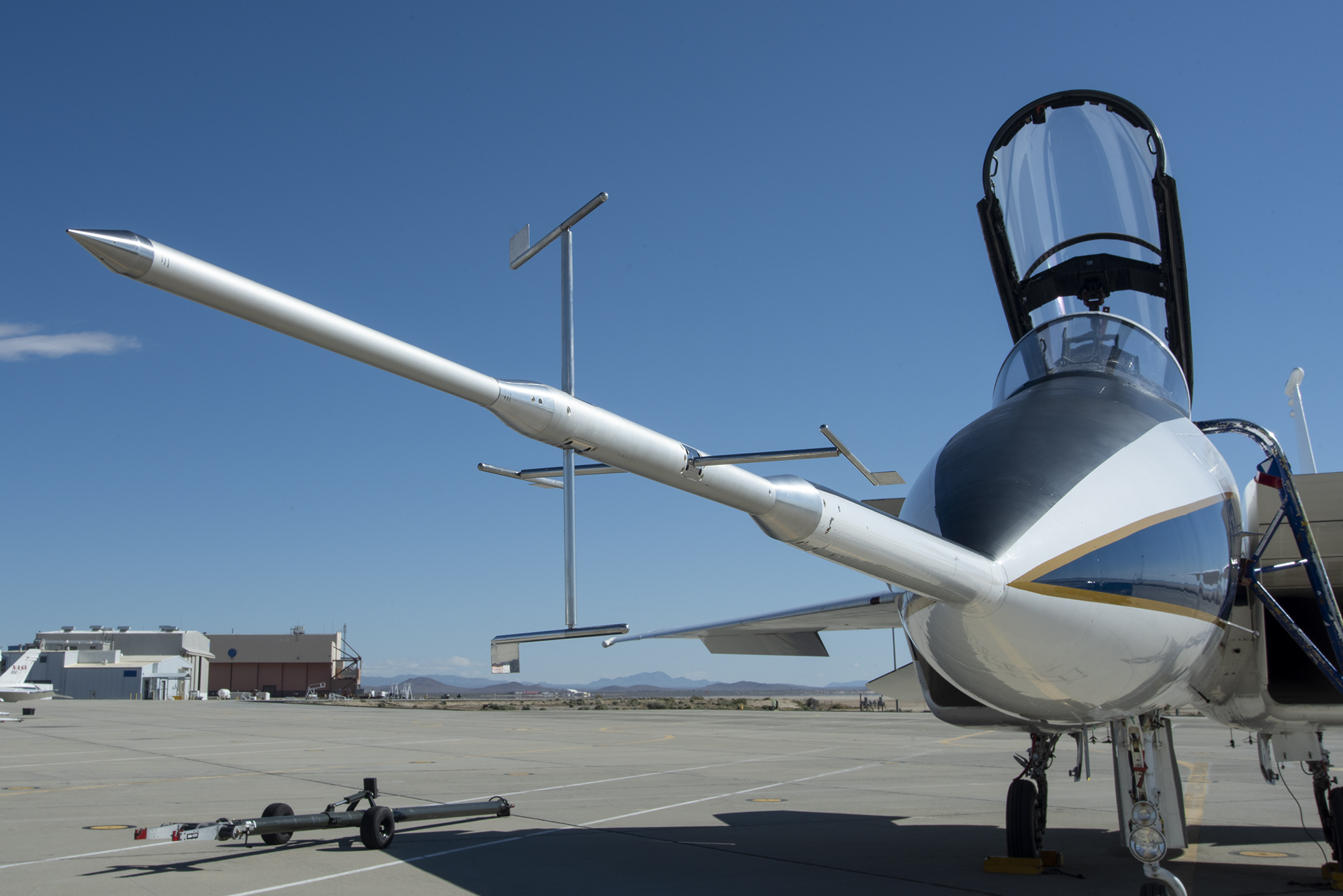
Image above: A 2019 design of the Shock Sensing Probe, a cone-shaped aeronautical test instrument, extends from the nose of a NASA F-15 aircraft. As the aircraft flies through the shockwaves of a nearby F/A-18 aircraft, the probe, designed to capture high-quality measurements of shock waves created by supersonic aircraft in flight, used five “pressure ports” to measure the pressure on the surface around the instrument, which is shaped like a cone. This method will help NASA validate the acoustic signature of the X-59 Quiet SuperSonic Technology X-plane. Image Credits: NASA Photo/Ken Ulbrich.

“It’s neat working with a space center,” said Matthew Moholt, deputy project manager for SCHAMROQ. “Their willingness and eagerness to help out a sister center is welcomed and appreciated. When you have another center willing to help out and do critical work that’s critical to your schedule, that’s really significant.”

During supersonic flight, planes create shockwaves that merge together as they travel through the air to produce the sonic boom. Moholt says SCHAMROQ aims to build and test multiple tools to help researchers observe and validate these same shockwaves during quiet supersonic flight.

These tools include the Shock Sensing Probe, a device that will evaluate the characteristics of the X-59's shockwaves while in flight, a schlieren photography technique to visualize the X-59's shockwaves as they distort light through a camera, and a navigation software that will allow pilots to fly accurately during X-59 tests.

Moholt said all of this technology will be placed on a NASA F-15 research aircraft, which will take on the role of a chase plane, following the X-59 in the sky during flight tests to collect data.

“We have this big effort to instrument and put all the research systems into the F-15 that allows it to fly all of these technologies,” Moholt said. “As the pandemic hit, it was right in the peak of getting instrumentation wiring put through it so that all of our instrumentation systems could get put in, and our electronic fabrication shop was impacted by that.”

This SCHAMROQ technology needs to be tested to ensure it can withstand the demands of supersonic flight while onboard NASA’s F-15. Deputy instrumentation lead Matthew Waldersen said part of the testing process requires the usage of a network switch with cables – similar to an ethernet network, but for airplanes.


Image above: NASA’s X-59 Quiet SuperSonic Technology X-plane, or QueSST, will fly over communities in the United States to demonstrate quiet supersonic. X-59 is designed so that, when flying faster than the speed of sound, people on the ground will hear nothing more than a quiet sonic thump – rather than a loud sonic boom. Scientifically valid data gathered from these community overflights will be presented to U.S. and international regulators, who will use the information to help them come up with rules based on noise levels that may enable new commercial markets for supersonic flight over land. Image Credit: Lockheed Martin.

Waldersen explained that, to help ensure the project remained on schedule, Kennedy Space Center was contacted to build cables for the network switch.

“We reached out to their branch chief, and they said ‘yeah, we want to take this work on,’” Waldersen recalls. “‘We have the capacity, we’ve got the staff, we’ve got the ability to do it’, so this is fantastic.”

Jeff Crisafulli, branch chief of testing and design in Kennedy Space Center Engineering, said Kennedy identified onsite subcontractors capable of building these cables.

“These are highly skilled technicians, with 25-30 years of experience fabricating and designing, the NASA way,” Crisafulli said. “They’re considered part of the team.”

Crisafulli said each center at NASA has their own unique skillsets that they bring to the table, and that it is good to share knowledge. This collaboration between an aeronautics center like Armstrong and a space center like Kennedy reinforces one of NASA’s goals – working together for the benefit of the future.

“This is a unique opportunity to help out our buddies at Armstrong by providing this fabrication service,” Crisafulli said. “It goes back to the ‘One NASA’ idea – we are ‘One NASA’. This is a good example of pathfinding and opening up the door to some potential future work together.”

Related article:

NASA Captures First Air-to-Air Images of Supersonic Shockwave Interaction in Flight
https://orbiterchspacenews.blogspot.com/2019/03/nasa-captures-first-air-to-air-images.html

Related links:

Shock Sensing Probe: https://www.nasa.gov/centers/armstrong/featrures/nasa-tests-supersonic-probe-using-old-naca-technique.html

Quiet SuperSonic Technology X-plane (QueSST): https://www.nasa.gov/X59

Kennedy Space Center (KSC): https://www.nasa.gov/centers/kennedy/home/index.html

Armstrong Flight Research Center: https://www.nasa.gov/centers/armstrong/home/index.html

Images (mentioned), Text, Credits: NASA/Monroe Conner/Langley Research Center/Gracie Awalt/Armstrong Flight Research Center/Matt Kamlet.

Greetings, Orbiter.ch

lundi 23 novembre 2020

CASC - Long March-5 Y5 launches Chang’e-5 lunar mission


CLEP - China Lunar Exploration Program logo.


Nov. 23, 2020

Long March-5 Y5 launches Chang’e-5 lunar mission

The Long March-5 Y5 launch vehicle launched the Chang’e-5 lunar probe from the Wenchang Space Launch Center, Hainan Province, China, on 23 November 2020, at 20:30 UTC (24 November, 04:30 local time).

Long March-5 Y5 launches Chang’e-5 lunar mission

Chang’e-5 (嫦娥五号) is China’s first mission to attempt to collect samples from the Moon and bring them back to Earth.

Chang’e-5 (嫦娥五号) mission diagram

Currently, Long March-5 Y5 is scheduled to launch Chang’e-5 “in late November 2020”.

Chang’e-5 (嫦娥五号) mission, takeoff from Lunar surface

A Chinese Long March 5 rocket launches the Chang’e 5 mission to return samples from the moon. It is the first lunar sample return mission attempted since 1976. Delayed from November 2019.

Related article:

ESA tracks Chang'e-5 Moon mission
https://orbiterchspacenews.blogspot.com/2020/11/esa-tracks-change-5-moon-mission.html

For more information about China Aerospace Science and Technology Corporation (CASC), visit: http://english.spacechina.com/n16421/index.html

For more information about China National Space Administration (CNSA), visit: http://www.cnsa.gov.cn/

Images, Video, Text, Credits: China Central Television (CCTV)/CASC/CNSA/SciNews/Orbiter.ch Aerospace/Roland Berga.

Best regards, Orbiter.ch

Advanced Science in Full Gear Today as Cosmonauts Relax


ISS - Expedition 64 Mission patch.


Nov. 23, 2020

Five Expedition 64 astronauts had their day packed with microgravity research while the two cosmonauts had a light duty day aboard the International Space Station following last week’s spacewalk.

All seven crew members started the day measuring their body mass with an instrument that follows Newton’s second law of motion to account for the lack of gravity. Known as SLAMMD, or Space Linear Acceleration Mass Measurement Device, it applies a known force to an astronaut with the resulting acceleration used to calculate the person’s mass.


Image above: Expedition 64 Flight Engineer Shannon Walker of NASA installs an airborne particulate monitor in the Tranquility module. Image Credit: NASA.

New station Flight Engineers Michael Hopkins and Victor Glover continued studying how microgravity impacts dexterous manipulation today. Their inputs for the Grip study could help scientists and engineers develop safer, more advanced spacecraft systems and interfaces.

Astronaut Soichi Noguchi of JAXA (Japan Aerospace Exploration Agency) removed a CubeSat deployer from the Kibo laboratory module’s airlock during Monday morning. During the afternoon, he configured life support hardware in the Harmony module.

NASA Flight Engineer Shannon Walker relaxed Monday morning before spending the rest of the afternoon exploring how to manufacture high quality, next generation fiber optic cables in space. Kate Rubins, on her second station mission, studied how water droplets behave in space to help engineers design improved spacecraft fuel and life support systems.

Animation Credit: ISS HD Live

The two station cosmonauts worked on a pair of docked Russian Progress cargo ships, but otherwise relaxed Monday. Commander Sergey Ryzhikov and Flight Engineer Sergey Kud-Sverchkov are winding down several days of cleaning their spacesuits and stowing their tools following Wednesday’s six-hour and 48-minute spacewalk.

Related links:

Expedition 64: https://www.nasa.gov/mission_pages/station/expeditions/expedition64/index.html

SLAMMD: https://www.nasa.gov/mission_pages/station/research/experiments/explorer/Facility.html?#id=630

Grip: https://www.nasa.gov/mission_pages/station/research/experiments/explorer/Investigation.html?#id=1188

Kibo laboratory module: https://www.nasa.gov/mission_pages/station/structure/elements/japan-kibo-laboratory

Harmony module: https://www.nasa.gov/mission_pages/station/structure/elements/harmony

Fiber optic cables in space: https://www.nasa.gov/mission_pages/station/research/experiments/explorer/Investigation.html?#id=7375

Water droplets: https://www.nasa.gov/mission_pages/station/research/experiments/explorer/Investigation.html?#id=7681

Space Station Research and Technology: https://www.nasa.gov/mission_pages/station/research/overview.html

International Space Station (ISS): https://www.nasa.gov/mission_pages/station/main/index.html

Image (mentioned), Animation (mentioned), Text, Credits: NASA/Mark Garcia.

Best regards, Orbiter.ch