jeudi 3 décembre 2020

Twenty million for an electric plane


Solar Impulse Spin Off — H55 logo.


Dec. 3, 2020

An electric plane developed in Valais by H55 will be available to aviation schools from 2022.


Image above: The two-seater electric aircraft is equipped with an electric propulsion system.

Thanks to a fundraising of 20 million francs, the spin-off H55 will continue to develop a two-seater electric aircraft in Valais. It will be available to aviation schools from 2022.

The 20 million francs will be used, among other things, to finalize the certification of the electric propulsion system, a system made up of an engine and batteries. They will also make it possible to go from around thirty engineers, revolving around the project, to "around fifty by 2022," André Borschberg, former CEO and pilot of Solar Impulse, and co-founder and president of H55 told Keystone-ATS.

"Essential element"

This certification is “an essential element to be able to fly. In particular, it shows that the technology is safe and reliable, ”continues André Borschberg. It is expected for 2022, or in less than 18 months.

Once the sesame is in its pocket, the aircraft, intended for pilot training, will be made available to aviation schools. Compared to the presentation of the project and the aircraft in a hangar at Sion airport in June 2019, the project is six months behind schedule. This is because of the addition of an "important element in the motor controller," says the co-founder and president of H55.

Cantonal subsidy

Of the 20 million francs raised, fifteen come from a capital increase subscribed by the shareholders of the company and by new investors based in Switzerland and in Silicon Valley. The remaining five million is a subsidy from the State of Valais.

In 2018, a first fundraising of five million francs allowed H55 to develop the electric propulsion system and to fly the plane for the first time in June 2019 in the Valais skies. Since then, the aircraft manufactured by the Czech company BRM Aero and equipped with the system developed by H55 has carried out "dozens of flights" in particular to measure its performance.

Solar Impulse spin-off

H55, a Solar Impulse spin-off, develops electric motors, batteries, management and control systems and interfaces with the pilot. It is based on three sites in Sion, including one at the airport.

Solar Impulse Spin Off — H55

The H55 aircraft is a springboard for developing new solutions in air transport. The analysis of its flights and its performance makes it possible to collect data essential to the development over the next five to ten years of transport aircraft with four to six seats and VTOLs (vertical take-off and landing aircraft used for example to move from one point to another in a large city).

Related articles:

A two-seater electric plane unveiled in Sion, Switzerland
https://orbiterchspacenews.blogspot.com/2019/06/a-two-seater-electric-plane-unveiled-in.html

A new electric plane will soon be launched in Switzerland
https://orbiterchspacenews.blogspot.com/2019/06/a-new-electric-plane-will-soon-be.html

Related link:

Solar Impulse Spin Off — H55: https://www.h55.ch/solar-impulse-spin-off

Image, Video, Text, Credits: Keystone-ATS/24 heures/H55/Orbiter.ch Aerospace/Roland Berga.

Best regards, Orbiter.ch

Gaia’s new data takes us to the Milky Way’s anticentre and beyond


ESA - Gaia Mission patch.


Dec. 3, 2020

The motion of stars in the outskirts of our galaxy hints at significant changes in the history of the Milky Way. This and other equally fascinating results come from a set of papers that demonstrate the quality of ESA’s Gaia Early third Data Release (EDR3), which is made public today.

Gaia’s stellar motion for the next 400 thousand years

Astronomers from the Gaia Data Processing and Analysis Consortium (DPAC) saw the evidence of the Milky Way’s past by looking at stars in the direction of the galaxy’s ‘anticentre’. This is in the exact opposite direction on the sky from the centre of the galaxy.

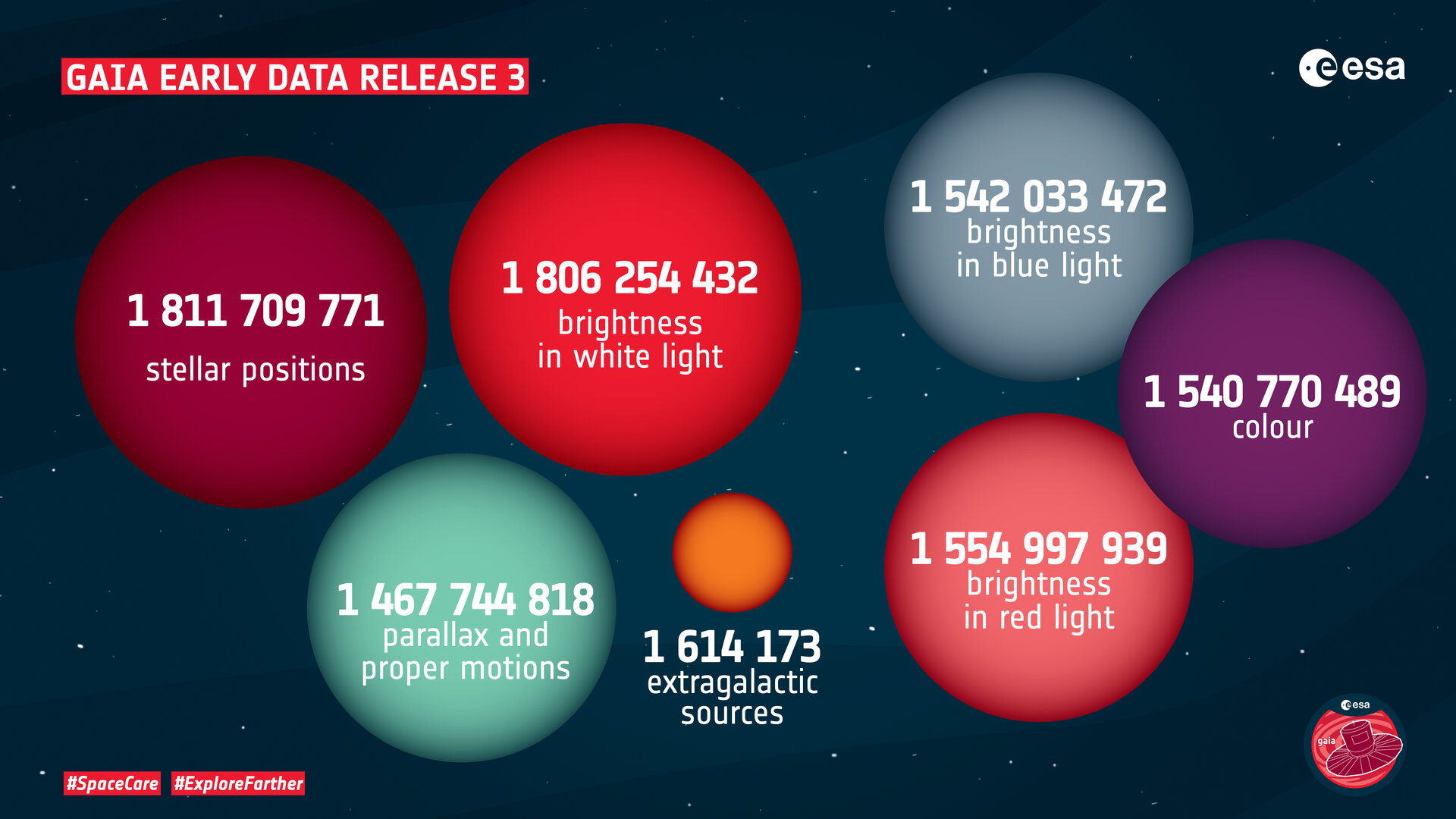
Gaia’s Early Data Release 3 in numbers

What’s new in EDR3?

Gaia EDR3 contains detailed information on more than 1.8 billion sources, detected by the Gaia spacecraft. This represents an increase of more than 100 million sources over the previous data release (Gaia DR2), which was made public in April 2018. Gaia EDR3 also contains colour information for around 1.5 billion sources, an increase of about 200 million sources over Gaia DR2. As well as including more sources, the general accuracy and precision of the measurements has also improved.

The density of stars from Gaia’s Early Data Release 3

“The new Gaia data promise to be a treasure trove for astronomers,” says Jos de Bruijne, ESA’s Gaia Deputy Project Scientist.

Gaia’s view of the Milky Way’s neighbouring galaxies

To the galactic anticentre

The new Gaia data have allowed astronomers to trace the various populations of older and younger stars out towards the very edge of our galaxy – the galactic anticentre. Computer models predicted that the disc of the Milky Way will grow larger with time as new stars are born. The new data allow us to see the relics of the 10 billion-year-old ancient disc and so determine its smaller extent compared to the Milky Way’s current disc size.

Measuring the acceleration of the Solar System with Gaia

The new data from these outer regions also strengthen the evidence for another major event in the more recent past of the galaxy.

Orbits of the nearby stars around the galaxy

The data show that in the outer regions of the disc there is a component of slow-moving stars above the plane of our galaxy that are heading downwards towards the plane, and a component of fast-moving stars below the plane that are moving upwards. This extraordinary pattern had not been anticipated before. It could be the result of the near-collision between the Milky Way and the Sagittarius dwarf galaxy that took place in our galaxy’s more recent past.

The colour of the sky from Gaia’s Early Data Release 3

The Sagittarius dwarf galaxy contains a few tens of millions of stars and is currently in the process of being cannibalised by the Milky Way. Its last close pass to our galaxy was not a direct hit, but this would have been enough so that its gravity perturbed some stars in our galaxy like a stone dropping into water.

Using Gaia DR2, members of DPAC had already found a subtle ripple in the movement of millions of stars that suggested the effects of the encounter with Sagittarius sometime between 300 and 900 million years ago. Now, using Gaia EDR3, they have uncovered more evidence that points to its strong effects on our galaxy’s disc of stars.

“The patterns of movement in the disc stars are different to what we used to believe,” says Teresa Antoja, University of Barcelona, Spain, who worked on this analysis with DPAC colleagues. Although the role of the Sagittarius dwarf galaxy is still debated in some quarters, Teresa says, “It could be a good candidate for all these disturbances, as some simulations from other authors show.”

Measuring the Solar System’s orbit

The history of the galaxy is not the only result from the Gaia EDR3 demonstration papers. DPAC members across Europe have performed other work to demonstrate the extreme fidelity of the data and the unique potential for unlimited scientific discovery.

In one paper, Gaia has allowed scientists to measure the acceleration of the Solar System with respect to the rest frame of the Universe. Using the observed motions of extremely distant galaxies, the velocity of the Solar System has been measured to change by 0.23 nm/s every second. Because of this tiny acceleration, the trajectory of the Solar System is deflected by the diameter of an atom every second, and in a year this adds up to around 115 km.  The acceleration measured by Gaia shows a good agreement with the theoretical expectations and provides the first measurement of the curvature of the Solar System’s orbit around the galaxy in the history of optical astronomy.

Exploring Gaia's 2020 data release

A new stellar census

Gaia EDR3 has also allowed a new census of stars in the solar neighbourhood to be obtained. The Gaia Catalogue of Nearby Stars contains 331 312 objects, which is estimated to be 92 percent of the stars within 100 parsecs (326 light years) of the Sun. The previous census of the solar neighbourhood, called the Gliese Catalogue of Nearby stars, was carried out in 1957. It possessed just 915 objects initially, but was updated in 1991 to 3803 celestial objects. It was also limited to a distance of 82 light years: Gaia’s census reaches four times farther and contains 100 times more stars. It also provides location, motion, and brightness measurements that are orders of magnitude more precise than the old data.

Beyond the Milky Way

A fourth demonstration paper analysed the Magellanic Clouds: two galaxies that orbit the Milky Way. Having measured the movement of the Large Magellanic Cloud’s stars to greater precision than before, Gaia EDR3 clearly shows that the galaxy has a spiral structure. The data also resolve a stream of stars that is being pulled out of the Small Magellanic Cloud, and hints at previously unseen structures in the outskirts of both galaxies.

Bridge of stars

At 12:00 CET on 3 December, the data produced by the many scientists and engineers of the Gaia DPAC Consortium become public for anyone to look at and learn from. This is the first of a two-part release; the full Data Release 3 is planned for 2022.

“Gaia EDR3 is the result of a huge effort from everyone involved in the Gaia mission. It’s an extraordinarily rich data set, and I look forward to the many discoveries that astronomers from around the world will make with this resource,” says Timo Prusti, ESA’s Gaia Project Scientist. “And we’re not done yet; more great data will follow as Gaia continues to make measurements from orbit.”

Related links:

Data Processing and Analysis Consortium (DPAC): https://www.esa.int/ESA_Multimedia/Images/2020/12/Gaia_Data_Processing_and_Analysis_Consortium

Gaia: https://sci.esa.int/web/gaia

Animation, Images, Videos, Text, Credits: ESA/Gaia/DPAC; CC BY-SA 3.0 IGO. Acknowledgement: A. Brown, S. Jordan, T. Roegiers, X. Luri, E. Masana, T. Prusti and A. Moitinho.

Best regards, Orbiter.ch

mercredi 2 décembre 2020

Astronauts (and Cosmonauts) Harvest First Radish Crop on International Space Station


ISS - Veggie Mission patch.


Dec. 2, 2020

On Nov. 30, 2020, NASA astronaut Kate Rubins harvested radish plants growing in the Advanced Plant Habitat (APH) aboard the International Space Station. She meticulously collected and wrapped in foil each of the 20 radish plants, placing them in cold storage for the return trip to Earth in 2021 on SpaceX’s 22nd Commercial Resupply Services mission.

The plant experiment, called Plant Habitat-02 (PH-02), is the first time NASA has grown radishes on the orbiting laboratory. NASA selected radishes because they are well understood by scientists and reach maturity in just 27 days. These model plants are also nutritious and edible, and are genetically similar to Arabidopsis, a small flowering plant related to cabbage that researchers frequently study in microgravity.


Image above: On Nov. 27, 2020, NASA astronaut and Expedition 64 Flight Engineer Kate Rubins checks out radish plants growing for the Plant Habitat-02 experiment that seeks to optimize plant growth in the unique environment of space and evaluate nutrition and taste of the plants. Image Credit: NASA.

“Radishes are a different kind of crop compared to leafy greens that astronauts previously grew on the space station, or dwarf wheat which was the first crop grown in the APH,” said Nicole Dufour, NASA APH program manager at Kennedy Space Center. “Growing a range of crops helps us determine which plants thrive in microgravity and offer the best variety and nutritional balance for astronauts on long-duration missions.”

The structure of the experiment will allow NASA to identify the optimum balance of care and feeding needed to produce quality plants. While growing inside the habitat, the radishes required little maintenance from the crew.


Image above: Photo documentation of the Plant Habitat-02 investigation aboard the International Space Station on Nov. 30, 2020. Plant Habitat-02 uses the Advanced Plant Habitat to cultivate radishes, a model plant that is nutritious and edible and has a short cultivation time. This research could help optimize plant growth in the unique environment of space, as well as evaluation of nutrition and taste of the plants. Image Credit: NASA.

Unlike previous experiments in NASA’s APH and Vegetable Production System (Veggie), which used porous clay material preloaded with a slow-release fertilizer, this trial relies on precisely defined quantities of provided minerals. Such precision allows for a better comparison of nutrients provided to and absorbed by the plants.  

The chamber also uses red, blue, green and broad-spectrum white LED lights to provide a variety of light to stimulate plant growth. Sophisticated control systems deliver water, while control cameras and more than 180 sensors in the chamber allow researchers at NASA’s Kennedy Space Center to monitor the plant growth as well as regulate moisture levels, temperature, and carbon dioxide (CO2) concentration.

The study’s principal investigator, Karl Hasenstein, a professor at the University of Louisiana at Lafayette, has conducted plant experiments with NASA since 1995. From this project, Hasenstein hopes to learn how space conditions like weightlessness affect plant growth, and how well the light response and metabolism resembles “Earth-grown” plants.

“Radishes provide great research possibilities by virtue of their sensitive bulb formation,” Hasenstein said. “We can grow 20 plants in the APH, analyze CO2 effects, and mineral acquisition and distribution.”

Radish Experiment Ready for Launch

The team has set up a control population of plants in the ground control plant habitat unit in the International Space Station Environmental Simulator (ISSES) chamber inside Kennedy’s Space Station Processing Facility. Radishes have been growing under nearly identical conditions in the ISSES since Nov. 17, and researchers will harvest the control crop Dec. 15 for comparison with the radishes grown on station.

This historic harvest does not mean the experiment is over, Dufour added.

“The APH has two science carriers, so shortly after the first harvest, the second carrier will be used to repeat the experiment by planting another set of radish seeds,” she said. “Replicating the plant experiment increases the sample size and improves scientific accuracy.”

The researchers credit two partner organizations with helping make the mission a success.

Hasenstein highlighted the contracted support team from Techshot. Teams from this mission, integration, and support contractor helped shape the payload from the beginning and guided it through the path to space. Project scientists also assist the principal investigator with the experiment and made it possible for researchers to interact with payloads even when they aren’t at the center.

Likewise, Dufour cited Sierra Nevada Corporation’s team in Madison, Wisconsin, for remotely monitoring the telemetry from the APH flight unit and helping tweak performance parameters. She said their dedication contributed to the success of the flight implementation.

With plans to explore the Moon and someday Mars, NASA knows astronauts will need to grow their own food to support long-duration missions far from home. As part of the Artemis program, NASA plans to establish sustainable exploration on and around the Moon by the end of the decade.

Radishes Growing in Space: 27 Days in 10 Seconds

“It’s a privilege to help lead a team that is paving the way to the future of space crop production for NASA’s exploration efforts,” Dufour said. “I’ve worked on APH since the beginning, and each new crop that we’re able to grow brings me great joy because what we learn from them will help NASA send astronauts to Mars and bring them back safely.”

The Biological and Physical Sciences (BPS) Division of NASA’s Science Mission Directorate at NASA Headquarters in Washington provides funding for Veggie, the APH, and related investigations.

Related links:

Advanced Plant Habitat (APH): https://www.nasa.gov/content/growing-plants-in-space

Vegetable Production System (Veggie): https://www.nasa.gov/sites/default/files/atoms/files/veggie_fact_sheet_508.pdf

Biological and Physical Sciences (BPS): https://science.nasa.gov/biological-physical

Sierra Nevada Corporation: https://www.sncorp.com/what-we-do/environmental-systems/

Techshot: https://techshot.com/aerospace/services/

Space Station Research and Technology: https://www.nasa.gov/mission_pages/station/research/overview.html

International Space Station (ISS): https://www.nasa.gov/mission_pages/station/main/index.html

Images (mentioned), Video (NASA), Text, Credits: NASA's John F. Kennedy Space Center, by Linda Herridge.

Best regards, Orbiter.ch

SpaceX Falcon 9 and Cargo Dragon Prepare for Rollout


SpaceX - Dragon CRS-21 Mission patch.


Dec. 2, 2020

A SpaceX Falcon 9 rocket, topped with the upgraded version of the Cargo Dragon spacecraft, is seen inside the company’s hangar at NASA’s Kennedy Space Center in Florida on Dec. 2, 2020, prior to being rolled out to the launch pad in preparation for the CRS-21 launch. The rocket and spacecraft are slated to make the short journey to the pad later this afternoon.


Image above: A SpaceX Falcon 9 rocket and Cargo Dragon spacecraft are seen inside the company’s hangar at NASA’s Kennedy Space Center in Florida on Dec. 2, 2020, prior to being rolled out to the launch pad in preparation for the 21st Commercial Resupply Services (CRS-21) launch. Liftoff is scheduled for 11:39 a.m. EST on Saturday, Dec. 5, from Kennedy’s Launch Complex 39A. Photo Credit: SpaceX.

The first launch for SpaceX under NASA’s second Commercial Resupply Services contract, CRS-21 is scheduled to lift off from Kennedy’s Launch Complex 39A on Saturday, Dec. 5, at 11:39 a.m. EST. Weather officials with the U.S. Air Force 45th Space Wing predict a 40% chance of favorable weather conditions for liftoff, with primary concerns revolving around flight through precipitation, the cumulus cloud rule, and thick cloud layer rule.

The mission will deliver critical supplies and equipment to the International Space Station. Included in that delivery are materials for a variety of science experiments, including meteorite samples and microbes, 3D engineered heart tissues, and a tool being tested for quick and accurate blood analysis in microgravity.

Related articles:

NASA and SpaceX “Go” for Dec. 5 Cargo Resupply Launch
https://orbiterchspacenews.blogspot.com/2020/11/nasa-and-spacex-go-for-dec-5-cargo.html

Hearts, Airlocks, and Asteroids: New Research Flies on 21st SpaceX Cargo Mission
https://orbiterchspacenews.blogspot.com/2020/11/hearts-airlocks-and-asteroids-new.html

Related links:

SpaceX Commercial Resupply: https://www.nasa.gov/mission_pages/station/structure/launch/spacex.html

Space Station Research and Technology: https://www.nasa.gov/mission_pages/station/research/overview.html

International Space Station (ISS): https://www.nasa.gov/mission_pages/station/main/index.html

Image (mentioned), Text, Credits: NASA/Danielle Sempsrott.

Best regards, Orbiter.ch

New Data Confirm 2020 SO to be the Upper Centaur Rocket Booster from the 1960’s


Asteroid Watch logo.


Dec. 2, 2020

Using data collected at NASA’s Infrared Telescope Facility (IRTF) and orbit analysis from the Center for Near-Earth Object Studies (CNEOS) at NASA’s Jet Propulsion Laboratory, scientists have confirmed that Near-Earth Object (NEO) 2020 SO is, in fact, a 1960’s-Era Centaur rocket booster.


Image above: In addition to supporting a variety of NASA planetary missions, NASA's Infrared Telescope Facility on Maunakea on the Big Island of Hawaii is also used to determine the composition of near-Earth objects. Image Credits: University of Hawaii Institute for Astronomy / Michael Connelley.

The object, discovered in September by astronomers searching for near-Earth asteroids from the NASA-funded Pan-STARRS1 survey telescope on Maui, garnered interest in the planetary science community due to its size and unusual orbit and was studied by observatories around the world.

Further analysis of 2020 SO’s orbit revealed the object had come close to Earth a few times over the decades, with one approach in 1966 bringing it close enough to suggest it may have originated from Earth. Comparing this data with the history of previous NASA missions, Paul Chodas, CNEOS director, concluded 2020 SO could be the Centaur upper stage rocket booster from NASA’s ill-fated 1966 Surveyor 2 mission to the Moon.

Equipped with this knowledge, a team led by Vishnu Reddy, an associate professor and planetary scientist at the Lunar and Planetary Laboratory at the University of Arizona, performed follow up spectroscopy observations of 2020 SO using NASA’s IRTF on Maunakea, Hawai’i.

“Due to extreme faintness of this object following CNEOS prediction it was a challenging object to characterize” said Reddy. “We got color observations with the Large Binocular Telescope or LBT that suggested 2020 SO was not an asteroid.”

Through a series of follow up observations, Reddy and his team analyzed 2020 SO’s composition using NASA’s IRTF and compared the spectrum data from 2020 SO with that of 301 stainless steel, the material Centaur rocket boosters were made of in the 1960’s. While not immediately a perfect match, Reddy and his team persisted, realizing the discrepancy in spectrum data could be a result of analyzing fresh steel in a lab against steel that would have been exposed to the harsh conditions of space weather for 54 years. This led Reddy and his team to do some additional investigation.

2020 SO to be the Upper Centaur Rocket Booster from the 1960’s

“We knew that if we wanted to compare apples to apples, we’d need to try to get spectral data from another Centaur rocket booster that had been in Earth orbit for many years to then see if it better matched 2020 SO’s spectrum,” said Reddy. “Because of the extreme speed at which Earth-orbiting Centaur boosters travel across the sky, we knew it would be extremely difficult to lock on with the IRTF long enough to get a solid and reliable data set.”

However, on the morning of Dec. 1, Reddy and his team pulled off what they thought would be impossible. They observed another Centaur D rocket booster from 1971 launch of a communication satellite that was in Geostationary Transfer Orbit, long enough to get a good spectrum. With this new data, Reddy and his team were able to compare it against 2020 SO and found the spectra to be consistent with each another, thus definitively concluding 2020 SO to also be a Centaur rocket booster.

“This conclusion was the result of a tremendous team effort,” said Reddy. “We were finally able to solve this mystery because of the great work of Pan-STARRS, Paul Chodas and the team at CNEOS, LBT, IRTF, and the observations around the world.”

2020 SO made its closest approach to Earth on Dec. 1, 2020 and will remain within Earth’s sphere of gravitational dominance—a region in space called the “Hill Sphere” that extends roughly 930,000 miles (1.5 million kilometers) from our planet—until it escapes back into a new orbit around the Sun in March 2021. As NASA-funded telescopes survey the skies for asteroids that could pose an impact threat to Earth, the ability to distinguish between natural and artificial objects is valuable as nations continue to explore and more artificial objects find themselves in orbit about the Sun.  Astronomers will continue to observe this particular relic from the early Space Age until it’s gone.

Related article:

Earth May Have Recaptured a 1960s-Era Rocket Booster
https://orbiterchspacenews.blogspot.com/2020/11/earth-may-have-recaptured-1960s-era.html

Related links:

NASA’s Infrared Telescope Facility (IRTF): http://irtfweb.ifa.hawaii.edu/

Center for Near-Earth Object Studies (CNEOS): https://cneos.jpl.nasa.gov/

Pan-STARRS1: https://panstarrs.stsci.edu/

Surveyor 2: https://solarsystem.nasa.gov/missions/surveyor-2/in-depth/

For more information about NASA's Planetary Defense Coordination Office, visit:

https://www.nasa.gov/planetarydefense

For asteroid and comet news and updates, follow @AsteroidWatch on Twitter:

https://twitter.com/AsteroidWatch

Images, Text, Credits: NASA/Tricia Talbert/Grey Hautaluoma/Joshua Handal.

Best regards, Orbiter.ch

NASA Confirms New SIMPLEx Mission Small Satellite to Blaze Trails Studying Lunar Surface


NASA logo.


Dec. 2, 2020

A small satellite mission to understand the lunar water cycle – detecting and mapping water on the lunar surface in order to investigate how its form, abundance, and location relate to geology – has received NASA approval to proceed with the next phase of its development.


Image above: An illustration depicts NASA’s Lunar Trailblazer spacecraft. Image Credit: Lockheed Martin.

On Nov. 24, the Lunar Trailblazer, a mission selected under NASA’s Small Innovative Missions for Planetary Exploration (SIMPLEx) program, passed its Key Decision Point-C (KDP-C) milestone, obtaining agency-level endorsement to begin final design of hardware and build. The milestone also provides the project’s official schedule and budget determination.

“Lunar Trailblazer will confirm whether water on the Moon is tightly bound in crystalline rock, as recently suggested by NASA’s SOFIA (Stratospheric Observatory for Infrared Astronomy) observations, or loosely bound and mobile as a function of temperature,” said Thomas Zurbuchen, associate administrator for science at the agency’s headquarters in Washington. “This SIMPLEx mission bolsters our portfolio of targeted science missions designed to test pioneering technologies while reducing overall costs using new streamlined processes.”

Producing the highest resolution basemaps to locate ice or water trapped in rock at the Moon’s surface, Lunar Trailblazer will help support NASA’s Artemis program, which includes establishing a sustainable presence on the Moon by the end of the decade and preparing for crewed missions to Mars.

“We’re excited to help answer big planetary science questions with a small satellite by making the new maps of water on the Moon,” said Bethany Ehlmann, the mission’s principal investigator, of Caltech. “Given the importance of water on the Moon for future robotic and human missions, Lunar Trailblazer will provide critical basemaps to guide future exploration.”

Peering into the Moon’s permanently shadowed regions, Lunar Trailblazer will detect signatures of ice in reflected light, and it will pinpoint the locations of micro-cold traps less than a football field in size. Collecting measurements at multiple times of day over sunlit regions, the mission will help scientists understand whether the water signature on the illuminated surface changes as the lunar surface temperature changes by hundreds of degrees over the course of a lunar day.

“Lunar Trailblazer will vastly advance our understanding of water cycles on airless bodies like the Moon,” said Lori Glaze, director of NASA’s Planetary Science Division at the agency’s headquarters in Washington. “By measuring both direct light and low levels of terrain-scattered light, Lunar Trailblazer will generate comprehensive maps of surface water ice, even in the Moon’s darkest regions.”

Selected in 2019, Lunar Trailblazer is the second mission from the current round of programs to receive confirmation and plans to deliver its flight system in October 2022, with a currently planned February 2025 launch. The Janus mission received its confirmation in early September 2020 and will investigate the formation and evolution of small, deep-space “rubble pile” asteroids. The Escape and Plasma Acceleration and Dynamics Explorers (EscaPADE) mission is still in formulation, with its KDP-C planned for summer of 2021.

“Lunar Trailblazer has a talented, multi-institutional team whose collective effort resulted in a successful formulation phase and confirmation review,” said Calina Seybold, Lunar Trailblazer Project manager, at NASA’s Jet Propulsion Laboratory. “I am thrilled that the team has earned the privilege of continuing to our final design and fabrication phase.”

Lunar Trailblazer is managed by NASA’s Jet Propulsion Laboratory (JPL) in Southern California as part of the Solar System Exploration Program at NASA Headquarters in Washington and guided by agency priorities and the Decadal Survey process of the National Academy of Sciences. Managed for NASA by Caltech in Pasadena, California, JPL also provides system engineering and mission assurance as well as navigation. Lockheed Martin provides the spacecraft and integrates the flight system, under contract with Caltech.

SIMPLEx mission investigations will be managed by the Planetary Missions Program Office at NASA’s Marshall Space Flight Center in Huntsville, Alabama as part of the Solar System Exploration Program at NASA Headquarters in Washington. The program conducts space science investigations in the Planetary Science Division of NASA’s Science Mission Directorate at NASA Headquarters, guided by NASA’s agency priorities and the Decadal Survey process of the National Academy of Sciences.

For information on NASA’s Lunar Trailblazer mission, visit: https://trailblazer.caltech.edu/

For information on NASA’s small satellite activities, visit: https://www.nasa.gov/smallsat-institute

Image (mentioned), Text, Credits: NASA/Tricia Talbert/Grey Hautaluoma/Alana Johnson/JPL/Ian J. O'Neill.

Greetings, Orbiter.ch

Awakening Newborn Stars


NASA & ESA - Hubble Space Telescope patch.


Dec. 2, 2020


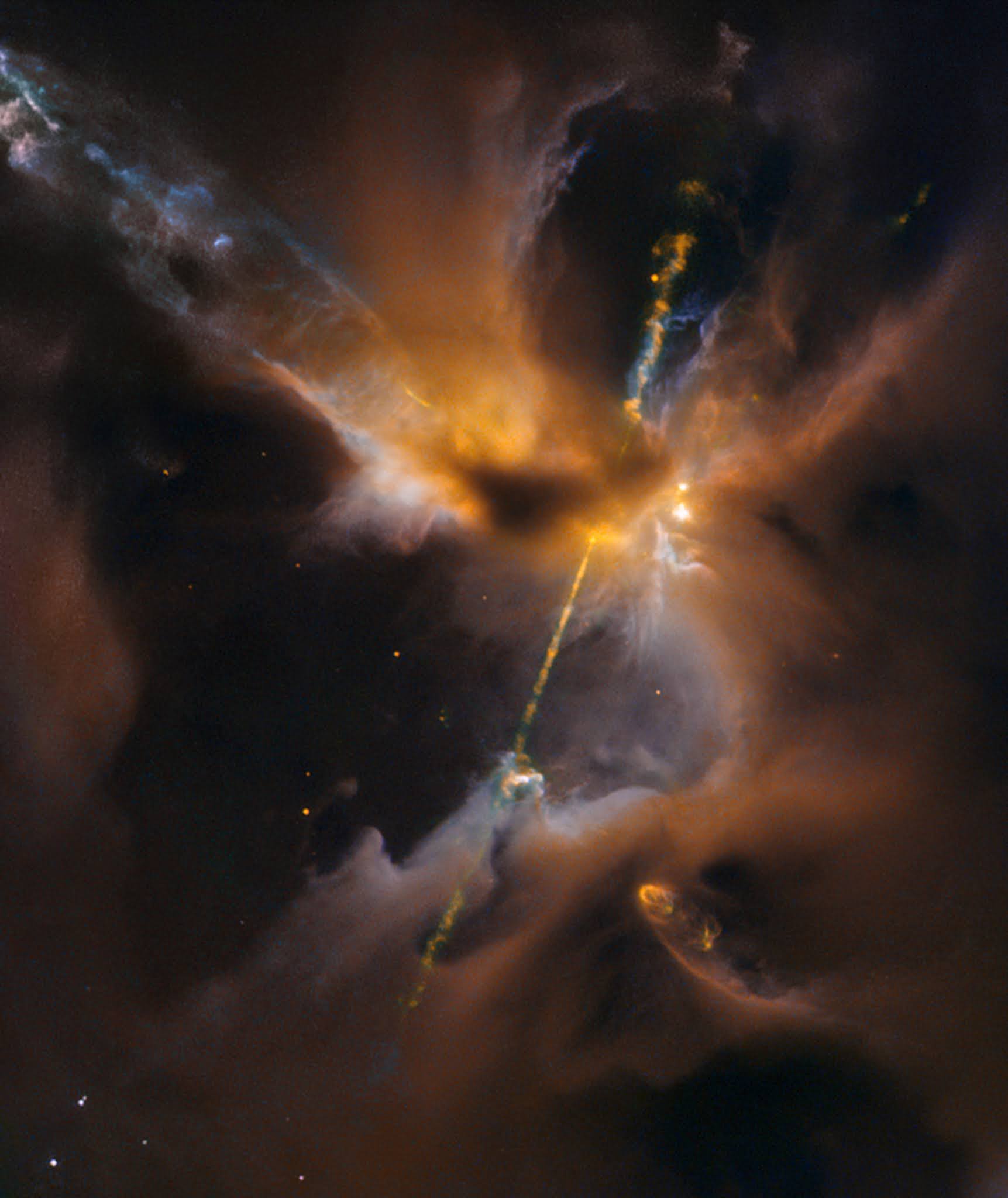
Lying inside our home galaxy, the Milky Way, this Herbig–Haro object is a turbulent birthing ground for new stars in a region known as the Orion B molecular cloud complex, located 1,350 light-years away.

Herbig–Haro (HH) objects are bright patches of nebulosity associated with newborn stars that form when narrow jets of partially ionized gas ejected by stars collide with nearby clouds of gas and dust. This image of Herbig-Haro Jet HH 24 was taken by the Hubble Space Telescope in 2015.

When stars form within giant clouds of cool molecular hydrogen, some of the surrounding material collapses under gravity to form a rotating, flattened disk encircling the newborn star.

Although planets will later congeal in the disk, at this early stage the protostar is feeding on the disk with a voracious appetite. Gas from the disk rains down onto the protostar and engorges it. Superheated material spills away and is shot outward from the star in opposite directions along an uncluttered escape route – the star's rotation axis.

Shock fronts develop along the jets and heat the surrounding gas to thousands of degrees Fahrenheit. The jets collide with the surrounding gas and dust and clear vast spaces, like a stream of water plowing into a hill of sand.

Hubble Space Telescope (HST)

For more information about Hubble, visit:

http://hubblesite.org/

http://www.nasa.gov/hubble

http://www.spacetelescope.org/

Image, Animation, Text Credits: NASA/Yvette Smith, ESA, the Hubble Heritage (STScI/AURA)/Hubble-Europe (ESA) Collaboration, D. Padgett (GSFC), T. Megeath (University of Toledo), and B. Reipurth (University of Hawaii).

Greetings, Orbiter.ch