mercredi 13 janvier 2021

NASA’s Juno Mission Expands Into the Future


NASA - JUNO Mission logo.


Jan. 13, 2021

The spacecraft, which has been gathering data on the gas giant since July 2016, will become an explorer of the full Jovian system – Jupiter and its rings and moons.


Image above: This view from the JunoCam imager on NASA’s Juno spacecraft shows two storms merging. The two white ovals seen within the orange-colored band left of center are anticyclonic storms – that is, storms that rotate counterclockwise. The image was taken on Dec. 26, 2019. Image Credits: NASA/JPL-Caltech/SwRI/MSSS Image processing by Tanya Oleksuik, © CC BY.

NASA has authorized a mission extension for its Juno spacecraft exploring Jupiter. The agency’s most distant planetary orbiter will now continue its investigation of the solar system’s largest planet through September 2025, or until the spacecraft’s end of life. This expansion tasks Juno with becoming an explorer of the full Jovian system – Jupiter and its rings and moons – with multiple rendezvous planned for three of Jupiter’s most intriguing Galilean moons: Ganymede, Europa, and Io.

“Since its first orbit in 2016, Juno has delivered one revelation after another about the inner workings of this massive gas giant,” said principal investigator Scott Bolton of the Southwest Research Institute in San Antonio. “With the extended mission, we will answer fundamental questions that arose during Juno’s prime mission while reaching beyond the planet to explore Jupiter’s ring system and Galilean satellites.”

Proposed in 2003 and launched in 2011, Juno arrived at Jupiter on July 4, 2016. The prime mission will be completed in July 2021. The extended mission involves 42 additional orbits, including close passes of Jupiter’s north polar cyclones; flybys of Ganymede, Europa, and Io; as well as the first extensive exploration of the faint rings encircling the planet.


Image above: NASA has extended the mission of its Juno spacecraft exploring Jupiter. The extended mission involves 42 additional orbits, expands on discoveries Juno has already made and adds exploration of the rings encircling the planet as well as flybys of Ganymede, Europa, and Io. Image Credits: NASA/JPL-Caltech/SwRI.

“By extending the science goals of this important orbiting observatory, the Juno team will start tackling a breadth of science historically required of flagships,” said Lori Glaze, planetary science division director at NASA Headquarters in Washington. “This represents an efficient and innovative advance for NASA’s solar system exploration strategy.”

The data Juno collects will contribute to the goals of the next generation of missions to the Jovian system – NASA’s Europa Clipper and the ESA (European Space Agency) JUpiter ICy moons Explorer (JUICE) mission. Juno’s investigation of Jupiter’s volcanic moon Io addresses many science goals identified by the National Academy of Sciences for a future Io explorer mission.

The extended mission’s science campaigns will expand on discoveries Juno has already made about Jupiter’s interior structure, internal magnetic field, atmosphere (including polar cyclones, deep atmosphere, and aurora), and magnetosphere.

JUNO spacecraft orbiting Jupiter. Animation Credit: NASA

“With this extension, Juno becomes its own follow-on mission,” said Steve Levin, Juno project scientist at NASA’s Jet Propulsion Laboratory in Southern California. “Close-up observations of the pole, radio occultations” – a remote sensing technique to measure properties of a planetary atmosphere or ring systems – “satellite flybys, and focused magnetic field studies combine to make a new mission, the next logical step in our exploration of the Jovian system.”

Jupiter’s enigmatic Great Blue Spot, an isolated patch of intense magnetic field near the planet’s equator, will be the target of a high-spatial-resolution magnetic survey during six flybys early in the extended mission. As Juno’s orbit evolves, multiple flybys of the moons Ganymede (2), Europa (3), and Io (11) are planned, as well as multiple passages through Jupiter’s tenuous rings.

Juno will also fly through the Europa and Io tori – ring-shaped clouds of ions – on multiple occasions, characterizing the radiation environment near these satellites to better prepare the Europa Clipper and JUICE missions for optimizing observation strategies and planning, science priorities, and mission design. The extended mission also adds planetary geology and ring dynamics to Juno’s extensive list of science investigations.

An Evolving Orbit

The natural evolution of Juno’s orbit around the gas giant provides the wealth of new science opportunities that the extended mission capitalizes on. Every science pass sends the solar-powered spacecraft zooming low over Jupiter’s cloud tops, collecting data from a unique vantage point no other spacecraft has enjoyed.

The point during each orbit where Juno comes closest to the planet is called perijove (or PJ). Over the course of the mission, Juno’s perijoves have migrated northward, dramatically improving resolution over the northern hemisphere. The design of the extended mission takes advantage of the continued northward migration of these perijoves to sharpen its view of the multiple cyclones encircling the north pole while incorporating ring and Galilean moon flybys.

“The mission designers have done an amazing job crafting an extended mission that conserves the mission’s single most valuable onboard resource – fuel,” said Ed Hirst, the Juno project manager at JPL. “Gravity assists from multiple satellite flybys steer our spacecraft through the Jovian system while providing a wealth of science opportunities.” The satellite flybys also reduce Juno’s orbital period, which increases the total number of science orbits that can be obtained.”

The satellite encounters begin with a low-altitude flyby of Ganymede on June 7, 2021 (PJ34), which reduces the orbital period from about 53 days to 43 days. That flyby sets up a close flyby of Europa on Sept. 29, 2022 (PJ45), reducing the orbital period further to 38 days. A pair of close Io flybys, on Dec. 30, 2023 (PJ57), and Feb. 3, 2024 (PJ58), combine to reduce the orbital period to 33 days.

More About the Mission

JPL, a division of Caltech in Pasadena, California, manages the Juno mission for the principal investigator, Scott J. Bolton, of the Southwest Research Institute in San Antonio. Juno is part of NASA’s New Frontiers Program, which is managed at NASA’s Marshall Space Flight Center in Huntsville, Alabama, for the agency’s Science Mission Directorate in Washington. Lockheed Martin Space in Denver built and operates the spacecraft.

Related article:

NASA Extends Exploration for Two Planetary Science Missions
https://orbiterchspacenews.blogspot.com/2021/01/nasa-extends-exploration-for-two.html

More information about Juno is available at:

https://www.nasa.gov/juno

https://www.missionjuno.swri.edu

Images (mentioned), Animation (mentioned), Text, Credits: NASA/Tony Greicius/Grey Hautaluoma/Alana Johnson/JPL/DC Agle/Southwest Research Institute/Deb Schmid.

Greetings, Orbiter.ch

New Horizons Spacecraft Answers Question: How Dark Is Space?


NASA - New Horizon Mission patch.


Jan. 13, 2021

How dark does space get? If you get away from city lights and look up, the sky between the stars appears very dark indeed. Above the Earth’s atmosphere, outer space dims even further, fading to an inky pitch-black. And yet even there, space isn’t absolutely black. The universe has a suffused feeble glimmer from innumerable distant stars and galaxies.


Image above: This artist’s illustration shows NASA’s New Horizons spacecraft in the outer solar system. In the background lies the Sun and a glowing band representing zodiacal light, caused by sunlight reflecting off of dust. Image Credits: Joe Olmsted/STScI.

New measurements of that weak background glow show that the unseen galaxies are less plentiful than some theoretical studies suggested, numbering only in the hundreds of billions rather than the previously reported two trillion galaxies.

“It’s an important number to know – how many galaxies are there?” said Marc Postman of the Space Telescope Science Institute in Baltimore, Maryland, a lead author on the study. “We simply don’t see the light from two trillion galaxies.”

The earlier estimate was extrapolated from very deep sky observations by NASA’s Hubble Space Telescope. It relied on mathematical models to estimate how many galaxies were too small and faint for Hubble to see. That team concluded that 90% of the galaxies in the universe were beyond Hubble’s ability to detect in visible light. The new findings, which relied on measurements from NASA’s distant New Horizons mission, suggest a much more modest number, consistent with older Hubble data.

“Take all the galaxies Hubble can see, double that number, and that’s what we see – but nothing more,” said Tod Lauer of NSF’s NOIRLab, a lead author on the study.

These results were presented on Wednesday, Jan. 13, at the 237th meeting of the American Astronomical Society, which is open to registered participants.

The cosmic optical background that the team sought to measure is the visible-light equivalent of the more well-known cosmic microwave background – the weak afterglow of the big bang itself, before stars ever existed.

“While the cosmic microwave background tells us about the first 450,000 years after the big bang, the cosmic optical background tells us something about the sum total of all the stars that have ever formed since then,” explained Postman. “It puts a constraint on the total number of galaxies that have been created, and where they might be in time.”

As powerful as Hubble is, the team couldn’t use it to make these observations. Although located in space, Hubble orbits Earth and still suffers from light pollution. The inner solar system is filled with tiny dust particles from disintegrated asteroids and comets. Sunlight reflects off those particles, creating a glow called the zodiacal light that can be observed even by skywatchers on the ground.

To escape the zodiacal light, the team had to use an observatory that has escaped the inner solar system. Fortunately,the New Horizons spacecraft, which has delivered the closest ever images of Pluto and the Kuiper Belt object Arrokoth, is far enough to make these measurements. At its distance (more than 4 billion miles away when these observations were taken), New Horizons experiences an ambient sky 10 times darker than the darkest sky accessible to Hubble.

New Horizon sending data to Earth. Animation Credit: NASA

“These kinds of measurements are exceedingly difficult. A lot of people have tried to do this for a long time,” said Lauer. “New Horizons provided us with a vantage point to measure the cosmic optical background better than anyone has been able to do it.”

The team analyzed existing images from the New Horizons archives. To tease out the feeble background glow, they had to correct for a number of other factors. For example, they subtracted the light from the galaxies expected to exist that are too faint to be identifiable. The most challenging correction was removing light from Milky Way stars that was reflected off interstellar dust and into the camera.

The remaining signal, though extremely faint, was still measurable. Postman compared it to living in a remote area far from city lights, lying in your bedroom at night with the curtains open. If a neighbor a mile down the road opened their refrigerator looking for a midnight snack, and the light from their refrigerator reflected off the bedroom walls, it would be as bright as the background New Horizons detected.

So, what could be the source of this leftover glow? It’s possible that an abundance of dwarf galaxies in the relatively nearby universe lie just beyond detectability. Or the diffuse halos of stars that surround galaxies might be brighter than expected. There might be a population of rogue, intergalactic stars spread throughout the cosmos. Perhaps most intriguing, there may be many more faint, distant galaxies than theories suggest. This would mean that the smooth distribution of galaxy sizes measured to date rises steeply just beyond the faintest systems we can see – just as there are many more pebbles on a beach than rocks.

NASA’s upcoming James Webb Space Telescope may be able to help solve the mystery. If faint, individual galaxies are the cause, then Webb ultra-deep field observations should be able to detect them.

This study is accepted for publication in the Astrophysical Journal.

Related links:

Hubble Space Telescope (HST): https://www.nasa.gov/mission_pages/hubble/main/index.html

New Horizons: http://www.nasa.gov/mission_pages/newhorizons/main/index.html

Image (mentioned), Animation (mentioned), Text, Credits: NASA/Tricia Talbert/Space Telescope Science Institute/Christine Pulliam.

Greetings, Orbiter.ch

NASA Missions Unmask Magnetar Eruptions in Nearby Galaxies


NASA Goddard Space Flight Center logo.


Jan. 13, 2021

On April 15, 2020, a brief burst of high-energy light swept through the solar system, triggering instruments on several NASA and European spacecraft. Now, multiple international science teams conclude that the blast came from a supermagnetized stellar remnant known as a magnetar located in a neighboring galaxy.

This finding confirms long-held suspicions that some gamma-ray bursts (GRBs) – cosmic eruptions detected in the sky almost daily – are in fact powerful flares from magnetars relatively close to home.

NASA Missions Unveil Magnetar Eruptions in Nearby Galaxies

Video above: A pulse of X-rays and gamma rays lasting just 140 milliseconds swept across the solar system on April 15, 2020. The event was a giant flare from a magnetar, a type of city-sized stellar remnant that boasts the strongest magnetic fields known. Watch to learn more. Video Credits: NASA’s Goddard Space Flight Center.

“This has always been regarded as a possibility, and several GRBs observed since 2005 have provided tantalizing evidence,” said Kevin Hurley, a Senior Space Fellow with the Space Sciences Laboratory at the University of California, Berkeley, who joined several scientists to discuss the burst at the virtual 237th meeting of the American Astronomical Society. “The April 15 event is a game changer because we found that the burst almost certainly lies within the disk of the nearby galaxy NGC 253.”

Papers analyzing different aspects of the event and its implications were published on Jan. 13 in the journals Nature and Nature Astronomy.

GRBs, the most powerful explosions in the cosmos, can be detected across billions of light-years. Those lasting less than about two seconds, called short GRBs, occur when a pair of orbiting neutron stars – both the crushed remnants of exploded stars – spiral into each other and merge. Astronomers confirmed this scenario for at least some short GRBs in 2017, when a burst followed the arrival of gravitational waves – ripples in space-time – produced when neutron stars merged 130 million light-years away.

Magnetars are neutron stars with the strongest-known magnetic fields, with up to a thousand times the intensity of typical neutron stars and up to 10 trillion times the strength of a refrigerator magnet. Modest disturbances to the magnetic field can cause magnetars to erupt with sporadic X-ray bursts for weeks or longer.

Rarely, magnetars produce enormous eruptions called giant flares that produce gamma rays, the highest-energy form of light.

Most of the 29 magnetars now cataloged in our Milky Way galaxy exhibit occasional X-ray activity, but only two have produced giant flares. The most recent event, detected on Dec. 27, 2004, produced measurable changes in Earth’s upper atmosphere despite erupting from a magnetar located about 28,000 light-years away.

Shortly before 4:42 a.m. EDT on April 15, 2020, a brief, powerful burst of X-rays and gamma rays swept past Mars, triggering the Russian High Energy Neutron Detector aboard NASA’s Mars Odyssey spacecraft, which has been orbiting the Red Planet since 2001. About 6.6 minutes later, the burst triggered the Russian Konus instrument aboard NASA’s Wind satellite, which orbits a point between Earth and the Sun located about 930,000 miles (1.5 million kilometers) away. After another 4.5 seconds, the radiation passed Earth, triggering instruments on NASA’s Fermi Gamma-ray Space Telescope, as well as on the European Space Agency’s INTEGRAL satellite and Atmosphere-Space Interactions Monitor (ASIM) aboard the International Space Station.

The eruption occurred beyond the field of view of the Burst Alert Telescope (BAT) on NASA’s Neil Gehrels Swift Observatory, so its onboard computer did not alert astronomers on the ground. However, thanks to a new capability called the Gamma-ray Urgent Archiver for Novel Opportunities (GUANO), the Swift team can beam back BAT data when other satellites trigger on a burst. Analysis of this data provided additional insight into the event.

The pulse of radiation lasted just 140 milliseconds – as fast as the blink of an eye or a finger snap.


Image above: The giant flare, cataloged as GRB 200415A, reached detectors on different NASA spacecraft at different times. Each instrument pair established its possible location in different swaths of the sky, but the bands intersect in the central part of the bright spiral galaxy NGC 253. This is the most precise position yet established for a magnetar located well beyond our galaxy. Image Credits: NASA's Goddard Space Flight Center and Adam Block/Mount Lemmon SkyCenter/University of Arizona.

The Fermi, Swift, Wind, Mars Odyssey and INTEGRAL missions all participate in a GRB-locating system called the InterPlanetary Network (IPN). Now funded by the Fermi project, the IPN has operated since the late 1970s using different spacecraft located throughout the solar system. Because the signal reached each detector at different times, any pair of them can help narrow down a burst’s location in the sky. The greater the distances between spacecraft, the better the technique’s precision.

The IPN placed the April 15 burst, called GRB 200415A, squarely in the central region of NGC 253, a bright spiral galaxy located about 11.4 million light-years away in the constellation Sculptor. This is the most precise sky position yet determined for a magnetar located beyond the Large Magellanic Cloud, a satellite of our galaxy and host to a giant flare in 1979, the first ever detected.

Giant flares from magnetars in the Milky Way and its satellites evolve in a distinct way, with a rapid rise to peak brightness followed by a more gradual tail of fluctuating emission. These variations result from the magnetar’s rotation, which repeatedly brings the flare location in and out of view from Earth, much like a lighthouse.

Observing this fluctuating tail is conclusive evidence of a giant flare. Seen from millions of light-years away, though, this emission is too dim to detect with today’s instruments. Because these signatures are missing, giant flares in our galactic neighborhood may be masquerading as much more distant and powerful merger-type GRBs.

A detailed analysis of data from Fermi’s Gamma-ray Burst Monitor (GBM) and Swift’s BAT provides strong evidence that the April 15 event was unlike any burst associated with mergers, noted Oliver Roberts, an associate scientist at Universities Space Research Association’s Science and Technology Institute in Huntsville, Alabama, who led the study.

In particular, this was the first giant flare known to occur since Fermi’s 2008 launch, and the GBM’s ability to resolve changes at microsecond timescales proved critical. The observations reveal multiple pulses, with the first one appearing in just 77 microseconds – about 13 times the speed of a camera flash and nearly 100 times faster than the rise of the fastest GRBs produced by mergers. The GBM also detected rapid variations in energy over the course of the flare that have never been observed before.

“Giant flares within our galaxy are so brilliant that they overwhelm our instruments, leaving them to hang onto their secrets,” Roberts said. “For the first time, GRB 200415A and distant flares like it allow our instruments to capture every feature and explore these powerful eruptions in unparalleled depth.”

Giant flares are poorly understood, but astronomers think they result from a sudden rearrangement of the magnetic field. One possibility is that the field high above the surface of the magnetar may become too twisted, suddenly releasing energy as it settles into a more stable configuration. Alternatively, a mechanical failure of the magnetar’s crust – a starquake – may trigger the sudden reconfiguration.

Roberts and his colleagues say the data show some evidence of seismic vibrations during the eruption. The highest-energy X-rays recorded by Fermi’s GBM reached 3 million electron volts (MeV), or about a million times the energy of blue light, itself a record for giant flares. The researchers say this emission arose from a cloud of ejected electrons and positrons moving at about 99% the speed of light. The short duration of the emission and its changing brightness and energy reflect the magnetar’s rotation, ramping up and down like the headlights of a car making a turn. Roberts describes it as starting off as an opaque blob – he pictures it as resembling a photon torpedo from the “Star Trek” franchise – that expands and diffuses as it travels.

The torpedo also factors into one of the event’s biggest surprises. Fermi’s main instrument, the Large Area Telescope (LAT), also detected three gamma rays, with energies of 480 MeV, 1.3 billion electron volts (GeV), and 1.7 GeV – the highest-energy light ever detected from a magnetar giant flare. What’s surprising is that all of these gamma rays appeared long after the flare had diminished in other instruments.

Nicola Omodei, a senior research scientist at Stanford University in California, led the LAT team investigating these gamma rays, which arrived between 19 seconds and 4.7 minutes after the main event. The scientists conclude that this signal most likely comes from the magnetar flare. “For the LAT to detect a random short GRB in the same region of the sky and at nearly the same time as the flare, we would have to wait, on average, at least 6 million years,” he explained.

Magnetar Giant Flare Produces Gamma Rays

Video above: Astronomers explain the observations of GRB 200415A with the sequence of events illustrated here. A sudden reconfiguration of the magnetar's magnetic field produced a quick, powerful pulse of X-rays and gamma rays. The event also ejected a blob of matter, which followed the pulse traveling at about 99% the speed of light. After a few days, they both reached the boundary, called a bow shock, where a steady outflow from the magnetar causes a pile-up of interstellar gas. Light from the flare passed through, followed many seconds later by the ejected cloud. The fast-moving matter interacted with gas at the bow shock, creating shock waves that accelerated particles and produced high-energy gamma rays. This accounts for the delay in the arrival of the most energetic gamma rays detected by NASA's Fermi spacecraft. Video Credits: NASA’s Goddard Space Flight Center/Chris Smith (USRA/GESTAR).

A magnetar produces a steady outflow of fast-moving particles. As it moves through space, this outflow plows into, slows, and diverts interstellar gas. The gas piles up, becomes heated and compressed, and forms a type of shock wave called a bow shock.

In the model proposed by the LAT team, the flare’s initial pulse of gamma rays travels outward at the speed of light, followed by the cloud of ejected matter, which is moving nearly as fast. After several days, they both reach the bow shock. The gamma rays pass through. Seconds later, the cloud of particles – now expanded into a vast, thin shell – collides with accumulated gas at the bow shock. This interaction creates shock waves that accelerate particles, producing the highest-energy gamma rays after the main burst.  

The April 15 flare proves that these events constitute their own class of GRBs. Eric Burns, an assistant professor of physics and astronomy at Louisiana State University in Baton Rouge, led a study investigating additional suspects using data from numerous missions. The findings will appear in The Astrophysical Journal Letters. Bursts near the galaxy M81 in 2005 and the Andromeda galaxy (M31) in 2007 had already been suggested to be giant flares, and the team additionally identified a flare in M83, also seen in 2007 but newly reported. Add to these the giant flare from 1979 and those observed in our Milky Way in 1998 and 2004.

“It’s a small sample, but we now have a better idea of their true energies, and how far we can detect them,” Burns said. “A few percent of short GRBs may really be magnetar giant flares. In fact, they may be the most common high-energy outbursts we’ve detected so far beyond our galaxy – about five times more frequent than supernovae.”

Related links:

InterPlanetary Network (IPN): http://www.ssl.berkeley.edu/ipn3/

Atmosphere-Space Interactions Monitor (ASIM): https://www.esa.int/Science_Exploration/Human_and_Robotic_Exploration/Research/Atmosphere_Space_Interactions_Monitor

Gamma-ray Urgent Archiver for Novel Opportunities (GUANO): https://iopscience.iop.org/article/10.3847/1538-4357/aba94f

Mars Odyssey: https://mars.nasa.gov/odyssey/

Wind satellite: https://www.nasa.gov/wind/

Russian Konus instrument: https://asd.gsfc.nasa.gov/konus/

INTEGRAL satellite: https://sci.esa.int/web/integral

Swift: http://www.nasa.gov/mission_pages/swift/main/index.html

Fermi Gamma-ray Space Telescope: http://www.nasa.gov/mission_pages/GLAST/main/index.html

Goddard Space Flight Center (GSFC): https://www.nasa.gov/centers/goddard/home/index.html

Image (mentioned), Videos (mentioned), Text, Credits: NASA/GSFC/By Francis Reddy/Claire Andreoli.

Best regards, Orbiter.ch

Scientists Observe Cells Responding To Magnetic Fields For First Time


Astrobiology logo.


Jan. 13, 2021

Many animals are known to navigate by sensing the Earth’s magnetic field, including bacteria, birds, bats, eels and whales. Some observations suggests that even dogs and cows sense the Earth's magnetic field. But exactly how magnetoreception – the ability to detect magnetic fields – works remains a mystery. Some bacteria use magnetite crystals, a magnetic iron-oxide, like a compass needle to follow the magnetic field lines. However, vertebrates don’t possess such structures inside their cells. Another leading hypothesis involves chemical reactions induced in cells by a magnetic field. If certain molecules are excited, electrons can jump between them to their neighbors. Magnetic fields can influence the speed of this exchange, affecting the chemical behavior of the molecule. This effect could slow down or speed up certain chemical reactions that change an animals’ behavior.

Artwork of the Earth's core and magnetosphere. Image Credit: NASA

In the living cells of animals with magnetoreception, proteins called cryptochromes are thought to be such magnetic field sensitive molecules. Cryptochromes are a class of photoactive pigments found in plants and animals. When they absorb light, they emit an electromagnetic signal. Based on this property, researchers believe that they are also sensitive to magnetic fields.

Now, for the first time ever, a team of researchers at the University of Tokyo directly observed cryptochromes responding to magnetic fields in a living cell. The research was published in the journal Proceedings of the National Academy of Sciences.

Using a special optical microscope, sensitive to faint flashes of light, the team watched a culture of human cells containing a special pigment used to dye proteins like cryptochromes. The researchers irradiated the cells with blue light under the microscope so that their dyed proteins fluoresced, then swept a magnetic field over them every four seconds. And each time it swept over them, the fluorescence of the cells dropped by about 3.5 percent in response to the protein's activity. The magnetic field used in the experiments was about the same as a regular fridge magnet, which is much stronger than the Earth’s natural field.

Image above: A cell's fluorescence dimming as a magnetic field passes over it. Image Credit: Ikeya et al. 2020.

The Earth's magnetic field is a result of the movement or convection of liquid iron in the outer core. As the liquid metal in the outer core moves, it generates electric currents, which lead to a magnetic field. Earth's magnetic field plays a vital role in protecting the Earth from the Sun's harsh solar wind, and provides a world-spanning grid useful for navigation. So it's not too surprising that organisms developed a sense to detect it.

In human cells, cyrptochromes act as a molecular clock, using sunlight to synchronize the body's function with the solar day. In species of migratory birds, cyrptochromes levels are especially high in specialized cells found in the retina, the light receptive part of the eye. Biologists already suspected that these cells react to changes in the electromagnetic field, and birds use the variability and orientation of Earth's magnetic field to navigate. This new study provides first direct evidence on how birds and other migratory species may do it. How magnetic fields could indirectly affect other biological processes, or even humans, remains to be seen.

Related link:

Proceedings of the National Academy of Sciences: https://www.pnas.org/content/118/3/e2018043118

Images (mentioned), Text, Credits: Forbes/David Bressan.

Greetings, Orbiter.ch

A million X-ray sources in the "northern" half of the sky


ROSCOSMOS & DLR - Spetrum-RG orbital X-ray observatory patch.


Jan. 13, 2021

By mid-December 2020, the Russian orbital X-ray observatory Spectrum-RG completed the second sky survey. The addition of these two surveys makes it possible to almost double the sensitivity of the X-ray maps received by the observatory's telescopes.


Image above: RGB-map of the sky, built by the SRG / EROSITA telescope based on the sum of the first two sky surveys (c) Gilfanov, Medvedev, Sunyaev and the Russian consortium eROSITA, 2021.

“According to the eROSITA telescope, we see about a million sources that are located on the hemisphere for which Russian scientists are responsible for processing the data. Of these, about 200,000 are stars located in our Galaxy, active in the X-ray range. " - says Corresponding Member of the Russian Academy of Sciences Marat Gilfanov, employee of the Space Research Institute of the Russian Academy of Sciences.

“This is a colossal amount of data that is first encountered by X-ray astronomers. The sky appears amazing and "alive", we see that in six months between two scans of the sky many tens of thousands of X-ray sources have changed their brightness. Every day, exploring a large circle in the sky just one degree wide, we discover the variability of hundreds of sources that were dimmer or, on the contrary, bright just six months ago, "says academician Rashid Sunyaev, scientific director of the Russian Spectrum-RG observatory.

About 20% of all sources discovered by the eROSITA telescope are stars in our Galaxy, with very hot corona like the sun, but much brighter. Accordingly, X-ray flares on these stars are much brighter than on the Sun. The eROSITA data also contain a wealth of information on instabilities in accretion disks around supermassive black holes, which regulate the flow of accreting matter to them. eROSITA detects blazars in which relativistic jets emit - jets of matter ejected from the vicinity of supermassive black holes at speeds close to the speed of light.

Spectrum-RG & eROSITA orbital X-ray observatory

The astrometric satellite Gaia operates in the same halo orbit around the L2 point "not far" from the Spektr-RG observatory. The observatory is equipped with a specialized optical telescope and monitors the proper motion of more than a billion stars in our Galaxy. Relatively recently, the scientific group of the Gaia telescope published new catalogs of stars and changes in their position, obtained from the results of a five-year scan of the Galaxy. All objects in our Galaxy have been registered that are bright enough in the optical range of the spectrum and have changed their position in the sky by one or two milliseconds of an arc during this time.

At the same time, extragalactic objects - quasars and active galactic nuclei are located at much greater distances from us and therefore remain stationary for observers from Earth in the celestial sphere. Comparison of the catalog of X-ray sources "Spectrum-RG" with the catalog of Gaia objects, as well as with the results of measurements of their proper motions, makes it possible to distinguish between extragalactic sources and stars in our Galaxy, whose corona is bright in X-rays. The fact that the energy flux of their optical and infrared radiation is much higher than in the X-ray range also helps to distinguish stars. For most quasars and active galactic nuclei, this ratio is much smaller.

“We are working on catalogs of X-ray sources so that all astronomers working in other ranges of the spectrum can immediately check how an object of interest behaves in X-rays,” continues Academician Sunyaev.

“The data obtained allowed us to increase the contrast of the multicolor X-ray sky map that the eROSITA telescope continues to accumulate. A number of structures found on the map of the first survey, for example, the southern bubble eROSITA (in galactic coordinates), are seen more clearly, and now they can be examined in detail, ”says Marat Gilfanov.


Image above: RGB map of the sky area covered during the first three weeks of scanning, which began in mid-December 2020, by the SRG / eROSITA telescope (c) 2021 Gilfanov, Medvedev, Sunyaev and the Russian consortium eROSITA.

Recall that the "eROSITA bubbles" are gigantic structures tens of thousands of light years across, that is, comparable to the diameter of the Galaxy. The sky map obtained by the eROSITA telescope after the first survey of the sky and, in particular, the detection of the southern bubble, proved that their appearance is associated with activity in the center of our Galaxy tens of millions of years ago.

Three weeks ago, the Russian observatory Spectrum-RG began the third survey of the sky (out of eight planned). Scanned for the third time already more than 5000 square degrees in the celestial sphere. The eROSITA telescope, manufactured by the Max Planck Institute for Extraterrestrial Physics in Germany, continues to accumulate X-ray photons, discover new sources of X-ray radiation and monitor changes in their brightness. The enterprises of the State Corporation "Roscosmos" control the satellite, antennas for long-distance space communications receive scientific data every day and send commands to the satellite and scientific instruments located at a distance of one and a half million kilometers from the Earth (four times farther than the Moon). Scientists from IKI RAS are processing scientific data on powerful computers in the project data center.

Related article & links:

Milky Way on x-ray sky map
https://orbiterchspacenews.blogspot.com/2020/06/milky-way-on-x-ray-sky-map.html

ROSCOSMOS Press Release: https://www.roscosmos.ru/29814/

Spectrum-RG: http://roscosmos.ru/srg/

Images, Text, Credits: ROSCOSMOS/Orbiter.ch Aerospace/Roland Berga.

Best regards, Orbiter.ch

Muscles, metals, bubbles and rotifers – a month of European science in space


ESA - Columbus Laboratory Module patch.


Jan. 13, 2021

Columbus Laboratory (Cutaway view)

The month of December comes with holidays for many, but for the International Space Station and mission controls around the world, science never rests.

SpaceX cargo spacecraft CRS-21 arrives at Space Station

The arrival of the 21st cargo spaceship Dragon on 7 December brought new experiments to unpack and prepare, while the impending return of SpaceX CRS-21 meant others needed to be completed and readied for a journey back to Earth. Join us as we look back on at the last month of 2020, and European research activities, 400 km overhead.

COVID research in space

ICE Cube commercial COVID-19 experiment

The first COVID-19 drug research in space started operations in the European commercial ICE-Cubes facility in December. By examining this medicine in microgravity, researcher aim to better understand how Remdesivir interacts with its delivery substance cyclodextrin so that the drug’s efficiency can be improved. This commercial research from Hungarian companies was installed next to other commercial cube experiments that continued to run in the facility, these include an art project from the International Space University, a test of how standard consumer equipment handles the radiation found in space, and an ESA test of cyber-security in space.

ICE Cube facility modules

Metals

Shannon Walker in Columbus

On 3 December NASA astronaut Shannon Walker prepared ESA’s Materials Science Lab for a run of the Metcomp experiment by removing a finished cartridge with metal alloys. Copper and tin alloys are being melted and studied as they solidify to improve mathematical models of the process. The knowledge gained will allow for better industrial production of these metals on Earth. The new run with different alloys run was finished on 17 December and set aside for return to Earth on SpaceX CRS-21.

Bubbles

Bubbles from Multiscale Boiling experiment on Space Station

Meanwhile, the Multiscale Boiling experiment is well into its second round of experiments that looks at how bubbles transfer heat. On 14 December a bonus run was conducted that focusses on shear flow and electrical fields. The facility will continue to run until January before it is placed in storage.

Wheel animals

Preparing Rotifer-2 experiment

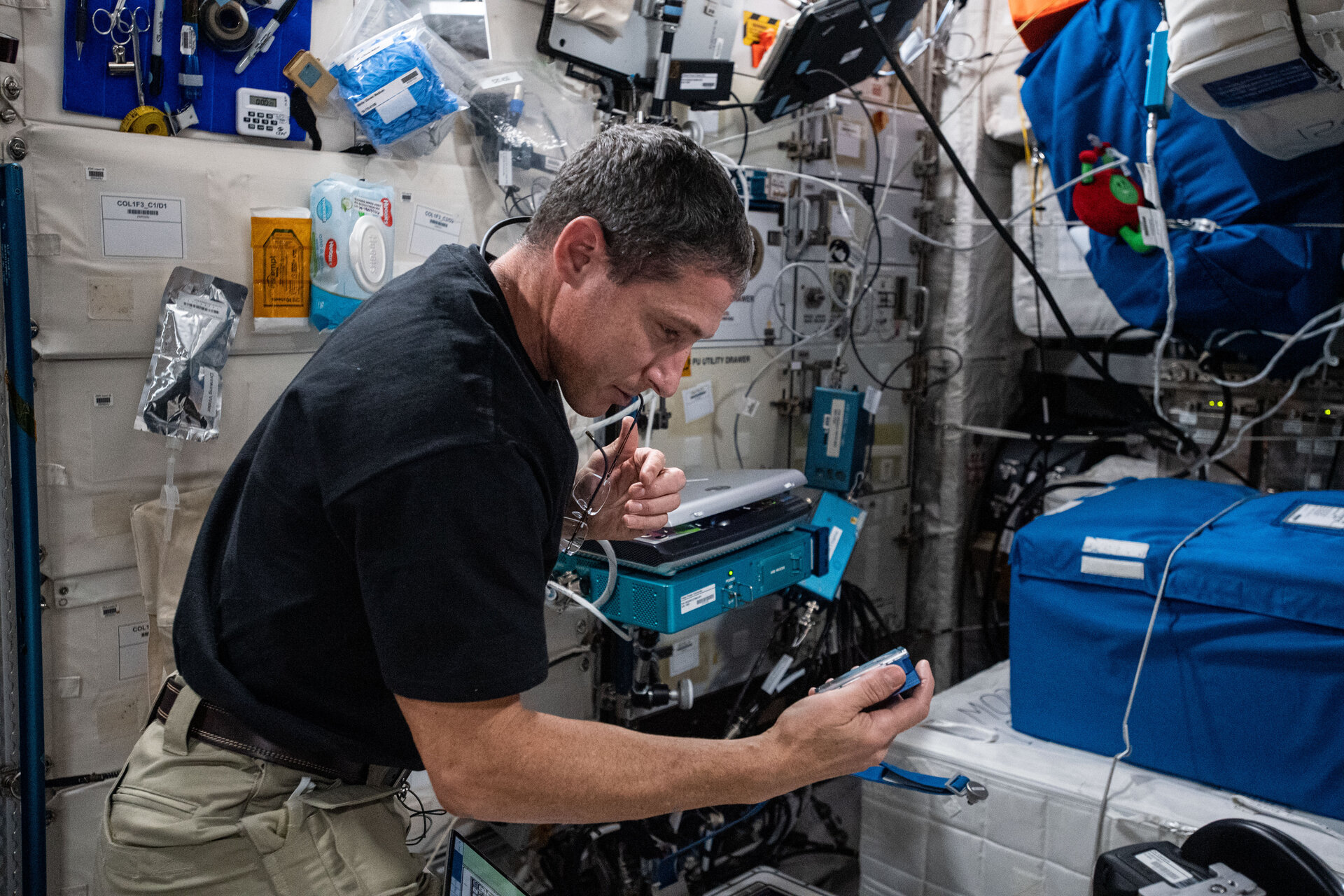
Rotifers are microscopic animals that are known to be very resistant to radiation. Researchers are eager to understand how the organisms manage to repair their DNA after receiving radiation damage. A bunch of these animals were sent to the Space Station on Dragon and NASA astronaut Mike Hopkins prepared their home in advance: ESA’s Kubik incubator centrifuge. After a week, Mike removed the organisms and put them in the Station’s freezer ready for shipment back to Earth.

Radiation is a significant problem for life outside of Earth’s atmosphere, and ESA’s Dosis-3D sensors are continuously charting radiation levels around the International Space Station. On 22 December Japanese astronaut Soichi Noguchi performed a monthly check of the dosimeters that are dotted around the outpost.

Muscles

Tricorder

Mike and NASA astronaut Victor Glover ran their first sessions of the Myotones experiment on 16 and 17 December to understand how muscle tone changes from spaceflight. Results from this investigation provide a better understanding of the principles of human resting muscle tone. This could lead to the development of new strategies for alternative treatments for rehabilitation on Earth, as well as for future space missions.

The Myotones experiment uses the Echo unit to download data to Earth. The same Echo hardware was used a few days later to support the Canadian Vascular Aging experiment that uses ultrasound to look at astronauts’ arteries and how they react to spaceflight.

Microbes and asteroids

Kubik facility

On 22 December Mike let loose a bunch of microbes to munch their way through a rock in liquid by placing the BioAsteroid container inside Kubik. The microbes will be assessed for performance under different gravitational circumstances to extract resources from rocks. So-called bio-mining has potential on Earth and in space exploration to recover economically useful elements from rock, as well as creating soil from lunar dust. Kubik will spin and incubate these microbes into January.

Return

Packing foam

The astronauts in space started preparing experiments and hardware to return to Earth on SpaceX CRS-21. On 1 December Victor wrapped up the Foam-Coarsening sample cell for analysis on Earth. This experiment is looking at foam behaviour at different stages, particularly as it transitions from a solid to liquid-like state. The actual cells are also planned for return to Earth in January, together with many of the experiments listed above – more on this next month.

Related article:

Cargo Dragon Undocks from Station and Heads for Splashdown
https://orbiterchspacenews.blogspot.com/2021/01/cargo-dragon-undocks-from-station-and.html

Related links:

Commercial ICE-Cubes facility: https://icecubesservice.com/

ESA test of cyber-security: https://www.esa.int/ESA_Multimedia/Images/2019/07/Cryptography_ICE_Cube_experiment

Metcomp experiment: https://www.esa.int/Science_Exploration/Human_and_Robotic_Exploration/Research/Physics_and_materials

Multiscale Boiling experiment: https://www.esa.int/Science_Exploration/Human_and_Robotic_Exploration/Research/Bubbles_in_space

Rotifers: https://www.esa.int/Science_Exploration/Human_and_Robotic_Exploration/Radiation_rotifer

ESA’s Dosis-3D sensors: https://www.esa.int/ESA_Multimedia/Images/2019/03/Dosis-3D_radiation_monitor

Myotones experiment: https://blogs.esa.int/alexander-gerst/2018/07/05/testing-the-tone-with-myotones/

BioAsteroid container inside Kubik: https://www.esa.int/ESA_Multimedia/Images/2019/09/BioAsteroid

Foam-Coarsening sample cell: https://www.esa.int/ESA_Multimedia/Images/2020/03/Foam-Coarsening_experiment

Human and Robotic Exploration: https://www.esa.int/Science_Exploration/Human_and_Robotic_Exploration

Science & Exploration: https://www.esa.int/Science_Exploration

Columbus laboratory: https://www.esa.int/Science_Exploration/Human_and_Robotic_Exploration/Columbus/Columbus_laboratory

International Space Station (ISS): https://www.esa.int/Science_Exploration/Human_and_Robotic_Exploration/International_Space_Station

Images, Text, Credits: ESA/NASA.

Best regards, Orbiter.ch

Blue Origin - New Shepard NS-14 - Astronaut Experience Upgrades


Blue Origin logo.


Jan. 13, 2021

Blue Origin’s next New Shepard flight is targeting liftoff tomorrow, January 14, at 9:45 AM CST / 15:45 UTC from Launch Site One in West Texas. Mission NS-14 is the 14th flight for the New Shepard program.


For this mission, the crew capsule will be outfitted with upgrades for the astronaut experience as the program nears human space flight. The upgrades include improvements to environmental features such as acoustics and temperature regulation inside the capsule, crew display panels, and speakers with a microphone and push-to-talk button at each seat. The mission will also test a number of astronaut communication and safety alert systems. The capsule will be outfitted with six seats, including one occupied by Mannequin Skywalker. 


Also inside the capsule, Blue Origin’s nonprofit Club for the Future will fly more than 50,000 postcards to space and back from students around the globe. A selection of postcards will fly in Mannequin Skywalker’s pockets. This is the third batch of Club for the Future postcards flown to space. To participate in the postcard program, go here: https://www.clubforfuture.org/missions/

All mission crew supporting this launch are exercising strict social distancing and safety measures to mitigate COVID-19 risks to personnel, customers, and surrounding communities.   

Launch coverage begins at T-30 minutes on https://www.blueorigin.com/

Images, Text, Credits: Blue Origin/Gradatim Ferociter.

Greetings, Orbiter.ch