mercredi 31 mars 2021

Crew Dragon Relocation Preps during Botany, Nervous System Research


ISS - Expedition 64 Mission patch.


March 31, 2021

Four Expedition 64 astronauts are getting ready to move their SpaceX Crew Dragon vehicle to another docking port on the International Space Station next week. The orbital residents also continued advanced research into space agriculture and the human nervous system.

Resilience, the docked commercial crew craft from SpaceX, will taxi four astronauts from the Harmony module’s forward-facing port to its zenith, or space-facing port, on Monday at 6:30 a.m. EDT. The autonomous relocation maneuver will take about 45 minutes with NASA TV beginning its live coverage at 6 a.m.


Image above: The SpaceX Crew Dragon spacecraft, with its nose cone open, is pictured docked to the Harmony module's forward international docking adapter. The International Space Station was orbiting 264 miles above southern Brazil when this photograph was taken. Image Credit: NASA.

Crew-1 Commander Michael Hopkins is riding along with Pilot Victor Glover and Mission Specialists Shannon Walker and Soichi Noguchi. The astronauts checked their Crew Dragon flight suits and communications gear during the afternoon. The quartet needs to be on the vehicle in the unlikely event Resilience is unable to redock. This assures there aren’t more crewmembers on the station than seats available on docked crew ships.

International Space Station (ISS). Animation Credit: NASA

Meanwhile, the station crew kept up its space botany work today testing hydroponics as a way to maintain and grow crops in microgravity. NASA Flight Engineer Kate Rubins kicked off her day with the Plant Water Management study as Hopkins took over the activities after lunch time.

Hopkins and Glover were also back in the Columbus laboratory module exploring how weightlessness affects their grip force and up/down movements. The experiment requires the astronauts to strap themselves in a specialized seat and perform a series of dexterous manipulation exercises. Observations could improve the design of spacecraft interfaces and offer deeper insights into the human nervous system in different gravity environments.


Image above: The seven-member Expedition 64 crew is pictured inside the space station’s “window to the world,” the cupola. Image Credit: NASA.

Walker was on Crew Medical Officer duties during the morning scanning Glover’s neck, shoulder and leg veins with the Ultrasound-2 device. She then spent the afternoon setting up alternate sleep accommodations ahead of the Expedition 65 crew arrival on April 9 when 10 people will be on the station for just over a week.

Station Commander Sergey Ryzhikov spent the day collecting water samples from Russian life support systems and checking smoke detectors. Roscosmos Flight Engineer Sergey Kud-Sverchkov cleaned ventilation systems and transferred water from the docked Progress 77 resupply ship.

Related article:

NASA TV to Air First US Commercial Crew Port Relocation on Space Station
https://www.nasa.gov/press-release/nasa-tv-to-air-first-us-commercial-crew-port-relocation-on-space-station

Related links:

Expedition 64: https://www.nasa.gov/mission_pages/station/expeditions/expedition64/index.html

Expedition 65: https://www.nasa.gov/mission_pages/station/expeditions/expedition65/index.html

Harmony module: https://www.nasa.gov/mission_pages/station/structure/elements/harmony

Plant Water Management: https://www.nasa.gov/mission_pages/station/research/experiments/explorer/Investigation.html?#id=7884

Columbus laboratory module: https://www.nasa.gov/mission_pages/station/structure/elements/europe-columbus-laboratory

Grip force: https://www.nasa.gov/mission_pages/station/research/experiments/explorer/Investigation.html?#id=1188

Ultrasound-2 device: https://www.nasa.gov/mission_pages/station/research/experiments/explorer/Facility.html?#id=736

Space Station Research and Technology: https://www.nasa.gov/mission_pages/station/research/overview.html

International Space Station (ISS): https://www.nasa.gov/mission_pages/station/main/index.html

Images (mentioned), Animation (mentioned), Text, Credits: NASA/Mark Garcia.

Greetings, Orbiter.ch

ALPHA cools antimatter using laser light for the first time


CERN - European Organization for Nuclear Research logo.


March 31, 2021

The result opens the door to considerably more precise studies of the internal structure of antihydrogen and of how it behaves under the influence of gravity

View of the ALPHA experiment (Image: CERN)

Geneva (Switzerland), 31 March 2021. The ALPHA collaboration at CERN has succeeded in cooling down antihydrogen atoms – the simplest form of atomic antimatter – using laser light. The technique, known as laser cooling, was first demonstrated 40 years ago on normal matter and is a mainstay of many research fields. Its first application to antihydrogen by ALPHA, described in a paper published today in Nature, opens the door to considerably more precise measurements of the internal structure of antihydrogen and of how it behaves under the influence of gravity. Comparing such measurements with those of the well-studied hydrogen atom could reveal differences between matter and antimatter atoms. Such differences, if present, could shed light on why the universe is made up of matter only, an imbalance known as matter–antimatter asymmetry.

“The ability to laser-cool antihydrogen atoms is a game-changer for spectroscopic and gravitational measurements, and it could lead to new perspectives in antimatter research, such as the creation of antimatter molecules and the development of anti-atom interferometry,” says ALPHA spokesperson, Jeffrey Hangst. “We’re over the moon. About a decade ago, laser cooling of antimatter was in the realm of science fiction.”

The ALPHA team makes antihydrogen atoms by taking antiprotons from CERN’s Antiproton Decelerator and binding them with positrons originating from a sodium-22 source. It then confines the resulting antihydrogen atoms in a magnetic trap, which prevents them from coming into contact with matter and annihilating. Next, the team typically performs spectroscopic studies, that is, it measures the anti-atoms’ response to electromagnetic radiation – laser light or microwaves. These studies have allowed the team to, for example, measure the 1S–2S electronic transition in antihydrogen with unprecedented precision. However, the precision of such spectroscopic measurements and of planned future measurements of the behaviour of antihydrogen in the Earth’s gravitational field in ongoing experiments is limited by the kinetic energy or, equivalently, the temperature, of the antiatoms.

This is where laser cooling comes in. In this technique, laser photons are absorbed by the atoms, causing them to reach a higher-energy state. The anti-atoms then emit the photons and spontaneously decay back to their initial state. Because the interaction depends on the atoms’ velocity and as the photons impart momentum, repeating this absorption–emission cycle many times leads to cooling of the atoms to a low temperature.

In their new study, the ALPHA researchers were able to laser-cool a sample of magnetically trapped antihydrogen atoms by repeatedly driving the anti-atoms from the atoms’ lowest-energy state (the 1S state) to a higher-energy state (2P) using pulsed laser light with a frequency slightly below that of the transition between the two states. After illuminating the trapped atoms for several hours, the researchers observed a more than tenfold decrease in the atoms’ median kinetic energy, with many of the anti-atoms attaining energies below a microeletronvolt (about 0.012 degrees above absolute zero in temperature equivalent).

Having successfully laser-cooled the anti-atoms, the researchers investigated how the laser cooling affected a spectroscopic measurement of the 1S–2S transition and found that the cooling resulted in a narrower spectral line for the transition – about four times narrower than that observed without laser cooling.

ALPHA cools antimatter using laser light for the first time

“Our demonstration of laser cooling of antihydrogen atoms and its application to 1S–2S spectroscopy represents the culmination of many years of antimatter research and developments at CERN’s Antiproton Decelerator. This is by far the most difficult experiment we have ever done,” says Hangst.

“Historically, researchers have struggled to laser-cool normal hydrogen, so this has been a bit of a crazy dream for us for many years,” says Makoto Fujiwara, the first proponent of the idea of using a pulsed laser to cool trapped antihydrogen in ALPHA. “Now, we can dream of even crazier things with antimatter.”

Note:

CERN, the European Organization for Nuclear Research, is one of the world’s largest and most respected centres for scientific research. Its business is fundamental physics, finding out what the Universe is made of and how it works. At CERN, the world’s largest and most complex scientific instruments are used to study the basic constituents of matter — the fundamental particles. By studying what happens when these particles collide, physicists learn about the laws of Nature.

The instruments used at CERN are particle accelerators and detectors. Accelerators boost beams of particles to high energies before they are made to collide with each other or with stationary targets. Detectors observe and record the results of these collisions.

Founded in 1954, the CERN Laboratory sits astride the Franco–Swiss border near Geneva. It was one of Europe’s first joint ventures and now has 23 Member States.

Related links:

Nature: https://www.nature.com/articles/s41586-021-03289-6

ALPHA: https://home.cern/science/experiments/alpha

Antiproton Decelerator: https://home.cern/about/accelerators/antiproton-decelerator

For more information about European Organization for Nuclear Research (CERN), Visit: https://home.cern/

Image, Video, Text, Credits: European Organization for Nuclear Research (CERN).

Best regards, Orbiter.ch

First X-rays from Uranus Discovered


NASA - Chandra X-ray Observatory patch.


Mar 31, 2021


Astronomers have detected X-rays from Uranus for the first time, using NASA’s Chandra X-ray Observatory. This result may help scientists learn more about this enigmatic ice giant planet in our solar system.

Uranus is the seventh planet from the Sun and has two sets of rings around its equator. The planet, which has four times the diameter of Earth, rotates on its side, making it different from all other planets in the solar system. Since Voyager 2 was the only spacecraft to ever fly by Uranus, astronomers currently rely on telescopes much closer to Earth, like Chandra and the Hubble Space Telescope, to learn about this distant and cold planet that is made up almost entirely of hydrogen and helium.

In the new study, researchers used Chandra observations taken in Uranus in 2002 and then again in 2017. They saw a clear detection of X-rays from the first observation, just analyzed recently, and a possible flare of X-rays in those obtained fifteen years later. The main graphic shows a Chandra X-ray image of Uranus from 2002 (in pink) superimposed on an optical image from the Keck-I Telescope obtained in a separate study in 2004. The latter shows the planet at approximately the same orientation as it was during the 2002 Chandra observations.

What could cause Uranus to emit X-rays? The answer: mainly the Sun. Astronomers have observed that both Jupiter and Saturn scatter X-ray light given off by the Sun, similar to how Earth’s atmosphere scatters the Sun’s light. While the authors of the new Uranus study initially expected that most of the X-rays detected would also be from scattering, there are tantalizing hints that at least one other source of X-rays is present. If further observations confirm this, it could have intriguing implications for understanding Uranus.

One possibility is that the rings of Uranus are producing X-rays themselves, which is the case for Saturn’s rings. Uranus is surrounded by charged particles such as electrons and protons in its nearby space environment. If these energetic particles collide with the rings, they could cause the rings to glow in X-rays. Another possibility is that at least some of the X-rays come from auroras on Uranus, a phenomenon that has previously been observed on this planet at other wavelengths.

On Earth, we can see colorful light shows in the sky called auroras, which happen when high-energy particles interact with the atmosphere. X-rays are emitted in Earth’s auroras, produced by energetic electrons after they travel down the planet’s magnetic field lines to its poles and are slowed down by the atmosphere. Jupiter has auroras, too. The X-rays from auroras on Jupiter come from two sources: electrons traveling down magnetic field lines, as on Earth, and positively charged atoms and molecules raining down at Jupiter’s polar regions. However, scientists are less certain about what causes auroras on Uranus. Chandra’s observations may help figure out this mystery.

Chandra X-ray Observatory

Uranus is an especially interesting target for X-ray observations because of the unusual orientations of its spin axis and its magnetic field. While the rotation and magnetic field axes of the other planets of the solar system are almost perpendicular to the plane of their orbit, the rotation axis of Uranus is nearly parallel to its path around the Sun. Furthermore, while Uranus is tilted on its side, its magnetic field is tilted by a different amount, and offset from the planet’s center. This may cause its auroras to be unusually complex and variable. Determining the sources of the X-rays from Uranus could help astronomers better understand how more exotic objects in space, such as growing black holes and neutron stars, emit X-rays

A paper describing these results appears in the most recent issue of the Journal of Geophysical Research and is available online. The authors are William Dunn (University College London, United Kingdom), Jan-Uwe Ness (University of Marseille, France), Laurent Lamy (Paris Observatory, France), Grant Tremblay (Center for Astrophysics | Harvard & Smithsonian), Graziella Branduardi-Raymont (University College London), Bradford Snios (CfA), Ralph Kraft (CfA), Z. Yao (Chinese Academy of Sciences, Beijing), Affelia Wibisono (University College London).

NASA's Marshall Space Flight Center manages the Chandra program. The Smithsonian Astrophysical Observatory's Chandra X-ray Center controls science from Cambridge Massachusetts and flight operations from Burlington, Massachusetts.

Read more from NASA's Chandra X-ray Observatory: https://chandra.harvard.edu/photo/2021/uranus/

For more Chandra images, multimedia and related materials, visit: http://www.nasa.gov/chandra

Journal of Geophysical Research: https://agupubs.onlinelibrary.wiley.com/doi/10.1029/2020JA028739

Image, Animation Credits: X-ray: NASA/CXO/University College London/W. Dunn et al; Optical: W.M. Keck Observatory/Text Credits: NASA/Lee Mohon.

Greetings, Orbiter.ch

ATLAS searches for pairs of Higgs bosons in a rare particle decay


CERN - ATLAS Experiment logo.


March 31, 2021

The ATLAS search achieves the world’s best constraints on the size of the Higgs boson’s self-coupling, creating a portal of better understanding into the fundamental Higgs mechanism


Image above: Candidate HH → ɣɣbb event in ATLAS data taken in 2017. Charged-particle tracks are shown in green, the two photons are shown as cyan towers and the two b-jets are shown as red cones. (Image: CERN).

Since the Higgs boson was discovered in 2012, scientists at the Large Hadron Collider (LHC) have been studying the properties of this very special particle and its relation to the fundamental mechanism essential to the generation of mass of elementary particles. One property that remains to be experimentally verified is whether the Higgs boson is able to couple to itself, known as self-coupling. Such an interaction would contribute to the production of a pair of Higgs bosons in the LHC's high-energy proton–proton collisions, an incredibly rare process in the Standard Model – more than 1000 times rarer than the production of a single Higgs boson! Measuring a Higgs boson self-coupling that is different from the predicted value would have important consequences; the universe might be able to transition into a lower energy state and the laws that govern the interactions of matter could take a very different shape.

At the ongoing Rencontres de Moriond conference, the ATLAS collaboration presented the result of a study that further explores this question. ATLAS physicists looked for the two intimately related Higgs-pair production processes that could be present in LHC collisions, though only one of these is related to the Higgs boson self-coupling and contributes favourably to the production of Higgs pairs when their total mass is low. These two processes interfere quantum mechanically and suppress Higgs boson pair production in the Standard Model. If a new physics phenomenon is at play, it could change the Higgs boson self-coupling and ATLAS might see more pairs of Higgs bosons than expected – or in particle physics parlance, measure a higher cross-section.

For their new study, ATLAS physicists have developed new analysis techniques to search for the rare process in which one of the two Higgs bosons decays to two photons and the other decays to two bottom quarks (HH → ɣɣbb). First, they divided the proton–proton collision events into low and high mass regions, so as to optimise the sensitivity to the Higgs boson self-coupling. Then, using a machine-learning algorithm, they separated the events that look like the HH → ɣɣbb process from those that don’t. Finally, they determined the cross-section for Higgs-pair production and observed how it varies as a function of the ratio of the Higgs boson self-coupling to its Standard Model value. This allowed ATLAS to constrain the Higgs boson self-coupling, between –1.5 and 6.7 times the Standard Model prediction, and also the Higgs-pair production cross-section. The result on the Higgs boson self-coupling is more than twice as powerful as the previous ATLAS result in the same Higgs-pair decay channel.

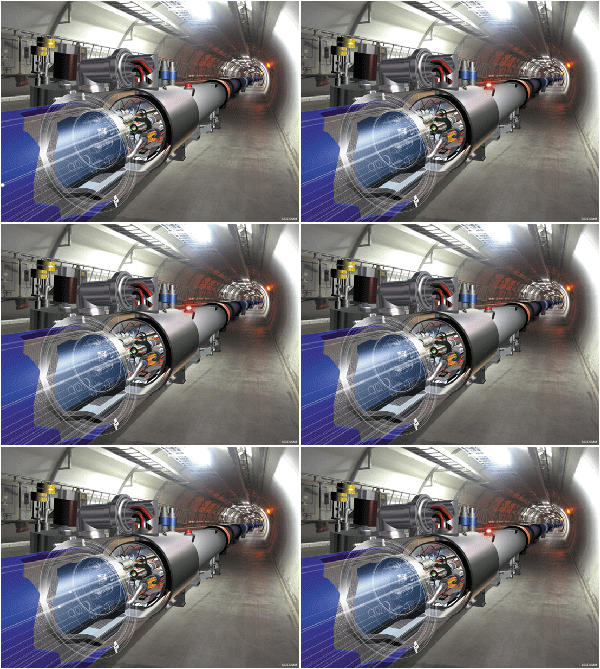
Large Hadron Collider (LHC)

Although this result sets the world’s best constraints on the size of the Higgs boson self-coupling, the work is just beginning. This is a preview of what is to come, as much more data would be needed to observe the Higgs boson self-coupling if it were close to its Standa­­­rd Model prediction. Observing the Higgs boson self-coupling is indeed one of the raisons d’être of the High-Luminosity LHC (HL-LHC) programme, an upgrade to the LHC scheduled to begin operations in the late 2020s. The HL-LHC is expected to deliver a dataset more than 20 times larger than the one used in this analysis and to operate at higher collision energy. If Higgs-pair production is as predicted by the Standard Model, it should be observed in this huge dataset, and a more quantitative statement will be made on the strength of the Higgs boson coupling to itself.

Read more on the ATLAS website: https://atlas.cern/updates/briefing/twice-higgs-twice-challenge

Note:

CERN, the European Organization for Nuclear Research, is one of the world’s largest and most respected centres for scientific research. Its business is fundamental physics, finding out what the Universe is made of and how it works. At CERN, the world’s largest and most complex scientific instruments are used to study the basic constituents of matter — the fundamental particles. By studying what happens when these particles collide, physicists learn about the laws of Nature.

The instruments used at CERN are particle accelerators and detectors. Accelerators boost beams of particles to high energies before they are made to collide with each other or with stationary targets. Detectors observe and record the results of these collisions.

Founded in 1954, the CERN Laboratory sits astride the Franco–Swiss border near Geneva. It was one of Europe’s first joint ventures and now has 23 Member States.

Related links:

Higgs boson: https://home.cern/science/physics/higgs-boson

Standard Model: https://home.cern/science/physics/standard-model

Rencontres de Moriond: http://moriond.in2p3.fr/2021/

ATLAS collaboration result study: https://atlas.web.cern.ch/Atlas/GROUPS/PHYSICS/CONFNOTES/ATLAS-CONF-2021-016

Large Hadron Collider (LHC): https://home.cern/science/accelerators/large-hadron-collider

High-Luminosity LHC (HL-LHC): https://home.cern/science/accelerators/high-luminosity-lhc

For more information about European Organization for Nuclear Research (CERN), Visit: https://home.cern/

Image, Animation, Text, Credits: European Organization for Nuclear Research (CERN).

Best regards, Orbiter.ch

Starship Prototype SN11 Explodes in mid-air, Raining Debris on the Launch Site


SpaceX - Starship (unofficial) patch.


March 31, 2021

Starship SN11 on the launch-pad At Boca Chica

As early as Tuesday, March 30, the SpaceX team will attempt a high-altitude flight test of Starship serial number 11 (SN11) – our fourth high-altitude flight test of a Starship prototype from Starbase in Texas. Similar to previous high-altitude flight tests of Starship, SN11 will be powered through ascent by three Raptor engines, each shutting down in sequence prior to the vehicle reaching apogee – approximately 10 km in altitude. SN11 will perform a propellant transition to the internal header tanks, which hold landing propellant, before reorienting itself for reentry and a controlled aerodynamic descent.
 
The Starship prototype will descend under active aerodynamic control, accomplished by independent movement of two forward and two aft flaps on the vehicle. All four flaps are actuated by an onboard flight computer to control Starship’s attitude during flight and enable precise landing at the intended location. SN11’s Raptor engines will then reignite as the vehicle attempts a landing flip maneuver immediately before touching down on the landing pad adjacent to the launch mount.

Starship | SN11 | High-Altitude Flight Test

A controlled aerodynamic descent with body flaps and vertical landing capability, combined with in-space refilling, are critical to landing Starship at destinations across the solar system where prepared surfaces or runways do not exist, and returning to Earth. This capability will enable a fully reusable transportation system designed to carry both crew and cargo on long-duration, interplanetary flights and help humanity return to the Moon, and travel to Mars and beyond.

At 5 minutes and 48 seconds into the flight, ground crews began reigniting the Raptor engines to reorient the spacecraft. However, the engine compartment camera suddenly stopped broadcasting a second later. By 8:06:06 A.M. local time, the ground cameras recorded the unmistakable sound of an explosion. For close to a minute after, debris was spotted and heard falling around the landing pad.

Starship Prototype SN11 Explodes in mid-air

Some of the debris even landed close to where the ground cameras were set up, but no injuries were reported. Based on the final seconds of footage captured by the SpaceX engine compartment camera, it was clear at least Raptor engine managed to reignite. However, the prototype exploded before it had a chance to touch down, exploding in midair and throwing debris around the facility.

The ground teams immediately began poring over the data to determine the cause. Elon Musk took to Twitter shortly after the explosion to share their preliminary findings:

“Looks like engine 2 had issues on ascent & didn’t reach operating chamber pressure during landing burn, but, in theory, it wasn’t needed. Something significant happened shortly after landing burn start. Should know what it was once we can examine the bits later today.”

SpaceX: https://www.spacex.com/

Images, Video, Text, Credits: SpaceX/Universe Today/RadarScopePro/Orbiter.ch Aerospace.

Greetings, Orbiter.ch

mardi 30 mars 2021

Human Research, Botany, Tech Demo on Station Science Schedule


ISS - Expedition 64 Mission patch.


March 30, 2021

Human research, botany and a technology demonstration were on the science schedule aboard the International Space Station today.

NASA Flight Engineer Shannon Walker was the Crew Medical Officer on Tuesday imaging the eyes of astronauts Michael Hopkins and Soichi Noguchi. Walker operated non-invasive imaging technology hardware to detect how microgravity impacts a crew member’s eyes and especially the retina.


Image above: Russia’s ISS Progress 77 cargo craft is pictured attached to the space station while orbiting 260 miles above the Gulf of Mexico. Image Credit: NASA.

Hopkins also joined Flight Engineer Victor Glover for an experiment investigating how astronauts manipulate objects and move around in weightlessness. The duo strapped themselves in a specialized seat inside the Columbus laboratory module for a series of tests exploring their grip force and up/down movements. Results could inform future spacecraft interfaces and provide new insights into the human nervous system.

NASA Flight Engineer Kate Rubins explored hydroponics today as way to support space agriculture for the Plant Water Management botany study. Noguchi tested a new optical device that beams down large amounts of data to Earth from outside the space station.

International Space Station (ISS). Animation Credit: NASA

Expedition 64 Commander Sergey Ryzhikov of Roscosmos worked on computer and life support maintenance throughout the day. Flight Engineer Sergey Kud-Sverchkov serviced video gear then photographed hardware on the outside of the Poisk mini-research module.

Related links:

Expedition 64: https://www.nasa.gov/mission_pages/station/expeditions/expedition64/index.html

Columbus laboratory module: https://www.nasa.gov/mission_pages/station/structure/elements/europe-columbus-laboratory

Grip force: https://www.nasa.gov/mission_pages/station/research/experiments/explorer/Investigation.html?#id=1188

Plant Water Management: https://www.nasa.gov/mission_pages/station/research/experiments/explorer/Investigation.html?#id=7884

New optical device: https://www.nasa.gov/mission_pages/station/research/experiments/explorer/Investigation.html?#id=7750

Poisk mini-research module: https://www.nasa.gov/mission_pages/station/structure/elements/poisk-mini-research-module-2

Space Station Research and Technology: https://www.nasa.gov/mission_pages/station/research/overview.html

International Space Station (ISS): https://www.nasa.gov/mission_pages/station/main/index.html

Image (mentioned), Animation (mentioned), Text, Credits: NASA/Mark Garcia.

Best regards, Orbiter.ch

NASA Finds 2021 Arctic Winter Sea Ice Tied for 7th-Lowest on Record


NASA Goddard Space Flight Center logo.


Mar 30, 2021

Sea ice in the Arctic appears to have hit its annual maximum extent after growing through the fall and winter. The 2021 wintertime extent reached on March 21 ties with 2007’s as the seventh-smallest extent of winter sea ice in the satellite record, according to scientists at the NASA-supported National Snow and Ice Data Center and NASA.


Image above: After growing through the fall and winter, sea ice in the Arctic appears to have reached its annual maximum extent. The data visualization shows the ice extent – defined as the total area in which the ice concentration is at least 15% – at its 2021 maximum, which occurred on March 21. On this day the extent of the Arctic sea ice cover peaked at 14.77 million square kilometers (5.70 million square miles), making it the seventh-lowest on record, tied with 2007. Image Credits: NASA's Scientific Visualization Studio.

This year’s maximum extent peaked at 5.70 million square miles (14.77 million square kilometers) and is 340,000 square miles (880,000 square kilometers) below the 1981 to 2010 average maximum – equivalent to missing an area of ice larger than the state of Texas and Florida combined.    

This image, created at NASA’s Goddard Space Flight Center in Greenbelt, Maryland, was created using data provided by the Japan Aerospace Exploration Agency (JAXA), acquired by the Advanced Microwave Scanning Radiometer 2 (AMSR2) instrument aboard the Global Change Observation Mission 1st-Water “SHIZUKU” (GCOM-W1) satellite.

2021 Arctic Sea Ice Maximum Extent Ranks 7th-Lowest on Record

Video above: On March 21, 2021, Arctic sea ice reached its maximum extent for winter 2020-2021, tying with 2007 for the seventh-lowest maximum on record. Video Credits: NASA's Goddard Space Flight Center/Scientific Visualization Studio.

Related links:

National Snow and Ice Data Center: https://nsidc.org/

NASA’s Goddard Space Flight Center (GSFC): https://www.nasa.gov/centers/goddard/home/index.html

Image (mentined), Video (mentioned), Text, Credits: NASA/Sofie Bates/Goddard Space Flight Center (GSFC)/By Roberto Molar Candanosa.

Greetings, Orbiter.ch