mardi 5 octobre 2021

Hubble Views a Galaxy with More than Meets the Eye


NASA / ESA - Hubble Space Telescope (HST) patch.


Oct 5, 2021


Meet NGC 5728, a spiral galaxy around 130 million light-years from Earth. This image was acquired using Hubble’s Wide Field Camera 3 (WFC3), which is extremely sensitive to visible and infrared light. Therefore, it beautifully captures the regions of NGC 5728 that are emitting light at those wavelengths. However, there are many other types of light that galaxies such as NGC 5728 emit, which WFC3 can’t see.

In this image, NCG 5728 appears to be an elegant, luminous, barred spiral galaxy. What this image doesn’t show, is that NGC 5728 is also a monumentally energetic type of galaxy, known as a Seyfert galaxy. Powered by their active cores, Seyfert galaxies are an extremely energetic class of galaxies known as active galactic nuclei (AGNs). There are many different types of AGNs, but Seyfert galaxies are distinguished from other galaxies with AGNs because the galaxy itself is clearly seen. Other AGNs, such as quasars, emit so much radiation that it is almost impossible to observe the galaxy that houses them. As this image shows, NGC 5728 is clearly observable, and at visible and infrared wavelengths it looks quite normal. It is fascinating to know that the galaxy’s center is emitting vast amounts of light in parts of the electromagnetic spectrum that WFC3 just isn’t sensitive to! Just to complicate things, the AGN at NGC 5728’s core might actually be emitting some visible and infrared light – but it may be blocked by the dust surrounding the galaxy’s core.

Hubble Space Telescope (HST)

For more information about Hubble, visit:

http://hubblesite.org/

http://www.nasa.gov/hubble

http://www.spacetelescope.org/

Text Credits: ESA (European Space Agency)/NASA/Lynn Jenner/Image, Animation Credits: NASA/ESA/Hubble, A. Riess et al., J. Greene.

Greetings, Orbiter.ch

Using the Moon to Address Earth’s Digital Inequality


NASA - ARTEMIS Program logo.


Oct 5, 2021

Most Americans take access to reliable, fast wireless internet (Wi-Fi) for granted. Yet, in underserved communities, reliable internet access can be as elusive as it is on the Moon. NASA is working to solve both challenges.

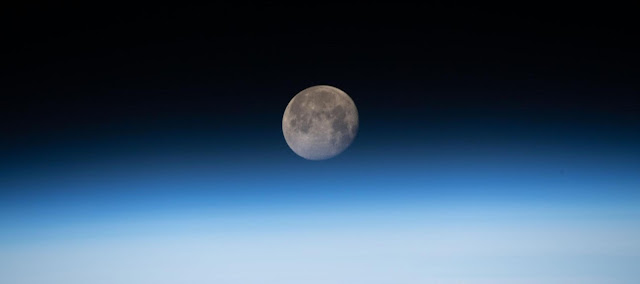
A view of the Moon from Earth. Image Credit: NASA

Digital inequality or inadequate internet access is a socioeconomic concern across the United States, and the pandemic has worsened the divide. In Cleveland, home of NASA’s Glenn Research Center, a study by the National Digital Inclusion Alliance found that about 31% of the city’s households have no broadband access.

Following the study, the Greater Cleveland Partnership (GCP), an economic development organization, reached out to NASA Glenn for assistance in examining the technical barriers of digital inequality the way only a space agency can – by using the Moon to solve an earthly problem.

“This presented a great opportunity to develop solutions to the challenges we face sending astronauts to the Moon under Artemis while also addressing a growing societal issue in our hometown,” said Mary Lobo, director of Technology Incubation and Innovation at Glenn. “We were pleased to establish a mutually beneficial study partnership with the GCP.”


Image above: A crew member aboard the International Space Station captured this night view of Cleveland from an altitude of approximately 240 miles. Image Credit: NASA.

NASA’s Compass Lab at Glenn, which specializes in abstract spacecraft and mission design, applied lunar network approaches to address technical challenges to Wi-Fi connectivity in the local community. Comparing a lunar surface area and an area around Cleveland produced interesting results

The study found that attaching Wi-Fi routers to approximately 20,000 lampposts or other utility poles would help solve Cleveland’s connectivity issues. By spacing routers no more than 100 yards apart, this approach would provide around 7.5 megabits per second (Mbps) download speed in a four-person home.

“That connectivity is good enough to complete schoolwork, participate in virtual calls, and other internet-based activities, but it isn’t high enough to allow for 4K streaming,” said Steve Oleson, Compass team lead at NASA Glenn. “If we move the routers a little closer, 50-75 yards apart, that greatly improves bandwidth.”

Each router would provide connections to outdoor and indoor users within a 50-yard radius from its host pole. Though, Wi-Fi repeaters would most likely be required to help older, low-performing devices connect indoors.

“This technological examination will help inform key aspects of the collaborative strategy to solve the digital divide in Greater Cleveland,” said Marty McGann, GCP executive vice president of advocacy and strategy. “Addressing this will have lasting impacts on the growth of our economy for years to come and is a major step to creating a much more equitable, inclusive economy.”

Building on the effort, Cuyahoga County, where Cleveland is located, released a request for proposals (RFP), asking companies for affordable internet access solutions throughout the county.

“NASA’s work helps set the stage for evaluation of the RFP responses to determine the most effective plan for connecting our neighborhoods,” said Catherine Tkachyk, Cuyahoga County’s chief innovation and performance officer.


Image above: An illustration of NASA’s Artemis Basecamp near the Moon’s South Pole. Image Credit: NASA.

The lunar portion of the study assumed a basecamp at Malapert Massif, a large impact crater near the Moon’s South Pole. This area meets NASA’s requirements for Sun exposure and line-of-sight communications with the Deep Space Network, and it is a prime spot for in-situ resource utilization.  

Surface exploration will require high-rate communications between astronauts and various elements like the Gateway, landers, habitats, rovers, and more. However, there are many unknowns when it comes to Wi-Fi connectivity on the Moon.

“While the Moon doesn’t have the level of interference found in a neighborhood full of houses and trees, it also does not have the advantage of an existing infrastructure of power, back feeds, and even a lunar internet, all of which need to be supplied,” said Oleson.

Using the same pole-based approach, the team recommends mounting routers on multiple 24-foot poles attached to habitats, landers, or other large hardware. In contrast to a single, large tower, this approach would provide astronauts in habitats network stability while mobile explorers could roam between routers.

This lunar Wi-Fi framework is still very conceptual, but the team hopes the Wi-Fi study will help inform future Artemis plans. In the meantime, the analysis will help American cities bring underserved communities vital internet access and the many benefits of the digital age.

Related links:

Greater Cleveland Partnership (GCP): https://greatercle.com/

Artemis: https://www.nasa.gov/artemisprogram

Moon to Mars: https://www.nasa.gov/topics/moon-to-mars/

Images (mentioned), Text, Credits: NASA/Kelly Sands/Glenn Research Center/Jimi Russell/Greater Cleveland Partnership/Dena Cipriano.

Best regards, Orbiter.ch

The first catalog of events of tidal destruction of stars by supermassive black holes


ROSCOSMOS / DLR - Spectrum-RG Mission patch.


Oct. 5, 2021

Based on the data of the X-ray sky survey of the eROSITA telescope of the Russian astrophysical observatory “Spektr-RG”, the first catalog of events of tidal destruction of stars near supermassive black holes in the cores of distant galaxies has been compiled.

In the 70s and 80s of the last century, astrophysical researchers, studying galaxies and supermassive black holes in their cores, suggested that very violent events could occur around the latter. If an ordinary star flies near such a supermassive black hole, then it can be torn apart by tidal forces, and the subsequent accretion of matter from the destroyed star onto the black hole will lead to a powerful burst of X-ray radiation.


Image above: Image from an article by Sazonov et al. 2021.

This scenario seemed very plausible, but at that time such "tidal disruption events" (TDE) could not be observed - there was not enough sensitivity of telescopes.

For the first time, several events of this type were detected in the early 1990s using an X-ray telescope aboard the German orbiting ROSAT observatory. Then the events of tidal destruction began to be found also with the help of optical and ultraviolet telescopes. But these discoveries were still very rare. The small number of registered tidal destruction events did not allow a sufficiently good study of their statistical and physical properties.

The Russian Astrophysical Observatory Spektr-RG, which began work in space in 2019, surveys the entire sky using two X-ray telescopes: the German eROSITA and the Russian ART-XC named after M.N. Pavlinsky. The high sensitivity of the detectors and the wide field of view of the eROSITA telescope, for the first time in the history of X-ray astronomy, made it possible to begin a massive search for tidal destruction events in the Universe.

The first results of this search were published in a paper accepted for publication in the Monthly Notices of the Royal Astronomical Society and published on the arXiv.org preprint site. It was attended by 25 researchers from the Institute for Space Research and the Special Astrophysical Observatory of the Russian Academy of Sciences, the Institute of Solar-Terrestrial Physics of the Siberian Branch of the Russian Academy of Sciences, the State Astronomical Institute named after V.I. PC. Sternberg Moscow State University. M.V. Lomonosov, Kazan Federal University, California Institute of Technology (USA) and Leiden University (Netherlands).

At the first stage of the study, we compiled a catalog of X-ray sources that were detected with the eROSITA telescope during the second half-year (June 10 - December 14, 2020) sky survey, but were not registered during the first survey. We also set the condition that the brightness of the source in the second scan should be at least ten times higher than its brightness in the first scan. Thus, a sample of about a hundred bright variable sources (transients) of X-ray radiation, located in half of the sky, was compiled. Pavel Medvedev, Researcher, High Energy Astrophysics Department, IKI RAS.


Image above: The position in the sky (against the background of optical images according to the Pan-STARRS survey) of the tidal destruction of stars discovered by the SRH / eROSITA telescope. The circles show the regions of localization of X-ray flares, and the arrows show the "parent" galaxies in which the star was destroyed.

Comparison with the Gaia Astrometric Catalog (ESA) showed that many of these objects are stars in our Galaxy. To study the rest, presumably extragalactic, transients, observations were organized on almost all large optical telescopes in our country: the 6-meter telescope BTA SAO RAS, the 2.5-meter telescope of the Caucasian Mountain Observatory GAISH MSU, the 1.6-meter telescope AZT-33IK ISTP SB RAS, 1.5 -meter Russian-Turkish telescope, as well as one of the largest telescopes in the world - the 10-meter Keck telescope in Hawaii (USA).

Based on the obtained optical spectra, it was possible to classify these objects, measure the distances to them, and distinguish among them sixteen events of tidal destruction, thirteen of which are discussed in the article.

“The fact that we are dealing with the destruction of a star near a massive black hole is evidenced by the softness of the obtained X-ray spectra, the presence of an extended object - a galaxy - in the region of the localization of the X-ray source and the absence of powerful emission lines in the optical spectrum of the galaxy. According to their properties, these objects are clearly different from active galactic nuclei, in which there is a prolonged (thousands and millions of years) accretion of interstellar gas onto a supermassive black hole, ”explains Ph.D. Georgy Khorunzhev, Researcher, High Energy Astrophysics Department, IKI RAS.

Tidal destruction of stars is most easily found in the "passive" cores of galaxies, in which the black hole usually "sleeps" and can erupt only for a short time after the star burst. Such a "dormant" black hole exists in the center of our Milky Way Galaxy, but in our Galaxy we have never seen TDE and are unlikely to see it in the next thousand years.

The closest of the tidal destruction events discovered by the Spektr-RG observatory took place in a galaxy at a distance of about 500 million light years from us, and the farthest - in a galaxy at a cosmological redshift of 0.581, i.e. happened about 6 billion years ago. And their X-ray luminosities reached 1038 watts in some cases.

Spectrum-RG (Spektr-RG)

“To provide such a colossal energy release, a black hole must absorb matter at a rate of about a hundred Earth masses per day,” says RAS professor Sergei Sazonov, head of the laboratory of experimental astrophysics at IKI RAS and the first author of the article. - The X-ray flare lasts at least several months, as evidenced by the repeated detection of a number of transients six months later (in the third sky scan of the eROSITA telescope) after their discovery. During this time, a black hole with its own mass of the order of ten thousand - one hundred million solar masses manages to absorb about half of the substance of the destroyed star.

Using the obtained unique sample, scientists have constructed for the first time a function of the X-ray luminosity of tidal destruction events. It turned out that the frequency of occurrence of such events in the Universe decreases with increasing luminosity (the more X-ray photons in a flare, the less frequent), and on average, the destruction of stars occurs approximately once every hundred thousand years per galaxy. Therefore, we do not register such events in the core of our Galaxy or in nearby galaxies, and in order to search for them, we have to examine a large volume of the Universe, containing millions of galaxies.

Most of the tidal destruction events that the eROSITA telescope discovers manifest themselves only in X-rays. This is how they differ from the events that are detected in optical surveys, in particular with the help of the Installation for the search for transients to them. Zwicky (Zwicky Transient Facility, USA). But some of the events that SRH / eROSITA detects in X-rays still manifest themselves as optical transients.

One of these - SRGe J131014.2 + 444315 - was recently reported in the ATel astronomical telegram No. 14800 (this was reported in a press release by the SRG / eROSITA saw the beginning of the tidal destruction of a star by a supermassive black hole). Scientists continue to argue why the events of tidal destruction of stars can manifest themselves in different ways.

“There is still no complete picture of how exactly the destruction of the star by tidal forces occurs and how radiation is formed at different wavelengths. Some theoretical models predict that when a star collapses, a thick accretion disk appears around a black hole, with X-rays being generated in the inner region of this disk. If such an object is observed along the axis of the accretion disk, we will see X-rays from the vicinity of the black hole, and when viewed from the side, along the plane of the disk, X-rays are shaded by the thickness of the disk and we observe only optical radiation, ”explains RAS Corresponding Member Marat Gilfanov. Leading researcher of the Astrophysics Department of the IKI RAS.

“The Spectr-RG observatory continues to search for events of tidal destruction of stars by black holes. To date, optical observations from Earth have already confirmed more than forty such events discovered by Russian scientists using eROSITA. This is more than the number of events of this type known before the launch of the observatory. All in all, in four years of survey across the entire sky, there is a chance to detect about seven hundred such events. In every galaxy, such events are extremely rare, but, as we can see, eROSITA is able to record the rarest TDE cases from billions of galaxies, where supermassive black holes lurk, which do not manifest themselves as bright X-ray sources until a star flies too close. from her, "concludes Academician Rashid Sunyaev, scientific director of the Spektr-RG orbital observatory.

Source: IKI RAN.

Related links:

ROSCOSMOS Press Release: https://www.roscosmos.ru/32817/

IKI RAN: https://www.roscosmos.ru/tag/iki-ran/

Spectrum-RG: https://www.roscosmos.ru/tag/spektr-rg/

Images, Text, Credits: ROSCOSMOS/IKI RAN/Orbiter.ch Aerospace/Roland Berga.

Greetings, Orbiter.ch

Russian Soyuz MS-19 Trio Meets Expedition 65 Crew


ROSCOSMOS - Soyuz MS-19 Mission patch.


October 5, 2021


Image above: The Soyuz MS-19 rocket with three Russian crewmates aboard ascends into space shortly after launching under clear blues skies in Kazakhstan. Image ROSCOSMOS.

Nearly nine minutes after a successful launch at 4:55 a.m. EDT of the Soyuz MS-19 spacecraft, Roscosmos cosmonaut Anton Shkaplerov, actress Yulia Peresild and producer Klim Shipenko safely reached orbit. They have begun a two-orbit, three-hour flight to reach the International Space Station and join the Expedition 65 crew. At the time of launch, the station was flying about 260 miles over southwest Kazakhstan.


Image above: The Soyuz MS-19 crew with (from left) Roscosmos cosmonaut Anton Shkaplerov, producer Klim Shipenko and actress Yulia Peresild. Image Credit: ROSCOSMOS.

The Soyuz spacecraft carrying Roscosmos cosmonaut Anton Shkaplerov, actress Yulia Peresild and producer Klim Shipenko docked to the International Space Station at 8:22 a.m. EDT while both spacecraft were flying about 260 miles above Earth to the north of the Philippine islands.

Soyuz MS-19 launch (On-board camera view)

When the hatches between the two spacecraft are opened following standard pressurization and leak checks, the trio will join Expedition 65 Commander Thomas Pesquet of ESA (European Space Agency), NASA astronauts Mark Vande Hei, Shane Kimbrough and Megan McArthur, Aki Hoshide of the Japan Aerospace Exploration Agency, and Roscosmos cosmonauts Oleg Novitskiy and Pyotr Dubrov.


Image above: Five spaceships are parked at the space station including Northrop Grumman’s Cygnus space freighter; the SpaceX Crew Dragon vehicle; and Russia’s Soyuz MS-18 and MS-19 crew ships and ISS Progress 78 resupply ship. Image Credit: NASA.


Image Above: The Soyuz MS-19 manned spacecraft arrival to International Space Station (ISS). Image Credit: ROSCOSMOS.

The hatches between the International Space Station and the newly arrived Soyuz spacecraft officially opened at 11 a.m. EDT. The arrival of three new crew members to the existing seven people already aboard for Expedition 65 temporarily increases the station’s population to 10.

Soyuz MS-19 manual docking

This is the fourth flight into space for Roscosmos cosmonaut Anton Shkaplerov. Actress Yulia Peresild and producer Klim Shipenko are making their first flights into space and will spend 12 days on the space station, filming segments for a movie titled “Challenge” under a commercial agreement between Roscosmos and Moscow-based media entities.


Image above: The three new residents aboard the station (front row, from left) are Russian actress Yulia Peresild, Roscosmos cosmonaut Anton Shkaplerov, and Russian Producer Klim Shipenko. In the back, are Expedition 65 crew members Shane Kimbrough, Oleg Novitskiy, Thomas Pesquet, Megan McArthur, Pyotr Dubrov, Mark Vande Hei, and Akihiko Hoshide. Image Credit: NASA TV.

Peresild and Shipenko will return to Earth with Roscosmos cosmonaut Oleg Novitskiy Oct. 16 (Oct. 17 Kazakhstan time) on the Soyuz MS-18 spacecraft, which is currently docked at the space station, for a parachute-assisted landing on the Kazakh steppe. Shkaplerov will remain aboard the station through next March, returning with NASA astronauts Mark Vande Hei, and Roscosmos cosmonaut and Pyotr Dubrov on the Soyuz MS-19 spacecraft. The return of Vande Hei and Dubrov will mark the end of a 355-day mission. Vande Hei will have completed the longest single spaceflight by an astronaut in U.S. history.

Soyuz MS-19 hatch opening

Expedition 65 Commander Thomas Pesquet of ESA (European Space Agency), NASA astronauts Shane Kimbrough and Megan McArthur, and Aki Hoshide of the Japan Aerospace Exploration Agency have been aboard since arriving April 23, 2021, on the SpaceX Crew Dragon Endeavour. Endeavor and its crew are currently planned to return early-to-mid November.

Related links:

Expedition 65: https://www.nasa.gov/mission_pages/station/expeditions/expedition65/index.html

International Space Station (ISS): https://www.nasa.gov/mission_pages/station/main/index.html

Images (mentioned), Videos, Text, Credits: NASA/Mark Garcia/NASA TV/SciNews.

Best regards, Orbiter.ch

lundi 4 octobre 2021

International Astronauts to Swap Command; Soyuz Crew Launches on Tuesday


ISS - Expedition 65 Mission patch.


October 4, 2021

Expedition 65 Commander Akihiko Hoshide of the Japan Aerospace Exploration Agency will hand over command of the International Space Station today to ESA (European Space Agency) Flight Engineer Thomas Pesquet. Pesquet will command the station until he departs with Hoshide and NASA astronauts Megan McArthur and Shane Kimbrough in mid-to-late November.

The four crewmates have been living on the orbital lab since April when they arrived aboard the SpaceX Crew Dragon Endeavour. The quartet will return to Earth next month inside Endeavour and parachute to a splashdown off the coast of Florida completing a six-month stay in space.


Image above: European astronaut Thomas Pesquet takes command of the space station from Japanese astronaut Akihiko Hoshide today. Image Credit: NASA.

About 12 hours after Pesquet takes command of the orbiting lab, three Russian crewmates will launch toward the space station from the Baikonur Cosmodrome in Kazakhstan. Soyuz Commander Anton Shkaplerov will ride inside the Soyuz MS-19 crew ship in between spaceflight participants Klim Shipenko and Yulia Peresild.

The trio will lift off inside the Soyuz MS-19 crew ship at 4:55 a.m. EDT on Tuesday and orbit the Earth twice before docking to the Rassvet module less than three-and-a-half hours later. Shkaplerov will stay in space until April while Shipenko and Yulia Peresild will return to Earth about 12 days later. The two spaceflight participants will ride back to Earth and parachute to a landing in Kazakhstan inside the Soyuz MS-18 crew ship with Roscosmos Flight Engineer Oleg Novitskiy.

NASA TV starts its live coverage of the change of command ceremony today at 3:20 p.m. EDT on the NASA app and the agency’s website. NASA TV will be back on the air on Tuesday at 4:15 a.m. broadcasting the launch, docking and crew greeting at the space station of the new Russian trio.

International Space Station (ISS). Animation Credit: NASA

The seven residents aboard the station today started the work week servicing a variety of research hardware. Kimbrough cleaned the Life Science Glovebox today following two weeks of rodent research activities. NASA Flight Engineer Mark Vande Hei swapped fuel bottles inside the Combustion Integrated Rack and also helped McArthur organize food to open up more space on the station.

Hoshide installed the Tele-Luminescence Analysis System that observes tissues and genes in small animals in the Kibo laboratory module. Pesquet set up the Fluidics experiment for a couple of runs today to better understand how fuels behave in spacecraft fuel tanks.

Related articles:

Thomas Pesquet takes commanding role on Space Station
https://orbiterchspacenews.blogspot.com/2021/10/thomas-pesquet-takes-commanding-role-on.html

NASA TV Coverage Set for Russian Film Production Launch
https://www.nasa.gov/press-release/nasa-tv-coverage-set-for-russian-film-production-launch

Related links:

Expedition 65: https://www.nasa.gov/mission_pages/station/expeditions/expedition65/index.html

Rassvet module: https://www.nasa.gov/mission_pages/station/structure/elements/rassvet

NASA TV: https://www.nasa.gov/multimedia/nasatv/index.html

Life Science Glovebox: https://www.nasa.gov/mission_pages/station/research/experiments/explorer/Facility.html?#id=7676

Rodent research: https://www.nasa.gov/mission_pages/station/research/experiments/explorer/Investigation.html?#id=8584

Combustion Integrated Rack: https://www.nasa.gov/mission_pages/station/research/experiments/explorer/Facility.html?#id=317

Tele-Luminescence Analysis System: https://www.nasa.gov/mission_pages/station/research/experiments/explorer/Facility.html?#id=8117

Kibo laboratory module: https://www.nasa.gov/mission_pages/station/structure/elements/japan-kibo-laboratory

Fluidics: https://www.nasa.gov/mission_pages/station/research/experiments/explorer/Investigation.html?#id=2043

Space Station Research and Technology: https://www.nasa.gov/mission_pages/station/research/overview.html

International Space Station (ISS): https://www.nasa.gov/mission_pages/station/main/index.html

Image (mentioned), Animation (mentioned), Text, Credits: NASA/Mark Garcia.

Greetings, Orbiter.ch

October 4, 1957 - the beginning of space exploration


CCCP - Sputnik 1 Mission patch.


Oct. 4, 2021

On Monday, October 4, 2021, all of humanity celebrates the 64th anniversary of the beginning of the space age. In 1957, the first artificial Earth satellite, created in the Soviet Union, was launched into space. Thanks to this event, a huge breakthrough in science took place, and humanity set foot on the road into space. It is from this day that the world cosmonautics counts down!

Sputnik

The creation of the first spacecraft began at OKB-1 (today the SP Korolev Rocket and Space Corporation Energia, part of the State Corporation Roscosmos) in November 1956. The satellite was developed as a very simple device, and therefore received the name - the PS-1 spacecraft (the simplest satellite). It was a ball with a diameter of 58 cm, weighing 83.6 kg and was equipped with four pin antennas for transmitting signals from battery-powered transmitters.

The scientists M.V. Keldysh, M.K. Tikhonravov, N. S. Lidorenko, G. Yu. Maksimov, V. I. Lapko, B S. Chekunov, A. V. Bukhtiyarov and many others.

The launch was carried out on October 4, 1957 at 22 hours 28 minutes 34 seconds Moscow time from the 5th research site of the USSR Ministry of Defense "Tyura-Tam" (now - the Baikonur cosmodrome) on the launch vehicle "Sputnik" (R-7 No. 8K71PS). 295 seconds after the launch, the first satellite and the central block of the rocket were launched into an elliptical orbit with an altitude of 947 km at apogee and 288 km at a perigee. At 314.5 seconds after the launch, the satellite separated, and he gave his voice. "Beep! Beep!" - so his callsigns sounded. They were caught at the test site for 2 minutes, then the satellite "went" beyond the horizon.

October 4 - the beginning of space exploration

On the first loop of its flight, the TASS message sounded: "... As a result of a lot of hard work of research institutes and design bureaus, the world's first artificial Earth satellite was created ..."

The satellite flew for 92 days, until January 4, 1958, completing 1,440 revolutions around our planet, flying about 60 million km, and its radio transmitters worked for two weeks after launch.

The main tasks facing this satellite were:

- Verification of calculations and basic technical solutions adopted for the launch;

- Ionospheric studies of the transmission of radio waves emitted by satellite transmitters;

- Experimental determination of the density of the upper layers of the atmosphere by the deceleration of the satellite;

- Investigation of the conditions of operation of the equipment in the space environment.

The launch of an artificial satellite of the Earth was of great importance for the knowledge of the properties of outer space and the study of the Earth as a planet of our solar system. The analysis of the received signals from the satellite gave scientists the opportunity to study the upper layers of the ionosphere, which was not possible before. In addition, information on the operating conditions of the equipment, most useful for further launches, was obtained, all calculations were checked, and the density of the upper atmosphere was determined by the deceleration of the satellite.

On October 5, 1957, the Pravda newspaper reported:

“... On October 4, 1957, the first satellite was successfully launched in the USSR. According to preliminary data, the launch vehicle told the satellite the required orbital speed of about 8000 meters per second. At present, the satellite describes elliptical trajectories around the Earth and its flight can be observed in the rays of the rising and setting Sun with the help of the simplest optical instruments (binoculars, telescopes, etc.).

According to calculations, which are now being refined by direct observations, the satellite will move at altitudes up to 900 kilometers above the Earth's surface; the time of one complete revolution of the satellite will be 1 hour 35 minutes, the angle of inclination of the orbit to the equatorial plane is 65 °. On October 5, 1957, the satellite will pass over the Moscow region twice - at 1 hour 46 minutes. nights and at 6 o'clock. 42 minutes morning Moscow time. Messages about the subsequent movement of the first artificial satellite launched in the USSR on October 4 will be broadcast regularly by broadcast radio stations.

Sputnik description

The satellite has the shape of a sphere with a diameter of 58 cm and a weight of 83.6 kg. It has two radio transmitters that continuously emit radio signals with a frequency of 20.005 and 40.002 megahertz (wavelengths of about 15 and 7.5 meters, respectively). The power of the transmitters ensures reliable reception of radio signals by a wide range of radio amateurs. The signals are in the form of telegraph transmissions with a duration of about 0.3 seconds. with a pause of the same duration. A signal of one frequency is sent while a signal of another frequency is paused ... ”.

The launch of an artificial satellite of the Earth was of great importance for the knowledge of the properties of outer space and the study of the Earth as a planet of our solar system. The analysis of the received signals from the satellite gave scientists the opportunity to study the upper layers of the ionosphere, which was not possible before. In addition, information on the operating conditions of the equipment, most useful for further launches, was obtained, all calculations were checked, and the density of the upper atmosphere was determined by the deceleration of the satellite.

Related article by ROSCOSMOS:

Поздравление экипажа МКС с годовщиной начала космической эры / Congratulations to the ISS crew on the anniversary of the beginning of the space age
https://www.roscosmos.ru/32828/

Related links:

ROSCOSMOS Press Release: https://www.roscosmos.ru/32814/

First satellite: https://www.roscosmos.ru/tag/pervihy-sputnik/

Image, Animation, Video, Text, Credits: ROSCOSMOS/Orbiter.ch Aerospace/Roland Berga.

Best regards, Orbiter.ch

NASA won’t rename James Webb space telescope — and astronomers are angry


NASA / ESA / CSA-ASC - James Webb Space Telescope (JWST) patch.


Oct. 4, 2021

The agency found no evidence that the flagship observatory’s namesake was involved in anti-LGBT+ activities, but some say that Webb bears responsibility.


Image above: NASA’s James Webb Space Telescope being prepared for shipment to its launch site. Image Credits: Chris Gunn/NASA.

NASA has decided not to rename its soon-to-be-launched flagship observatory, the James Webb Space Telescope (JWST), after investigating whether its namesake, former NASA administrator James Webb, was involved in persecuting gay and lesbian people in the 1950s and 1960s. The agency says it found no evidence to support the allegations.

The decision and the lack of transparency with which it was announced — NASA released no report about the scope of the investigation — has angered a number of astronomers.

“I’m disappointed,” says Johanna Teske, an astronomer at the Carnegie Institution for Science in Washington DC. “Without knowing what factors were considered, it’s hard for me to respect the decision to keep the current name.”

Since May, more than 1,200 people, including scientists who are slated to use the telescope after its planned December launch, have signed a petition calling for the JWST to be renamed. Webb held multiple leadership positions in the US government during a period in which gay and lesbian federal employees were systematically fired because of their sexual orientation. For instance, he was NASA administrator when an agency employee was fired in 1963 on suspicion of being gay.

Former NASA Administrator James E. Webb. Image Credit: Wikipedia

In response to the concerns, NASA began an internal study of historical documents that might shed light on Webb’s behaviour towards gay and lesbian people. On 27 September, current agency administrator Bill Nelson released a one-sentence statement to some media outlets, including Nature, saying: “We have found no evidence at this time that warrants changing the name of the James Webb Space Telescope.” NASA’s acting chief historian, Brian Odom, who led the inquiry, told Nature on 30 September that he considers the investigation closed.

‘Gut punch’

A NASA official had said in June that the agency would be transparent with the scientific community in its decision, but there is no final written report that could be released. Odom says that “under the circumstances of COVID, the investigation was as thorough as possible and very objective”. He says it consisted of several archivists going through NASA’s internal records, interviewing other historians who had studied Webb, and hiring an external historian to explore aspects such as Webb’s career at other government agencies. Several relevant repositories, such as the National Archives in Washington DC and the Harry S. Truman Presidential Library & Museum in Independence, Missouri, have been closed for long periods because of the COVID-19 pandemic; Odom’s team was not able to study materials from them that were not already digitized.

Odom says he met Nelson several times to present the material that the investigators were able to gather. “The administrator’s participation in this was very thoughtful and very objective,” he says. Nelson made the decision to keep the name of the telescope.

But some think NASA’s decision is the wrong one. Webb, they say, was head of the agency during a period of discrimination, and bears responsibility. “The gut punch is in the outright refusal to hear the voices of queer astronomers,” says Brian Nord, an astrophysicist at the Fermi National Accelerator Laboratory in Batavia, Illinois. “This is a refusal to confront history. If we can’t have that, how are we going to shed light on the oppression that people are facing?”

Nord is one of four astronomers who led the petition for the telescope to be renamed. The other three are Lucianne Walkowicz at the Adler Planetarium in Chicago, Illinois; Chanda Prescod-Weinstein at the University of New Hampshire in Durham; and Sarah Tuttle at the University of Washington in Seattle. In an e-mail to Nature about NASA’s decision, they wrote: “For all the institution’s talk of equity and diversity, they don’t seem to be particularly concerned with public accountability about sensitive issues that have impacted a historically marginalized group.”

Naming a telescope

At the heart of the controversy is what responsibility government officials bear for discriminatory actions and policies at agencies they headed. Webb ran NASA between 1961 and 1968, during the height of the exploration programmes that eventually sent astronauts to walk on the Moon. Critics point out that Webb was therefore in charge in 1963, when Clifford Norton, a suspected gay employee, was fired.

Odom says he looked closely at the Norton case for evidence of whether Webb was involved in directing the firing. “It just didn’t turn up,” he says.

But the broader context is important for assessing Webb’s legacy, critics say. Webb worked in the US government system — including holding the influential position of undersecretary of state from 1949 to 1952, during Truman’s administration — when firing gay people was seen as acceptable and even encouraged. Rolf Danner, an astronomer at the Jet Propulsion Laboratory in Pasadena, California, who is chair of the American Astronomical Society’s committee on sexual orientation and gender minorities in astronomy, says Webb was probably an effective manager in that framework. “I just don’t think that makes him the right choice for NASA’s premier science project more than 60 years later.”

James Webb Space Telescope (JWST). Image Credits: NASA/ESA/CSA-ASC

As successor to the Hubble Space Telescope, the JWST will study cosmic phenomena including star formation, galaxy evolution and exoplanets. International partners in the mission include the European and Canadian space agencies. It was named in 2002 by former NASA administrator Sean O’Keefe, who wanted to highlight Webb’s accomplishments in government. Webb “had the ability to bring together those from multiple disciplines and collectively work together to achieve something larger than themselves”, says O’Keefe, who is now at Syracuse University in New York. He says that NASA would not be the same today had Webb not been administrator, and that the agency’s investigation reinforces the conclusion that he and others had reached: that “indeed, this is a person of character”.

Yet some say that Webb’s accomplishments don’t justify naming the telescope after him, given the context in which he worked. “Webb did his job, for better or worse, and will be remembered in history,” says Peter Gao, a planetary scientist at the Carnegie Institution. “It’s not necessary to further celebrate him given what happened under his tenure.”

Astronomers who disagree with NASA’s decision are now considering the future. For many, boycotting the JWST is not an option, because of its transformational capabilities. Some are talking about ways to acknowledge the controversy while still working with JWST data, perhaps by putting information about Webb’s associations with anti-LGBT+ actions in the acknowledgments of papers. Others might call the telescope something else in their dealings with it. For instance, Prescod-Weinstein tweeted on 30 September: “I am personally thrilled about the Just Wonderful Space Telescope (JWST).”

doi: https://doi.org/10.1038/d41586-021-02678-1

JWST is a partnership between NASA, ESA and the Canadian Space Agency.

For more information about NASA’s James Webb Space Telescope, visit:

http://www.nasa.gov/webb and http://jwst.nasa.gov and http://sci.esa.int/jwst/ and http://www.esa.int/Our_Activities/Space_Science/JWST  and http://www.asc-csa.gc.ca/eng/satellites/jwst/

Images (mentioned), Text, Credits: Nature/Alexandra Witze.

Greetings, Orbiter.ch