dimanche 26 décembre 2021

China Space Station - Shenzhou-13 mission’s second spacewalk begins


CMS - China Manned Space logo.


Dec 26, 2021

Taikonaut Ye Guangfu starting the second EVA

On 26 December 2021, at 10:44 UTC (18:44 China Standard Time), astronaut (taikonaut) Ye Guangfu opened the hatch of the Tianhe core module, starting the second extravehicular activity for the Shenzhou-13 (神舟十三) mission.

Shenzhou-13 mission’s second spacewalk begins

During the spacewalk, astronauts Zhai Zhigang (翟志刚) and Ye Guangfu(叶光富) will work outside the core module of the China Space Station (中国空间站), while astronaut Wang Yaping (王亚平) will provide support from inside, including operation of the robotic arm. The Tianhe core module (天和核心舱) is the first and main component of the China Space Station (中国空间站), informally known as Tiangong (天宫, Heavenly Palace).

Related articles & link:

China Space Station - Shenzhou-13 crew space lecture highlights
https://orbiterchspacenews.blogspot.com/2021/12/china-space-station-shenzhou-13-crew.html

China Space Station - Shenzhou-13 astronauts complete first spacewalk
https://orbiterchspacenews.blogspot.com/2021/11/china-space-station-shenzhou-13.html

China Space Station - Astronaut Wang Yaping begins first spacewalk
https://orbiterchspacenews.blogspot.com/2021/11/china-space-station-astronaut-wang.html

What’s next for the China Space Station (CSS)
https://orbiterchspacenews.blogspot.com/2021/10/whats-next-for-china-space-station-css.html

China Space Station (CSS) - Shenzhou-13 hatch opening
https://orbiterchspacenews.blogspot.com/2021/10/china-space-station-css-shenzhou-13.html

China Space Station - Shenzhou-13 mission
https://orbiterchspacenews.blogspot.com/2021/10/china-space-station-shenzhou-13-mission.html

For more information about China National Space Administration (CNSA), visit: http://www.cnsa.gov.cn/

Image, Video, Text, Credits: Credits: China National Space Administration (CNSA)/China Media Group(CMG)/China Central Television (CCTV)/SciNews/Orbiter.ch Aerospace/Roland Berga.

Best regards, Orbiter.ch

CASC - Long March-4C launches ZY-1 02E


CASC - Long March-4C / ZY-1 02E Mission patch.


Dec 26, 2021

Long March-4C carrying ZY-1 02E liftoff

A Long March-4C launch vehicle launched ZY-1 02E and one small satellite from the Taiyuan Satellite Launch Center, Shanxi Province, northern China, on 26 December 2021, at 03:11 UTC (11:11 local time).

Long March-4C launches ZY-1 02E

ZY-1 02E (Ziyuan 1-02E,  资源一号02E星) is an Earth-observation satellite that “will provide observation data for natural resources asset management, ecological monitoring, disaster prevention and control, environmental protection, urban construction, transportation and contingency management”.

Ziyuan 1-02E (资源一号02E星) satellite

For more information about China Aerospace Science and Technology Corporation (CASC): http://english.spacechina.com/n16421/index.html

Images, Video, Text, Credits: China Media Group(CMG)/China Central Television (CCTV)/China Aerospace Science and Technology Corporation (CASC)/SciNews/Günter's Space Page/Orbiter.ch Aerospace/Roland Berga.

Greetings, Orbiter.ch

Comet Hartley


Moscow Planetarium logo.


Dec 26, 2021

Comet Hartley has a fairly short orbital period around the Sun - just over 6.4 years. Despite the fact that it was observed in 1991, 1997 and 2004, its return in 2010 was one of the most successful to study.

Position of Comet Hartley in the Solar System on October 20, 2010

The approaching comet was first noticed back in May 2008 by the astronomers of the Paranal Observatory in Chile. In August of the same year, it was studied by the Spitzer orbiting telescope in the infrared range. In 2011, the comet was explored by the Herschel Space Observatory. Thus, comet Hartley became the fifth comet visited by a spacecraft.

Studies have shown that the comet's nucleus is highly elongated and consists of two parts with a bar. Its length along the long axis is 2.2 km. The nucleus rotates along a complex trajectory with a period of 18 hours, which is possibly due to its unusual shape and uneven heating of different parts of the comet. The surface topography turned out to be very heterogeneous. A smooth bridge is adjacent to a hilly surface on two halves of the comet, which are covered with huge boulders up to 90 meters in size, with three times higher albedo than the surrounding surface.

Close-up photography of the Deep Impact probe, November 4, 2010

The core consists of frozen water mixed with ice, carbon monoxide and carbon dioxide. At the same time, the concentration of ice on the comet is uneven. Water vapor is released in the middle, and carbon dioxide degasses most intensively in the edge parts of the comet.

Analysis of the water showed that the ratio between heavy water and ordinary water is the same as in the oceans of the Earth. The main feature of Hartley's comet is its high activity during its approach to the Sun, when it loses thousands of tons of mass in a very short time. According to scientists, after 700 years, it will cease its cometary activity.

Source: Moscow Planetarium.

Related links:

ROSCOSMOS Press Release: https://www.roscosmos.ru/33691/

Moscow Planetarium: https://www.roscosmos.ru/tag/moskovskiy-planetariy/

Comet: https://www.roscosmos.ru/tag/kometa/

Images, Text, Credits: ROSCOSMOS/NASA/Moscow Planetarium/Orbiter.ch Aerospace/Roland Berga.

Greetings, Orbiter.ch

samedi 25 décembre 2021

Webb liftoff on Ariane 5 to unlock secrets of the Universe


Arianespace - Ariane 5 / Flight VA-256 / JWST poster.


Dec 25, 2021

The James Webb Space Telescope lifted off on an Ariane 5 rocket from Europe’s Spaceport in French Guiana, at 13:20 CET on 25 December on its exciting mission to unlock the secrets of the Universe.

Webb liftoff on Ariane 5

Following launch and separation from the rocket, Webb’s mission operations centre in Baltimore, USA confirmed Webb deployed its solar array and is in good condition, marking the launch a success.

In the coming month, Webb, an international partnership between NASA, ESA and the Canadian Space Agency (CSA), will travel to its destination: the second Lagrange point (L2), where it will study the Universe in infrared.

Webb’s journey to L2

“Launching Webb is a huge celebration of the international collaboration that made this next-generation mission possible. I want to thank everyone involved with the design, construction, and launch of this ambitious telescope, for making this day a reality. We are close to receiving Webb’s new view of the Universe and the exciting scientific discoveries that it will make,” says Josef Aschbacher, ESA Director General.

Liftoff replay - Webb on Ariane 5

“The James Webb Space Telescope represents the ambition that NASA and our partners maintain to propel us forward into the future,” says NASA administrator Bill Nelson. “The promise of Webb is not what we know we will discover; it’s what we don’t yet understand or can’t yet fathom about our Universe. I can’t wait to see what it uncovers!”

“CSA is proud to have contributed critical instruments to this large‑scale international partnership as part of a global effort to spur the next great scientific leap. Canadian astronomers are excited to use Webb’s data and benefit from the tremendous science opportunities offered by this one-of-a-kind observatory,” says CSA President Lisa Campbell.

Webb mission trailer

Webb’s journey to space

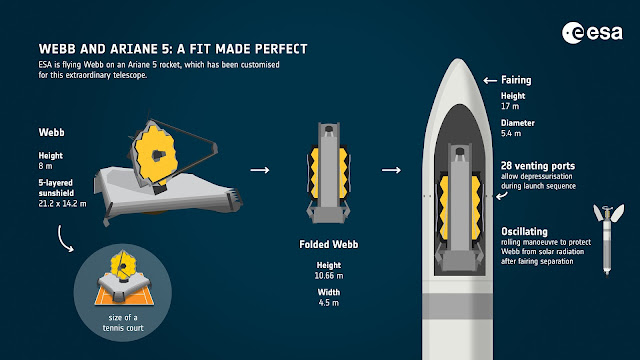
The Webb observatory had to be carefully folded into the specially adapted Ariane 5 fairing for launch, which jettisoned away about three minutes after liftoff. Ariane 5 then began a special roll manoeuvre to protect Webb from the Sun’s radiation. After 27 minutes the telescope was released and the upper stage boosted away.

“I am very happy and proud that the versatility and reliability of Ariane 5 have enabled the launch of such a ground-breaking mission. This is a tribute to the skill and dedication of all the teams involved,” says Daniel Neuenschwander, ESA Director of Space Transportation.

Webb and Ariane 5: a fit made perfect

ESA’s ESTRACK network of ground stations played a key role in tracking Ariane 5 and Webb following liftoff until separation.

Now in space and on its way to L2, Webb will undergo a complex unfolding sequence. In the months after, the instruments will be turned on and their capabilities tested. After half a year in space, Webb will start its routine science observations.

JWST – A new view of the Universe

Seeing farther

Webb will see farther into our origins: from the Universe's first galaxies, to the birth of stars and planets, to exoplanets with the potential for life, and our own Solar System.

“The idea for Webb started with the dream of astronomers to observe the birth of the first galaxies in the early Universe, but the telescope will be able to do so much more than everyone had hoped for,” says Günther Hasinger, ESA Director of Science.

Webb science

ESA contributed to two of the four scientific instruments on board Webb: NIRSpec and MIRI. “It is down to the excellence of the European industry and scientific community that the development of these complex instruments was made possible,” Günther adds.

“We are now looking forward to the beautiful images and spectra that Webb will obtain. The European astronomical community is excited to see the results of the 33% available observing time they competitively won for Webb's first year,” says Antonella Nota, ESA Webb Project Scientist.

Impression of Webb’s journey to space

For the entire duration of the Webb mission, 15 ESA astronomers will be working on telescope operations.

More about Webb:

Webb news updates: https://www.esa.int/Webb

ESA launch kit (available in 6 languages): https://www.esa.int/Science_Exploration/Space_Science/Webb/James_Webb_Space_Telescope_launch_kit

ESA interactive brochure (available in 6 languages): https://www.esa.int/About_Us/ESA_Publications/ESA_BR-348_Webb_Seeing_farther

Webb: https://www.esa.int/Science_Exploration/Space_Science/Webb

Images, Videos, Text, Credits: ESA/CNES/Arianespace.

Best regards, Happy Christmas, Orbiter.ch (Roland Berga)

vendredi 24 décembre 2021

Correction of the ISS orbit altitude


ROSCOSMOS - Russian Vehicles patch.


Dec 24, 2021

The orbital altitude of the International Space Station was adjusted in order to form the initial ballistic conditions before the launch of the Soyuz MS-21 manned spacecraft into orbit and the landing of the Soyuz MS-19 descent vehicle in 2022. According to preliminary data, after the maneuver, the ISS orbital altitude decreased by 1.89 km.

International Space Station (ISS)

On Friday, December 24, 2021, at 04:18 Moscow time, a command was issued and the engines of the Progress MS-18 cargo vehicle docked to the Russian segment of the ISS were turned on. They worked for 544 seconds, and the impulse value was 1.02 m / s. According to the updated data from the ballistic and navigation support service of the Flight Control Center of TsNIIMash, the parameters of the ISS orbit after the evasion maneuver were:

- Circulation period: 92.86 minutes;

- Orbital inclination: 51.66 degrees;

- Minimum orbital altitude: 415.63 km;

- Maximum orbital altitude: 433.15 km.

Earlier, the station's orbital altitude was adjusted on December 3 in order to evade "space debris" - a stage fragment of the American Pegasus launch vehicle launched from the US in 1994.

The launch of the Soyuz MS-21 manned transport vehicle with the crew of the 67th long-term expedition is scheduled for March 18, 2022. For the first time, the transport vehicle should dock to the Prichal nodal module, which in November 2021 became part of the Russian segment of the ISS. The landing of the Soyuz MS-19 descent vehicle with Roscosmos cosmonauts Anton Shkaplerov and Peter Dubrov, as well as NASA astronaut Mark Vande Hei, is scheduled for late March.

Related links:

ROSCOSMOS Press Release: https://www.roscosmos.ru/33687/

TsNIIMash: https://www.roscosmos.ru/tag/cniimash/

RSC Energia: https://www.roscosmos.ru/tag/rkk-ehnergija/

International Space Station (ISS): https://www.roscosmos.ru/tag/mks/

Image, Text, Credits: ROSCOSMOS/TsNIIMash/Orbiter.ch Aerospace/Roland Berga.

Greetings, Orbiter.ch

jeudi 23 décembre 2021

Space Station Science Highlights: Week of December 20, 2021


ISS - Expedition 66 Mission patch.


Dec 23, 2021

Crew members aboard the International Space Station conducted scientific investigations during the week of Dec. 20 that included examining formation of amyloid fibrils, analyzing the effect of impurities in protein crystals, and studying adaptation of muscle tissues. The 24th SpaceX cargo resupply services mission arrived at the space station on Dec. 22 delivering new scientific research and technology demonstrations.

24th SpaceX cargo resupply services mission arrive at the space station. Image Credit: ROSCOSMOS

The space station, continuously inhabited by humans for 21 years, has supported many scientific breakthroughs. A robust microgravity laboratory with dozens of research facilities and tools, the station supports investigations spanning every major scientific discipline, conveying benefits to future space exploration and advancing basic and applied research on Earth. The orbiting lab also provides a platform for a growing commercial presence in low-Earth orbit that includes research, satellite services, and in-space manufacturing.


Image above: Dec. 22, 2021: International Space Station Configuration. Four spaceships are parked at the space station including the SpaceX Crew Dragon and Cargo Dragon vehicles, and Russia’s Soyuz MS-19 crew ship and Progress 79 resupply ship. Image Credit: NASA.

Here are details on some of the microgravity investigations currently taking place:

Look Ma, no container

Gravity forces and interactions between liquids and the containers that hold them can affect some scientific research. For NASA’s Ring Sheared Drop investigation, which studies protein aggregations called amyloid fibrils, scientists created a device that uses surface tension rather than a solid container to hold liquids. Amyloid fibrils form a waxy plaque in the brain and are believed to be involved in development of some neurological diseases. Results may contribute to a better understanding of these diseases and development of potential treatments. This ability to process materials without containers in microgravity could benefit other experiments, including those that grow protein crystals and microorganisms and research on pharmaceuticals. During the week, crew members set up and conducted operations for the experiment.

Impacts of impurities


Image above: NASA astronaut Mark Vande Hei is shown installing the Advanced Nano Step cartridge in the station’s Solution Crystallization Observation Facility (SCOF). This JAXA investigation monitors how the incorporation of specific impurity molecules affect the development and quality of protein crystals. Image Credit: NASA.

The crew exchanged specimen cells for the Advanced Nano Step experiment during the week. This investigation from the Japan Aerospace Exploration Agency (JAXA) monitors and records how specific impurity molecules affect the development and quality of protein crystals grown aboard the station. The research aims to improve the success rate for growing protein crystals and to shorten the sample preparation period. Results could advance capabilities for research on and production of materials and drugs in space and may be useful in crystallization trials conducted on Earth.

What we have here is a failure to contract


Image above: Samantha Jones at the Institute of Life Course and Medical Sciences, University of Liverpool, assembles the experimental unit for MicroAge. This ESA investigation helps identify the mechanisms behind loss of skeletal muscle mass in microgravity and could lead to better exercise regimens and nutritional or pharmacological interventions. Image Credits: University of Liverpool.

MicroAge, an investigation from ESA (European Space Agency), examines adaptation of muscles in microgravity, and whether this adaptation is similar to that seen in elderly subjects on Earth. A failure of muscles to adapt their contractile activity may be the cause of loss of muscle mass from aging or space exposure. The investigation uses 3D engineered skeletal muscle tissues that are exposed to electrical stimulation to induce repeated contractions. The tissues are returned to Earth for analysis. Results could help identify the mechanisms behind loss of muscle mass in space and in aging populations on Earth and support development of appropriate prevention measures. Crew members installed the experiment containers and initiated the investigation during the week.

Other investigations involving the crew:

- EasyMotion from ESA tests a suit worn during pre- and postflight exercise that provides Electro-Myo-Stimulation (EMS). It could save crew time and improve outcomes of inflight exercise on future space missions and in otherwise healthy populations on Earth.
https://www.nasa.gov/mission_pages/station/research/experiments/explorer/Investigation.html?#id=8526


Animation above: NASA astronaut Raja Chari works on the Combustion Integration Rack, which hosts Flame Design, a study of the production and control of soot in oxygen-enriched combustion and the design of soot-free flames. Animation Credit: NASA.

- Flame Design studies the production and control of soot in oxygen-enriched combustion and the design of soot-free flames. This research may lead to cleaner and more efficient burner designs for combustion applications on Earth and aid the development of future space-based combustion devices for tasks such as solid waste processing or to improve spacecraft fire safety.
https://www.nasa.gov/mission_pages/station/research/experiments/explorer/Investigation.html?#id=2059

- NutrISS, an investigation from ESA, periodically assesses body composition and measures long-term energy balance modification over time. Results may improve understanding of the mechanisms behind body composition changes during spaceflight and help lead to ways to mitigate any negative effects of those changes.
https://www.nasa.gov/mission_pages/station/research/experiments/explorer/Investigation.html?#id=7875

- InSPACE-4 studies magnetic assembly of structures from colloids, or particles suspended in a liquid in microgravity. Results could lead to more advanced materials for space applications, including thermal shields, protection from micrometeorites, energy production, and sensors for robotic and human missions.
https://www.nasa.gov/mission_pages/station/research/experiments/explorer/Investigation.html?#id=7669

- Touching Surfaces tests laser-structured antimicrobial surfaces as a method for reducing microbial contamination aboard the space station. Results from this ESA investigation could help determine the most suitable design for antimicrobial surfaces for spacecraft and habitats as well as for terrestrial applications such as public transportation and clinical settings.
https://www.nasa.gov/mission_pages/station/research/experiments/explorer/Investigation.html?#id=8540

- ISS Ham Radio provides students, teachers, parents, and others the opportunity to communicate with astronauts using ham radio units. Before a scheduled call, students learn about the station, radio waves, and other topics, and prepare a list of questions on topics they have researched.
https://www.nasa.gov/mission_pages/station/research/experiments/explorer/Investigation.html?#id=337

Season’s Greetings from NASA

Related links:

Expedition 66: https://www.nasa.gov/mission_pages/station/expeditions/expedition66/index.html

Ring Sheared Drop: https://www.nasa.gov/mission_pages/station/research/experiments/explorer/Investigation.html?#id=7383

Advanced Nano Step: https://www.nasa.gov/mission_pages/station/research/experiments/explorer/Investigation.html?#id=7468

MicroAge: https://www.nasa.gov/mission_pages/station/research/experiments/explorer/Investigation.html?#id=8550

ISS National Lab: https://www.issnationallab.org/

Spot the Station: https://spotthestation.nasa.gov/

Space Station Research and Technology: https://www.nasa.gov/mission_pages/station/research/overview.html

International Space Station (ISS): https://www.nasa.gov/mission_pages/station/main/index.html

Animation (mentioned), Images (mentioned), Video (NASA), Text, Credits: NASA/Carrie Gilder/John Love, ISS Research Planning Integration Scientist Expedition 66.

Best regards, Happy Holidays, Orbiter.ch (Roland Berga)

mercredi 22 décembre 2021

Instrument and assembly compartment "Progress M-UM" undocked from the ISS


ROSCOSMOS - Prichal Port Module patch.


Dec 22, 2021

Today, December 23, 2021, at 02:03 Moscow time, the instrument-assembly compartment of the Progress M-UM cargo module undocked from the Prichal module of the International Space Station in the normal mode. Thus, he freed the airlock for subsequent docking of Russian manned and cargo ships.

Photo: Roscosmos cosmonaut Anton Shkaplerov

The Progress M-UM module ship is an assembly of the Pryhal nodal module with an instrument-assembly compartment by means of a newly developed transition compartment. The instrument-assembly compartment by design corresponds to the instrument-assembly compartment of the base ship "Progress M" with modifications to increase its rigidity and strength in connection with the mass of the ship increased to 8,180 kg.

At 02:03 Moscow time, the specialists of the TsNIIMash Mission Control Center (part of the Roscosmos State Corporation) issued a command to undock the instrument-assembly compartment from the ISS, after which they undocked from the station and sent to "free voyage". After it was withdrawn for safe removal, Russian specialists began a controlled descent of the instrument-assembly compartment from near-earth orbit.

Photo: Roscosmos cosmonaut Anton Shkaplerov

The flight pattern of the instrument-assembly compartment after separation from the Prichal module is similar to the flight pattern of this compartment of the Progress M-CO1 and Progress M-MIM2 module ships. It is expected that the propulsion system will be engaged in braking at 06:45 Moscow time and will operate for about 13 minutes. After that, the instrument-aggregate compartment will begin to de-orbit and in about 24 minutes will enter the dense layers of the Earth's atmosphere. The main part of the ship will burn up in the atmosphere, and the non-combustible elements will be flooded in the non-navigable region of the Pacific Ocean: 2,460 km from the city of Wellington and 7,030 km from the city of Santiago.

The state corporation Roscosmos has completed all the procedures to establish this area as temporarily dangerous for navigation by sea and aircraft.

Photo: Roscosmos cosmonaut Anton Shkaplerov

The instrument-and-assembly compartment of the Progress M-UM cargo vehicle-module has fully fulfilled its task of delivering the new Russian module to the International Space Station. With the help of Progress M-UM, on November 24, 2021, the Pryhal nodal module was launched. Docking with the Russian segment of the ISS took place on November 26 in automatic mode.

The "Prichal" nodal module is designed to increase the technical and operational capabilities of the ISS Russian segment. Further development of the Russian segment of the station is ensured by connecting to the nodal module of transport systems, including promising ones. The developer of the nodal module is the Rocket and Space Corporation Energia named after S.P. Queen (included in Roscosmos).

Progress M-UM undocking and departure

The "Prichal" nodal module is a spherical sealed compartment with components located inside and outside it, ensuring the performance of its tasks. It includes a body and a complex of on-board systems, including a control system for equipment, radio equipment, a system for ensuring a thermal regime, means for providing gas composition, means for controlling movement and navigation, transit lines for refueling, an active hybrid docking system, a passive hybrid docking system, means redocking.

Related articles:

Russia’s New Docking Module Arrives at Station
https://orbiterchspacenews.blogspot.com/2021/11/russias-new-docking-module-arrives-at.html

Russian Port Module is Safely in Orbit Headed for Station
https://orbiterchspacenews.blogspot.com/2021/11/russian-port-module-is-safely-in-orbit.html

Related links:

ROSCOSMOS Press Release: https://www.roscosmos.ru/33678/

Progress M-UM: https://www.roscosmos.ru/tag/progress-m-um/

RSC Energia: https://www.roscosmos.ru/tag/rkk-ehnergija/

International Space Station (ISS): https://www.roscosmos.ru/tag/mks/

Images (mentioned), Video, Text, Credits: ROSCOSMOS/RSC Energia/SciNews/Orbiter.ch Aerospace/Roland Berga.

Best regards, Orbiter.ch