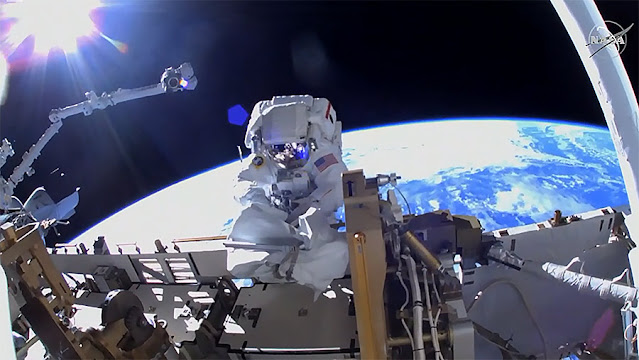
mercredi 16 mars 2022

NASA Adds Giant New Dish to Communicate With Deep Space Missions


NASA - Deep Space Network (DSN) logo.


March 16, 2022

Part of an ongoing project to grow the capacity of the Deep Space Network, which acts as a kind of interplanetary switchboard, the new antenna is the network’s 14th.


Image above: NASA’s DSS-53 antenna went online in February 2022 at the Deep Space Network’s Madrid facility. The addition is part of the agency’s effort to expand the capacity of the network, which supports about 40 missions and is expected to support another 40 that will launch in the coming years. Image Credits: NASA/JPL-Caltech.

There’s a powerful new member of NASA’s family of giant antennas that enable engineers and scientists on Earth to communicate with the growing number of spacecraft exploring our solar system.
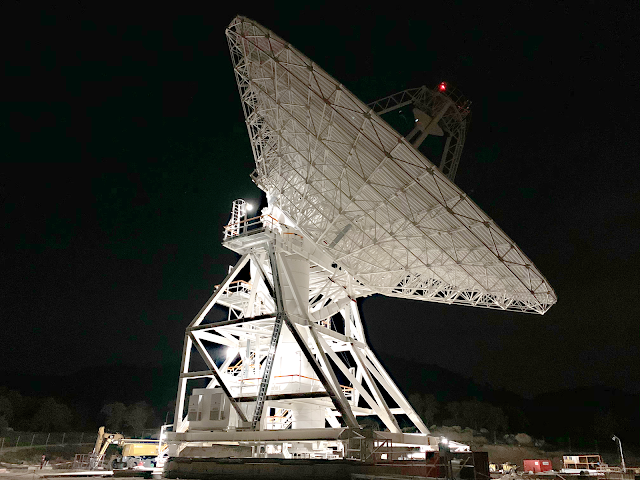

Image above: With the addition of the DSS-53 antenna, the Madrid complex of NASA’s Deep Space Network is the first of the network’s three ground stations to have completed its build-out as part of project to expand network capacity. Image Credits: NASA/JPL-Caltech.

Called Deep Space Station 53, or DSS-53, the 111-foot (34-meter) antenna is part of NASA’s Deep Space Network (DSN). It’s now operational at the network’s facility outside Madrid, one of three such ground stations around the globe. The Madrid station is managed on NASA’s behalf by Spain’s Instituto Nacional de Técnica Aeroespacial (National Institute of Aerospace Technology). To mark the antenna’s debut, King Felipe VI of Spain attended the March 16 inauguration ceremony alongside NASA officials and dignitaries from Spain and the U.S.


Image above: NASA officials and dignitaries from Spain and the U.S. flank King Felipe VI of Spain at the inauguration of the DSN’s DSS-53 antenna. Kathy Lueders, associate administrator for the Space Operations Mission Directorate, and Badri Younes, deputy associate administrator for SCaN, led the NASA delegation. Image Credit: NASA.

“NASA is honored and humbled to have the king acknowledge this important milestone by joining us at the Madrid station. His inauguration of the Deep Space Station 53 antenna highlights the critical and historical collaboration between the Kingdom of Spain and the United States that, through the Deep Space Network, will continue to enable humankind’s exploration of the heavens for many years to come,” said Badri A. Younes, deputy associate administrator for Space Communications and Navigation (SCaN) at NASA Headquarters in Washington.

Managed by NASA’s Jet Propulsion Laboratory in Southern California for SCaN, the DSN allows missions to track, send commands to, and receive scientific data from faraway spacecraft. Now with 14 operational antennas, the network supports about 40 missions and is expected to support another 40 that will launch in the coming years.

Growing the Network

With so many missions to support currently and in the future, NASA began a project to expand the DSN more than a decade ago. DSS-53 is the fourth among six new beam waveguide antennas that the agency is adding to the network. When the project is complete, each ground station – Madrid, along with one in Canberra, Australia, and the Goldstone facility near Barstow, California – will have a total of four such antennas. The DSN’s three ground stations are spaced almost evenly around the globe so the network never loses sight of missions as Earth turns.

Built in Under 60 Seconds: The DSN Welcomes a New Antenna

Video above: Construction of NASA’s DSS-53 antenna at the Deep Space Network’s Madrid complex is shown from November 2018 to March 2020. A nearly two-year commissioning process followed – including installation of electronics and testing – before the antenna became operational in late February 2022. Video Credits: NASA/JPL-Caltech.

Together, the new antennas are capable of backing up each site’s 230-foot (70-meter) antenna. They also mean increased capacity to receive information on Earth – like images of the mysterious asteroid Psyche that the mission of the same name will acquire, or data from the forthcoming Europa Clipper mission revealing whether Jupiter’s icy moon has the capability to support life as we know it.

“This new antenna adds about 8% more capacity to the network. What it’s going to mean is 8% more science, and that’s really significant,” said JPL’s Bradford Arnold, the DSN project manager.

DSS-53 will act as a “workhorse” antenna capable of communicating on the frequencies most commonly used by NASA spacecraft. Its construction began in 2016. A complicated two-year commissioning period included a weekslong process when engineers and technicians adjusted each of the dish’s some 300 reflector panels, often as little as a quarter-turn of a screw, to optimize performance.

The new antenna follows DSS-56 coming online in Spain in early 2021, making the Madrid facility the first to have completed its build-out as part of NASA’s antenna-enhancement effort. The fifth new antenna in the effort, DSS-23, is expected to go online at Goldstone in 2025. The sixth antenna will be at the Canberra facility.

More About the Deep Space Network

The forerunner to the Deep Space Network was established in 1958 when JPL was contracted by the U.S. Army to deploy portable radio tracking stations in California, Nigeria, and Singapore to receive telemetry of the first successful U.S. satellite, Explorer 1. Shortly after JPL was transferred to NASA later that year, the newly formed U.S. civilian space program established the Deep Space Network to communicate with all deep space missions. It has been in continuous operation since 1963 and remains the backbone of deep space communications for NASA and international missions, supporting historic events such as the Apollo Moon landings and checking in on our interstellar explorers, Voyager 1 and 2.

Related links:

Deep Space Network (DSN): http://go.nasa.gov/about-dsn

Instituto Nacional de Técnica Aeroespacial (National Institute of Aerospace Technology): https://www.inta.es/INTA/en/

SCaN: https://www.nasa.gov/directorates/heo/scan/index.html

Canberra: https://www.cdscc.nasa.gov/

Goldstone: https://www.gdscc.nasa.gov/

Images (mentioned), Video (mentioned), Text, Credits: NASA/JPL/Ian J. O'Neill/Melissa Pamer.

Greetings, Orbiter.ch

Webb reaches alignment milestone


NASA / ESA / CSA-ASC - James Webb Space Telescope (JWST) patch.


March 16, 2022

Following the completion of critical mirror alignment steps, the NASA/ESA/CSA James Webb Space Telescope team expects that Webb’s optical performance will be able to meet or exceed the science goals the observatory was built to achieve.

Webb reaches alignment milestone: image of focused star

On 11 March, the Webb team completed the stage of alignment known as “fine phasing”. At this key stage in the commissioning of Webb’s Optical Telescope Element, every optical parameter that has been checked and tested is performing at, or above, expectations. The team also found no critical issues and no measurable contamination or blockages to Webb’s optical path. The observatory is able to successfully gather light from distant objects and deliver it to its instruments without issue.

Although there are months to go before Webb ultimately delivers its new view of the cosmos, achieving this milestone means the team is confident that Webb’s first-of-its-kind optical system is working as well as possible.

James Webb Space Telescope Instruments

With the fine phasing stage of the telescope’s alignment complete, the team has now fully aligned Webb’s primary imager, the Near-Infrared Camera, to the observatory’s mirrors.

Over the next six weeks, the team will proceed through the remaining alignment steps before final science instrument preparations. The team will further align the telescope to include the Near-Infrared Spectrograph, Mid-Infrared Instrument, and Near InfraRed Imager and Slitless Spectrograph. In this phase of the process, an algorithm will evaluate the performance of each instrument and then calculate the final corrections needed to achieve a well-aligned telescope across all science instruments. Following this, Webb’s final alignment step will begin, and the team will adjust any small, residual positioning errors in the mirror segments.

Webb reaches alignment milestone (selfie)

The team is on track to conclude all aspects of Optical Telescope Element alignment by early May, if not sooner, before moving on to approximately two months of science instrument preparations. Webb’s first full-resolution imagery and science data will be released in the summer.

Webb is the world's premier space science observatory and once fully operational, will help solve mysteries in our Solar System, look beyond to distant worlds around other stars, and probe the mysterious structures and origins of our universe and our place in it.

Webb is an international partnership between NASA, ESA and the Canadian Space Agency (CSA).

Related articles:

Webb Mirror Alignment Continues Successfully
https://orbiterchspacenews.blogspot.com/2022/02/webb-mirror-alignment-continues.html

Photons Incoming: Webb Team Begins Aligning the Telescope
https://orbiterchspacenews.blogspot.com/2022/02/photons-incoming-webb-team-begins.html

Photons received: Webb sees its first star – 18 times
https://orbiterchspacenews.blogspot.com/2022/02/photons-received-webb-sees-its-first.html

Related links:

Webb’s Optical Telescope Element: https://jwst.nasa.gov/content/observatory/ote/index.html#:~:text=NASA%2FChris%20Gunn-,The%20Optical%20Telescope%20Element%20(OTE)%20is%20the%20eye%20of%20the,subsystems%20that%20support%20the%20optics

Near-Infrared Camera: https://jwst.nasa.gov/content/observatory/instruments/nircam.html

Near-Infrared Spectrograph: http://jwst.nasa.gov/nirspec.html

Mid-Infrared Instrument: https://webb.nasa.gov/content/observatory/instruments/miri.html

Near InfraRed Imager and Slitless Spectrograph: https://jwst.nasa.gov/content/observatory/instruments/fgs.html

James Webb Space Telescope (JWST): https://www.esa.int/Science_Exploration/Space_Science/Webb

Images, Animation, Text, Credits: ESA/NASA/STScI.

Best regards, Orbiter.ch

International Space Station Frequently Asked Questions


ISS - International Space Station patch.


March 16, 2022

The International Space Station Program brings together international flight crews, multiple launch vehicles, globally distributed launch, operations, training, engineering, and development facilities, communications networks, and the international scientific research community.

Launched in 1998 and involving the U.S., Russia, Canada, Japan, and the participating countries of the European Space Agency — the International Space Station is one of the most complex international collaborations ever attempted.

International Space Station (ISS). Image Credit: NASA

Q. Who operates the International Space Station?

Five partner agencies (the Canadian Space Agency, the European Space Agency, the Japan Aerospace Exploration Agency, the National Aeronautics and Space Administration, and the State Space Corporation “Roscosmos”) operate the International Space Station, with each partner responsible for managing and controlling the hardware it provides. The station was designed to be interdependent and relies on contributions from across the partnership to function. No one partner currently has the capability to function without the other.

The space station was not designed to be disassembled, and current interdependencies between each segment of the station prevent the U.S. Orbital Segment and Russian Segment from operating independently. Attempts to detach the U.S. Orbital Segment and the Russian Segment would encounter major logistical and safety challenges given the multitude of external and internal connections, the need to control spacecraft attitude and altitude, and software interdependency.

Q. What are some examples of how the International Space Station is interdependent?

Examples include:

- Russia provides all of the propulsion for International Space Station used for station reboost, attitude control, debris avoidance maneuvers and eventual de-orbit operations by the Russian Segment, Russian propulsion systems, and Progress resupply cargo spacecraft.

- Propellant for thrusters on the Russian Segment is supplied by Russian Progress cargo spacecraft.

- The U.S. gyroscopes provide day-to-day attitude control to control the orientation of the station. Russian thrusters are used for attitude control during dynamic events, like spacecraft dockings, and provide attitude control recovery when the gyroscopes reach their control limits.

- Power from the U.S. solar arrays is transferred to the Russian Segment to augment their power needs.

- NASA’s Tracking and Data Relay Satellites (TDRS) provide communications and data transfer capability between the ground and the entire station, with some additional, less-continuous capability through Russian ground stations and satellites.

- There are life support systems on both the U.S. Orbital Segment and Russian Segment, responsible for generating oxygen and scrubbing carbon dioxide from the atmosphere. This allows space station to have more crew on board, and having dissimilar systems enables increased levels of safety for crew.

- Mission control centers for NASA in Houston and Roscosmos in Moscow only command and control their respective segments.

Q. What areas of Earth does the International Space Station fly over?

The International Space Station orbits with an inclination of 51.6 degrees. This means that, as it orbits, the farthest north and south of the Equator it will ever go is 51.6 degrees latitude. An explanation and visuals of the space station orbit is available online.

On the Spot The Station page, you can enter a country or region to watch the International Space Station pass overhead from several thousand worldwide locations.

Q. Can astronauts fly to the International Space Station on one type of spacecraft and return on a different one?

Astronauts typically launch and return in the same type of spacecraft (i.e., Crew Dragon or Soyuz).  Each astronaut has custom hardware including a launch and entry suit or a seat liner that is not interchangeable between different models of spacecraft. A crew member can launch on one Russian Soyuz and return on a different Soyuz, but transferring them to return on a SpaceX Dragon would require a different launch and entry suit that is custom fitted and created on the ground. NASA astronaut Mark Vande Hei has transferred seat liners between Soyuz spacecraft on his record setting mission.

Q. Do NASA and Roscosmos always need its astronauts or cosmonauts on the International Space Station?

Operating the space station requires physical, hands-on maintenance by the crew, on both U.S. Operating Segment and the Russian Segment, to ensure systems continue functioning. NASA and Roscosmos crew members are not trained to operate each other’s respective segments without onboard assistance. In failure scenarios on the United States Orbital Segment, only U.S. astronauts are trained to fully respond, either through actions inside the station (e.g., to change out a component) or through spacewalks. The same is true for Russian cosmonauts in failure situations originating on the Russian segment.

Q. How is the International Space Station’s attitude and altitude controlled and can any current functions be replaced or upgraded?

All International Space Station propulsion is provided by the Russian Segment and Russian cargo spacecraft.  Propulsion is used for station reboost, attitude control, debris avoidance maneuvers and eventual deorbit operations are handled by the Russian Segment and Progress cargo craft. The U.S. gyroscopes provide day-to-day attitude control or controlling the orientation of the station. Russian thrusters are used for attitude control during dynamic events like spacecraft dockings and provide attitude control recovery when the gyroscopes reach their control limits.

International Space Station (ISS). Animation Credit: ESA

Northrop Grumman’s Cygnus is the only U.S. commercial spacecraft currently in testing to provide limited capability for future reboosts. This capability relies on the Russian Segment for attitude control during the small reboost. It does not currently have the capability to replace attitude control functions for the space station or carry adequate propellant for long-term sustained operations.

Attitude control and propulsive reboost capability is a continuous requirement, which means the space station needs a continuous and steady supply of propulsion spacecraft. Changes to the current propulsion scheme would take considerable new hardware/software development, and significant time and funding to enact.

Q. How long do all the International Space Station partners plan to operate the complex?

NASA and its international partners have maintained a continuous and productive human presence aboard the International Space Station for more than 21 years. Life extension analysis for the US Segment has been completed through 2028 with no issues that would prevent space station from being further extended.  The United States has committed to extend International Space Station operations through 2030. NASA’s space agency partners have all recommended International Space Station extension through 2030 with approvals pending through their own government processes.

Q. How will NASA and Roscosmos safely deorbit the International Space Station after its planned decommissioning?

The primary objective during space station deorbit operations is the safe re-entry of the space station’s structure into an unpopulated area in the ocean as outlined in the agency’s International Space Station transition plan.

The space station will accomplish the deorbit maneuvers by using the propulsive capabilities of the space station and its visiting spacecraft. NASA and its partners have evaluated varying quantities of Russian Progress spacecraft to support deorbit operations. Additionally, NASA is evaluating whether U.S. commercial spacecraft can be modified to provide capability to deorbit the space station.

Read our International Space Station transition plan FAQ page: https://www.nasa.gov/feature/faq-the-international-space-station-2022-transition-plan

Related links:

Spot The Station: https://spotthestation.nasa.gov/home.cfm

International Space Station transition plan: https://www.nasa.gov/feature/nasa-provides-updated-international-space-station-transition-plan

International Space Station (ISS): https://www.nasa.gov/mission_pages/station/main/index.html

Image (mentioned), Animation (mentioned), Text, Credits: NASA/Cheryl Warner.

Greetings, Orbiter.ch

Gaia snaps photo of Webb at L2


ESA - Gaia Mission patch.


March 16, 2022

On 18 February, the NASA/ESA/CSA James Webb Space Telescope was photographed by ESA’s Gaia observatory.

Gaia snaps photo of Webb

Both spacecraft are located in orbits around the Lagrange point 2 (L2), 1.5 million km from Earth in the direction away from the Sun. Gaia arrived there in 2014, and Webb in January 2022.

On 18 February 2022, the two spacecraft were 1 million km apart, with an edge-on view of Gaia towards Webb’s huge sunshield. Very little reflected sunlight came Gaia’s way, and Webb therefore appears as a tiny, faint spec of light in Gaia’s two telescopes without any details visible.

Sky mapper

A few weeks before Webb’s arrival at L2, Gaia experts Uli Bastian of Heidelberg University (Germany) and Francois Mignard of Nice Observatory (France) realised that during Gaia’s continuous scanning of the entire sky, its new neighbour at L2 should occasionally cross Gaia’s fields of view.


 Gaia

Gaia is not designed to take real pictures of celestial objects. Instead, it collects very precise measurements of their positions, motions, distances, and colours. However, one part of the instruments on board takes a sort of sky images. It is the ‘finder scope’ of Gaia, also called the sky mapper.

The orbits of Gaia and Webb

Every six hours, Gaia’s sky mapper scans a narrow 360-degree strip around the entire celestial sphere. The successive strips are slightly tilted with respect to each other, so that every few months the entire sky is covered – touching everything that’s there and that’s bright enough to be seen by Gaia. Within seconds, these slices are automatically scrutinized for star images, the positions of which are then used to predict when and where those stars could be recorded in Gaia’s main scientific instruments. Then they are routinely deleted.

But the computer can be manually requested to exceptionally keep a stretch of the image data. The sky mapper was originally planned for technical servicing purposes, but during the mission it has also found some scientific uses. Why not use it for a snapshot of Webb?

Got it!

After Webb had reached its destination at L2, the Gaia scientists calculated when the first opportunity would arise for Gaia to spot Webb, which turned out to be 18 February 2022.

After Gaia’s two telescopes had scanned the part of the sky where Webb would be visible, the raw data was downloaded to Earth. In the morning after, Francois sent an email to all people involved. The enthusiastic subject line of the email was "JWST: Got it!!"

Gaia snaps photo of Webb (zoom)

The astronomers had to wait a few more days for Juanma Martin-Fleitas, ESA’s Gaia calibration engineer, to identify Webb in the sky mapper images. "I've identified our target" was the message sent by him, with the images attached and the two tiny specks labelled as ‘Webb candidates’.

After scrutinising these carefully, Uli replied: “Your ‘candidates’ can be safely renamed ‘Webb’”.

Gaia snaps photo of Webb (animation)

Gaia now has a spacecraft friend at L2, and together they will uncover our home galaxy, and the Universe beyond.

Related links:

Gaia: https://www.esa.int/Science_Exploration/Space_Science/Gaia

James Webb Space Telescope (JWST): https://www.esa.int/Science_Exploration/Space_Science/Webb

Images, Animation, Video, Text, Credits: ESA/Gaia/DPAC; CC BY-SA 3.0 IGO.

Best regards, Orbiter.ch

Lunar scientists and engineers design Moon cave explorer


ESA - Daedalus Mission patch.


March 16, 2022

Lunar caves are not only a geologically pristine record of the Moon's history, but they could also provide a safe home for future human explorers. Building upon ESA Discovery's OSIP call and SysNova challenge, ESA gathered a spectrum of over 60 experts in many different areas of science and engineering to design a mission to enter a pit on the Moon's surface and explore the entrance to a lunar cave.

Lunar caves exploration mission

The Moon is dotted with pits that scientists think could lead to huge underground tunnels. But a space mission has never been sent to explore what could lie within.

"A view into the interior of a lunar cave would be true exploration – it would reveal unexpected scientific information," says Francesco Sauro, cave scientist and planetary lava tube expert, as well as technical course director of ESA CAVES and PANGAEA.

Marius Hills pit

ESA kick-started such a mission in 2019, when the Discovery element of ESA's Basic Activities launched a public Open Space Innovation Platform (OSIP) call for ideas to detect, map and explore lunar caves. Five ideas were chosen to be studied in more detail through an ESA Discovery SysNova challenge, each addressing a different phase of a potential mission.

Most recently, the two winning SysNova studies – RoboCrane and Daedalus – were united and expanded into one complete mission plan through ESA's Concurrent Design Facility (CDF). The mission would use a robotic crane (RoboCrane) to lower down a cave explorer (Daedalus) into a lunar pit. On its way down, Daedalus would explore and document the entrance to the cave, before mapping the closest part of the cave at the bottom.

Artist's impression of the lunar caves exploration mission

"The OSIP Campaign and SysNova challenge paved the way to the CDF mission analysis," explains Loredana Bessone, CAVES and PANGAEA project lead and technical officer for the studies. "They allowed us to identify the interest in lunar cave missions from European and Canadian industry and research institutes, as well as revealing their expertise. It allowed industry and academia to confront the challenges of such missions and learn from lunar cave scientists about constraints, opportunities and potential mission scenarios."

There is a huge amount to think about when designing a space mission; by bringing together experts from many different areas of science and engineering – including specialists from the RoboCrane and Daedalus teams, as well as ESA experts – this much-larger-than-usual CDF study came up with a complete vision of a lunar caves exploration mission. It confirmed that the mission is feasible and would be scientifically very interesting.

The mission could launch on an Ariane 6 in 2033 at the earliest, and would use the European Large Logistic Lander (EL3) to reach the Moon's surface. It would target the Marius Hills pit and last a fortnight – equivalent to one day on the Moon.

Three key stages of a mission to explore and map lunar caves

Experts taking part in the CDF study came up with rough designs for the rover that would carry the equipment to the pit, as well as concrete designs for RoboCrane and Daedalus themselves. They also studied the environment of the pit, created models of the Moon's subsurface and the mission elements, generated roadmaps for developing the technologies that will be needed to make the mission a success, and assessed the main challenges that the mission will face.

"A mission like this would require the development of innovative technologies, encouraging the space sector to develop new solutions compared to previous lunar missions," explains Francesco. "This advancement in technology would be a big step forward for lunar and martian exploration."

The progress that has been made so far puts ESA at the frontline of pushing space exploration beyond the surface of the Moon and into its subsurface. But there is still lots to be done in the next decade to make such a mission possible.

The teams behind RoboCrane and Daedalus continue to work on their ideas. Led by the University of Oviedo, RoboCrane researchers published a paper in December 2021 describing their system to provide a power and communication link between the lunar surface and lunar caves for exploration robots.

Artist’s impression of Daedalus

"The mission will need to be defined in even more detail during the coming years," says Loredana. "The rover that will carry RoboCrane and Daedalus to the pit will need to be described, and a lunar test range would be required to try out the techniques planned for the mission."

A 'Topical Team' made up of 17 experts from universities and research institutes across Europe and Canada has now been established to support ESA in the development of a strategy that includes lunar caves in the framework of European lunar exploration. The Team is organising a planetary caves conference for 2023, where an international group of scientists and engineers will push the need for a lunar cave mission within the next decade.

Related links:

OSIP call: https://www.esa.int/Enabling_Support/Preparing_for_the_Future/Discovery_and_Preparation/Seeking_innovative_ideas_for_exploring_lunar_caves

SysNova challenge: https://www.esa.int/Enabling_Support/Preparing_for_the_Future/Discovery_and_Preparation/En_route_to_exploring_lunar_caves

CAVES: https://www.esa.int/Lunar_caves_CDF_results_FS_LB_NS_MF_JT.docx

PANGAEA: http://blogs.esa.int/caves

ESA's Concurrent Design Facility (CDF): https://www.esa.int/Enabling_Support/Space_Engineering_Technology/CDF

RoboCrane: https://sea.grupos.uniovi.es/en/-/robotic-crane-for-wireless-power-and-data-transmission-between-surface-and-cave

Daedalus: https://www.informatik.uni-wuerzburg.de/space/mitarbeiter/nuechter/projects/daedalus/

Ariane 6: https://www.esa.int/Enabling_Support/Space_Transportation/Launch_vehicles/Ariane_6

RoboCrane researchers published a paper: https://www.researchgate.net/publication/356723920_RoboCrane_A_system_for_providing_a_power_and_a_communication_link_between_lunar_surface_and_lunar_caves_for_exploring_robots

Discovery and Preparation: https://www.esa.int/Enabling_Support/Preparing_for_the_Future/Discovery_and_Preparation

Animation, Images, Video, Text, Credits: ESA/Vigea/NASA/Francesco Sauro/Julius-Maximilians-University.

Best regards, Orbiter.ch

mardi 15 mars 2022

NASA Astronauts Complete Spacewalk for Solar Array Work


EVA - Extra Vehicular Activities patch.


March 15, 2022

NASA astronauts Kayla Barron and Raja Chari concluded their spacewalk at 3:06 p.m. EDT after 6 hours and 54 minutes in preparation for upcoming solar array installation.


Image above: NASA astronauts Kayla Barron and Raja Chari will work outside the space station to prepare it for the next roll-out solar array due to be delivered soon. Image Credit: NASA.

Barron and Chari completed their major objectives for today to prepare the space station for upcoming solar array upgrades by assembling and installing modification kits. The duo built a support bracket onto which a future ISS roll out solar array (iROSA) will be mounted. So far, two of six iROSAs have been deployed on station with four additional arrays to be delivered. The arrays will ultimately augment six of the station’s eight power channels, increasing the station’s total available power from 160 kilowatts to up to 215 kilowatts.


Image above: Six iROSA solar arrays in the planned configuration will augment the power drawn from the existing arrays on the International Space Station. Image Credit: Boeing.

It was the 247th spacewalk in support of space station assembly, upgrades and maintenance, and was the first in Chari’s career and the second for Barron. Chari and Barron are in the midst of a planned six-month science mission living and working aboard the microgravity laboratory to advance scientific knowledge and demonstrate new technologies for future human and robotic exploration missions as part of NASA’s Moon and Mars exploration approach, including lunar missions through NASA’s Artemis program.


Image above: NASA astronaut Kayla Barron works to ready the space station for a third set of roll-out solar arrays about 260 miles above the Earth. Image Credit: NASA TV.

Astronaut roles for the next spacewalk on March 23 will be confirmed soon. NASA TV coverage for the March 23 spacewalk will begin at 7:30 a.m. for a spacewalk expected to begin around 8:50am.

For the Wednesday, March 23, spacewalk, designated U.S. EVA 80, two astronauts will install hoses on a Radiator Beam Valve Module that routes ammonia through the station’s heat-rejecting radiators to keep systems at the proper temperature. The crew members also will install a power and data cable on the Columbus module’s Bartolomeo science platform, replace an external camera on the station’s truss, and conduct other upgrades to station hardware.

NASA Astronaut Breaks American Space Record

Vande Hei made it into record books on Tuesday, March 15, 2022: He broke the record for the most consecutive days in space by an American explorer.

Vande Hei arrived at the space station on April 9, 2021, and is expected to return home March 30, 2022, after spending 355 days in low-Earth orbit. This duration breaks the previous record, held by NASA astronaut Scott Kelly, by 15 days.


In this image from August 2021, NASA astronaut Mark Vande Hei sits and reads while aboard the International Space Station. Image Credit: NASA.

His then-crewmate Thomas Pesquet, who snapped the picture, said: "If you are reading this sitting down, maybe on a sofa or couch, consider that we will not sit down... until we are back on Earth! Of course we don't need to sit down up here, and I am not complaining at all, but sometimes that wonderful feeling of relaxation – that moment when you change from running around to letting yourself drop into a chair – that moment can be wonderful I am sure you all agree, and we do miss it sometimes! I think Mark did here too and made a makeshift reading table to enjoy a book – absolutely unnecessary in weightlessness but so nice to construct some semblances of normal life every now and again!"

Related links:

Expedition 66: https://www.nasa.gov/mission_pages/station/expeditions/expedition66/index.html

U.S. Quest airlock: https://www.nasa.gov/mission_pages/station/structure/elements/joint-quest-airlock

Starboard-4 truss structure: https://www.nasa.gov/mission_pages/stat.ion/structure/elements/truss-structure

Space Station Research and Technology: https://www.nasa.gov/mission_pages/station/research/overview.html

International Space Station (ISS): https://www.nasa.gov/mission_pages/station/main/index.html

Images (mentioned), Text, Credits: NASA/Mark Garcia.

Greetings, Orbiter.ch

NASA Extends Ingenuity Helicopter Mission


NASA - Ingenuity Mars Helicopter logo.


March 15, 2022

With its recent 21st flight complete, the Red Planet rotorcraft is on its way to setting more records during its second year of operations.


Animation above: The Ingenuity Mars Helicopter’s carbon fiber blades can be seen in this video taken by the Mastcam-Z instrument aboard NASA’s Perseverance Mars rover on April 8, 2021, the 48th Martian day, or sol, of the mission. They are performing a wiggle test before the actual spin-up to ensure they were working properly. Animation Credits: NASA/JPL-Caltech/ASU.

NASA has extended flight operations of the Ingenuity Mars Helicopter through September. In the months ahead, history’s first aircraft to operate from the surface of another world will support the Perseverance rover’s upcoming science campaign exploring the ancient river delta of Jezero Crater. Along the way, it will continue testing its own capabilities to support the design of future Mars air vehicles.

The announcement comes on the heels of the rotorcraft’s 21st successful flight, the first of at least three needed for the helicopter to cross the northwest portion of a region known as “Séítah” and reach its next staging area.

“Less than a year ago we didn’t even know if powered, controlled flight of an aircraft at Mars was possible,” said Thomas Zurbuchen, the associate administrator of NASA’s Science Mission Directorate. “Now, we are looking forward to Ingenuity’s involvement in Perseverance’s second science campaign. Such a transformation of mindset in such a short period is simply amazing, and one of the most historic in the annals of air and space exploration.”

NASA’s Mars Rovers Are On the Move and Bringing the Public Along

Video above: NASA’s hard at work on the Red Planet. Watch the latest Mars Report for more on Ingenuity, along with the agency’s Perseverance and Curiosity rovers. Video Credits: NASA/JPL-Caltech.

Ingenuity’s new area of operations is entirely different from the modest, relatively flat terrain it has been flying over since its first flight last April. Several miles wide and formed by an ancient river, the fan-shaped delta rises more than 130 feet (40 meters) above the crater floor. Filled with jagged cliffs, angled surfaces, projecting boulders, and sand-filled pockets that could stop a rover in its tracks (or upend a helicopter upon landing), the delta promises to hold numerous geologic revelations – perhaps even the proof necessary to determine that microscopic life once existed on Mars billions of years ago.

Upon reaching the delta, Ingenuity’s first orders will be to help determine which of two dry river channels Perseverance should take when it’s time to climb to the top of the delta. Along with routing assistance, data provided by the helicopter will help the Perseverance team assess potential science targets. Ingenuity may even be called upon to image geologic features too far afield (or outside of the rover’s traversable zone), or perhaps scout landing zones and caching sites for the Mars Sample Return program.


Image above: NASA’s Ingenuity Mars Helicopter acquired this image in the northwest portion of a region known as “Séítah” using its high-resolution color camera during its 20th flight on Feb. 25, 2022. Image Credits: NASA/JPL-Caltech.

“The Jezero river delta campaign will be the biggest challenge the Ingenuity team faces since first flight at Mars,” said Teddy Tzanetos, Ingenuity team lead at NASA’s Jet Propulsion Laboratory in Southern California. “To enhance our chances of success, we have increased the size of our team and are making upgrades to our flight software geared toward improving operational flexibility and flight safety.”

Higher Flights

Several of these upgrades have led to reduced navigation errors during flight, which increases both flight and landing safety. A recent software change already on the rotorcraft frees Ingenuity from its previously programmed maximum altitude of 50 feet (15 meters). The altitude gains could result in incremental increases in both air speed and range. A second upgrade allows Ingenuity to change airspeed as it flies. Another enables it to better understand and adjust to changes in terrain texture during flight. Future software upgrades may include adding terrain elevation maps into the navigation filter and a landing-hazard-avoidance capability.

Before aerial reconnaissance of the delta can begin, Ingenuity has to complete its journey to the area. Scheduled for no earlier than March 19, Ingenuity’s next flight will be a complex journey, about 1,150 feet (350 meters) in length, that includes a sharp bend in its course to avoid a large hill. After that, the team will determine whether two or three more flights will be required to complete the crossing of northwest Séítah.


Image above: This annotated image depicts the multiple flights – and two different routes – NASA’s Ingenuity Mars Helicopter could take on its trip to Jezero Crater’s delta. Image Credits: NASA/JPL-Caltech/University of Arizona/USGS.

The first experimental flight on another world took place on April 19, 2021, and lasted 39.1 seconds. After another four flights, six more minutes in the air, and traveling a total distance of 1,637 feet (499 meters), NASA transitioned Ingenuity into an operations demonstration phase, testing its ability to provide an aerial dimension to the Perseverance mission. With the completion of Flight 21, the rotorcraft has logged over 38 minutes aloft and traveled 2.9 miles (4.64 kilometers). As Ingenuity pushes farther into uncharted territory, these numbers will inevitably go up, and previous flight records will more than likely fall.

“This upcoming flight will be my 22nd entry in our logbook,” said Ingenuity chief pilot Håvard Grip of JPL. “I remember thinking when this all started, we’d be lucky to have three entries and immensely fortunate to get five. Now, at the rate we’re going, I’m going to need a second book.”

More About Ingenuity

The Ingenuity Mars Helicopter was built by JPL, which also manages this technology demonstration project for NASA Headquarters. It is supported by NASA’s Science Mission Directorate. NASA’s Ames Research Center in California’s Silicon Valley and NASA’s Langley Research Center in Hampton, Virginia, provided significant flight performance analysis and technical assistance during Ingenuity’s development. AeroVironment Inc., Qualcomm, and SolAero also provided design assistance and major vehicle components. Lockheed Space designed and manufactured the Mars Helicopter Delivery System.

At NASA Headquarters, Dave Lavery is the program executive for the Ingenuity Mars Helicopter.

More About Perseverance

A key objective for Perseverance’s mission on Mars is astrobiology, including the search for signs of ancient microbial life. The rover will characterize the planet’s geology and past climate, pave the way for human exploration of the Red Planet, and be the first mission to collect and cache Martian rock and regolith (broken rock and dust).

Subsequent NASA missions, in cooperation with ESA (European Space Agency), would send spacecraft to Mars to collect these sealed samples from the surface and return them to Earth for in-depth analysis.

The Mars 2020 Perseverance mission is part of NASA’s Moon to Mars exploration approach, which includes Artemis missions to the Moon that will help prepare for human exploration of the Red Planet.

JPL, which is managed for NASA by Caltech in Pasadena, California, built and manages operations of the Perseverance rover.

For more information about Ingenuity: https://mars.nasa.gov/technology/helicopter

Related link:

Mars Sample Return program: https://www.jpl.nasa.gov/missions/mars-sample-return-msr

Animation (mentioned), Images (mentioned), Video (mentioned), Text, Credits: NASA/Tony Greicius/Karen Fox/Alana Johnson/JPL/DC Agle.

Best regards, Orbiter.ch