mercredi 27 juillet 2022

NASA Marks 25 Years Since Pathfinder Touched Down on Mars


NASA - Mars Pathfinder Mission patch.


Jul 27, 2022

When a daring team of engineers put a lander and the first rover on the Red Planet a quarter century ago, they changed how the world explores.


Image above: This eight-image mosaic was acquired by Pathfinder July 5, 1997, the second Martian day, or sol, of the mission. The newly deployed Sojourner rover – the first of its kind on the Red Planet – sits on the Martian surface after driving down Pathfinder’s ramp. Image Credits: NASA/JPL-Caltech.

On a July evening in 1997, Jennifer Trosper drove home from work at NASA’s Jet Propulsion Laboratory holding a picture of the Martian surface to her steering wheel. Earlier that day, the agency’s Pathfinder mission had landed on Mars encased in protective air bags and taken the image of the red, rubbly landscape that transfixed her.

“As I was on the freeway, I had that image on my steering wheel and kept looking at it,” Trosper said, reminiscing. “I probably should have been looking more closely at the road.”

Given that Trosper was the mission’s flight director, her excitement was understandable. Not only had Pathfinder landed on Mars, a feat all its own, but it had done so at a fraction of the cost and time required of previous Mars missions. And, the next day, the team was set to change the course of Mars exploration forever: They had sent instructions to Pathfinder to extend a ramp so that history’s first Mars rover, Sojourner, could roll down onto the planet’s surface.


Image above: NASA’s Sojourner Mars rover is seen on the 22nd Martian day, or sol, of the Pathfinder mission near a location nicknamed “The Dice” (three small rocks behind the rover) and a rock nicknamed “Yogi.” Image Credits: NASA/JPL-Caltech.

Named after the fiery American abolitionist and women’s rights activist Sojourner Truth, the rover weighed just 25 pounds (11 kilograms) and was no larger than a microwave oven. But after touching down and spending 83 days traveling the surface, the tiny spacecraft proved that exploring Mars with a rover was possible. It also led Trosper to work on a series of ever-larger, more complex rovers: Spirit and Opportunity, Curiosity, and NASA’s most advanced Mars rover to date, Perseverance, on which she served as project manager until recently.

JPL and the Space Age: The Pathfinders

Video above: The documentary film “The Pathfinders” tells the story of a small group of engineers at NASA’s Jet Propulsion Laboratory who took on the challenge of both putting a lander on the Red Planet with airbags and deploying the first Mars rover. Video Credits: NASA/JPL-Caltech.

In fact, just as Pathfinder took Sojourner along for the ride, Perseverance brought Ingenuity, the plucky little helicopter that proved powered, controlled flight in Mars’ thin atmosphere is possible. Slated for just five flights, Ingenuity has flown 29 times so far, and it has the potential to reshape Mars exploration every bit as much as Sojourner did a quarter century ago.

With every new mission and every new way of exploring Mars, humanity gains a better understanding of how the Red Planet once resembled Earth, covered by rivers and lakes and featuring the chemistry needed to support life.


Image above: NASA’s Sojourner Mars rover captured this panorama on the Red Planet about a week before its final data transmission, which occurred Sept. 27, 1997. Image Credits: NASA/JPL-Caltech.

NASA’s search for life on the Martian surface started in earnest in 1976, when the twin Viking landers arrived. The agency wouldn’t land another spacecraft on Mars until Pathfinder, which arose in an era when NASA had been directed to build its missions “faster, better, cheaper.” Pathfinder’s team harnessed new approaches and technologies to deliver the mission ahead of schedule and at a lower cost than the Viking landers.

Inspiring Future Explorers

Jessica Samuels, an engineering intern in Arizona at the time of Pathfinder’s landing, remembers watching news coverage of the event with her roommate. The excitement helped lead her to pursue aerospace engineering.

“That moment – seeing this little mechanical rover exploring the surface of another planet – made me realize that’s something I would love to do,” said Samuels, now Perseverance’s mission manager. “I had always been interested in space, but that was the spark where I thought this could actually be my profession.”


Image above: NASA’s Sojourner Mars rover captured this image of the Pathfinder lander with airbags, now deflated, that were used to cushion the spacecraft during touchdown. The letters “JPL” and an American flag can be seen on the lander’s electronics box below the lander’s camera, which is mounted on a mast. Image Credits: NASA/JPL-Caltech.

To take the public along for the journey, the agency harnessed the power of another kind of relatively new technology: the Internet. A website devoted to the mission featured the latest images from Mars, and it became a sensation.

Doug Ellison, who today uploads commands to Curiosity from JPL, was about to enter college in rural England when Pathfinder touched down. After hearing about Pathfinder’s website, he bicycled into town to an IT business that let people pay by the hour for Internet access.

With the business’ employees huddled behind him, Ellison saved Pathfinder’s Martian landscapes onto a 3 1/2-inch floppy disk (this was an era long before cloud computing) and printed them out on a black-and-white dot matrix printer to create a vista of the Red Planet he could look at from home.


Image above: The Mars Pathfinder overlooks the rock-strewn Martian landscape in this image taken over three Martian days in 1997. In the distance are the red planet's Twin Peaks. mage Credits: NASA/JPL-Caltech.

He taped the print-outs up to form a circle. Then, he stuck his head in it.

“It was pretty much the worst VR experience ever,” Ellison said.

Even so, the Internet provided an inspiring new way to experience space exploration.

“Putting so much online so quickly was a paradigm shift. That’s the motivation today to share as much as we can as quickly as we can from our rover missions,” said Ellison. “I think the Mars program owes Pathfinder a debt of gratitude for being the entire stepping stone for everything since.”

Tech Demos Lead the Way

Sojourner began as a technology demonstration, NASA’s way of testing and proving what is possible. Ingenuity began the same way – though now it’s an operations demonstration scouting locations on Mars not just for Perseverance, but for a possible landing spot for a future Mars Sample Return campaign.

The campaign would bring samples collected by Perseverance to Earth to be studied by powerful lab equipment searching for signs of ancient microscopic life. But the campaign would include other milestones, like the first instance of a rocket launching off the surface of another planet (a crucial part of getting samples from Mars to Earth). That feat would also support future efforts to land humans on Mars and bring them back home.

Back in 1997, Trosper and team had their hands full just learning to drive a rover on Mars for the first time. “We were a little bit cowboyish. We just didn’t know what we didn’t know,” she said.

What they did know was this: Their mission has lived up to its name, finding a path forward to what had seemed almost impossible before.

Mars Pathfinder Mission: https://mars.nasa.gov/mars-exploration/missions/pathfinder/

Images (mentioned), Video (mentioned), Text, Credits: NASA/Tony Greicius/Karen Fox/Alana Johnson/JPL/Andrew Good.

Greetings, Orbiter.ch

NASA Will Inspire World When It Returns Mars Samples to Earth in 2033


NASA - Mars Sample Return (MSR) patch.


Jul 27, 2022

NASA has finished the system requirements review for its Mars Sample Return Program, which is nearing completion of the conceptual design phase. During this phase, the program team evaluated and refined the architecture to return the scientifically selected samples, which are currently in the collection process by NASA’s Perseverance rover in the Red Planet’s Jezero Crater.

The architecture for the campaign, which includes contributions from the European Space Agency (ESA), is expected to reduce the complexity of future missions and increase probability of success.


Image above: This illustration shows a concept for multiple robots that would team up to ferry to Earth samples collected from the Mars surface by NASA's Mars Perseverance rover. Image Credits: NASA/JPL-Caltech.

“The conceptual design phase is when every facet of a mission plan gets put under a microscope,” said Thomas Zurbuchen, associate administrator for science at NASA Headquarters in Washington. “There are some significant and advantageous changes to the plan, which can be directly attributed to Perseverance’s recent successes at Jezero and the amazing performance of our Mars helicopter.”

This advanced mission architecture takes into consideration a recently updated analysis of Perseverance’s expected longevity. Perseverance will be the primary means of transporting samples to NASA’s Sample Retrieval Lander carrying the Mars Ascent Vehicle and ESA’s Sample Transfer Arm.

As such, the Mars Sample Return campaign will no longer include the Sample Fetch Rover or its associated second lander. The Sample Retrieval Lander will include two sample recovery helicopters, based on the design of the Ingenuity helicopter, which has performed 29 flights at Mars and survived over a year beyond its original planned lifetime. The helicopters will provide a secondary capability to retrieve samples cached on the surface of Mars.

The ESA Earth Return Orbiter and its NASA-provided Capture, Containment, and Return System remain vital elements of the program architecture.

Earth Return Orbiter (ERO). Image Credit: ESA

With planned launch dates for the Earth Return Orbiter and Sample Retrieval Lander in fall 2027 and summer 2028, respectively, the samples are expected to arrive on Earth in 2033.

With its architecture solidified during this conceptual design phase, the program is expected to move into its preliminary design phase this October. In this phase, expected to last about 12 months, the program will complete technology development and create engineering prototypes of the major mission components.

This refined concept for the Mars Sample Return campaign was presented to the delegates from the 22 participating states of Europe’s space exploration program, Terrae Novae, in May. At their next meeting in September, the states will consider the discontinuation of the development of the Sample Fetch Rover.

“ESA is continuing at full speed the development of both the Earth Return Orbiter that will make the historic round-trip from Earth to Mars and back again; and the Sample Transfer Arm that will robotically place the sample tubes aboard the Orbiting Sample Container before its launch from the surface of the Red Planet,” said David Parker, ESA director of Human and Robotic Exploration.

The respective contributions to the campaign are contingent upon available funding from the U.S. and ESA participating states. More formalized agreements between the two agencies will be established in the next year.

“Working together on historic endeavors like Mars Sample Return not only provides invaluable data about our place in the universe but brings us closer together right here on Earth,” said Zurbuchen.

The first step in the Mars Sample Return Campaign is already in progress. Since it landed at Jezero Crater Feb. 18, 2021, the Perseverance rover has collected 11 scientifically-compelling rock core samples and one atmospheric sample.

Bringing Mars samples to Earth would allow scientists across the world to examine the specimens using sophisticated instruments too large and too complex to send to Mars and would enable future generations to study them. Curating the samples on Earth would also allow the science community to test new theories and models as they are developed, much as the Apollo samples returned from the Moon have done for decades. This strategic NASA and ESA partnership will fulfill a solar system exploration goal, a high priority since the 1970s and in the last three National Academy of Sciences Planetary Science Decadal Surveys.

Learn more about the Mars Sample Return Program: https://mars.nasa.gov/msr/

Images (mentioned), Text, Credits: NASA/Sean Potter/Dewayne Washington/JPL/DC Agle.

Best regards, Orbiter.ch

CAS Space - Lijian-1 first launch (ZK-1A)


CAS - Chinese Academy of Science logo.


July 27, 2022

Lijian-1 launch vehicle (力箭一号, ZK-1A) first liftoff

The Lijian-1 launch vehicle (力箭一号, ZK-1A) was launched for the first time from the Jiuquan Satellite Launch Center, Gansu Province, northwest China, on 27 July 2022, at 04:12 UTC (12:12 local time).

Lijian-1 first launch (ZK-1A)

The Lijian-1 rocket (力箭一号), also known as ZK-1A, is a four-stage solid-propellant launch vehicle jointly developed by the Institute of Mechanics of the Chinese Academy of Sciences and CAS Space (Beijing Zhongke Aerospace Exploration Technology Co., Ltd.). For its maiden launch, Lijian-1 launched six satellites into space.

CAS Space: https://english.nssc.cas.cn/
 
Image, Video, Text, Credits: China Central Television (CCTV)/China Aerospace Science and Technology Corporation (CASC)/Chinese Academy of Sciences (CAS)/CAS Space/SciNews/Orbiter.ch Aerospace/Roland Berga.

Greetings, Orbiter.ch

NASA Announces Astronaut Shane Kimbrough to Retire


NASA logo.


July 27, 2022

NASA’s Shane Kimbrough is retiring after 22 years, including 18 years as an astronaut. His last day with the agency is Sunday, July 31.

The retired U.S. Army colonel spent 388 days in space, landing him fifth on the list of record holders for cumulative time in space for all NASA astronauts. He was the fourth person to fly on three different spacecraft – the space shuttle, Soyuz, and SpaceX Crew Dragon – and he performed nine spacewalks during his three spaceflights.


Image above: Shane Kimbrough. Image Credit: NASA.Kimbrough was recently the commander of NASA’s SpaceX Crew-2 mission to the International Space Station, the second long-duration mission for the Crew Dragon spacecraft, and the longest spaceflight for a U.S. human spacecraft. Throughout the mission, Kimbrough and the Expedition 65 crew performed more than 250 scientific investigations designed to benefit all of humanity and help future exploration.

The crew studied how gaseous flames behave in microgravity, grew hatch green chiles in the station’s Plant Habitat Facility, tested free-flying robotic assistants, and even donned virtual-reality goggles to test new methods for performing maintenance activities in space. Kimbrough also performed spacewalks to install and deploy the new International Space Station Roll-out Solar Arrays.

“Shane’s expertise and leadership has been a huge asset to me personally and the astronaut office for many years. He has been a mentor to many astronauts, and it has been an absolute pleasure and honor to serve with him,” said Chief Astronaut Reid Wiseman at NASA’s Johnson Space Center in Houston.

Kimbrough was selected as an astronaut candidate by NASA in May 2004. He completed his first spaceflight in 2008 aboard the space shuttle Endeavour to the space station on the STS-126 mission. Highlights of the almost 16-day mission included expanding the living quarters of the space station to eventually house six-member crews by delivering a new bathroom, kitchen, two bedrooms, an exercise machine, and a water recycling system. His second spaceflight launched Oct. 19, 2016, aboard a Soyuz spacecraft to become part of Expedition 49/50 on the station. A week after he arrived, he became station commander until he departed almost six months later. In addition to his spaceflight experience, Kimbrough supported his colleagues by serving as chief of the Astronaut Office’s Vehicle Integration Test Office and its Robotics Branch at various times throughout his career.

“I am grateful for the opportunity to serve as a NASA astronaut for the past 18 years,” Kimbrough said. “I am honored to have been able to fly on three different spacecraft and to spend time at the International Space Station. I’ve worked with the best of the best in orbit and on the ground and am grateful for those that have supported me and my family. I’ve wanted to be an astronaut since I was a little kid watching NASA astronauts go to the Moon. To accomplish three spaceflights and nearly 400 days in space in my career is truly a dream come true.”

Kimbrough was born in Killeen, Texas, and graduated from The Lovett School in Atlanta in 1985. He received a Bachelor of Science degree in aerospace engineering from the U.S. Military Academy in West Point, New York, in 1989, and a Master of Science degree in operations research from the Georgia Institute of Technology in Atlanta in 1998.

Learn more about how NASA explores the unknown and innovates for the benefit of humanity at: https://www.nasa.gov/

Shane Kimbrough: https://www.nasa.gov/astronauts/biographies/robert-shane-kimbrough

Image (mentioned), Text, Credits: NASA/Joshua Finch/JSC/Megan Dean.

Best regards, Orbiter.ch

NASA Prepares for Space Launch System Rocket Services Contract


NASA - Space Launch System (SLS) logo.


July 27, 2022

As NASA prepares for the first integrated flight test of the Space Launch System (SLS) rocket and the Orion spacecraft to the Moon this summer as part of Artemis, the agency is moving toward a services contract model for long-term SLS hardware production and operations to reduce costs.

“SLS is not just a NASA investment, it has been a national investment. Through this contract approach, we are working to enable the use of this one-of-a-kind heavy lift capability to other customers,” said Kathy Lueders, associate administrator for the Space Operations Mission Directorate at NASA Headquarters in Washington. “This approach will also allow NASA to streamline SLS production and operations under one contract, creating a more affordable and sustainable exploration framework for decades to come.”


Image above: NASA’s Space Launch System (SLS) rocket and mobile launcher, carried atop the crawler-transporter 2, are seen at Launch Pad 39B at the agency’s Kennedy Space Center in Florida. The agency intends to proceed with a single services contract model for long-term SLS hardware production and operations beginning after the Artemis IV mission in the 2026 timeframe. Image Credit: NASA.

In a pre-solicitation notice for the Exploration Production and Operations Contract published Tuesday, NASA is proposing to transfer SLS production and associated testing, manufacturing, and transportation facilities from multiple existing hardware procurement contracts to a single launch service contract with Deep Space Transport LLC. Due to the proprietary nature of the processes for manufacturing of the SLS rocket, NASA does not expect to recover costs through competition associated with an alternate source’s design, development, and testing. The notice conveys NASA’s intended acquisition plan for a long-term SLS production and operations contract, to which industry may respond with feedback in accordance with the instructions in the pre-solicitation notice. An award is anticipated by Dec. 31, 2023.

The contractor would be responsible for producing hardware and services for up to 10 Artemis launches beginning with the Artemis V mission, and up to 10 launches for other NASA missions. NASA expects to procure at least one flight per year to the Moon or other deep-space destinations.

Spanning multiple centers and facilities, the NASA SLS workforce will continue to provide expertise for the first four Artemis missions and for future Artemis missions.

“We have a big job ahead of us to fly the first four Artemis missions and develop the new exploration upper stage,” said Jody Singer, center director of NASA’s Marshall Space Flight Center in Huntsville, Alabama. “While NASA transitions the contracting approach for long-term SLS operations, the talented team that brought the rocket to the launchpad will also be needed for other projects necessary for the agency’s exploration missions.”

NASA previously issued a request for information in October 2021 and conducted  discussions with industry this year to gather inform the approach to maximize the long-term efficiency of the SLS rocket.

With Artemis, NASA will land the first woman and the first person of color on the lunar surface and establish long-term exploration at the Moon in preparation for human missions to Mars. SLS and NASA’s Orion spacecraft, along with the commercial human landing system and the Gateway in orbit around the Moon, are NASA’s backbone for deep space exploration. SLS is the only rocket that can send Orion, astronauts, and supplies to the Moon in a single mission.

For more on NASA’s Space Launch System rocket, visit: https://www.nasa.gov/sls

Image (mentioned), Text, Credits: NASA/Kathryn Hambleton/Marshall Space Flight Center/Corinne Edmiston.

Greetings, Orbiter.ch

mardi 26 juillet 2022

Physics, Life Sciences, and Dragon Cargo Transfer Top Tuesday’s Task List for Crew


ISS - Expedition 67 Mission patch.


July 26, 2022

The Expedition 67 crewmembers aboard the International Space Station spent Tuesday predominantly on research, maintenance, and cargo transfer operations.

Research beneficial to humans on Earth and future crews in space is happening around the clock aboard the orbiting laboratory. NASA Flight Engineer Kjell Lindgren used a majority of his day to service samples for the Immunosenescence investigation inside the Life Science Glovebox. Results from this study may one day inform treatments for accelerated aging processes commonly observed in microgravity and contribute to countermeasures for normal aging progression.


Image above: NASA astronaut and Expedition 67 Flight Engineer Bob Hines is pictured during maintenance activities inside the International Space Station’s Unity module on May 14, 2022. Image Credit: NASA.

NASA Flight Engineer Bob Hines inspected the Cold Atom Lab (CAL) Moderate Temperature Loop Jumper to check for leaks. In the CAL, atoms are chilled to temperatures near absolute zero, allowing scientists to observe fundamental behaviors and quantum characteristics not possible on the ground.

Meanwhile, NASA Flight Engineer Jessica Watkins set up hardware and worked on the Space Fibers-3 space manufacturing study. ESA (European Space Agency) Flight Engineer Samantha Cristoforetti took over Space Fiber-3 study runs later in the day.


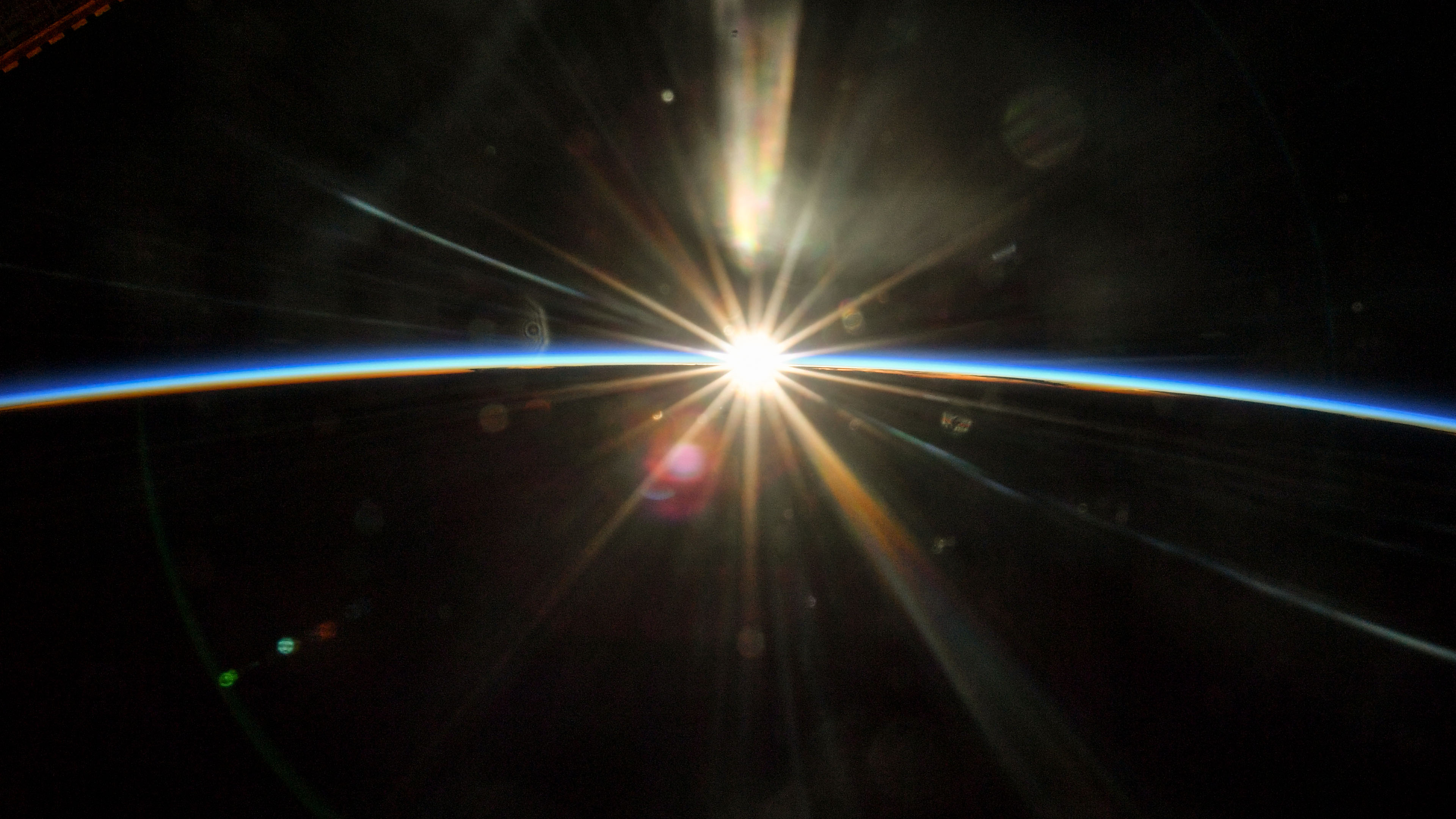
Image above: The Sun's rays begin to illuminate the Earth's atmosphere as the International Space Station flew into an orbital sunrise 261 miles above Texas, as seen in this image taken by astronaut Bob Hines. Image Credit: NASA.

Early in the day, Cristoforetti swapped samples inside the Electrostatic Levitation Furnace, an advanced research device that enables high-temperature thermophysics studies.

A larger contingent of the crew — Cristoforetti, Hines, Lindgren, and Watkins — took turns transferring cargo from the SpaceX CRS-25 Dragon spacecraft.

Maintenance tasks continued in the Russian segment, with Commander Oleg Artemyev of Roscosmos checking for leaks in the Zvezda service module and Flight Engineer Denis Matveev refilling freon bottles to maintain the orbiting laboratory’s air-conditioning system. Matveev also set up dosimeters for a long-running radiation detection experiment while cosmonaut Sergey Korsakov worked on the Cardiovector study.

Related links:

Expedition 67: https://www.nasa.gov/mission_pages/station/expeditions/expedition67/index.html

Immunosenescence: https://www.nasa.gov/mission_pages/station/research/experiments/explorer/Investigation.html?#id=8343

Life Science Glovebox: https://www.nasa.gov/mission_pages/station/research/experiments/explorer/Facility.html?#id=7676

Cold Atom Lab (CAL): https://www.nasa.gov/mission_pages/station/research/experiments/explorer/Facility.html?#id=7396

Space Fibers-3: https://www.nasa.gov/mission_pages/station/research/experiments/explorer/Investigation.html?#id=7375

Electrostatic Levitation Furnace: https://www.nasa.gov/mission_pages/station/research/experiments/explorer/Facility.html?#id=1536

Zvezda service module: https://www.nasa.gov/mission_pages/station/structure/elements/zvezda-service-module.html

Radiation detection experiment: https://www.nasa.gov/mission_pages/station/research/experiments/explorer/Investigation.html?#id=633

Space Station Research and Technology: https://www.nasa.gov/mission_pages/station/research/overview.html

International Space Station (ISS): https://www.nasa.gov/mission_pages/station/main/index.html

Images (mentioned), Text, Credits: NASA/Heidi Lavelle.

Best regards, Orbiter.ch

NASA’s VIPER Prototype Motors Through Moon-like Obstacle Course


NASA - Volatiles Investigating Polar Exploration Rover (VIPER) logo.


July 26, 2022

It faced the quicksand-like soil in the “sink tank,” climbed the “tilt bed,” and conquered boulders and craters. NASA’s Volatiles Investigating Polar Exploration Rover (VIPER) prototype recently endured the most realistic tests to-date of its ability to drive through the most difficult terrain during its mission to the Moon’s South Pole.

VIPER Hits the SLOPEs NASA Glenn Research Center

Video above: NASA’s Volatiles Investigating Polar Exploration Rover (VIPER) prototype recently endured the most realistic tests to-date of its ability to drive through the most difficult terrain during its mission to the Moon’s South Pole – all at the Simulated Lunar Operations (SLOPE) Laboratory at NASA's Glenn Research Center in Cleveland. Video Credit: NASA.

Engineers tested the latest VIPER mobility engineering test unit, known as Moon Gravitation Representative Unit 3 (MGRU3) in the Simulated Lunar Operations (SLOPE) Laboratory at NASA's Glenn Research Center in Cleveland. This MGRU3 features motor controllers specially designed for the Moon rover – a critical piece of hardware in the rover’s mobility system that controls the motors that send power the rover’s four wheels.

“Unlike most car engines, which uses a throttle and brake to speed up and slow down all four wheels, VIPER’s motor controllers make the rover wheels turn at the force and rate the drivers want, with extreme precision to allow for better performance,” said Arno Rogg, test director and rover systems engineer at NASA’s Ames Research Center in California’s Silicon Valley. “These tests allowed us to verify the performance of the rover mobility system and know it will work well on the Moon.”

The tests also helped engineers determine how well the rover will handle challenging conditions on the lunar surface.


Image above: The VIPER engineering team observe the rover prototype's ability to navigate the fluffy lunar soil simulant in the SLOPE lab at NASA's Glenn Research Center in Cleveland. Image Credit: NASA.

“We wanted to see if the rover is capable of moving forward in an extreme sinkage environment, and how much slower VIPER might drive or how much additional power the rover would use because of tricky soil conditions,” said Mercedes Herreras-Martinez VIPER risk manager and mission systems engineering technical interchange lead at Ames.

Using the latest build of the rover software, engineers also tested out the prototype’s ability to “inch-worm” – or move its wheels in a special, caterpillar-like coordinated way that helps the rover get itself unstuck. The rover prototype also demonstrated it will autonomously stop moving if it approaches a slope that is too steep for it to climb or if it were to ever lose track of where it is on the Moon.

“We’ve captured a lot of data with these tests about what happens when the rover wheels grind over a rock or slip on loose terrain, and any sensor drifts – when the rover gets slightly off-course,” said Rogg.

All the Moon-like terrain and other hazards the rover prototype encountered were methodically and deliberately placed in the SLOPE lab following recommendations of the VIPER science team. The engineering test team then carefully selected the soil simulants, hand-picked rocks, and even carefully crafted the shape and size of the craters to realistically mimic actual features at the surface of the Moon’s South Pole.


Image above: The VIPER engineering test team uses lunar soil simulants and hand-picked rocks to carefully shape the terrain to realistically mimic actual features at the surface of the Moon’s South Pole. Image Credit: NASA.

Along with testing the rover’s ability to drive over difficult terrain features, another goal was to test the rover’s performance over lunar terrain the team expects the rover to encounter most of the time.

“Using data and imagery from previous lunar missions, we created various randomized scenes to mimic the surface terrain of the Moon, with craters and rocks of different sizes and shapes scattered over the SLOPE tilt bed,” said Kevin May, rover and mission systems engineering intern at Ames who led the terrain preparation for the test. “With help from the VIPER science team, which generated cut-out templates of crater profiles, we were able to form features out of the terrain and shape more accurate craters than ever before. By recreating realistic Moon-like environments, we can get a much better idea of how VIPER will perform on the surface.”

Related links:

Volatiles Investigating Polar Exploration Rover (VIPER): https://www.nasa.gov/viper

Ames Research Center: https://www.nasa.gov/centers/ames/home/index.html

Images (mentioned), Video (mentioned), Text, Credits: NASA/Gianine Figliozzi/Author: Rachel Hoover, NASA's Ames Research Center.

Greetings, Orbiter.ch