mercredi 2 mars 2011

EGNOS navigation system begins serving Europe’s aircraft


ESA - EGNOS logo labeled.

2 March 2011

Today, the EGNOS Safety-of-Life signal was formally declared available to aviation. For the first time, space-based navigation signals have become officially usable for the critical task of vertically guiding aircraft during landing approaches.

By using three satellites and a 40-strong network of ground stations, the European Geostationary Navigation Overlay System (EGNOS) sharpens the accuracy of GPS satnav signals across Europe.

The signals are guaranteed to the extremely high reliability set out by the International Civil Aviation Organisation standard, adapted for Europe by Eurocontrol, the European Organisation for the Safety of Air Navigation.

EGNOS-guided aircraft on approach

The EGNOS Open Service was launched in October 2009, for navigation applications where the safety of human life is not at stake, such as personal navigation, goods tracking and precision farming.

Today, following an arduous certification and verification process, the EGNOS Safety-of-Life Service has been declared operational, and suitable for use by European aviation.

“We are very proud of the large effort ESA put into EGNOS, and very pleased that it can now be used for the purpose it was initially designed for,” said Philippe Michel, head of ESA’s EGNOS project team.

“Through EGNOS, satellite navigation guidance is being made available for the first time in the vertical as well as horizontal domain,” explained Francisco Salabert of Eurocontrol.

EGNOS sharpens GPS accuracy over Europe

“EGNOS offers the aviation industry the means to provide accurate and safe vertically guided approaches to smaller airports where a conventional precision landing system is not today economically viable.

“Its introduction will reduce delays, diversions and cancellations of flights into and out of these airfields while improving passenger safety.”

In order to use EGNOS for approaches, Air Navigation Service Providers must publish runway procedures and aircraft and operators have to be equipped with certified receivers and be approved for operations.

EGNOS-equipped aircraft cockpit

“Eurocontrol is coordinating EGNOS’s operational introduction across Europe,” Mr Salabert added. “Runway procedures have already been designed for various airports and heliports, with more on the way.

“On the airline side, we are encouraging early adaptors – called EGNOS pioneers.”

After six years in operation, the ‘WAAS’ US equivalent to EGNOS, is being used by more than 40 000 aircraft and more than 2000 procedures have been published.

Some 15 years in the making, EGNOS is the result of a tripartite agreement between ESA, the European Commission (EC) and Eurocontrol.

As initial EGNOS programme manager, ESA designed, qualified and procured the system from a consortium led by Thales Alenia Space France. Overall programme management passed to the EC in 2009. The system's day-to-day running is overseen by the Toulouse-based European Satellite Service Provider (ESSP).

Meeting the aviation industry’s demanding safety requirements, set by Eurocontrol, posed the real challenge for EGNOS’s Safety-of-Life service.

ESA produced much of the technical documentation needed for formal safety certification, while Eurocontrol performed independent monitoring of EGNOS performance.

The final system comes with an extremely high degree of integrity built in. The EGNOS signal is guaranteed to maintain a minimum level of accuracy, with just a one in 10 million chance of error.

If this reliability falls below this level then EGNOS users are alerted within six seconds.

ESA is now acting as the design and procurement agent on behalf of the EC for all major EGNOS system changes throughout its operational lifetime, as well as preparing for the next-generation EGNOS, expected around 2020.

Related links:

Eurocontrol: http://www.eurocontrol.int/

European Satellite Services Provider (ESSP): http://www.essp-sas.eu/

EGNOS: http://www.esa.int/esaNA/egnos.html

Images, Text, Credits: ESA / Eurocontrol.

Greetings, Orbiter.ch

mardi 1 mars 2011

STS-133 flight day 5 highlights, first spacewalk


NASA - STS-133 Mission patch.

02.28.11

Discovery spacewalkers wrapped up a six-hour, 34-minute spacewalk Monday, moving a failed 800-pound ammonia pump module, installing an extension cable and extending the rail track along the station’s main truss.

Mission Specialists Steve Bowen and Al Drew also moved a pump module vent tool, installed a camera wedge, relocated a tool stanchion and worked with a Japanese project to bring a bit of space back to Earth.

A Good Day for a Spacewalk

After the spacewalk, spacecraft communicator Stanley Love radioed the joint crew that mission managers have approved an extra day for the shuttle mission to set up the new Permanent Multipurpose Module that will be installed on the Unity module’s Earth-facing port tomorrow. The International Space Station mission management team is expected to make a decision Tuesday about a proposed Soyuz fly-about later in the mission.

Mission Specialist Nicole Stott helped coach the spacewalkers from inside the station, while Mission Specialist Michael Barratt and station Commander Scott Kelly operated the station’s Canadarm2 for the spacewalk. Astronaut Tim Kopra, who had been scheduled to be one of the spacewalkers himself before being hurt in a bicycle accident weeks before launch, joined Love on console in the station flight control room.

The excursion began at 9:46 a.m. CST when the spacewalkers switched their suits to battery power. The first task was to install the extension cable between the Unity and Tranquility nodes. That included work in an area that will be inaccessible after the Leonardo Permanent Multipurpose Module is in place.


Video above: The first EVA of STS-133 was completed on Flight Day 5 by astronauts Steve Bowen and Al Drew. The two installed equipment on numerous positions outside the International Space Station.

Drew then retrieved a tool to be used on Wednesday’s spacewalk to remove ammonia from the failed pump. Bowen installed a foot restraint on the station arm to get ready for the module’s move from the arm’s mobile base to a more permanent position on an external stowage platform near the airlock. The work was delayed slightly by a problem with the robotic arm controls in the cupola, but Barratt and Kelly moved to a duplicate control center in the Destiny Laboratory to complete their work with Canadarm2.

The astronauts then removed tether and cart stoppers along the railway of the mobile transporter, and lengthened the track with an extension on each rail.

Near the end of the spacewalk both astronauts worked with the Japanese “Message in a Bottle.” They opened a metal canister, autographed by astronauts, to capture a bit of the vacuum of space, then sealed it. The canister will return on Discovery for display.

The spacewalk was the sixth for Bowen and the first for Drew. On leaving the airlock, Drew became the 200th human to walk in space.

Inside the shuttle and station, transfer of equipment continued between the docked spacecraft. The extra day will allow more time to transfer supplies and leave the station in the best possible posture.

Eventually, Robonaut 2 will be able to perform EVAs (spacewalks)

With the one-day extension in place, the winners of the "Top 40 Song Contest" now are set to be played early next week. On Monday, March 7, the "Theme from Star Trek," which finished second in the contest, will serve as a wake-up song for the shuttle crew. On Tuesday, March 8, "Blue Sky" by Big Head Todd and the Monsters will be played as the most requested song to wake up shuttle Discovery's crew.

For the planned wakeup times, reference the mission television schedule: http://www.nasa.gov/shuttletv

For daily STS-133 mission recap videos, visit: http://www.nasa.gov/video


Images, Video, Text, Credit: NASA / MCC / NASA TV on Youtube.

Greetings, Orbiter.ch

Greetings from Mars!


ESA / ROSCOSMOS Mars500 Mission patch.

1 March 2011

Now that the Mars500 crew has been united, when the Marswalkers, 'returned' from the surface of the Red Planet to join the 'orbital' trio, Diego has again had time to send his thoughts. This diary was written on 21 February, before the last egress to the simulated martian surface.

The last few weeks have been truly exciting. As you probably know, Wang, Aleksandr and I, transferred to the landing module, have been living in further isolation, in a reduced room (about 50 cubic metres) for a couple of weeks, in order to represent the landing on Mars.

In spite of it not being the real Red Planet, it did mean so much in our 'microcosmos' that I think that even if it wasn't exactly the same emotion someone would feel on Mars, it did come quite close, at least for me.

Diego Urbina used during the 'Marswalk' tools that were designed originally for the Russian manned Lunar missions in 1960's and 1970's

After transferring, we initiated the operations that a crew would need to do on Mars. We used a software called 'Virtu' that simulates several environments and situations. One of the scenarios was this: imagine a pressurized rover that we had to drive from our base to the (purposely hidden and difficult to reach) landing place of a probe that had been sent to Mars before the manned mission. It was quite tricky, especially when coming back to the base, when a sandstorm and drained batteries made our road tougher.

The same software allowed us to play a marsonaut, stranded on Mars, who suddenly faced a meteorite shower that obliged him to seek refuge in a cave. I am not 100% sure you will need to run frequently from meteorites on Mars to save your life, but caves are certainly excellent places to escape from the more common threat of a peak in solar activity, from which the Martian atmosphere and lack of magnetic field do not shield you as well as on Earth! For this task we wore a virtual reality helmet, to make it more realistic.

Screen capture from 'Virtu' simulation software

We also drove two different rovers in this sort of 'advanced' video game. With the rovers, we obtained samples from the ground and got them to the base, often accompanied by several duties at the same time (listening to the radio signal, classifying information, etc) that challenged our multi-tasking capabilities. We often wore, as usual, a bunch of electrodes that recorded our bodies’ reaction to these all these simulations.

The 'games' were cool, yes, but obviously what everyone was looking forward to, was the REAL Extravehicular Activity (EVA) – or a Marswalk.

EVAs on orbit can be incredibly challenging, you are packed in a spacesuit that is pressurized, so it doesn't allow you to move easily. Here the EVAs were on the ground, where to that difficulty you can add gravity, that is, having to carry this rather heavy suit on you. Astronauts on the moon moved somewhat more easily, because the gravity there is very low. On Mars it is about 38% that of the Earth, and that is still quite a bit for our current suit technology.

Ready for the first 'Marswalk'!

The engineers at the Russian suit manufacturer removed some of the weight of these spacesuits, that can weigh about 100 kilos, and they ended up weighing 35 kilos. This would be their weight if astronauts wear on them on Mars.

The spacesuits were fantastic, after 8 months of not having used them, we could still remember how to work with them. Like riding a bike!

In the first EVA, Sasha (Aleksandr) and I, went out and used a set of tools that were made for the (sadly ill-fated) Soviet Lunar programme. I am talking here about the real tools! It was such an honour.

Following 'Marswalk' in 'orbit'

When Wang said "you are GO for EVA", that was the moment I had been anticipating for months. We picked samples of soil and stones from the ground , helped by Wang on the radio. Of course, not before having planted the ESA, Russian and Chinese flags. Whether you lived it or saw this scene from the outside, you couldn't avoid thinking of the first steps on the Moon, and this time there was in the environment some sort of cosmic projection of the moment, into the future. It felt very inspiring. I could say, beyond a simple simulation.

Besides the ample space of that room (keep in mind we had been living in small modules for several months) what also had an impact on me was the loneliness of the place. It was only us in there, working with, and listening to the only 2 people in the Universe that could communicate live with us. This contrasted a lot with the pictures and videos we got later of lots of people witnessing the EVAs in huge screens at the Mir station control Room in Mission Control Centre in Moscow.

It's not a picnic table!

After this first EVA that impressed so much our senses, came the second EVA, when Sasha and Wang ventured as well into this very big room that represented the surface of the Gusev Crater on Mars. I was on the radio, helping them out when they needed. Communication over the radio is not easy either in such a multicultural crew.

I came to realize it is not rare for us to rely on hand language and facial expressions to fill some of our 'linguistic differences', which is of course impossible or very difficult with a spacesuit. Therefore I am very proud that in the end we managed to communicate almost flawlessly during all the EVAs thanks to the hard work pre-EVA: we spent long nights before each EVA to make sure the 'choreography' would be well executed, we discussed the best order of the tasks among ourselves and with the ground, key words we all needed to know, and other matters as well in order to make it very efficient and as realistic as we could. The orbital crew also watched our runs, and especially Romain took careful note of absolutely every step in the EVAs and then made suggestions for the next ones.

- Diego

Related links:

Mars500: http://www.esa.int/SPECIALS/Mars500/index.html

Mars500 quick facts: http://www.esa.int/SPECIALS/Mars500/SEMGX9U889G_0.html

Mars500 crew: http://www.esa.int/SPECIALS/Mars500/SEMO4BU889G_0.html

Credits: ESA / Diego Urbina / Roscosmos.

Best regards, Orbiter.ch

Leonardo attached to Space Station


NASA / MSFC MPLM patch.

1 March 2011

After a flawless launch last Thursday and a textbook docking on Saturday, the Space Shuttle today delivered the European-built Leonardo Permanent Multipurpose Module to the International Space Station.

This final flight of Discovery marks the eighth and final trip of Leonardo to the orbiting complex. This visit will be longer: the module will be left attached to the Station as a permanent extension. Originally built to ferry cargo to and from the Station in the Shuttle cargo bay, Leonardo’s modifications include improved debris shielding and easier access by the crew to its internal equipment.

The European-built Leonardo Permanent Multipurpose Module was removed from the cargo bay of the Space Shuttle Discovery

Leonardo flew into space for the first time in 2001, also on Discovery, as the first of three Multipurpose Logistics Modules built by the Italian space agency, ASI, under an agreement with NASA.

Discovery as seen from ISS

Its final cargo for the Station includes an experiment rack and a range of stowage facilities. Leonardo can also support microgravity research into fluid physics, materials science, biology and biotechnology.

Leonardo was removed from the Shuttle’s cargo bay using the Station’s robotic arm and mated to the Earth-facing port of the Unity node. Attachment was called complete at 16:05 CET.

Discovery is scheduled to return to Earth on 8 March.

Related links:

MagISStra mission: http://www.esa.int/SPECIALS/magisstra/index.html

STS-133 mission (NASA): http://www.nasa.gov/mission_pages/shuttle/shuttlemissions/sts133/index.html

Space Station / NASA: http://www.nasa.gov/station

Credits: ESA / NASA.

Cheers, Orbiter.ch

lundi 28 février 2011

STS-133 flight day 4 highlights


NASA - STS-133 Mission patch.

02.28.11

Moving equipment and supplies between Discovery and the International Space Station, robotics activities and preparation for Monday’s 6.5-hour spacewalk kept shuttle astronauts busy much of Sunday.

 Shuttle docked at ISS at sunset

Transfer activities began during the crews’ morning. About 2,000 pounds of cargo was brought to the station on Discovery’s middeck, and about 2,600 pounds is to be returned to Earth by the shuttle.

One early activity for the shuttle crew, Commander Steve Lindsey, Pilot Eric Boe and Mission Specialists Alvin Drew, Steve Bowen, Michael Barratt and Nicole Stott, involved robotics. The station’s Canadarm2 arm, operated by Barratt and Stott, grasped the orbiter boom sensor system from the left sill of Discovery’s cargo bay.


Image above: The docked space shuttle Discovery and the Canadian-built Dextre, also known as the Special Purpose Dextrous Manipulator, are featured in this photograph taken by the STS-133 crew aboard the station. The blackness of space and Earth's horizon provide the backdrop for the scene.

It handed the boom off to the shuttle’s arm, which could not reach it with the spacecraft docked at the station. The shuttle’s arm held it to await a decision on whether a focused inspection of its thermal protection system would be necessary.

It wasn’t. Experts completed their analysis of 302 photos (155 using an 800 mm lens, 147 with a 400 mm lens) of the heat shield taken by station Flight Engineers Paolo Nespoli and Cady Coleman during Discovery’s backflip before docking to check for damage. The Mission Management Team met Sunday afternoon and decided that no focused inspection of the heat shield would be necessary.

Spacewalkers Drew and Bowen configured tools for their Monday spacewalk. All shuttle crew members along with station Commander Scott Kelly and Nespoli were scheduled for an hour-long procedures review. A little before 8 p.m. CST the spacewalkers will begin the standard campout in the low pressure of the station’s Quest airlock.

STS-133 Flight Day 4 Highlights - Spacewalk One Preparations Video
 

 The shuttle crew with Kelly and Coleman also talked with media representatives during the afternoon. Asking the questions were reporters from The Weather Channel, Boston’s WBZ Radio, WSB-TV of Atlanta and WTVT-TV of Tampa, Fla.

Images, Video, Text, Credit: NASA / MCC / NASA TV on Youtube.

Greetings, Orbiter.ch
dimanche 27 février 2011

Space shuttle Discovery docked to the International Space Station


NASA - STS-133 Mission patch.

02.27.11

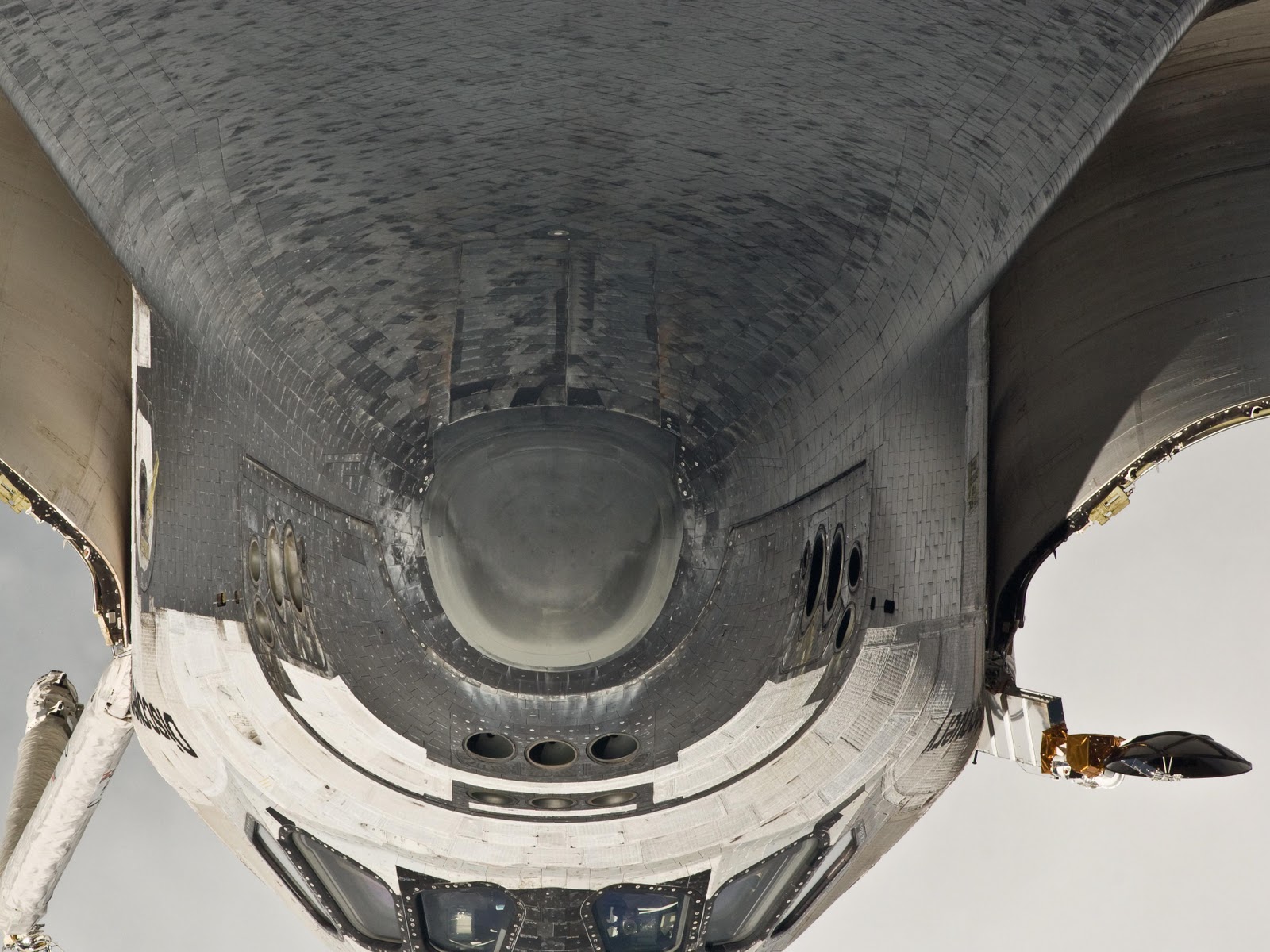
Space shuttle Discovery docked to the International Space Station at 1:14 p.m. CST Saturday with its cargo of a new station module, equipment and supplies for the orbiting laboratory.

Discovery's Final Flip

After a delay to let the relative motion between the two spacecraft, with a combined mass of 1.2 million pounds, dampen out, hatches separating crews were opened at 3:16 p.m. Shuttle astronauts, Commander Steve Lindsey, Pilot Eric Boe and Mission Specialists Alvin Drew, Steve Bowen, Michael Barratt and Nicole Stott moved into the station.

Following handshakes, hugs and a welcoming ceremony by the station crew, Expedition 26 Commander Scott Kelly and Flight Engineers Oleg Skripochka, Alexander Kaleri, Dmitry Kondratyev, Paolo Nespoli and Catherine Coleman, Discovery astronauts received the standard station safety briefing.

Discovery docked at ISS

The crews promptly went to work, with Barratt and Stott preparing to use the station’s robotic arm to pluck Express Logistic Carrier 4 from the shuttle cargo bay and hand it off to the shuttle’s arm, operated by Drew and Boe. After moving the base of Canadarm2, the shuttle arm was to hand ELC4 back for installation on the Earth-facing side of the station’s starboard truss. There it will be used for stowage of spare parts, including a spare radiator launched aboard Discovery.

STS-133 space Shuttle Discovery flight day 3 ISS Rendez-vous

As the shuttle slowly approached the station, with both spacecraft moving at 17,500 mph, it paused about 600 feet below it to do the standard backflip. Nespoli and Coleman used cameras with 400 mm and 800 mm lenses for a minute-and-a-half photo session, shooting numerous pictures of the shuttle’s thermal protection system. The photos will be sent down for analysis by experts to check for any damage.

After both crews focus on transfer of equipment and supplies Sunday, Drew and Bowen will do 6.5-hour spacewalks on Monday and Wednesday. On Tuesday the station arm, again controlled by Barratt and Stott, will take the Permanent Multipurpose Module from Discovery’s cargo bay and install it on the Earth-facing port of the station’s Unity node.

Images, Video, Text, Credits: NASA / MCC / Youtube.

Greetings, Orbiter.ch

X-37B Ready for Second Test Flight


NASA / Boeing - X-37 ALTV patch.

27.02.2011

The US Air Force plans to launch the second test flight for the X-37B space plane on 4 March, the service says, provided the weather at Cape Canaveral cooperates. The Boeing-built 8.8m-long (28.8ft), 4.2m-wide reusable space plane will lift off inside the nose cone of a United Launch Alliance Atlas 5 rocket.


The second unmanned aircraft, known as Operational Test Vehicle-2, is expected to stay on orbit for 270 days or more, collecting test data similar to that from the first flight last year and expanding the flight envelope. The test team will also be paying particular attention to the performance of the electromechanical and autonomous landing algorithms, the service says. There will also be fewer cross-range and wind restrictions for the second flight.

X-37B (Artist's view)

"The first flight was focused on vehicle check out and you obviously want to check things more than once," the air force says. "It's still an X-plane, still an experimental test programme."
The only anomaly in the first flight of OTV-1 was a blown tyre on landing at Vandenberg AFB in California on 3 December 2010; tyre pressure on OTV-2 has been reduced by 15%, the service says.
OTV-1 was launched on 22 April 2010 and returned, with its classified payload, after 224 days and 9h in space.

X-37B

The USAF will not comment on possible payloads for OTV-2 or the partially classified programme's price tag, saying only that funds for the second test launch have already been allocated and were not tied to the fiscal year 2012 budget released on 14 February, or the still-under-debate 2011 budget.

 First launch of the X-37B (failed)

Related link:

Designation Systems: http://www.designation-systems.net/dusrm/app4/x-37.html

Images, Video, Text, Credits: NASA  / USAF / Roscosmos / Flightglobal.com / Space Com / ULA.

Best regards, Orbiter.ch