vendredi 4 mars 2011

NASA'S Glory Satellite Fails To Reach Orbit


NASA - Glory Mission patch.

March 4, 2011

NASA's Glory spacecraft launched aboard a Taurus XL rocket from Vandenberg Air Force Base in California Friday at 5:09:45 a.m. EST failed to reach orbit.

Taurus XL rocket, ready for launch

Telemetry indicated the fairing, the protective shell atop the Taurus XL rocket, did not separate as expected about three minutes after launch.


Image above: The Taurus XL rocket launches from Space Launch Complex 576-E at Vandenberg Air Force Base in California. Image credit: NASA TV.

A press briefing to discuss the Glory launch failure is planned at Vandenberg for approximately 8:00 a.m. EST. NASA TV will carry the press conference live.

The new Earth-observing satellite was intended to improve our understanding of how the sun and tiny atmospheric particles called aerosols affect Earth's climate.

Taurus XL Launch
 
Project management for Glory is the responsibility of NASA's Goddard Space Flight Center in Greenbelt, Md. The launch management for the mission is the responsibility of NASA's Launch Services Program at the Kennedy Space Center in Florida. Orbital Sciences Corp. of Dulles, Va., is the launch service provider to Kennedy of the four-stage Taurus XL rocket and is also builder of the Glory satellite for Goddard.

NASA TV: http://www.nasa.gov/multimedia/nasatv/index.html

Images, Video, Text, Credits: NASA / Goddard.

Greetings, Orbiter.ch

The scars of impacts on Mars


ESA - Mars Express Mission patch.

4 March 2011

 Elongated crater on Mars

ESA’s Mars Express has returned new images of an elongated impact crater in the southern hemisphere of Mars. Located just south of the Huygens basin, it could have been carved out by a train of projectiles striking the planet at a shallow angle.

The large Huygens basin (not visible in the main image but seen in the wider contextual image) is about 450 km in diameter and lies in the heavily cratered southern highlands. In this area there are many impact scars but none perhaps are more intriguing than the ‘elongated craters’.

 Elongated crater, south of Huygens crater

One of these craters is seen in this new image, which covers an area of 133 x 53 km at 21°S / 55°E. The scene was captured on 4 August 2010 and the smallest objects distinguishable by the camera are about 15 m across.

This unnamed elongated crater sits just to the south of the much larger Huygens basin. It is about 78 km in length, opens from just under 10 km wide at one end to 25 km at the other, and reaches a depth of 2 km.

Features in the elongated crater

Impact craters are generally round because the projectiles that create them push into the ground before the shockwave of the impact can explode outwards. So why is this one elongated?

The clue comes from the surrounding blanket of material, thrown out in the initial impact. This ‘ejecta blanket’ is shaped like a butterfly’s wings, with two distinct lobes. This hints that two projectiles, possibly halves of a once-intact body, slammed into the surface here.

Elevation of the elongated crater

In the crater itself, there are three deeper areas that could be evidence for more than two projectiles. In addition, a second elongated crater lies to the north-northwest. It can be seen in the wider contextual image and is in line with the one seen here, reinforcing the notion that these structures were the result of a train of projectiles.

Elongated crater in high resolution

In the early 1980s, scientists proposed that elongated impact craters were formed by incoming chains of orbital debris following trajectories that decayed with time. As the debris spiralled downwards, it eventually struck the planet at shallow angles, gouging out the elongated craters.

Perspective view of elongated crater

This particular ejecta blanket contains many smaller craters, indicating that the original formed a relatively long time ago and then itself become a target.

Perspective view of elongated crater

In addition, there are several small channels on the blanket, suggesting that the strike took place into a surface rich in volatiles, perhaps even water, that were melted by the heat of impact and flowed away.

Perspective view of elongated crater

Below the eastern crater rim are two well-formed and relatively deep craters. They have punched through the ejecta blanket and so must have appeared after the formation of the large crater. Despite their sizes of 4 km and 5 km, these smaller craters show no indication of the presence of water.

Perspective view of elongated crater

To the north there is another crater that must be older because the butterfly-ejecta blanket has partially flowed into it.

Several landslides have modified the steep crater rim. This can be most clearly seen on the two smaller craters on the rim, which are only partially preserved, parts of them having fallen away.

The formation of these elongated features is not over: the martian moon Phobos will plough into the planet in a few tens of millions of years, breaking up in the process, and likely creating new chains across the surface.

Elongated crater in 3D

Related links:

High Resolution Stereo Camera: http://berlinadmin.dlr.de/Missions/express/indexeng.shtml

Behind the lens: http://www.esa.int/SPECIALS/Mars_Express/SEMSXE1PGQD_0.html

Frequently asked questions: http://www.esa.int/SPECIALS/Mars_Express/SEM76D9OY2F_0.html

Images, Text, Credits: ESA/DLR/FU Berlin (G. Neukum) / NASA MGS MOLA Science Team.

Greetings, Orbiter.ch

jeudi 3 mars 2011

Spitzer Captures Infrared Rays From a Sunflower


NASA - SPITZER Space Telescope logo.

03.03.11

The various spiral arm segments of the Sunflower galaxy, also known as Messier 63, show up vividly in this image taken in infrared light by NASA's Spitzer Space Telescope. Infrared light is sensitive to the dust lanes in spiral galaxies, which appear dark in visible-light images. Spitzer's view reveals complex structures that trace the galaxy's spiral arm pattern.


 This view of the Sunflower galaxy highlights a variety of infrared wavelengths captured by Spitzer. Image credit: NASA / JPL-Caltech.

Messier 63 lies 37 million-light years away -- not far from the well-known Whirlpool galaxy and the associated Messier 51 group of galaxies.

The dust, glowing red in this image, can be traced all the way down into the galaxy's nucleus, forming a ring around the densest region of stars at its center.


This image from NASA's Spitzer Space Telescope shows infrared light from the Sunflower galaxy, otherwise known as Messier 63. Spitzer's view highlights the galaxy's dusty spiral arms. Image credit: NASA / JPL-Caltech.

The short, diagonal line seen on the lower right side of the galaxy's disk is actually a much more distant galaxy, oriented with its edge facing toward us.

Blue shows infrared light with wavelengths of 3.6 microns, green represents 4.5-micron light, and red, 8.0-micron light. The contribution from starlight measured at 3.6 microns has been subtracted from the 8.0-micron image to enhance the visibility of the dust features.

Images (mentioned), Text, Credit: NASA / Whitney Clavin, JPL.

Cheers, Orbiter.ch

STS-133 Mission, second spacewalk accomplished


NASA - STS-133 Mission patch.

03.03.2011

Discovery astronauts wrapped up a six-hour, 14-minute spacewalk Wednesday, draining ammonia from an 800-pound pump module, working with the Canadian robotic device Dextre and completing a variety of other tasks.


Image above: Mission Specialist Steve Bowen works outside the International Space Station during the second STS-133 spacewalk. Image credit: NASA TV.

The spacewalkers, Mission Specialists Steve Bowen and Alvin Drew, spent most of their time outside working separately. The start of the spacewalk, which began when the crew members switched their spacesuits to battery power at 9:42 a.m. CST, had been delayed 24 minutes to replace an O-ring on the lithium hydroxide canister of Bowen’s suit to fix a minor leak.

Bowen began by setting up the station’s Canadarm2, operated by Mission Specialist Michael Barratt and station Commander Scott Kelly. He moved on to retrieve a lightweight adapter plate assembly, an experiment holder, from the outer end of the Columbus module and installed it in Discovery’s cargo bay for return to Earth.


Image above: Spacewalkers Steve Bowen and Alvin Drew worked outside for more than six hours on Wednesday, performing maintenance on the International Space Station, including venting ammonia from a failed pump module.

Drew started with the relocated pump module for the station’s external ammonia cooling system, using a device he had installed on Monday’s spacewalk to vent the remaining coolant from the pump. He subsequently removed the device for return to the airlock.

Coaching the spacewalkers was Mission Specialist Nicole Stott inside the station. Astronaut Tim Kopra, who had been scheduled to be one of the spacewalkers but was hurt in a bicycle accident weeks before launch, also helped advise the crew from the station flight control room.

Bowen spent about an hour working on Dextre, the Special Purpose Dexterous Manipulator, installing a camera light pan and tilt assembly and removing some insulation. Meanwhile, Drew removed and jettisoned insulation and repositioned a slipped sunshade on a nearby camera. He then installed a light on one of the small handcars, a crew and equipment translation aid. The astronauts use the carts, mounted on the station’s truss rails, to move objects.

After doing some cleanup, Bowen installed a camera lens cover on the arm’s elbow and relocated a foot restraint and a Russian cargo arm adapter. Drew moved on to the port truss to repair insulation on a radiator beam valve module. He also secured a grapple fixture stowage beam.

Flight day 7 highlights

Near the end of the spacewalk, Drew’s helmet light set came loose from his suit. Attempts by Bowen to reinstall it were unsuccessful so they attached a tether to take it back to the airlock.

This was the final STS-133 spacewalk, the 244th by U.S. astronauts. It was the seventh for Bowen totaling 47 hours, 18 minutes, and places him sixth on the all-time list of most time spent by U.S. spacewalking astronauts. It was the second spacewalk for Drew, who now has a total of 12 hours, 48 minutes. It was the 155th spacewalk in support of International Space Station assembly and maintenance, totaling 973 hours, 53 minutes, which is the equivalent of 40 full days of spacewalking.

Additional STS-133 Resources:

- Discovery's Career in Photos: http://www.nasa.gov/mission_pages/shuttle/flyout/multimedia/discovery/gallery-index.html

- Discovery Retrospective: http://www.nasa.gov/mission_pages/shuttle/flyout/multimedia/discovery/gallery-index.html

Images, Text, Video, Credit: NASA / NASA TV on Youtube.

Greetings, Orbiter.ch

mercredi 2 mars 2011

Russia Moves Beyond Near-Earth Orbit


ROSCOSMOS logo.

03.03.2011

In time for the 50th anniversary of Yuri Gagarin’s historic first flight to space, Russian space scientists have prepared three programs to explore our solar system for the period until 2050.

Although differing in scale and costs, all of the proposed scenarios reach beyond the near-Earth orbit to the far cosmos. Chief of Russia’s Roscosmos space agency Anatoly Perminov unveils some details:

"The programs envisage flights to the Moon in the middle of the 2020s, the creation of Moon-based research laboratories in the 30s and first exploratory missions to Mars by the beginning of the 40s. The proposals are now being scrutinized. The ultimate choice will, of course, be determined by the government’s financial abilities. In my opinion, most of those projects could be implemented in cooperation with other countries. Take the Moon, for example. Lunar research and the creation of human settlements on the Moon could involve countries that are currently working on the International Space Station. This would minimize our expenses and would also make it possible to take rocket and space hardware from countries which are the best at making them, for instance, heavy carrier rockets from the Americans and manned spacecraft and descent modules from Russia."

Human settlements on the Moon

Russia is looking into the possibility of creating a nuclear-powered transport and energy module having no analogues in the world and offering certain advantages in terms of space exploration. Anatoly Perminov:

"We have teamed up with [the state nuclear energy corporation] Rosatom to design and build such transport and energy units for an interplanetary flight, for the far space, for the exploration of such planets as Mars. The existing engines propelled by solid or liquid fuel will make an interplanetary flight too long, which is not safe for man. Here, flight duration could be shortened by dozens of times. Yet it does pose another challenge – we will need a radiation shield. We are going through all those issues."

Artist's concept of nuclear powered spacraft

The latter project is deemed as highly promising and has riveted the attention of other countries. Anatoly Perminov said that it too could be brought to life through international efforts. Russia is in turn ready to join space hotel construction planned by the United States. Russian specialists would be glad to provide the necessary assistance to make those seemingly incredible projects more reliable.

A large group of NASA officials under the U.S. space agency’s Administrator Charles Bolden will come to Moscow in the middle of April with the joint exploration of the solar system expected to be high on the agenda. As Anatoly Perminov said, both sides have something to offer each other.

Images Credit: NASA, Text, Credit: Roscosmos PAO.

Cheers, Orbiter.ch

NASA-Sponsored Research Explains Missing Sunspots


NASA - ESA SOHO Mission patch.

March 02, 2011

NASA-sponsored research has resulted in the first computer model that explains the recent period of decreased solar activity during the sun's 11-year cycle.

This recent solar minimum, a period characterized by a lower frequency of sunspots and solar storms, was the deepest observed in almost 100 years. The solar minimum has repercussions on the safety of space travel and the amount of orbital debris our planet accumulates.


Image above: In this artistic cutaway view of the sun, the Great Conveyor Belt appears as a set of black loops connecting the stellar surface to the interior. Credit: Andrés Muñoz-Jaramillo of the Harvard CfA.

Solar scientists around the world were puzzled by the extended disappearance of sunspots in 2008-2009. Results published in Thursday's edition of Nature indicate the mystery may be solved.

"Plasma currents deep inside the sun interfered with the formation of sunspots and prolonged the solar minimum," says lead author Dibyendu Nandi of the Indian Institute of Science Education and Research in Kolkata.

During this deep solar minimum, the sun's magnetic field weakened, allowing cosmic rays to penetrate the solar system in record numbers, making space a more dangerous place to travel. At the same time, the decrease in ultraviolet radiation caused Earth's upper atmosphere to cool and collapse.


Image above: Sunspot cycles over the last century. The blue curve shows the cyclic variation in the number of sunspots. Red bars show the cumulative number of sunspot-less days. The minimum of sunspot cycle 23 was the longest in the space age with the largest number of spotless days. Credit: Dibyendu Nandi et al.

As a consequence space debris stopped decaying and started accumulating in Earth orbit due to increased atmospheric drag. These effects demonstrate the importance of understanding the entire solar cycle, during both minimum and maximum.

Observations from NASA's Solar Dynamics Observatory (SDO) will eventually provide measurements that could validate the current model and provide the basis for future solar cycle prediction.


Image above: Three years ago on March 2, 2008, the face of the sun was featureless--no sunspots. Credit: SOHO / MDI.

"This research demonstrates how observations from Heliophysics System Observatory missions stimulate new theories and advance modeling techniques," said Richard Fisher, director of the Heliophysics Division in NASA's Science Mission Directorate at the agency's headquarters in Washington.

This research was funded by NASA's Living With a Star Program and the Department of Science and Technology of the government of India.

For more information about the research, visit: http://www.nasa.gov/sunearth 

NASA's Goddard Space Flight Center: http://www.nasa.gov/centers/goddard/home/index.html

Images (mentioned), Text, Credit: NASA's Goddard Space Flight Center.

Greetings, Orbiter.ch

ESO - The Dusty Disc of NGC 247


ESO - European Southern Observatory logo.

2 March 2011

Wide Field Imager view of the spiral galaxy NGC 247

This image of NGC 247, taken by the Wide Field Imager on the MPG/ESO 2.2-metre telescope at ESO’s La Silla Observatory in Chile, reveals the fine details of this highly inclined spiral galaxy and its rich backdrop. Astronomers say this highly tilted orientation, when viewed from Earth, explains why the distance to this prominent galaxy was previously overestimated.

The spiral galaxy NGC 247 is one of the closest spiral galaxies of the southern sky. In this new view from the Wide Field Imager on the MPG/ESO 2.2-metre telescope in Chile large numbers of the galaxy’s component stars are clearly resolved and many glowing pink clouds of hydrogen, marking regions of active star formation, can be made out in the loose and ragged spiral arms.

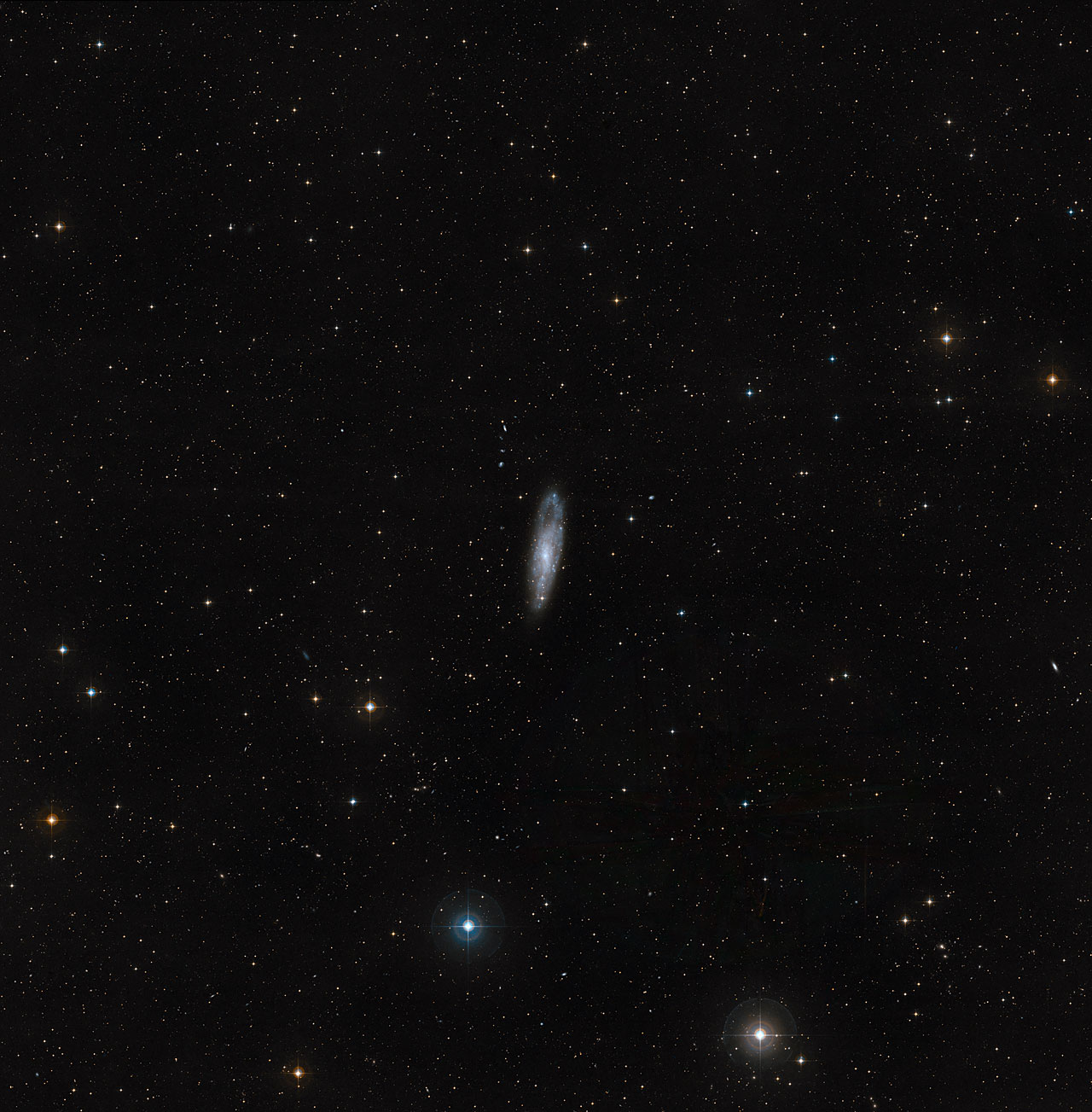
NGC 247 in the constellation of Cetus

NGC 247 is part of the Sculptor Group, a collection of galaxies associated with the Sculptor Galaxy (NGC 253, also shown in eso0902 and eso1025). This is the nearest group of galaxies to our Local Group, which includes the Milky Way, but putting a precise value on such celestial distances is inherently difficult.

To measure the distance from the Earth to a nearby galaxy, astronomers have to rely on a type of variable star called a Cepheid to act as a distance marker. Cepheids are very luminous stars, whose brightness varies at regular intervals. The time taken for the star to brighten and fade can be plugged into a simple mathematical relation that gives its intrinsic brightness. When compared with the measured brightness this gives the distance. However, this method isn’t foolproof, as astronomers think this period–luminosity relationship depends on the composition of the Cepheid.

Wide-field view of the sky around NGC 247

Another problem arises from the fact that some of the light from a Cepheid may be absorbed by dust en route to Earth, making it appear fainter, and therefore further away than it really is. This is a particular problem for NGC 247 with its highly inclined orientation, as the line of sight to the Cepheids passes through the galaxy’s dusty disc.

However, a team of astronomers is currently looking into the factors that influence these celestial distance markers in a study called the Araucaria Project [1]. The team has already reported that NGC 247 is more than a million light-years closer to the Milky Way than was previously thought, bringing its distance down to just over 11 million light-years.

ESO - Zooming in on the spiral galaxy NGC 247

Apart from the main galaxy itself, this view also reveals numerous galaxies shining far beyond NGC 247. In the upper right of the picture three prominent spirals form a line and still further out, far behind them, many more galaxies can be seen, some shining right through the disc of NGC 247.

ESO - Panning across the spiral galaxy NGC 247
 
This colour image was created from a large number of monochrome exposures taken through blue, yellow/green and red filters taken over many years. In addition exposures through a filter that isolates the glow from hydrogen gas have also been included and coloured red. The total exposure times per filter were 20 hours, 19 hours, 25 minutes and 35 minutes, respectively.

Notes:

[1] The Araucaria Project is a collaboration between astronomers from institutions in Chile, the United States and Europe. ESO’s Very Large Telescope provided data for the project.
More information

ESO, the European Southern Observatory, is the foremost intergovernmental astronomy organisation in Europe and the world’s most productive astronomical observatory. It is supported by 15 countries: Austria, Belgium, Brazil, the Czech Republic, Denmark, France, Finland, Germany, Italy, the Netherlands, Portugal, Spain, Sweden, Switzerland and the United Kingdom. ESO carries out an ambitious programme focused on the design, construction and operation of powerful ground-based observing facilities enabling astronomers to make important scientific discoveries. ESO also plays a leading role in promoting and organising cooperation in astronomical research. ESO operates three unique world-class observing sites in Chile: La Silla, Paranal and Chajnantor. At Paranal, ESO operates the Very Large Telescope, the world’s most advanced visible-light astronomical observatory and VISTA, the world’s largest survey telescope. ESO is the European partner of a revolutionary astronomical telescope ALMA, the largest astronomical project in existence. ESO is currently planning a 42-metre European Extremely Large optical/near-infrared Telescope, the E-ELT, which will become “the world’s biggest eye on the sky”.

Links:

    * Araucaria Project: https://sites.google.com/site/araucariaproject/

    * Research paper: http://adsabs.harvard.edu/abs/2009ApJ...700.1141G

Images, Text, Credits: ESO, IAU and Sky & Telescope / Digitized Sky Survey 2. Acknowledgment: Davide De Martin / Videos: ESO / A. Fujii / Digitized Sky Survey 2. Music: John Dyson (from the album Moonwind).

Best regards, Orbiter.ch