lundi 7 mars 2011

How to keep LISA’s laser on target five million km away


ESA - LISA Mission patch.

7 March 2011

A key technical challenge of the joint ESA–NASA LISA mission has been solved: how to maintain precise pointing of a laser beam across five million km of space.

The next-decade Laser Interferometer Space Antenna (LISA) mission will look for ripples in spacetime – their existence predicted by Albert Einstein – known as gravitational waves. A trio of identical spacecraft will fly five million km apart in an equilateral triangle formation, linked by laser beams.

LISA satellite connected by lasers

A precision-measuring method called interferometry can combine these laser beams to identify the slightest movement between free-floating metallic cubes within each spacecraft.

Motion within a set frequency range will be scrutinised to search out gravitational waves emitted by massive black holes and similarly energetic cosmic objects.

“Our research set out to solve one of LISA’s most challenging elements,” said Lucio Scolamiero, overseeing some of the LISA technology studies for ESA.

Three LISA spacecraft

“How do we maintain the optical pathways between the spacecraft and therefore the measurement chain between them?”

Owing to the finite speed of light, it will take 16 seconds for each laser beam to cover the five million km to its receiving spacecraft.

LISA must steer the laser beam to compensate for the orbital movement of each spacecraft during this time.

In the process, the steering mirror has to remain stable down to the subatomic scale: any motion would be misinterpreted as a gravitational wave.

“That this could be achieved at all was by no means certain: to begin with, we didn’t even have available means to measure the performance of such a system,” Lucio added.

TNO-developed pointing system

“But we received two promising proposals and decided to pursue both of them.”

The two designs were developed independently by separate industrial groups: TNO in the Netherlands and RUAG and CSEM in Switzerland.

“ESA doesn’t duplicate technology development but does sometimes pursue complementary approaches,” Lucio explained.

RUAG & CSEM pointing system

“If one proves inadequate then we have another as backup.”

The two palm-sized designs share some elements. Both use capacitance-based sensors to measure mirror angle errors needing correction. Electrodes are spaced a very short distance apart; any shift in this distance causes a change in the electric charge running between them.
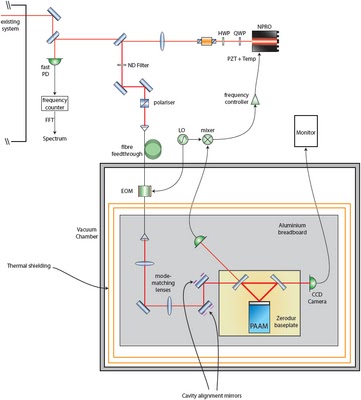
Test setup

The motor to make the adjustment is based on piezoelectric ceramics similar to those found in quartz watches, which convert electric signals into movement.

These ceramics are sliced up for precision performance. TNO’s design uses ‘piezo-stacks’ while RUAG–CSEM’s employs a ‘piezo-leg’ reproducing ‘walking’ motion.

To steer the mirror, both approaches reject ball-bearing components in favour of ‘flexural hinges’. Metallic blades around 0.1 mm thick are carefully shaped using a precision manufacturing technique.

The Albert Einstein Institute in Hannover, Germany, developed an ultra-stable measuring system to validate device performance. They used laser-based interferometry – the same technique LISA will rely on – with the experiment performed inside a vacuum chamber and mounted on a bench of ZERODUR glass, all-but immune to temperature-driven distortion.

“Both developments are fully compliant to our extreme performance requirements,” Lucio concluded. A decision on which version to fly will be taken later during LISA's implementation phase.

A single-satellite precursor, LISA Pathfinder, will be launched in 2013 to flight-validate key technologies for the full LISA mission, a large-mission candidate in ESA's Cosmic Vision programme.

Related links:

TNO: http://www.tno.nl/index.cfm?Taal=2

RUAG: http://www.ruag.com/

CSEM: http://www.csem.ch/

Albert Einstein Institute, Hannover: http://www.aei.mpg.de/hannover-en/66-contemporaryIssues/home/index.html

Images, Text, Credits: ESA / AEI/ MildeMarketing / Exozet / TNO / RUAG / CSEM / Albert Einstein Institute.

Best regards, Orbiter.ch

Space Shuttle Discovery Makes Final Return to Earth Wednesday


NASA - STS-133 Mission patch.

7 March 2011

Space shuttle Discovery is scheduled to return to Earth for the final time on Wednesday, March 9, completing a 13-day mission to outfit the International Space Station. If Discovery lands Wednesday, it will have spent a total of 365 days in space and traveled more than 148 million miles during 39 flights. It launched on its first mission on Aug. 30, 1984.

Space shuttle Discovery performs its flyaround of the International Space Station as both spacecraft orbit over the Sahara Desert

After touchdown, the astronauts will undergo routine physical examinations and meet with their families. The crew may participate in a post-landing news conference about 6.5 hours after landing. The news events will be broadcast live on NASA Television and the agency's website.

The Kennedy news center will open for landing activities at 8 a.m. Wednesday and remain open until 11 p.m. because of shuttle Endeavour's 8 p.m. rollout to Launch Pad 39A. Endeavour is targeted to launch April 19 on the STS-134 mission to the space station.

STS-133 Flyaround
 
The STS-133 media badges are in effect through landing. The media accreditation building on State Road 3 will be open from 7 to 10 a.m. Wednesday. The last bus will depart from the news center for the Shuttle Landing Facility one hour before landing.

The NASA News Twitter feed is updated throughout the shuttle mission and landing. To follow, visit: http://www.twitter.com/nasa

For NASA TV downlink information, schedules and links to streaming video, visit: http://www.nasa.gov/ntv

For the latest information about the STS-133 mission and accomplishments, visit: http://www.nasa.gov/shuttle

For more information about the space station and its crew, visit: http://www.nasa.gov/station

Images, Video, Text, Credit: NASA / NAS TV / MCC.

Cheers, Orbiter.ch

Carbon fibre stretches from comet to machine tools


ESA - Rosetta Mission patch.

7 March 2011

Ultra-light carbon-fibre rods used to stiffen a comet probe’s legs are now being harnessed by a German manufacturer to boost the precision and efficiency of their laser cutters.

 Rosetta swoops over its lander on Comet Churyumov–Gerasimenko

Right now, the rods in question are on a collision course with a comet – literally.

In 2014 ESA’s Rosetta spacecraft will end a decade-long chase through space by catching up with Comet Churyumov–Gerasimenko.

It will orbit the comet and release its Philae lander to anchor itself to the icy surface.

Carbon-fibre rods guarantee safe landing

To ensure a safe landing, the lander’s legs are made of lightweight carbon fibre rods.

Designed by Schütze, a German company in Braunschweig, these rods are six times lighter than steel, but can be made up to 50% stiffer.

Rosetta’s Philae lander on comet nucleus

These 'sandwich rods' have a lightweight, rigid foam core wrapped in carbon fibre and coated with thin fibreglass.

“No mould is necessary, making the production of tailored rod dimensions feasible,” said director Rainer Schütze. As well as the lander legs, the folding antenna and frame of Rosetta are also based on the lightweight rods.

“The carbon fibre sandwich rods combine high strength and stiffness with very low weight,” added Mr Schütze.

Rosetta lander

Thanks to ESA’s Technology Transfer Programme, the rods’ special qualities are also improving products here on Earth.

Better cuts and customisation

ESA’s technology broker MST Aerospace in Germany put Mr Schütze in touch with Trumpf Sachsen, a German machine tool manufacturer.

“Probably the cooperation would not have taken place without MST making the connection,” explained Mr Schütze.

Trumpf was looking for ways to improve laser cutting machines that make extremely precise, extremely complex shapes out of large sheets of metal. One common use is for electric motors, which can stack hundreds of thin metal sheets together.

Laser cutting machine

Rather than building a stamping die for the specified shape, Trumpf’s laser machine can precisely cut each panel to fit, then start immediately on an entirely new shape.

“When you do it right, it’s a very, very smooth cut,” said Christian Koerber, Head of New Business Development at Trumpf.

The flexible nature of laser cutting opens up the possibility of offering customised solutions – prohibitively difficult, time-consuming and costly with the previous stamping methods.

Inside the machine, two laser cutting heads are fixed to a crossbar that together weigh 620 kg but move extremely quickly. To make the precision cuts needed, the laser beams are required to stop and turn in less than the blink of an eye. There’s no room for error.

The two laser cutting heads in action

“We need to have a precision of a few micrometres,” Mr Koerber added – a micrometre is smaller than a typical bacterium. “If the machine stops, it needs to stop exactly where we programmed it to.”

Once ESA brought the two companies together, Schütze’s carbon fibre sandwich rods proved an ideal added ingredient to Trumpf laser machines.

Precise laser cuts

By mounting the laser cutting heads on the light but stiff rods, their machines are able to make the exact cuts needed, while accelerating and decelerating quickly.

With ESA’s help, Trumpf should have as much success landing new contracts as the Rosetta mission promises to have landing on a speeding comet deep in space.

Related links:

Technology Forum: http://www.technology-forum.com/

MST Aerospace: http://www.mst-aerospace.de/e/default.html

Schütze: http://www.schuetze-staebe.de/

Trumpf: http://www.trumpf.com/en.html

Images, Text, Credits: ESA / AOES Medialab / Astrium - E. Viktor / Trumpf Group.

Greetings, Orbiter.ch

dimanche 6 mars 2011

STS-133 Mission, Hatches Closed Between Discovery and Station


NASA - STS-133 Mission patch.

Sun, 06 Mar 2011

Discovery astronauts are in the second of two docked days added to their stay at the International Space Station. They’re giving their station crew colleagues a leg up on outfitting and unloading cargo from the new PMM, Leonardo.

Commander Steve Lindsey, Pilot Eric Boe, and Mission Specialists Alvin Drew, Steve Bowen and Nicole Stott and station Flight Engineer Cady Coleman spent most of their day in the new module. The movement of material from Leonardo to the station was virtually complete.


Image above: The STS-133 and Expedition 26 crew members participate in a farewell ceremony. Image credit: NASA TV.

In addition to unpacking and working on Leonardo’s interior, they moved packing material into the Japanese H-II Transfer Vehicle for destruction on its re-entry after undocking later this month.

Station Flight Engineer Paolo Nespoli and Mission Specialist Michael Barratt worked on the Carbon Dioxide Removal Assembly in the Destiny laboratory, bypassing a failed heater circuit. It was up and running.

Anchored to a Canadarm2 mobile foot restraint, NASA astronaut Steve Bowen participates in the STS-133 mission's second spacewalk

Station Commander Scott Kelly worked to install a new filter on an Oxygen Generation Assembly. That job was almost complete.

“All in all, it was a great day in orbit,” said Royce Renfrew, lead station flight director.

Hatches Closed Between Discovery and Station

At 4:11 p.m. EST, hatches were closed between space shuttle Discovery and the International Space Station. The hatches between the two spacecraft were opened at 4:16 p.m. on February 26 and remained open for joint crew operations for a total of 7 days, 23 hours, and 55 minutes.

Prior to hatch closure, the shuttle and station crews exchanged farewells. Discovery Commander Steve Lindsey thanked station Commander Scott Kelly for the hospitality. Kelly responded, “It was a very successful time onboard. We enjoyed having you as guests, we’re going to miss you, and we’re going to miss space shuttle Discovery. Discovery been a great ship and has really supported ISS more than any other shuttle and we wish her fair winds and following seas. Thank you.”

STS-133 Daily Mission Recap - Flight Day 10

Discovery’s six crew members will awaken to a special song with a surprise twist at 3:23 a.m. Monday, “Theme from Star Trek” by Alexander Courage. It was the runner-up in the wakeup song contest - https://songcontest.nasa.gov/.

Images, Video, Text, Credit: NASA / NASA TV / MCC.

Best regards, Orbiter.ch

samedi 5 mars 2011

Cargo Transfers and Maintenance for Shuttle and Station Crews Today


NASA - STS-133 Mission patch.

Sat, 05 Mar 2011

The crews of space shuttle Discovery and the International Space Station awoke at 3:24 a.m. EST to the song “(Ohio) Come Back to Texas” by Bowling for Soup for the entire crew from their families.

STS-133 & Expedition 26 crew posing

Today, the crew will spend much of its time offloading the Permanent Multipurpose Module and filling the H-II Transfer Vehicle with items no longer needed aboard the station. They also will perform maintenance on the Oxygen Generation Assembly and the Carbon Dioxide Removal Assembly.

 STS-133 Mission Specialist Michael Barratt works aboard the International Space Station. Image credit: NASA TV

During space shuttle Discovery's final spaceflight, the STS-133 crew members will take important spare parts to the International Space Station along with the Express Logistics Carrier-4.

STS-133 Daily Mission Recap - Flight Day 9
 
Steve Bowen replaced Tim Kopra as Mission Specialist 2 following a bicycle injury on Jan. 15 that prohibited Kopra from supporting the launch window. Bowen last flew on Atlantis in May 2010 as part of the STS-132 crew. Flying on the STS-133 mission will make Bowen the first astronaut ever to fly on consecutive missions.

- STS-133 Crew: http://www.nasa.gov/mission_pages/shuttle/shuttlemissions/sts133/index.html

Images, Video, Text, Credits: NASA / NASA TV / MCC.

Cheers, Orbiter.ch

NASA Develops Light Microscope For International Space Station


ISS - International Space Station patch.

March 05, 2011

NASA began testing a new multi-capability microscope this week on the International Space Station. It will help scientists study the effects of the space environment on physics and biology aboard the orbiting laboratory. The microscope is isolated from vibrations on the station, allowing it to obtain clear, high-resolution images. Using high-resolution magnification, scientists can examine microorganisms and individual cells of plants and animals, including humans.

 LMM description

The microscope will allow real-time study of the effects of the space environment without the need to return samples to Earth. Any living specimens returned to Earth must endure the effects of re-entry through the atmosphere. The ability to use the Light Microscopy Module (LMM) on station will enable scientists to study data unaffected by re-entry.

"We really need to maximize life science investigations conducted on the International Space Station," said Jacob Cohen, principal investigator of the technology demonstration and a researcher at NASA's Ames Research Center, Moffett Field, Calif. "It's really amazing to be able to remotely manage, optimize and troubleshoot experiments observed with a microscope in space without the need to return the samples back to Earth. This microscope is helping fulfill the vision of a true laboratory in space."

Mouse tissue slide

The biological samples for the LMM launched on space shuttle Discovery's STS-133 mission on Feb. 24. They include eight fixed slides containing yeast; bacteria; a leaf; a fly; a butterfly wing; tissue sections and blood; six containers of live C. elegans worms, an organism biologists commonly study; a typed letter "r" and a piece of fluorescent plastic. The wing is from a previous study, Butterflies in Space, involving students from around the country, and flown on STS-129 in 2009. Some of the worms are descendants of those that survived the space shuttle Columbia (STS-107) accident; and others are modified to fluoresce. Scientists commonly attach green, yellow and red florescent proteins to study gene expression.

"Operating the LMM on the space station has been a goal of NASA's Life and Physical Sciences Program for many years," said Ron Sicker, LMM project manager at NASA's Glenn Research Center in Cleveland. "Scientists and engineers at Glenn modified the commercial microscope in the LMM with 23 micro motors and cameras to allow remote control operations."

C. Elegans (worms) on LMM microscope

Cohen and Sicker expect the LMM to perform the same as a microscope on Earth. In the future, the microscope could be used to assist in maintenance of station crew health, advance our knowledge of the effects of space on biology and contribute to the development of applications for space exploration and on Earth. This technology demonstration was developed by Ames and Glenn, which developed and manages the LMM. The Advanced Capabilities Division in the Exploration Systems Mission Directorate at NASA Headquarters in Washington, funds the project.

"This is a facility to support research in both physical and life sciences by NASA-funded and National Laboratory users," said Julie Robinson, International Space Station Program scientist at NASA's Johnson Space Center in Houston. "It gives us a capability not available before that allows more types of research to be done."

For more information about the Light Microscopy Module, visit: http://issresearchproject.grc.nasa.gov/Investigations/LMM

To see samples of the slides, visit: http://www.nasa.gov/centers/glenn/news/pressrel/2011/11-012_addm.html

For more information about the International Space Station, visit: http://www.nasa.gov/station

For more information about NASA's Ames Research Center, visit: http://www.nasa.gov/ames

For more information about NASA's Glenn Research Center, visit: http://www.nasa.gov/glenn

Images, Video, Text, Credits: NASA / LMM / Ames / GRC.

Greetings, Orbiter.ch

vendredi 4 mars 2011

NASA Astronaut Garrett Reisman Leaves Agency


NASA logo.

March 04, 2011

NASA astronaut Garrett Reisman has left the agency to return to private industry. Reisman is a veteran of two spaceflight missions, including a long-duration mission on the International Space Station.

"I had the pleasure of working with Garrett in space during Expedition 16," said Peggy Whitson, chief of the Astronaut Office at NASA's Johnson Space Center in Houston. "He is an incredibly accomplished professional and well-known for his great sense of humor. We wish him the best in this new phase of his career, but we will miss him greatly."

Astronaut Garrett Reisman

Reisman, who holds a doctorate in mechanical engineering, joined NASA in 1998. Before flying in space, he served in multiple technical roles including work supporting robotics and the advanced vehicles branch of the Astronaut Office.

Reisman's first spaceflight mission was as flight engineer during Expeditions 16 and 17 on the station in 2008. During his three months aboard, he performed a seven-hour spacewalk, conducted numerous robotics activities and participated in the installation of the Japanese Kibo laboratory and its logistics module.

Reisman visited the station again during his second spaceflight, STS-132 in May 2010. He conducted two additional spacewalks during the mission, logging 14 more hours outside.

For Reisman's biography, visit: http://www.jsc.nasa.gov/Bios/htmlbios/reisman.html

Images, Text, Credit: NASA.

Best regards, Orbiter.ch