mercredi 26 juin 2013

From CERN to space - and back


CERN - European Organization for Nuclear Research logo.

June 26, 2013

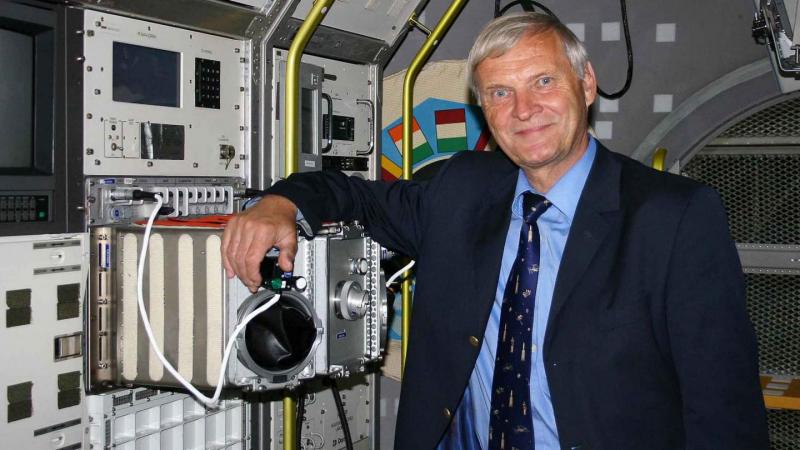
At the end of May, 40 years after he worked as a fellow on the Intersecting Storage Rings (ISR), former astronaut Ernst Messerschmid gave a seminar at CERN. His experience in the laboratory’s international environment was an important factor in the process that led to his becoming one of the first Germans in space.

Ernst Messerschmid in the Spacelab module (Image: DLR - CC-BY 3.0)

Ernst Messerschmid first arrived at CERN as a summer student in 1970, just as preparations were being made for the start-up of the ISR, and he soon returned as a fellow. His diploma thesis and PhD thesis were both based on his work at the ISR. All seemed set for a career in accelerator physics, but in 1977, while deciding on his future, Ernst spotted an advert in the newspaper Die Zeit: "Astronauts wanted". “There were five boxes that needed to be ticked,” he says. “Scientific training, good health, psychological stability, language skills and experience in an international environment. Thanks to my time at CERN I was able to tick them all.”

Out of some 7000 applicants in ESA’s first astronaut selection campaign, he was among five in Germany of whom three were later chosen for training and for spaceflight missions. In 1978 he went to work at the German Aerospace Test and Research Institute for Aviation and Space Flight (DFVLR). He finally went into space in 1985, as a payload specialist on the first German Spacelab mission, D1, on board the space shuttle Challenger.

Ernst Messerschmid's colloquium at CERN

In the video above, astronaut Ernst Messerschmid returns to Spacelab - 25 years after the D1 mission" (Video: German Aerospace Center).

Ernst and his colleagues performed more than 70 experiments, which were the first series, he says, to take full advantage of the “weightless” conditions. They covered a range of topics in physical, engineering and life science disciplines. It was the experiments – rather than the launch and the distance from the Earth – that proved the most stressful. “There were 100 or so professors and some 200 students relying on the data we were collecting,” says Messerschmid. “We worked 15 to 18 hours a day. There was not much time to look out of the window!”

After his space flight, Ernst moved to the University of Stuttgart and went on to become head of the European Astronaut Centre in Cologne from 2000 to 2004. There he was involved in training Christer Fuglesang, another CERN fellow who became an astronaut and has since flown twice on board a space shuttle to the International Space Station.

Ernst continues to teach astronautics and, as in the colloquium at CERN, to spread the word about the value of space flights for knowledge and innovation. “We fly on a mission,” he says, “and afterwards, as professors, we become 'missionaries’ - ambassadors for science and innovation.”

Note:

CERN, the European Organization for Nuclear Research, is one of the world’s largest and most respected centres for scientific research. Its business is fundamental physics, finding out what the Universe is made of and how it works. At CERN, the world’s largest and most complex scientific instruments are used to study the basic constituents of matter — the fundamental particles. By studying what happens when these particles collide, physicists learn about the laws of Nature.

The instruments used at CERN are particle accelerators and detectors. Accelerators boost beams of particles to high energies before they are made to collide with each other or with stationary targets. Detectors observe and record the results of these collisions.

Founded in 1954, the CERN Laboratory sits astride the Franco–Swiss border near Geneva. It was one of Europe’s first joint ventures and now has 20 Member States.

Related links:

Intersecting Storage Rings (ISR): http://home.web.cern.ch/about/accelerators/intersecting-storage-rings

CERN summer student: http://home.web.cern.ch/students-educators/summer-student-programme

European Organization for Nuclear Research (CERN): http://home.web.cern.ch/

Image (mentioned), Video (mentioned), Text, Credits: CERN /  Christine Sutton.

Cheers, Orbiter.ch

Ten Thousandth Near-Earth Object Unearthed in Space


Asteroid Watch.

June 26, 2013

More than 10,000 asteroids and comets that can pass near Earth have now been discovered. The 10,000th near-Earth object, asteroid 2013 MZ5, was first detected on the night of June 18, 2013, by the Pan-STARRS-1 telescope, located on the 10,000-foot (3,000-meter) summit of the Haleakala crater on Maui. Managed by the University of Hawaii, the PanSTARRS survey receives NASA funding.

Ninety-eight percent of all near-Earth objects discovered were first detected by NASA-supported surveys.

"Finding 10,000 near-Earth objects is a significant milestone," said Lindley Johnson, program executive for NASA's Near-Earth Object Observations Program at NASA Headquarters, Washington. "But there are at least 10 times that many more to be found before we can be assured we will have found any and all that could impact and do significant harm to the citizens of Earth." During Johnson's decade-long tenure, 76 percent of the NEO discoveries have been made.

Near-Earth objects (NEOs) are asteroids and comets that can approach the Earth's orbital distance to within about 28 million miles (45 million kilometers). They range in size from as small as a few feet to as large as 25 miles (41 kilometers) for the largest near-Earth asteroid, 1036 Ganymed.

Asteroid 2013 MZ5 is approximately 1,000 feet (300 meters) across. Its orbit is well understood and will not approach close enough to Earth to be considered potentially hazardous.

"The first near-Earth object was discovered in 1898," said Don Yeomans, long-time manager of NASA's Near-Earth Object Program Office at the Jet Propulsion Laboratory in Pasadena, Calif. "Over the next hundred years, only about 500 had been found. But then, with the advent of NASA's NEO Observations program in 1998, we've been racking them up ever since. And with new, more capable systems coming on line, we are learning even more about where the NEOs are currently in our solar system, and where they will be in the future."


Animation above: Asteroid 2013 MZ5 as seen by the University of Hawaii's PanSTARR-1 telescope. In this animated gif, the asteroid moves relative to a fixed background of stars. Asteroid 2013 MZ5 is in the right of the first image, towards the top, moving diagonally left/down. Image credit: PS-1/UH.

Of the 10,000 discoveries, roughly 10 percent are larger than six tenths of a mile (one kilometer) in size - roughly the size that could produce global consequences should one impact the Earth. However, the NASA NEOO program has found that none of these larger NEOs currently pose an impact threat and probably only a few dozen more of these large NEOs remain undiscovered.

The vast majority of NEOs are smaller than one kilometer, with the number of objects of a particular size increasing as their sizes decrease. For example, there are expected to be about 15,000 NEOs that are about one-and-half football fields in size (460 feet, or 140 meters), and more than a million that are about one-third a football field in size (100 feet, or 30 meters). A NEO hitting Earth would need to be about 100 feet (30 meters) or larger to cause significant devastation in populated areas. Almost 30 percent of the 460-foot-sized NEOs have been found, but less than 1 percent of the 100-foot-sized NEOs have been detected.

When it originated, the NASA-instituted Near-Earth Object Observations Program provided support to search programs run by the Massachusetts Institute of Technology's Lincoln Laboratory (LINEAR); the Jet Propulsion Laboratory (NEAT); the University of Arizona (Spacewatch, and later Catalina Sky Survey) and the Lowell Observatory (LONEOS). All these search teams report their observations to the Minor Planet Center, the central node where all observations from observatories worldwide are correlated with objects, and they are given unique designations and their orbits are calculated.

"When I began surveying for asteroids and comets in 1992, a near-Earth object discovery was a rare event," said Tim Spahr, director of the Minor Planet Center. "These days we average three NEO discoveries a day, and each month the Minor Planet Center receives hundreds of thousands of observations on asteroids, including those in the main-belt. The work done by the NASA surveys, and the other international professional and amateur astronomers, to discover and track NEOs is really remarkable."

Within a dozen years, the program achieved its goal of discovering 90 percent of near-Earth objects larger than 3,300 feet (1 kilometer) in size. In December 2005, NASA was directed by Congress to extend the search to find and catalog 90 percent of the NEOs larger than 500 feet (140 meters) in size. When this goal is achieved, the risk of an unwarned future Earth impact will be reduced to a level of only one percent when compared to pre-survey risk levels. This reduces the risk to human populations, because once an NEO threat is known well in advance, the object could be deflected with current space technologies.

Currently, the major NEO discovery teams are the Catalina Sky Survey, the University of Hawaii's Pan-STARRS survey and the LINEAR survey. The current discovery rate of NEOs is about 1,000 per year.

NASA's Near-Earth Object Observations Program manages and funds the search for, study of and monitoring of asteroids and comets whose orbits periodically bring them close to Earth. The Minor Planet Center is funded by NASA and hosted by the Smithsonian Astrophysical Observatory in Cambridge, MA. JPL manages the Near-Earth Object Program Office for NASA's Science Mission Directorate in Washington. JPL is a division of the California Institute of Technology in Pasadena. More information about asteroids and near-Earth objects is available at: http://neo.jpl.nasa.gov/, http://www.jpl.nasa.gov/asteroidwatch and via Twitter at http://www.twitter.com/asteroidwatch .

Animation (mentioned), Text, Credits: NASA / JPL / DC Agle.

Greetings, Orbiter.ch

Shenzhou-10 capsule makes successful landing


CASC - Shenzhou-10 Mission patch.

June 26, 2013

 Shenzhou-10 landing

Return capsule of Shenzhou 10 spacecraft touched down successfully at around 8:07 a.m. Beijing Time Wednesday at the main landing area in north China's Inner Mongolia autonomous region.

Three astronauts  (Taïkonaut's) within the return capsule all reported good health condition prior to their entry of the black-out area, the control center said.

The three astronauts on the country's fifth and longest manned mission are expected to complete their trip and return to Earth at around 8 am on Wednesday.

Before its return, the manned Shenzhou 10 spacecraft conducted the country's first test flight around the Tiangong-1 space module on Tuesday, as future vessels will need to dock from more than one direction.

On Tuesday morning, the astronauts left the orbiting space module where they had lived for 12 days.

The three Taïkonaut's, safety landed

The three astronauts — crew commander Nie Haisheng, astronaut Zhang Xiaoguang and female astronaut Wang Yaping — closed the module's hatch at 5:07 am, according to the manned space program.

Before they left, each of them used sign language to express their gratitude to scientific staff on the ground and others following the space mission.

At 7:05 am, the spacecraft undocked from Tiangong-1. The spacecraft then flew around the space module. In the process, both vessels were maneuvered to reverse their positions in orbit, and then conducted a rendezvous procedure.

Shenzhou-10 docked at  Tiangong-1 space lab

"The first circling and rendezvous test was successful, and we have achieved our expected result," said a space program spokesman.

Bao Weimin, the technological division chief of the spacecraft's builder, China Aerospace Science and Technology Corp, said the experiment was conducted to gain experience for the future construction of a space station in orbit.

A space station might have multiple docking ports, requiring spacecraft to dock from different directions, so China must test these skills, Bao said.

Shenzhou-10 docks with space module

The experiment was also a test of the ground staff's ability to maneuver the vessels as well as a test of the spacecraft's performance, said a space expert who declined to be named.

"It's the same as piloting a jet. The pilot will always want to develop better skills to control the jet, so that he can be flexible when tough situations emerge," the expert said.

China's Shenzhou 10 spacecraft's docking maneuvers a success

Video above: Chinese astronauts in the Shenzhou X space module carry out docking tests high over the Earth. The craft undocked and then re-docked with the Tiangong 1 space station in a complex move for the crew members. The test was designed to provide more data toward the construction by the Chinese of another space station.

Tuesday also marked the end of the mission of Tiangong-1, which was sent into orbit on Sept 29, 2011.

The simple space lab, designed with a two-year lifespan, had operated in orbit for 634 days by Tuesday, the spokesman said.

The unmanned Shenzhou VIII spacecraft docked with it in 2011, and the manned Shenzhou IX vessel in 2012. It has sheltered six astronauts on two missions.

Zhou Jianping, chief designer of the manned space program, told China Daily in March that the space lab has sufficient fuel to operate in orbit for another two years. He did not reveal what additional tasks it will be used for.

The Shenzhou X spacecraft blasted off from northwestern China on June 11.

For more information about China Aerospace Science and Technology Corporation (CASC), visit: http://zhuanti.spacechina.com/n429412/index.html

Images, Videos, Text, Credits: CASC / China Daily / Xin Dingding / CCTV / News.cn.

Best regards, Orbiter.ch

mardi 25 juin 2013

Arianespace: O3b Networks’ first four satellites are in orbit


Arianespace - O3b satellites launch poster.


June 25, 2013

Soyuz flight VS05

Soyuz 2-1b rocket with four 03b satellites aboard, waiting for liftoff

Arianespace played an important role in improving the world’s connectivity with a successful medium-lift Soyuz launch this afternoon that orbited O3b Networks’ initial four satellites.

Launch of Soyuz-STB from Kourou with O3b Constellation

The cluster of spacecraft was lofted on Arianespace’s maiden Soyuz mission for O3b Networks, clearing the way for the establishment of telecommunications and Internet services over Asia, Africa, South America, Australia and the Middle East that combine the global reach of satellite coverage with the speed of a fiber-optic network.

O3b Networks’ strategy is to provide billions of consumers and businesses in nearly 180 countries with low-cost, high-speed, low latency Internet and mobile connectivity.

The O3b Networks’ slogan for this crucial launch was: “The Journey Begins,” with these words even emblazoned on a charter aircraft that brought its executives – along with personnel from Arianespace, satellite manufacturer Thales Alenia Space and other guests – to French Guiana from Paris.

O3b satellite

“Definitely, we can now say that ‘the O3b journey has begun,’” said Arianespace Chairman & CEO Stéphane Israël in comments from the mission control center after confirmation of the Soyuz mission success.  “Let me tell you that there is no better reward for Arianespace than seeing the happy faces of our customer in the front row.  In this very moment, pride and gratitude are the two words coming naturally to my mind.”

Israël noted that O3b Networks is the 33rd new entrant in the satellite telecommunications business to choose Arianespace for launches that have started their operations.

Today’s 2 hour, 22 minute flight began with the propulsion of Soyuz’ basic three-stage launch vehicle, and was followed by four burns of its Fregat upper stage. O3b Networks’ four satellites were released in two phases from a dispenser system atop the Fregat stage for operation in medium Earth orbit.

Soyuz 2-1b rocket with four 03b satellites aboard, liftoff!

A total of 12 O3b Networks satellites are to be orbited by Arianespace in groups of four, with the next mission planned for later this year, and another in 2014.  Thales Alenia Space produced the Ka-band relay platforms, which have a liftoff mass of approximately 700 kg. each.

Total payload lift performance for this mission – designated Flight VS05 in Arianespace’s family numbering system, notating the fifth launch of its medium-lift workhorse from French Guiana – was 3,204 kg.

03b networks satellites constellation

Steve Collar, the CEO of O3b Networks, thanked Arianespace for a “remarkable demonstration of power and beauty” during Soyuz’ liftoff from the Spaceport’s ELS launch zone, and confirmed that initial contact was made with the four satellites shortly after their deployment.

Today’s flight was Arianespace's third since Stéphane Israël became its new Chairman & CEO, which he noted in post-launch comments, acknowledging that the company’s worldwide reputation is more than deserved.


Image above: O3b Networks team members show the company spirit in front of a chartered Boeing 767 that brought executives and guests from Paris to French Guiana for today’s VS05 Soyuz mission. This aircraft carried the company’s slogan for today’s mission: “The Journey Begins,” along with the logos of O3b Networks, Arianespace and Thales Alenia Space.

“Arianespace’s key success factors are the commitment of its institutional and industrial partners, the complementarity, reliability and availability of its launch vehicle family, as well as the dedication and competency of its teams,” Israël explained. “Indeed, I wanted tonight to pay a tribute to the women and men who make Arianespace what it is on a daily basis, wherever they are located, in Evry, Kourou, or in our commercial offices abroad.

The next Arianespace mission is scheduled for July 25, using a heavy-lift Ariane 5 to orbit the Alphasat and INSAT-3D satellites.

Related links:

O3b Networks website: http://www.o3bnetworks.com/homepage.aspx

Blog for O3b Networks: http://www.o3bnetworks.com/additional-pages/blog

Thales Alenia Space website: http://www.thalesgroup.com/space/

Arianespace: http://www.arianespace.com/index/index.asp

Images, Video, Text, Credits: Arianespace / Arianespace TV / Thales Alenia Space.

Best regards, Orbiter.ch

From the Baikonur Cosmodrome launch of the spacecraft Resource-P


ROSCOSMOS patch.

June 25, 2013

Launch of Soyuz 2-1B with Resurs-P1 on board

June 25 at 21 hours 28 minutes Moscow time from the Baikonur launch facility Baikonur pl.31 was launched missile launch vehicle (LV), Soyuz-2.1b with the spacecraft (SC) Resource-P.

In accordance with cyclogram flight 21 hours 38 minutes Resource-P separated from the third stage of the Soyuz-2.1b and launched into the desired orbit.

Spacecraft Resource-P is designed and manufactured "TsSKB Progress" and is designed for remote sensing (RS) and the transmission of the data over the air to the ground complex planning target application, receiving, processing and dissemination of remote sensing data for a wide range of targets in the interests of its customers - the Ministry of Environment, Ministry of Emergency Situations, Ministry of Agriculture, Fishery Agency, Meteorological, and the Federal Service for State Registration, Cadastre and Cartography of Russia.

Resource-P spacecraft

Remote sensing data obtained by space complex Resource-P, will be used to solve problems:

- Inventory and monitoring of natural resources (agricultural and forest land, pasture, fishing areas seafood Cadastre) and control business processes to ensure the rational activity in agriculture, forestry, fisheries, water and other sectors of the economy;

- Monitoring of the emergency zones in order to pre-empt the development of natural disasters, accidents, and to assess their implications for planning remediation.

- Provide data for compiling and updating the general geographic, topographic and thematic maps of various scales;

- Control of pollution and degradation of the environment, including environmental monitoring in areas of exploration and mining operations, the identification and study of environmental pollution,

- Control of water conservation and protected areas;

- Information support for search of oil, natural gas, ore and other mineral deposits;

- Control of development of territories, to obtain data for engineering evaluation areas for the benefit of economic activity;

- Information provision laying roads and major buildings, roads, railways, oil and gas pipelines, communication systems;

- The detection of illicit drug cultivation and control of their destruction;

- Assess the ice conditions.

Information obtained from satellite Resource-P, can also be used to promote international cooperation in the field of Russian control and protection of the environment and other pressing problems of remote sensing of the Earth.

ROSCOSMOS Press Release: http://www.federalspace.ru/main.php?id=2&nid=20178

Image, Video, Text, Credits: Press Service of the Russian Federal Space Agency (Roscosmos PAO) / Tsenki.com / Translation: Orbiter.ch Aerospace.

Greetings, Orbiter.ch

Three Planets in Habitable Zone of Nearby Star


ESO - European Southern Observatory logo.

25 June 2013

Gliese 667C reexamined

Artist's impression of the Gliese 667C system

A team of astronomers has combined new observations of Gliese 667C with existing data from HARPS at ESO’s 3.6-metre telescope in Chile, to reveal a system with at least six planets. A record-breaking three of these planets are super-Earths lying in the zone around the star where liquid water could exist, making them possible candidates for the presence of life. This is the first system found with a fully packed habitable zone.

Gliese 667C is a very well-studied star. Just over one third of the mass of the Sun, it is part of a triple star system known as Gliese 667 (also referred to as GJ 667), 22 light-years away in the constellation of Scorpius (The Scorpion). This is quite close to us — within the Sun’s neighbourhood — and much closer than the star systems investigated using telescopes such as the planet-hunting Kepler space telescope.

The planetary system around Gliese 667C

Previous studies of Gliese 667C had found that the star hosts three planets (eso0939, eso1214) with one of them in the habitable zone. Now, a team of astronomers led by Guillem Anglada-Escudé of the University of Göttingen, Germany and Mikko Tuomi of the University of Hertfordshire, UK, has reexamined the system. They have added new HARPS observations, along with data from ESO's Very Large Telescope, the W.M. Keck Observatory and the Magellan Telescopes, to the already existing picture [1]. The team has found evidence for up to seven planets around the star [2].

These planets orbit the third fainter star of a triple star system. Viewed from one of these newly found planets the two other suns would look like a pair of very bright stars visible in the daytime and at night they would provide as much illumination as the full Moon. The new planets completely fill up the habitable zone of Gliese 667C, as there are no more stable orbits in which a planet could exist at the right distance to it.

The sky around the star Gliese 667C

“We knew that the star had three planets from previous studies, so we wanted to see whether there were any more,” says Tuomi. “By adding some new observations and revisiting existing data we were able to confirm these three and confidently reveal several more. Finding three low-mass planets in the star’s habitable zone is very exciting!”

Three of these planets are confirmed to be super-Earths — planets more massive than Earth, but less massive than planets like Uranus or Neptune — that are within their star’s habitable zone, a thin shell around a star in which water may be present in liquid form if conditions are right. This is the first time that three such planets have been spotted orbiting in this zone in the same system [3].

Artist's impression of the orbits of the planets in the Gliese 667C system

“The number of potentially habitable planets in our galaxy is much greater if we can expect to find several of them around each low-mass star — instead of looking at ten stars to look for a single potentially habitable planet, we now know we can look at just one star and find several of them,” adds co-author Rory Barnes (University of Washington, USA).

Compact systems around Sun-like stars have been found to be abundant in the Milky Way. Around such stars, planets orbiting close to the parent star are very hot and are unlikely to be habitable. But this is not true for cooler and dimmer stars such as Gliese 667C. In this case the habitable zone lies entirely within an orbit the size of Mercury's, much closer in than for our Sun. The Gliese 667C system is the first example of a system where such a low-mass star is seen to host several potentially rocky planets in the habitable zone.

Artist's impression of the Gliese 667C system

The ESO scientist responsible for HARPS, Gaspare Lo Curto, remarks: “This exciting result was largely made possible by the power of HARPS and its associated software and it also underlines the value of the ESO archive. It is very good to also see several independent research groups exploiting this unique instrument and achieving the ultimate precision.”

And Anglada-Escudé concludes: “These new results highlight how valuable it can be to re-analyse data in this way and combine results from different teams on different telescopes.”

Artist's impression of the Gliese 667C system

Notes:

[1] The team used data from the UVES spectrograph on ESO’s Very Large Telescope in Chile (to determine the properties of the star accurately), the Carnegie Planet Finder Spectrograph (PFS) at the 6.5-metre Magellan II Telescope at the Las Campanas Observatory in Chile, the HIRES spectrograph mounted on the Keck 10-metre telescope on Mauna Kea, Hawaii as well as extensive previous data from HARPS (the High Accuracy Radial velocity Planet Searcher) at ESO’s 3.6-metre telescope in Chile (gathered through the M dwarf programme led by X. Bonfils and M. Mayor 2003–2010 described here).

[2] The team looked at radial velocity data of Gliese 667C, a method often used to hunt for exoplanets. They performed a robust Bayesian statistical analysis to spot the signals of the planets. The first five signals are very confident, while the sixth is tentative, and seventh more tentative still. This system consists of three habitable-zone super-Earths, two hot planets further in, and two cooler planets further out. The planets in the habitable zone and those closer to the star are expected to always have the same side facing the star, so that their day and year will be the same lengths, with one side in perpetual sunshine and the other always night.

[3] In the Solar System Venus orbits close to the inner edge of the habitable zone and Mars close to the outer edge. The precise extent of the habitable zone depends on many factors.

More information:

This research was presented in a paper entitled “A dynamically-packed planetary system around GJ 667C with three super-Earths in its habitable zone”, to appear in the journal Astronomy & Astrophysics.

The team is composed of G. Anglada-Escudé (University of Göttingen, Germany), M. Tuomi (University of Hertfordshire, UK), E. Gerlach (Technical University of Dresden, Germany), R. Barnes (University of Washington, USA), R. Heller (Leibniz Institute for Astrophysics, Potsdam, Germany), J. S. Jenkins (Universidad de Chile, Chile), S. Wende (University of Göttingen, Germany), S. S. Vogt (University of California, Santa Cruz, USA), R. P. Butler (Carnegie Institution of Washington, USA), A. Reiners (University of Göttingen, Germany), and H. R. A. Jones (University of Hertfordshire, UK).

ESO is the foremost intergovernmental astronomy organisation in Europe and the world’s most productive ground-based astronomical observatory by far. It is supported by 15 countries: Austria, Belgium, Brazil, the Czech Republic, Denmark, France, Finland, Germany, Italy, the Netherlands, Portugal, Spain, Sweden, Switzerland and the United Kingdom. ESO carries out an ambitious programme focused on the design, construction and operation of powerful ground-based observing facilities enabling astronomers to make important scientific discoveries. ESO also plays a leading role in promoting and organising cooperation in astronomical research. ESO operates three unique world-class observing sites in Chile: La Silla, Paranal and Chajnantor. At Paranal, ESO operates the Very Large Telescope, the world’s most advanced visible-light astronomical observatory and two survey telescopes. VISTA works in the infrared and is the world’s largest survey telescope and the VLT Survey Telescope is the largest telescope designed to exclusively survey the skies in visible light. ESO is the European partner of a revolutionary astronomical telescope ALMA, the largest astronomical project in existence. ESO is currently planning the 39-metre European Extremely Large optical/near-infrared Telescope, the E-ELT, which will become “the world’s biggest eye on the sky”.

Links:

Research paper: http://www.eso.org/public/archives/releases/sciencepapers/eso1328/eso1328a.pdf

Description of HARPS: http://www.eso.org/sci/facilities/lasilla/instruments/harps.html

Photos of the La Silla Observatory: http://www.eso.org/public/images/archive/category/lasilla/

eso1214 — press release describing earlier observations of Gliese 667C by the HARPS team: http://www.eso.org/public/news/eso1214/

eso0939 — press release describing original observations of this star using HARPS: http://www.eso.org/public/news/eso0939/

Keck Observatory: http://www.keckobservatory.org/

Las Campanas — Magellan telescopes: http://www.lco.cl/telescopes-information/magellan

Images, Text, Credits: ESO / M. Kornmesser / Videos: ESO  /M. Kornmesser/Rory Barnes.

Greetings, Orbiter.ch

lundi 24 juin 2013

Spacewalkers Prepare Exterior of Station for New Russian Lab


EVA - Extra Vehicular Activities patch / ISS - International Space Station patch.

June 24, 2013

 Expedition 35 Flight Engineers Fyodor Yurchikhin and Alexander Misurkin preparing spacewalk

Expedition 35 Flight Engineers Fyodor Yurchikhin and Alexander Misurkin completed a 6-hour, 34-minute spacewalk  Monday. Opened the hatch to the International Space Station’s Pirs docking compartment at 4:06 p.m. EDT. Image above, credit: NASA TV.

Yurchikhin and Misurkin are conducting the excursion to prepare for the addition of a new Russian module later this year.

During the spacewalk, they replaced an aging fluid flow control panel on the station's Zarya module as preventative maintenance on the cooling system for the Russian segment of the station. They also installed clamps for future power cables as an early step toward swapping the Pirs airlock with a new multipurpose laboratory module. The Russian Federal Space Agency plans to launch a combination research facility, airlock and docking port late this year on a Proton rocket.


Image above: Flight Engineers Fyodor Yurchikhin and Alexander Misurkin work on the exterior of the International Space Station during a spacewalk. Credit: NASA TV.

Yurchikhin and Misurkin also retrieved two science experiments and installed one new one.

The spacewalk was the 169th in support of space station assembly and maintenance, the sixth for Yurchikhin and the first for Misurkin.

Yurchikhin wore the Orlan-MK spacesuit with red stripes and Misurkin wore a suit with blue stripes. Both spacewalkers were equipped with NASA helmet cameras to provide close-up views of their work.


Image above: Russian Flight Engineers Fyodor Yurchikhin and Alexander Misurkin perform a spacewalk outside the International Space Station. Credit: NASA TV.

This was the second of up to six Russian spacewalks planned for this year. Two U.S. spacewalks by NASA's Chris Cassidy and Luca Parmitano of the European Space Agency are scheduled in July.

Meanwhile inside the orbiting laboratory, the other four Expedition 36 crew members, Commander Pavel Vinogradov and Flight Engineers Chris Cassidy, Karen Nyberg and Luca Parmitano, provided spacewalk support and continued their work on a variety of science and maintenance activities.

During the spacewalk, Cassidy and Vinogradov were isolated in their Soyuz TMA-08M spacecraft that is attached to the Poisk module on the Russian segment due to the closure of hatches to the other passageways on the Russian side of the station. Parmitano and Nyberg were free to move about the U.S. segment of the station since their Soyuz vehicle (TMA-09M) is docked to the Rassvet module on the Earth-facing side of the Zarya module.

Russian spacewalk_June 24, 2013

Parmitano and Nyberg participated in vision tests as part of the crew Health Maintenance System. The data collected was then downlinked for analysis by medical ground support teams to study the effect of microgravity on sight.

Nyberg also worked with the Advanced Colloids Experiment which observes materials containing small colloidal particles and how their physical properties behave in space.

Read more about the Advanced Colloids Experiment: http://www.nasa.gov/mission_pages/station/research/experiments/814.html

Read more about Expedition 36: http://www.nasa.gov/mission_pages/station/expeditions/expedition36/index.html

Images (mentioned), Video, Text, Credit: NASA / NASA TV.

Best regards, Orbiter.ch