jeudi 19 décembre 2013

NASA's Asteroid Hunter Spacecraft Returns First Images after Reactivation


NASA - NEO WISE Mission logo.

Dec. 19, 2013

Probe Will Assist Agency in Search for Candidates to Explore


Image above: This image of a patch of sky in the constellation Pisces is among the first taken by the infrared cameras of NASA's NEOWISE spacecraft. Image Credit: NASA/JPL-Caltech.

NASA's Near-Earth Object Wide-field Infrared Survey Explorer (NEOWISE), a spacecraft that made the most comprehensive survey to date of asteroids and comets, has returned its first set of test images in preparation for a renewed mission.

NEOWISE discovered more than 34,000 asteroids and characterized 158,000 throughout the solar system during its prime mission in 2010 and early 2011. It was reactivated in September following 31 months in hibernation to assist NASA's efforts to identify the population of potentially hazardous near-Earth objects (NEOs). NEOWISE also can assist in characterizing previously detected asteroids that could be considered potential targets for future exploration missions.

"NEOWISE not only gives us a better understanding of the asteroids and comets we study directly, but it will help us refine our concepts and mission operation plans for future, space-based near-Earth object cataloging missions," said Amy Mainzer, principal investigator for NEOWISE at NASA's Jet Propulsion Laboratory (JPL) in Pasadena, Calif. "The spacecraft is in excellent health, and the new images look just as good as they were before hibernation. Over the next weeks and months we will be gearing up our ground-based data processing and expect to get back into the asteroid hunting business, and acquire our first previously undiscovered space rock, in the next few months."

Some of the deep space images taken by the spacecraft include a previously detected asteroid named (872) Holda. With a diameter of 26 miles (42 kilometers), this asteroid orbits the sun between Mars and Jupiter in a region astronomers call the asteroid belt. The images tell researchers the quality of the spacecraft's observations is the same as during its primary mission.

The spacecraft uses a 16-inch (40-centimeter) telescope and infrared cameras to seek out and discover unknown NEOs and characterize their size, albedo or reflectivity, and thermal properties. Asteroids reflect, but do not emit visible light, so data collected with optical telescopes using visible light can be deceiving.

Infrared sensors, similar to the cameras on NEOWISE, are a powerful tool for discovering, cataloging and understanding the asteroid population. Some of the objects about which NEOWISE will be collecting data could become candidates for the agency's announced asteroid initiative.

NASA's initiative will be the first mission to identify, capture and relocate an asteroid. It represents an unprecedented technological feat that will lead to new scientific discoveries and technological capabilities that will help protect our home planet. The asteroid initiative brings together the best of NASA's science, technology and human exploration efforts to achieve President Obama's goal of sending humans to an asteroid by 2025.

WISE Reactivated to Hunt for Asteroids. Image Credit: NASA/JPL-Caltech

"It is important that we accumulate as much of this type of data as possible while the spacecraft remains a viable asset," said Lindley Johnson, NASA's NEOWISE program executive in Washington. "NEOWISE is an important element to enhance our ability to support the initiative."

NEOWISE began as WISE. The prime mission, which was launched in December 2009, was to scan the entire celestial sky in infrared light. WISE captured more than 2.7 million images in multiple infrared wavelengths and cataloged more than 747 million objects in space, ranging from galaxies faraway to asteroids and comets much closer to Earth. NASA turned off most of WISE's electronics when it completed its primary mission in February 2011.

Upon reactivation, the spacecraft was renamed NEOWISE with the goal of discovering and characterizing asteroids and comets whose orbits approach within 28 million miles (45 million kilometers) from Earth's path around the sun.

JPL manages the project for NASA's Science Mission Directorate in Washington. The Space Dynamics Laboratory in Logan, Utah, built the science instrument. Ball Aerospace & Technologies Corp. of Boulder, Colo., built the spacecraft. Science operations and data processing take place at the Infrared Processing and Analysis Center at the California Institute of Technology in Pasadena. Caltech manages JPL for NASA.

Some of the first images taken during the spacecraft's checkout period are available at: http://go.nasa.gov/1dnQPyc

More information about NEOWISE is available online at: http://www.nasa.gov/wise

For more information on the asteroid initiative, visit: http://www.nasa.gov/asteroidinitiative

Images (mentioned), Text, Credits: NASA / Dwayne Brown / JPL / DC Agle.

Cheers, Orbiter.ch

Liftoff for ESA’s billion-star surveyor


ARIANESPACE - GAIA launch poster / ESA - GAIA Mission patch.

19 December 2013

 Gaia liftoff

ESA’s Gaia mission blasted off this morning on a Soyuz rocket from Europe’s Spaceport in Kourou, French Guiana, on its exciting mission to study a billion suns.

Gaia is destined to create the most accurate map yet of the Milky Way. By making accurate measurements of the positions and motions of 1% of the total population of roughly 100 billion stars, it will answer questions about the origin and evolution of our home Galaxy.

Gaia launch

The Soyuz launcher, operated by Arianespace, lifted off at 09:12 GMT (10:12 CET). About ten minutes later, after separation of the first three stages, the Fregat upper stage ignited, delivering Gaia into a temporary parking orbit at an altitude of 175 km.

A second firing of the Fregat 11 minutes later took Gaia into its transfer orbit, followed by separation from the upper stage 42 minutes after liftoff. Ground telemetry and attitude control were established by controllers at ESA’s operations centre in Darmstadt, Germany, and the spacecraft began activating its systems.

The sunshield, which keeps Gaia at its working temperature and carries solar cells to power the satellite, was deployed in a 10-minute automatic sequence, completed around 88 minutes after launch.

Gaia is now en route towards an orbit around a gravitationally-stable virtual point in space called L2, some 1.5 million kilometres beyond Earth as seen from the Sun.

Tomorrow, engineers will command Gaia to perform the first of two critical thruster firings to ensure it is on the right trajectory towards its L2 home orbit. About 20 days after launch, the second critical burn will take place, inserting it into its operational orbit around L2.

Gaia: launch to orbit

A four-month commissioning phase will start on the way to L2, during which all of the systems and instruments will be turned on, checked and calibrated. Then Gaia will be ready to begin its five-year science mission.

Gaia’s sunshield will block heat and light from the Sun and Earth, providing the stable environment needed by its sophisticated instruments to make an extraordinarily sensitive and precise census of the Milky Way’s stars.

“Gaia promises to build on the legacy of ESA’s first star-mapping mission, Hipparcos, launched in 1989, to reveal the history of the galaxy in which we live,” says Jean-Jacques Dordain, ESA’s Director General.

“It is down to the expertise of Europe’s space industry and scientific community that this next-generation mission is now well and truly on its way to making ground-breaking discoveries about our Milky Way.”

Repeatedly scanning the sky, Gaia will observe each of the billion stars an average of 70 times each over the five years. It will measure the position and key physical properties of each star, including its brightness, temperature and chemical composition.

Gaia mapping the stars of the Milky Way

By taking advantage of the slight change in perspective that occurs as Gaia orbits the Sun during a year, it will measure the stars’ distances and, by watching them patiently over the whole mission, their motions across the sky.

The position, motion and properties of each star provide clues about its history, and Gaia’s huge census will allow scientists to piece together a ‘family tree’ for our home Galaxy.

The motions of the stars can be put into ‘rewind’ to learn more about where they came from and how the Milky Way was assembled over billions of years from the merging of smaller galaxies, and into ‘fast forward’ to learn more about its ultimate fate.

“Gaia represents a dream of astronomers throughout history, right back to the pioneering observations of the ancient Greek astronomer Hipparchus, who catalogued the relative positions of around a thousand stars with only naked-eye observations and simple geometry,” says Alvaro Giménez, ESA’s Director of Science and Robotic Exploration.

Deployment of Gaia's DSA

“Over 2000 years later, Gaia will not only produce an unrivalled stellar census, but along the way has the potential to uncover new asteroids, planets and dying stars.”

By comparing its repeated scans of the sky, Gaia will also discover tens of thousands of supernovas, the death cries of stars as they reach the end of their lives and explode. And slight periodic wobbles in the positions of some stars should reveal the presence of planets in orbit around them, as they tug the stars from side to side.

Gaia will also uncover new asteroids in our Solar System and refine the orbits of those already known, and will make precise tests of Einstein’s famous theory of General Relativity.

After five years, the data archive will exceed 1 Petabyte or 1 million Gigabytes, equivalent to about 200 000 DVD’s worth of data. The task of processing and analysing this mountain of data will fall to the Gaia Data Processing and Analysis Consortium, comprising more than 400 individuals across at scientific institutes across Europe.

“Where Hipparcos catalogued 120 000 stars, Gaia will survey almost 10 000 times as many and at roughly 40 times higher precision,” says Timo Prusti, ESA’s Gaia project scientist.

“Along with tens of thousands of other celestial and planetary objects, this vast treasure trove will give us a new view of our cosmic neighbourhood and its history, allowing us to explore the fundamental properties of our Solar System and the Milky Way, and our place in the wider Universe.”

“After years of hard work and determination of everyone involved in the mission, we are delighted to see our Gaia discovery machine on the road to L2, where we will continue the noble European tradition of star charting to decipher the history of the Milky Way,” adds Giuseppe Sarri, ESA’s Gaia project manager.

The spacecraft was designed and built by Astrium, with a core team composed out of Astrium France, Germany and the United Kingdom.

Related links:

Gaia overview: http://www.esa.int/Our_Activities/Space_Science/Gaia/Gaia_overview

Gaia factsheet: http://www.esa.int/Our_Activities/Space_Science/Gaia/Gaia_factsheet

Frequently asked questions: http://www.esa.int/Our_Activities/Space_Science/Gaia/Frequently_Asked_Questions_about_Gaia

Gaia brochure: http://www.esa.int/About_Us/ESA_Publications/ESA_BR-296_Gaia_ESA_s_galactic_census

Hipparcos mission: http://sci.esa.int/science-e/www/area/index.cfm?fareaid=20

Images, Videos, Text, Credits: ESA / S. Corvaja / M. Pedoussaut / C. Carreau / ATG medialab; background: ESO / S. Brunier.

Greetings, Orbiter.ch

mercredi 18 décembre 2013

Expedition 38 Gets Ready for U.S. and Russian Spacewalks


ISS - Expedition 38 Mission patch.


Dec. 18, 2013

Flight Engineers Rick Mastracchio and Mike Hopkins continue preparing for a series of spacewalks to remove a failed pump module and install a spare pump module. NASA managers have planned for the first spacewalk to begin Saturday, the second on Monday and if necessary a third spacewalk on Christmas day.

Station Program Manager Mike Suffredini, Flight Director Dina Contella and lead spacewalk manager Allison Bolinger provided more details during a spacewalk briefing at Johnson Space Center.


Image above: Rick Mastracchio (left) and Mike Hopkins check a U.S. spacesuit inside the Quest airlock. Image Credit: NASA TV.

View spacewalk briefing graphics: http://www.flickr.com/photos/nasa2explore/sets/72157638802205565/

Read more about the news conference: http://www.nasa.gov/press/2013/december/nasa-postpones-orbital-launch-sets-spacewalks-to-repair-faulty-station-pump/

Mastracchio has six spacewalks to his credit with 38 hours and 30 minutes of experience working outside a spacecraft. This will be Hopkins first spacewalk.

The last time a spacewalk took place on Christmas day was in 1974 during the Skylab 4 mission. NASA astronauts Gerald Carr and William Pogue stepped outside the Skylab space station to retrieve film from a telescope and photograph Comet Kohoutek.


Image above: This computer graphic depicts a spacewalker attached to the Canadarm2 removing the starboard pump module. Image Credit: NASA TV.

Orbital Sciences is preparing to roll back their Antares rocket carrying the Cygnus commercial resupply craft back from the launch pad to its integration hangar. The Antares rolled out to the launch pad on Tuesday to protect for a planned Dec. 19 launch to deliver gear to the International Space Station. That launch has now slipped to no earlier than January so NASA can focus on replacing the pump module.

Read more about the Orbital 1 mission: http://www.nasa.gov/mission_pages/station/structure/launch/orbital.html

Commander Oleg Kotov and Flight Engineer Sergey Ryazanskiy are also preparing for a spacewalk. This is a pre-planned spacewalk scheduled for Dec. 27 outside the station’s Russian segment. The duo will install a foot restraint; install medium and high resolution cameras; jettison gear from a pair of external experiments; and install a new experiment as well as a payload boom on the Zvezda service module.

For more information about the International Space Station (ISS), visit: http://www.nasa.gov/mission_pages/station/main/

Images (mentioned), Text, Credits:  NASA.

Greetings, Orbiter.ch

NASA's Deep Space Network: The Original 'Wireless Network' Turns 50


NASA patch.

Dec. 18, 2013

Dawn in the Apollo Valley

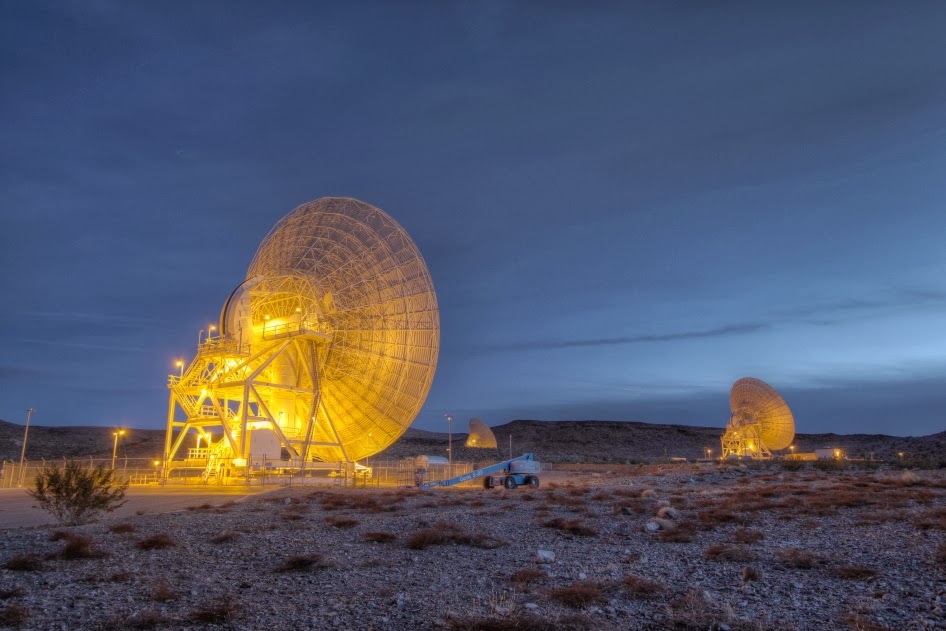
Image above: Beam Wave Guide antennas at Goldstone, known as the "Beam Waveguide Cluster." Each antenna is 111.5-feet (34-m) in diameter. Image Credit: NASA/JPL-Caltech.

NASA's Deep Space Network, the world's largest and most powerful communications system for "talking to" spacecraft, will reach a milestone on Dec. 24: the 50th anniversary of its official creation.

Over the past 50 years, antennas of the Deep Space Network (DSN) have communicated with just about every mission that has gone to the moon or beyond. The historic communiqués include "That's one small step for man. One giant leap for mankind"; numerous encounters with the outer planets of our solar system; images taken by rovers exploring Mars; and the data confirming that NASA's Voyager spacecraft had finally entered interstellar space.

The Deep Space Network has been so critical to so many missions over the decades, the network's team members like to use the phrase "Don't leave Earth without us."

From the very beginning of NASA's space program, it was clear that a simple, direct way to communicate with missions in deep space would be needed. For example, what is the purpose of sending a spacecraft to Mars if we can't receive data, images and other vital information from that spacecraft?

What is now known as the Deep Space Network first existed as just a few small antennas called the Deep Space Instrumentation Facility. The facility was originally operated by the U.S. Army in the 1950s and then later moved over to the jurisdiction of the newly created National Aeronautics and Space Administration (NASA).

On December 24, 1963, the Deep Space Instrumentation Facility officially morphed into the Deep Space Network and quickly became the de facto network for any planned missions into deep space. Three antenna complexes were established around the globe, spread out at roughly 120 degrees of longitude so that even as Earth rotated, spacecraft would always be above the horizon of at least one complex. While some of the communication facilities have moved over the decades, today the three complexes, which operate 24/7/365, are located in Canberra, Australia; Madrid, Spain; and Goldstone, Calif.

 Goldstone 70-Meter

Image above: Late night in the desert: Goldstone's 230-foot (70-meter) antenna tracks spacecraft day and night. This photograph was taken on Jan. 11, 2012. Image Credit: NASA/JPL-Caltech.

Space agencies in Europe, Japan and Russia have all relied on the Deep Space Network when planning and communicating with their own missions over the decades. The Deep Space Network has been used recently by India's first interplanetary probe, the Mars Orbiter Mission (MOM).

"Today, the DSN supports a fleet of more than 30 U.S. and international robotic space missions," said DSN Project Manager Al Bhanji of NASA's Jet Propulsion Laboratory, Pasadena, Calif., which manages the Deep Space Network.  "Without the DSN, we would never have been able to undertake voyages to Mercury and Venus, visit asteroids and comets, we'd never have seen the stunning images of robots on Mars, or close-up views of the majestic rings of Saturn."

In addition to allowing missions to upload and download data to and from dozens of spacecraft, the network helps navigators pinpoint spots for landings and conduct burns that place spacecraft into orbit around other planets, or fine-tune their trajectory. Currently, the list of spacecraft supported by the DSN includes NASA's Curiosity rover on Mars, the Spitzer Space Telescope, the Saturn explorer Cassini and the two Voyager spacecraft, which are more than 9.6 billion miles (15.5 billion kilometers) away from Earth.

 Goldstone 34-meter Beam Waveguide

Image above: Goldstone's 111.5-foot (34-meter) Beam Waveguide tracks a spacecraft as it comes into view. This photograph was taken on Jan. 11, 2012. Image Credit: NASA/JPL-Caltech.

The Deep Space Network is also instrumental in carrying out its own science investigations. For instance, the 230-foot (70-meter) antenna at Goldstone is capable of using its radar to "ping" the near-Earth asteroids to determine a highly accurate position and velocity, and scientists are then able to calculate trajectories the asteroids will take over the next 100 years or more. This is crucial for tracking asteroids that could potentially cause damage were they to impact Earth. If the asteroid is close enough, they can also use the radar to “image” the objects to determine its size, shape and rotation.

Additionally, by combining signals from the DSN antennas with other radio telescopes in an appropriate manner, one can create a "synthetic telescope" that's able to peer into the cores of active galaxies halfway across the observable universe. Likewise, the DSN can be used to probe interiors of planets in our own galaxy, study the solar wind and study gravitational physics.

The future of the Deep Space Network looks bright, with optical communications on the horizon to augment the traditional RF-technology (radio waves moving at the speed of light). Optical communications, when operational, will provide a dramatic increase in data return from science missions; the potential bandwidth carried by an optical communications laser beam is far greater than with traditional radio frequencies. In fact, the DSN team envisions the day, not so far off, when, in addition to returning photos of robotic wheel tracks in the dusty surface of Mars, they will be streaming video to a wide-eyed public as the first humans leave their own footprints on its surface.

"In 2063, when we celebrate the Deep Space Network's 100th anniversary, we can imagine that we might be recalling the amazing days when our antennas streamed high-res video as the first humans stepped onto the surface of Mars," said Al Bhanji. "Or that day when we discovered a new living 'Earth' orbiting a distant star."

Of course, no one knows if or when that day might come. But the DSN will likely play a paramount role in breaking the "Earth-shattering" news.

JPL, a division of the California Institute of Technology in Pasadena, manages the Deep Space Network for NASA. More information about the Deep Space Network is online at: http://www.jpl.nasa.gov/dsn50/

More information about NASA's Space Communications and Navigation program is at: http://www.spacecomm.nasa.gov

Images (mentioned), Text, Credits: NASA / Joshua Buck / JPL / David Israel.

Best regards, Orbiter.ch

Solar Dynamics Observatory Shows Sun's Rainbow of Wavelengths


NASA - Solar Dynamics Observatory (SDO) patch / NASA - ESA - SOHO Mission patch.

Dec. 18, 2013


This still image was taken from a new NASA movie of the sun based on data from NASA's Solar Dynamics Observatory, or SDO, showing the wide range of wavelengths – invisible to the naked eye – that the telescope can view. SDO converts the wavelengths into an image humans can see, and the light is colorized into a rainbow of colors.

Jewel Box Sun

Video above: This movie, created by NASA's Scientific Visualization Studio at NASA's Goddard Space Flight Center in Greenbelt, Md., shows how features of the sun can appear dramatically different when viewed in different wavelengths. Image Credit: NASA's Goddard Space Flight Center.

Telescopes help distant objects appear bigger, but this is only one of their advantages. Telescopes can also collect light in ranges that our eyes alone cannot see, providing scientists ways of observing a whole host of material and processes that would otherwise be inaccessible.

A new NASA movie of the sun based on data from NASA's Solar Dynamics Observatory, or SDO, shows the wide range of wavelengths – invisible to the naked eye – that the telescope can view. SDO converts the wavelengths into an image humans can see, and the light is colorized into a rainbow of colors.

As the colors sweep around the sun in the movie, viewers should note how different the same area of the sun appears. This happens because each wavelength of light represents solar material at specific temperatures. Different wavelengths convey information about different components of the sun's surface and atmosphere, so scientists use them to paint a full picture of our constantly changing and varying star.

Yellow light of 5800 Angstroms, for example, generally emanates from material of about 10,000 degrees F (5700 degrees C), which represents the surface of the sun. Extreme ultraviolet light of 94 Angstroms, which is typically colorized in green in SDO images, comes from atoms that are about 11 million degrees F (6,300,000 degrees C) and is a good wavelength for looking at solar flares, which can reach such high temperatures. By examining pictures of the sun in a variety of wavelengths – as is done not only by SDO, but also by NASA's Interface Region Imaging Spectrograph, NASA's Solar Terrestrial Relations Observatory and the European Space Agency/NASA Solar and Heliospheric Observatory (SOHO)-- scientists can track how particles and heat move through the sun's atmosphere.

Related Links:

Why scientists observe the sun in different wavelengths: http://1.usa.gov/1gvGGVn

About NASA’s heliosphysics fleet: http://www.nasa.gov/sunearth

To download the video in high resolution and various formats: http://svs.gsfc.nasa.gov/goto?11385

More information:

NASA Solar Dynamics Observatory (SDO): http://www.nasa.gov/mission_pages/sdo/main/

NASA SOHO Mission: http://www.nasa.gov/mission_pages/soho/#.UrHm6bS1udw

ESA SOHO Mission: http://sci.esa.int/soho/

Image, Video (mentioned), Text, Credits: NASA Goddard Space Flight Center / Karen C. Fox.

Greetings, Orbiter.ch

mardi 17 décembre 2013

High-energy cosmic rays from solar flares


ROSCOSMOS patch.

17.12.2013

High-energy cosmic rays from solar flares during the period from November 10 to December 10, 2013 according spectrometers Pamela and Arina.

Magnetic Spectrometer Pamela and scintillation spectrometer Arina installed on board the satellite Resource-DK1 continue precision measurements of the charged component of cosmic rays and solar galactic nature.

Resource -DK1

In the past month (from November 10 to December 10), despite the large number of sunspots on the Sun almost did not happen powerful explosive processes (flares).

During this time, in experiments Arina and Pamela received time - intensity profiles of galactic and solar protons with energies of 45-100 MeV and 100 MeV - tens of GeV, respectively.

For clarity, Figure 1 shows the time profiles in the energy range 45 ÷ 55 MeV, 100 MeV and 145 ÷ 400 ÷ 540 MeV. Moments solar flares that occurred 10 and 19 November , marked by arrows, next to which specified event class (X1.1 and H1.0).


Figure 1. The intensity of galactic and solar cosmic rays in the period from November 10 until December 10, according spectrometers Pamela and Arina. Recess instruments related to the prevention of the spacecraft systems.

Thin horizontal lines in the figure shows the average flows in a quiet period of solar activity. During outbreaks spectrometers recorded appearance in near space high-energy solar protons with energies greater than 150 MeV. Other components of solar cosmic rays were detected.

ROSCOSMOS Press Release: http://www.federalspace.ru/20064/

Image, Graphic, Text, Credits: Roscosmos press service / ROSCOSMOS / Translation: Orbiter.ch Aerospace.

Best regards, Orbiter.ch

NASA Postpones Orbital Launch, Sets Spacewalks to Repair Faulty Pump Module


Dec. 17, 2013

NASA managers are postponing the upcoming Orbital Sciences commercial cargo resupply mission to the International Space Station to proceed with a series of spacewalks to replace a faulty pump module on the space station.

Cygnus spacecraft

NASA Television will air a news briefing at 3 p.m. EST on Wednesday, Dec. 18 to preview the spacewalks.

Orbital Sciences' Cygnus spacecraft, atop its Antares rocket, now will launch no earlier than mid-January. The postponement of the Antares launch will allow ample time for the station crew to focus on repairing a faulty pump module that stopped working properly on Dec. 11.


Image above: Astronaut Rick Mastracchio posted this image of a spacesuit inside the Quest airlock Tuesday via his Twitter account, @AstroRM. Image Credit: NASA.

NASA currently plans for two Expedition 38 astronauts to venture outside the space station Dec. 21, 23 and 25. NASA astronauts Rick Mastracchio and Mike Hopkins will remove a pump module that has a failed valve. They will replace it with an existing spare that is stored on an external stowage platform. The pump is associated with one of the station's two external cooling loops, which circulate ammonia outside the station to keep both internal and external equipment cool. Each of the three spacewalks will begin at 7:10 a.m. and is scheduled to last six and a half hours. NASA TV coverage will begin at 6:15 a.m.

International Space Station (ISS)

Wednesday's spacewalks preview briefing will take place from NASA's Johnson Space Center in Houston. Reporters may attend the 3 p.m. briefing at Johnson and other participating NASA centers, or ask questions by calling the Johnson newsroom at 281-483-5111 no later than 2:45 p.m. Briefers will include:

- Michael Suffredini, International Space Station program manager

- Dina Contella, International Space Station flight director

- Allison Bolinger, lead spacewalk officer

View Tweet from @AstroRM: https://twitter.com/AstroRM/status/413061370184085505

For more information about the International Space Station, visit: http://www.nasa.gov/mission_pages/station/main/index.html

Images, Text, Credit: NASA / Orbital.

Best regards, Orbiter.ch