mercredi 25 juin 2014

Increased height of the ISS orbit


ISS - International Space Station patch.


25.06.2014

June 25 underwent elective correction orbit of the International Space Station.

According to calculations by the ballistic and navigation support Mission Control Center FSUE TsNIIMash today in 14 hours 41 minutes Moscow time included engines service module Zvezda, who worked 63.9 seconds. As a result, ISS received increment speed of 1 m/sec. The average height of the station's orbit increased by 1.8 km and reached 415.7 km.

International Space Station (ISS)

Orbit correction station flight was performed in order to create optimal conditions for docking with the ISS cargo spacecraft Progress M-24M, the launch of which is scheduled for July 24, 2014 from the Baikonur Cosmodrome.

ROSCOSMOS Press Release: http://www.federalspace.ru/20718/

Image, Text, Credits: Roscosmos press service / ROSCOSMOS / NASA / Translation: Orbiter.ch Aerospace.

Cheers, Orbiter.ch

mardi 24 juin 2014

CERN announces LHC restart schedule


CERN - European Organization for Nuclear Research logo.

24 June 2014

The Large Hadron Collider (LHC), the largest and most powerful particle accelerator in the world, has started to get ready for its second three-year run. Cool down of the vast machine has already begun in preparation for research to resume early in 2015 following a long technical stop to prepare the machine for running at almost double the energy of run 1. The last LHC magnet interconnection was closed on 18 June 2014 and one sector of 1/8 of the machine has already been cooled to operating temperature. The accelerator chain that supplies the LHC’s particle beams is currently starting up, with beam in the Proton Synchrotron accelerator last Wednesday for the first time since 2012.

"There is a new buzz about the laboratory and a real sense of anticipation," says CERN Director General Rolf Heuer, speaking at a press conference at the EuroScience Open Forum
External Links icon
 (ESOF) meeting in Copenhagen. "Much work has been carried out on the LHC over the last 18 months or so, and it’s effectively a new machine, poised to set us on the path to new discoveries."

Over the last 16 months, the LHC has been through a major programme of maintenance and upgrading, along with the rest of CERN’s accelerator complex, some elements of which have been in operation since 1959. Some 10,000 superconducting magnet interconnections of were consolidated in order to prepare the LHC machine for running at its design energy.

"The machine is coming out of a long sleep after undergoing an important surgical operation," says Frédérick Bordry, CERN’s Director for Accelerators and Technology. "We are now going to wake it up very carefully and go through many tests before colliding beams again early next year. The objective for 2015 is to run the physics programme at 13 TeV."


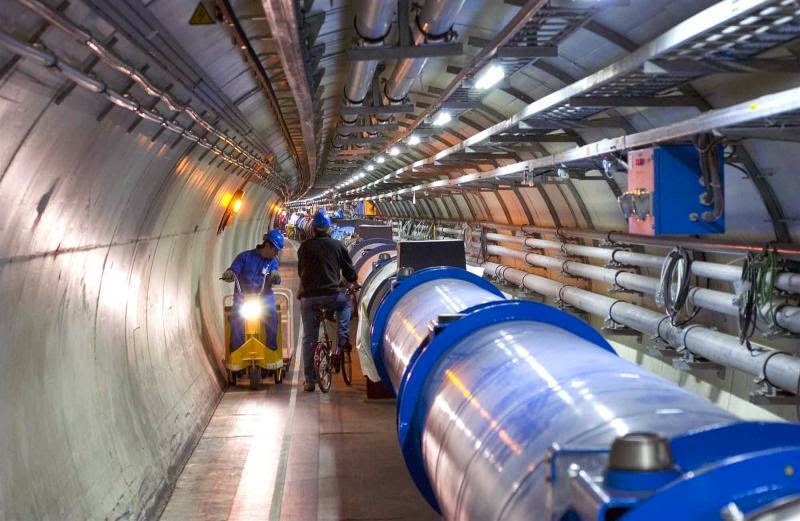
Image above: The Large Hadron Collider is being prepared for its second three-year run (Image: CERN).

The LHC experiments also took advantage of this long pause to upgrade their particle detectors. "The discovery of a Higgs boson was just the beginning of the LHC’s journey," said senior CERN physicist Fabiola Gianotti at the same press conference. "The increase in energy opens the door to a whole new discovery potential."

The Higgs boson, first mentioned in a 1964 paper by Peter Higgs, is linked to the mechanism, proposed the same year by Higgs and independently by Robert Brout and François Englert, that gives mass to fundamental particles. During its first three years, the LHC ran at a collision energy of 7 to 8 TeV delivering particle collisions to four major experiments: ATLAS, CMS, ALICE and LHCb. With the large amount of data provided by the LHC during this first period, the ATLAS and CMS experiments were able to announce the discovery of the long-sought Higgs boson on 4 July 2012, paving the way for the award of the 2013 Nobel Prize in physics to theorists François Englert and Peter Higgs.

By providing collisions at energies never reached in a particle accelerator before, the LHC will open a new window for potential discovery, allowing further studies on the Higgs boson and potentially addressing unsolved mysteries such as dark matter. The ordinary matter of which we, and everything visible in the universe is composed, makes up just 5% of what the universe is made of. The remainder is dark matter and energy, so the stakes for LHC run 2 are high.

CERN’s accelerator complex: Restart schedule:

- 2 June 2014     Restart of the Proton Synchrotron Booster

- 18 June 2014     Restart of the Proton Synchrotron (PS)

- Early July     Powering tests at the Super Proton Synchrotron (SPS)

- Mid-July     Physics programme to restart at the ISOLDE facility and at the PS

- Mid-August     Antimatter Physics programme to restart at the Antiproton Decelerator

- Mid-October     Physics programme to restart at the SPS

- Early 2015     Beam back into the Large Hadron Collider (LHC)

- Spring 2015     Physics programme to restart at the LHC experiments

Note:

CERN, the European Organization for Nuclear Research, is one of the world’s largest and most respected centres for scientific research. Its business is fundamental physics, finding out what the Universe is made of and how it works. At CERN, the world’s largest and most complex scientific instruments are used to study the basic constituents of matter — the fundamental particles. By studying what happens when these particles collide, physicists learn about the laws of Nature.

The instruments used at CERN are particle accelerators and detectors. Accelerators boost beams of particles to high energies before they are made to collide with each other or with stationary targets. Detectors observe and record the results of these collisions.

Founded in 1954, the CERN Laboratory sits astride the Franco–Swiss border near Geneva. It was one of Europe’s first joint ventures and now has 20 Member States.

Related links:

Large Hadron Collider (LHC): http://home.web.cern.ch/topics/large-hadron-collider

EuroScience Open Forum (ESOF): http://esof2014.org/

ATLAS: http://home.web.cern.ch/about/experiments/atlas

CMS: http://home.web.cern.ch/about/experiments/cms

ALICE: http://home.web.cern.ch/about/experiments/alice

LHCb: http://home.web.cern.ch/about/experiments/lhcb

Image (mentioned), Text, Credits: CERN / Cian O'Luanaigh.

Cheers, Orbiter.ch

CERN experiments report new Higgs boson measurements


CERN - European Organization for Nuclear Research logo.

24 June 2014

In a paper published in the journal Nature Physics today, the CMS experiment at CERN reports new results on an important property of the Higgs particle, whose discovery was announced by the ATLAS and CMS experiments on 4 July 2012. The CMS result follows preliminary results from both experiments, which both reported strong evidence for the fermionic decay late in 2013.

The Higgs boson is associated with a mechanism first put forward in 1964 by Robert Brout, François Englert and Peter Higgs to account for the different ranges of two fundamental forces of nature. Now referred to as BEH, this mechanism is postulated to give rise to the masses of all the fundamental particles. In order to test that idea fully, it is necessary to measure the direct decay of the Higgs boson into all kinds of particles.

When the Higgs boson discovery was announced in 2012, it was based on measurements of the decay of the Higgs to other bosons, the carriers of nature’s forces. The results reported by ATLAS and CMS discuss the decay of Higgs bosons directly to fermions, the particles that make up matter.

The measurements from both have given substantial evidence that the Higgs boson decays directly to fermions at a rate consistent with that predicted by the Standard Model of particle physics, the theory that accounts for the fundamental particles of visible matter and the interactions that work between them, giving structure to matter.


Image above: An artist’s approximation of a collision of two protons that produce a Higgs boson. Image Credit: CERN.

"With our on-going analyses, we are really starting to understand the BEH mechanism in depth," says CMS spokesperson Tiziano Camporesi. "So far, it is behaving exactly as predicted by theory."

"These results show the power of the detectors in allowing us to do precision Higgs physics," says ATLAS spokesperson Dave Charlton. "We’re coming close to achieving all we can on the Higgs analysis with run 1 data, and are all looking forward to new data when the LHC restarts in 2015."

The Large Hadron Collider, CERN’s flagship research facility, has been off-line for maintenance and upgrading in last 18 months. Preparations are now underway for it to restart early in 2015.

More information will be available as results are announced at the International Conference on High Energy Physics, ICHEP, which starts in Valencia, Spain, on 2 July.

Links to relevant ATLAS and CMS papers/notes:

CMS Collaboration, "Evidence for the direct decay of the 125 GeV Higgs boson to fermions” - Nature Physics (2014): http://dx.doi.org/10.1038/nphys3005

CMS Collaboration, “Search for the standard model Higgs boson produced in association with a W or a Z boson and decaying to bottom quarks”: http://dx.doi.org/10.1103/PhysRevD.89.012003

CMS Collaboration, “Evidence for the 125 GeV Higgs boson decaying to a pair of tau leptons”: http://dx.doi.org/10.1007/JHEP05(2014)104

ATLAS Collaboration, “Evidence for Higgs Boson Decays to the tau+tau- Final State with the ATLAS Detector” - 28 November 2013: https://atlas.web.cern.ch/Atlas/GROUPS/PHYSICS/CONFNOTES/ATLAS-CONF-2013-108/

ATLAS Collaboration, “Updated coupling measurements of the Higgs boson with the ATLAS detector using up to 25/fb of proton-proton collision data” - 20 March 2014: https://atlas.web.cern.ch/Atlas/GROUPS/PHYSICS/CONFNOTES/ATLAS-CONF-2014-009/

Note:

CERN, the European Organization for Nuclear Research, is one of the world’s largest and most respected centres for scientific research. Its business is fundamental physics, finding out what the Universe is made of and how it works. At CERN, the world’s largest and most complex scientific instruments are used to study the basic constituents of matter — the fundamental particles. By studying what happens when these particles collide, physicists learn about the laws of Nature.

The instruments used at CERN are particle accelerators and detectors. Accelerators boost beams of particles to high energies before they are made to collide with each other or with stationary targets. Detectors observe and record the results of these collisions.

Founded in 1954, the CERN Laboratory sits astride the Franco–Swiss border near Geneva. It was one of Europe’s first joint ventures and now has 20 Member States.

Related links:

Higgs particle: http://home.web.cern.ch/topics/higgs-boson

CMS experiment: http://home.web.cern.ch/about/experiments/cms

ATLAS: http://home.web.cern.ch/about/experiments/atlas

Large Hadron Collider (LHC): http://home.web.cern.ch/topics/large-hadron-collider

International Conference on High Energy Physics: http://ichep2014.es/

Image (mentioned), Text, Credits: CERN / Cian O'Luanaigh.

Greetings, Orbiter.ch

Roscosmos continues cooperation with the International Charter "Space and Major Disasters"


ROSCOSMOS logo.

24/06/2014

Due to the emergency situation in the state of Paraná (Brazil) as a result of floods, 16.06.2014, the International Charter has been activated. Roscosmos, as a member of the Charter since 2013, has carried out survey of the affected area using a spacecraft Canopus-V.

(Click on the image for enlarge)

Image above: Fragment of space images from the spacecraft "Canopus-V" for the city 22/6/2014.

The obtained data were processed at the Research Center for Earth Operative Monitoring (NTs OMZ) JSC "Russian Space Systems" and promptly provided in the Charter to monitor the situation in the affected area.

Canopus-V spacecraft

ROSCOSMOS Press Release: http://www.federalspace.ru/20714/

Images, Text, Credits: Roscosmos press service / ROSCOSMOS / Translation: Orbiter.ch Aerospace.

Cheers, Orbiter.ch

Puzzling X-rays point to dark matter


ESA - XMM-Newton Mission patch / NASA - Chandra X-ray Observatory patch.

24 June 2014

Astronomers using ESA and NASA high-energy observatories have discovered a tantalising clue that hints at an elusive ingredient of our Universe: dark matter.


Image above: Perseus galaxy cluster. Credit: Chandra: NASA/CXC/SAO/E.Bulbul, et al.; XMM-Newton: ESA.

Although thought to be invisible, neither emitting nor absorbing light, dark matter can be detected through its gravitational influence on the movements and appearance of other objects in the Universe, such as stars or galaxies.

Based on this indirect evidence, astronomers believe that dark matter is the dominant type of matter in the Universe – yet it remains obscure.

Now a hint may have been found by studying galaxy clusters, the largest cosmic assemblies of matter bound together by gravity.

Galaxy clusters not only contain hundreds of galaxies, but also a huge amount of hot gas filling the space between them.

However, measuring the gravitational influence of such clusters shows that the galaxies and gas make up only about a fifth of the total mass – the rest is thought to be dark matter.

The gas is mainly hydrogen and, at over 10 million degrees celsius, is hot enough to emit X-rays. Traces of other elements contribute additional X-ray 'lines' at specific wavelengths.

Examining observations by ESA's XMM-Newton and NASA's Chandra spaceborne telescopes of these characteristic lines in 73 galaxy clusters, astronomers stumbled on an intriguing faint line at a wavelength where none had been seen before.


Image above: Mysterious signal in the Perseus galaxy cluster. Credit: NASA/CXC/SAO/E.Bulbul, et al.

"If this strange signal had been caused by a known element present in the gas, it should have left other signals in the X-ray light at other well-known wavelengths, but none of these were recorded," says Dr Esra Bulbul from the Harvard-Smithsonian Center for Astrophysics in Cambridge, Massachusetts, USA, lead author of the paper discussing the results.

"So we had to look for an explanation beyond the realm of known, ordinary matter."

The astronomers suggest that the emission may be created by the decay of an exotic type of subatomic particle known as a 'sterile neutrino', which is predicted but not yet detected.

Ordinary neutrinos are very low-mass particles that interact only rarely with matter via the so-called weak nuclear force as well as via gravity. Sterile neutrinos are thought to interact with ordinary matter through gravity alone, making them a possible candidate as dark matter.

"If the interpretation of our new observations is correct, at least part of the dark matter in galaxy clusters could consist of sterile neutrinos," says Dr Bulbul.

The surveyed galaxy clusters lie at a wide range of distances, from more than a hundred million light-years to a few billion light-years away. The mysterious, faint signal was found by combining multiple observations of the clusters, as well as in an individual image of the Perseus cluster, a massive structure in our cosmic neighbourhood.

The implications of this discovery may be far-reaching, but the researchers are being cautious. Further observations with XMM-Newton, Chandra and other high-energy telescopes of more clusters are needed before the connection to dark matter can be confirmed.

"The discovery of these curious X-rays was possible thanks to the large XMM-Newton archive, and to the observatory's ability to collect lots of X-rays at different wavelengths, leading to this previously undiscovered line," comments Norbert Schartel, ESA's XMM-Newton Project Scientist.

"It would be extremely exciting to confirm that XMM-Newton helped us find the first direct sign of dark matter.

"We aren't quite there yet, but we're certainly going to learn a lot about the content of our bizarre Universe while getting there."
More information

"Detection of an unidentified emission line in the stacked X-ray spectrum of galaxy clusters," by E. Bulbul et al. is published in the 1 July 2014 issue of the Astrophysical Journal: http://iopscience.iop.org/0004-637X/789/1/13/

For more information about NASA's Chandra X-ray Observatory, visit: http://www.nasa.gov/mission_pages/chandra/main/

For more information about ESA's XMM-Newton: http://www.esa.int/Our_Activities/Space_Science/XMM-Newton_overview

Images (mentioned), Text, Credits: ESA / Markus Bauer / XMM-Newton Project Scientist, Norbert Schartel / Harvard-Smithsonian Center for Astrophysics, Esra Bulbul.

Best regards, Orbiter.ch

Whale of a target: harpooning space debris


ESA - Clean Space program logo.

24 June 2014

Faced with the challenge of capturing tumbling satellites to clear key orbits, ESA is considering turning to an ancient terrestrial technology: the harpoon.

Used since the Stone Age, first to spear fish and later to catch whales, the humble harpoon is being looked at for snagging derelict space hardware.

Decades of launches have left Earth surrounded by a halo of space junk: more than 17 000 trackable objects larger than a coffee cup, threatening working missions with catastrophic collision. Even a 1 cm nut could slam into a valuable satellite with the force of a hand grenade.

Harpooning in space

The only way to control the debris cloud across crucial lower orbits – like those that allow observation satellites to go on monitoring our planet at the same local time of day – is to remove large items such as derelict satellites and rocket upper stages.

These uncontrolled multitonne objects are time bombs: sooner or later they will be involved in a collision. That is, if they don’t explode earlier due to leftover fuel or partially charged batteries heated up by sunlight.

Harpoon system

The resulting debris clouds would make these vital orbits much more hazardous and expensive to use, and follow-on collisions may eventually trigger a chain reaction of break-ups.

To avoid this outcome, ESA’s Clean Space initiative is working on the e.DeOrbit mission for flight in 2021. Its sophisticated sensors and autonomous control will identify and home in on a target – potentially of several tonnes and tumbling uncontrollably.

Space debris around Earth

Then comes the challenge of capturing and securing it. Several different solutions have been considered, including a throw-net, clamping mechanisms, robotic arms – and a tethered harpoon.

The harpoon concept has already undergone initial investigations by Airbus Defence and Space in Stevenage, UK.

Harpoons rely on three physical actions to ensure safe and clean grasping: a high-energy impact into the target, piercing the structure and then reeling it in.

Harpoon used to capture a satellite

A prototype harpoon was shot into representative satellite material to assess its penetration, its strength as the target is pulled close and the generation of additional fragments that might threaten the e.DeOrbit satellite.

As a next step, ESA plans to build and test a prototype ‘breadboard’ version in the hope of adopting the harpoon and its ejection mechanism for the mission.

Harpoon for whaling

The project will investigate all three stages of harpooning through computer models, analysis and experiments, leading to a full hardware demonstration.

Bidders are welcome on the study contract. For more information, check the invitation package, accessible throuugh ESA's tendering system: http://www.esa.int/About_Us/Industry/Industry_how_to_do_business/ESA_s_Invitation_to_Tender_System_EMITS

Related links:

EMITS: http://emits.esa.int/emits/owa/emits.main

How to catch a satellite: http://www.esa.int/Our_Activities/Space_Engineering/Clean_Space/How_to_catch_a_satellite

Technologies for space debris remediation: http://www.esa.int/Our_Activities/Space_Engineering/Clean_Space/Technologies_for_space_debris_remediation

Images, Text, Credits: ESA/P. Carril/Airbus Defence and Space/Wikimedia Commons.

Greetings, Orbiter.ch

lundi 23 juin 2014

Titan's Building Blocks Might Pre-date Saturn


NASA / ESA - Cassini-Huygens Mission to Saturn & Titan patch.

June 23, 2014


Image above: New research on the nitrogen in Titan's atmosphere indicates that the moon's raw materials might have been locked up in ices that condensed before Saturn began its formation. Image Credit: NASA/JPL-Caltech/Space Science Institute.

A combined NASA and European Space Agency (ESA)-funded study has found firm evidence that nitrogen in the atmosphere of Saturn's moon Titan originated in conditions similar to the cold birthplace of the most ancient comets from the Oort cloud. The finding rules out the possibility that Titan's building blocks formed within the warm disk of material thought to have surrounded the infant planet Saturn during its formation. 

The main implication of this new research is that Titan's building blocks formed early in the solar system's history, in the cold disk of gas and dust that formed the sun. This was also the birthplace of many comets, which retain a primitive, or largely unchanged, composition today.

The research, led by Kathleen Mandt of Southwest Research Institute in San Antonio, and including an international team of researchers, was published this week in the Astrophysical Journal Letters.

Nitrogen is the main ingredient in the atmosphere of Earth, as well as on Titan. The planet-sized moon of Saturn is frequently compared to an early version of Earth, locked in a deep freeze.

The paper suggests that information about Titan's original building blocks is still present in the icy moon's atmosphere, allowing researchers to test different ideas about how the moon might have formed. Mandt and colleagues demonstrate that a particular chemical hint as to the origin of Titan's nitrogen should be essentially the same today as when this moon formed, up to 4.6 billion years ago. That hint is the ratio of one isotope, or form, of nitrogen, called nitrogen-14, to another isotope, called nitrogen-15.

The team finds that our solar system is not old enough for this nitrogen isotope ratio to have changed significantly. This is contrary to what scientists commonly have assumed.

"When we looked closely at how this ratio could evolve with time, we found that it was impossible for it to change significantly. Titan's atmosphere contains so much nitrogen that no process can significantly modify this tracer even given more than four billion years of solar system history," Mandt said.

The small amount of change in this isotope ratio over long time periods makes it possible for researchers to compare Titan's original building blocks to other solar system objects in search of connections between them.

As planetary scientists investigate the mystery of how the solar system formed, isotope ratios are one of the most valuable types of clues they are able to collect. In planetary atmospheres and surface materials, the specific amount of one form of an element, like nitrogen, relative to another form of that same element can be a powerful diagnostic tool because it is closely tied to the conditions under which materials form.


Image above: The building blocks of comets, and apparently Saturn's largest moon, Titan, formed under similar conditions in the disk of gas and dust that formed the sun. Image Credit: NASA/JPL-Caltech.

The study also has implications for Earth. It supports the emerging view that ammonia ice from comets is not likely to be the primary source of Earth's nitrogen. In the past, researchers assumed a connection between comets, Titan and Earth, and supposed the nitrogen isotope ratio in Titan's original atmosphere was the same as that ratio is on Earth today. Measurements of the nitrogen isotope ratio at Titan by several instruments of the NASA and ESA Cassini-Huygens mission showed that this is not the case -- meaning this ratio is different on Titan and Earth -- while measurements of the ratio in comets have borne out their connection to Titan. This means the sources of Earth’s and Titan’s nitrogen must have been different.

Other researchers previously had shown that Earth’s nitrogen isotope ratio likely has not changed significantly since our planet formed.

"Some have suggested that meteorites brought nitrogen to Earth, or that nitrogen was captured directly from the disk of gas that formed the sun. This is an interesting puzzle for future investigations," Mandt said.

Mandt and colleagues are eager to see whether their findings are supported by data from ESA's Rosetta mission, when it studies comet 67P/ Churyumov-Gerasimenko beginning later this year. If their analysis is correct, the comet should have a lower ratio of two isotopes -- in this case of hydrogen in methane ice -- than the ratio on Titan. In essence, they believe this chemical ratio on Titan is more similar to Oort cloud comets than comets born in the Kuiper Belt, which begins near the orbit of Neptune (67P/ Churyumov-Gerasimenko is a Kuiper Belt comet).

“This exciting result is a key example of Cassini science informing our knowledge of the history of solar system and how the Earth formed,” said Scott Edgington, Cassini deputy project scientist at NASA's Jet Propulsion Laboratory, Pasadena, California.

The Cassini-Huygens mission is a cooperative project of NASA, ESA and the Italian Space Agency. JPL, a division of the California Institute of Technology, Pasadena, manages the mission for NASA's Science Mission Directorate in Washington.

Rosetta is an ESA mission with contributions from its member states and NASA. JPL manages the U.S. contribution of the Rosetta mission for NASA's Science Mission Directorate in Washington.

More information about Cassini is available at the following sites:

http://www.nasa.gov/cassini

http://saturn.jpl.nasa.gov

http://www.esa.int/Our_Activities/Space_Science/Cassini-Huygens

Images (mentioned), Text, Credits: NASA's Jet Propulsion Laboratory/Preston Dyches/Whitney Clavin.

Greetings, Orbiter.ch