dimanche 3 juillet 2016

China FAST hunt for alien life with giant telescope


Five-hundred-meter Aperture Spherical Telescope (FAST) logo.

July 3, 2016

 Artist's view of the Five-hundred-meter Aperture Spherical Telescope (FAST). Image Credit: NAOC

China on Sunday hoisted the final piece into position on what will be the world's largest radio telescope, which it will use to explore space and help in the hunt for extraterrestrial life, state media said.

Installation was completed on the Five-hundred-meter Aperture Spherical Telescope (FAST) on Sunday morning as the last of 4,450 panels was fitted into the center of the big dish.

Hoisting of the last triangular panel to the reflector, which is the size of 30 football fields, began at 10:47 am and lasted about 40 minutes. It was a landmark step for the telescope's planned launch of operations in September.


Image above: The installation of the world's largest radio telescope, Five-hundred-meter Aperture Spherical Telescope (FAST), is completed in Guizhou, China, on July 3, 2016. Image Credit: Xinhua.

About 300 people, including builders, experts, science fiction enthusiasts and reporters, witnessed the installation at a karst valley in Pingtang county in the southwestern province of Guizhou.

"The telescope is of great significance for humans to explore the universe and extraterrestrial civilizations," said Liu Cixin, a renowned science fiction writer, at the site.

"I hope scientists can make epoch-making discoveries," said Liu, who won the 2015 Hugo Award for Best Novel.

Scientists will then begin debugging and trial observation of the telescope, said Zheng Xiaonian, deputy head of the National Astronomical Observation under the Chinese Academy of Sciences, which built the telescope.


Image above: Balloons are released to celebrate the completion of installation of the world's largest radio telescope, Five-hundred-meter Aperture Spherical Telescope (FAST), in Guizhou, China, on July 3, 2016. Image Credit: Xinhua.

The project has the potential to search for more strange objects to better understand the origin of the universe and boost the global hunt for extraterrestrial life, said Zheng.

Zheng said the radio telescope will be the global leader for the next 10 to 20 years.

In the first two or three years after its completion, the telescope will undergo further adjustment, and during that period Chinese scientists will use it for early-stage research. After that, it will be open to scientists worldwide, said Peng Bo, director of the NAO Radio Astronomy Technology Laboratory.

Scientists can also carry out remote control and observation in other cities such as Beijing, more than 2,000 kilometers from the telescope site, said Peng.

Upon completion, the telescope will dwarf Puerto Rico's Arecibo Observatory, which is 300 meters in diameter. It will also be 10 times more sensitive than the steerable 100-meter telescope near Bonn, Germany, he said.

"Most of the technology and materials are domestically made," said Wang Qiming, chief technologist of the FAST project.

Among the 7 FAST receivers, five were domestically made and another two were co-produced by Chinese, Australian and American institutions.

Work on the 1.2-billion-yuan (US$180 million) FAST project began in 2011.

For more information about Five-hundred-meter Aperture Spherical Telescope (FAST), visit: http://fast.bao.ac.cn/en/

Images (mentioned), Text, Credits: CDN/Orbiter.ch Aerospace/Roland Berga.

Greetings, Orbiter.ch

vendredi 1 juillet 2016

CERN - LHCb unveils new particles


CERN - European Organization for Nuclear Research logo.

July 1, 2016

A view of the LHCb experimental cavern. (Image: Claudia Marcelloni/CERN)

On 28 June, the LHCb collaboration reported the observation of three new "exotic" particles and the confirmation of the existence of a fourth one in data from the Large Hadron Collider (LHC). These particles seem to be formed by four quarks (the fundamental constituent of the matter inside all the atoms of the universe): two quarks and two antiquarks (that is, a tetraquark). Due to their non-standard quark content, the newly observed particles have been included in the broad category of so-called exotic particles, although their exact theoretical interpretation is still under study.

The quark model, proposed in 1964 by Murray Gell-Mann and George Zweig, is the most valid classification scheme of hadrons (all the composite particles) that has been found so far and it is part of the Standard Model of particle physics. In this model, hadrons are classified according to their quark content. However, it has been for a long-held mystery that all observed hadrons were formed either by a pair of quark-antiquark (mesons) or by three quarks (baryons) only. But, in the last decade several collaborations have found evidence of the existence of particles formed by more than three quarks. For example, in 2009 the CDF collaboration found one of these, called X(4140) – where the number in parentheses is its reconstructed mass in megaelectronvolts. This result was then confirmed later by a new CDF analysis, and by the CMS and D0 collaborations.

Nevertheless, until now, the X(4140) quantum numbers – characteristic numbers with which the properties of a specific particle are identified – were not fully determined, and this ambiguity exposed the theoretical explanation to uncertainty. The LHCb collaboration could determine the X(4140) quantum numbers with high precision. This result has a large impact on the possible theoretical interpretations, and indeed it excludes some of the previously proposed theories on its nature.

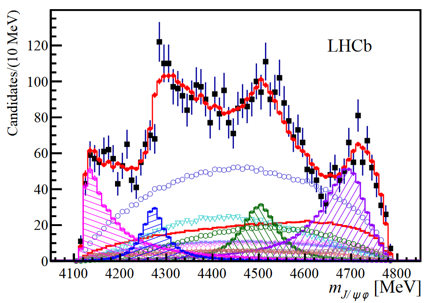
While the X(4140) had already been seen, the observation of the three new exotic particles with higher masses, called X(4274), X(4500) and X(4700), has been announced for the first time. Even though the four particles all contain the same quark composition, they each have a unique internal structure, mass and their own sets of quantum numbers.


Graphic above: The image shows the data (black dots) of the mass distribution resulting from the association of the J/ψ and φ mesons, where the contribution of the four exotic particles is put into evidence by the four peaking structures at the bottom. Graphic Credit: CERN.

These results are based on a detailed analysis of the decay of a B+ meson into mesons called J/ψ, φ and K+, where the new particles appear as intermediate ones decaying to a pair of J/ψ and φ mesons. To perform this research, the LHCb physicists used the full set of data collected during the first LHC run, from 2010 to 2012. The large signal yield efficiently collected with the LHCb detector has allowed LHCb scientists to discover those three new particles that were (literally, see the picture) peaking out from the data.

This news comes in addition to the discovery of the first two pentaquark particles by the LHCb collaboration last year.

More information on the tetraquark results on the LHCb website and in the two submitted scientific papers: http://arxiv.org/abs/1606.07895 and http://arxiv.org/abs/1606.07898

Note:

CERN, the European Organization for Nuclear Research, is one of the world’s largest and most respected centres for scientific research. Its business is fundamental physics, finding out what the Universe is made of and how it works. At CERN, the world’s largest and most complex scientific instruments are used to study the basic constituents of matter — the fundamental particles. By studying what happens when these particles collide, physicists learn about the laws of Nature.

The instruments used at CERN are particle accelerators and detectors. Accelerators boost beams of particles to high energies before they are made to collide with each other or with stationary targets. Detectors observe and record the results of these collisions.

Founded in 1954, the CERN Laboratory sits astride the Franco–Swiss border near Geneva. It was one of Europe’s first joint ventures and now has 21 Member States.

Related links:

LHCb experiment: https://home.cern/about/experiments/lhcb

Large Hadron Collider (LHC): https://home.cern/topics/large-hadron-collider

CMS experiment: https://home.cern/about/experiments/cms

D0 collaboration: http://www-d0.fnal.gov/

Standard Model of particle physics: https://home.cern/about/physics/standard-model

For more information about the European Organization for Nuclear Research (CERN), visit: http://home.web.cern.ch/

Image (mentioned), Graphic (mentioned), Text, Credits: CERN/Stefania Pandolfi.

Greetings, Orbiter.ch

NASA's Juno Spacecraft Getting Close to Jupiter


NASA - JUNO Mission logo.

July 1, 2016

NASA's Juno mission, launched nearly five years ago, will soon reach its final destination: the most massive planet in our solar system, Jupiter. On the evening of July 4, at roughly 9 p.m. PDT (12 a.m. EDT, July 5), the spacecraft will complete a burn of its main engine, placing it in orbit around the king of planets.

During Juno's orbit-insertion phase, or JOI, the spacecraft will perform a series of steps in preparation for a main engine burn that will guide it into orbit. At 6:16 p.m. PDT (9:16 p.m. EDT), Juno will begin to turn slowly away from the sun and toward its orbit-insertion attitude. Then 72 minutes later, it will make a faster turn into the orbit-insertion attitude.


Image above: This illustration depicts NASA's Juno spacecraft at Jupiter, with its solar arrays and main antenna pointed toward the distant sun and Earth. Image Credits: NASA/JPL-Caltech.

At 7:41 p.m. PDT (10:41 p.m. EDT), Juno switches to its low-gain antenna. Fine-tune adjustments are then made to the spacecraft's attitude. Twenty-two minutes before the main engine burn, at 7:56 p.m. PDT (10:56 p.m. EDT), the spacecraft spins up from 2 to 5 revolutions per minute (RPM) to help stabilize it for the orbit insertion burn.

At 8:18 p.m. PDT (11:18 p.m. EDT), Juno's 35-minute main-engine burn will begin. This will slow it enough to be captured by the giant planet’s gravity. The burn will impart a mean change in velocity of 1,212 mph (542 meters a second) on the spacecraft. It is performed in view of Earth, allowing its progress to be monitored by the mission teams at NASA's Jet Propulsion Laboratory in Pasadena, California, and Lockheed Martin Space Systems in Denver, via signal reception by Deep Space Network antennas in Goldstone, California, and Canberra, Australia.

After the main engine burn, Juno will be in orbit around Jupiter. The spacecraft will spin down from 5 to 2 RPM, turn back toward the sun, and ultimately transmit telemetry via its high-gain antenna.

Juno starts its tour of Jupiter in a 53.5-day orbit. The spacecraft saves fuel by executing a burn that places it in a capture orbit with a 53.5-day orbit instead of going directly for the 14-day orbit that will occur during the mission's primary science collection period. The 14-day science orbit phase will begin after the final burn of the mission for Juno’s main engine on October 19.

Jupiter Into the Unknown (NASA Juno Mission Trailer)

JPL manages the Juno mission for NASA. The mission's principal investigator is Scott Bolton of Southwest Research Institute in San Antonio. The mission is part of NASA's New Frontiers Program, managed at the agency's Marshall Space Flight Center in Huntsville, Alabama, for NASA's Science Mission Directorate. Lockheed Martin Space Systems in Denver built the spacecraft.

Related articles:

NASA's Juno Spacecraft Enters Jupiter's Magnetic Field
http://orbiterchspacenews.blogspot.ch/2016/06/nasas-juno-spacecraft-enters-jupiters.html

NASA's Juno Peers Inside a Giant
http://orbiterchspacenews.blogspot.ch/2016/06/nasas-juno-peers-inside-giant.html

Juno on Jupiter's Doorstep
http://orbiterchspacenews.blogspot.ch/2016/06/juno-on-jupiters-doorstep.html

Learn more about the June mission, and get an up-to-date schedule of events, at:

http://www.nasa.gov/juno

https://solarsystem.nasa.gov/planets/jupiter/junotoolkit

Follow the mission on social media at:

http://www.facebook.com/NASAJuno

http://www.twitter.com/NASAJuno

For NASA TV streaming video and schedules, visit:

http://www.nasa.gov/nasatv

Image (mentioned), Video, Text, Credits: NASA/Martin Perez/JPL/DC Agle/Caltech/Whitney Clavin.

Greetings, Orbiter.ch

New Horizons Receives Mission Extension to Kuiper Belt, Dawn to Remain at Ceres


NASA logo.

July 1, 2016

Following its historic first-ever flyby of Pluto, NASA’s New Horizons mission has received the green light to fly onward to an object deeper in the Kuiper Belt, known as 2014 MU69. The spacecraft’s planned rendezvous with the ancient object – considered one of the early building blocks of the solar system -- is Jan. 1, 2019.

“The New Horizons mission to Pluto exceeded our expectations and even today the data from the spacecraft continue to surprise,” said NASA’s Director of Planetary Science Jim Green. “We’re excited to continue onward into the dark depths of the outer solar system to a science target that wasn’t even discovered when the spacecraft launched.”

Exploring the Solar System

Based upon the 2016 Planetary Mission Senior Review Panel report, NASA this week directed nine extended missions to plan for continued operations through fiscal years 2017 and 2018.  Final decisions on mission extensions are contingent on the outcome of the annual budget process.

In addition to the extension of the New Horizons mission, NASA determined that the Dawn spacecraft should remain at the dwarf planet Ceres, rather than changing course to the main belt asteroid Adeona.

Green noted that NASA relies on the scientific assessment by the Senior Review Panel in making its decision on which extended mission option to approve. “The long-term monitoring of Ceres, particularly as it gets closer to perihelion – the part of its orbit with the shortest distance to the sun -- has the potential to provide more significant science discoveries than a flyby of Adeona,” he said.

Also receiving NASA approval for mission extensions, contingent on available resources, are: the Mars Reconnaissance Orbiter (MRO), Mars Atmosphere and Volatile EvolutioN (MAVEN), the Opportunity and Curiosity Mars rovers, the Mars Odyssey orbiter, the Lunar Reconnaissance Orbiter (LRO), and NASA’s support for the European Space Agency’s Mars Express mission.

Related links:

New Horizons mission: http://www.nasa.gov/mission_pages/newhorizons/main/index.html

Dawn mission: http://dawn.jpl.nasa.gov/mission

Mars Reconnaissance Orbiter (MRO): http://www.nasa.gov/mission_pages/MRO/main/index.html

Mars Atmosphere and Volatile EvolutioN (MAVEN): https://www.nasa.gov/mission_pages/maven/main/index.html

Opportunity and Curiosity Mars rovers: http://www.nasa.gov/rovers and http://mars.jpl.nasa.gov/msl

Mars Odyssey orbiter: http://mars.nasa.gov/odyssey/

Lunar Reconnaissance Orbiter (LRO): http://www.nasa.gov/mission_pages/LRO/main/index.html

European Space Agency’s Mars Express mission: http://www.esa.int/Our_Activities/Space_Science/Mars_Express

Solar System: https://www.nasa.gov/topics/solarsystem/index.html

Image, Text, Credits: NASA/Dwayne Brown/Laurie Cantillo/Tony Greicius.

Greetings, Orbiter.ch

Hubble Hotbed of Vigorous Star Formation


NASA - Hubble Space Telescope patch.

July 1, 2016


This NASA/ESA Hubble Space Telescope image reveals the iridescent interior of one of the most active galaxies in our local neighborhood — NGC 1569, a small galaxy located about eleven million light-years away in the constellation of Camelopardalis (The Giraffe).

This galaxy is currently a hotbed of vigorous star formation. NGC 1569 is a starburst galaxy, meaning that — as the name suggests — it is bursting at the seams with stars, and is currently producing them at a rate far higher than that observed in most other galaxies. For almost 100 million years, NGC 1569 has pumped out stars more than 100 times faster than the Milky Way!

As a result, this glittering galaxy is home to super star clusters, three of which are visible in this image — one of the two bright clusters is actually the superposition of two massive clusters. Each containing more than a million stars, these brilliant blue clusters reside within a large cavity of gas carved out by multiple supernovae, the energetic remnants of massive stars.

In 2008, Hubble observed the galaxy's cluttered core and sparsely populated outer fringes. By pinpointing individual red giant stars, Hubble’s Advanced Camera for Surveys enabled astronomers to calculate a new — and much more precise — estimate for NGC 1569’s distance. This revealed that the galaxy is actually one and a half times farther away than previously thought, and a member of the IC 342 galaxy group.

Astronomers suspect that the IC 342 cosmic congregation is responsible for the star-forming frenzy observed in NGC 1569. Gravitational interactions between this galactic group are believed to be compressing the gas within NGC 1569. As it is compressed, the gas collapses, heats up and forms new stars.

 Hubble and the sunrise over Earth

The Hubble Space Telescope is a project of international cooperation between ESA and NASA.

For more information about the Hubble Space Telescope, visit:

http://hubblesite.org/
http://www.nasa.gov/hubble
https://www.spacetelescope.org/

Image Credits: ESA/Hubble & NASA, Aloisi, Ford; Acknowledgement: Judy Schmidt/Text Credits: European Space Agency (ESA)/NASA/Ashley Morrow/Video: ESA.

Best regards, Orbiter.ch

jeudi 30 juin 2016

NASA's Juno Spacecraft Enters Jupiter's Magnetic Field


NASA - JUNO Mission logo.

June 30, 2016

NASA's Jupiter-bound Juno spacecraft has entered the planet's magnetosphere, where the movement of particles in space is controlled by what's going on inside Jupiter.

"We've just crossed the boundary into Jupiter's home turf," said Juno Principal Investigator Scott Bolton of Southwest Research Institute, San Antonio. "We're closing in fast on the planet itself and already gaining valuable data."

Data Recorded as Juno Crossed Jovian Bow Shock

Video above: This chart presents data the Waves investigation on NASA's Juno spacecraft recorded as the spacecraft crossed the bow shock just outside of Jupiter's magnetosphere on July 24, 2016. Audio accompanies the animation, with volume and pitch correlated to the amplitude and frequency of the recorded waves. Video Credits: NASA/JPL-Caltech/SwRI/Univ. of Iowa.

Juno is on course to swing into orbit around Jupiter on July 4. Science instruments on board detected changes in the particles and fields around the spacecraft as it passed from an environment dominated by the interplanetary solar wind into Jupiter's magnetosphere. Data from Juno's Waves investigation, presented as audio stream and color animation, indicate the spacecraft's crossing of the bow shock just outside the magnetosphere on June 24 and the transit into the lower density of the Jovian magnetosphere on July 25.

Infographic: Juno, Built to Withstand Intense Radiation Environments

Infographic above: Juno has been headed for Jupiter since 2011 to study the gas giant’s atmosphere, aurora, gravity and magnetic field. This infographic illustrates the radiation environments Juno has traveled through on its journey near Earth and in interplanetary space. Credits: NASA's Goddard Space Flight Center.

"The bow shock is analogous to a sonic boom," said William Kurth of the University of Iowa in Iowa City, lead co-investigator for the Waves investigation. "The solar wind blows past all the planets at a speed of about a million miles per hour, and where it hits an obstacle, there's all this turbulence."

The obstacle is Jupiter's magnetosphere, which is the largest structure in the solar system.

Data Recorded as Juno Entered Magnetosphere

Video above: This chart presents data that the Waves investigation on NASA's Juno spacecraft recorded as the spacecraft entered Jupiter's magnetosphere on July 25, 2016, while approaching Jupiter. Audio accompanies the animation, with volume and pitch correlated to the amplitude and frequency of the recorded waves. Video Credits: NASA/JPL-Caltech/SwRI/Univ. of Iowa.

"If Jupiter's magnetosphere glowed in visible light, it would be twice the size of the full moon as seen from Earth," Kurth said. And that's the shorter dimension of the teardrop-shaped structure; the dimension extending outward behind Jupiter has a length about five times the distance between Earth and the sun.

Out in the solar wind a few days ago, Juno was speeding through an environment that has about 16 particles per cubic inch (one per cubic centimeter). Once it crossed into the magnetosphere, the density was about a hundredfold less. The density is expected to climb again, inside the magnetosphere, as the spacecraft gets closer to Jupiter itself. The motions of these particles traveling under the control of Jupiter's magnetic field will be one type of evidence Juno examines for clues about Jupiter's deep interior.


Image above: NASA's Juno spacecraft obtained this color view on June 28, 2016, at a distance of 3.9 million miles (6.2 million kilometers) from Jupiter. Image Credits: NASA/JPL-Caltech/SwRI/MSSS.

While this transition from the solar wind into the magnetosphere was predicted to occur at some point in time, the structure of the boundary between those two regions proved to be unexpectedly complex, with different instruments reporting unusual signatures both before and after the nominal crossing.

"This unusual boundary structure will itself be the subject of scientific investigation," said Barry Mauk of the Johns Hopkins University Applied Physics Laboratory, Laurel, Maryland, who is the instrument lead for the Jupiter Energetic-Particle Detector Instrument (JEDI) on Juno.


Image above: This illustration depicts NASA's Juno spacecraft approaching Jupiter. Image Credits: NASA/JPL-Caltech.

The Juno spacecraft launched on Aug. 5, 2011, from Cape Canaveral, Florida.

NASA's Jet Propulsion Laboratory, Pasadena, California, manages the Juno mission for Principal Investigator Bolton. Juno is part of NASA's New Frontiers Program, which is managed at NASA's Marshall Space Flight Center in Huntsville, Alabama, for NASA's Science Mission Directorate. Lockheed Martin Space Systems, Denver, built the spacecraft. Caltech, in Pasadena, manages JPL for NASA.

More information on the Juno mission is available at: http://www.nasa.gov/juno

The public can follow the mission on Facebook and Twitter at:

http://www.facebook.com/NASAJuno

http://www.twitter.com/NASAJuno

Images (mentioned), Videos (mentioned), Text, Credits: NASA/Dwayne Brown/Laurie Cantillo/Tony Greicius/JPL/DC Agle.

Greetings, Orbiter.ch

NASA Rover's Sand-Dune Studies Yield Surprise


NASA - Mars Science Laboratory (MSL) patch.

June 30, 2016

Some of the wind-sculpted sand ripples on Mars are a type not seen on Earth, and their relationship to the thin Martian atmosphere today provides new clues about the atmosphere's history.

The determination that these mid-size ripples are a distinct type resulted from observations by NASA's Curiosity Mars rover. Six months ago, Curiosity made the first up-close study of active sand dunes anywhere other than Earth, at the "Bagnold Dunes" on the northwestern flank of Mars' Mount Sharp.

(Click on the image for enlarge)

Image above: Two sizes of ripples are evident in this Dec. 13, 2015, view of a top of a Martian sand dune, from NASA's Curiosity Mars rover. Sand dunes and the smaller type of ripples also exist on Earth. The larger ripples are a type not seen on Earth nor previously recognized as a distinct type on Mars. Image Credits: NASA/JPL-Caltech/MSSS.

"Earth and Mars both have big sand dunes and small sand ripples, but on Mars, there's something in between that we don't have on Earth," said Mathieu Lapotre, a graduate student at Caltech in Pasadena, California, and science team collaborator for the Curiosity mission. He is the lead author of a report about these mid-size ripples published in the July 1 issue of the journal Science.

Both planets have true dunes -- typically larger than a football field -- with downwind faces shaped by sand avalanches, making them steeper than the upwind faces.

Earth also has smaller ripples -- appearing in rows typically less than a foot (less than 30 centimeters) apart -- that are formed by wind-carried sand grains colliding with other sand grains along the ground. Some of these "impact ripples" corrugate the surfaces of sand dunes and beaches.

Images of Martian sand dunes taken from orbit have, for years, shown ripples about 10 feet (3 meters) apart on dunes' surfaces. Until Curiosity studied the Bagnold Dunes, the interpretation was that impact ripples on Mars could be several times larger than impact ripples on Earth. Features the scale of Earth's impact ripples would go unseen at the resolution of images taken from orbit imaging and would not be expected to be present if the meter-scale ripples were impact ripples.

"As Curiosity was approaching the Bagnold Dunes, we started seeing that the crest lines of the meter-scale ripples are sinuous," Lapotre said. "That is not like impact ripples, but it is just like sand ripples that form under moving water on Earth. And we saw that superimposed on the surfaces of these larger ripples were ripples the same size and shape as impact ripples on Earth."


Image above: This May 11, 2016, self-portrait of NASA's Curiosity Mars rover shows the vehicle at the "Okoruso" drilling site on lower Mount Sharp's "Naukluft Plateau." The scene is a mosaic of multiple images taken with the arm-mounted Mars Hands Lens Imager (MAHLI). Image Credits: NASA/JPL-Caltech/MSSS.

Besides the sinuous crests, another similarity between the mid-size ripples on Mars and underwater ripples on Earth is that, in each case, one face of each ripple is steeper than the face on the other side and has sand flows, as in a dune. Researchers conclude that the meter-scale ripples are built by Martian wind dragging sand particles the way flowing water drags sand particles on Earth -- a different mechanism than how either dunes or impact ripples form. Lapotre and co-authors call them "wind-drag ripples."

"The size of these ripples is related to the density of the fluid moving the grains, and that fluid is the Martian atmosphere," he said. "We think Mars had a thicker atmosphere in the past that might have formed smaller wind-drag ripples or even have prevented their formation altogether. Thus, the size of preserved wind-drag ripples, where found in Martian sandstones, may have recorded the thinning of the atmosphere."

The researchers checked ripple textures preserved in sandstone more than 3 billion years old at sites investigated by Curiosity and by NASA's Opportunity Mars rover. They found wind-drag ripples about the same size as modern ones on active dunes. That fits with other lines of evidence that Mars lost most of its original atmosphere early in the planet's history.

Other findings from Curiosity's work at the Bagnold Dunes point to similarities between how dunes behave on Mars and Earth.

"During our visit to the active Bagnold Dunes, you might almost forget you’re on Mars, given how similar the sand behaves in spite of the different gravity and atmosphere. But these mid-sized ripples are a reminder that those differences can surprise us," said Curiosity Project Scientist Ashwin Vasavada, of NASA's Jet Propulsion Laboratory in Pasadena.

After examining the dune field, Curiosity resumed climbing the lower portion of Mount Sharp. The mission is investigating evidence about how and when ancient environmental conditions in the area evolved from freshwater settings favorable for microbial life, if Mars has ever hosted life, into conditions drier and less habitable. For more information about Curiosity, visit: http://mars.jpl.nasa.gov/msl

Images (mentioned), Text, Credits: NASA/Tony Greicius/JPL/Guy Webster/Caltech/Robert Perkins.

Greetings, Orbiter.ch