mardi 6 mars 2018
Busy Day Aboard Station Ahead of New Crew Launch
ISS - Expedition 55 Mission patch.
March 6, 2018
The orbiting Expedition 55 crew members participated in a variety of biology research and life support maintenance today. Their counterparts on the ground took part in traditional ceremonies today ahead of their liftoff to the International Space Station in two weeks.
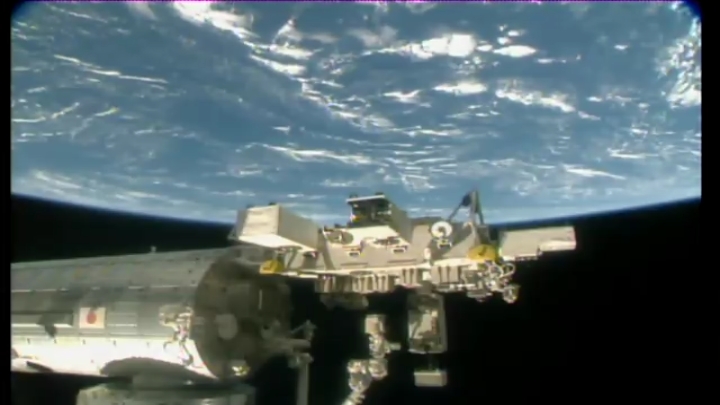
Image above: Flying over South Atlantic Ocean seen by EarthCam on ISS, speed: 27'564 Km/h, altitude: 423,11 Km, image captured by Roland Berga (on Earth in Switzerland) from International Space Station (ISS) using ISS-HD Live application with EarthCam's from ISS on March 5, 2018 at 22:40 UTC.
NASA astronaut Scott Tingle started his day photographing and watering plants being grown for the Veggie-3 botany study. He later charged a pair of U.S. spacesuit batteries before inspecting emergency equipment including portable fire extinguishers and breathing apparatus.
Norishige Kanai, from the Japan Aerospace Exploration Agency, set up hardware to measure the levels and analyze the exhaled air in the station’s environment. Afterward, he positioned an infrared sensor arm to measure Dwarf Wheat leaf temperatures growing inside the Kibo laboratory’s Plant Habitat.
Image above: A waxing gibbous moon was pictured above the Earth’s limb as the International Space Station orbited over the southern Indian Ocean just southwest of the African continent. Image Credit: NASA.
Commander Anton Shkaplerov spent Tuesday morning working on Russian environmental and life support systems. The veteran cosmonaut also activated video gear and checked the tension of an exercise treadmill shock absorber.
In the midst of all the orbital maintenance work, Shkaplerov still had time for a pair of science experiments. The commander explored the internal and external radiation the space station encounters along its flight path. He also researched how international crews interact with each other during different phases of a long term space mission.
Back in Kazakhstan, three new Expedition 55-56 crew members are counting down to their March 21 liftoff and two-day trip to the space station. Cosmonaut Oleg Artemyev and NASA astronauts Ricky Arnold and Drew Feustel raised the flags of their respective countries today at their Cosmonaut Hotel crew quarters in Baikonur near their launch site. The trio is in final preparations training for their launch aboard the Soyuz MS-08 spacecraft.
Related links:
Plant Habitat: https://www.nasa.gov/mission_pages/station/research/experiments/explorer/Facility.html?#id=2036
Internal and external radiation: https://www.nasa.gov/mission_pages/station/research/experiments/explorer/Investigation.html?#id=633
Expedition 55: https://www.nasa.gov/mission_pages/station/expeditions/expedition55/index.html
Space Station Research and Technology: https://www.nasa.gov/mission_pages/station/research/index.html
International Space Station (ISS): https://www.nasa.gov/mission_pages/station/main/index.html
Image (mentioned), Text, Credits: NASA/Mark Garcia/Orbiter.ch Aerospace/Roland Berga.
Best regards, Orbiter.ch
Hubble Finds Huge System of Dusty Material Enveloping the Young Star HR 4796A
NASA - Hubble Space Telescope patch.
March 6, 2018
Astronomers have used NASA's Hubble Space Telescope to uncover a vast, complex dust structure, about 150 billion miles across, enveloping the young star HR 4796A. A bright, narrow, inner ring of dust is already known to encircle the star and may have been corralled by the gravitational pull of an unseen giant planet. This newly discovered huge structure around the system may have implications for what this yet-unseen planetary system looks like around the 8-million-year-old star, which is in its formative years of planet construction.
The debris field of very fine dust was likely created from collisions among developing infant planets near the star, evidenced by a bright ring of dusty debris seen 7 billion miles from the star. The pressure of starlight from the star, which is 23 times more luminous than the Sun, then expelled the dust far into space.
But the dynamics don't stop there. The puffy outer dust structure is like a donut-shaped inner tube that got hit by a truck. It is much more extended in one direction than in the other and so looks squashed on one side even after accounting for its inclined projection on the sky. This may be due to the motion of the host star plowing through the interstellar medium, like the bow wave from a boat crossing a lake. Or it may be influenced by a tidal tug from the star's red dwarf binary companion (HR 4796B), located at least 54 billion miles from the primary star.
Image above: Hubble uncovers a vast, complex dust structure, about 150 billion miles across, enveloping the young star HR 4796A. A bright, narrow inner ring of dust is already known to encircle the star, based on much earlier Hubble images. This newly discovered huge dust structure around the system may have implications for what a yet-unseen planetary system looks like around the 8-million-year-old star. Image Credits: NASA/ESA/G. Schneider (Univ. of Arizona).
"The dust distribution is a telltale sign of how dynamically interactive the inner system containing the ring is," said Glenn Schneider of the University of Arizona, Tucson, who used Hubble's Space Telescope Imaging Spectrograph (STIS) to probe and map the small dust particles in the outer reaches of the HR 4796A system, a survey that only Hubble's sensitivity can accomplish.
"We cannot treat exoplanetary debris systems as simply being in isolation. Environmental effects, such as interactions with the interstellar medium and forces due to stellar companions, may have long-term implications for the evolution of such systems. The gross asymmetries of the outer dust field are telling us there are a lot of forces in play (beyond just host-star radiation pressure) that are moving the material around. We've seen effects like this in a few other systems, but here's a case where we see a bunch of things going on at once," Schneider further explained.
Though long hypothesized, the first evidence for a debris disk around any star was uncovered in 1983 with NASA's Infrared Astronomical Satellite. Later photographs revealed an edge-on debris disk around the southern star Beta Pictoris. In the late 1990s, Hubble's second-generation instruments, which had the capability of blocking out the glare of a central star, allowed many more disks to be photographed. Now, such debris rings are thought to be common around stars. About 40 such systems have been imaged to date, largely by Hubble.
Hubble Space Telescope (HST). Animation Credits: NASA/ESA
Schneider's paper appears in the February 2018 Astronomical Journal:
http://iopscience.iop.org/article/10.3847/1538-3881/aaa3f3
The Hubble Space Telescope is a project of international cooperation between NASA and ESA (European Space Agency). NASA's Goddard Space Flight Center in Greenbelt, Maryland, manages the telescope. The Space Telescope Science Institute (STScI) in Baltimore conducts Hubble science operations. STScI is operated for NASA by the Association of Universities for Research in Astronomy, Inc., in Washington, D.C.
Read more:
NASA's Hubble Portal: http://www.nasa.gov/hubble
The science paper by G. Schneider et al: http://iopscience.iop.org/article/10.3847/1538-3881/aaa3f3/pdf
HubbleSite link: http://hubblesite.org/news_release/news/2018-11
Image (mentioned), Animation (mentioned), Text, Credits: NASA/ Karl Hille/University of Arizona/Glenn Schneider/Space Telescope Science Institute/Ray Villard.
Best regards, Orbiter.ch
The Case of the Martian Boulder Piles
NASA - Mars Reconnaissance Orbiter (MRO) patch.
March 6, 2018
This image was originally meant to track the movement of sand dunes near the North Pole of Mars, but what's on the ground in between the dunes is just as interesting!
The ground has parallel dark and light stripes from upper left to lower right in this area. In the dark stripes, we see piles of boulders at regular intervals.
What organized these boulders into neatly-spaced piles? In the Arctic back on Earth, rocks can be organized by a process called "frost heave." With frost heave, repeatedly freezing and thawing of the ground can bring rocks to the surface and organize them into piles, stripes, or even circles. On Earth, one of these temperature cycles takes a year, but on Mars it might be connected to changes in the planet's orbit around the Sun that take much longer.
The map is projected here at a scale of 25 centimeters (9.8 inches) per pixel. [The original image scale is 32 centimeters (12.6 inches) per pixel (with 1 x 1 binning); objects on the order of 96 centimeters (37.8 inches) across are resolved.] North is up.
This is a stereo pair with https://www.uahirise.org/ESP_053937_2550
The University of Arizona, Tucson, operates HiRISE, which was built by Ball Aerospace & Technologies Corp., Boulder, Colorado. NASA's Jet Propulsion Laboratory, a division of Caltech in Pasadena, California, manages the Mars Reconnaissance Orbiter Project for NASA's Science Mission Directorate, Washington.
Mars Reconnaissance Orbiter (MRO): http://www.nasa.gov/mission_pages/MRO/main/index.html
Image, Text, Credits: NASA/Tony Greicius/JPL-Caltech/Univ. of Arizona.
Greetings, Orbiter.ch
SpaceX - Hispasat 30W-6 Mission Success
SpaceX - Falcon 9 / Hispasat 30W-6 Mission patch.
March 6, 2018
Falcon 9 carrying Hispasat 30W-6 launch
Falcon 9 successfully delivered the Hispasat 30W-6 satellite to a Geostationary Transfer Orbit (GTO) on Tuesday, March 6 after launching from Space Launch Complex 40 (SLC-40) at Cape Canaveral Air Force Station, Florida.
HISPASAT 30W-6 Mission
The Hispasat 30W-6 satellite was deployed approximately 33 minutes after launch. SpaceX did not attempt to land Falcon 9’s first stage after launch due to unfavorable weather conditions in the recovery area off the Atlantic Coast.
Hispasat 30W-6 satellite
Hispasat 30W-6 communications satellite, formerly known as Hispasat 1F, for Madrid-based Hispasat. Hispasat 30W-6 will provide television, broadband, corporate networks and other communications services over Europe, North Africa and the Americas. The Hispasat 30W-6 satellite was built by Space Systems/Loral.
For more information about SpaceX, visit: http://www.spacex.com/
Images, Video, Text, Credits: SpaceX/Günter Space Page/Orbiter.ch Aerospace/Roland Berga.
Greetings, Orbiter.ch
lundi 5 mars 2018
Hubble's Frenzy of Stars
NASA - Hubble Space Telescope patch.
March 5, 2018
Discovered in 1900 by astronomer DeLisle Stewart and here imaged by the NASA/ESA Hubble Space Telescope, IC 4710 is an undeniably spectacular sight. The galaxy is a busy cloud of bright stars, with bright pockets - marking bursts of new star formation - scattered around its edges.
IC 4710 is a dwarf irregular galaxy. As the name suggests, such galaxies are irregular and chaotic in appearance, lacking central bulges and spiral arms - they are distinctly different from spirals or ellipticals. It is thought that irregular galaxies may once have been spirals or ellipticals, but became distorted over time through external gravitational forces during interactions or mergers with other galaxies. Dwarf irregulars in particular are important to our overall understanding of galactic evolution, as they are thought to be similar to the first galaxies that formed in the universe.
IC 4710 lies roughly 25 million light-years away in the southern constellation of Pavo (the Peacock). This constellation also contains the third-brightest globular cluster in the sky, NGC 6752, the spiral galaxy NGC 6744, and six known planetary systems (including HD 181433, which is host to a super-Earth).
The data used to create this image were gathered by Hubble's Advanced Camera for Surveys (ACS).
Hubble Space Telescope (HST)
For more information about Hubble, visit:
http://hubblesite.org/
http://www.nasa.gov/hubble
http://www.spacetelescope.org/
Image, Animation Credits: ESA/Hubble & NASA, Acknowledgements: Judy Schmidt/Text: European Space Agency/NASA/Karl Hille.
Best regards, Orbiter.ch
New Crew Arrives at Launch Site Before March 21 Liftoff
ISS - Expedition 55 Mission patch.
March 5, 2018
Image above: Expedition 55 crew members (from left) Ricky Arnold, Oleg Artemyev and Drew Feustel pose for pictures with their Russian Sokol launch and entry suits as part of the crew’s first vehicle fit check activities. Image Credit: NASA.
The next three International Space Station crew members arrived at their launch site Sunday at the Baikonur Cosmodrome in Kazakhstan. Cosmonaut Oleg Artemyev and NASA astronauts Ricky Arnold and Drew Feustel are in final launch preparations ahead of their March 21 launch to their new home in space. They suited up in their Russian Sokol launch and entry suits today and climbed into their Soyuz MS-08 spacecraft for their first vehicle fit check activities.
Waiting for them onboard the orbital laboratory are Expedition 55 Commander Anton Shkaplerov and Flight Engineers Scott Tingle and Norishige Kanai. Their new crewmates will dock on March 23 to the Poisk module inside the Soyuz MS-08 spacecraft.
Image above: Flying over South Atlantic Ocean seen by EarthCam on ISS, speed: 27'579 Km/h, altitude: 417,19 Km, image captured by Roland Berga (on Earth in Switzerland) from International Space Station (ISS) using ISS-HD Live application with EarthCam's from ISS on March 2, 2018 at 16:50 UTC.
Meanwhile, the current orbital residents are ensuring the station remains in tip-top shape and conducting ongoing microgravity science.
Shkaplerov worked on Russian life support equipment throughout the day and handed over radiation detection equipment to the U.S. astronauts. Tingle inspected the Destiny laboratory module’s large window and cleaned vents in the Tranquility module.
Kanai worked on a variety of scientific gear all day Monday. He disassembled and replaced the METEOR camera before some maintenance work on a physics furnace and science freezer. The rest of the afternoon Kanai worked on the Combustion Integrated Rack connecting cables and checking for leaks.
Related links:
Radiation detection equipment: https://www.nasa.gov/mission_pages/station/research/experiments/explorer/Investigation.html?#id=190
METEOR: https://www.nasa.gov/mission_pages/station/research/experiments/explorer/Investigation.html?#id=1174
Physics furnace: https://www.nasa.gov/mission_pages/station/research/experiments/explorer/Facility.html?#id=1536
Science freezer: https://www.nasa.gov/mission_pages/station/research/experiments/explorer/Facility.html?#id=56
Combustion Integrated Rack: https://www.nasa.gov/mission_pages/station/research/experiments/explorer/Facility.html?#id=317
Expedition 55: https://www.nasa.gov/mission_pages/station/expeditions/expedition55/index.html
Space Station Research and Technology: https://www.nasa.gov/mission_pages/station/research/index.html
International Space Station (ISS): https://www.nasa.gov/mission_pages/station/main/index.html
Images (mentioned), Text, Credits: NASA/Mark Garcia/Orbiter.ch Aerospace/Roland Berga.
Greetings, Orbiter.ch
Donor Star Breathes Life Into Zombie Compagnion
ESA - Integral Mission patch.
5 March 2018
ESA’s Integral space observatory has witnessed a rare event: the moment that winds emitted by a swollen red giant star revived its slow-spinning companion, the core of a dead star, bringing it back to life in a flash of X-rays.
The X-ray flare was first detected by Integral on 13 August 2017 from an unknown source in the direction of the crowded centre of our Milky Way. The sudden detection triggered a slew of follow-up observations in the following weeks to pin down the culprit.
Red giant and neutron star interaction
The observations revealed a strongly magnetised and slowly rotating neutron star that had likely just begun to feed on material from a neighbouring red giant star.
Stars the mass of our Sun, and up to eight times more massive, evolve into red giants towards the end of their lives. Their outer layers puff up and expand millions of kilometres, their dusty, gassy shells blown away from the central star in relatively slow winds up to few hundreds of km/s.
Even larger stars, up to 25–30 times more massive than the Sun, race through their fuel and explode in a supernova, sometimes leaving behind a spinning stellar corpse with a strong magnetic field, known as a neutron star. This tiny core packs the mass of nearly one and half Suns into a sphere only 10 km across, making them some of the densest celestial objects known.
It is not uncommon to find stars paired together, but the new system of a neutron star and red giant is a particularly rare breed known as a ‘symbiotic X-ray binary’, with no more than 10 known.
“Integral caught a unique moment in the birth of a rare binary system,” says Enrico Bozzo from University of Geneva and lead author of the paper that describes the discovery. “The red giant released a sufficiently dense slow wind to feed its neutron star companion, giving rise to high-energy emission from the dead stellar core for the first time.”
Stellar evolution
The pairing is certainly peculiar. ESA’s XMM-Newton and NASA’s NuSTAR space telescopes showed that the neutron star spins almost every two hours – very slow compared with other neutron stars, which can spin up to many times per second. Then, the first measurement of the magnetic field of such a neutron star revealed it to be surprisingly strong.
A strong magnetic field typically points to a young neutron star – the magnetic field is thought to fade over time – while a red giant is much older, making it a bizarre couple to have grown up together.
“These objects are puzzling,” says Enrico. “It might be that either the neutron star magnetic field does not decay substantially with time after all, or the neutron star actually formed later in the history of the binary system. That would mean it collapsed from a white dwarf into a neutron star as a result of feeding off the red giant over a long time, rather than becoming a neutron star as a result of a more traditional supernova explosion of a short-lived massive star.”
With a young neutron star and an old red giant, at some point the winds travelling from the puffed-up giant will begin to rain on to the smaller star, slowing its spin and emitting X-rays.
Integral spacecraft
Notes for Editors:
“IGR J17329-2731: the birth of a symbiotic X-ray binary,” by E. Bozzo et al is accepted for publication in Astronomy & Astrophysics: https://doi.org/10.1051/0004-6361/201832588
The rapid response of the follow-up observations was enabled by the SmartNet community. This included important contributions from ESA’s XMM-Newton and NASA’s NuSTARand Swift space telescopes, and the ground-based Southern Astrophysical Research Telescope, Faulkes Telescopes North and South and the Las Cumbres Observatory.
Related links:
SmartNet: http://www.isdc.unige.ch/smartnet/
ESA’s Integral space observatory: http://sci.esa.int/integral/
Images, Animation, Text, Credits: ESA/Markus Bauer/Erik Kuulkers/University of Geneva/Enrico Bozzo.
Best regards, Orbiter.ch
Inscription à :
Articles (Atom)


