jeudi 18 avril 2019

Hubble Celebrates its 29th Birthday with Unrivaled View of the Southern Crab Nebula


ESA - Hubble Space Telescope logo.

18 April 2019

The Crab of the Southern Sky

This incredible image of the hourglass-shaped Southern Crab Nebula was taken to mark the NASA/ESA Hubble Space Telescope’s 29th anniversary in space. The nebula, created by a binary star system, is one of the many objects that Hubble has demystified throughout its productive life. This new image adds to our understanding of the nebula and demonstrates the telescope’s continued capabilities.

On 24 April 1990, the NASA/ESA Hubble Space Telescope was launched on the space shuttle Discovery. It has since revolutionised how astronomers and the general public see the Universe. The images it provides are spectacular from both a scientific and a purely aesthetic point of view.

Southern Crab Nebula

Each year the telescope dedicates a small portion of its precious observing time to take a special anniversary image, focused on capturing particularly beautiful and meaningful objects. This year’s image is the Southern Crab Nebula, and it is no exception [1].

This peculiar nebula, which exhibits nested hourglass-shaped structures, has been created by the interaction between a pair of stars at its centre. The unequal pair consists of a red giant and a white dwarf. The red giant is shedding its outer layers in the last phase of its life before it too lives out its final years as a white dwarf. Some of the red giant’s ejected material is attracted by the gravity of its companion.

Formation of the Southern Crab Nebula (artist's impression)

When enough of this cast-off material is pulled onto the white dwarf, it too ejects the material outwards in an eruption, creating the structures we see in the nebula. Eventually, the red giant will finish throwing off its outer layers, and stop feeding its white dwarf companion. Prior to this, there may also be more eruptions, creating even more intricate structures.

Astronomers did not always know this, however. The object was first written about in 1967, but was assumed to be an ordinary star until 1989, when it was observed using telescopes at the European Southern Observatory’s La Silla Observatory. The resulting image showed a roughly crab-shaped extended nebula, formed by symmetrical bubbles of gas and dust.

Zooming in on the Southern Crab Nebula

These observations only showed the outer hourglass emanating from a bright central region that could not be resolved. It was not until Hubble observed the Southern Crab in 1999 that the entire structure came into view. This image revealed the inner nested structures, suggesting that the phenomenon that created the outer bubbles had occurred twice in the (astronomically) recent past.

It is fitting that Hubble has returned to this object twenty years after its first observation. This new image adds to the story of an active and evolving object and contributes to the story of Hubble’s role in our evolving understanding of the Universe.

Formation of the Southern Crab Nebula

Notes:

[1] The Southern Crab Nebula is so named to distinguish it from the better-known Crab Nebula, a supernova remnant visible in the constellation of Taurus.

More information:

The Hubble Space Telescope is a project of international cooperation between ESA and NASA.

Links:

Hubblecast 119: Hubble’s 29th anniversary: https://www.spacetelescope.org/videos/heic1907a/

Images of Hubble: http://www.spacetelescope.org/images/archive/category/spacecraft/

Hubblesite release: http://hubblesite.org/news_release/news/2019-15

The Southern Crab Nebula observed by the European Southern Observatory: https://www.eso.org/public/news/eso8901/

Past anniversary images: https://www.spacetelescope.org/images/archive/category/anniversary/

NASA/ESA Hubble Space Telescope: https://spacetelescope.org/

European Southern Observatory (ESO): https://www.eso.org/

La Silla Observatory: https://www.eso.org/public/teles-instr/lasilla/

Images, Text, Credits: NASA/ESA/Bethany Downer/STScI/Romano Corradi, Instituto de Astrofisica de Canarias, Tenerife, Spain; Mario Livio, Space Telescope Science Institute, Baltimore, Md.; Ulisse Munari, Osservatorio Astronomico di Padova-Asiago, Italy; HugoSchwarz, Nordic Optical Telescope, Canarias, Spain/Hubble, M. Kornmesser/Videos: Hubble, DSS, Nick Risinger (skysurvey.org)/NASA, ESA, STScI, ESO/M. Kornmesser.

Best regards, Orbiter.ch

Planck reveals link between active galaxies and their dark matter environment


ESA - Planck Mission patch.

18 April 2019

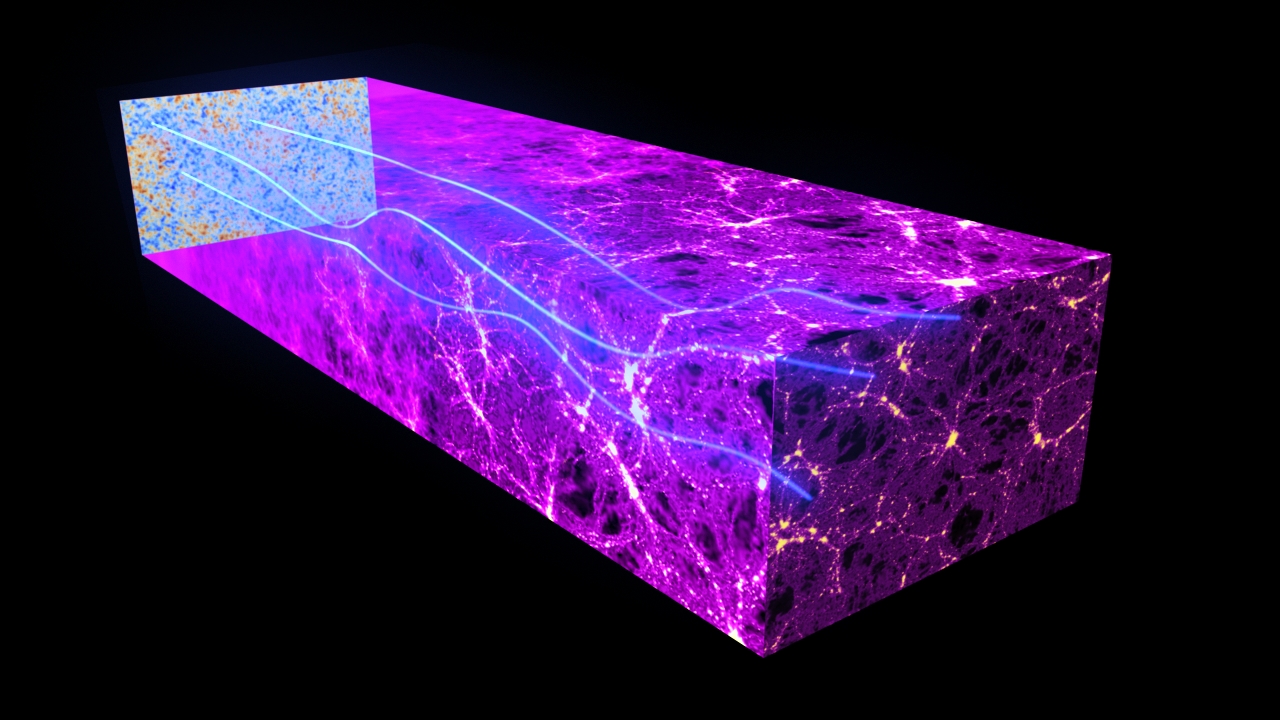
Scientists have used the tiny distortions imprinted on the cosmic microwave background by the gravity of matter throughout the Universe, recorded by ESA's Planck satellite, to uncover the connection between the luminosity of quasars – the bright cores of active galaxies – and the mass of the much larger 'halos' of dark matter in which they sit. The result is an important confirmation for our understanding of how galaxies evolve across cosmic history.


Image above: Gravitational deflection by quasar-hosting dark matter halos. Image Credits: David Tree, Professor Peter Richardson, Games and Visual Effects Research Lab, University of Hertfordshire.

Most galaxies in the Universe are known to host supermassive black holes, with masses of millions to billions of times the Sun's mass, at their cores. The majority of these cosmic monsters are 'dormant', with little or no activity going on near them, but about one percent are classified as 'active', accreting matter from their surroundings at very intense rates. This accretion process causes material in the black hole's vicinity to shine brightly across the electromagnetic spectrum, making these active galaxies, or quasars, some of the brightest sources in the cosmos.

While it is still unclear what activates these black holes, switching on and off their phase of intense accretion, it is likely that quasars play an important role in regulating the evolution of galaxies across cosmic history. For this reason, it is crucial to understand the relationship between quasars, their host galaxies, and their environment on even larger scales.

In a recent study led by James Geach of the University of Hertfordshire, UK, scientists have combined data from ESA's Planck mission with the largest survey of quasars available to date to shed light on this fascinating topic.

Planck. Image Credit: ESA

According to the leading scenario of structure formation in the Universe, galaxies take shape out of ordinary matter in the densest knots of the cosmic web – a filamentary network, made up primarily of the invisible dark matter, that pervades the cosmos. In turn, the complex distribution of both ordinary and dark matter originates from tiny fluctuations in the primordial Universe, which leave an imprint in the Cosmic Microwave Background (CMB), the most ancient light in the history of the Universe.

The Planck satellite has been scanning the sky between 2009 and 2013 to create the most precise all-sky map of the CMB, enabling scientists to refine our knowledge of the age, expansion, history, and contents of the Universe to unprecedented levels of accuracy.

And there is more: as predicted by Albert Einstein's general theory of relativity, massive objects bend the fabric of spacetime around them, distorting the path of everything – even light – that passes nearby. This phenomenon, known as gravitational lensing, affects also Planck's measurements of the CMB, which carry an imprint of the large-scale distribution of matter that the most ancient cosmic light encountered along its way to the satellite.


Image above: Gravitational lensing of the Cosmic Microwave Background. (See also the animated version of this image.) Image Credits: ESA and the Planck Collaboration.

"We know that galaxies form and evolve within an invisible 'scaffolding' of dark matter that we cannot directly observe, but we can exploit the gravitational lensing distortions imprinted on the cosmic microwave background to learn about the dark matter structures around galaxies," says James Geach.

Gravitational lensing distortions of the CMB are small, rearranging the CMB sky picture on scales of about 10 minutes of arc – equivalent to just one third the diameter of the full Moon. But many tiny deflections from across the sky can be combined, with the help of statistical methods, to obtain a stronger signal, piling up the data gathered around many quasars.

In their research, Geach and colleagues analysed the latest gravitational lensing map obtained by the Planck team, made public as part of the Planck Legacy Release in 2018, in combination with 200 000 quasars drawn from the largest sample ever compiled, the more than half-a-million quasars that comprise Data Release 14 of the Sloan Digital Sky Survey quasar catalogue.

"By combining the Planck data with such a large sample of quasars, we could measure the mass of the dark matter halos in which the quasar host galaxies are embedded, and investigate how this varies for quasars of different luminosity," says Geach.

The analysis hints that that the more luminous a quasar is, the more massive its halo of dark matter.

"This is compelling evidence that a correlation exists between the luminosity of a quasar, energy that is released in the immediate vicinity of a supermassive black hole – a region spanning perhaps a few light days – and the mass of the encompassing halo of dark matter and surrounding environment, which extends for tens of millions of light years around the quasar," Geach explains.


Image above: Gravitational deflection by quasar-hosting dark matter halos. Image Credits: David Tree, Professor Peter Richardson, Games and Visual Effects Research Lab, University of Hertfordshire.

"We're using the cosmic microwave background as a kind of 'backlight' to the Universe. That backlight has been gravitationally lensed by foreground matter, and so by correlating galaxies with the Planck lensing map, we have a new way to study galaxies and their evolution."

The finding supports theoretical models of quasar formation, which predict a correlation between quasar luminosity and halo mass, in particular for the most luminous quasars, where the black holes are accreting matter at close to the maximum rate.

The study focused on distant quasars that are observed as they were when the Universe was about four billion years old – about one third of its current age of nearly 14 billion years. This is close to the peak era of supermassive black hole growth. In combination with deeper quasar surveys in the future, the Planck data could enable scientists to push these investigations to even earlier times in cosmic history, up to the epoch when the first quasars formed.

"This result shows the power of Planck's gravitational lensing measurements, which make it possible for us to measure the invisible structures of dark matter in which galaxies form and evolve," says Jan Tauber, Planck project scientist at ESA.

"The legacy of Planck is quite astonishing, with data that are being used for a much wider range of scientific applications than originally conceived for."

Notes for editors

"The halo mass of optically-luminous quasars at z~1–2 measured via gravitational deflection of the cosmic microwave background" by J. E. Geach et al. is published in The Astrophysical Journal, Volume 874, Number 1: https://doi.org/10.3847/1538-4357/ab0894

Launched in 2009, Planck was designed to map the sky in nine frequencies using two state-of-the-art instruments: the Low Frequency Instrument (LFI), which includes three frequency bands in the range 30-70 GHz, and the High Frequency Instrument (HFI), which includes six frequency bands in the range 100-857 GHz. Seven of Planck's nine frequency channels were equipped with polarisation-sensitive detectors. HFI completed its survey in January 2012, while LFI continued to make science observations until October 2013.

ESA Planck: http://sci.esa.int/planck/

Images (mentioned), Text, Credit: ESA/Jan Tauber/Centre for Astrophysics Research/University of Hertfordshire/James E. Geach.

Greetings, Orbiter.ch

Northrop Grumman Heads to Space Station with New NASA Science, Cargo


Northrop Grumman - Cygnus NG-11 Mission patch.

April 18, 2019

Northrop Grumman's Cygnus spacecraft is on its way to the International Space Station with about 7,600 pounds of science investigations and cargo after launching at 4:46 p.m. EDT Wednesday from NASA’s Wallops Flight Facility in Virginia.


Image above: The Northrop Grumman Antares rocket, with Cygnus resupply spacecraft onboard, launches from Pad-0A, Wednesday, April 17, 2019 at NASA's Wallops Flight Facility in Virginia. Northrop Grumman's 11th contracted cargo resupply mission for NASA to the International Space Station will deliver about 7,600 pounds of science and research, crew supplies and vehicle hardware to the orbital laboratory and its crew. Image Credits: NASA/Bill Ingalls.

The spacecraft launched on an Antares 230 Rocket from the Virginia Mid-Atlantic Regional Spaceport’s Pad 0A at Wallops and is scheduled to arrive at the orbiting laboratory around 5:30 a.m. Friday, April 19. Coverage of the spacecraft’s approach and arrival will begin at 4 a.m. on NASA Television and the agency’s website.

Expedition 59 astronauts Anne McClain of NASA and David Saint-Jacques of the Canadian Space Agency (CSA) will use the space station’s robotic arm to capture Cygnus, while NASA’s Nick Hague monitors telemetry. The spacecraft will stay at the space station until July.

This delivery, Northrop Grumman’s 11th cargo flight to the space station under NASA’s Commercial Resupply Services contract, will support dozens of new and existing investigations. Here are details about some of the scientific investigations Cygnus is delivering to the space station:

Models for growing increasingly complex materials

Advanced Colloids Experiment-Temperature-10 (ACE-T-10) will test gels in a microgravity environment. This research could aid in the development of increasingly complex materials that may serve as the building blocks for a range of applications on Earth including foods, drugs, and electronic devices. The process also may provide an efficient method to build new materials and equipment in space.

Better life science research in a few drops

Although the space station is well equipped for health and life sciences research, the equipment available for cellular and molecular biology still is limited compared to capabilities found in laboratories on Earth. To address this limitation, CSA designed Bio-Analyzer, a new tool the size of a video game console that astronauts on station easily can use to test body fluids such as blood, saliva, and urine, with just a few drops. It returns key analyses, such as blood cell counts, in just two to three hours, eliminating the need to freeze and store samples.

Analyzing aging of the arteries in astronauts

The Vascular Aging investigation uses ultrasounds, blood samples, oral glucose tolerance tests, and wearable sensors to study aging-like changes that occur in many astronauts during their stay on the space station. It’s one of three Canadian experiments exploring the effects of weightlessness on the blood vessels and heart, and the links between these effects and bone health, blood biomarkers, insulin resistance, and radiation exposure. Increased understanding of these mechanisms can be used to address vascular aging in both astronauts and the aging Earth population.

Testing immune response in space

Spaceflight is known to have a dramatic influence on an astronaut’s immune response, but there is little research on its effect following an actual challenge to the body’s immune system. The rodent immune system closely parallels that of humans, and Rodent Research-12: Tetanus Antibody Response by B cells in Space (TARBIS) will examine the effects of spaceflight on the function of antibody production and immune memory. This investigation aims to advance the development of measures to counter these effects and help maintain crew health during future long-duration space missions. On Earth, it could advance research to improve the effectiveness of vaccines and therapies for treating diseases and cancers.

Big buzz for new robot

A fleet of small robots is set to take on big jobs aboard the space station. Building on the success of SPHERES, NASA will test Astrobee, a robotic system comprised of three cube-shaped robots and a docking station for recharging; the first two are aboard Cygnus. The free-flying robots use electric fans for propulsion and cameras and sensors help them navigate their surroundings. The robots also have an arm to grasp station handrails or grab and hold items. Astrobee can operate in automated mode or under remote control from the ground as it assists with routine chores on station, and requires no supervision from the crew. This has the potential to free up astronauts to conduct more research.


Image above: File photo of a Cygnus cargo spacecraft with UltraFlex solar arrays deployed. This Cygnus was photographed as it departed the International Space Station Dec. 5, 2017, during Expedition 53. Image Credit: NASA.

These are just a few of the hundreds of investigations that will help us learn how to keep astronauts healthy during long-duration space travel and demonstrate technologies for future human and robotic exploration beyond low-Earth orbit to the Moon and Mars.  Space station research also provides opportunities for other U.S. government agencies, private industry, and academic and research institutions, to conduct microgravity research that leads to new technologies, medical treatments, and products that improve life on Earth.

For more than 18 years, humans have lived and worked continuously aboard the International Space Station, advancing scientific knowledge and demonstrating new technologies, making research breakthroughs not possible on Earth that will enable long-duration human and robotic exploration into deep space. A global endeavor, more than 230 people from 18 countries have visited the unique microgravity laboratory that has hosted more than 2,500 research investigations from researchers in 106 countries.

Related articles:

Liftoff!
https://orbiterchspacenews.blogspot.com/2019/04/liftoff.html

Northrop Grumman Carries Technology, Scientific Investigations on Mission to Space Station
https://orbiterchspacenews.blogspot.com/2019/04/northrop-grumman-carries-technology.html

Related links:

Advanced Colloids Experiment-Temperature-10 (ACE-T-10): https://www.nasa.gov/mission_pages/station/research/experiments/explorer/Investigation.html?#id=7881

Bio-Analyzer: https://www.nasa.gov/mission_pages/station/research/experiments/explorer/Facility.html?#id=7393

Vascular Aging: https://www.nasa.gov/mission_pages/station/research/experiments/explorer/Investigation.html?#id=7644

Rodent Research-12: https://www.nasa.gov/mission_pages/station/research/experiments/explorer/Investigation.html?#id=7868

SPHERES: https://www.nasa.gov/mission_pages/station/research/experiments/explorer/Investigation.html?#id=303

Astrobee: https://www.nasa.gov/mission_pages/station/research/experiments/explorer/Facility.html?#id=1891

Moon and Mars: https://www.nasa.gov/topics/moon-to-mars

NASA Television: https://www.nasa.gov/live

Cygnus: http://www.nasa.gov/mission_pages/station/structure/launch/orbital.html

Commercial Resupply: http://www.nasa.gov/mission_pages/station/structure/launch/index.html

Northrop Grumman: https://www.nasa.gov/northropgrumman

International Space Station (ISS): https://www.nasa.gov/mission_pages/station/main/index.html

Images (mentioned), Text, Credits: NASA/Karen Northon/Gina Anderson/Stephanie Schierholz/JSC/Courtney Beasley.

Greetings, Orbiter.ch

mercredi 17 avril 2019

Liftoff!


Northrop Grumman - Cygnus NG-11 Mission patch.

 April 17, 2019

NASA’s commercial partner Northrop Grumman launched its Antares rocket carrying its Cygnus cargo spacecraft to the International Space Station at about 4:46 p.m. EDT today, April 17.


Image above: The Northrop Grumman Antares rocket, with Cygnus resupply spacecraft onboard, launches from Pad-0A, Wednesday, April 17, 2019, at NASA’s Wallops Flight Facility in Virginia. Northrop Grumman’s 11th contracted cargo resupply mission for NASA to the International Space Station will deliver about 7,600 pounds of science and research, crew supplies and vehicle hardware to the orbital laboratory and its crew. Photo Credits: NASA/Bill Ingalls.

NG-11: Antares 230 launches S.S. Roger Chaffee Cygnus

Loaded with 7,600 pounds of research, crew supplies and hardware, this is Northrop Grumman’s 11th commercial resupply NASA-contracted mission. Launched from Virginia Space’s Mid-Atlantic Regional Spaceport at NASA’s Wallops Flight Facility.


Image above: Mission engineers load the final cargo into the Cygnus resupply spacecraft on board the Northrop Grumman Antares rocket, Tuesday, April 16, 2019, at launch Pad-0A. Photo Credits: NASA/Bill Ingalls.

Commercial Resupply Services (CRS) NG-11 mission, Cygnus delivers about 3450 kilograms (7600 pounds) of cargo to the International Space Station and is scheduled to arrive on 19 April 2019, at 09:30 UTC (05:30 EDT). The NG-11 Cygnus Cargo Delivery Spacecraft is named in honor of the American astronaut Roger Chaffe, the pilot of the Apollo 1 spacecraft, the first manned mission of the Apollo program.

Related article:

Northrop Grumman Carries Technology, Scientific Investigations on Mission to Space Station
https://orbiterchspacenews.blogspot.com/2019/04/northrop-grumman-carries-technology.html

Related links:

Northrop Grumman: https://www.nasa.gov/mission_pages/station/structure/launch/northrop-grumman.html

NASA Television: https://www.nasa.gov/live

International Space Station (ISS): https://www.nasa.gov/mission_pages/station/main/index.html

Images (mentioned), Video, Text, Credits: NASA/Rob Garner/NASA TV/SciNews.

Best regards, Orbiter.ch

The Universe’s First Type of Molecule Is Found at Last


NASA & DLR - SOFIA Mission patch.

April 17, 2019

The first type of molecule that ever formed in the universe has been detected in space for the first time, after decades of searching. Scientists discovered its signature in our own galaxy using the world’s largest airborne observatory, NASA’s Stratospheric Observatory for Infrared Astronomy, or SOFIA, as the aircraft flew high above the Earth’s surface and pointed its sensitive instruments out into the cosmos.

SOFIA aircraft is a Boeing 747SP, telescope door opening. Animation Credit: NASA

When the universe was still very young, only a few kinds of atoms existed. Scientists believe that around 100,000 years after the big bang, helium and hydrogen combined to make a molecule called helium hydride for the first time. Helium hydride should be present in some parts of the modern universe, but it has never been detected in space — until now.

SOFIA found modern helium hydride in a planetary nebula, a remnant of what was once a Sun-like star. Located 3,000 light-years away near the constellation Cygnus, this planetary nebula, called NGC 7027, has conditions that allow this mystery molecule to form. The discovery serves as proof that helium hydride can, in fact, exist in space. This confirms a key part of our basic understanding of the chemistry of the early universe and how it evolved over billions of years into the complex chemistry of today. The results are published in this week’s issue of Nature.

“This molecule was lurking out there, but we needed the right instruments making observations in the right position — and SOFIA was able to do that perfectly,” said Harold Yorke, director of the SOFIA Science Center, in California’s Silicon Valley.

Today, the universe is filled with large, complex structures such as planets, stars and galaxies. But more than 13 billion years ago, following the big bang, the early universe was hot, and all that existed were a few types of atoms, mostly helium and hydrogen. As atoms combined to form the first molecules, the universe was finally able to cool and began to take shape. Scientists have inferred that helium hydride was this first, primordial molecule.


Image above: Illustration of planetary nebula NGC 7027 and helium hydride molecules. In this planetary nebula, SOFIA detected helium hydride, a combination of helium (red) and hydrogen (blue), which was the first type of molecule to ever form in the early universe. This is the first time helium hydride has been found in the modern universe. Image Credits: NASA/SOFIA/L. Proudfit/D.Rutter.

Once cooling began, hydrogen atoms could interact with helium hydride, leading to the creation of molecular hydrogen — the molecule primarily responsible for the formation of the first stars. Stars went on to forge all the elements that make up our rich, chemical cosmos of today. The problem, though, is that scientists could not find helium hydride in space. This first step in the birth of chemistry was unproven, until now.

“The lack of evidence of the very existence of helium hydride in interstellar space was a dilemma for astronomy for decades,” said Rolf Guesten of the Max Planck Institute for Radio Astronomy, in Bonn, Germany, and lead author of the paper.

Helium hydride is a finicky molecule. Helium itself is a noble gas making it very unlikely to combine with any other kind of atom. But in 1925, scientists were able to create the molecule in a laboratory by coaxing the helium to share one of its electrons with a hydrogen ion.

Then, in the late 1970s, scientists studying the planetary nebula called NGC 7027 thought that this environment might be just right to form helium hydride. Ultraviolet radiation and heat from the aging star create conditions suitable for helium hydride to form. But their observations were inconclusive. Subsequent efforts hinted it could be there, but the mystery molecule continued to elude detection. The space telescopes used did not have the specific technology to pick out the signal of helium hydride from the medley of other molecules in the nebula.

In 2016, scientists turned to SOFIA for help. Flying up to 45,000 feet, SOFIA makes observations above the interfering layers of Earth’s atmosphere. But it has a benefit space telescopes don't— it returns after every flight.

“We’re able to change instruments and install the latest technology,” said Naseem Rangwala SOFIA deputy project scientist. “This flexibility allows us to improve observations and respond to the most pressing questions that scientists want answered.”

A recent upgrade to one of SOFIA’s instruments called the German Receiver at Terahertz Frequencies, or GREAT, added the specific channel for helium hydride that previous telescopes did not have. The instrument works like a radio receiver. Scientists tune to the frequency of the molecule they’re searching for, similar to tuning an FM radio to the right station. When SOFIA took to the night skies, eager scientists were onboard reading the data from the instrument in real time. Helium hydride’s signal finally came through loud and clear.

“It was so exciting to be there, seeing helium hydride for the first time in the data,” said Guesten. “This brings a long search to a happy ending and eliminates doubts about our understanding of the underlying chemistry of the early universe.

The Universe's First Molecule is Found at Last

Video above: Scientists on the airborne observatory SOFIA detected the first type of molecule that ever formed in the universe. They found the combination of helium and hydrogen, called helium hydride, in a planetary nebula near the constellation Cygnus. This discovery confirms a key part of our basic understanding of the early universe and how it evolved over billions of years into the complex chemistry of today. Video Credits: NASA/Ames Research Center.

SOFIA, the Stratospheric Observatory for Infrared Astronomy, is a Boeing 747SP jetliner modified to carry a 106-inch diameter telescope. It is a joint project of NASA and the German Aerospace Center, DLR. NASA’s Ames Research Center in California’s Silicon Valley manages the SOFIA program, science and mission operations in cooperation with the Universities Space Research Association headquartered in Columbia, Maryland, and the German SOFIA Institute (DSI) at the University of Stuttgart. The aircraft is maintained and operated from NASA’s Armstrong Flight Research Center Building 703, in Palmdale, California.

Related links:

Nebulae: https://www.nasa.gov/subject/6893/nebulae

Universe: https://www.nasa.gov/topics/solarsystem/index.html

SOFIA: http://www.nasa.gov/mission_pages/SOFIA/index.html

Image (mentioned), Animation (mentioned), Text, Credits: NASA/Kassandra Bell/Elizabeth Landau/Ames Research Center/Nicholas Veronico.

Greetings, Orbiter.ch

NASA Announces First Flight, Record-Setting Mission


ISS - International Space Station patch.

April 17, 2019

NASA and its International Space Station partners have set a new schedule and new crew assignments that will include the first flight of NASA astronaut Jessica Meir, an extended stay for NASA astronaut Andrew Morgan, and a record-setting flight for NASA astronaut Christina Koch.

Astronauts Koch and Meir React to International Space Station Mission Updates

Video above: Astronaut Jessica Meir is now set to fly to the International Space Station for the first time in September, and Christina Koch, who is currently in space, has her stay onboard extended to an expected record-setting flight of 328 days. With Koch now scheduled to remain in orbit until February 2020, she will set a record for the longest single spaceflight by a woman, eclipsing the previous mark set by Peggy Whitson of 288 days in 2016-17. Video Credit: NASA.

Koch, who arrived at the space station March 14, and now is scheduled to remain in orbit until February 2020, will set a record for the longest single spaceflight by a woman, eclipsing the record of 288 days set by former NASA astronaut Peggy Whitson in 2016-17. She will be part of three expeditions – 59, 60 and 61 – during her current first spaceflight. Her mission is planned to be just shy of the longest single spaceflight by a NASA astronaut – 340 days, set by former NASA astronaut Scott Kelly during his one-year mission in 2015-16.

The mission schedule currently is as follows:

June 24: Current Expedition 59 crew members Anne McClain of NASA, David Saint-Jacques of the Canadian Space Agency, and Oleg Kononenko of Roscosmos will return to Earth. Koch and fellow NASA astronaut Nick Hague, and Roscosmos cosmonaut Alexey Ovchinin will remain aboard the space station and begin Expedition 60.

July 20: NASA astronaut Andrew Morgan, ESA (European Space Agency) astronaut Luca Parmitano, and Roscosmos cosmonaut Alexander Skvortsov are scheduled to launch to the space station and join Expedition 60, returning the orbiting laboratory’s crew complement to six. Parmitano and Skvortsov will return in February 2020 with Koch, leaving Morgan behind for his extended stay.

Sept. 25: NASA astronaut Jessica Meir is scheduled to launch to the station with Roscosmos cosmonaut Oleg Skripochka and United Arab Emirates’ Hazzaa Ali Almansoori, a Roscosmos spaceflight participant who will return with Hague and Ovchinin Oct. 3. Meir and Skripochka will return in spring 2020 with Morgan.

The extended missions of Koch and Morgan will help scientists gather additional data about the effects of long-duration human spaceflight beyond those of the normal six-month station expedition. Such research is essential to support future deep space exploration missions to the Moon and Mars.


Image above: NASA astronaut Christina Koch conducts botany research aboard the International Space Station, where she’s been living and working since March 14, 2019. Her mission has been extended, and she will remain at the station until February 2020. Image Credit: NASA.

NASA has gathered vast amounts of data on astronaut health and performance over the past 50 years and has focused recently on extended durations up to one year with the dedicated mission of Scott Kelly and extended mission of Peggy Whitson. These opportunities also have demonstrated that there is a significant degree of variability in human response to spaceflight and it’s important to determine the acceptable degree of change for both men and women.

“Astronauts demonstrate amazing resilience and adaptability in response to long duration spaceflight exposure,” said Jennifer Fogarty, chief scientist of the Human Research Program at NASA’s Johnson Space Center in Houston. “This will enable successful exploration missions with healthy, performance-ready astronauts. NASA is looking to build on what we have learned with additional astronauts in space for more than 250 days. Christina’s extended mission will provide additional data for NASA’s Human Research Program and continue to support future missions to the Moon and Mars.”


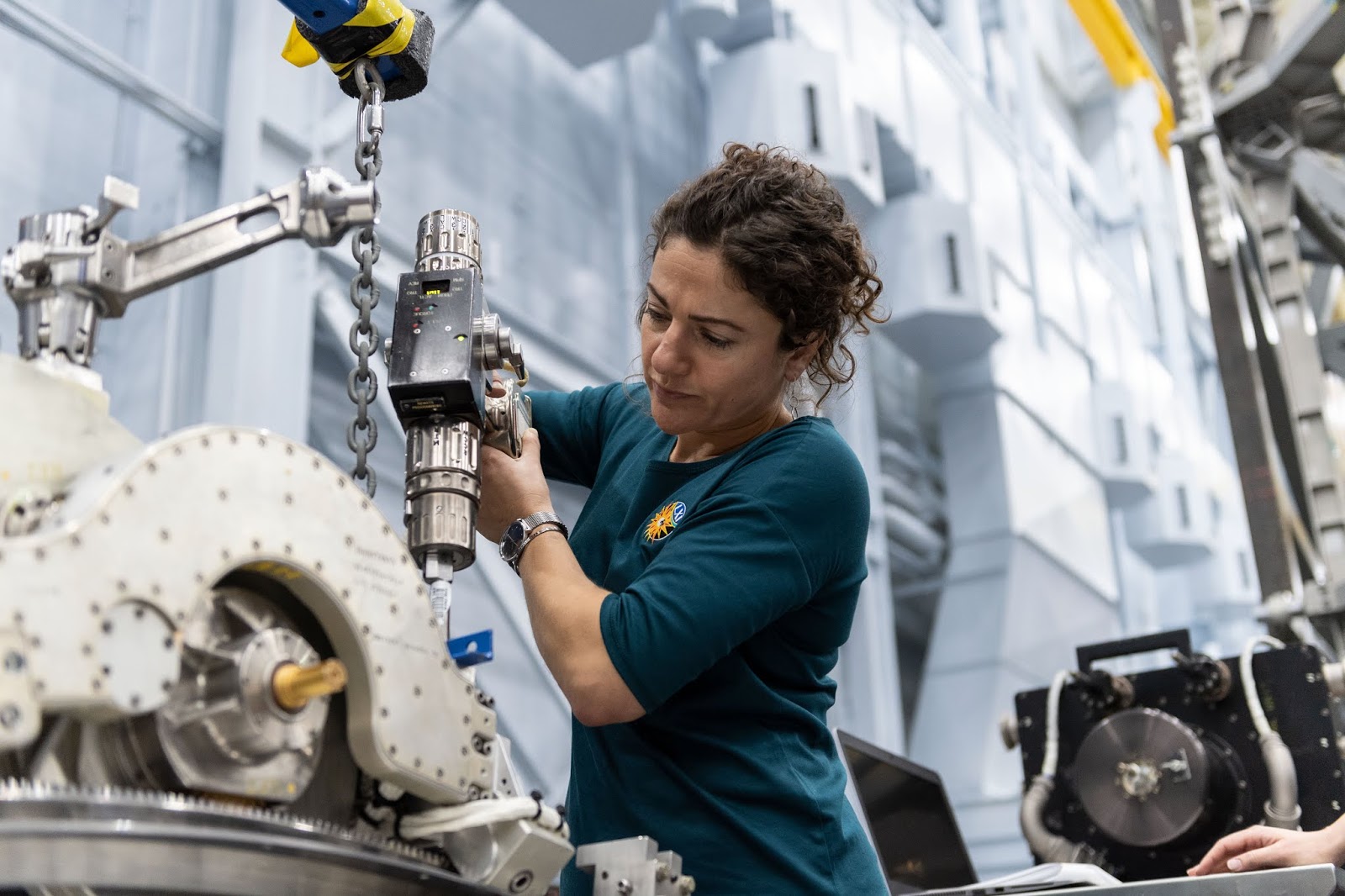
Image above: NASA astronaut Jessica Meir trains inside the Space Vehicle Mockup Facility at NASA’s Johnson Space Center. She has been assigned to her first spaceflight, and will launch to the International Space Station in September 2019. Image Credit: NASA.

This schedule also allows NASA to get the most time dedicated to other research aboard the station, as U.S. commercial crew launch providers prepare for operations to and from U.S. soil and the space station.

Meir’s September launch to the station will mark her first spaceflight. The Caribou, Maine, native was selected as an astronaut in 2013, while serving as an assistant professor at Harvard Medical School/Massachusetts General Hospital. She holds a bachelor’s in biology from Brown University, a master’s in space studies from International Space University, and a doctorate in marine biology from Scripps Institution of Oceanography.


Image above: NASA astronaut Drew Morgan trains inside a mockup of the International Space Station at NASA’s Johnson Space Center. His mission, which will launch in July 2019, has been extended through March 2020. Image Credit: NASA.

Prior to her selection to the astronaut corps, Meir’s career focused on the physiology of animals in extreme environments, studying emperor penguins in the Antarctic, elephant seals in California, and bar-headed geese in studies at the University of British Columbia and in Mongolia. Meir also previously worked for Lockheed Martin’s Human Research Facility, participated in reduced gravity research flights, took part in diving expeditions to the Antarctic and Belize, and served as a spaceflight analog crewmember for a NASA Extreme Environment Mission Operations underwater mission and an ESA caving mission (ESA CAVES).

Morgan will make his first flight into space this summer. A New Castle, Pennsylvania, native, Morgan was selected to be an astronaut in 2013, when he was serving as an emergency physician in the U.S. Army with sub-specialty certification in primary care sports medicine. He is a graduate of the U.S. Military Academy at West Point and the Uniformed Services University of the Health Sciences in Bethesda, Maryland.

Related links:

Expedition 59: https://www.nasa.gov/mission_pages/station/expeditions/future.html

Expedition 60: https://www.nasa.gov/mission_pages/station/expeditions/future.html

International Space Station (ISS): https://www.nasa.gov/mission_pages/station/main/index.html

Follow Meir on social media at:

https://www.instagram.com/astro_jessica/ and https://twitter.com/astro_jessica

Follow Koch during her extended mission at:

https://www.instagram.com/astro_christina/ and https://twitter.com/Astro_Christina and https://www.facebook.com/AstroChristina/

Follow Morgan throughout his extended mission at:

https://www.instagram.com/astrodrewmorgan/ and https://twitter.com/AstroDrewMorgan and https://www.facebook.com/AstroDrewMorgan/

Keep up with the International Space Station, and its research and crew, at: https://www.nasa.gov/station

Johnson Space Center (JSC): https://www.nasa.gov/centers/johnson/home/index.html

Images (mentioned), Video (mentioned), Text, Credits: NASA/Karen Northon/Stephanie Schierholz/JSC/Gary Jordan/Brandi Dean.

Greetings, Orbiter.ch

mardi 16 avril 2019

U.S. Resupply Ship Poised for Launch as Crew Studies Life Science


ISS - Expedition 59 Mission patch.

April 16, 2019

The U.S. Cygnus resupply ship from Northrop Grumman is encapsulated atop the Antares rocket and standing at its launch pad in Virginia. The Expedition 59 crew is training for its capture at the end of the week in the midst of ongoing life science aboard the International Space Station.

Cygnus will blast off Wednesday at 4:46 p.m. EDT from NASA’s Wallops Flight Facility. It will deliver about 7,600 pounds of science, supplies and hardware to the orbital residents. Flight Engineer Anne McClain, with astronaut David Saint-Jacques backing her up, will command the Canadarm2 robotic arm to reach out and capture Cygnus Friday about 5:30 a.m.


Image above: The Northrop Grumman Antares rocket carrying a Cygnus resupply spacecraft is seen during sunrise on Pad-0A, Tuesday, April 16, 2019 at NASA’s Wallops Flight Facility in Virginia. Image Credit: Northrop Grumman.

The duo continued sharpening their robotics skills today as they practiced Friday’s Cygnus capture maneuvers and techniques on a computer. NASA TV will broadcast the space freighter’s launch and capture activities live.

McClain started the day setting up a mouse habitat that will house rodents to gain insight into the immune system’s response to long-term spaceflight. Saint-Jacques set up the 360° camera in Tranquility module for more virtual reality filming of crew life on the station.

International Space Station (ISS). Animation Credit: NASA

Flight Engineer Christina Koch started Tuesday collecting and spinning her blood samples in a centrifuge for the Myotones muscle study. She then joined NASA astronaut Nick Hague for body measurements and ultrasound scans to research how microgravity impacts the biochemical properties of muscles.

Related links:

Expedition 59: https://www.nasa.gov/mission_pages/station/expeditions/expedition59/index.html

Northrop Grumman: https://www.nasa.gov/northropgrumman

Canadarm2 robotic arm: https://www.nasa.gov/mission_pages/station/structure/elements/mobile-servicing-system.html

NASA TV: https://www.nasa.gov/nasatv

Rodents: https://www.nasa.gov/mission_pages/station/research/experiments/explorer/Investigation.html?#id=7868

Tranquility module: https://www.nasa.gov/mission_pages/station/structure/elements/tranquility/

Virtual reality filming: https://www.nasa.gov/mission_pages/station/research/experiments/explorer/Investigation.html?#id=7877

Space Station Research and Technology: https://www.nasa.gov/mission_pages/station/research/index.html

International Space Station (ISS): https://www.nasa.gov/mission_pages/station/main/index.html

Image (mentioned), Animation (mentioned), Text, Credits: NASA/Mark Garcia.

Best regards, Orbiter.ch