vendredi 22 novembre 2019

The “Goodbye Ryugu” campaign


JAXA - Hayabusa2 Mission patch.

Nov. 22, 2019


Image above: Asteroid Ryugu captured with the Optical Navigation Camera - Telescopic (ONC-T) immediately after departure. Image time is November 13 10:15 JST (onboard time), 2019. Image Credits: JAXA, Chiba Institute of Technology, University of Tokyo, Kochi University, Rikkyo University, Nagoya University, Meiji University, University of Aizu, AIST.

Hayabusa2: Sayonara Ryugu!

Video above: JAXA’s Asteroid Explorer “Hayabusa2” departed the orbit of asteroid Ryugu on 13 November 2019. The video was created from images captured with Hayabusa2’s navigation camera. Hayabusa2 is scheduled to return samples from asteroid Ryugu to Earth at the end of 2020. Video Credits: JAXA, University of Tokyo, Kochi University, Rikkyo University, Nagoya University, Chiba Institute of Technology, Meiji University, Aizu University, AIST.

Hayabusa2. Image Credit: JAXA

On November 13, 2019 at 10:05 JST (onboard time), the Hayabusa2 spacecraft departed from asteroid Ryugu to return to Earth. Until November 18 ~ 19, images of the receding Ryugu will be captured by the camera mounted on the spacecraft (images here). After this time, the spacecraft will perform an attitude control maneuver to the orientation needed to operate the ion engines and will no longer be able to take photographs of Ryugu.

Related article:

Hayabusa2 departs from Ryugu
https://orbiterchspacenews.blogspot.com/2019/11/hayabusa2-departs-from-ryugu.html

Related links:

Hayabusa2 Asteroid Probe (ISAS):
http://www.isas.jaxa.jp/en/missions/spacecraft/current/hayabusa2.html

Asteroid Explorer "Hayabusa2":
https://global.jaxa.jp/projects/sas/hayabusa2/index.html

Images (mentioned), Video (mentioned), Text, Credits: JAXA/SciNews.

Greetings, Orbiter.ch

Hubble Eyes an Emitting Galaxy


NASA - Hubble Space Telescope patch.

Nov. 22, 2019


For this image, the NASA/ESA Hubble Space Telescope turned its powerful eye toward an emission-line galaxy called NGC 3749.

When astronomers explore the contents and constituent parts of a galaxy somewhere in the universe, they use various techniques and tools. One of these is to spread out the incoming light from that galaxy into a spectrum and explore its properties. This is done in much the same way as a glass prism spreads white light into its constituent wavelengths to create a rainbow. By hunting for specific signs of emission from various elements within a galaxy’s spectrum of light —so-called emission lines — or, conversely, the signs of absorption from other elements — so-called absorption lines — astronomers can start to deduce what might be happening within.

If a galaxy’s spectrum shows many absorption lines and few emission lines, this suggests that its star-forming material has been depleted and that its stars are mainly old, while the opposite suggests it might be bursting with star formation and energetic stellar newborns. This technique, known as spectroscopy, can tell us about a galaxy’s type and composition, the density and temperature of any emitting gas, the star formation rate, or how massive the galaxy’s central black hole might be.

While not all galaxies display strong emission lines, NGC 3749 does. It lies over 135 million light-years away and is moderately luminous. The galaxy has been used as a “control” in studies of especially active and luminous galaxies — those with centers known as active galactic nuclei, which emit copious amounts of intense radiation. In comparison to these active cousins, NGC 3749 is classified as inactive, and has no known signs of nuclear activity.

Hubble Space Telescope (HST)

For more information about Hubble, visit:

http://hubblesite.org/

http://www.nasa.gov/hubble

http://www.spacetelescope.org/

Text Credits: ESA (European Space Agency)/NASA/Isabelle Yan/Image, Animation, Credits: ESA/Hubble & NASA, D. Rosario et al.

Best regards, Orbiter.ch

jeudi 21 novembre 2019

Final Spacewalk Preps as Life Science Work Ramps Up


ISS - Expedition 61 Mission patch.

November 21, 2019

The Expedition 61 astronauts are in final preparations before Friday’s spacewalk to continue repairing the International Space Station’s cosmic particle detector. The orbital residents also had time today to set up research hardware for upcoming space biology activities.

Spacewalkers Andrew Morgan and Luca Parmitano will exit the Quest airlock on Friday after setting their U.S. spacesuits to battery power at 6:50 a.m. EST. The duo will translate to the far side of the station’s starboard truss structure to continue the intricate work to upgrade the Alpha Magnetic Spectrometer’s (AMS) thermal control system. NASA TV begins its live coverage beginning at 5:30 a.m.


Image above: NASA astronaut Andrew Morgan waves as he is photographed during the first spacewalk to repair the Alpha Magnetic Spectrometer on Nov. 15, 2019. Image Credit: NASA.

Flight Engineers Jessica Meir and Christina Koch will assist the spacewalkers during the excursion from inside the station on Friday. Meir will be on robotics duty maneuvering the Canadarm2 robotic arm while Koch manages their spacesuits.

Even with spacewalk activities dominating the schedule aboard the orbiting lab, the station crew still had time to conduct advanced space research. Meir set up a 3-D bioprinter for a test run today before the device begins manufacturing complex organ-like tissues in space. Koch is readying a variety of life science gear for next week’s operations to study how microgravity affects systems at the cellular level for insights into Earth-bound ailments.

International Space Station (ISS). Animation Credit: NASA

The cosmonauts in the Russian segment of the space station focused primarily on lab maintenance. Flight Engineers Alexander Skvortsov and Oleg Skripochka replaced batteries and dust filters. The duo then packed the Progress 72 (72P) resupply ship with trash and repressurized the station with oxygen from the 72P.

Related links:

Expedition 61: https://www.nasa.gov/mission_pages/station/expeditions/expedition61/index.html

Quest airlock: https://www.nasa.gov/mission_pages/station/structure/elements/joint-quest-airlock

NASA TV: https://www.nasa.gov/multimedia/nasatv/index.html#public

Canadarm2: https://www.nasa.gov/mission_pages/station/structure/elements/mobile-servicing-system.html

3-D bioprinter: https://www.nasa.gov/mission_pages/station/research/experiments/explorer/Facility.html?#id=7599

Earth-bound ailments: https://www.nasa.gov/mission_pages/station/research/experiments/explorer/Investigation.html?#id=7906

Space Station Research and Technology: https://www.nasa.gov/mission_pages/station/research/index.html

International Space Station (ISS): https://www.nasa.gov/mission_pages/station/main/index.html

Image (mentioned), Animation (mentioned), Text, Credits: NASA/Mark Garcia.

Best regards, Orbiter.ch

50 Years Ago: Apollo 12 – The Journey Home


NASA - Apollo 12 Mission patch.

Nov. 21, 2019

Apollo 12 astronauts Charles “Pete” Conrad and Alan L. Bean were in high spirits when they re-entered their Lunar Module (LM) Intrepid on the Moon’s Ocean of Storms. They had completed two Extravehicular Activities (EVAs) or spacewalks on the lunar surface, spending a total of 7 hours and 45 minutes outside. One the second EVA, they paid a visit to Surveyor 3, a robotic spacecraft that had landed nearby in April 1967, and snipped off several parts of the spacecraft to return them to Earth for scientists and engineers to assess the effects of 31 months in the harsh lunar environment. Conrad and Bean collected 76 pounds of lunar rocks, soil, and core samples, safely stowed in two Sample Return Containers (SRC). Inside the LM they prepared to liftoff from the surface and rejoin the third Apollo 12 crewmember, Richard F. Gordon, who continued to orbit the Moon in the Command Module (CM) Yankee Clipper, taking photographs and making other observations. 

Left: View from Conrad’s window after EVA2 showing some of Intrepid’s thrusters
and a few footprints. Right: View from Bean’s window after EVA2, showing a profusion
of footprints in the lunar dust, the American flag, and the S-band antenna’s shadow.

When they returned inside Intrepid, Conrad and Bean used up their remaining film by taking photographs out the windows, showing the signs of their visit – numerous footprints, the American flag, the S-band antenna, and in the distance, the Apollo Lunar Surface Experiment Package (ALSEP) station. They jettisoned their Portable Life Support System (PLSS) backpacks, gloves, and cameras, and ate a meal, after which Conrad said they were ready to “have a little chitty chat about the EVA” with Capcom Edward G. Gibson. In that conversation, Conrad said, “Al and I look just like a couple of bituminous coal miners right at the moment. But we’re happy.” To which Gibson replied, “So are a lot of people down here.” Gordon, coming around the Moon’s front side on his 28th revolution, congratulated Conrad and Bean on a job well done. To prepare for liftoff, Conrad and Bean tested Intrepid’s Reaction Control System (RCS) thrusters. The firings kicked up a fair bit of dust and also knocked over the S-band antenna, but the vehicle automatically switched to its own antenna with no loss of communications.

Two views in Mission Control during the lunar orbit rendezvous.

As Gordon in Yankee Clipper flew overhead on his 30th lunar revolution, Intrepid’s Ascent Stage engine ignited and Conrad and Bean lifted off from the Moon after 31 hours and 31 minutes on the surface, leaving the Descent Stage behind.  Conrad exclaimed, “Liftoff! And away we go!” with Bean adding, “Boy, did it fire!”  Even though the astronauts had deployed the ALSEP instruments more than 400 feet from Intrepid, several of the sensitive ones recorded the liftoff – the seismometer detected the vibrations, ion and dust detectors noted spikes in their readings, and the magnetometer recorded field fluctuations for 12 minutes. Ten seconds after liftoff at an altitude of 275 feet, Intrepid pitched over by 45 degrees to begin its climb to orbit. The 7-minute burn placed Intrepid into an intermediate 53-by-10-mile orbit, trailing Yankee Clipper by about 290 miles. The lunar dust that had settled on the floor of the LM floated throughout the cabin now that they were weightless again, so Conrad and Bean elected to keep their suits including helmets on to avoid breathing in the abrasive dust. In a repeat of the Apollo 11 rendezvous sequence Intrepid and Yankee Clipper executed a series of maneuvers that led to their docking about three and a half hours after liftoff from the Moon. Gordon relayed color TV views of the docking to Mission Control. Their independent flights had lasted 37 hours and 42 minutes.

Three stills from 16 mm film recorded aboard Yankee Clipper of Intrepid’s approach just prior to docking.

The three astronauts opened the hatches between the two spacecraft and quickly began transferring all the required items from Intrepid into Yankee Clipper, including all the lunar samples, cameras, and film. Conrad and Bean decided to remove their spacesuits in Intrepid and then transfer them across in an attempt to minimize contaminating Yankee Clipper with lunar dust.  Gordon transferred some unneeded items to be jettisoned in Intrepid. The transfers completed, they closed the hatches between the spacecraft and jettisoned the LM. To calibrate the seismometer left on the Moon, controllers sent a command to Intrepid to fire its thrusters for 83 seconds to drop it out of orbit and send it crashing on the surface about 40 miles from the instrument. The seismometer recorded signals for nearly one hour after the impact. Meanwhile, the astronauts prepared for their sleep period after a strenuous nearly 24-hour day.

Recording from the Apollo 12 seismometer of the intentional crash of the LM ascent stage.
 
Apollo 12 photographs taken on their last day in lunar orbit. Left: Fra Mauro highlands.
Middle: Descartes region. Right: Smyth Sea.

The astronauts began their final day in lunar orbit as they appeared on the Moon’s front side on their 38th revolution. The primary activity for their remaining time around the Moon consisted of photographing potential landing sites for future Apollo missions, such as the Fra Mauro highlands and the Descartes region, as well as targets of opportunity such as the Smyth Sea. To achieve the best orbital track for this task the crew performed a 19-second out-of-plane maneuver using the Service Propulsion System (SPS) engine. On their 45th revolution, they went around to the Moon’s backside for the last time as they fired the SPS for the 2-minute and 10-second Trans Earth Injection (TEI) burn. Apollo 12 left lunar orbit after 3 days 17 hours and 2 minutes. As they rounded from the back side of the Moon, Conrad radioed to Mission Control, “Hello, Houston.  Apollo 12’s en route home.” They had already set up the color TV camera and began transmitting views of the rapidly receding Moon. Capcom Don L. Lind commented, “We really get the impression that you’re on a fast elevator,” eliciting this response from Gordon, “Yes, we're really moving out, Don. It doesn't take very long to get some altitude out of that place.”  They concluded the 38-minute TV broadcast by filming themselves in the cabin, having already traveled nearly 2,900 miles from the Moon. Shortly thereafter, all three crewmembers began a well-earned sleep period.

Four views of the rapidly receding Moon after TEI.

While the astronauts slept for about 12 hours, Apollo 12 passed from the Moon’s gravitational sphere of influence to the Earth’s and the spacecraft began to accelerate toward its final destination. The first order of business on this crew day involved a minor course correction, at a distance of about 200,000 miles from Earth, a burn of the RCS thrusters of less than five seconds to refine the spacecraft’s trajectory. While Capcom Gibson read up the day’s news to the astronauts, he also reported that their wives Jane Conrad, Barbara Gordon, and Sue Bean greeted reporters that morning outside the Conrads’ house wearing white pantsuits and holding up signs that read, “Proud,” Thrilled,” and “Happy.” Gibson also reported to the crew that the ALSEP experiments were all working as expected. The astronauts answered questions from geologists and other scientists, relayed by Capcoms Gibson and Lind, about their lunar traverses and their impressions of Surveyor 3. The astronauts finished the day with some housekeeping chores, which included frequent cleaning of air filters due to the lunar dust they brought in from the LM, and went to sleep, some 187,000 miles from Earth.

Left: Apollo 12 astronauts’ wives (left to right) Sue Bean, Barbara Gordon, and Jane Conrad hold up signs for reporters. Right: Apollo 12 astronauts (left to right) Gordon, Conrad, and Bean aboard Yankee Clipper during the inflight press conference on the way home from the Moon.

The next morning, the astronauts awoke before Mission Control could call them, and Conrad asked Capcom Paul J. Weitz to send the following tongue-in-cheek message full of Navy slang to Rear Admiral Donald C. Davis, head of the US Navy Recovery Forces aboard the prime recovery ship USS Hornet (CVS-12), “Dear Red Dog, Apollo 12 with three tail-hookers expect recovery ship to make its PIM (Point of Intended Movement) as we have energy for only one pass. Signed Pete, Dick, and Al.” A few minutes later, after the astronauts had a glimpse of Earth now 160,000 miles away, Conrad told Capcom Weitz, “Houston, we just got our first glimpse of you this morning, and there’s not very much of you out there.”  With the Sun and the Earth nearly aligned, the astronauts could only see a very thin crescent of their home planet. They passed the halfway mark of their journey home, being an equidistant 126,787 miles from the Moon and Earth. Later in the day, the trio held a televised news conference, with Capcom Gerald P. “Jerry” Carr reading up 13 questions submitted by reporters at the Manned Spacecraft Center, now the Johnson Space Center in Houston. At the end of the 37-minute broadcast the crew held up a homemade sign to the camera that read, “Yankee Clipper sailed with Intrepid to the Sea of Storms, Moon, November 14, 1969,” signed by all three crewmembers. Soon after, the three astronauts turned in for their last night’s sleep in space, only 108,000 miles from their home planet.

Left: The Moon continued to shrink in size as Apollo 12 headed home.
Right: The Earth appeared as a very thin crescent with the Sun almost directly behind it.

To be continued...

Related article:

50 Years Ago: Return to the Moon
https://orbiterchspacenews.blogspot.com/2019/11/50-years-ago-return-to-moon.html

New NASA Study Reveals Origin of Organic Matter in Apollo Lunar Samples
https://orbiterchspacenews.blogspot.com/2019/11/new-nasa-study-reveals-origin-of.html

Related links:

Apollo: https://www.nasa.gov/mission_pages/apollo/index.html

Apollo 12: https://www.nasa.gov/mission_pages/apollo/apollo-12

Images, Text, Credits: NASA/Kelli Mars/JSC/John Uri.

Greetings, Orbiter.ch

Fractured ice sheets on Mars


ESA - Mars Express Mission patch.

Nov. 21, 2019

Plan view of Deuteronilus Mensae

Where the two hemispheres of Mars meet, the planet is covered in broken-up terrain: a sign that slow-but-steady flows of icy material once forged their way through the landscape, carving out a fractured web of valleys, cliffs and isolated mounds of rock.

Mars is a planet of two halves. Its hemispheres are drastically different; the smooth northern lowlands sit up to three kilometres below the rugged southern highlands, and the surface in Mars’ northern regions appears to be far younger than the ancient swaths of the south.

Deuteronilus Mensae in context

Where these regions meet, they sometimes form a transition area filled with a wide range of intriguing geological features, patterns and processes: a type of landscape unique to Mars known as fretted terrain. Fretted terrain is found in a couple of key areas on Mars, and an especially good example, named Deuteronilus Mensae, can be seen in these images from Mars Express’ High Resolution Stereo Camera (HRSC).

This landscape shows clear and widespread signs of significant, lasting erosion. As is common with fretted terrain, it contains a mix of cliffs, canyons, scarps, steep-sided and flat-topped mounds (mesa), furrows, fractured ridges and more, a selection of which can be seen dotted across the frame.

Topographic view of Deuteronilus Mensae

These features were created as flowing material dissected the area, cutting through the existing landscape and carving out a web of winding channels. In the case of Deuteronilus Mensae, flowing ice is the most likely culprit. Scientists believe that this terrain has experienced extensive past glacial activity across numerous martian epochs.

It is thought that glaciers slowly but surely ate away at the plains and plateaus that once covered this region, leaving only a scattering of steep, flat, isolated mounds of rock in their wake.

Perspective view of Deuteronilus Mensae

Smooth deposits cover the floor itself, some marked with flow patterns from material slowly moving downhill – a mix of ice and accumulated debris that came together to form and feed viscous, moving flows of mass somewhat akin to a landslide or mudflow here on Earth.

Studies of this region by NASA’s Mars Reconnaissance Orbiter have shown that most of the features seen here do indeed contain high levels of water ice. Estimates place the ice content of some glacial features in the region at up to 90%. This suggests that, rather than hosting individual or occasional icy pockets and glaciers, Deuteronilus Mensae may actually represent the remnants of an old regional ice sheet. This ice sheet may once have covered the entire area, lying atop the plateaus and plains. As the martian climate changed this ice began to shift around and disappear, slowly revealing the rock beneath.

Perspective view of Deuteronilus Mensae

Overall, the features seen in these Mars Express images are reminiscent of the rock- and debris-covered glaciers found in cold regions of Earth. Glaciers may actually be relatively common on both past and present-day Mars; recent studies suggest that the planet may have belts of glacial activity above and below its equator, containing huge amounts of ice covered in thick protective layers of dust, and many other areas show signs of having hosted glaciers in the past – just like Deuteronilus Mensae.

Mars Express

Mars Express has been orbiting the Red Planet since 2003. Using the HRSC, which obtained these new images, the mission has continually mapped the martian surface and characterised various key properties of and phenomena on the planet – from the presence of a planet-wide groundwater system to intricate old river systems, various intriguing surface deposits, giant regional dust storms, spikes of tell-tale gases in the planet’s atmosphere, and much more.

Deuteronilus Mensae in 3D

The mission will continue to explore the Red Planet in collaboration with the ESA-Roscosmos ExoMars Trace Gas Orbiter, which arrived at Mars in 2016, and the ExoMars Rosalind Franklin rover and its accompanying surface science platform, which will arrive in 2021.

Mars Express: http://www.esa.int/Science_Exploration/Space_Science/Mars_Express

Images, Text, Credits: ESA/DLR/FU Berlin, CC BY-SA 3.0 IGO/NASA MGS MOLA Science Team.

Best regards, Orbiter.ch

mercredi 20 novembre 2019

Stars Are Being Born in the Depths of a Black Hole


NASA - Chandra X-ray Observatory patch.

Nov. 20, 2019


Located about 5.8 billion light years from Earth in the Phoenix Constellation, astronomers have confirmed the first example of a galaxy cluster where large numbers of stars are being born at its core.

Galaxy clusters are the largest structures in the cosmos that are held together by gravity, consisting of hundreds or thousands of galaxies embedded in hot gas, as well as invisible dark matter. The largest supermassive black holes known are in galaxies at the centers of these clusters.

For decades, astronomers have looked for galaxy clusters containing rich nurseries of stars in their central galaxies. Instead, they found powerful, giant black holes pumping out energy through jets of high-energy particles and keeping the gas too warm to form many stars.

Now, scientists have compelling evidence for a galaxy cluster where stars are forming at a furious rate, apparently linked to a less effective black hole in its center. In this unique cluster, the jets from the central black hole instead appear to be aiding in the formation of stars. Researchers used new data from NASA’s Chandra X-ray Observatory and Hubble Space Telescope, and the NSF’s Karl Jansky Very Large Array (VLA) to build on previous observations of this cluster.

Chandra X-Ray Observatory

Chandra X-Ray Observatory: https://www.nasa.gov/mission_pages/chandra/main/index.html

Image, Animation Credit: X-ray: NASA/CXC/SAO/G.Schellenberger et al.; Optical:SDSS/Text Credits: NASA/Yvette Smith.

Greetings, Orbiter.ch

NASA’s Fermi, Swift Missions Enable a New Era in Gamma-ray Science


NASA - Fermi Gamma-ray Space Telescope logo / NASA - Swift Mission patch.

Nov. 20, 2019

A pair of distant explosions discovered by NASA’s Fermi Gamma-ray Space Telescope and Neil Gehrels Swift Observatory have produced the highest-energy light yet seen from these events, called gamma-ray bursts (GRBs). The record-setting detections, made by two different ground-based observatories, provide new insights into the mechanisms driving gamma-ray bursts.

Astronomers first recognized the GRB phenomenon 46 years ago. The blasts appear at random locations in the sky about once a day, on average.

The most common type of GRB occurs when a star much more massive than the Sun runs out of fuel. Its core collapses and forms a black hole, which then blasts jets of particles outward at nearly the speed of light. These jets pierce the star and continue into space. They produce an initial pulse of gamma rays — the most energetic form of light — that typically lasts about a minute.


Image above: On Jan. 14, 2019, the Major Atmospheric Gamma Imaging Cherenkov (MAGIC) observatory in the Canary Islands captured the highest-energy light every recorded from a gamma-ray burst. MAGIC began observing the fading burst just 50 seconds after it was detected thanks to positions provided by NASA's Fermi and Swift spacecraft (top left and right, respectively, in this illustration). The gamma rays packed energy up to 10 times greater than previously seen. Image Credits: NASA/Fermi and Aurore Simonnet, Sonoma State University.

As the jets race outward, they interact with surrounding gas and emit light across the spectrum, from radio to gamma rays. These so-called afterglows can be detected up to months — and rarely, even years — after the burst at longer wavelengths.

“Much of what we’ve learned about GRBs over the past couple of decades has come from observing their afterglows at lower energies,” said Elizabeth Hays, the Fermi project scientist at NASA’s Goddard Space Flight Center in Greenbelt, Maryland. “Now, thanks to these new ground-based detections, we’re seeing the gamma rays from gamma-ray bursts in a whole new way.”

Two papers published in the journal Nature describe each of the discoveries. A third paper analyzes one of the bursts using a rich set of multiwavelength data from observatories in space and on the ground. A fourth paper, accepted by The Astrophysical Journal, explores the Fermi and Swift data in greater detail.

On Jan. 14, 2019, just before 4 p.m. EST, both the Fermi and Swift satellites detected a spike of gamma rays from the constellation Fornax. The missions alerted the astronomical community to the location of the burst, dubbed GRB 190114C.


Image above: The fading afterglow of GRB 190114C and its home galaxy were imaged by the Hubble Space Telescope on Feb. 11 and March 12, 2019. The difference between these images reveals a faint, short-lived glow (center of the green circle) located about 800 light-years from the galaxy’s core. Blue colors beyond the core signal the presence of hot, young stars, indicating that this is a spiral galaxy somewhat similar to our own. It is located about 4.5 billion light-years away in the constellation Fornax. Image Credits: NASA, ESA, and V. Acciari et al. 2019.

One facility receiving the alerts was the Major Atmospheric Gamma Imaging Cherenkov (MAGIC) observatory, located on La Palma in the Canary Islands, Spain. Both of its 17-meter telescopes automatically turned to the site of the fading burst. They began observing the GRB just 50 seconds after it was discovered and captured the most energetic gamma rays yet seen from these events.

The energy of visible light ranges from about 2 to 3 electron volts. In 2013, Fermi’s Large Area Telescope (LAT) detected light reaching an energy of 95 billion electron volts (GeV), then the highest seen from a burst. This falls just shy of 100 GeV, the threshold for so-called very high-energy (VHE) gamma rays. With GRB 190114C, MAGIC became the first facility to report unambiguous VHE emission, with energies up to a trillion electron volts (1 TeV). That’s 10 times the peak energy Fermi has seen to date.

“Twenty years ago, we designed MAGIC specifically to search for VHE emission from GRBs, so this is a tremendous success for our team,” said co-author Razmik Mirzoyan, a scientist at the Max Planck Institute for Physics in Munich and the spokesperson for the MAGIC collaboration. “The discovery of TeV gamma rays from GRB 190114C shows that these explosions are even more powerful than thought before. More importantly, our detection facilitated an extensive follow-up campaign involving more than two dozen observatories, offering important clues to the physical processes at work in GRBs.”

Swift. Image Credit: NASA

These included NASA’s NuSTAR mission, the European Space Agency’s XMM-Newton X-ray satellite, the NASA/ESA Hubble Space Telescope, in addition to Fermi and Swift, along with many ground-based observatories. Hubble images acquired in February and March captured the burst’s optical afterglow. They show that the blast originated in a spiral galaxy about 4.5 billion light-years away. This means the light from this GRB began traveling to us when the universe was two-thirds of its current age.

Another paper presents observations of a different burst, which Fermi and Swift both discovered on July 20, 2018. Ten hours after their alerts, the High Energy Stereoscopic System (H.E.S.S.) pointed its large, 28-meter gamma-ray telescope to the location of the burst, called GRB 180720B. A careful analysis carried out during the weeks following the event revealed that H.E.S.S. clearly detected VHE gamma rays with energies up to 440 GeV. Even more remarkable, the glow continued for two hours following the start of the observation. Catching this emission so long after the GRB’s detection is both a surprise and an important new discovery.

Scientists suspect that most of the gamma rays from GRB afterglows originate in magnetic fields at the jet’s leading edge. High-energy electrons spiraling in the fields directly emit gamma rays through a mechanism called synchrotron emission.


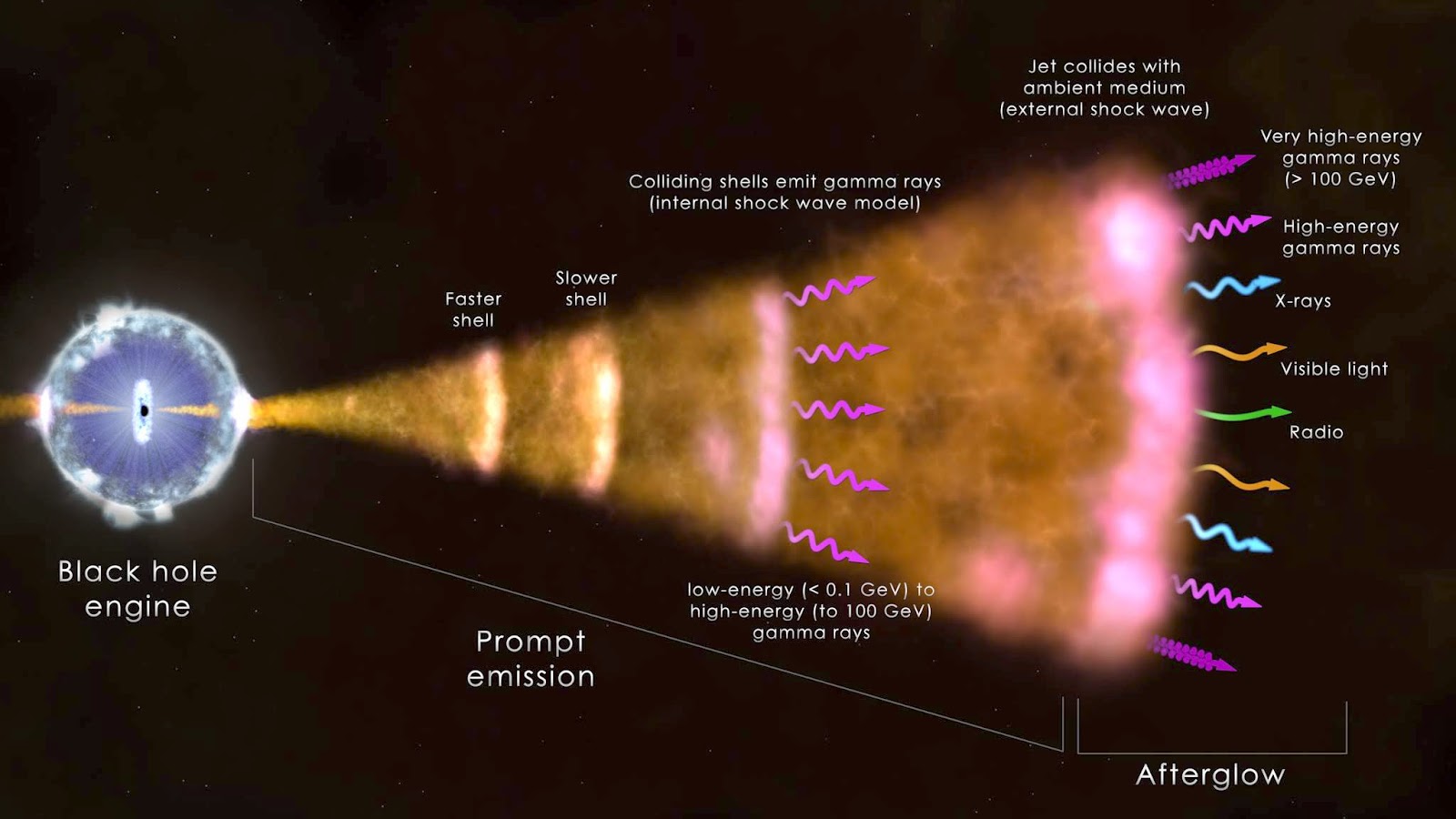
Image above: Ground-based facilities have detected radiation up to a trillion times the energy of visible light from a cosmic explosion called a gamma-ray burst (GRB). This illustration shows the set-up for the most common type. The core of a massive star (left) has collapsed and formed a black hole. This “engine” drives a jet of particles that moves through the collapsing star and out into space at nearly the speed of light. The prompt emission, which typically lasts a minute or less, may arise from the jet’s interaction with gas near the newborn black hole and from collisions between shells of fast-moving gas within the jet (internal shock waves). The afterglow emission occurs as the leading edge of the jet sweeps up its surroundings (creating an external shock wave) and emits radiation across the spectrum for some time — months to years, in the case of radio and visible light, and many hours at the highest gamma-ray energies yet observed. These far exceed 100 billion electron volts (GeV) for two recent GRBs. Image Credits: NASA's Goddard Space Flight Center.

But both the H.E.S.S. and MAGIC teams interpret the VHE emission as a distinct afterglow component, which means some additional process must be at work. The best candidate, they say, is inverse Compton scattering. High-energy electrons in the jet crash into lower-energy gamma rays and boost them to much higher energies.

In the paper detailing the Fermi and Swift observations, the researchers conclude that an additional physical mechanism may indeed be needed to produce the VHE emission. Within the lower energies observed by these missions, however, the flood of synchrotron gamma rays makes uncovering a second process much more difficult.

Fermi Gamma-ray Space Telescope. Image Credit: NASA

“With Fermi and Swift, we don’t see direct evidence of a second emission component,” said Goddard’s S. Bradley Cenko, the principal investigator for Swift and a co-author of the Fermi-Swift and multiwavelength papers. “However, if the VHE emission arises from the synchrotron process alone, then fundamental assumptions used in estimating the peak energy produced by this mechanism will need to be revised.”

Future burst observations will be needed to clarify the physical picture. The new VHE data open a new pathway for understanding GRBs, one that will be further extended by MAGIC, H.E.S.S. and a new generation of ground-based gamma-ray telescopes now being planned.

The Fermi Gamma-ray Space Telescope is an astrophysics and particle physics partnership managed by NASA's Goddard Space Flight Center in Greenbelt, Maryland. Fermi was developed in collaboration with the U.S. Department of Energy, with important contributions from academic institutions and partners in France, Germany, Italy, Japan, Sweden and the United States.

Goddard manages the Swift mission in collaboration with Penn State in University Park, the Los Alamos National Laboratory in New Mexico and Northrop Grumman Innovation Systems in Dulles, Virginia. Other partners include the University of Leicester and Mullard Space Science Laboratory in the United Kingdom, Brera Observatory and the Italian Space Agency in Italy.

Related article:

Hubble Studies Gamma-Ray Burst with the Highest Energy Ever Seen
https://orbiterchspacenews.blogspot.com/2019/11/hubble-studies-gamma-ray-burst-with.html

Related links:

NASA’s Fermi Gamma-ray Space Telescope: https://www.nasa.gov/content/fermi-gamma-ray-space-telescope and http://www.nasa.gov/mission_pages/GLAST/main/index.html

Neil Gehrels Swift Observatory: https://www.nasa.gov/mission_pages/swift/main

The Astrophysical Journal: https://arxiv.org/abs/1909.10605

Major Atmospheric Gamma Imaging Cherenkov (MAGIC): https://www.mpp.mpg.de/en/research/astroparticle-physics-and-cosmology/magic-and-cta-gamma-ray-telescopes/magic/

NASA’s NuSTAR: https://www.nasa.gov/mission_pages/nustar/main/index.html

High Energy Stereoscopic System (H.E.S.S.): https://www.mpi-hd.mpg.de/hfm/HESS/

NASA's Swift: http://www.nasa.gov/mission_pages/swift/main/index.html

Images (mentioned), Text, Credits: NASA/Rob Garner/GSFC, by Francis Reddy.

Greetings, Orbiter.ch