jeudi 26 novembre 2020

Chang’e-5 completes first orbital correction


CLEP - China Lunar Exploration Program logo.


Nov. 26, 2020

On 24 November 2020, at 14:06 UTC (22:06 Beijing Time), the Chang’e-5 spacecraft successfully performed its first orbital correction.

Chang’e-5 completes first orbital correction

China’s Chang’e-5 lunar mission was launched by the Long March-5 Y5 launch vehicle on 23 November 2020, at 20:30 UTC (24 November, 04:30 local time).

Chang’e-5 (嫦娥五号) mission diagram

The Chang’e-5 lunar mission will attempt to land near Mons Rümker, a volcanic complex in the northern region of Oceanus Procellarum. The spacecraft will try to collect about 2 kilograms of lunar soil and return the samples to Earth.

Chang’e-5 to sample Mons Rümker, Oceanus Procellarum

According to Lin Yangting (professor, Institute of Geology and Geophysics, Chinese Academy of Sciences), a joint team will be formed with European researchers to study the samples, part of the cooperation with the European Space Agency (ESA).

Chang’e-5 (嫦娥五号) mission, takeoff from Lunar surface

Related articles:

CASC - Long March-5 Y5 launches Chang’e-5 lunar mission
https://orbiterchspacenews.blogspot.com/2020/11/casc-long-march-5-y5-launches-change-5.html

ESA tracks Chang'e-5 Moon mission
https://orbiterchspacenews.blogspot.com/2020/11/esa-tracks-change-5-moon-mission.html

For more information about China Aerospace Science and Technology Corporation (CASC), visit: http://english.spacechina.com/n16421/index.html

For more information about China National Space Administration (CNSA), visit: http://www.cnsa.gov.cn/

Image, Videos, Text, Credits: China Central Television (CCTV)/CASC/CNSA/SciNews/Orbiter.ch Aerospace/Roland Berga.

Greetings, Orbiter.ch

Precise maps of millions of bright quasars show our place in the cosmos as never before


ESA - Gaia Mission patch.


Nov. 26, 2020

On a Friday at the end of 2018, the top brass of a NASA deep space mission convened for a tense meeting. Hour by hour the New Horizons probe was hurtling toward a New Year’s Day rendezvous with Arrokoth, an ancient, icy rock at the edge of the Solar System. The team had one last chance to send instructions for pointing the probe’s cameras. Success would ensure in-frame pictures of Arrokoth, and the clues it held for how the planets formed. Failure would mean expensive pictures of an empty void.

The mission managers who gathered at New Horizons headquarters in suburban Maryland realized they had a “massive problem,” says Marc Buie, a team member and planetary scientist at the Southwest Research Institute in Boulder, Colorado. Something was off in images already beamed back. Either the flying spacecraft or the orbiting rock was a teensy bit lost in a universe where nothing is nailed down.


Image above: Quasars, generated by black holes in distant galaxies, are far more stable beacons than nearby stars. Image Credits: J. PAULSON/ALAMY STOCK PHOTO.

The team debated what to fix. Some thought the probe’s position, calculated from Earth-based measurements, was correct, in which case Arrokoth was in an unexpected place. But Buie believed the rock was right where it should be, which suggested thrusters had nudged the spacecraft itself a hair off course.

Buie was confident because he was tracking Arrokoth’s position relative to an ultraprecise map of far-off beacons called quasars: cosmic lighthouses generated by black holes in distant galactic centers. But the map was largely untested, having just been released by a European Space Agency star-mapping satellite called Gaia. It was the basis of a brand-new celestial reference frame, a fixed, imaginary grid against which everything else moves, akin to lines of latitude and longitude on Earth. And Buie was gambling the Arrokoth flyby on that new grid.

For the past few decades, astronomers have based their celestial grid on radio observations of several thousand quasars. These radio beacons not only guide the pointing of telescopes, but they are also the bedrock of the reference frame for the spinning, bucking Earth. Without them, GPS devices would lose their accuracy and many ultraprecise studies of processes such as plate tectonics and climate change would be impossible. But observations of these beacons are costly and rely on radio telescopes.

By 2018, when New Horizons was approaching Arrokoth, Gaia had produced its own version of a reference frame, based on half a million quasars seen in the visible wavelengths most astronomers use, not radio. Buie persuaded the New Horizons team to trust the new framework. A correction based on the Gaia positions went up to the probe.

The team got it right: When the closest flyby images came back, Arrokoth was framed perfectly. “None of that would have happened if we hadn’t had the Gaia catalog,” Buie says. “It’s a fundamental rewriting of how we do positional astronomy.”

The rewriting has continued. Next week, on 3 December, Gaia will release, along with the latest data about billions of Milky Way stars, its newest reference frame, built from 1.6 million quasars scattered across the sky. “It is improved, larger, better, more beautiful,” says François Mignard, an astronomer at the Côte d’Azur Observatory in France who leads Gaia’s reference frame team.

The Gaia reference frame is only the latest solution to a very, very old problem. From planets to comets to asteroids, much of the sky drifts from night to night. Studying these objects would be hopeless without comparing them with points that stay still.

At first, the stars looked like trustworthy reference points. In the second century C.E., the Alexandrian astronomer Ptolemy revisited constellations his predecessor Hipparcos had observed some 3 centuries earlier. With his naked eyes, Ptolemy couldn’t find any movement among the stars, which he assumed were fixed points on a sphere rotating around Earth.

But by the 1700s, careful observations with telescopes proved the stars’ apparent positions in the sky do shift over the years, as they move through the cosmos. In response, astronomers spent whole lifetimes building catalogs of stars far enough away or slow enough to mostly stay still.


Image above: Next week, Europe’s star-mapping Gaia mission will release a new celestial reference frame, built from the positions of 1.6 million quasars. Image Credits: ESA/ATG MEDIALAB; ESO/S. BRUNIER.

The game changed again when astronomers started to observe quasars in the 1970s, using radio dishes on different continents to make hyperprecise measurements of their positions. Like stars, quasars appear as points of light. But they are billions of light-years away, so they barely budge within human lifetimes. Finally, the distant sky, not Earth, was the ultimate arbiter of where things are.

Today, the radio measurements feed into a global bureaucracy that maintains reference frames, imposing order on space in the same way astronomical observatories used to keep time. Many of the quasar measurements are accurate to about a hundred-millionth of a degree—smaller than the apparent size of a basketball on the Moon. They not only hold the sky in place, but also reveal jerks in Earth’s rotation speed and wobbles in its axis that arise from earthquakes and hurricanes. The calculated tweaks are used in turn to correct GPS devices, which would otherwise lose track of Earth’s spinning surface.

The growing number of rock-solid quasars, now in the thousands, also transformed interplanetary navigation. For decades, NASA tracked its spacecraft mainly by measuring their velocities as they flew away, which made it possible to calculate their distances from Earth. Their positions in other dimensions were only coarsely estimated by the sensors on the spacecraft. But after a pair of high-profile Mars failures in 1999, the agency added another method: It looks for quasars that are near the craft’s current location in the sky—anchoring the probe to the reference frame. The approach has enabled subsequent bull’s-eye landings on Mars and elsewhere, says Barry Geldzahler, who recently retired as NASA’s navigation lead. “We make the hard things routine, and kind of boring.”

For the many space scientists who work outside of radio wavelengths, however, a radio-based reference frame isn’t so useful. Astronomers had spent decades trying to build up rival reference points in visible light. But quasars are faint specks at those wavelengths, and optical telescopes peering through Earth’s blurry atmosphere struggled to match the precision of radio arrays.

Then the 2018 Gaia data set dropped, after the probe scanned the whole sky with sensitive space-based detectors. “Ninety-eight percent of that work was obliterated after the Gaia release,” says Leonid Petrov, an astronomer at NASA’s Goddard Space Flight Center who conducts radio quasar observations to build reference frames. “In 1 day, they became history.”

The consensus grid for outer space—the third iteration of the official International Celestial Reference Frame, maintained by the International Astronomical Union (IAU)—still relies on radio quasars. But at the next IAU general assembly in 2021, Mignard says he plans to propose a multi-wavelength system, with the optical quasar positions listed alongside the radio ones.

Tiny offsets between the two systems can already be seen, but they are not errors. They reflect astrophysical reality—and a tantalizing research opportunity. Quasars are powered by gas swirling around supermassive black holes at the centers of galaxies. As the gas circles the drain, it kicks out bright jets of plasma at nearly the speed of light. The radio telescopes are trained on the black hole itself, whereas Gaia picks up an average position between the black hole and the jets. No single telescope can distinguish between these locations. But the discrepancies between the radio and optical positions point to these fine details and offer a new way to investigate the physics at galaxy centers.

“If you’re a fan of active galactic nuclei, this is a great time to be alive,” says Bryan Dorland, an astronomer at the U.S. Naval Observatory. “The last time positional astronomy was exciting was around, like, Ptolemy. Right?”

Eventually, the Gaia data might even feed back into terrestrial position-finding systems, but not before lengthy studies and negotiations, says Manuela Seitz, of the German Geodetic Research Institute. “It’s a long way between showing, OK, you can have an improvement if you use it to, OK, you now have products which are really consistent,” she says.

To stay useful, the Gaia system will require tending. Right now, it has a firm handle on not just its quasars, but also more than 1 billion closer, drifting stars. These stars, anchored to the quasar-based grid, are useful guides for spacecraft with simple star trackers, or when no quasar is visible in a particular part of the sky. But the Gaia mission is set to end its vigil in 2025. After that, the stars will meander relative to background quasars unless astronomers dispatch a follow-up mission to remap the sky.

Meanwhile, the quasars themselves will drift glacially. Ultimately, Mignard says, high-precision reference frames of the future might require anchors even more stable than quasars: perhaps points on the cosmic microwave background, the afterglow of the big bang, which lies at the farthest observable distance in the cosmos.

Buie, for his part, plans to use the Gaia reference frame for as long as he can in his work pinpointing and studying tiny outer Solar System rocks. The Gaia data make it easier for him to calculate when and where to go on Earth to watch a star wink out as a remote object crosses in front of it—a so-called occultation event that relies on the momentary backlight to reveal details about the object.

He’s also playing the same game he did with New Horizons and Arrokoth for Lucy, an upcoming NASA mission that plans to buzz past five small asteroids near the orbit of Jupiter. The extra precision of the Gaia system will help mission controllers home in precisely on their targets. “They don’t think they need it, but they do,” Buie says.

doi:10.1126/science.abf8476

Related articles:

Largest 3D Universe Map Released
https://orbiterchspacenews.blogspot.com/2020/07/largest-3d-universe-map-released.html

A new technique to gauge the distant Universe
https://orbiterchspacenews.blogspot.com/2015/12/a-new-technique-to-gauge-distant.html

Related link:

Gaia: https://www.esa.int/Science_Exploration/Space_Science/Gaia_overview

Images (mentioned), Text, Credits: ESA/Space/Science/Joshua Sokol.

Best regards, Orbiter.ch

New Hubble Data Explains Missing Dark Matter


ESA - Hubble Space Telescope logo.


Nov. 26, 2020

New data from the NASA/ESA Hubble Space Telescope provides further evidence for tidal disruption in the galaxy NGC 1052-DF4. This result explains a previous finding that this galaxy is missing most of its dark matter. By studying the galaxy’s light and globular cluster distribution, astronomers have concluded that the gravity forces of the neighbouring galaxy NGC 1035 stripped the dark matter from NGC 1052-DF4 and are now tearing the galaxy apart.

Ground-based view of the sky around the galaxies NGC 1052-DF4 NGC & 1052-DF2

In 2018 an international team of researchers using the NASA/ESA Hubble Space Telescope and several other observatories uncovered, for the first time, a galaxy in our cosmic neighbourhood that is missing most of its dark matter. This discovery of the galaxy NGC 1052-DF2 was a surprise to astronomers, as it was understood that Dark matter (DM) is a key constituent in current models of galaxy formation and evolution. In fact, without the presence of DM, the primordial gas would lack enough gravity pull to start collapsing and forming new galaxies. A year later, another galaxy that misses dark matter was discovered, NGC 1052-DF4, which further triggered intense debates among astronomers about the nature of these objects.

Now, new Hubble data [1] have been used to explain the reason behind the missing dark matter in NGC 1052-DF4, which resides 45 million light-years away. Mireia Montes of the University of New South Wales in Australia led an international team of astronomers to study the galaxy using deep optical imaging. They discovered that the missing dark matter can be explained by the effects of tidal disruption. The gravity forces of the neighbouring massive galaxy NGC 1035 are tearing NGC 1052-DF4 apart. During this process, the dark matter is removed, while the stars feel the effects of the interaction with another galaxy at a later stage.

Until now, the removal of dark matter in this way has remained hidden from astronomers as it can only be observed using extremely deep images that can reveal extremely faint features. “We used Hubble in two ways to discover that NGC 1052-DF4 is experiencing an interaction,” explained Montes. “This includes studying the galaxy’s light and the galaxy’s distribution of globular clusters.”


 Region around Galaxy NGC1052-DF4

Thanks to Hubble’s high resolution, the astronomers could identify the galaxy’s globular clusters population. The 10.4-metre Gran Telescopio Canarias (GTC) telescope and the IAC80 telescope in the Canaries, Spain, were also used to complement Hubble’s observations by further studying the data.

“It is not enough just to spend a lot of time observing the object, but a careful treatment of the data is vital,” explained team member Raúl Infante-Sainz of the Instituto de Astrofísica de Canarias in Spain. “It was therefore important that we use not just one telescope/instrument, but several (both ground- and space-based) to conduct this research. With the high resolution of Hubble, we can identify the globular clusters, and then with GTC photometry we obtain the physical properties.”

Globular clusters are thought to form in the episodes of intense star formation that shaped galaxies. Their compact sizes and luminosity make them easily observable and they are therefore good tracers of the properties of their host galaxy. In this way, by studying and characterising the spatial distribution of the clusters in NGC 1052-DF4, astronomers can develop insight into the present state of the galaxy itself. The alignment of these clusters suggests they are being “stripped” from their host galaxy, and this supports the conclusion that tidal disruption is occurring.

By studying the galaxy’s light, the astronomers also found evidence of tidal tails, which are formed of material moving away from NGC1052-DF4 — this further supports the conclusion that this is a disruption event. Additional analysis concluded that the central parts of the galaxy remain untouched and only ∼ 7% of the stellar mass of the galaxy is hosted in these tidal tails. This means that dark matter, which is less concentrated than stars, was previously and preferentially stripped from the galaxy, and now the outer stellar component is starting to be stripped as well.

“This result is a good indicator that, while the dark matter of the galaxy was evaporated from the system, the stars are only now starting to suffer the disruption mechanism,” explained team member Ignacio Trujillo of the Instituto de Astrofísica de Canarias in Spain. “In time, NGC1052-DF4 will be cannibalised by the large system around NGC1035, with at least some of their stars floating free in deep space.”

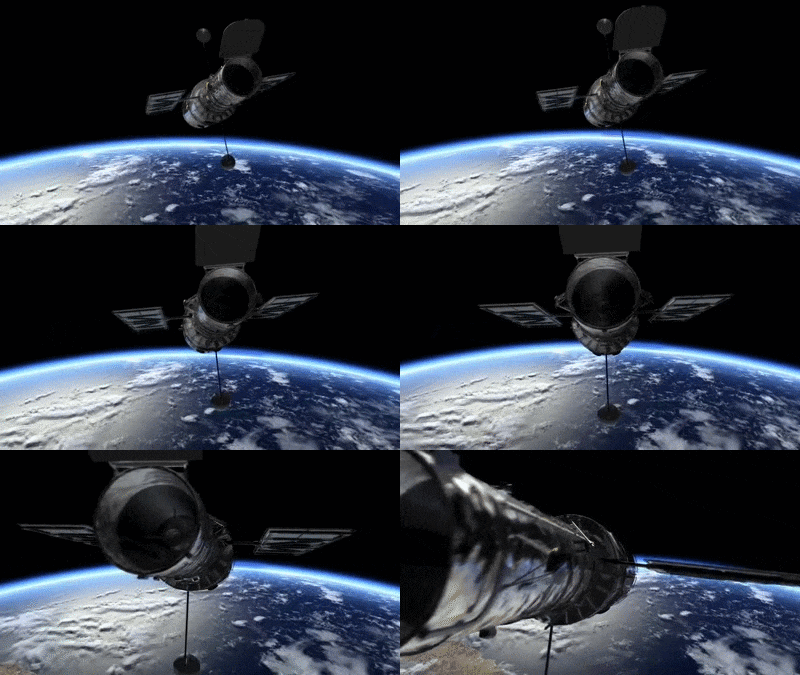
Hubble Space Telescope (HST). Animation Credits: ESA/NASA

The discovery of evidence to support the mechanism of tidal disruption as the explanation for the galaxy’s missing dark matter has not only solved an astronomical conundrum, but has also brought a sigh of relief to astronomers. Without it, scientists would be faced with having to revise our understanding of the laws of gravity.

“This discovery reconciles existing knowledge of how galaxies form and evolve with the most favorable cosmological model,” added Montes.

Notes:

[1] These results were achieved using data from Hubble Space Telescope programs GO-14644 and GO-15695 (PI: van Dokkum).


More information:

The Hubble Space Telescope is a project of international cooperation between ESA and NASA.

The international team of astronomers in this study consists of M. Montes, R. Infante-Sainz, A. Madrigal-Aguado, J. Román, M. Monelli, A. S. Borlaff, and I. Trujillo.

These results have been published in the Astrophysical Journal.

Links:

Images of Hubble: http://www.spacetelescope.org/images/archive/category/spacecraft/

Science paper: https://iopscience.iop.org/journal/0004-637X

Instituto de Astrofísica de Canarias release: https://iac.es/en/outreach/news/mechanism-removing-dark-matter-galaxies-has-been-found

Link to Space Scoop - a kid friendly version of this news: http://www.spacescoop.org/en/scoops/2046/missing-darkness/

Images Credits: ESA/Hubble, NASA, Digitzed Sky Survey 2. Acknowledgement: Davide de Martin/School of Physics, University of New South Wales/M. Montes et al./Instituto de Astrofísica de Canarias/Ignacio Trujillo/ESA/Hubble, Public Information Officer/Bethany Downer.

ESA and ClearSpace SA Sign Contract for World's First Debris Removal Mission


ESA - ClearSpace logo.


Nov. 26, 2020

ESA signs an 86 million euro contract with an industrial team led by the young Swiss company ClearSpace SA for the purchase of a unique service: the first removal of space debris in orbit.

ClearSpace-1

So in 2025 ClearSpace SA will launch the first active debris removal mission, ClearSpace-1, which will rendezvous with a Vespa payload adapter to capture and deorbit it.

A new methodology for ESA

At the Space19 + Ministerial Council, ministers granted ESA the necessary funding to enter into a service contract with a commercial supplier for the safe removal of an inactive object in low earth orbit.

Following a competitive process, an industrial team led by ClearSpace SA, a spin-off company of the Federal Polytechnic School of Lausanne (EPFL), was invited to submit the final proposal. With the signing of this contract, a crucial step in establishing a new business sector in space will be taken.

ClearSpace-1 with captured Vespa

Purchasing the mission as part of an end-to-end service contract, rather than developing an ESA-defined spacecraft for in-house operation, represents a new approach for ESA. ESA purchases the initial mission and provides key expertise within the framework of the ADRIOS (Active Debris Removal / In-Orbit Servicing) project of its Space Security program. ClearSpace SA will finance the remaining cost of the assignment through commercial investors.

The size of the target, Vespa, is close to that of a small satellite

The ClearSpace-1 mission will target a Vespa dual-launch carrier structure of the Vega rocket, left after the second flight of the European Vega launcher in 2013 in an orbit meeting debris mitigation standards, at an altitude of approximately 660 km to 800 km. With a mass of 112 kg, the size of the target, Vespa, is close to that of a small satellite.

Process of Vespa capture

In nearly 60 years of space activity, more than 5,550 launches have tracked 42,000 objects in orbit, of which approximately 23,000 are still in space and are being tracked regularly. With an average today of nearly one hundred launches annually, and with decays continuing to occur at a historic average rate of four to five per year, the number of space debris will continue to steadily increase.


Image above: ClearSpace-1 will target the tapered top portion of the payload adapter that put Proba-V into orbit.

ClearSpace-1 will demonstrate its technical and commercial ability to significantly enhance the long-term sustainability of spaceflight. The mission is supported under the ESA Space Security program, based at the ESOC Operations Center located in Darmstadt, Germany.

Participation of European industry in ClearSpace-1

Companies from a large number of European countries are participating in the ClearSpace-1 mission. While the management of the industrial team is provided by ClearSpace AG, contributions come from companies in Switzerland, the Czech Republic, Germany, Sweden, Poland, the United Kingdom, Portugal and Romania.

Distribution of space debris around the Earth

Media representatives are invited to attend an online panel discussion on Tuesday, December 1 from 1:30 p.m. to 2:30 p.m. CET. Information and accreditation request at this link:
https://www.esa.int/Newsroom/Press_Releases/Call_for_Media_ESA_and_ClearSpace_SA_sign_contract_for_world_s_first_debris_removal_mission

Related links:

ClearSpace SA: https://clearspace.today/

École Polytechnique Fédérale de Lausanne (EPFL): https://www.epfl.ch/en/

ClearSpace-1: https://www.esa.int/ESA_Multimedia/Images/2019/12/ClearSpace-1

Space19+: http://www.esa.int/About_Us/Corporate_news/ESA_ministers_commit_to_biggest_ever_budget

Images, Animations, Text, Credits: ESA/ClearSpace/CNES/Arianespace/Optique Video du CSG/Orbiter.ch Aerospace/Roland Berga.

Greetings, Orbiter.ch

mercredi 25 novembre 2020

Дебютанты открытого космоса / Open space debutants


ROSCOSMOS patch / Russian Cosmonaut patch.


Nov. 25, 2020

русский / Russian:


18 ноября 2020 года космонавты Роскосмоса Сергей Рыжиков и Сергей Кудь-Сверчков в рамках подготовки к запуску и последующей стыковке лабораторного модуля «Наука» выполнили 47-й плановый выход в открытый космос по российской программе Международной космической станции. Продолжительность внекорабельной деятельности составила 6 часов 47 минут.


Космонавты Роскосмоса также заменили планшет эксперимента «Импакт» по изучению влияния выбросов из сопел двигателей ориентации служебного модуля «Звезда». И ближе к концу своей работы за бортом Сергей Рыжиков и Сергей Кудь-Сверчков повернули блок давления и осаждений, который установлен на малом исследовательском модуле.


Для обоих космонавтов это был первый выход в открытый космос в карьере. Работы по внекорабельной деятельности они выполняли в новых скафандрах «Орлан-МКС», один из них с красными лампасами (Рыжиков), другой — с синими (Кудь-Сверчков). Сегодня космонавт Роскосмоса Сергей Кудь-Сверчков опубликовал на своей официальной странице ВКонтакте уникальные фотографии из открытого космоса.


«На что же похожа работа за бортом? Конечно, работа снаружи очень сильно похожа на наши тренировки в гидролаборатории, — отмечает Сергей Кудь-Сверчков. — Тяжелый скафандр массой 120 кг и передвижение только на руках. Мне лично передвижение по поручням напомнило восхождения в горах, когда ты находишься на большой высоте, двигаешься по веревкам (или без них), перестёгиваешься, думая о точках страховки и ключевых точках маршрута. Шаг за шагом, плавно, но без остановок, а когда наступала тень, то в памяти ясно всплывали картинки уже из спелеоэкспедиций или кейв-дайвинга: ничего не видно, кроме снаряжения и окружающего пространства, попадающего в пятно фонарей. Внутренние ощущения были знакомы и уже не вызывали удивления или дискомфорта».


English / английский:

On November 18, 2020, Roscosmos cosmonauts Sergei Ryzhikov and Sergei Kud-Sverchkov, in preparation for the launch and subsequent docking of the Nauka laboratory module, performed the 47th planned spacewalk under the Russian program of the International Space Station. The duration of the extravehicular activity was 6 hours 47 minutes.


Roscosmos cosmonauts also replaced the tablet of the Impact experiment to study the effect of emissions from the nozzles of the orientation engines of the Zvezda service module. And towards the end of their work overboard, Sergei Ryzhikov and Sergei Kud-Sverchkov turned the pressure and deposition unit, which is installed on the small research module.


For both astronauts, this was the first spacewalk in their careers. They performed work on extravehicular activities in new Orlan-ISS spacesuits, one with red stripes (Ryzhikov), the other with blue stripes (Kud-Sverchkov). Today Roskosmos cosmonaut Sergei Kud-Sverchkov published unique photographs from outer space on his official VKontakte page.


“What is working overboard like? Of course, working outside is very much like our training in the hydro laboratory, - says Sergey Kud-Sverchkov. - A heavy spacesuit weighing 120 kg and moving only by hand. For me personally, moving on the handrails reminded me of climbing in the mountains, when you are at a high altitude, move along the ropes (or without them), change the harness, thinking about belay points and key points of the route. Step by step, smoothly, but without stopping, and when the shadow came, the pictures from speleo expeditions or cave diving clearly popped up in my memory: nothing was visible except the equipment and the surrounding space that fell into the spot of the lanterns. Internal sensations were familiar and no longer caused surprise or discomfort. "


Related articles:

Cosmonauts Wrap Up Spacewalk at Station
https://orbiterchspacenews.blogspot.com/2020/11/cosmonauts-wrap-up-spacewalk-at-station.html

Cosmonauts Begin Spacewalk to Ready Station for New Module
https://orbiterchspacenews.blogspot.com/2020/11/cosmonauts-begin-spacewalk-to-ready.html

Related links:

Notes: https://vk.com/wall-198882297_1167

ROSCOSMOS Press Release: https://www.roscosmos.ru/29604/

Images, Text, Credits: ROSCOSMOS/Orbiter.ch Aerospace/Roland Berga.

Best regards / С уважением, Orbiter.ch

Crew Off-Duty for Thanksgiving and Preps for Dragon Cargo Mission


ISS - Expedition 64 Mission patch.


Nov. 25, 2020

The seven-member Expedition 64 crew from the United States, Russia and Japan will take the day off on Thanksgiving before ending the week with a day full of microgravity research. In the meantime, the crew spent Wednesday on a wide array of space science while getting the International Space Station ready for an upgraded SpaceX Dragon resupply ship.

NASA Flight Engineers Kate Rubins and Shannon Walker worked throughout Wednesday readying the station’s Tranquility module for a new commercial airlock from NanoRacks. Dubbed Bishop, the airlock will be delivered on the next SpaceX Dragon cargo mission targeted to launch on Dec. 5. The Bishop airlock will enable private industries to increase research opportunities in the vacuum of space.


Image above: A bright blue, South Atlantic Ocean is pictured as the International Space Station soared nearly 270 miles above, just off the coast of Argentina. Image Credit: NASA.

Planned for Dec. 6, this will be the first automated docking of the Cargo Dragon to the space-facing port on the Harmony module. Previous Cargo Dragon vehicles were captured with the Canadarm2 robotic arm maneuvered by astronauts. Robotics controllers then took over and remotely installed Dragon to Harmony’s Earth-facing port.

The GRASP human research experiment, sponsored by the European Space Agency (ESA), was back on the science schedule Wednesday. Flight Engineers Michael Hopkins and Victor Glover wore virtual reality goggles and responded to virtual stimuli to help doctors understand how the central nervous system, specifically hand-eye coordination, adapts to weightlessness.

Sunrise seen from the International Space Station (ISS). Animation Credit: Orbiter.ch Aerospace

JAXA astronaut and Flight Engineer Soichi Noguchi started his day servicing the Kibo laboratory module’s Cell Biology Experiment Facility, a specialized incubator that can generate artificial gravity. Later, he joined Kate Rubins and examined her eyes using optical coherence tomography.

The orbiting lab’s two cosmonauts, Commander Sergey Ryzhikov and Flight Engineer Sergey Kud-Sverchkov, continued studying ways to make space workouts more effective. The duo later joined Rubins and practiced chest compressions, or cardiopulmonary resuscitation, in the event of a medical emergency aboard the space station.

Related links:

Expedition 64: https://www.nasa.gov/mission_pages/station/expeditions/expedition64/index.html

Tranquility module: https://www.nasa.gov/mission_pages/station/structure/elements/tranquility/

New commercial airlock: https://www.nasa.gov/directorates/spacetech/spinoff/New_Doorway_to_Space

Harmony module: https://www.nasa.gov/mission_pages/station/structure/elements/harmony

Canadarm2 robotic arm: https://www.nasa.gov/mission_pages/station/structure/elements/mobile-servicing-system.html

GRASP: https://www.nasa.gov/mission_pages/station/research/experiments/explorer/Investigation.html?#id=2038

Kibo laboratory module: https://www.nasa.gov/mission_pages/station/structure/elements/japan-kibo-laboratory

Specialized incubator: https://www.nasa.gov/mission_pages/station/research/experiments/explorer/Facility.html?#id=333

Space Station Research and Technology: https://www.nasa.gov/mission_pages/station/research/overview.html

International Space Station (ISS): https://www.nasa.gov/mission_pages/station/main/index.html

Image (mentioned), Animation (mentioned), Text, Credits: NASA/Mark Garcia/Orbiter.ch Aerospace/Roland Berga.

Best regards, Orbiter.ch

Over to you, Eumetsat!


ESA & NASA - Sentinel-6 Mission patch.


Nov. 24, 2020

Ice lost from ice sheets contributes to sea-level rise

It was a spectacular launch on 21 November, as the Copernicus Sentinel-6 Michael Freilich satellite was lifted into space on a SpaceX Falcon 9 rocket. After taking care of the Earth observation spacecraft during the critical early days and making it at home in its new environment, ESA is ready to hand over control to Eumetsat.

About an hour after a flawless launch, Sentinel-6 Michael Freilich Earth separated from the SpaceX Falcon 9 rocket, and for the first time it was flying on its own.


Animation above: Sentinel-6 Michael Freilich separates from the SpaceX Falcon 9 rocket shortly after launch.

Soon after, ESA’s mission control in Germany received the very first signals from the fledgling mission. This vital moment, the ‘acquisition of signal’, is what teams had been waiting for, because it meant they could lock on to the satellite with ground stations across the globe and receive its ‘telemetry’ - data providing information on the mission’s health.

Of course, controlling missions is a two way conversation. We receive information about the spacecraft and all the observational data it has gathered in the signals it beams down to Earth, but we also speak to it, sending commands. Once teams at ESA’s ESOC Operations Centre had sent their first commands, it was time to declare “we have a mission!”.

“It’s always tense in the moments before we capture the first signal, until then, it's too soon to celebrate as we haven't yet taken control,” explains Jose Morales, Head of Earth observation missions at ESA.

Over to you, Eumetsat!

“Once our screens lit up green, we knew that Sentinel-6 was in our hands and it is then that the real work began getting the spacecraft ready for an important life in space.”

In the days since launch, known as the Launch and Early Orbit Phase (LEOP), the flight control team at the Agency’s Operations Centre took meticulous care of the new Sentinel. These early days came with many challenges, as the new spacecraft began using its solar arrays for power, woke up to test its core functioning and performed two manoeuvres to initiate its drift towards its final, operational orbit, all the while at its most vulnerable to the hazards of space.

Mission control happy to hear Sentinel-6's first words

Now the LEOP is complete, ESA’s mission control team is handing over command and control of the satellite to Eumetsat – Europe’s weather and climate satellite organisation – who will complete the final ‘orbit acquisition’ and take on responsibility for commissioning, routine operations and distribution of the mission’s vital data.

“The critical Launch and Early Orbit Phase went smoothly and is now complete, and we are thrilled to pass on this mission to our friends at Eumetsat, who will distribute its data on Earth’s changing oceans,” explains Simon Plum, ESA’s Head of Mission Operations. “I am particularly proud of the dedication shown by everyone involved at all stages of this important mission. Their commitment has gone above and beyond expectation and truly demonstrates how seriously they take their roles.”

“It’s testament to the hard work and expertise of our teams at ESOC that in the midst of a global pandemic they continue to safely carry out some of the hardest jobs in space.”

Related article:

New Copernicus satellite to monitor sea-level rise launched
https://orbiterchspacenews.blogspot.com/2020/11/new-copernicus-satellite-to-monitor-sea.html

Related links:

Sentinel-6: https://www.esa.int/Applications/Observing_the_Earth/Copernicus/Sentinel-6

Copernicus: https://www.esa.int/Applications/Observing_the_Earth/Copernicus

Observing the Earth: https://www.esa.int/Applications/Observing_the_Earth

Animations, Images, Text, Credits: ESA/ATG medialab.

Best regards, Orbiter.ch