jeudi 8 avril 2021

NASA TV Broadcasts Friday Launch to Station on Soyuz Crew Ship


ISS - Expedition 65 Mission patch.


April 8, 2021

A trio of space travelers, including NASA astronaut Mark Vande Hei, is scheduled to launch aboard the Soyuz MS-18 spacecraft from the Baikonur Cosmodrome in Kazakhstan to the International Space Station at 3:42 a.m. EDT (12:42 p.m. Kazakhstan time) Friday, April 9.

Beginning at 2:45 a.m., NASA Television, the agency’s website, and the NASA app will provide live coverage of the crew’s launch. Teams at the Baikonur Cosmodrome in Kazakhstan are making final preparations for the liftoff of Vande Hei and Russian cosmonauts Oleg Novitskiy and Pyotr Dubrov.


Image above: Expedition 65 crew members (from left) Mark Vande Hei, Oleg Novitskiy and Pyotr Dubrov pose for a portrait at the Gagarin Cosmonaut Training Center in Russia. Image Credit: ROSCOSMOS.

The launch will send the crew members on a two-orbit, three-hour journey to the space station, where they will join the Expedition 64 crew, temporarily increasing the orbiting laboratory’s population to 10 people.

They will join NASA Flight Engineer Kate Rubins, who arrived on the station with Commander Sergey Ryzhikov and Flight Engineer Sergey Kud-Sverchkov of Roscosmos in October 2020, and the crew of the SpaceX Crew Dragon Resilience – NASA astronauts Michael Hopkins, Victor Glover, and Shannon Walker, as well as Japan Aerospace Exploration Agency (JAXA) astronaut Soichi Noguchi – who have been in orbit since November.


Image above: Expedition 65 crew members Russian cosmonaut Pyotr Dubrov of Roscosmos, left, Russian cosmonaut Oleg Novitskiy of Roscosmos, center, and NASA astronaut Mark Vande Hei, pose for a photo during qualification exams, Saturday, March 20, 2021, at the Gagarin Cosmonaut Training Center (GCTC) in Star City, Russia, in advance of their scheduled launch April 9 from Baikonur Cosmodrome in Kazakhstan to the International Space Station. Image Credits: NASA/GCTC/Andrey Shelepin.

It will be the second spaceflight for Vande Hei, the third for Novitskiy, and the first for Dubrov. The launch comes three days before the 60th anniversary of cosmonaut Yuri Gagarin’s launch to become the first human in space and the 40th anniversary of the first launch of NASA’s space shuttle.

During their six-month mission, the Expedition 65 crew will continue work on hundreds of experiments in biology, biotechnology, physical science, and Earth science aboard the International Space Station, humanity’s only permanently occupied microgravity laboratory. Work on the unique microgravity laboratory advances scientific knowledge and demonstrates new technologies, making research breakthroughs that will enable long-duration human and robotic exploration of the Moon and Mars.

Below is the crew’s launch timeline in EDT:

April 8 EDT   L-Hr/M/Sec  Event

18:05:41pm    9:37:00        Crew wakeup at Cosmonaut Hotel (time appx)
21:05:41pm    6:37:00        Crew departs Cosmonaut Hotel (time appx)
21:50:41pm    5:52:00        Crew arrives at Site 254
21:57:41pm    5:45:00        Batteries installed in booster
22:35:41pm    5:07:00        Crew suit up
22:42:41pm    5:00:00        Tanking begins
23:37:41pm    4:05:00        Booster loaded with liquid oxygen; crew meets with officials
23:56:41pm    3:46:00        Crew walkout from 254; boards bus for the launch pad

April 9 EDT

00:01:41am    3:41:00        Crew departs for launch pad at Site 31
00:37:41am    3:05:00        First and second stage oxygen fueling complete
01:11:41am    2:31:00        Crew arrives at launch pad at site 31
01:17:41am    2:25:00        Crew boards Soyuz; strapped in to the Descent module
02:07:41am    1:35:00        Descent module hardware tested
02:22:41am    1:20:00        Hatch closed; leak checks begin
02:42:41am    1:00:00        Launch vehicle control system prep; gyro activation

02:45:00am     :57:41        NASA TV LAUNCH COVERAGE BEGINS

02:57:41am     :45:00        Pad service structure components lowered
02:58:41am     :44:00        Clamshell gantry service towers retracted

03:05:00am     :37:41         NASA TV: Crew pre-launch activities played (B-roll)

03:05:41am      :37:00        Suit leak checks begin; descent module testing complete
03:08:41am      :34:00        Emergency escape system armed
03:27:41am      :15:00        Suit leak checks complete; escape system to auto
03:32:41am      :10:00        Gyros in flight readiness and recorders activated
03:35:41am      :07:00        Pre-launch operations complete
03:36:41am      :06:00        Launch countdown operations to auto; vehicle ready
03:37:41am      :05:00        Commander’s controls activated
03:38:41am      :04:00        Combustion chamber nitrogen purge
03:39:41am      :03:00        Propellant drainback
03:39:58am      :02:43        Booster propellant tank pressurization
03:41:11am      :01:30        Ground propellant feed terminated
03:41:41am      :01:00        Vehicle to internal power
03:42:06am      :00:35        First umbilical tower separates

Auto sequence start

03:42:11am      :00:30        Ground umbilical to third stage disconnected
03:42:26am      :00:15        Second umbilical tower separates
03:42:29am      :00:12        Launch command issued

Engine Start Sequence Begins

03:42:31am      :00:10        Engine turbopumps at flight speed
03:42:36am      :00:05        Engines at maximum thrust
03:42:41am      :00:00        LAUNCH OF SOYUZ MS-18 TO THE ISS
03:43:23am    +:00:42       ISS FLIES OVER THE BAIKONUR COSMODROME
03:51:27am      +8:46        Third stage separation and orbital insertion for the Soyuz MS-18 spacecraft

Related links:

NASA Television: https://www.nasa.gov/live

Expedition 65: https://www.nasa.gov/mission_pages/station/expeditions/expedition65/index.html

International Space Station (ISS): https://www.nasa.gov/mission_pages/station/main/index.html

Images (mentioned), Text, Credits: NASA/Mark Garcia.

Greetings, Orbiter.ch

NASA Mourns the Passing of Astronaut Philip K. Chapman


NASA logo.


Apr 8, 2021

Astronaut Philip K. Chapman. Image Credit: NASA

NASA is saddened by the death of Apollo-era astronaut Philip K. Chapman. He was selected in August 1967 to be a member of Astronaut Group 6, who were primarily scientists rather than pilots.

Chapman was the first Australian-born American astronaut. During the International Geophysical Year in 1958, he was an auroral/radio physicist at Mawson Station, Antarctica, as a member of the Australian National Antarctic Research Expeditions. Later, he was awarded a Doctor of Science in Aeronautics and Astronautics by the Massachusetts Institute of Technology.

After his selection to the astronaut corps, he completed one year of training at Randolph Air Force Base, Texas, and he was involved in preparations for lunar missions, serving in particular as mission scientist for the Apollo 14 mission. Dr. Chapman left the agency in 1972.

Dr. Chapman wanted to expand humanity beyond Earth: “We can build arks for societies of humans to go on multi-generational missions.”

His career after leaving NASA is reported on Wikipedia’s Chapman page. Philip Chapman died on April 5, 2021, in Scottsdale, Arizona.

In this image from 1968, Dr. Chapman trains in the Lunar Module Simulator, Centrifuge, and the Apollo Mission Simulator at the then-Manned Spacecraft Center, now Johnson Space Center. in Houston.

Related links:

Apollo 14: https://www.nasa.gov/mission_pages/apollo/missions/apollo14.html

Wikipedia’s Chapman page: https://en.wikipedia.org/wiki/Philip_K._Chapman

Image (mentioned), Text, Credits: NASA/Yvette Smith.

R.I.P., Orbiter.ch

Satellites monitor Mount Etna’s unpredictable behaviour


ESA - Copernicus logo.


April 8, 2021

ESA's Sentinel satellites

Italy’s Mount Etna, Europe’s most active volcano, has recently been on explosive form, with 17 eruptions in less than three months. Instruments onboard three different satellites orbiting Earth have acquired imagery of the eruptions – revealing the intensity of the lava-fountaining eruptive episodes, known as paroxysms.

Located on the east coast of Sicily, Mount Etna is one of the world’s most active volcanoes. Its eruptions occur at the summit, where there are four craters: the Voragine and the Bocca Nuova, formed in 1945 and 1928 respectively, the Northeast Crater, the highest point on Etna (3330 m) and the Southeast Crater, which has recently been the most active of the four.

Starting in February 2021, the Southeast Crater produced a series of intense lava fountains colouring the night sky in hues of orange and red. Over the course of the following weeks, the volcano produced lava fountains reaching as high as 1.5 km.

Mount Etna eruptions

These spectacular explosions are amongst the highest observed at the Southeast Crater in recent decades. In the past, lava fountains reaching the same height were only observed at the Voragine crater in December 2015 – with lava fountains of over 2000 m.

Different satellites carry different instruments that can provide a wealth of complementary information to understand volcanic eruptions. Once an eruption begins, optical instruments can capture the various phenomena associated with it, including lava flows, mudslides, ground fissures and earthquakes.

The images below show the latest activity taking place in the volcano. The images, captured by the Copernicus Sentinel-2 and Sentinel-3 missions, have been processed using the shortwave-infrared band to show the ongoing activity in the crater. Smoke plumes can be seen blowing eastwards towards the town of Giarre.

Sulphur dioxide concentrations on 24 March 2021

Atmospheric sensors on satellites can also identify the gases and aerosols released by the eruption, as well as quantify their wider environmental impact. The image below, captured by the Copernicus Sentinel-5P satellite, shows the sulphur dioxide concentrations visible travelling southwards towards Libya. Sulphur dioxide is released from a volcano when magma is relatively close to the surface.

After a week or so of remaining calm, Etna’s Southeast Crater re-awoke on the morning of 31 March with a loud explosion at around 07:00 CEST, followed by several puffs of ash and lava.

According to the National Institute of Geophysics and Volcanology in Italy (INGV), the explosive activity increased in the late afternoon and during the night with lava flowing towards the Valle del Bove, with smaller flows advancing southwards. As of today, activity in the Southeast Crater remains calm.

Related links:

Sentinel-2: http://www.esa.int/Applications/Observing_the_Earth/Copernicus/Sentinel-2

Sentinel-3: http://www.esa.int/Applications/Observing_the_Earth/Copernicus/Sentinel-3

Sentinel-5P: https://www.esa.int/Applications/Observing_the_Earth/Copernicus/Sentinel-5P

Copernicus: https://www.esa.int/Applications/Observing_the_Earth/Copernicus

National Institute of Geophysics and Volcanology in Italy (INGV): https://ingvvulcani.com/2021/04/02/etna-31-marzo-1-aprile-2021-un-parossismo-insolito/

Observing the Earth: https://www.esa.int/Applications/Observing_the_Earth

Animation, Image, Text, Credits: ESA/Contains modified Copernicus Sentinel data (2021), processed by ESA, CC BY-SA 3.0 IGO.

Greetings, Orbiter.ch

Seven Ways the International Space Station Helps Us Study Plant Growth in Space


ISS - Veggie Mission patch.


Apr 8, 2021

As NASA plans long-duration missions to the Moon and Mars, a key factor is figuring out how to feed crews during their weeks, months, and even years in space.

Food for crews aboard the International Space Station is primarily prepackaged, requires regular resupply deliveries aboard cargo spacecraft, and degrades in quality and nutrition after about 18 months. But what if astronauts could grow some of their own food in microgravity? Researchers on Earth and crews aboard the International Space Station are exploring the idea by testing various crops and equipment to see if the plan could work.


Image above: NASA astronaut Peggy Whitson looks at the Advanced Astroculture Soybean plant growth experiment. Image Credit: NASA.

NASA hopes to successfully grow fresh, pick-and-eat crops that are easy to produce and do not require a lot of extra equipment or precious electrical power.

“Crews really seem to enjoy growing the food themselves,” said Howard Levine, chief scientist for NASA’s International Space Station Research Office at Kennedy Space Center in Florida. “It’s a nice reprieve from typical activities on the station, and astronauts often volunteer their free time to do it.”


Image above: NASA astronauts Shannon Walker and Michael Hopkins collect leaf samples from plants growing inside the European Columbus laboratory for the Veg-03 experiment during Expedition 64. Image Credit: NASA.

To date, NASA has grown a variety of plants, including lettuces, mustard varieties, and radishes – and learned a lot about how to successfully do so in the process.

Here are seven aspects of plant growth we are studying aboard the space station:

1) Picking the right plants

What grows well on Earth may or may not do so well in space. Before sending a crop to space, scientists must identify which plants to test aboard the space station. To improve that process, NASA started a project in 2015 with the Fairchild Botanical Garden in Miami called “Growing Beyond Earth.” The program has recruited more than 230 middle and high school science classes across the U.S. to grow different seeds using special equipment. Seeds that grow well in the classrooms are then tested in a chamber at Kennedy that closely resembles the space station’s equipment. Selected seeds that do well at Kennedy are then sent to station. How they grow in orbit can inform the selection of plants for long-duration missions nly minimal crew attention.

Radishes Growing in Space: 27 Days in 10 Seconds

2) Learning to garden in space

Plants need a place to grow, and NASA has tested out a number of facilities to host a microgravity garden. One way is by experimenting with the Vegetable Production System, or “Veggie,” which is a simple, low-power gardening chamber that can hold six crop plants. Seeds are grown in small fabric “pillows” placed in Veggie. Crews then look after and water the plants by hand, similar to caring for a window herb garden on Earth.

NASA is developing another system, called the Passive Orbital Nutrient Delivery System, or PONDS, to work with the Veggie platform. PONDS replaces the seed pillows with a new plant holder that automatically feeds and waters the produce, but still requires the crew to do some cultivation tasks.Research also uses a hands-off system called the Advanced Plant Habitat. This fully-automated device is designed to study the physiology of how plants grow in space in ways that require only minimal crew attention.


Image above: NASA astronauts Christina Koch and Jessica Meir harvested Mizuna mustard greens on Thanksgiving Day 2019 inside the VEGGIE facility for the Veg-04B experiment. Image Credit: NASA.

3) The right light

The composition of light that shines on plants can affect their size, nutritional content, microbial growth, and taste. Plants particularly rely on red and blue light to grow. Researchers ran experiments aboard the space station to see how different ratios of red and blue light influenced plant development in space. The experiments showed that plants in space grow well under the same light conditions preferred by plants on Earth. While green lights are not necessary for plant growth, they are included in plant growth systems so the plants also appear similar to those grown on Earth.

4) The influence of gravity

Changes in gravity can affect how plants grow and how many crops they yield. Plants can sense gravity using a mechanism that involves changes to calcium within their cells. Astronauts recently ran experiments aboard the space station to measure how microgravity affects these calcium levels, which could offer clues for designing improved ways of growing crops for food in space.

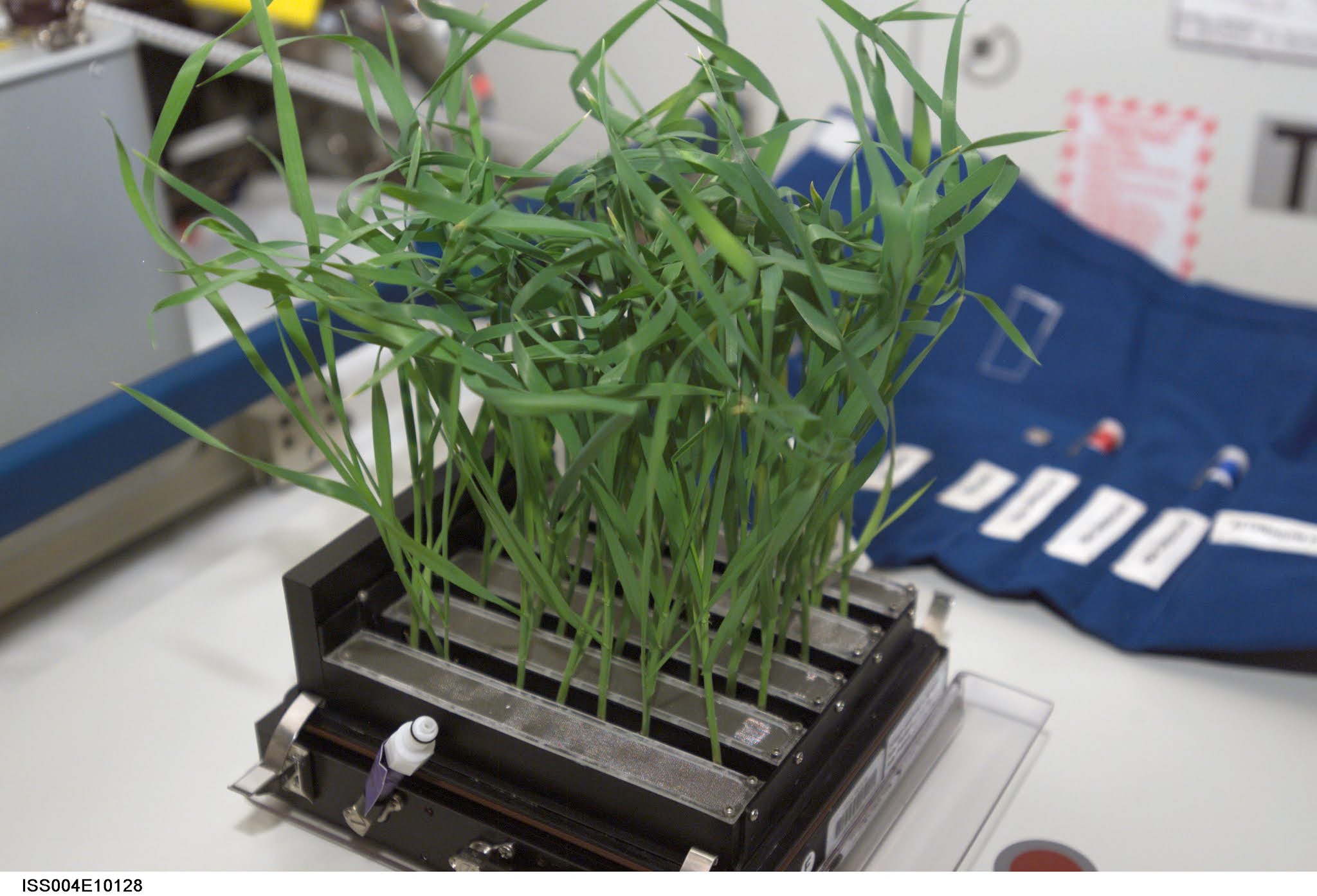
In the PESTO experiment, crews grew wheat plants to see how microgravity may change some of their key features. They found that microgravity alters leaf development, plant cells, and the chloroplasts used in photosynthesis, but did not harm the plants overall -- in fact, wheat plants grew 10% taller compared to those on Earth.

Station crews also successfully grew two generations of mustard plants using the Advanced Astroculture chamber for an experiment that showed the change in gravity caused seeds to be smaller and secondary branches and seed pods to grow differently. Additionally, the experiment grew soybeans from seed-to-seed in space, which produced larger plants and seeds.


Image above: NASA astronaut Victor Glover works on the Plant Water Management experiment that is exploring hydroponics as a way to sustain plants in microgravity from germination through harvest. Image Credit: NASA.

5) Water delivery

One significant challenge to growing plants in microgravity is providing enough water to their roots to keep them healthy without drowning the plants in too much water. Numerous experiments have tested a variety of methods to achieve this, including the new PONDS facility mentioned above and the Plant Water Management experiment. The water management study demonstrated a hydroponic method for providing water and air to the root zone to help them grow. Researchers are growing plants both aboard the space station and on Earth to compare how well they develop.

6) How old is too old?

Future space missions could go on for years, which means the seeds that astronauts bring along could be far from fresh by the time they need to plant them. On Earth, seeds have a decrease in viability and germination over time. But how does the age of seeds and long-term exposure to the spaceflight environment affect their ability to germinate and grow? To find out, in January 2021 NASA grew lettuce and seeds from the cabbage family (kale, mustard, and bok choi) that had been aboard the station for nearly three years. The results showed that while the lettuce seeds did not grow well compared to seeds that had been in space less time, the mustard seeds responded better than expected to the storage time in space.


Image above: Close-up view of Apogee Wheat Plants grown as part of the PESTO experiment during Expedition 4. Image Credit: NASA.

7) The human effect

Gardens need tending, of course, which means astronauts or robots have to look after the plants that are growing. NASA studied how gardening in space could contribute to the behavior and well-being of astronauts. Many astronauts reported they found caring for the plants a fun and relaxing activity.

“Taking care of plants can also help astronauts stay in touch with the life-cycles on Earth,” said Gioia Massa, a life sciences project scientist at Kennedy. Massa’s research focuses on growing plants aboard the space station.

What’s more, astronauts say the time spent gardening makes them excited to eat the fresh produce once it’s ready. The excitement motivates astronauts to creatively use the produce as ingredients in their meals, increasing their quality of life in space and boosting their morale.

Space in 4K - First Lettuce Grown and Eaten in Space

The Biological and Physical Sciences (BPS) Division of NASA’s Science Mission Directorate at NASA Headquarters in Washington provides funding for Veggie, the APH, and related investigations.

Explore more pictures of plants aboard the space station here:

https://www.flickr.com/photos/nasa2explore/albums/72157709539678606

Check out this list of links for more information on how NASA is researching growing plants on the International Space Station:

Veggie

Mission Commander Thrives as ‘Space Gardener’: https://www.nasa.gov/feature/mission-commander-thrives-as-space-gardener

Seed Film Brings New Way to Grow Plants in Space: https://www.nasa.gov/feature/seed-film-brings-new-way-to-grow-plants-in-space

Microgravity Works Wonders With Plant Transplants: https://www.nasa.gov/feature/microgravity-works-wonders-with-plant-transplants

How Does Your Space Garden Grow?:
https://www.nasa.gov/feature/how-does-your-space-garden-grow

PONDS

The Shape of Watering Plants in Space:
https://www.nasa.gov/feature/the-shape-of-watering-plants-in-space

NASA Testing Method to Grow Bigger Plants in Space: https://www.nasa.gov/feature/nasa-testing-method-to-grow-bigger-plants-in-space

Tupperware Takes to Space to Help Improve Astronaut Diets: https://www.nasa.gov/feature/tupperware-takes-to-space-to-help-improve-astronaut-diets

Advanced Plant Habitat

Astronauts Harvest Radish Crop on International Space Station: https://www.nasa.gov/feature/astronauts-harvest-radish-crop-on-international-space-station

Astronauts Grow Radishes in Second Advanced Plant Habitat Experiment: https://www.nasa.gov/image-feature/astronauts-grow-radishes-in-second-advanced-plant-habitat-experiment

NASA Initiates First Grow Out in Advanced Plant Habitat on Space Station: https://www.nasa.gov/feature/nasa-initiates-first-grow-out-in-advanced-plant-habitat-on-space-station

Related links:

Fairchild Botanical Garden: https://fairchildgarden.org/gbe/

Growing Beyond Earth: https://www.nasa.gov/feature/students-help-nasa-researchers-decide-what-plants-to-grow-in-space/

Vegetable Production System (Veggie): https://www.nasa.gov/sites/default/files/atoms/files/veggie_fact_sheet_508.pdf

Passive Orbital Nutrient Delivery System (PONDS): https://www.nasa.gov/mission_pages/station/research/experiments/explorer/Investigation.html?#id=7581

Advanced Plant Habitat: https://www.nasa.gov/sites/default/files/atoms/files/advanced-plant-habitat.pdf

Advanced Astroculture chamber: https://www.nasa.gov/mission_pages/station/research/experiments/explorer/Investigation.html?#id=178

PESTO experiment: https://www.nasa.gov/mission_pages/station/research/experiments/explorer/Investigation.html?#id=215

Plant Water Management experiment: https://www.nasa.gov/mission_pages/station/research/experiments/explorer/Investigation.html?#id=7884

Biological and Physical Sciences (BPS): https://science.nasa.gov/biological-physical

Space Station Research and Technology: https://www.nasa.gov/mission_pages/station/research/overview.html

International Space Station (ISS): https://www.nasa.gov/mission_pages/station/main/index.html

Images (mentioned), Videos (mentioned), Text, Credits: NASA/Ana Guzman/JSC/International Space Station Program Research Office/Charlie Plain.

Best regards, Orbiter.ch

mercredi 7 avril 2021

SpaceX Starlink 24 launch


SpaceX - Falcon 9 / Starlink Mission patch.


April 7, 2021

SpaceX Starlink 24 launch

A SpaceX Falcon 9 rocket launched 60 Starlink satellites (Starlink-24) from Space Launch Complex 40 (SLC-40) at Cape Canaveral Space Force Station, Florida, on 7 April 2021, at 16:34 UTC (12:34 EDT).

SpaceX Starlink 24 launch & Falcon 9 first stage landing, 7 April 2021

Following stage separation, Falcon 9’s first stage landed on the “Of Course I Still Love You” droneship, stationed in the Atlantic Ocean. Falcon 9’s first stage (B1058) previously supported six missions: Demo-2, ANASIS-II, CRS-21, Transporter-1 and two Starlink mission.

Related links:

SpaceX: https://www.spacex.com/

Starlink: https://www.starlink.com/
 
Image, Video, Text, Credits: SpaceX/SciNews/Orbiter.ch Aerospace/Roland Berga.

Greetings, Orbiter.ch

Exodus of civilization into space - Biological End of the World. Part 4


Species extinctions logo.


April 7, 2021

Preamble

Here the fourth article of a series of articles by Ph.D. Morozov Sergey Lvovich, expert in chronology and calendar systems, as well as space biology and medicine, Parliamentarian of Asgardia (AMP) the first space Nation.

Ph.D. Morozov Sergey Lvovich

Biological End of the World (Species extinctions)

Fossilized dinosaur eggs

Earlier, we considered the relationship of climatic periods on Earth with the survival of the species Homo Sapiens and showed the primary influence of Milankovitch cycles on natural selection.

In total, in the history of our planet, as a result of "natural selection", there are 5 massive changes of flora and fauna.

1. Ordovician-Silurian - death of invertebrates, 450 million BC
2. Devonian - death of marine animals, 370 million years BC
3. Permian - death of sea and land animals, 250 million years BC
4. Triassic - death of archosaurs, 200 million years BC
5. Cretaceous-Paleogene I - death of dinosaurs, 65 million years BC

Photo by Mike Beauregard. Royal Tyrrell Museum of Paleontology. Canada

Currently, according to the author, civilization is in transition to the sixth mass change of flora and fauna:

6. Cretaceous-Paleogene II - (?) The beginning of the death of human civilization, 2020 AD.

What species will replace humanity on Earth? We run the risk of never knowing the answer to this question, if we do not timely move the human civilization of our time to Space.

Coming soon to read the continuation of the cycle "The Exodus of Civilization into Space".

Related articles:

Exodus of civilization into space - Geochronological Ice Ages, periods, eras. Part 3
https://orbiterchspacenews.blogspot.com/2021/04/exodus-of-civilization-into-space_5.html

Exodus of civilization into space - Astrophysical End of the World. Part 2
https://orbiterchspacenews.blogspot.com/2021/04/exodus-of-civilization-into-space.html

The ideology of space expansion - Space calendar. Part 1
https://orbiterchspacenews.blogspot.com/2021/03/the-ideology-of-space-expansion-space.html

Related links:

About Ph.D. Morozov Sergey Lvovich: https://zen.yandex.ru/media/id/5fbb90753e3ad265054f930a/ob-avtore-kanala-5fbd2bf80b4af80149fb12c2

Original article in Russian on Zen.Yandex:
https://zen.yandex.ru/media/id/5fbb90753e3ad265054f930a/ishod-civilizacii-v-kosmos-chast-4--biologicheskii-konec-sveta-5fc60e00e8c5ae189c33e90d

Asgardia website: https://asgardia.space/

Author: Ph.D. Morozov Sergey Lvovich / Zen.Yandex. Editor / Translation: Roland Berga. 

Best regards, Orbiter.ch

Station Readies for Expanded Crew as Science Stays in Focus


ISS - Expedition 64 Mission patch.


April 7, 2021

The Expedition 64 crew is getting ready to welcome three new crew members who are due to launch on Friday to the International Space Station. Meanwhile, a variety of space research activities are underway aboard the orbiting lab today.

One NASA astronaut and two Roscosmos cosmonauts are in final preparations for their liftoff on a Soyuz rocket set for Friday at 3:42 a.m. EDT. Flight Engineers Mark Vande Hei and Pyotr Dubrov will flank Soyuz Commander Oleg Novitskiy for the short trip to the station inside the new Soyuz MS-18 crew ship.


Image above: A waning gibbous Moon is pictured above the Earth’s horizon as the space station orbited 269 miles above the Atlantic Ocean. Image Credit: NASA.

Docking of the new Expedition 65 trio to the Rassvet module is planned for 7:07 a.m. The crew will open the hatch after leak and pressure checks and enter the station about 9 a.m. A welcoming ceremony with the expanded 10-person crew along with participants on the ground will occur shortly afterward. NASA TV will broadcast the launch and docking activities beginning at 2:45 a.m.

NASA Flight Engineers Michael Hopkins, Victor Glover and Shannon Walker are busy readying the station to temporarily accommodate the new crew members. The trio is setting up extra sleep stations for this month’s crew swaps when there will be as many as 11 people occupying the space station.

International Space Station (ISS). Animation Credit: ESA

Biomedical studies, or human research, is always ongoing aboard the station. Saliva and blood sample collections were the first tasks of the day for Hopkins, Roscosmos Flight Engineer Sergey Kud-Sverchkov and station Commander Sergey Ryzhikov. Glover scanned his own neck, leg and cardiac veins with an ultrasound device then checked his blood pressure for the Vascular Aging study.

NASA Flight Engineer Kate Rubins installed the new TangoLab-2 biology research hardware, delivered in February aboard the Cygnus space freighter, inside the U.S. Destiny laboratory module. Japanese astronaut Soichi Noguchi readied a materials space exposure study for placement outside the Kibo laboratory module.

Related links:

Expedition 64: https://www.nasa.gov/mission_pages/station/expeditions/expedition64/index.html

Expedition 65: https://www.nasa.gov/mission_pages/station/expeditions/expedition65/index.html

NASA TV: https://www.nasa.gov/nasatv

Rassvet module: https://www.nasa.gov/mission_pages/station/structure/elements/rassvet

Saliva and blood sample: https://www.nasa.gov/mission_pages/station/research/experiments/explorer/Investigation.html?#id=7711

https://www.energia.ru/en/iss/researches/human/22.html

Vascular Aging: https://www.nasa.gov/mission_pages/station/research/experiments/explorer/Investigation.html?#id=7644

TangoLab-2: https://www.nasa.gov/mission_pages/station/research/experiments/explorer/Facility.html?#id=7519

U.S. Destiny laboratory module: https://www.nasa.gov/mission_pages/station/structure/elements/us-destiny-laboratory

Materials space exposure study: https://www.nasa.gov/mission_pages/station/research/experiments/explorer/Investigation.html?#id=8349

Kibo laboratory module: https://www.nasa.gov/mission_pages/station/structure/elements/japan-kibo-laboratory

Space Station Research and Technology: https://www.nasa.gov/mission_pages/station/research/overview.html

International Space Station (ISS): https://www.nasa.gov/mission_pages/station/main/index.html

Image (mentioned), Animation (mentioned), Text, Credits: NASA/Mark Garcia.

Greetings, Orbiter.ch