samedi 27 novembre 2021

55th anniversary of the first launch of the Soyuz rocket carrier


CCCP - Soyuz Rocket patch.


Nov. 27, 2021

55 years ago, on November 28, 1966, the first launch of the Soyuz carrier rocket with the unmanned Soyuz spacecraft was performed from the Baikonur cosmodrome. The Soyuz launch vehicle became the basis for its numerous modifications: Soyuz-U, Soyuz-FG, Soyuz-2. Rockets of this family have become a reliable support for Russian astronautics.

Soyuz FG first launch

The Soyuz is undoubtedly the most famous Russian launch vehicle. It is easily recognizable by the four conical side blocks of the first stage, the characteristic head fairing with four rectangles of lattice fins and the graceful "turret" of the emergency rescue system (on manned launches).

After successful launches of Vostok carrier rockets in 1963, Chief Designer of OKB-1 (now the Energia Rocket and Space Corporation, part of the Roscosmos State Corporation) Sergey Korolev began developing a new direction in manned astronautics. Considered not only simple flights with passive rendezvous of ships in orbit, but also long-term group flights with active rendezvous and docking, the transition of astronauts from ship to ship. To support these tasks, OKB-1 created a spacecraft with new engines and a control system, more comfortable flight conditions for cosmonauts (a utility compartment was introduced into the design) and, accordingly, having a large mass.

Soyuz rocket family

The most powerful rocket at that time was the Voskhod rocket. Nevertheless, its power-to-weight ratio was not enough for the implementation of new space programs. In parallel with the creation of a new spacecraft at OKB-1 by its branch No. 3 in Kuibyshev (now the Progress Rocket and Space Center, part of Roscosmos), work was underway to create a new generation of automatic spacecraft of the Zenit-4MT type, which also required an increase in energy carrier. In addition, there was an acute issue of equipping a manned spacecraft with an active emergency rescue system. So the need arose to develop a new modification of the launch vehicle. She received the name "Union".

By the mid-1960s, all design documentation for the R-7 and R-7A missiles was transferred from the Podlipki near Moscow to Kuibyshev by order of Sergei Korolev. Therefore, in accordance with the Decree of the Government of December 3, 1963, a new three-stage medium-class launch vehicle began to be developed by specialists of branch No. 3 of OKB-1 under the leadership of Dmitry Kozlov. The launch vehicle "Voskhod" with the spacecraft "Voskhod-1" and the world's first crew of three cosmonauts has not yet been launched. Aleksey Leonov had not yet made a spacewalk from the Voskhod-2 spacecraft, and the Kuibyshev designers had already developed a new launch vehicle, which awaited a long and happy fate of the main rocket of the domestic manned cosmonautics.

Soyuz FG

The Soyuz launch vehicle was created on the basis of the Voskhod rocket. The modernization of the three stages was carried out by branch No. 3 of OKB-1. Outwardly, the rocket stages remained practically unchanged, but in terms of their characteristics it was a completely different rocket. As a result of the measures taken, the specific thrust of the first stage engines was increased, the control system of the third stage was modernized and the on-board cable network was significantly lightened. In addition, a new type of emergency rescue system has been developed. She provided the rescue of the crew in the event of a launch vehicle accident both at the launch pad and at any stage of the flight. The structural and layout scheme of the SAS became the base for all modifications of launch vehicles and spacecraft of the Soyuz series, and has survived to this day, although it has been modernized several times over the course of many years of operation.
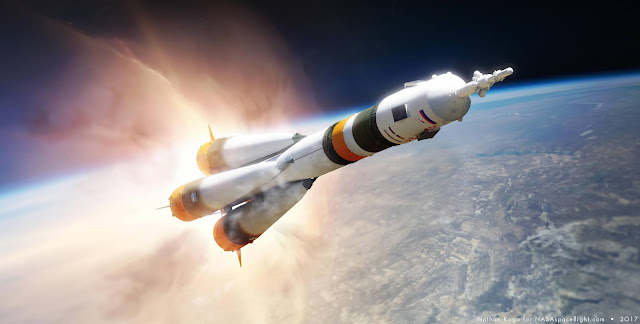
Soyuz FG

On October 26, 1968, the first manned launch of the Soyuz carrier rocket took place from the Baikonur cosmodrome. The Soyuz-3 spacecraft with cosmonaut Georgy Beregov was launched into orbit. More than half a century has passed, but even now Russian spacecraft are sent into space on the most reliable rocket in the world, which bears the name "Soyuz" (Union).

Soyuz FG roll-out

At present, preparations for the next manned launch are underway at the Baikonur cosmodrome. The launch of the Soyuz-2.1a carrier rocket with the Soyuz MS-20 spacecraft is scheduled for December 8, 2021 at 10:38 Moscow time. The flight to the International Space Station will last 12 days under a contract with Space Adventures. The commander of the prime crew is Roscosmos cosmonaut Alexander Misurkin, while Yusaku Maezawa, president of the Start Today corporation, and Yozo Hirano, Yusaku Maezawa's personal assistant, are appointed to the prime crew.
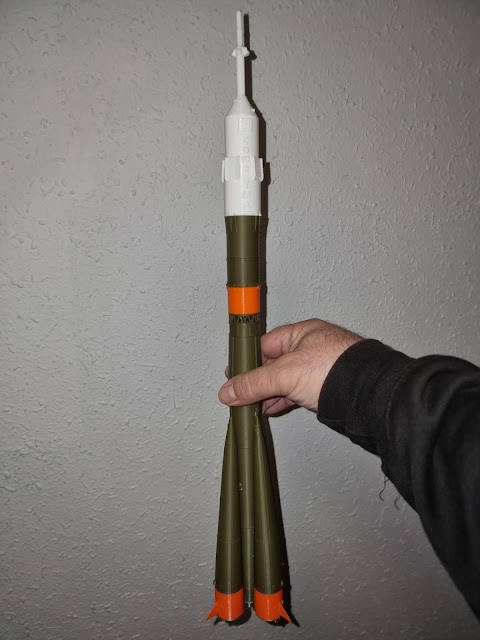
Soyuz FG 3D printing

Order your Soyuz FG scale model (1/100) online (you can also specify a smaller or larger model) via Orbiter 3D Printing: https://www.impresion3d.shop

Related links:

ROSCOSMOS Press Release: https://www.roscosmos.ru/33464/

RSC Energia: https://www.roscosmos.ru/tag/rkk-ehnergija/

RCC Progress: https://www.roscosmos.ru/tag/rkc-progress/

Images, Text, Credits: ROSCOSMOS/RSC Energia/Orbiter.ch Aerospace/Orbiter 3D/Roland Berga.

Best regards, Orbiter.ch

Potentially dangerous asteroid


Moscow Planetarium logo.


Nov. 27, 2021

There is a huge number of asteroids in the solar system, the bulk of which (more than 98%) is concentrated in the main belt located between the orbits of Mars and Jupiter. Sometimes, under the influence of gravity of larger objects, they leave their usual orbits, flying towards the Earth. Asteroids over 150 meters in diameter, which can approach the Earth at a distance of less than 7.5 million km, are considered potentially hazardous objects.


Image above: Asteroid Bennu. The photo is composed of 12 images taken on December 2, 2018 by the OSIRIS-REx spacecraft from a distance of 24 km. Photo Credit: NASA.

Such objects include the asteroid Bennu (101955 Bennu). It was discovered in 2013 at the Socorro Observatory as part of the Lincoln Near-Earth Asteroid Research program to find asteroids. The asteroid was named after the Bennu bird from ancient Egyptian mythology, which was always reborn after death.

In 2016, Bennu became the target of the automatic interplanetary station OSIRIS-REx, designed to deliver soil samples from an asteroid. In 2018, the station reached this facility, and in October 2020, soil sampling took place. The planned return to Earth of the module with samples is September 2023.

The diameter of the asteroid is about 500 meters. It belongs to the spectral class B. It is a relatively rare class that belongs to the group of carbonaceous asteroids that predominate in the outer part of the main belt. Bennu is an active asteroid, periodically throwing out jets of dust and stones up to 10 cm in size. Spectroscopic data showed that its surface consists of a carbonaceous chondrite material, in which the mineral magnetite is present.


Image above: A snapshot of the surface of the asteroid Bennu, taken by OSIRIS-REx after landing (2020). The round head of the robotic arm has a diameter of 30 cm. Photo Credit: NASA.

According to scientists, the likelihood of a possible collision of an asteroid with the Earth between 2178 and 2290 is negligible. Bennu's orbit is dynamically unstable, as are the orbits of all objects approaching the Earth. Therefore, some scientists believe that Bennu has more chances to fly away towards the Sun.

Source: Moscow Planetarium.

Related links:

ROSCOSMOS Press Release: https://www.roscosmos.ru/33467/

Moscow Planetarium: https://www.roscosmos.ru/tag/moskovskiy-planetariy/

Asteroid: https://www.roscosmos.ru/tag/asteroid/

Images (mentioned), Text, Credits: ROSCOSMOS/Moscow Planetarium/Orbiter.ch Aerospace/Roland Berga.

Greetings, Orbiter.ch

vendredi 26 novembre 2021

Space Station Science Highlights: Week of November 22, 2021


ISS - Expedition 66 Mission patch.


Nov 26, 2021

Crew members aboard the International Space Station conducted scientific investigations during the week of Nov. 22 that included testing thermal protection for re-entry to Earth’s atmosphere and a device for detecting eye changes during spaceflight, and studying magnetically assembled colloidal structures. On Saturday, Nov. 20, Northrop Grumman’s uncrewed Cygnus spacecraft departed the space station more than three months after it delivered supplies and scientific investigations.


Image above: Cygnus undocking from the space station. The cargo craft carried capsules for KREPE, an experiment demonstrating a thermal protection system for spacecraft and their contents during re-entry to Earth’s atmosphere. Image Credit: NASA.  

The space station has been continuously inhabited by humans for 21 years, supporting many scientific breakthroughs. The orbiting lab provides a platform for long-duration research in microgravity and for learning to live and work in space, experience that supports Artemis, NASA’s program to go forward to the Moon and on to Mars.

Here are details on some of the microgravity investigations currently taking place:

Coming in hot

KREPE, an experiment using the departing Cygnus craft, demonstrates a thermal protection system for spacecraft and their contents during re-entry to Earth’s atmosphere. Capsules stowed inside Cygnus carry sensors that begin collecting temperature data during re-entry and transmit it to the ground until splashdown. These measurements can be difficult to replicate in ground simulations and KREPE provides an inexpensive platform for atmospheric re-entry experiments. Researchers plan to analyze the data and use it to verify numerical models. Results also could help improve heat shielding materials for applications on Earth, such as in fire disasters.

Keeping an eye on the eyes


Image above: NASA astronaut Raja Chari (standing, left) and ESA astronaut Matthias Maurer (seated, in black) are shown in preflight training for the Retinal Diagnostics investigation, which tests taking images of astronauts’ eyes with a handheld device. Image Credit: ESA.

An ESA (European Space Agency) investigation, Retinal Diagnostics tests using an ophthalmology lens approved for clinical use on Earth to capture images of the human retina in space for detection of vision changes common among astronauts, known as Spaceflight Associated Neuro-ocular Syndrome (SANS). The images are used to test and train machine learning models to detect SANS. Results could show that that a lightweight, mobile, and non-invasive device and a machine learning model can help detect and document the progression of SANS. The technology ultimately could improve space-based medical data collection in support of future long-duration spaceflight missions. On Earth, this technology could enable diagnoses of patients in remote or developing regions that may not otherwise have access to ophthalmology or neurology services. Crew members set up the hardware and performed image collection for the experiment during the week.

Assembling advanced materials

InSPACE-4 studies using magnetic fields to assemble tiny structures from colloids, or particles suspended in a liquid. Colloidal structures have unique properties, such as mechanical response to or interaction with light and heat. Microgravity makes it possible to observe colloidal assembly in ways and over time scales not possible on Earth. Results could lead to more advanced materials for space applications, including thermal shields, protection from micrometeorites, energy production, and sensors for robotic and human missions. This work also could advance the manufacturing of materials on Earth for applications such as sound damping devices, camouflage, medical diagnostics, and building foundation stabilizers for areas prone to earthquakes. During the week, crew members gathered and set up experiment materials in the Microgravity Science Glovebox (MSG).


Image above: This image from the space station shows Patagonia, a region in Chile and Argentina at the tip of the South American continent. Image Credit: NASA.

Other investigations involving the crew:

- JEM Water Recovery System, an investigation from Japanese Aerospace Exploration Agency (JAXA), tests a technology to increase the recovery of drinkable water from urine, which could become a vital part of the Environmental Control and Life Support System (ECLSS) for future space travel and also provide water regeneration in dry regions or post-disaster on Earth.
https://www.nasa.gov/mission_pages/station/research/experiments/explorer/Investigation.html?#id=2049

- The SUBSA-BRAINS investigation examines the process of a soldering technique known as brazing in microgravity. Brazing could be used to construct and repair vehicles and habitats on future space missions.
https://www.nasa.gov/mission_pages/station/research/experiments/explorer/Investigation.html?#id=8295


Image above: Two of the space station’s free-flying Astrobee robots perform operations for Astrobatics, which demonstrates a hopping or self-toss maneuver that could serve as a means of robotic propulsion that uses very little propellant or fuel. Image Credit: NASA.

- Astrobatics demonstrates a hopping or self-toss maneuver with the Astrobee robotic vehicles, which could serve as a means of propulsion using very little propellant. Such maneuvers could be incorporated into future robotic missions and advanced terrestrial robotic applications.
https://www.nasa.gov/mission_pages/station/research/experiments/explorer/Investigation.html?#id=7841

https://www.nasa.gov/mission_pages/station/research/experiments/explorer/Facility.html?#id=1891

- Acoustic Diagnostics, an ESA investigation, tests the hearing of crew members before, during, and after flight to assess possible adverse effects of noise and the microgravity environment on human hearing.
https://www.nasa.gov/mission_pages/station/research/experiments/explorer/Investigation.html?#id=7898

- Metabolic Space, an ESA investigation, demonstrates a wearable system to measure the cardiopulmonary function of astronauts during physical activities. The system could make it easier to monitor astronauts and other space travelers and enable early diagnosis of emerging health issues.
https://www.nasa.gov/mission_pages/station/research/experiments/explorer/Investigation.html?#id=7574

- The ESA GRASP investigation examines how the central nervous system integrates information from the senses to coordinate hand movement and visual input, in part to determine whether gravity is a frame of reference for control of this movement.
https://www.nasa.gov/mission_pages/station/research/experiments/explorer/Investigation.html?#id=2038

- Phospho-aging, an investigation from the Japan Aerospace Exploration Agency (JAXA), examines the molecular mechanism behind aging-like symptoms, such as bone and muscle loss, that can occur more rapidly in microgravity. Results could lead to development of more effective countermeasures.
https://www.nasa.gov/mission_pages/station/research/experiments/explorer/Investigation.html?#id=8278

- Touching Surfaces tests laser-structured antimicrobial surfaces as a method for reducing microbial contamination aboard the space station. Results from this ESA investigation could help determine the most suitable design for antimicrobial surfaces for spacecraft and habitats as well as for terrestrial applications such as public transportation and clinical settings.
https://www.nasa.gov/mission_pages/station/research/experiments/explorer/Investigation.html?#id=8540

- Lumina is an ESA investigation demonstrating real-time monitoring of radiation dose received by crew members using a dosimeter with optical fibers that darken when exposed to radiation. Monitoring ionizing radiation is a key challenge for future space exploration, and this dosimeter could help anticipate radiation flares and guide reaction to them.
https://www.nasa.gov/mission_pages/station/research/experiments/explorer/Investigation.html?#id=8444

Space to Ground: Giving Thanks: 11/26/2021

Related links:

Expedition 66: https://www.nasa.gov/mission_pages/station/expeditions/expedition66/index.html

KREPE: https://www.nasa.gov/mission_pages/station/research/experiments/explorer/Investigation.html?#id=8022

Retinal Diagnostics: https://www.nasa.gov/mission_pages/station/research/experiments/explorer/Investigation.html?#id=8547

InSPACE-4: https://www.nasa.gov/mission_pages/station/research/experiments/explorer/Investigation.html?#id=7669

ISS National Lab: https://www.issnationallab.org/

Spot the Station: https://spotthestation.nasa.gov/

Space Station Research and Technology: https://www.nasa.gov/mission_pages/station/research/overview.html

International Space Station (ISS): https://www.nasa.gov/mission_pages/station/main/index.html

Images (mentioned), Video (NASA), Text, Credits: NASA/Ana Guzman/John Love, ISS Research Planning Integration Scientist Expedition 66.

Best regards, Orbiter.ch

CASC - Long March-3B launches ZhongXing-1D (ChinaSat-1D)


CASC - China Aerospace Science and Technology Corporation  logo.


Nov. 26, 2021

Long March-3B carrying ZhongXing-1D liftoff

A Long March-3B rocket launched the ZhongXing-1D satellite from the Xichang Satellite Launch Center, Sichuan Province, southwest China, on 26 November 2021, at 16:40 UTC (27 November, at 00:40 local time).

Long March-3B launches ZhongXing-1D (ChinaSat-1D)

ZhongXing-1D (中星1D, also known as ChinaSat-1D) is a communications satellite designed to “provide users with high-quality voice, data, radio and television transmission services”.

ZhongXing-1D (ChinaSat-1D) satellite

For more information about China Aerospace Science and Technology Corporation (CASC): http://english.spacechina.com/n16421/index.html

Images, Video, Text, Credits: China Media Group(CMG)/China Central Television (CCTV)/China Aerospace Science and Technology Corporation (CASC)/SciNews/Gunter's Space Page/Orbiter.ch Aerospace/Roland Berga.

Greetings, Orbiter.ch

Scientists Fling Model Stars at a Virtual Black Hole to See Who Survives


NASA - Goddard Space Flight Center (GSFC) logo.


Nov 26, 2021


Image above: From left to right, this illustration shows four snapshots of a virtual Sun-like star as it approaches a black hole with 1 million times the Sun's mass. The star stretches, looses some mass, and then begins to regain its shape as it moves away from the black hole. Image Credits: NASA's Goddard Space Flight Center/Taeho Ryu (MPA).

Watch as eight stars skirt a black hole 1 million times the mass of the Sun in these supercomputer simulations. As they approach, all are stretched and deformed by the black hole’s gravity. Some are completely pulled apart into a long stream of gas, a cataclysmic phenomenon called a tidal disruption event. Others are only partially disrupted, retaining some of their mass and returning to their normal shapes after their horrific encounters.

Supercomputer Simulations Test Star-destroying Black Holes

Video above: Watch eight model stars stretch and deform as they approach a virtual black hole 1 million times the mass of the Sun. The black hole rips some stars apart into a stream of gas, a phenomenon called a tidal disruption event. Others manage to withstand their close encounters. These simulations show that destruction and survival depend on the stars’ initial densities. Yellow represents the greatest densities, blue the least dense. Video Credits: NASA’s Goddard Space Flight Center/Taeho Ryu (MPA).

These simulations, led by Taeho Ryu, a fellow at the Max Planck Institute for Astrophysics in Garching, Germany, are the first to combine the physical effects of Einstein’s general theory of relativity with realistic stellar density models. The virtual stars range from about one-tenth to 10 times the Sun’s mass.

The division between stars that fully disrupt and those that endure isn’t simply related to mass. Instead, survival depends more on the star’s density.

Ryu and his team also investigated how other characteristics, such as different black hole masses and stellar close approaches, affect tidal disruption events. The results will help astronomers estimate how often full tidal disruptions occur in the universe and will aid them in building more accurate pictures of these calamitous cosmic occurrences.

Related links:

Max Planck Institute for Astrophysics: https://www.mpa-garching.mpg.de/

Goddard Space Flight Center (GSFC): https://www.nasa.gov/centers/goddard/home/index.html

Black Holes: https://www.nasa.gov/black-holes

Image (mentioned), Video (mentioned), Text, Credits: NASA/Jeanette Kazmierczak/GSFC/Claire Andreoli.

Greetings, Orbiter.ch

Russia’s New Docking Module Arrives at Station


ROSCOSMOS - Prichal Port Module patch.


Nov. 26, 2021

The five-ton Prichal docking module arrived at the International Space Station at 10:19 a.m. EST, propelled by a modified Russian Progress propulsion compartment. They docked to the Nauka module on the Earth-facing side of the Russian segment two days after lifting off from the Baikonur Cosmodrome in Kazakhstan Wednesday, Nov. 24 at 8:06 a.m. EST (6:06 p.m. Baikonur time). The spacecraft were flying about 260 miles over Ukraine at the time of docking.


Image above: Russia’s new Prichal docking module arrives at the station providing additional docking ports and fuel transfer capabilities. Image Credit: NASA TV.

To make room for Prichal, the uncrewed Progress 78 cargo craft undocked from Nauka at 6:23 a.m. Thursday, Nov. 25, and burned up upon reentry in the Earth’s atmosphere later that morning.

Prichal, named for the Russian word for pier, has five available docking ports to accommodate multiple Russian spacecraft and provide fuel transfer capability to the Nauka module. Named for the Russian word for “science,” Nauka launched to the space station in July.

Prichal docking to the International Space Station

The modified Progress transport spacecraft that guided Prichal to the station will remain in place until late December.

Related article:

Russian Port Module is Safely in Orbit Headed for Station
https://orbiterchspacenews.blogspot.com/2021/11/russian-port-module-is-safely-in-orbit.html

Related links:

Nauka multipurpose laboratory module: https://www.roscosmos.ru/tag/nauka/

International Space Station (ISS): https://www.nasa.gov/mission_pages/station/main/index.html

Image (mentioned), Video, Text, Credits: NASA/Mark Garcia/NASA TV/SciNews.

Best regards, Orbiter.ch

jeudi 25 novembre 2021

Progress MS-17 completed its flight


ROSCOSMOS - Russian Vehicles patch.


Nov. 25, 2021

Today, November 25, 2021, at 14:23 Moscow time, the Progress MS-17 cargo vehicle undocked from the Nauka multipurpose laboratory module of the International Space Station. After 4 hours, it was deorbited, and the unburned parts were flooded in the non-navigable part of the Pacific Ocean.

Progress cargo spacecraft atmospheric reentry

At 17:34:51 Moscow time, the main engine was turned on for braking, having worked for almost 4 minutes, he reported to the "truck" a braking impulse of 118 meters per second. After that "Progress MS-17" left the near-earth orbit and ceased to exist. Unburned in dense layers of the atmosphere, fragments of the ship fell at 18:17:12 Moscow time at the "cemetery of spaceships" in the non-navigable region of the South Pacific Ocean, 1.8 thousand km from the city of Wellington and 7.7 thousand km from the city of Santiago.

The Progress MS-17 spacecraft undocked from the pressurized adapter of the Nauka module together with the transition spacer, which ensured the docking of the Soyuz MS and Progress MS transport vehicles. Now the multipurpose laboratory module is ready for the docking of the Progress M-UM cargo module, which is scheduled for November 26 at 18:26 Moscow time.

Progress MS-17 undocking and departure

As a reminder, the Soyuz-2.1a launch vehicle successfully launched the Progress MS-17 spacecraft into its target orbit on June 30, 2021. Two days later, it docked in the normal mode to the small research module "Poisk" of the Russian segment of the ISS. During its flight, the elements of a one-turn rendezvous scheme with the International Space Station were worked out. A month ago, the ship was re-docked: on October 21, it undocked from the "Search" and spent 29 hours in an autonomous flight. During this time, he made several maneuvers and moved away from the ISS by 185 kilometers. The next day Progress MS-17 spacecraft successfully docked to Nauka in automatic mode.

Related links:

ROSCOSMOS Press Release: https://www.roscosmos.ru/33453/

TsNIIMash: https://www.roscosmos.ru/tag/cniimash/

MCC: https://www.roscosmos.ru/tag/cup/

RSC Energia: https://www.roscosmos.ru/tag/rkk-ehnergija/

Progress MS-17: https://www.roscosmos.ru/tag/progress-ms-17/

International Space Station (ISS): https://www.roscosmos.ru/tag/mks/

Image, Video, Text, Credits: ROSCOSMOS/MCC/TsNIIMash/SciNews/Orbiter.ch Aerospace/Roland Berga.

Best regards, Orbiter.ch