mardi 28 décembre 2021

Crew Unpacks Cargo Dragon and Starts New Space Research


ISS - Expedition 66 Mission patch.


Dec 28, 2021

The Expedition 66 crew members continue unpacking the SpaceX Cargo Dragon vehicle and initiating brand new microgravity investigations. Some of the new science taking place aboard the International Space Station today is looking at plant genetics, human cellular function, and even space laundry techniques.

The four NASA astronauts living on the orbital lab took turns on Tuesday offloading some of the 6,500 pounds of new crew supplies, station hardware, and science experiments. Flight Engineer Kayla Barron began her morning working inside the Cargo Dragon. She then serviced samples inside the Electrostatic Levitation Furnace, a research device that observes the thermophysical properties of high temperature materials.


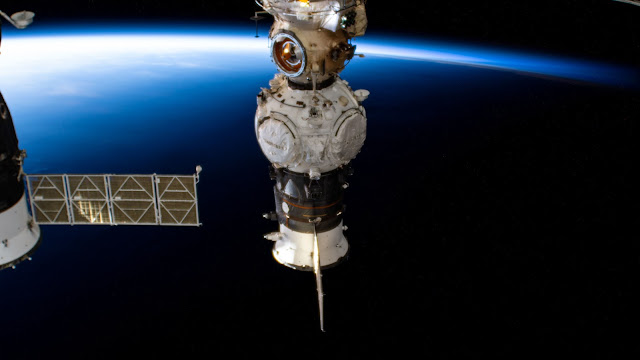
Image above: The Prichal, pictured still attached to the Progress delivery vehicle, is docked to the Nauka multipurpose laboratory module as the station orbited into a sunrise. Image Credits: ROSCOSMOS/NASA.

Astronauts Mark Vande Hei, Thomas Marshburn and Raja Chari got together on Tuesday afternoon to unpack the Cargo Dragon as well. Vande Hei and Marshburn have also begun work on a pair of new experiments exploring how to improve life in space. Vande Hei is testing detergent samples to learn how to keep clothes clean in a variety of gravity environments during long-term space missions. Marshburn set up the Veggie botany research facility for observing plant growth at the genetic level to promote space agriculture. Chari collected and spun his blood samples in a centrifuge then stowed them for later analysis. Afterward, Chari entered the Columbus laboratory module and began organizing cargo packed inside.

Flight Engineer Matthias Maurer of ESA (European Space Agency) collected research hardware from inside Columbus for a space biology investigation. He then began assembling that gear and thawing culture chambers inside the Kibo laboratory module. The work is for the new Cytoskeleton biology study, taking place in the Life Science Glovebox, and will explore how the machinery of the human cell is impacted by weightlessness.

ISS HD Live/Orbiter.ch Aerospace

Cosmonauts Anton Shkaplerov and Pyotr Dubrov, along with Vande Hei, started their day practicing emergency evacuation procedures. The trio trained on a computer for the procedures they would use in the unlikely event they would have to quickly board the Soyuz MS-19 crew ship, undock and return to Earth. Shkaplerov then unpacked Russian spacewalk gear delivered recently aboard the Prichal docking module. Dubrov focused on electronics and hardware maintenance for the rest of the day.

Related links:

Expedition 66: https://www.nasa.gov/mission_pages/station/expeditions/expedition66/index.html

Electrostatic Levitation Furnace: https://www.nasa.gov/mission_pages/station/research/experiments/explorer/Facility.html?#id=1536

Testing detergent samples: https://www.nasa.gov/mission_pages/station/research/experiments/explorer/Investigation.html?#id=8595

Veggie: https://www.nasa.gov/mission_pages/station/research/experiments/explorer/Facility.html?#id=374

Plant growth at the genetic level: https://www.nasa.gov/mission_pages/station/research/experiments/explorer/Investigation.html?#id=8299

Columbus laboratory module: https://www.nasa.gov/mission_pages/station/structure/elements/europe-columbus-laboratory

Kibo laboratory module: https://www.nasa.gov/mission_pages/station/structure/elements/japan-kibo-laboratory

Cytoskeleton: https://www.nasa.gov/mission_pages/station/research/experiments/explorer/Investigation.html?#id=1702

Life Science Glovebox: https://www.nasa.gov/mission_pages/station/research/experiments/explorer/Facility.html?#id=7676

Prichal docking module: https://go.nasa.gov/3cOCFx6

Space Station Research and Technology: https://www.nasa.gov/mission_pages/station/research/overview.html

International Space Station (ISS): https://www.nasa.gov/mission_pages/station/main/index.html

Image (mentioned), Animation (mentioned9, Text, Credits: NASA/Mark Garcia.

Greetings, Orbiter.ch

The launch vehicle "Angara-A5" was launched from the Plesetsk Cosmodrome


ROSCOSMOS logo.


Dec 28, 2021

Angara-A5 liftoff

An Angara-A5 launch vehicle was launched from the Plesetsk Cosmodrome, Russia, on 27 December 2021, at 15:00 UTC (18:00 local time). This was the third test launch (Test flight No.3) for the Angara-A5 (Ангара-А5) heavy lift launch vehicle, the most powerful version of the Angara rocket.

Angara-A5 launch, 2021

The space forces of the Russian Aerospace Forces held on Monday, December 27, 2021, the third test launch of the Angara-A5 heavy carrier rocket with the overall mass model of the payload from the Plesetsk Cosmodrome, the Russian Defense Ministry reported.

Angara-A5 launch

A few minutes later, the orbital block separated from the third stage. Further insertion of the orbital block into the target geostationary orbit will be carried out using the upper stage according to a typical nine-hour three-pulse scheme with four starts of the main engine of the upper stage.

Angara-A5 on launch-pad

Roscosmos State Corporation congratulates the Aerospace Forces and the entire Russian space industry (the team of the Khrunichev Center, NPO Energomash, NPTs AP, TsENKI) on the successful test launch of the Angara-A5 launch vehicle with a new generation upper stage!

This flight showed that the tests of the Angara rocket are developing exactly according to plan. Next year, it is expected that work on the construction of a launch pad for this type of launch vehicle at the Vostochny cosmodrome will be completed. A year later - its first launch from the new Russian Cosmodrome!

Related links:

ROSCOSMOS Press Release: https://www.roscosmos.ru/33724/

Ministry of Defence: https://www.roscosmos.ru/tag/ministerstvo-oboronih/

Angara: https://www.roscosmos.ru/tag/angara/

Images, Video, Text, Credits: Roscosmos/Ministry of Defence of the Russian Federation/SciNews/Orbiter.ch Aerospace/Roland Berga.

Best regards, Orbiter.ch

Hubble Lends a Helping Hand


NASA - Hubble Space Telescope patch.


Dec 28, 2021

Far above rain clouds, light pollution, and atmospheric distortion, NASA’s Hubble Space Telescope has a clear view of the universe. It has shown us distant galaxies, tracked interstellar objects as they soar through our solar system, and studied the atmospheres of planets that orbit other stars. In addition to its own stunning images and groundbreaking discoveries, Hubble uses its powerful vision to support many other past, ongoing, and future missions in space.

Hubble Space Telescope (HST). Image Credit: NASA

These missions represent a vast array of science – from planetary probes that get up close to study the intricate dynamics of the gas giants’ atmospheres, to observatories that look beyond our solar system into deep space to study the early universe.


Image above: The James Webb Space Telescope is expected to launch on December 24, 2021.
Image Credits: NASA/GSFC.

An upcoming key example of support for such missions is Hubble’s preparatory observations for NASA's James Webb Space Telescope, a partnership with the European Space Agency and Canadian Space Agency, set to launch on December 24. Built to advance science goals motivated by Hubble’s discoveries, Webb will have a head start on its mission to learn more about the oldest galaxies in our cosmos, mysterious planets beyond other stars, and much more. This type of mission collaboration has been an important part of Hubble’s legacy.

Uncovering Our Solar System

Hubble has supported several of NASA’s most important and compelling planetary missions. The science and images gathered from these missions have not only allowed us to further our understanding of our outer solar system but also provide us with a closer look.

Hubble’s observations of Jupiter have assisted several missions studying the atmosphere, moons, and cosmic objects surrounding the gas giant. Monitoring activity in Jupiter’s atmosphere for decades, Hubble has seen massive storms burst forward from beneath the clouds, and watched its largest storm, the Great Red Spot, shrink as its wind speeds increase. Following up on these observations and working in tandem with Hubble, the Juno mission has continued to learn more about these cloud layers and what makes the storms stir.

The New Horizons mission used Hubble observations to learn more about its target, the dwarf planet Pluto. Hubble discovered four additional Plutonian moons from its observations, two of which were found after New Horizons launched. Without Hubble’s help, New Horizons would have discovered the tiny moons only a few months before its visit to Pluto, allowing for little time to properly plan all of the new observations. In June 2014, Hubble searched for and discovered another target for the New Horizons spacecraft, 2014 MU69, now called Arrokoth, the farthest and most primitive solar system object ever explored by humankind. New Horizons flew by Arrokoth in early 2019.

Hubble will help study the compositional components of the Trojan asteroids in support of NASA’s Lucy mission, which launched in October 2021. These asteroids orbit the Sun in tandem with Jupiter and are thought to be left over from the formation of the solar system. Because Hubble can detect a small, dim satellite orbiting a larger asteroid – something an Earth-bound telescope might miss – the Lucy team is using Hubble to search for Trojan satellites prior to Lucy’s launch. They made their first round of observations in the fall of 2018.

The next year they spotted something that might have been a satellite near Eurybates, a Trojan asteroid, and submitted an urgent proposal to use Hubble again. They were able to get their observations about a month later. Hubble discovered that Eurybates has a small satellite, subsequently named Queta. This discovery has become a “bonus” science exploration opportunity for the spacecraft as it will be visiting not seven but eight asteroids, targeted for a flyby in 2027.

Though searching for satellites is one of the mission’s central goals, finding these tiny worlds before Lucy launched gives the team the opportunity to investigate their orbits and plan for more detailed follow-up observations with the spacecraft.

Exoplanets, Stars, Galaxies, and More

When Hubble launched over 30 years ago, astronomers had no way to prove that planets existed outside our solar system.

Today, thousands of exoplanets are known to exist. Hubble currently works alongside other space telescopes like TESS, the Transiting Exoplanet Survey Satellite, which aims to find promising exoplanets orbiting our nearest and brightest stars. Hubble supports these TESS discoveries by obtaining ultraviolet spectra of the exoplanets’ host stars to establish how radiation from stars affects their exoplanets’ atmospheric chemistry and composition. Hubble also collects measurements of exoplanet atmospheres to search for evidence of clouds, hazes, and/or water.

Among many other goals, the James Webb Space Telescope will observe exoplanets where Hubble provided a confident detection of water in the atmosphere and measure its abundance.

Hubble is also supporting Webb through a series of preparatory science observations to identify potential targets for the telescope. Started in 2016, the program encourages astronomers to submit science proposals for Hubble observations to pave the way for Webb’s observations. Once launched, the telescope will be able to immediately start probing deeper into stellar populations and building upon observations of galaxies and their forms.

Recently, Hubble had its eye on a relic galaxy, NGC 1277, whose stars were born 10 billion years ago – but it has undergone no further star formation. Galaxies like NGC 1277 are called “red and dead,” and are typically too far away to be studied in detail. Webb will be able to measure the motions of the globular star clusters in NGC 1277 and potentially learn more about the dark matter it contains, providing new insight into this type of galaxy.

NASA's Roman Space Telescope, set to launch in the mid-2020s, will observe many objects Hubble or Webb already studied. It won't focus on a single object, but rather build upon the large mosaics taken by Hubble due to Roman’s large field of view and detectors. One example is the PHAT mosaic which covers a third of the Andromeda Galaxy and was created with over 400 Hubble images. Roman will capture this view in infrared light using only two images, opening a world of understanding about galaxies and their components.

The Future of Astronomy in Deep Space

The COSMOS survey began in 2002 as a Hubble program to image a wide and deep patch of sky, about the area of 10 full moons. Once Webb begins science observations in the summer of 2022, it will build on that legacy by surveying a half-million galaxies within that patch of sky, becoming the largest project Webb will undertake during its first year. Called COSMOS-Webb, this in-depth survey will allow scientists to learn more about dark matter and how it has evolved with galaxies and their stars over the universe’s lifetime.

Hubble Space Telescope (HST). Animation Credits: NASA/ESA

Gravitational waves are 'ripples' in space-time caused by some of the most violent and energetic processes in the universe; these disturbances can be picked up with ground-based detectors like the Laser Interferometer Gravitational-Wave Observatory, which is funded by the National Science Foundation and operated by Caltech and MIT. Because signals from a gravitational wave only give astronomers a very brief signal of spacetime disturbance without much directional information, astronomers then use telescopes that can be pointed very quickly across the sky and cover a vast area to hone in on the region of space where the signals originated. Gravity waves and light waves are physically different ways to transmit information, and observations using both are called multi-messenger astronomy, a rapidly growing field of astronomy.

James Webb Space Telescope (JWST). Animation Credits: NASA/ESA

Once astronomers have found the right galaxy where the cosmic event, such as the merging of two dense neutron stars, has occurred; Hubble is then focused on that area. Hubble can obtain a detailed spectrum of light and a sharp image of the galaxy to better understand the event, detecting radiation that is sometimes associated with the event producing gravitational waves. Once launched, Webb will also be used for in-depth study of these events.

Over its lifetime, Hubble’s powerful vision has “set the stage” for Webb and several other missions that aim to uncover fascinating facts about our universe – from our cosmic neighborhood to the farthest reaches of space.

Related links:

James Webb Space Telescope (JWST): https://jwst.nasa.gov/content/webbLaunch/index.html

Hubble Space Telescope (HST): https://www.nasa.gov/mission_pages/hubble/main/index.html

Images (mentioned), Animations (mentioned), Text, Credits: NASA/Andrea Gianopoulos/GSFC/Claire Andreoli.

Greetings, Orbiter.ch

lundi 27 décembre 2021

Last Week of 2021 Sees New Space Research Kick Off


ISS - Expedition 66 Mission patch.


Dec 27, 2021

The seven-member Expedition 66 crew is going into the final week of 2021 with a host of science experiments exploring numerous space phenomena benefitting astronauts in space and humans on Earth.

NASA Flight Engineers Mark Vande Hei and Kayla Barron worked on a pair of space farming studies during Monday afternoon exploring a variety of plant characteristics. Vande Hei set up components for the MVP (Multi Variable Platform) Plant-01 experiment inside the Harmony module. That study is investigating how a plant’s molecular mechanisms and regulatory networks adapt to weightlessness. Barron worked inside the Kibo laboratory module and configured the Plant Habitat-05 investigation which will observe the regenerative capacity of a variety of cotton genotypes.


Image above: The Soyuz MS-19 crew ship is pictured docked to the Rassvet module as the International Space Station orbited 260 miles above southeast Asia. Image Credit: NASA.

NASA astronauts Raja Chari and Thomas Marshburn started Monday morning transferring research samples to science freezers in the Kibo lab. Chari then moved on and updated emergency checklists while also collecting and stowing his blood and urine samples for later analysis. Marshburn serviced the station’s oxygen generation system then unpacked medical gear from the SpaceX Cargo Dragon vehicle.

Flight Engineer Matthias Maurer of ESA (European Space Agency) spent his day working throughout the orbiting lab on a variety of research gear. Maurer first swapped science freezers inside the Unity module. Next, he installed the BioSentinel radiation exposure study in the Kibo lab. Finally, the astronaut from Germany worked in the Columbus laboratory module thawing research samples for the Cytoskeleton experiment before uninstalling the Kubik incubator.

International Space Station (ISS). Animation Credit: ESA

The station’s commander, Roscosmos cosmonaut Anton Shkaplerov, recharged computer tablets inside the Soyuz MS-19 crew ship while also working on Russian life support maintenance throughout the day. Russian Flight Engineer Pyotr Dubrov checked out electronics gear in the morning before joining Shkaplerov in the afternoon and replacing components on the Zvezda service module’s treadmill.

Related links:

Expedition 66: https://www.nasa.gov/mission_pages/station/expeditions/expedition66/index.html

MVP (Multi Variable Platform) Plant-01: https://www.nasa.gov/mission_pages/station/research/experiments/explorer/Investigation.html?#id=8297

Harmony module: https://www.nasa.gov/mission_pages/station/structure/elements/harmony

Kibo laboratory module: https://www.nasa.gov/mission_pages/station/structure/elements/japan-kibo-laboratory

Plant Habitat-05: https://www.nasa.gov/mission_pages/station/research/experiments/explorer/Investigation.html?#id=8341

Unity module: https://www.nasa.gov/mission_pages/station/structure/elements/unity

BioSentinel: https://www.nasa.gov/mission_pages/station/research/experiments/explorer/Investigation.html?#id=7754

Columbus laboratory module: https://www.nasa.gov/mission_pages/station/structure/elements/europe-columbus-laboratory

Cytoskeleton: https://www.nasa.gov/mission_pages/station/research/experiments/explorer/Investigation.html?#id=1702

Kubik: https://www.nasa.gov/mission_pages/station/research/experiments/explorer/Facility.html?#id=894

Zvezda service module: https://www.nasa.gov/mission_pages/station/structure/elements/zvezda-service-module.html

Space Station Research and Technology: https://www.nasa.gov/mission_pages/station/research/overview.html

International Space Station (ISS): https://www.nasa.gov/mission_pages/station/main/index.html

Image (mentioned), Animation (mentioned), Text, Credits: NASA/Mark Garcia.

Best regards, Orbiter.ch

Arianespace - Flight ST37, successfully placed 36 more OneWeb satellites into orbit


Arianespace - OneWeb 12 / Flight ST37 Mission patch.


December 27, 2021

Flight ST37, the 15th operated by Arianespace in 2021, successfully placed 36 more OneWeb satellites into orbit

- Thanks to ST37, 60% of OneWeb’s constellation is now in orbit, bringing the constellation to 394 satellites launched.

- Thanks to ST37, Arianespace have conducted 15 launches in 2021, including eight  missions for the benefit of OneWeb and a total of nine Soyuz flights, from three different spaceports.

- This launch also marks a new milestone in Arianespace history: since its creation in 1980, the company has officially deployed 1,101 satellites.


On Monday, December 27, at precisely 06:10 p.m. local time at Russia’s Baikonur Cosmodrome (01:10 p.m. UTC), Soyuz flight ST37 lifted-off with 36 OneWeb satellites bringing, after this successful deployment, the size of the fleet in orbit to 394. Flight ST37 was the 63rd Soyuz mission carried out by Arianespace, the 37th with its Starsem affiliate, and the 12th mission for OneWeb.

The mission lasted three hours and 45 minutes. The 36 satellites were deployed during nine separation sequences, at an altitude of 450 km. It was also the fifteenth successful launch operated by Arianespace’s teams this year, bringing to 1,101 the total number of spacecraft orbited since the start of the company’s operations.

OneWeb 12 launch

“It is a very special time of the year, right between Christmas and New Year’s Eve. I would like to warmly thank all the Arianespace and Starsem teams involved in this mission and the incredible work they did alongside our Russian partners in order to allow us to launch, from Baikonour Cosmodrome, our 15th and last launch of 2021. This year has been marked by key milestones, the latest one being that, with today’s flight, we will officially have deployed more than 60% of OneWeb’s constellation,” said Stéphane Israël, CEO of Arianespace. “2021 has been a really busy year for us with 15 launches operated from three different spaceports, which represents a 50% increase in launches over 2020. With 2022 headed in the same direction, we are sure to demonstrate that our services and solutions answer our clients’ needs: any time, any mass, any orbit.”

Today’s launch, Arianespace’s 12th for OneWeb, also was the first time Soyuz delivered 36 satellites –instead of the usual 34- from the Baikonour Cosmodrome. This improvement of the efficiency of the flight itself will allow Arianespace to better and more quickly serve the needs of OneWeb. To obtain this result, the team worked to improve every step in the plan: from the manufacturing process to launch vehicle integration and mission programing.

OneWeb’s mission is to create a global connectivity platform through a next-generation satellite constellation in Low Earth Orbit. The OneWeb constellation will deliver high-speed, low-latency connectivity to a wide range of customer sectors, including aviation, maritime, enterprise and government. Central to its purpose, OneWeb seeks to bring connectivity to the hardest to reach places, where fiber cannot reach, and thereby bridge the digital divide.

OneWeb satellite

The satellite prime contractor is OneWeb Satellites, a joint venture of OneWeb and Airbus Defence and Space. The satellites were produced in Florida, USA, in its leading-edge satellite manufacturing facilities that can build up to two satellites per day on a series production line dedicated to spacecraft assembly, integration, and testing.

The launch of the satellites was operated by Arianespace and its Euro-Russian affiliate Starsem under contract with Glavkosmos, a subsidiary of Roscosmos, the Russian space agency. Arianespace is responsible for the overall mission and flight-worthiness, with the support of Starsem for launch campaign activities including management of its own launch facilities at the Baikonur Cosmodrome. RKTs-Progress (the Samara Space Center) is responsible for the design, development, manufacture and integration of the Soyuz launch vehicle as well as for the 3-stage Soyuz flight. NPO Lavotchkin is responsible for the launch preparation operations and flight of the Fregat orbital vehicle.


About Arianespace

Arianespace uses space to make life better on Earth by providing launch services for all types of satellites into all orbits. It has orbited more than 1,100 satellites since 1980, using its family of three launchers, Ariane, Soyuz and Vega, from launch sites in French Guiana (South America) and from the Russian cosmodromes in Baikonur and Vostochny. Arianespace is headquartered in Evry, near Paris, and has a technical facility at the Guiana Space Center in French Guiana, plus local offices in Washington, D.C., Tokyo and Singapore. Arianespace is a subsidiary of ArianeGroup, which holds 74% of its share capital, with the balance held by 15 other shareholders from the European launcher industry. https://www.arianespace.com

About Starsem

Starsem is dedicated to providing international commercial marketing and operation of the Soyuz launch vehicle from the Baikonur cosmodrome. Shareholders in Starsem are Arianespace, ArianeGroup, the State Space Corporation ROSCOSMOS and the Samara Space Center “RKTs-Progress”. https://www.starsem.com

Images, Video, Text, Credits: Arianespace/Starsem/SciNews.

Greetings, Orbiter.ch

More Than You Wanted to Know About Webb’s Mid-Course Corrections!


NASA / ESA / CSA-ASC - James Webb Space Telescope (JWST) patch.


Dec 27, 2021

James Webb Space Telescope separation

On Dec. 25, the Webb team successfully executed the first of three planned orbit corrections to get Webb into its halo orbit around the second Lagrange point, L2 (1,5 millions kilometers). To hear more about these important maneuvers, here is Randy Kimble, the Webb Integration, Test, and Commissioning Project Scientist, at NASA Goddard:

In sending the Webb Observatory into its orbit around the Sun-Earth L2 point, the vast majority of the energy required was provided by the Ariane 5 rocket. After release of the observatory from the rocket, several small tweaks to the trajectory are planned, to ease the observatory into its operating orbit about one month after launch.

The largest and most important mid-course correction (MCC), designated MCC-1a, has already been successfully executed as planned, beginning 12.5 hours after launch. This time was chosen because the earlier the course correction is made, the less propellant it requires. This leaves as much remaining fuel as possible for Webb’s ordinary operations over its lifetime: station-keeping (small adjustments to keep Webb in its desired orbit) and momentum unloading (to counteract the effects of solar radiation pressure on the huge sunshield).

The burn wasn’t scheduled immediately after launch to give time for the flight dynamics team to receive tracking data from three ground stations, widely separated over the surface of the Earth, thus providing high accuracy for their determination of Webb’s position and velocity, necessary to determine the precise parameters for the correction burn. Ground stations in Malindi Kenya, Canberra Australia, and Madrid Spain provided the necessary ranging data.  There was also time to do a test firing of the required thruster before executing the actual burn. We are currently doing the analysis to determine just how much more correction of Webb’s trajectory will be needed, and how much fuel will be left, but we already know that the Ariane 5’s placement of Webb was better than requirements.


Image above: Webb’s orbit is around L2—a point of gravitational balance on the other side of Earth from the Sun—but it does not reside exactly at the L2 point. Right at that point, Earth’s shadowing of the Sun would be large enough to greatly reduce the amount of power available for Webb’s solar arrays, without greatly simplifying the cooling challenges. In addition, when Webb’s communication antennas point at Earth to receive commands, they would be blinded by the huge radio emission of the Sun in the same direction. Instead, as the diagram indicates, Webb operates in a very loose orbit (many hundreds of thousands of km in diameter) around L2, in constant sunlight and with clean communications with the ground stations. Image Credit:  NASA.

One interesting aspect of the Webb launch and the Mid-Course Corrections is that we always “aim a little bit low.” The L2 point and Webb’s loose orbit around it are only semi-stable. In the radial direction (along the Sun-Earth line), there is an equilibrium point where in principle it would take no thrust to remain in position; however, that point is not stable. If Webb drifted a little bit toward Earth, it would continue (in the absence of corrective thrust) to drift ever closer; if it drifted a little bit away from Earth, it would continue to drift farther away. Webb has thrusters only on the warm, Sun-facing side of the observatory. We would not want the hot thrusters to contaminate the cold side of the observatory with unwanted heat or with rocket exhaust that could condense on the cold optics. This means the thrusters can only push Webb away from the Sun, not back toward the Sun (and Earth). We thus design the launch insertion and the MCCs to always keep us on the uphill side of the gravitational potential,  we never want to go over the crest – and drift away downhill on the other side, with no ability to come back.

Therefore, the Ariane 5 launch insertion was intentionally designed to leave some velocity in the anti-Sun direction to be provided by the payload. MCC-1a similarly was executed to take out most, but not all, of the total required correction (to be sure that this burn also would not overshoot). In the same way, MCC-1b, scheduled for 2.5 days after launch, and MCC-2, scheduled for about 29 days after launch (but neither time-critical), and the station-keeping burns throughout the mission lifetime will always thrust just enough to leave us a little bit shy of the crest. We want Sisyphus to keep rolling this rock up the gentle slope near the top of the hill – we never want it to roll over the crest and get away from him. The Webb team’s job, guided by the Flight Dynamics Facility at NASA Goddard, is to make sure it doesn’t.

Related article & link:

Webb liftoff on Ariane 5 to unlock secrets of the Universe
https://orbiterchspacenews.blogspot.com/2021/12/webb-liftoff-on-ariane-5-to-unlock.html

Track the Webb Telescope and Follow Its Deployment:
https://jwst.nasa.gov/content/webbLaunch/whereIsWebb.html

James Webb Space Telescope (JWST): https://www.nasa.gov/mission_pages/webb/main/index.html

Text Credits: Randy Kimble, JWST Integration, Test, and Commissioning Project Scientist, NASA Goddard Space Flight Center. Video Credits: Arianespace/NASA/SciNews.

Best regards, Orbiter.ch

China Space Station - Shenzhou-13 astronauts complete second spacewalk


CMS - China Manned Space logo.


Dec 27, 2021


On 26 December 2021, the Shenzhou-13 crew conducted an extravehicular activity (EVA, spacewalk). At 10:44 UTC (18:44 China Standard Time), astronaut Ye Guangfu opened the hatch of the Tianhe core module, starting starting his first spacewalk and the second extravehicular activity for the Shenzhou-13 (神舟十三) mission.

Shenzhou-13 astronauts complete second spacewalk

During the spacewalk, astronauts Zhai Zhigang (翟志刚) and Ye Guangfu(叶光富) adjusted the panoramic camera, installed hardware for future use and evaluated the spacesuits, while astronaut Wang Yaping (王亚平) provided support from inside, including operation of the robotic arm. At 16:55 UTC, on 26 December 2021(27 December, at 00:55 China Standard Time), the astronauts successfully completed all the planned tasks. The Tianhe core module (天和核心舱) is the first and main component of the China Space Station (中国空间站), informally known as Tiangong (天宫, Heavenly Palace).

Related articles & link:

China Space Station - Shenzhou-13 mission’s second spacewalk begins
https://orbiterchspacenews.blogspot.com/2021/12/china-space-station-shenzhou-13.html

China Space Station - Shenzhou-13 crew space lecture highlights
https://orbiterchspacenews.blogspot.com/2021/12/china-space-station-shenzhou-13-crew.html

China Space Station - Shenzhou-13 astronauts complete first spacewalk
https://orbiterchspacenews.blogspot.com/2021/11/china-space-station-shenzhou-13.html

China Space Station - Astronaut Wang Yaping begins first spacewalk
https://orbiterchspacenews.blogspot.com/2021/11/china-space-station-astronaut-wang.html

What’s next for the China Space Station (CSS)
https://orbiterchspacenews.blogspot.com/2021/10/whats-next-for-china-space-station-css.html

China Space Station (CSS) - Shenzhou-13 hatch opening
https://orbiterchspacenews.blogspot.com/2021/10/china-space-station-css-shenzhou-13.html

China Space Station - Shenzhou-13 mission
https://orbiterchspacenews.blogspot.com/2021/10/china-space-station-shenzhou-13-mission.html

For more information about China National Space Administration (CNSA), visit: http://www.cnsa.gov.cn/

Image, Video, Text, Credits: China National Space Administration (CNSA)/China Media Group(CMG)/China Central Television (CCTV)/SciNews/Orbiter.ch Aerospace/Roland Berga.

Greetings, Orbiter.ch