vendredi 18 mars 2022

Standing tall: Moon rocket milestone for Artemis


NASA - Artemis Exploration Mission 1 patch.


March 18, 2022

In brief

The rocket that will launch NASA’s Orion spacecraft with the European Service Module to the Moon has been moved to the launchpad in Florida, USA, for its first full test before the Artemis I launch later this year.
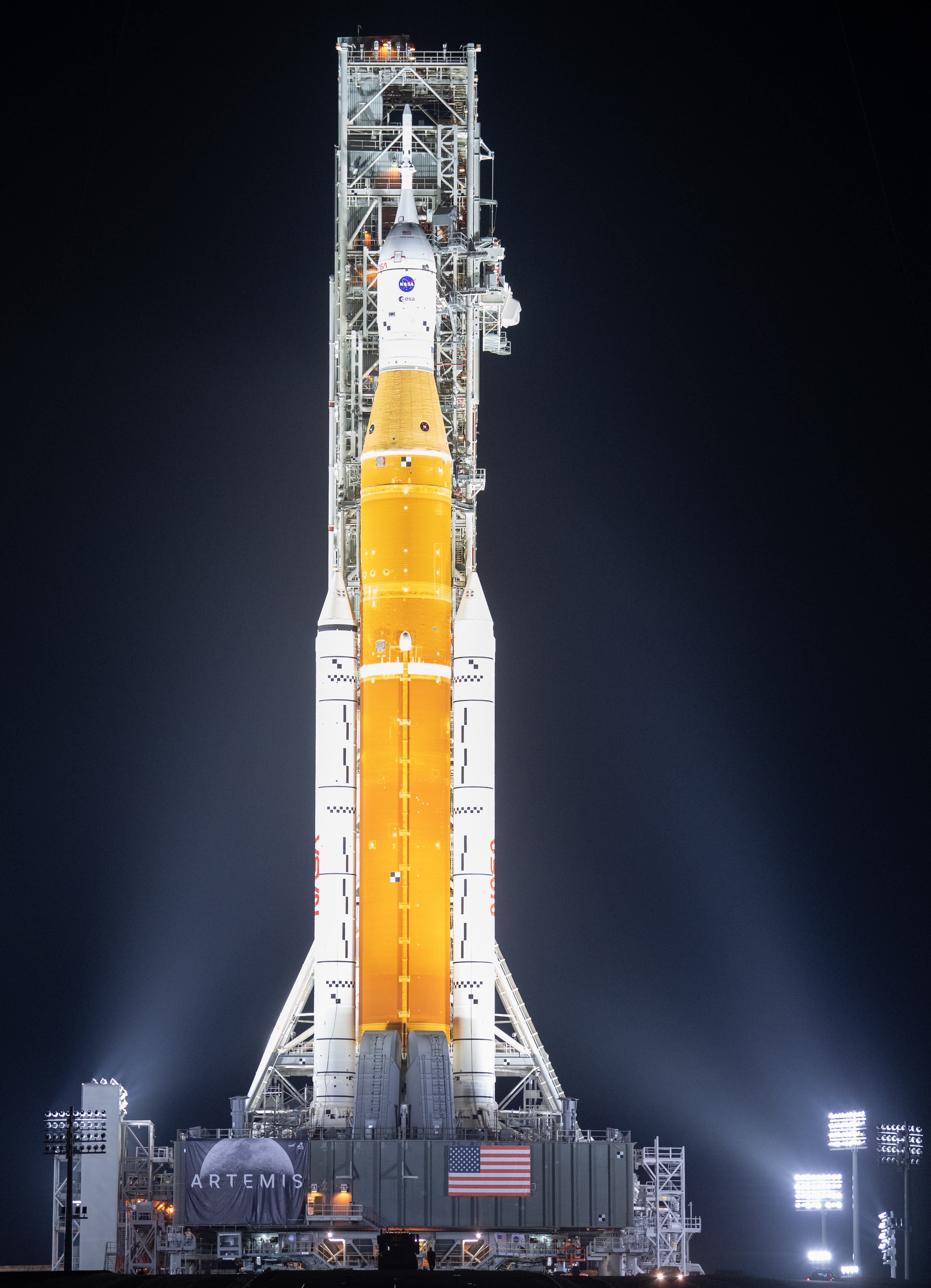

Image above: NASA’s Space Launch System (SLS) rocket with the Orion spacecraft aboard is seen illuminated by spotlights atop a mobile launcher at Launch Complex 39B, Friday, March 18, 2022, after being rollout out to the launch pad for the first time at NASA’s Kennedy Space Center in Florida. Ahead of NASA’s Artemis I flight test, the fully stacked and integrated SLS rocket and Orion spacecraft will undergo a wet dress rehearsal at Launch Complex 39B to verify systems and practice countdown procedures for the first launch. Image Credit: NASA.

In-depth

The Space Launch Systems rocket (SLS), with Orion atop it, left the Vehicle Assembly Building at NASA’s Kennedy Space Center at around 23:00 CET (22:00 GMT) on 17 March to begin its 6.5 km trip to Launchpad LC39B.

SLS rocket before rollout

The first Artemis mission will send Orion to the Moon and back, farther than any human-rated spacecraft has travelled before. ESA’s European Service Module is the powerhouse that fuels and propels Orion and provides everything needed to keep astronauts alive, including water, oxygen, power and temperature control.

A short but long trip

While the rocket will propel Orion to supersonic speeds, the rocket itself is moved slowly but securely to the launchpad. Traveling at a maximum speed of just 1.3 km/h, the 6.5-km voyage took nearly 12 hours to complete on a specially designed crawler vehicle.

Rocket rollout

Launching Orion and the European Service Module into Earth orbit and onto the Moon requires a huge amount of energy and the size of the mega-Moon rocket SLS is hard to convey in photos.

At 100 m tall, it is roughly the height of the Elizabeth Tower (Big Ben) in London, UK, or 16 giraffes stacked on top of each other. If you laid the rocket on the ground, it would take over a minute to walk from the engines to the tip of the launch abort system.

Artemis: crawling towards launch

We are going

“Seeing the complete rocket on the launchpad with the ESA and NASA logos on the fairing is an amazing view,” says ESA’s Pierre Boisvert on location, “to think that the European Service Module is inside there, ready to power a human-rated spacecraft to the Moon and back is a spine-tingling moment.

“Many of us in the ESA team have been working for years with our NASA partners on this spacecraft, and to see it on the launchpad is driving it home, we are going forward to the Moon!”

Logos on the Moon rocket

The first Artemis mission will be without astronauts, but it will include two mannequins to chart radiation received during the trip in deep space.

Space Launch System - First Roll to Launch Pad

Meanwhile the second and third Artemis missions are being prepared for their launch. The second European Service Module is undergoing pressure checks to ensure the welds connecting it to the rest of the Orion spacecraft were done correctly. This service module will power the first Artemis mission with astronauts around the Moon.

Moving third European Service Module structure

The third European Service Module is being built up in Bremen, Germany, after the structure arrived from Torino, Italy. Technicians at the Airbus integration hall have started laying kilometres of electric cables, the groundwork for sharing information and sending commands in the advanced Orion spacecraft. It has the honour of powering the Artemis III mission that will send astronauts to the Moon’s surface for the first time in over 60 years.

Artemis I – European Service Module perspective

Related article:

NASA Readies Rocket for Artemis I Wet Dress Rehearsal
https://orbiterchspacenews.blogspot.com/2022/03/nasa-readies-rocket-for-artemis-i-wet.html

Related links:

Orion (spacecraft): https://www.esa.int/Science_Exploration/Human_and_Robotic_Exploration/Orion

Space Launch System (SLS): https://www.nasa.gov/exploration/systems/sls/index.html

Artemis progam: https://www.nasa.gov/artemisprogram

Images, Videos, Text, Credits: ESA/A. Conigli/NASA/Airbus.

Greetings, Orbiter.ch

jeudi 17 mars 2022

Station Gets Ready for New Crew and Next Spacewalk


ISS - Expedition 66 Mission patch.


March 17, 2022

A new trio awaits its launch to join the Expedition 66 crew on Friday while two astronauts are preparing for next week’s spacewalk. Human research rounded out the science schedule aboard the International Space Station on Thursday.

Three cosmonauts are counting down to their lift off aboard the Soyuz MS-21 crew ship at 11:55 a.m. EDT on Friday from the Baikonur Cosmodrome in Kazakhstan. Soyuz Commander Oleg Artemyev will lead first-time space-flyers Denis Matveev and Sergey Korsakov on a three-hour and 10-minute ride to the Prichal module where they will dock beginning a six-and-a-half-month mission aboard the station. NASA TV, on the app and the website, will begin its live mission coverage of the crew launch and docking activities at 11:15 a.m. on Friday.


Image above: Astronaut Tom Marshburn of NASA (center) assists NASA astronaut Raja Chari (from left) and ESA astronaut Matthias Maurer during their U.S. spacesuit fit check. Image Credit: NASA.

Meanwhile, a second spacewalk is scheduled for Wednesday, March 23, for more upgrades at the orbiting lab. Flight Engineers Raja Chari of NASA and Matthias Maurer of ESA (European Space Agency) will set their spacesuits to battery power at 8:50 a.m. signifying the start of their spacewalk. The duo will spend about six-and-a-half-hours installing new thermal system and electronics components. NASA TV will begin its live spacewalk coverage at 7:30 a.m. on Wednesday.

The spacewalking pair was joined Thursday afternoon by NASA Flight Engineers Kayla Barron and Tom Marshburn reviewing robotics procedures necessary to support the astronauts during next week’s external maintenance job. Chari and Maurer also spent Thursday organizing their spacewalking tools and resizing their U.S. spacesuits.

EVA - Extra Vehicular Activities or spacewalk. Animation Credit: NASA

NASA Flight Engineer Mark Vande Hei worked inside the Kibo laboratory module setting up a small satellite deployer. In the afternoon, Vande Hei studied the effectiveness of detergents in microgravity then strapped sensors to himself to measure his performance during an exercise study.

Commander Anton Shkaplerov and Flight Engineer Pyotr Dubrov continued evaluating a specialized suit, the lower body negative pressure suit, for its ability to counteract the effects of weightlessness on the human body. Doctors are studying the suit’s ability to offset space-caused head and eye pressure by drawing fluids toward the legs and feet while expanding veins and tissues.

Related links:

NASA TV: https://www.nasa.gov/multimedia/nasatv/index.html#public

Expedition 66: https://www.nasa.gov/mission_pages/station/expeditions/expedition66/index.html

Prichal module: https://go.nasa.gov/3cOCFx6

Kibo laboratory module: https://www.nasa.gov/mission_pages/station/structure/elements/japan-kibo-laboratory

Effectiveness of detergents in microgravity: https://www.nasa.gov/mission_pages/station/research/experiments/explorer/Investigation.html?#id=8595

Lower body negative pressure suit: https://blogs.nasa.gov/ISS_Science_Blog/2015/06/02/rubber-vacuum-pants-that-suck/

Space Station Research and Technology: https://www.nasa.gov/mission_pages/station/research/overview.html

International Space Station (ISS): https://www.nasa.gov/mission_pages/station/main/index.html

Image (mentioned), Animation (mentioned), Text, Credits: NASA/Mark Garcia.

Best regards, Orbiter.ch

CASC - Long March-4C launches Yaogan-34-02


CASC - CZ-4C / Yaogan-34-02 Mission patch.


March 17, 2022

Long March-4C carrying Yaogan-34-02 liftoff

A Long March-4C launch vehicle launched the second Yaogan-34 remote-sensing satellite from the Jiuquan Satellite Launch Center, Gansu Province, northwest China, on 17 March 2022, at 07:09 UTC (15:09 local time).

Long March-4C launches Yaogan-34-02

According to official sources, the optical remote sensing satellite Yaogan-34-02 (遥感三十四号02星) will form a network with Yaogan-34-01 and subsequent satellites, that will be “mainly used for the survey of land resources, urban planning, the confirmation of land rights, road network design, crop yield estimation, and disaster prevention and reduction”.

Yaogan-34-02 satellite

For more information about China Aerospace Science and Technology Corporation (CASC), visit: http://english.spacechina.com/n16421/index.html
 
Images, Video, Text, Credits: China Media Group(CMG)/China Central Television (CCTV)/China Aerospace Science and Technology Corporation (CASC)/SciNews/Orbiter.ch Aerospace/Roland Berga.

Greetings, Orbiter.ch

NASA Readies Rocket for Artemis I Wet Dress Rehearsal


NASA - Artemis Exploration Mission-1 patch.


March 17, 2022

Engineers will conduct the final test, known as the wet dress rehearsal, of the Space Launch System (SLS) rocket, Orion spacecraft, and Exploration Ground Systems before the Artemis I launch at Launch Pad 39B at NASA’s Kennedy Space Center in Florida. The rehearsal will run the Artemis I launch team through operations to load propellant into the rocket’s tanks, conduct a full launch countdown, demonstrate the ability to recycle the countdown clock, and also drain the tanks to give them an opportunity to practice the timelines and procedures they will use for launch.


Image above: Space Launch System (SLS) rocket, Orion spacecraft, and Exploration Ground Systems before the Artemis I launch. Image Credit: NASA.

During the approximately two-day test, teams will start by activating the facilities needed for launch and formally beginning the countdown sequence. Team will staff the Launch Control Center at Kennedy and connect with staff in the Mission Control Center at NASA’s Johnson Space Center in Houston, the Space Force Eastern Range, and the SLS Engineering Support Center at the agency’s Marshall Space Flight Center in Huntsville, Alabama. Launch controllers will power on different rocket and spacecraft systems, along with ground support equipment.

Teams will then load more than 700,000 gallons of cryogenic, or super cold, propellants including liquid hydrogen and liquid oxygen into the rocket at the launch pad on the mobile launcher according to the detailed timeline they will use on the actual launch day. They will practice every phase of the countdown, including weather briefings, pre-planned holds in the countdown, conditioning and replenishing the propellants as needed, and validation checks.


Image above: NASA’s Space Launch System (SLS) rocket with the Orion spacecraft aboard is seen atop a mobile launcher in High Bay 3 of the Vehicle Assembly Building. In this image taken on Wednesday, March 16, 2022, members of the media set up remote cameras to capture the first rollout to Launch Complex 39B at NASA’s Kennedy Space Center in Florida. Ahead of NASA’s Artemis I flight test, the fully stacked and integrated SLS rocket and Orion spacecraft will undergo a wet dress rehearsal at Launch Complex 39B to verify systems and practice countdown procedures for the first launch. Image Credits: NASA/Joel Kowsky.

During the wet dress rehearsal, once launch controllers reach the point just before the rocket’s RS-25 engines will ignite on launch day, they will recycle back to the T-10 minute point, and then resume the countdown once more after a hold. The team will then deliberately halt the countdown at about 10 seconds before the simulated liftoff to demonstrate stopping a launch and draining the propellants from the rocket. Sometimes called a “scrub,” launch controllers may decide not to proceed with launch if a technical or weather issue arises during or prior to the countdown, so demonstrating the ability to remove propellants will ensure teams are prepared for various launch day scenarios.

(Illustration) Space Launch System (SLS) rocket, Orion spacecraft rollout. Image credit: NASA

Several days after the wet dress rehearsal, the integrated rocket and spacecraft will be rolled back to the Vehicle Assembly Building (VAB). In the VAB, technicians will extend platforms to reestablish access to several parts of the rocket and spacecraft. They will remove sensors specifically used for monitoring during the wet dress rehearsal, charge Orion and other system batteries, stow late-load cargo into Orion, and run final checkouts on several elements, among other tasks. Orion and SLS will roll to the launch pad for a final time about a week before launch.

NASA will review data from the rehearsal before setting a specific target launch date for the Artemis I launch. The first in a series of increasingly complex missions, Artemis I will provide a foundation for human deep space exploration and demonstrate our commitment and capability to extend human existence to the Moon and beyond prior to the first flight with crew on Artemis II.

Related links:

Artemis I: http://www.nasa.gov/artemis-1

Space Launch System (SLS): https://www.nasa.gov/exploration/systems/sls/index.html

Orion Spacecraft: https://www.nasa.gov/exploration/systems/orion/index.html

Artemis: https://www.nasa.gov/artemisprogram

Kennedy Space Center (KSC): https://www.nasa.gov/centers/kennedy/home/index.html

Images (mentioned), Text, Credits: NASA/Rachel Kraft.

Best regards, Orbiter.ch

NASA Mourns Passing of Visionary Heliophysicist Eugene Parker


R. I. P. - Rest In Peace.


Mar 17, 2022

Dr. Eugene N. Parker, visionary of heliophysics and namesake of NASA’s Parker Solar Probe, has passed away. He was 94.

Heliophysicist Eugene Parker. Image Credit: NASA

As a young professor at the University of Chicago in the mid-1950s, Parker developed a mathematical theory that predicted the solar wind, the constant outflow of solar material from the Sun. Throughout his career, Parker revolutionized the field time and again, advancing ideas that addressed the fundamental questions about the workings of our Sun and stars throughout the universe.

“We were saddened to learn the news that one of the great scientific minds and leaders of our time has passed,” said NASA Administrator Bill Nelson. “Dr. Eugene Parker’s contributions to science and to understanding how our universe works touches so much of what we do here at NASA. Dr. Parker’s legacy will live on through the many active and future NASA missions that build upon his work.”

“The field of heliophysics exists in large part because of Dr. Eugene Parker,” said Thomas Zurbuchen, NASA’s associate administrator for science. “Honoring his work by giving Parker Solar Probe his name is one of the proudest accomplishments of my career. My work, my passion for science, and my drive to keep exploring is strongly influenced by this great man. Parker Solar Probe ‘touching the Sun,’ is a fitting accomplishment for his namesake mission.”


Image above: Dr. Eugene Parker watches the launch of the spacecraft that bears his name – NASA’s Parker Solar Probe – early in the morning of Aug. 12, 2018. NASA Director of Heliophysics Dr. Nicky Fox stands behind him. Parker Solar Probe is humanity’s first mission to the Sun and will travel closer to our star than any spacecraft before. Image Credits: NASA/Glenn Benson.

In 2018, Parker became the first person to witness the launch of a spacecraft bearing his name. NASA’s Parker Solar Probe continues its mission today in pursuit of the pioneering questions Parker first envisaged more than a half century ago.

“Anyone who knew Dr. Parker, knew that he was a visionary,” said Nicola Fox, director of the Heliophysics Division at NASA Headquarters in Washington. “I was honored to stand with him at the launch of Parker Solar Probe and have loved getting to share with him all the exciting science results, seeing his face light up with every new image and data plot I showed him. I will sincerely miss his excitement and love for Parker Solar Probe. Even though Dr. Parker is no longer with us, his discoveries and legacy will live forever.”

Learn more about Parker Solar Probe and its mission at:

https://www.nasa.gov/content/goddard/parker-solar-probe

Images (mentioned), Text, Credits: NASA/Sean Potter/Karen Fox.

R. I. P.; Orbiter.ch

SpaceX rapidly stacks Starship and Super Heavy with ‘Mechazilla’


SpaceX - Starship Super Heavy SN-20 Mission patch.


March 17, 2022

For the second time ever, SpaceX has used Starbase’s ‘Mechazilla’ tower and arms to stack a Starship upper stage on top of a Super Heavy booster.

SpaceX Starship Super Heavy. Animation Credit: SpaceX

This time around, though, SpaceX clearly learned a great deal from its second February 9th Starship stack and was able to complete the stacking process several times faster on March 15th. During the second attempt, depending on how one measures it, it took SpaceX around three and a half hours from the start of the lift to Starship fully resting on Super Heavy. With Stack #3, however, SpaceX was able to lift, translate, lower, and attach Starship to Super Heavy in just over an hour.

Starship is Fully Stacked - SpaceX Boca Chica

Oddly, SpaceX managed that feat without a claw-like device meant to grab and stabilize Super Heavy during stacking operations. For Stack #2, all three arms were fully in play. First, a pair of ‘chopsticks’ – giant arms meant to grab, lift, and even recover Starships and boosters – grabbed Ship 20, lifted it close to 100 meters (~300 ft) above the ground, rotated it over top of Super Heavy, and briefly paused. A third arm – known as the ship quick-disconnect or umbilical arm – swung in and extended its ‘claw’ to grab onto hardpoints located near the top of Super Heavy. Once the booster was secured, the ‘chopsticks’ slowly lowered Ship 20 onto Booster 4’s interstage and six clamps joined the two stages together.

A few hours after the two were clamped together, an umbilical device located on the swing arm extended and connected to Ship 20. It’s unclear if the panel was actually used in any way but the umbilical is designed to connect Starship to ground systems to supply propellant, power, communications, and other consumables. Regardless, the device did appear to connect to Starship. Prior to Stack #3, however, SpaceX removed both of the swing arm’s ‘claws,’ meaning that it had no way to grab onto Super Heavy. That diminished capability clearly appeared to have zero impact on the ease or speed of the stacking process given that it was completed a full three times faster than Stack #2.


Image Above: SpaceX removed the umbilical arm’s claws prior to Stack #3. Photo Credit: Richard Angle.

That could imply that the claw is either completely unnecessary or only needed when attempting stacking operations in extreme winds. What is clear is that the claw removal likely only shaved a handful of minutes off of the full stacking process. What really saved time on Stack #3 was a faster lift and fewer pauses throughout – especially while lowering Starship the last several meters onto Super Heavy. During Stack #2, SpaceX took close to an hour and a half to fully lower Ship 20. The same sequence took just ~20 minutes during Stack #3.

SpaceX de-stacked Starship from atop a Super Heavy booster at their Boca Chica, Texas

Still, after the impressively rapid one-hour stack, it then took SpaceX close to two hours to connect the swing arm’s umbilical to Starship, leaving plenty of room for improvement. Ultimately, assuming SpaceX can speed up the start of the stacking process and replicate its Starship success with Super Heavy, which will also need to be grabbed and installed on an even more complex launch mount, it’s possible that Starbase’s orbital launch integration system is already capable of supporting multiple Starship launches per day. Of course, SpaceX has yet to demonstrate that the orbital launch site can be turned around in a matter of hours after being subjected to the violence and stresses of a Starship launch.

Starship Super Heavy Launch Animation

More significantly, SpaceX has never even attempted an orbital Starship launch, recovery, or reuse. That leaves the company in the unusual position of building and testing expensive, specialized support equipment before it actually knows that the rocket that equipment is designed to support is in any way capable of taking advantage of it. For an orbital spacecraft the size of Starship, only the Space Shuttle comes anywhere close and NASA’s all-time record for orbiter turnaround was 54 days. SpaceX has technically flown two Falcon 9 boosters twice in 27 days but no matter how impressive that feat is, reusing a far smaller suborbital booster is vastly easier than reusing a massive orbital spacecraft.

Image above: SpaceX preparing for third Starship 'full stack' after half a dozen 'cryoproof' tests. Image Credit: SpaceX.

At the end of the day, it’s not really SpaceX’s fault that it’s still waiting for permission to attempt orbital test flights. Nonetheless, the growing gap in maturity between Starship and Super Heavy and the orbital launch site designed to support them continuously raises the risk that SpaceX will have to extensively redesign the rocket, its support equipment, or both if significant problems arise during orbital test flights.

Up next, there’s a chance that SpaceX could attempt to cryoproof Starship while on top of Super Heavy – or perhaps both stages at once. While SpaceX has performed more than half a dozen cryoproofs of Ship 20 and Booster 4 using the orbital launch site’s propellant storage and distribution system, it hasn’t fully tested the hardware needed to route hundreds of tons of propellant hundreds of feet into the air – essential for full-stack testing and launch operations.

SpaceX: https://www.spacex.com/

Images (mentioned), Videos, Animation, Text, Credits: SpaceX/NASASpaceflight/space googlevesaire/Orbiter.ch Aerospace/Roland Berga.

Greetings, Orbiter.ch

mercredi 16 mars 2022

Next Crew Launch Set for Friday Following Tuesday’s Spacewalk


ISS - Expedition 66 Mission patch.


March 16, 2022

The International Space Station is set to welcome three new crewmates who are set to launch on Friday and arrive just over three hours later. In the meantime, the seven-member Expedition 66 crew turned its attention to science duties following Tuesday’s successful spacewalk.


Image above: NASA spacewalker Raja Chari is pictured tethered to the space station with the SpaceX Crew Dragon Endurance behind him and the Atlantic coast of South America 268 miles below. Image Credit: NASA.

The next crew ship to launch toward the orbiting lab has rolled out and now stands at the Baikonur Cosmodrome launch pad in Kazakhstan. The Soyuz MS-21 spacecraft is counting down to lift off on Friday at 11:55 a.m. EDT. It will carry three cosmonauts on a three-hour and 10-minute ride to the station where it will dock to the Prichal module. Veteran cosmonaut Oleg Artemyev, with first-time station visitors Denis Matveev and Sergey Korsakov, will open the hatch about an two-and-a-half hours later and begin a six-and-a-half-month mission aboard the space station. NASA TV, on the app and the website, will begin its live launch coverage at 11:15 a.m. on Friday.

Two NASA astronauts, Kayla Barron and Raja Chari, had a light schedule on Wednesday following Tuesday’s six-hour and 54-minute spacewalk to set up the station for its next roll-out solar array. The pair started the day with standard post-spacewalk medical exams looking at their hands, ears, blood pressure, and temperature. Barron then worked late in the afternoon in the Kibo laboratory module setting up the Confocal Microscope that looks at biological samples using spatial filtering techniques. Chari wrapped up his day charging the U.S. spacesuit’s lithium-ion batteries.

Soyuz FG launch. Animation Credit: Roscosmos

Flight Engineers Tom Marshburn of NASA and Matthias Maurer of ESA (European Space Agency) teamed up for a muscle study taking place in the Columbus laboratory module on Wednesday. The astronauts took turns measuring each other’s neck, back, and leg muscles to learn how microgravity affects their biochemical properties. NASA astronaut Mark Vande Hei serviced microbe samples growing inside a specialized incubator for the Space Biofilms study that could improve spacecraft safety and crew health.

In the station’s Russian segment, two cosmonauts, Commander Anton Shkaplerov and Flight Engineer Pyotr Dubrov, packed gear and prepared for their return to Earth on March 30. Shkaplerov will lead the ride home flanked by Dubrov and Vande Hei inside the Soyuz MS-19 crew ship. Vande Hei surpassed NASA astronaut Scott Kelly’s single spaceflight record of 340 days on March 15 and will land in Kazakhstan with a NASA record-breaking 355 days in space.

Related links:

NASA TV: https://www.nasa.gov/multimedia/nasatv/index.html#public

Expedition 66: https://www.nasa.gov/mission_pages/station/expeditions/expedition66/index.html

Prichal module: https://go.nasa.gov/3cOCFx6

Kibo laboratory module: https://www.nasa.gov/mission_pages/station/structure/elements/japan-kibo-laboratory

Confocal Microscope: https://www.nasa.gov/mission_pages/station/research/experiments/explorer/Facility.html?#id=7428

Columbus laboratory module: https://www.nasa.gov/mission_pages/station/structure/elements/europe-columbus-laboratory

Biochemical properties: https://www.nasa.gov/mission_pages/station/research/experiments/explorer/Investigation.html?#id=7573

Specialized incubator: https://www.nasa.gov/mission_pages/station/research/experiments/explorer/Facility.html?#id=1148

Space Biofilms: https://www.nasa.gov/mission_pages/station/research/experiments/explorer/Investigation.html?#id=7955

Space Station Research and Technology: https://www.nasa.gov/mission_pages/station/research/overview.html

International Space Station (ISS): https://www.nasa.gov/mission_pages/station/main/index.html

Image (mentioned), Animation (mentioned), Text, Credits: NASA/Mark Garcia.

Best regards, Orbiter.ch